Locke and Latham's Framework for Goal Setting

Set specific, difficult goals rather than vague targets like 'do your best'. Pair every goal with deadlines, feedback and genuine commitment. When tasks are complex or unfamiliar, set a learning goal first, not a performance goal. Skip SMART, cascading structures and percentage weights: research shows all three undercut the outcomes leaders want.
Why do most New Year's resolutions fail within weeks?
Vague intentions lack the specificity that drives sustained effort, so motivation fades once novelty wears off.
What makes a goal actually improve performance?
Difficulty, specificity, feedback and genuine commitment work together; remove any one and results drop sharply.
Why do SMART goals often produce mediocre results?
The "attainable" and "realistic" criteria quietly reward easy targets over the demanding ones that drive real effort.
Goal setting improves productivity and performance across dozens of studies, yet most people struggle to sustain it. Strava data covering 800 million data points found that only 20 percent of New Year's resolutions last past the second week of February. Psychologists Edwin Locke and Gary Latham spent 35 years studying why some goals succeed while others collapse, building what is now called goal-setting theory.1
Mechanisms
Their work identifies four mechanisms through which goals shape behavior and several conditions that determine whether a goal will succeed.
Direction
The first is direction. Goals point attention and effort toward relevant activities and pull them away from anything irrelevant, and this happens both cognitively and behaviorally. A person with a clear goal notices information that serves it and screens out information that does not. Students given specific learning goals absorbed relevant material better than irrelevant material in controlled studies, simply because their attention had a target. Drivers given feedback on particular aspects of their performance improved only on the dimensions tied to a goal, leaving other aspects of their driving unchanged, which shows the effect is selective rather than general.
Energy
The second is energy. Difficult goals consistently produce more effort than easy ones, and this pattern holds across very different kinds of tasks. It applies to physical effort, to tasks that require repeating the same action many times, to subjective effort that people report experiencing, and even to measurable physiological effort such as heart rate or exertion. A harder goal simply asks more of a person, and people tend to supply more in response, at least up to the point where the goal starts to feel impossible.
Persistence
The third is persistence. Hard goals extend how long people sustain effort, but persistence interacts with pace. There is a trade-off between the speed and the intensity of work: faced with a difficult goal, someone can either work faster and more intensely for a short burst, or work more slowly and less intensely over a longer stretch. Tight deadlines tip this trade-off toward speed, pushing people to compress effort into less time rather than spread it out.
Strategy
The fourth is strategy. Goals push people to draw on task-relevant knowledge and skills they already have, and research shows this response is largely automatic: people facing a goal instinctively reach for whatever relevant ability they already possess. When the goal demands more than a person's existing automatic skills can deliver, they instead pull from a broader repertoire of strategies used in other, related situations and adapt them to the task at hand. With the right kind of goal in place, people go further still and engage in deliberate planning, deciding in advance how they will approach the problem rather than improvising as they go.
How goals shape effort and attention
Goals work through four separate mechanisms. First, they direct attention toward relevant tasks and away from distractions, both mentally and physically. Students given specific learning goals absorbed relevant material better than irrelevant material in controlled studies. Drivers given feedback on particular aspects of their performance improved only on the dimensions tied to a goal.
Second, goals energize effort. Difficult goals consistently produce more effort than easy ones, across physical tasks, repeated tasks and tasks requiring sustained concentration. Third, goals sustain persistence. When a goal is hard, people either work faster for a short burst or sustain moderate intensity longer; tight deadlines push people toward the faster pace. Fourth, goals prompt people to draw on existing knowledge and strategies, and when current skills are not enough, to plan deliberately and search for new approaches.
The core findings that changed how leaders think about goals
Locke and Latham's research produced findings that still guide effective goal design.
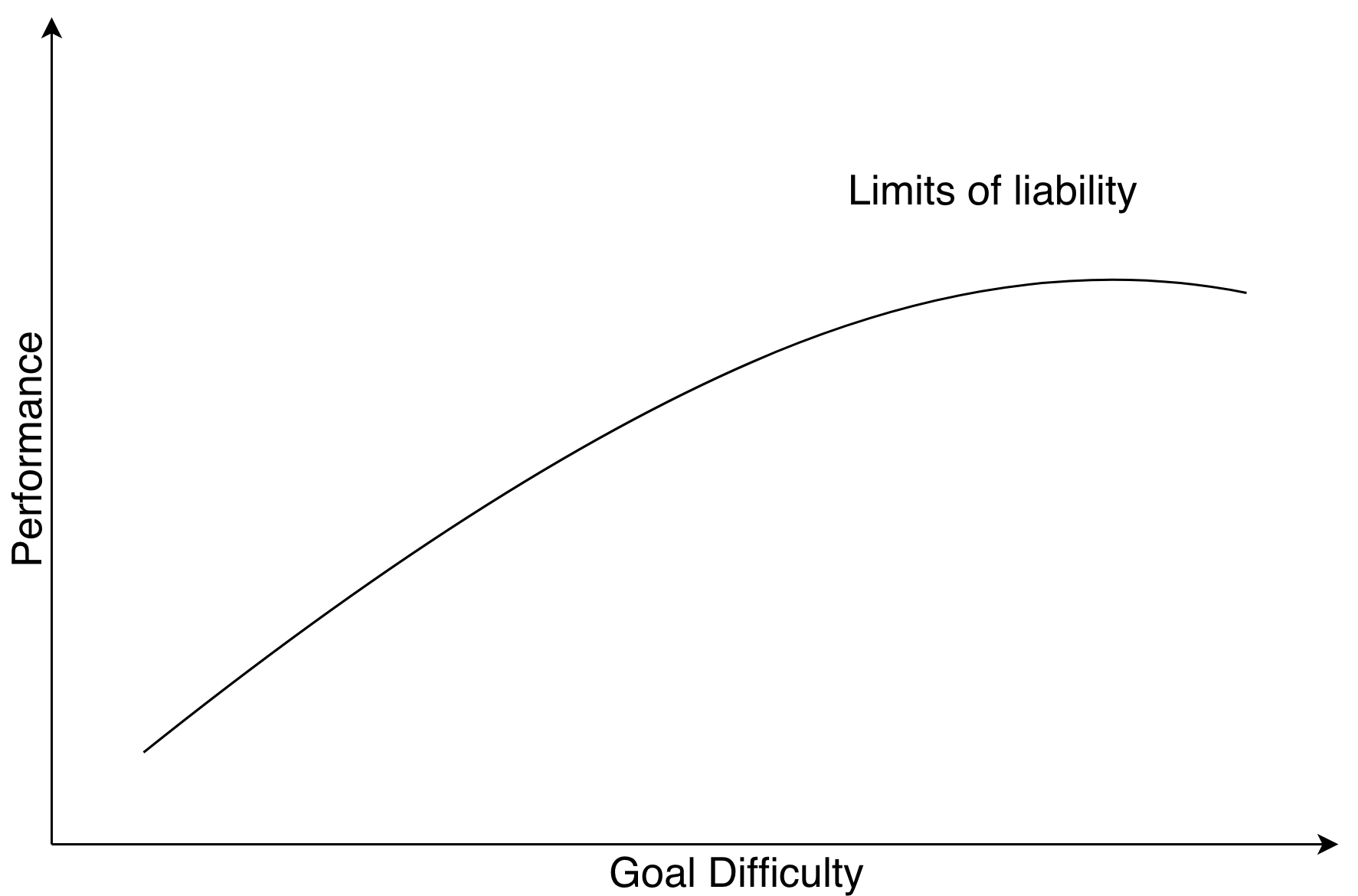
Goal difficulty and performance move together in a straight line, until ability limits are reached; beyond that point, performance drops. Locke found that participants with difficult goals performed over 250 percent better than those with the easiest goals.
Specific, difficult goals beat vague ones. Targets such as "do your best" sound motivating but leave performance standards undefined, so people give themselves the benefit of the doubt. A specific, high goal removes that ambiguity and defines exactly what success looks like.
Ability sets a hard ceiling. Within someone's ability range, goal difficulty and performance correlate strongly, near 0.82. Once a goal becomes genuinely impossible, that correlation collapses to roughly 0.11.
Commitment determines whether difficulty helps or backfires. Public commitment strengthens resolve because it makes performance a matter of personal integrity. Leaders who communicate an inspiring vision and act supportively also raise commitment. Letting people set their own goals increases ownership, though studies found that self-set and assigned goals do not differ meaningfully in performance once difficulty is held constant. Strong peer norms produce low variance in effort among group members, and commitment rises further when peers perform at a high level.
Money can help or hurt commitment. Higher pay generally increases effort, but tying pay strictly to goal attainment on very difficult goals can backfire. Once people sense the reward is out of reach, their personal goal and self-efficacy drop, and performance follows. This effect disappears on moderately difficult goals, or when people are paid for performance rather than for hitting the goal outright.
Self-efficacy, the belief that a goal is attainable, strengthens commitment on its own. Leaders raise it through training that builds real mastery, relatable role models, and communication that expresses genuine confidence in someone's ability to succeed.
Feedback without a goal accomplishes little, since feedback is only information until someone acts on it. Feedback tied to a goal shows people what to continue, stop or start doing. Goals and feedback together outperform either alone: goals direct and energize action, feedback tracks progress, and people behind target typically raise effort or change strategy.
When performance goals backfire
Setting a specific performance goal can hurt results on complex, unfamiliar tasks. Complexity has three dimensions: how many elements a task contains, how those elements relate to each other, and how relationships shift over time. As complexity rises, success depends more on discovering the right strategy than on raw effort.
An air traffic controller simulation illustrates the point. Participants given a performance goal struggled to acquire the knowledge the task demanded, while those simply told to do their best performed better. Participants given a specific learning goal outperformed both groups, confirming that learning goals beat performance goals once a task exceeds current skill.
A novice golfer offers a simpler example: someone who has never held a club benefits more from a goal to master grip and club selection than from a goal to shoot a particular score. In a business simulation modeled on the U.S. cellular telephone industry, participants making strategic pricing and advertising decisions across 13 rounds nearly doubled their market share when given a learning goal instead of a performance goal. They also showed stronger commitment and higher self-efficacy, since learning goals encourage people to build real competence before forcing decisions.
Five principles for setting goals that work
Set challenging goals. Goals function as standards against which people judge their own performance. People with high goals need to accomplish more before feeling satisfied, and that higher bar produces more effort and stronger outcome expectations, such as recognition or promotion.
Make goals specific. Specificity focuses effort and makes measurement and feedback possible. Vague goals let people rationalize mediocre results; specific goals remove that excuse and sharpen persistence, especially when no time limit exists.
Know when to set learning goals. Learning goals outperform performance goals on complex or unfamiliar tasks. Jack Welch at General Electric, Andy Grove at Intel and Sam Walton at Walmart built cultures around continuous learning, and workforce effectiveness rose at all three companies. Firms like PwC hire for aptitude and pair new employees with mentors who set learning goals rather than immediate performance targets. Senior executives benefit from job rotation paired with explicit learning goals, building the perspective needed for coherent decisions.
Gain real goal commitment. Commitment builds in two steps. Leaders first act as coaches, helping people see the link between actions and outcomes, keeping focus on improving performance rather than assigning blame. Second, leaders build self-efficacy: sequencing tasks so early wins come quickly, connecting people with relatable role models, and enlisting a trusted colleague to express genuine confidence in someone's ability to succeed.
Remove the obstacles blocking goal attainment. Goals fail when organizations do not clear the barriers in the way. Time, budget, staffing and equipment must match the goal's demands, and measurement systems need to track progress while actively supporting attainment. Training matters too, since difficulty and performance curve downward once a goal exceeds someone's ability.
Why common goal-setting techniques undermine this advice
Locke and Latham's research points to one formula: specific, difficult goals with clear deadlines and public visibility, regardless of whether goals are set collaboratively or assigned. Yet management consultant Dick Grote has identified three widely used techniques that directly contradict these findings.2
SMART goals require targets to be specific, measurable, attainable, realistic and time-bound, but say nothing about whether a goal is worth pursuing. Worse, the "attainable" and "realistic" criteria quietly reward easy targets, undercutting the difficulty that drives performance. SMART works best as a check on wording, not as a filter for which goals deserve pursuit.
Cascading goals, where targets flow down from the CEO through each layer, create a rigid dependency: nobody below can finalize a goal until the person above finishes theirs. This drags out the process and risks skipping goals with no obvious tie to a superior's target. A supervisor's goals should inform, not restrict, what an employee sets.
Percentage weighting, where each goal gets a numeric share of importance, invites false precision, since nobody can reliably say whether a goal deserves 20 percent or 25 percent. It also reduces appraisal to arithmetic rather than judgment about what mattered during the review period. Sorting goals into categories such as high, medium and low priority avoids this trap while still capturing relative importance.
Specific, difficult goals outperform vague ones, provided people stay committed and receive clear feedback. Use learning goals for complex tasks. Skip SMART, cascading structures and percentage weights, which quietly reward easy targets over meaningful ones.
Citation
Cite this article
Sridharan, M. A., & Sridharan, M. A. (2026, May 12). Locke and Latham's Framework for Goal Setting. Think Insights. https://thinkinsights.net/strategy/locke-and-lathams-framework-goal-setting (Accessed [[ACCESS_DATE]])
Sridharan, Mithun A., and Mithun A. Sridharan. "Locke and Latham's Framework for Goal Setting." Think Insights, 12 May 2026, https://thinkinsights.net/strategy/locke-and-lathams-framework-goal-setting. Accessed [[ACCESS_DATE]].
Mithun A. Sridharan and Mithun A. Sridharan, "Locke and Latham's Framework for Goal Setting," Think Insights, May 12, 2026, https://thinkinsights.net/strategy/locke-and-lathams-framework-goal-setting. Accessed [[ACCESS_DATE]].
Sridharan, M.A. and Sridharan, M.A. (2026) 'Locke and Latham's Framework for Goal Setting', Think Insights. Available at: https://thinkinsights.net/strategy/locke-and-lathams-framework-goal-setting (Accessed: [[ACCESS_DATE]]).
M. A. Sridharan and M. A. Sridharan, "Locke and Latham's Framework for Goal Setting," Think Insights, 2026. [Online]. Available: https://thinkinsights.net/strategy/locke-and-lathams-framework-goal-setting. [Accessed: [[ACCESS_DATE]]].
Sridharan MA, Sridharan MA. Locke and Latham's Framework for Goal Setting. Think Insights. Published May 12, 2026. Accessed [[ACCESS_DATE]]. https://thinkinsights.net/strategy/locke-and-lathams-framework-goal-setting
Test Your Knowledge
Quiz: Locke Latham Goal Setting
Challenge yourself on the concepts from this article and see how well you understood them.
Subscribers get weekly quizzes and insights — subscribe free
Sponsor this article
Partner with Think Insights
Reach 50,000+ business leaders, consultants, and strategists. Feature your brand alongside expert articles on strategy, leadership, and digital transformation.
Become a Sponsor
