LinkedIn's Professional Network Business Model


LinkedIn runs on a freemium model: professionals build profiles for free, while employers, advertisers and career-focused members pay for deeper access to that same network. Microsoft bought the company for $26.2 billion in 2016 and has run it since as a distinct subsidiary inside its Productivity and Business Processes segment. Three revenue lines drive the business: Talent Solutions for recruiters, Marketing Solutions for advertisers and Premium Subscriptions for individual members. Talent Solutions remains the largest of the three, recently boosted by Artificial Intelligence hiring tools that reached $450 million in annual revenue within months of launch. Premium Subscriptions has grown fastest, passing $2 billion in yearly revenue. LinkedIn now counts more than 1.3 billion registered members worldwide and in April 2026 named longtime executive Daniel Shapero as its new chief executive officer
How does LinkedIn make money?
LinkedIn earns revenue from three main sources: Talent Solutions for recruiters, Marketing Solutions for advertisers and Premium Subscriptions for individual members. Talent Solutions has historically been the largest of the three, while Premium Subscriptions has grown fastest, passing $2 billion in annual revenue.
Who owns LinkedIn today?
Microsoft has owned LinkedIn since December 2016, when it closed its $26.2 billion acquisition of the company. LinkedIn operates as a distinct subsidiary within Microsoft's Productivity and Business Processes segment, led by chief executive officer Daniel Shapero, who took over in April 2026.
What makes LinkedIn different from other social networks?
LinkedIn organizes its network around professional identity rather than personal content, linking résumés, job postings, company pages and learning courses in one graph. That structure lets LinkedIn sell access to the same data to three different audiences: job seekers, employers and advertisers.
A Network Built on Professional Identity
LinkedIn opened to the public in 2003, turning the résumé into a searchable web of contacts. Cofounder Reid Hoffman built the site on a simple premise: professional relationships carry commercial value and a network that captures job history, skills and education can broker that value for a fee. LinkedIn's own vision statement, drafted years before its business fully matured, still frames that idea:
Create economic opportunity for every member of the global workforce
That mission doubles as a business plan. Connect enough professionals in one place and employers and marketers lose any real substitute for reaching them, which is what has since happened at global scale.
From Startup to Microsoft Subsidiary
LinkedIn spent its first 13 years as an independent company, going public on the New York Stock Exchange in 2011. Microsoft ended that run in June 2016, agreeing to acquire LinkedIn for $196 a share in an all-cash deal valued at $26.2 billion, its largest acquisition at the time.1 The deal closed that December and LinkedIn kept its own brand, leadership and product roadmap rather than folding into an existing Microsoft division. Upon closing, LinkedIn's financial results moved into Microsoft's Productivity and Business Processes segment, where they still sit, giving the subsidiary access to Microsoft's cloud infrastructure, sales relationships and, later, its investment in Artificial Intelligence [AI].
Leadership in Transition
LinkedIn changed chief executive officers again in April 2026, when longtime chief operating officer [COO] Daniel Shapero succeeded Ryan Roslansky as chief executive officer [CEO].2 Roslansky had joined LinkedIn in 2009 and worked through most corners of the business before taking the top job in June 2020, just as pandemic-era hiring chaos reshaped the labor market. He inherited a platform with 700 million members and roughly $8 billion in annual revenue and left with more than 1.3 billion members and about $19 billion in revenue. Roslansky remains an executive vice president at Microsoft, a title he took on in mid-2025 and Shapero continues reporting to him rather than to Microsoft chief executive officer Satya Nadella directly.
The Freemium Foundation
LinkedIn's business model rests on a freemium structure: browsing profiles, posting updates and applying to jobs cost nothing, while deeper access to the network carries a price. That free layer gives the paid products their value, since employers and advertisers pay to reach a pool of professionals who would not gather there for a fee. The approach keeps producing growth: in the quarter ended March 31, 2026, LinkedIn revenue rose 12%, part of a Productivity and Business Processes segment that also includes Microsoft 365 and Dynamics 365.3 Three paid lines carry that revenue: Talent Solutions for recruiters, Marketing Solutions for advertisers and Premium Subscriptions for individual members, each drawing on the same underlying data set of profiles, companies and skills.
Talent Solutions and the Agentic Shift
Talent Solutions has long been LinkedIn's largest revenue line, built around Recruiter seats, job postings and applicant tools that let employers search the full member base rather than relying on résumés submitted directly. In April 2026, LinkedIn disclosed for the first time that its agentic AI hiring products, which let an AI agent take instructions from a recruiter and sift through profiles for follow-up, were on track for $450 million in annual revenue.4 LinkedIn CEO Daniel Shapero framed the milestone around a specific customer complaint:
Recruiters told us half their day was low-value work, so we made a bet on understanding their pain to get our solution right
The shift matters because Talent Solutions competes with dedicated applicant tracking vendors and automation gives LinkedIn a way to bundle software functions that once required separate recruiting tools.
Marketing Solutions, Sales Navigator and Premium Growth
Marketing Solutions sells advertisers access to that same professional audience through sponsored content, direct messaging campaigns and self-serve ad tools priced on a cost-per-click or cost-per-impression basis. Sales Navigator applies the same targeting logic to sales teams hunting for prospects instead of ads. Premium Subscriptions, sold directly to individual members for career search, networking and learning, passed $2 billion in revenue over a recent 12-month stretch, against total company revenue estimated at roughly $16.4 billion in fiscal 2024.5 That gap shows individual members still cover a modest share of the business, even as their direct payments grow faster than the recruiting and advertising lines built for employers and marketers.
A Moat Built on Data and Scale
LinkedIn's advantage over other recruiting and networking tools comes from scale rather than any single feature. With more than a billion members and tens of millions of company pages, switching costs run in both directions: employers stay because candidates are there and members stay because employers are looking. Competitors such as Indeed or specialized recruiting platforms can match individual features, but rebuilding that two-sided density from scratch takes years, not product cycles. That dynamic explains why Microsoft keeps investing directly in the platform instead of merging it into other products, even as it pushes LinkedIn's data into Copilot and other AI tools across the company.
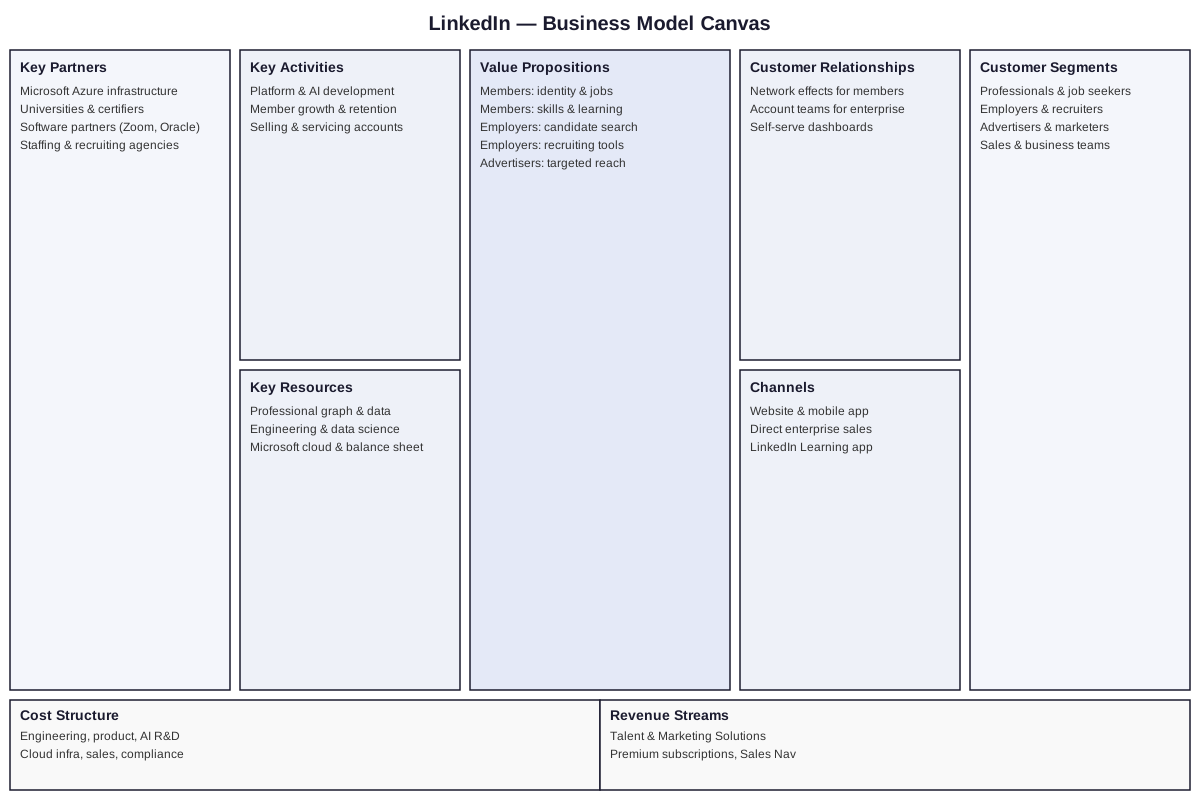
Key Partners
LinkedIn depends on Microsoft's Azure cloud infrastructure to run the platform at global scale, along with data centers that keep it available around the clock. Universities and professional certification bodies supply verified education data that feeds directly into member profiles. Software partners such as Zoom, Adobe and Oracle connect their own sales and marketing tools to LinkedIn through its developer interface. Staffing and recruiting agencies round out the partner base, feeding job listings into Talent Solutions.
Key Activities
LinkedIn's core activity is building and maintaining the platform, including the algorithms that rank feeds and job matches and the newer agentic AI recruiting tools. A second activity is growing and retaining membership, since the network's value depends on how many professionals stay active. Selling and servicing Talent Solutions, Marketing Solutions and Premium Subscriptions to employers, advertisers and members is a third ongoing task, alongside data protection and platform trust work.
Key Resources
The professional graph, meaning the profiles, connections, job postings and company pages that make up LinkedIn's database, is the company's central resource. Engineering and data science teams turn that raw graph into ranking, matching and advertising systems that generate revenue. Microsoft's cloud infrastructure and balance sheet back the platform's uptime and its investment in AI features. The LinkedIn brand, built over two decades as a trusted professional record, gives the company pricing power a newer entrant would lack.
Value Propositions
For individual members, LinkedIn offers a place to build a professional identity, find jobs and learn new skills through its course catalog. For employers, it offers a searchable pool of candidates larger than any internal applicant list, plus tools to manage recruiting end to end. For advertisers, LinkedIn provides access to a professional audience that can be targeted by job title, industry or seniority. Each value proposition draws on the same underlying data, priced differently for each audience.
Customer Relationships
LinkedIn relies on network effects for most individual members, who join because colleagues and peers are already there. For employers and advertisers, LinkedIn assigns account teams or self-serve dashboards, depending on deal size, to manage recruiting and advertising campaigns. Premium subscribers get support tied to their subscription tier, along with prompts encouraging renewal. Content moderation and identity verification maintain the trust underlying all three relationships.
Channels
LinkedIn's website and mobile app remain its primary distribution channels, reaching members directly without intermediaries. A direct sales force sells Talent Solutions and Marketing Solutions to large employers and advertisers, supplemented by self-serve purchase for smaller accounts. LinkedIn Learning distributes courses through the same app and website, plus integrations with corporate learning systems. Email notifications and browser extensions extend the platform's reach beyond its own site.
Customer Segments
LinkedIn serves three distinct segments through one platform: individual professionals building careers, employers and recruiters searching for talent and advertisers targeting a professional audience. Within the individual segment, job seekers, sales professionals and learners use different parts of the product. Employers range from small businesses posting single job listings to large enterprises running dedicated Recruiter accounts. Advertisers span software vendors, financial firms and other companies selling to professional buyers.
Cost Structure
LinkedIn's costs center on engineering and product development, including the salaries of developers and data scientists who maintain the platform and build AI features. Cloud infrastructure and data center capacity, run largely through Microsoft Azure, form a second major cost. Sales and marketing spending supports the direct sales teams selling Talent and Marketing Solutions to enterprise accounts. Legal, compliance and content moderation costs have grown as regulators scrutinize data privacy and AI use.
Revenue Streams
Talent Solutions, sold to recruiters and employers through Recruiter seats and job postings, remains LinkedIn's largest revenue line. Marketing Solutions charges advertisers on a cost-per-click, cost-per-impression or flat sponsorship basis for reaching LinkedIn's professional audience. Premium Subscriptions, billed monthly or annually to individual members, cover career, business and sales tiers and have grown fastest of the three lines. Sales Navigator, sold as a discrete subscription to sales teams, rounds out the mix.
LinkedIn's business model has stayed consistent since 2003: sell free access to professionals so employers and advertisers pay for reach into that audience. What has changed is the layer built on top of that structure. Microsoft has folded agentic AI into recruiting, pushed premium subscriptions past $2 billion in annual revenue and put a new chief executive officer, Daniel Shapero, in charge of the next phase after Ryan Roslansky's six years running the company. The core economics remain a freemium network funded by three paying customer types rather than one. As Microsoft leans further into AI across its productivity suite, LinkedIn's graph of profiles, companies and skills looks less like a stand-alone social network and more like a data asset feeding the rest of Microsoft's business
Citation
Cite this article
Sridharan, M. A. (2021, May 6). LinkedIn's Professional Network Business Model. Think Insights. https://thinkinsights.net/strategy/linkedins-professional-network-business-model (Accessed [[ACCESS_DATE]])
Sridharan, Mithun A. "LinkedIn's Professional Network Business Model." Think Insights, 6 May 2021, https://thinkinsights.net/strategy/linkedins-professional-network-business-model. Accessed [[ACCESS_DATE]].
Mithun A. Sridharan, "LinkedIn's Professional Network Business Model," Think Insights, May 6, 2021, https://thinkinsights.net/strategy/linkedins-professional-network-business-model. Accessed [[ACCESS_DATE]].
Sridharan, M.A. (2021) 'LinkedIn's Professional Network Business Model', Think Insights. Available at: https://thinkinsights.net/strategy/linkedins-professional-network-business-model (Accessed: [[ACCESS_DATE]]).
M. A. Sridharan, "LinkedIn's Professional Network Business Model," Think Insights, 2021. [Online]. Available: https://thinkinsights.net/strategy/linkedins-professional-network-business-model. [Accessed: [[ACCESS_DATE]]].
Sridharan MA. LinkedIn's Professional Network Business Model. Think Insights. Published May 6, 2021. Accessed [[ACCESS_DATE]]. https://thinkinsights.net/strategy/linkedins-professional-network-business-model
Test Your Knowledge
LinkedIn's Professional Network Business Model
Challenge yourself on the concepts from this article and see how well you understood them.
Subscribers get weekly quizzes and insights — subscribe free
Sponsor this article
Partner with Think Insights
Reach 50,000+ business leaders, consultants, and strategists. Feature your brand alongside expert articles on strategy, leadership, and digital transformation.
Become a Sponsor