Industry Analysis: Real Estate/Mortgage


Real Estate/Mortgage real estate brokerage, investment, lending and mortgage origination activities. The immediate strategic priority is to identify which part of the value chain controls scarce assets, trusted relationships or differentiated operating capability, then align investment with that position. The sector matters because it connects homebuyers, sellers, investors, landlords, lenders and developers with property inventory, capital, credit data, brokers, appraisers and technology and because its economics are shaped by interest rates, credit losses, transaction volumes, regulation and property cycles. Margin generally concentrates where firms control local market knowledge, funding access, distribution, data and servicing scale, while standardized delivery and concentrated procurement push economics toward buyers. Bargaining power is shifting through technology, consolidation, regulation and new distribution models. Leaders should therefore treat automation and portfolio design as economic choices, not technology projects and test whether each initiative improves pricing power, utilization, switching costs or access to scarce supply.
Is Real Estate/Mortgage attractive for new entrants?
Entry can work when a new firm chooses a narrow customer problem and builds around a clear structural advantage. Broad entry is harder because incumbents already control local market knowledge, funding access, distribution, data and servicing scale and established channels.
Which parts of the value chain are most profitable?
Profit usually concentrates around scarce assets, differentiated expertise, repeatable workflows and customer interfaces that carry switching costs. In this sector, those positions are closely linked to local market knowledge, funding access, distribution, data and servicing scale.
How is technology changing this industry?
Technology is changing how firms deliver origination, underwriting, brokerage, transaction execution, servicing and asset management and how customers buy it. The main economic effect is a change in labor intensity, cycle time, transparency or switching costs rather than technology adoption alone.
What capabilities are table stakes versus differentiators?
Table stakes include reliable delivery, regulatory compliance and basic operating discipline. Differentiators are more often sector expertise, data, integration, network access and the ability to improve the customer's economics.
How should investors evaluate opportunities here?
Investors should test demand quality, pricing power, capital intensity, customer concentration, working capital and reinvestment requirements. They should also map which competitors control the most defensible assets.
Where is bargaining power shifting?
Power is shifting toward whichever side controls scarce supply, customer access or decision-relevant data. In this sector, digital mortgages, housing shortages, rate cycles, institutional ownership and automated underwriting are changing that balance.
What makes a durable moat in this industry?
A durable moat usually combines one structural advantage with operating execution. Relevant sources include local market knowledge, funding access, distribution, data and servicing scale.
Which cost metric matters most?
The right metric depends on the delivery model, but management should isolate the cost of origination, underwriting, brokerage, transaction execution, servicing and asset management and connect it to utilization, throughput, quality and customer retention.
What should an incumbent defend first?
An incumbent should protect its strongest customer relationships and the capabilities that make those relationships difficult to replace. It should avoid defending low-return activity merely because it has historical scale.
What is the most common strategic mistake?
The recurring mistake is treating growth as the objective without identifying the economic mechanism that creates defensibility. Firms can add revenue while weakening margins, working capital or bargaining power.
Real Estate/Mortgage combines specialized inputs, operating processes and customer relationships into an economic system. The analysis below starts with the factual boundaries of the sector, then tests its structure through the five forces, follows the value chain into profit pools and closes with strategic choices that management teams can act on.
Industry at a glance
Real Estate/Mortgage is best understood as a system of economic exchanges rather than a single product category. Its participants coordinate property inventory, capital, credit data, brokers, appraisers and technology, transform them through origination, underwriting, brokerage, transaction execution, servicing and asset management and reach customers through broker networks, lenders, digital platforms, MLS systems and capital markets. The system works when the output can be delivered at a price that compensates scarce resources while remaining credible to buyers, regulators and capital providers. That makes operating design, not category labels, the practical unit of analysis. The industry also has a distinctive risk profile. Exposure comes from interest rates, credit losses, transaction volumes, regulation and property cycles, while demand is increasingly influenced by digital mortgages, housing shortages, rate cycles, institutional ownership and automated underwriting. Those pressures interact. A regulatory change can alter product design, a technology change can alter labor requirements and a supply shock can change which customer segments remain profitable. Executives should therefore evaluate the sector through linked economics rather than isolated trend statements. Customer value is created at the interface between the industry's output and a customer's operating model. In Real Estate/Mortgage, that interface often includes buyers, sellers, borrowers, lenders, agents and regulators. The strongest firms understand the customer's next decision, not just the transaction they are paid for. That insight shapes pricing, service levels, integration depth and the investment required to defend the account. Definition and scope. This analysis covers real estate brokerage, investment, lending and mortgage origination activities; excludes REITs as a separate investment structure. The boundary matters because adjacent activities can carry different regulation, capital intensity and profit pools. Keeping the scope narrow makes the competitive diagnosis more useful for executives deciding where to invest, partner or exit. Economic role. The sector serves homebuyers, sellers, investors, landlords, lenders and developers. It depends on upstream access to property inventory, capital, credit data, brokers, appraisers and technology and on downstream channels that include broker networks, lenders, digital platforms, MLS systems and capital markets. Its customers value a combination of availability, quality, reliability, compliance and total cost. Indicative economics. Common revenue patterns include commissions, interest income, origination fees, servicing fees and property investment returns. The sector is typically moderately sensitive to fixed-cost absorption, while labor intensity depends on how far origination, underwriting, brokerage, transaction execution, servicing and asset management has been standardized or automated. Regulation and quality requirements shape the minimum cost of participation.
Industry segmentation
The sector is not homogeneous. Competitive behavior changes across the points where origination, underwriting, brokerage, transaction execution, servicing and asset management becomes more standardized, where customers become more concentrated and where technology changes the economics of delivery.1
- Residential brokerage: This segment emphasizes a distinct combination of property inventory, capital, credit data, brokers, appraisers and technology and customer requirements. The relevant advantage is often tied to reliability, specialization and route-to-market rather than scale alone
- Mortgage origination: This segment emphasizes a distinct combination of property inventory, capital, credit data, brokers, appraisers and technology and customer requirements. The relevant advantage is often tied to reliability, specialization and route-to-market rather than scale alone
- Mortgage servicing: This segment emphasizes a distinct combination of property inventory, capital, credit data, brokers, appraisers and technology and customer requirements. The relevant advantage is often tied to reliability, specialization and route-to-market rather than scale alone
- Commercial real estate: This segment emphasizes a distinct combination of property inventory, capital, credit data, brokers, appraisers and technology and customer requirements. The relevant advantage is often tied to reliability, specialization and route-to-market rather than scale alone
- Property investment: This segment emphasizes a distinct combination of property inventory, capital, credit data, brokers, appraisers and technology and customer requirements. The relevant advantage is often tied to reliability, specialization and route-to-market rather than scale alone Across the segments, the key dimension is control of the customer interface. A company can own production but still capture little value if procurement controls the relationship. Conversely, a focused specialist can earn strong returns when its expertise is embedded in the customer's workflow.
Market structure: Porter's Five Forces
The five forces point to a sector in which economics depend on the interaction between local market knowledge, funding access, distribution, data and servicing scale, customer concentration and the cost of replacing suppliers. The forces are not static. Technology can lower entry costs, regulation can raise them and consolidation can change buyer and supplier power at the same time.2
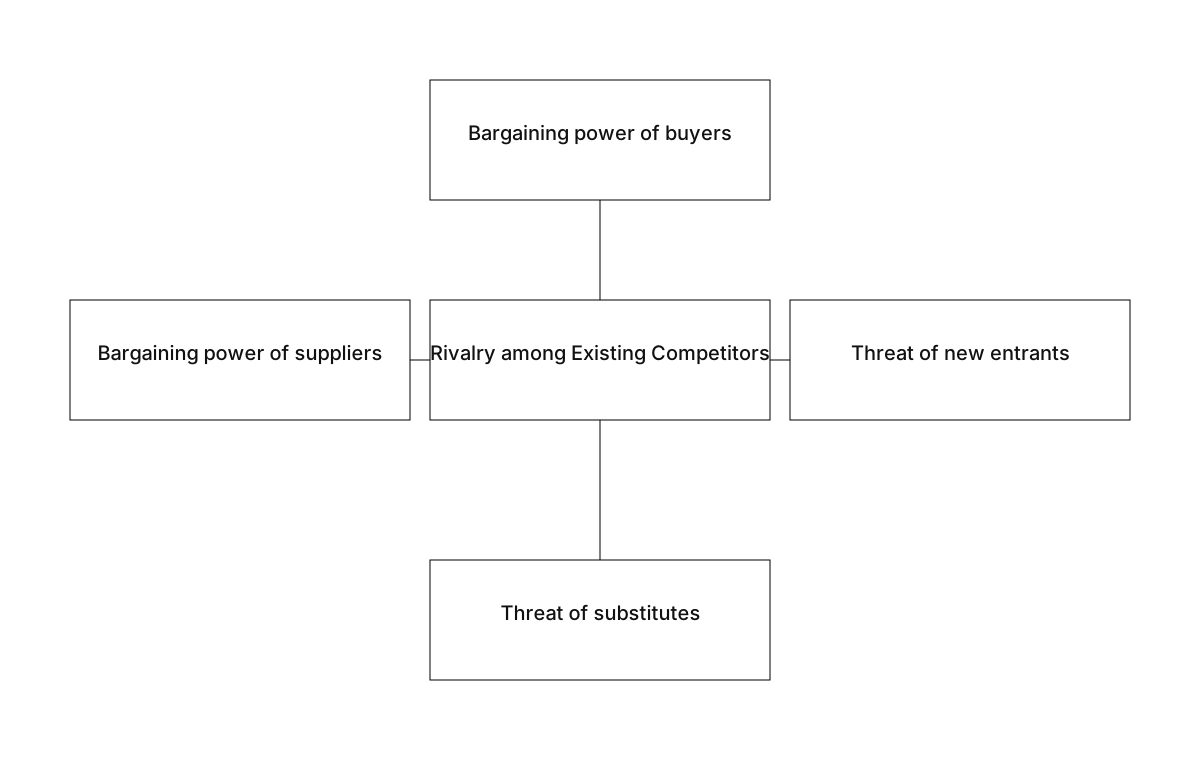
Bargaining power of buyers
Buyer power in Real Estate/Mortgage is shaped by concentration, procurement sophistication and the cost of changing suppliers. The customer base often includes homebuyers, sellers, investors, landlords, lenders and developers, but those groups do not exert identical pressure. Large accounts can demand lower prices, service guarantees, customization or data access when they represent a meaningful share of revenue. Smaller customers may have less direct leverage, yet digital comparison and transparent pricing can create indirect pressure. Switching costs matter when the relationship is embedded in buyers, sellers, borrowers, lenders, agents and regulators, but they fall when services become standardized and comparable. Management teams should translate this structural pressure into measurable indicators such as concentration, churn, switching time, supplier lead time, capacity utilization or share of wallet. The objective is not to label the force as high or low, but to understand which economic variable changes the bargaining relationship.
| Dimension | Observation |
|---|---|
| Buyer concentration | Large homebuyers accounts can negotiate harder when spend is concentrated |
| Switching friction | Embedded buyers, sellers, borrowers, lenders, agents and regulators relationships raise friction, while standardized offers reduce it |
| Price transparency | Digital comparison and formal procurement can shift negotiations toward measurable economics |
| Outcome sensitivity | Reliability, quality and risk can outweigh headline price when failure carries high cost |
| [caption]Bargaining power of buyers[/caption] |
Bargaining power of suppliers
Supplier power is concentrated where property inventory, capital, credit data, brokers, appraisers and technology are scarce, certified or difficult to replace. In Real Estate/Mortgage, the critical suppliers are often not limited to physical materials. Specialist labor, regulated infrastructure, proprietary technology and access to scarce assets can all become bottlenecks. A supplier gains leverage when replacement requires qualification, retraining, revalidation or redesign. Firms can reduce that exposure through dual sourcing, internal capability, longer contracts or design choices that widen the supplier pool. The strongest operators treat supplier resilience as a portfolio decision rather than a procurement exercise. Management teams should translate this structural pressure into measurable indicators such as concentration, churn, switching time, supplier lead time, capacity utilization or share of wallet. The objective is not to label the force as high or low, but to understand which economic variable changes the bargaining relationship.
| Dimension | Observation |
|---|---|
| Critical inputs | property inventory, capital, credit data, brokers, appraisers and technology can become bottlenecks when supply is specialized or regulated |
| Qualification cost | Validation, certification or training can make supplier replacement slow |
| Concentration | A narrow supplier base can transfer margin upstream |
| Mitigation | Dual sourcing, integration and longer contracts can reduce exposure |
| [caption]Bargaining power of suppliers[/caption] |
Rivalry among existing competitors
Rivalry in Real Estate/Mortgage usually turns on capacity, reputation, route-to-market and the degree of differentiation that customers can perceive. Competition intensifies when fixed costs are high and demand is cyclical because firms have an incentive to protect utilization. It also intensifies when customers can compare offers easily. The most defensible competitors shift the basis of competition toward local market knowledge, funding access, distribution, data and servicing scale, where price is only one part of the decision. Consolidation can improve discipline, but it can also create large competitors with enough scale to invest aggressively in technology, distribution or acquisitions. Management teams should translate this structural pressure into measurable indicators such as concentration, churn, switching time, supplier lead time, capacity utilization or share of wallet. The objective is not to label the force as high or low, but to understand which economic variable changes the bargaining relationship.
| Dimension | Observation |
|---|---|
| Market shape | Regional specialists and scaled incumbents often coexist |
| Basis of competition | Price competes with local market knowledge, funding access, distribution, data and servicing scale and delivery reliability |
| Capacity pressure | High fixed costs make utilization a major driver of competitive behavior |
| Consolidation | M&A can change bargaining power, coverage and investment capacity |
| [caption]Rivalry among existing competitors[/caption] |
Threat of new entrants
Entry into Real Estate/Mortgage is rarely blocked by one barrier. New firms must assemble mortgage systems, property databases, offices, servicing platforms and title infrastructure while building credibility with customers and regulators. Digital tools can lower the initial cost of launching a focused offer, but they do not automatically solve certification, operational reliability or customer acquisition. Incumbents retain an advantage when they control scarce assets, have embedded workflows or can spread compliance and technology costs over a large revenue base. Entrants therefore tend to win through a narrow wedge, a new channel, a lower-cost operating model or a capability that incumbents cannot adopt quickly. Management teams should translate this structural pressure into measurable indicators such as concentration, churn, switching time, supplier lead time, capacity utilization or share of wallet. The objective is not to label the force as high or low, but to understand which economic variable changes the bargaining relationship.
| Dimension | Observation |
|---|---|
| Capital barrier | Entry requires investment in mortgage systems, property databases, offices, servicing platforms and title infrastructure |
| Credibility | References, certifications and operating history reduce buyer risk |
| Technology | Digital tools can lower the cost of serving a narrow segment |
| Scale | Incumbents spread compliance, technology and sales costs over larger revenue bases |
| [caption]Threat of new entrants[/caption] |
Threat of substitutes
Substitution in Real Estate/Mortgage comes from adjacent ways of solving the customer's underlying problem, not only from direct competitors. The relevant alternatives include internal production, new technologies, different distribution channels and changes in customer behavior. Substitution risk rises when the industry's output becomes a commodity and falls when the service is tightly integrated with customer workflows. Firms should therefore monitor changes in the customer's total process, including what happens immediately before and after the industry's own contribution. That broader view often identifies substitutes earlier than a conventional competitor map. Management teams should translate this structural pressure into measurable indicators such as concentration, churn, switching time, supplier lead time, capacity utilization or share of wallet. The objective is not to label the force as high or low, but to understand which economic variable changes the bargaining relationship.
| Dimension | Observation |
|---|---|
| Internalization | Customers can bring selected activities in-house when economics and capability permit |
| Adjacent technology | New tools can change the customer's preferred workflow |
| Behavior change | New channels can reduce demand for established formats |
| Integration | The more embedded the offer, the harder it is to replace |
| [caption]Threat of substitutes[/caption] |
Value chain and profit pools
The value chain in Real Estate/Mortgage can be read as a sequence of control points. Upstream participants provide property inventory, capital, credit data, brokers, appraisers and technology; production or service delivery turns them into an output; distribution moves that output; the customer interface converts availability into revenue; and enabling infrastructure sets the rules under which the system operates. Profit does not accrue evenly across these stages.3
Upstream inputs
Property inventory, capital, credit data, brokers, appraisers and technology. The strategic question is whether inputs are abundant, differentiated or constrained. Control becomes valuable when supply is hard to qualify or transport. In practice, management should map revenue, gross margin, working capital and capital employed to this stage rather than treating the industry as one economic pool.
Production and processing
Origination, underwriting, brokerage, transaction execution, servicing and asset management. Scale matters when fixed assets, process know-how or utilization drive unit cost. Automation matters when it changes the slope of that cost curve. In practice, management should map revenue, gross margin, working capital and capital employed to this stage rather than treating the industry as one economic pool.
Distribution and logistics
Broker networks, lenders, digital platforms, mls systems and capital markets. Distribution becomes a moat when density, reliability or network access reduce the cost of serving each incremental customer. In practice, management should map revenue, gross margin, working capital and capital employed to this stage rather than treating the industry as one economic pool.
Customer interface
Buyers, sellers, borrowers, lenders, agents and regulators. The interface often determines who owns the relationship, data and pricing conversation. It can therefore capture more value than the underlying production step. In practice, management should map revenue, gross margin, working capital and capital employed to this stage rather than treating the industry as one economic pool.
Enabling infrastructure
Mortgage systems, property databases, offices, servicing platforms and title infrastructure. Standards, licenses, payment systems, data infrastructure and compliance rules can create barriers that persist even when technology changes. In practice, management should map revenue, gross margin, working capital and capital employed to this stage rather than treating the industry as one economic pool.
Profit pool
Profit in Real Estate/Mortgage tends to concentrate where customers face meaningful consequences from failure and where the supplier controls scarce capability. That often favors businesses with local market knowledge, funding access, distribution, data and servicing scale. Standardized activity remains strategically useful, but it is exposed to procurement, capacity cycles and substitution. Profit pools also shift when digital mortgages, housing shortages, rate cycles, institutional ownership and automated underwriting change the customer's buying criteria. A company that once earned a premium for production capacity can lose that premium if capacity becomes abundant. A company that owns the customer workflow can gain share even when the underlying product becomes cheaper. Management should track three pools separately: the margin on the core transaction, the margin on recurring services and the economic value of customer access. This separation prevents a common mistake in Real Estate/Mortgage:
treating high revenue volume as evidence of strategic strength
Industry economics and business models
Money is made in Real Estate/Mortgage through several recurring patterns. The first is an asset or capability-led model, where the provider earns for controlling property inventory, capital, credit data, brokers, appraisers and technology or delivering origination, underwriting, brokerage, transaction execution, servicing and asset management. The second is a recurring relationship model, where contracts, service, maintenance or subscriptions improve revenue visibility. The third is an outcome or transaction model, where pricing follows the value or volume of the customer's activity. Business model design determines who carries risk. Fixed-price contracts transfer delivery risk to the provider. Usage-based models transfer volume risk to the customer. Long-term contracts can support investment but may cap upside when market prices rise. The best model matches price mechanics to the part of the value chain the provider can actually control. A practical commercial test is to ask whether the customer is buying capacity, expertise, access, certainty or an outcome. That answer should determine pricing architecture. In Real Estate/Mortgage, firms that price the wrong unit often grow revenue while creating operational complexity and weaker returns.
Cost drivers & scalability
The cost structure starts with funding, labor, commissions, technology, compliance and servicing. Fixed costs matter when facilities, equipment, technology or specialist teams must be maintained regardless of volume. Variable costs rise with units, transactions, production hours or customer activity. The strategic objective is to understand where scale reduces unit cost and where scale merely increases complexity. Scale creates the strongest advantage when it improves procurement, utilization, data density, network coverage or service quality. Scope creates value when one capability can support multiple adjacent offerings without duplicating the cost base. Neither scale nor scope is inherently beneficial. The relevant test is whether incremental revenue adds less complexity than incremental contribution. Unit economics should connect operational drivers to customer economics. Service businesses should monitor utilization, productive hours, delivery quality and retention. Asset businesses should monitor throughput, yield, downtime and return on capital. Digital components should monitor acquisition cost, engagement, infrastructure cost and lifetime value where those measures apply. A useful flywheel in Real Estate/Mortgage is simple: better delivery improves trust, trust improves retention, retention lowers acquisition cost and higher utilization funds process investment. The flywheel breaks when growth increases low-margin work faster than the organization can standardize it. Executives should therefore distinguish profitable scale from volume that consumes management capacity.
Moats, advantages and strategic levers
Defensibility in Real Estate/Mortgage comes from cost advantage, differentiation, network effects, switching costs, regulatory access, data and learning. The most relevant source here is local market knowledge, funding access, distribution, data and servicing scale. A moat is credible only when it changes customer choice or competitor economics. Cost advantage can come from scale, location, process design or better utilization. Differentiation can come from quality, reliability, specialist knowledge or a trusted brand. Network effects matter when each participant increases the value of the system for another participant. Switching costs arise when replacing a provider would require data migration, retraining, qualification, process redesign or relationship rebuilding. Regulatory moats are strongest when compliance requires time, evidence and operating history. Data moats become valuable when repeated transactions improve prediction, quality or workflow performance. In Real Estate/Mortgage, leaders should avoid calling ordinary customer relationships a moat. The test is whether the relationship survives a credible competing offer.
Strategic levers
Customer segment focus
Prioritize customers for whom local market knowledge, funding access, distribution, data and servicing scale has measurable economic value rather than pursuing the largest addressable market. The decision should be supported by a clear economic hypothesis, a measurable leading indicator and an explicit exit condition. Strategic levers become expensive when management treats them as broad growth initiatives rather than targeted changes in bargaining power.
Product scope
Choose whether to own the full workflow around origination, underwriting, brokerage, transaction execution, servicing and asset management or dominate one high-value step. The decision should be supported by a clear economic hypothesis, a measurable leading indicator and an explicit exit condition. Strategic levers become expensive when management treats them as broad growth initiatives rather than targeted changes in bargaining power.
Integration versus partnering
Integrate when control of property inventory, capital, credit data, brokers, appraisers and technology or mortgage systems, property databases, offices, servicing platforms and title infrastructure changes economics; partner when scale is more valuable than ownership. The decision should be supported by a clear economic hypothesis, a measurable leading indicator and an explicit exit condition. Strategic levers become expensive when management treats them as broad growth initiatives rather than targeted changes in bargaining power.
Geographic expansion
Expand where customer density, supply conditions and regulation improve the economics of broker networks, lenders, digital platforms, MLS systems and capital markets. The decision should be supported by a clear economic hypothesis, a measurable leading indicator and an explicit exit condition. Strategic levers become expensive when management treats them as broad growth initiatives rather than targeted changes in bargaining power.
Ecosystem orchestration
Use data, standards, platforms or partnerships to make the firm a coordination point for buyers, sellers, borrowers, lenders, agents and regulators. The decision should be supported by a clear economic hypothesis, a measurable leading indicator and an explicit exit condition. Strategic levers become expensive when management treats them as broad growth initiatives rather than targeted changes in bargaining power.
Structural risks, regulation and trends
Structural risk in Real Estate/Mortgage comes from interest rates, credit losses, transaction volumes, regulation and property cycles. Regulatory risk matters because it can change who may participate, what evidence is required and which costs are unavoidable. Technology risk matters when automation changes the relative price of labor, capital or customer acquisition. Supply risk matters when property inventory, capital, credit data, brokers, appraisers and technology are concentrated or exposed to geopolitical constraints.4
Demand should be modeled through a small set of drivers: customer budgets, demographics, technology adoption, replacement cycles and regulatory requirements. Supply should be modeled through capacity additions, consolidation, labor availability and productivity. This approach is more useful than treating a single market forecast as a strategy. Three scenarios are useful for Real Estate/Mortgage. In a base case, digital mortgages, housing shortages, rate cycles, institutional ownership and automated underwriting continue at a measured pace and incumbents adapt. In a compression case, price transparency and technology reduce differentiation faster than expected. In a scarcity case, regulation, supply disruption or concentrated capacity shifts bargaining power toward the holders of scarce inputs. The right portfolio is one that remains viable across all three.
Strategic playbook
A new entrant should begin with a narrow problem where the incumbent cost structure is poorly matched to the customer's need. The wedge should exploit digital mortgages, housing shortages, rate cycles, institutional ownership and automated underwriting or a specific source of friction in buyers, sellers, borrowers, lenders, agents and regulators. Build-versus-buy decisions should follow the source of defensibility. If the moat depends on proprietary process knowledge, build it. If the advantage depends on broad infrastructure, partnering can accelerate entry.5
Incumbents should defend the part of the business that owns customer trust and recurring economics, then redesign low-differentiation work. They should use technology to reduce cost and cycle time while protecting the human or operational elements that customers still value. Portfolio reviews should ask which products improve the firm's bargaining position and which merely add revenue.6
Executives should also establish a small set of leading indicators: win rate against credible competitors, price realization, retention, supplier concentration, capacity utilization, quality, working capital and return on incremental capital. Those measures reveal structural change earlier than revenue growth alone. Management teams should pressure-test the economics of Real Estate/Mortgage at the point where the customer can most easily change behavior. That means examining the full delivered cost of the alternative, not just the quoted price. It also means separating structural advantages from temporary conditions such as favorable commodity prices, unusual capacity shortages or short-lived demand spikes. Firms that confuse temporary conditions with durable advantage often overinvest at the top of the cycle and discover too late that their returns depended on scarcity they did not control. A disciplined operating review therefore connects commercial metrics to the underlying constraints of origination, underwriting, brokerage, transaction execution, servicing and asset management, the availability of property inventory, capital, credit data, brokers, appraisers and technology and the strength of buyers, sellers, borrowers, lenders, agents and regulators. When those links are explicit, management can decide whether to add capacity, automate a process, deepen a customer relationship, or exit an activity that consumes capital without improving bargaining power.
Caselet
Rocket Mortgage's digital origination model: operating through structural change
History and operating model
Rocket Mortgage's digital origination model is a useful case because its history shows how Real Estate/Mortgage economics evolve when scale, customer expectations and technology change. The organization developed around a recognizable operating model and then expanded its capabilities as customer requirements changed. Public disclosures provide enough evidence to examine the relationship between its assets, people, customers and strategic choices without relying on private claims.
Industry dynamics
The case reflects the same pressures visible across the sector: customers want measurable outcomes, suppliers influence cost and availability and technology changes the economics of delivery. The organization's response illustrates why incumbents often combine internal investment with partnerships, acquisitions or ecosystem relationships. The relevant question is not whether the company adopted a particular technology, but whether the technology changed a constraint in its operating model.
Value capture
The case also shows that revenue growth and profit-pool control are different outcomes. A company can expand its addressable market while leaving the most defensible economics with suppliers, platforms or customer-owned capabilities. The strategic value of Rocket Mortgage's digital origination model lies in how it manages local market knowledge, funding access, distribution, data and servicing scale and how it connects those capabilities to repeat customer demand.
Strategic lesson
For executives in Real Estate/Mortgage, the case supports a practical lesson: build around the constraint that competitors cannot remove quickly. That may be access, trust, regulation, operating density, data or specialist capability. Once that constraint is defensible, use technology to lower the cost of serving the customer without weakening the source of differentiation. The case is most useful as a decision model rather than a template to copy.
Public evidence
Real Estate/Mortgage also depends on institutional rules and market data that change over time. The following sources provide authoritative reference points for those conditions.
Evidence and management implications
The case is useful because the business model can be examined through observable operating choices rather than reputation alone. Management teams should look at how the organization allocates capital, recruits scarce talent, manages customer or stakeholder relationships and responds when technology or regulation changes the economics of delivery. In Religious Institutions, these choices determine whether growth creates durable operating leverage or simply expands the amount of coordination required. A second lens is the value chain: identify which activities are standardized, which require scarce expertise and which control the relationship with the end customer or beneficiary. If a company owns a differentiated interface but outsources commodity production, its strategic priority may be to deepen that interface rather than add manufacturing capacity. If the reverse is true, process reliability and cost position may matter more than branding. The case therefore supports a practical review of pricing, utilization, retention, capital intensity, working capital and service quality. Those measures help separate temporary performance from structural advantage and give executives a repeatable way to compare the case with their own operating model.
The lesson is especially relevant when management must choose between protecting a legacy revenue stream and funding a capability that improves future bargaining power, because the latter can matter more than near-term volume.
Real Estate/Mortgage remains an industry in which position matters more than headline growth. The core economics are set by the interaction of property inventory, capital, credit data, brokers, appraisers and technology, origination, underwriting, brokerage, transaction execution, servicing and asset management, customer access and the cost of meeting mortgage systems, property databases, offices, servicing platforms and title infrastructure. Profit pools tend to favor operators that combine scale with a defensible source of differentiation, while commoditized work remains exposed to procurement and substitution. The practical levers are focused segmentation, disciplined scope, selective integration, geographic or channel expansion and stronger ecosystem control. Executives should measure progress through unit economics and bargaining power rather than activity alone. The winning position is the one that makes the customer's next alternative harder, slower or more expensive to choose.
Citation
Cite this article
Sridharan, M. A. (2020, July 13). Industry Analysis: Real Estate/Mortgage. Think Insights. https://thinkinsights.net/strategy/industry-analysis-real-estatemortgage (Accessed [[ACCESS_DATE]])
Sridharan, Mithun A. "Industry Analysis: Real Estate/Mortgage." Think Insights, 13 July 2020, https://thinkinsights.net/strategy/industry-analysis-real-estatemortgage. Accessed [[ACCESS_DATE]].
Mithun A. Sridharan, "Industry Analysis: Real Estate/Mortgage," Think Insights, July 13, 2020, https://thinkinsights.net/strategy/industry-analysis-real-estatemortgage. Accessed [[ACCESS_DATE]].
Sridharan, M.A. (2020) 'Industry Analysis: Real Estate/Mortgage', Think Insights. Available at: https://thinkinsights.net/strategy/industry-analysis-real-estatemortgage (Accessed: [[ACCESS_DATE]]).
M. A. Sridharan, "Industry Analysis: Real Estate/Mortgage," Think Insights, 2020. [Online]. Available: https://thinkinsights.net/strategy/industry-analysis-real-estatemortgage. [Accessed: [[ACCESS_DATE]]].
Sridharan MA. Industry Analysis: Real Estate/Mortgage. Think Insights. Published July 13, 2020. Accessed [[ACCESS_DATE]]. https://thinkinsights.net/strategy/industry-analysis-real-estatemortgage
Test Your Knowledge
Industry Analysis: Real Estate/Mortgage
Challenge yourself on the concepts from this article and see how well you understood them.
Subscribers get weekly quizzes and insights — subscribe free
Sponsor this article
Partner with Think Insights
Reach 50,000+ business leaders, consultants, and strategists. Feature your brand alongside expert articles on strategy, leadership, and digital transformation.
Become a Sponsor