Industry Analysis: Forestry


Forestry converts land, biological growth and industrial processing into timber, pulp, panels, packaging fiber and biomass. The industry matters because it feeds construction, packaging, tissue and energy systems while global trade in wood and paper products reached $486 billion in 2024. Margin concentrates with operators that control advantaged fiber, efficient mills and reliable routes to end markets. Bargaining power is shifting toward scaled buyers with tighter procurement disciplines and toward compliant suppliers that can prove legality, traceability and sustainability without raising delivered cost. The strategic decision is straightforward: build around the best wood basket and align processing, logistics and customer mix to that local advantage rather than chase scale for its own sake
Is forestry attractive for new entrants?
Selective entry can work when a new player controls a niche wood basket, a differentiated conversion process, or a route to premium demand. Broad entry is harder because land access, permits, certification, procurement relationships and transport infrastructure absorb time and capital before scale economics appear.
Which parts of the value chain are most profitable?
Profit pools usually concentrate where a company controls scarce timberlands, efficient pulp capacity, branded engineered wood products, or export logistics. Commodity conversion steps can stay profitable in strong cycles, but margins compress quickly when wood, freight, or energy costs move against the operator.
How is technology changing forestry?
Remote sensing, harvest planning software, mill automation and traceability systems are tightening inventory control and raising asset utilization. Technology now matters less as a novelty and more as an operating discipline that links silviculture, fiber allocation, compliance and customer service.
What capabilities are table stakes versus differentiators?
Table stakes include safe harvesting, dependable procurement, certification readiness, working capital discipline and on-time delivery. Differentiators include access to advantaged fiber, superior mill yields, a premium product mix, long-term offtake relationships and the ability to monetize sustainability attributes without adding cost faster than price realization.
How should investors and consultants evaluate opportunities here?
Start with the wood basket, not the story. The quality of local fiber supply, freight economics, end-market exposure, energy access and regulatory friction usually explains more value than headline demand growth alone.
Why do margins vary so much across forestry segments?
Because each segment faces a different mix of asset intensity, transport cost, product differentiation and exposure to global pricing. Timberland returns, pulp margins, sawmill spreads and packaging economics move on different clocks even when they draw from the same forest resource.
Where is bargaining power shifting?
Power is shifting toward buyers that can aggregate demand at scale and toward owners of advantaged, certified, low-cost fiber. Regulation is also changing bargaining dynamics because traceability and legality requirements raise the value of compliant supply chains.
What makes a forestry market structurally resilient?
Resilience comes from diverse end markets, short haul distances, disciplined harvesting and the ability to redirect fiber among lumber, panels, pulp, pellets, or biomass. Markets tied to one product category or one export route become more fragile when prices or policies turn.
How should incumbents defend their position?
They should protect the best wood baskets, improve recovery rates, move product mix toward higher-value applications and lock in customer relationships where service levels matter. Defending share with volume alone often destroys margin in downcycles.
What should a board watch most closely in forestry?
Three signals matter: the standing cost position of the fiber base, the flexibility of the industrial footprint and the speed of regulatory change. Those factors shape whether a company can keep earning through weak cycles rather than only during favorable ones.
The forestry industry looks simple from a distance: grow trees, harvest timber and sell wood or fiber into downstream markets. In practice, it is a multi-layered system that links biological growth, land economics, heavy industrial processing, logistics, construction demand, packaging demand, trade policy and environmental regulation. That mix creates an industry in which the location and quality of the wood basket matter as much as strategy and where value moves between landowners, processors, distributors and brand owners as technology, trade and regulation change the terms of competition.
Industry at a glance
Forestry covers the cultivation, management, harvesting and commercial use of forest resources for timber, pulp, paper, panels, biomass and a smaller set of non-wood outputs. For this analysis, the scope includes industrial roundwood, sawnwood, wood-based panels, pulp, paper, packaging grades, pellets and selected enabling services. It excludes pure conservation management, urban tree services and downstream finished goods such as retail furniture, except where those end markets shape bargaining power or profit distribution.
The industry sits at the intersection of land stewardship and industrial supply. It serves business-to-business buyers such as sawmills, pulp mills, converters, builders, packaging producers and energy operators, while the final demand base spans construction, consumer packaging, tissue, publishing and bioenergy. UNECE tracks the industry through roundwood, sawnwood, wood-based panels, pulp and paper, which is a useful reminder that forestry is not one market but a connected set of product systems1.
Revenue models differ by segment. Timberland owners earn from stumpage or delivered logs, sawmills sell lumber and residual chips, panel producers convert wood into higher-specification building materials and pulp and paper operators monetize fiber through packaging, tissue and specialty grades. Capital intensity is high in land acquisition, roads, harvesting fleets and mills. Regulation intensity is also high because harvesting rights, forest management, biodiversity, legality, traceability and emissions rules all shape what can be cut, where and at what cost.
Industry segmentation
A practical segmentation begins with five major groups. The first is timberland and forest management, where value is created by acquiring, planting, managing and harvesting forests over long biological cycles. The second is solid wood processing, including sawmilling and engineered wood products. The third is pulp and paper, which uses pulpwood, chips and recovered fiber to produce intermediate and finished paper-based goods. The fourth is biomass and energy, including pellets and other fuel uses. The fifth is specialty and enabling activities such as certification, forest technology, nursery stock and traceability services.
These segments can also be mapped by value chain position. Timberland and silviculture sit upstream. Sawmills, pulp mills and panel plants sit in processing. Wholesalers, ports, rail operators and merchants support distribution. Builders, converters, publishers and consumer goods firms form the customer interface. Certification bodies, regulators, digital monitoring platforms and financing institutions act as enabling infrastructure.
The economic logic differs sharply by segment. Timberland tends to reward patience, local knowledge and disciplined harvest planning. Processing businesses reward throughput, yield and plant uptime. Customer-facing segments reward specification management, service and product mix. That is why the same cubic meter of wood can generate very different returns depending on whether it becomes structural lumber, containerboard, dissolving pulp, biomass feedstock, or a low-value residual.
Market structure
Forestry is a structurally competitive industry with localized resource advantages. A company cannot move forests the way it can move software, so regional wood baskets define cost positions, while global trade links local supply to international demand. The result is an industry where rivalry is intense, but not uniform. Competitive pressure rises in commodity grades and eases where a player controls scarce fiber, advantaged logistics, or higher-specification products.
FAO reported that global exports of wood and paper products reached $486 billion in 2024 after the downturn in 2023, while industrial roundwood removals rose to 1.96 billion cubic metres and wood pulp production reached 189 million tonnes2. Those figures show a large, globally traded sector, but they also show why buyers and suppliers can renegotiate power quickly when markets soften or transport routes tighten.
| Driver | What matters | Implication |
|---|---|---|
| Buyer concentration | Large pulp mills, home improvement chains, converters and builders often purchase at scale | Volume buyers can push prices down and demand service guarantees |
| Switching costs | Buyers can change suppliers when grades are standardized and freight options are available | Commodity segments face faster price pressure |
| Specification control | Some buyers can define moisture, grade, legality and certification terms | Compliance becomes a price-of-entry rather than a premium feature |
| Procurement sophistication | Professional sourcing teams benchmark offers across regions | Sellers with weak service or inconsistent quality lose bargaining room |
| Demand cyclicality | Construction and packaging cycles alter order timing and mix | Downcycles shift power toward buyers |
| [caption]Bargaining power of buyers[/caption] |
| Driver | What matters | Implication |
|---|---|---|
| Fiber supply | Landowners, state forests and small private owners determine wood availability | Scarce local fiber raises delivered log costs |
| Critical inputs | Seedlings, fuel, machinery, chemicals and specialized labor affect uptime and output | Input inflation can compress margins faster than selling prices adjust |
| Transport control | Rail slots, trucking, ports and roads shape mill access to wood and export markets | Logistics bottlenecks strengthen supplier leverage |
| Data and certification systems | Traceability platforms and certification regimes are increasingly necessary | Operators that depend on third-party systems absorb compliance costs |
| Energy access | Electricity, steam and fuel prices matter for drying, pulping and conversion | Cost volatility shifts leverage to utility and fuel providers |
| [caption]Bargaining power of suppliers[/caption] |
| Driver | What matters | Implication |
|---|---|---|
| Asset specificity | Sawmills and pulp mills need high utilization to earn acceptable returns | Competitors chase volume aggressively in weak markets |
| Regional clustering | Firms often compete within the same wood basket and export corridors | Local rivalry can be sharper than global concentration suggests |
| Product overlap | Standard lumber, pulp and board grades invite price-based competition | Differentiation is limited unless product mix moves upmarket |
| Cycle exposure | Housing, paper demand, packaging and energy policy move on different cycles | Portfolio mix can soften rivalry for diversified firms |
| Integration | Vertically integrated groups can allocate fiber internally | Independent mills may face weaker positions during supply shocks |
| [caption]Rivalry among existing competitors[/caption] |
| Driver | What matters | Implication |
|---|---|---|
| Land access | New entrants need forest rights, timber supply agreements, or long-term procurement channels | Entry is slow without secured fiber |
| Capital intensity | Mills, roads, port access and working capital require significant upfront investment | Scale entry is expensive and risky |
| Regulation | Harvest permits, environmental approvals, legality rules and certification take time | Compliance slows greenfield entry |
| Relationships | Buyers prefer reliable delivery and consistent grade performance | Trust and track record deter new competitors |
| Biological time | Forest growth cycles cannot be compressed easily | Plantation strategies need long horizons |
| [caption]Threat of new entrants[/caption] |
| Driver | What matters | Implication |
|---|---|---|
| Material substitution | Steel, concrete, plastics, aluminum and recycled fiber compete with wood products | End-market economics can erode demand in specific categories |
| Digital substitution | Digital media has reduced some graphic paper demand | Legacy paper grades face structural pressure |
| Circularity trends | Recovered paper and recycled materials offset virgin fiber in some uses | Operators must manage mix shifts rather than assume steady demand |
| Alternative energy pathways | Electrification and other low-carbon fuels compete with pellets in some regions | Biomass demand depends on policy support |
| Engineered alternatives | Competing composites can displace traditional sawnwood in selected applications | Commodity lumber faces specification risk |
| [caption]Threat of substitutes[/caption] |
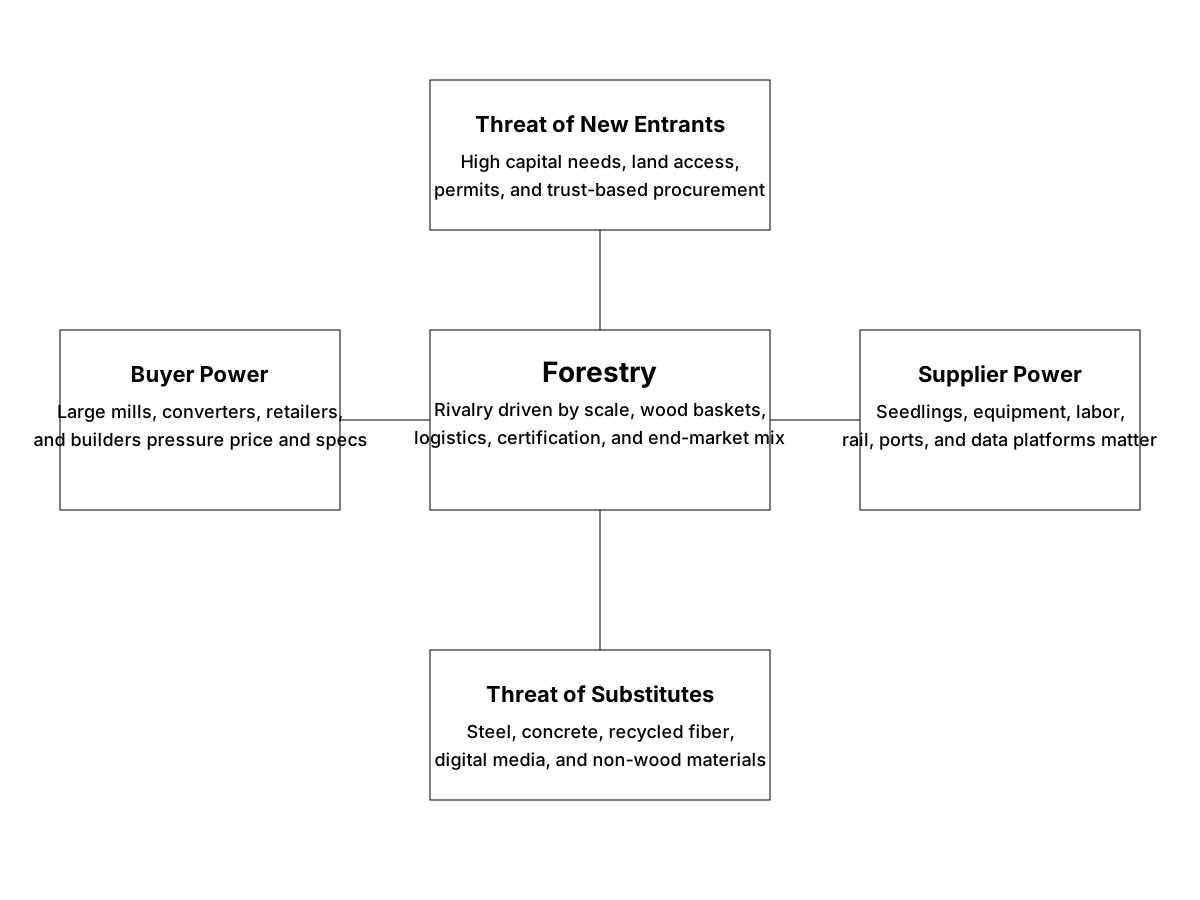
The five forces point to a clear conclusion. Forestry is rarely attractive for undifferentiated entry, yet it can be attractive for focused operators that secure advantaged fiber and choose defensible end markets. Buyer power is high in standardized grades, supplier power rises when wood or logistics are tight and substitutes matter most where customers can redesign products without major penalties. The best positions combine local wood access, plant efficiency and exposure to end uses where wood has technical or regulatory advantages.
Value chain and profit pools
The forestry value chain starts with upstream inputs: land, seedlings, genetics, silviculture expertise, machinery and increasingly data on growth, soil, pests and fire risk. Those inputs determine forest productivity, harvest timing and wood quality before any log reaches a mill. In plantation systems, superior genetics and disciplined silviculture can change yields materially over a rotation. In natural forests, access, concession terms and harvesting discipline matter more.
The next stage is production and processing. Harvesting contractors fell, bunch, extract and sort timber, while sawmills, panel plants and pulp mills convert logs and chips into industrial products. Yield management becomes the economic hinge at this stage. A mill that improves recovery, reduces downtime and channels residues into chips, pellets, or energy often outperforms a rival with similar headline capacity.
Distribution and logistics form the third stage. Forestry products are bulky, heavy and often low value per unit of weight relative to transport cost. That makes distance to mill, rail, port, or customer an economic variable rather than an operating detail. Operators with control over logistics corridors can protect margin even when product prices soften.
The customer interface comes next. Sales teams manage accounts with builders, converters, merchants, packaging buyers and energy firms. In commodity categories, service quality and reliability can still matter, especially when customers operate lean inventories. In higher-specification products such as engineered wood or specialty packaging grades, commercial execution has more room to shape price realization.
Enabling infrastructure supports every stage. Governments define tenure, harvesting rules, trade restrictions and emissions frameworks. Certification systems shape market access. Financing institutions determine the cost of capital for timberland, mills and working capital. Data platforms and remote sensing tools increasingly influence planning and compliance3.
Profit pools are unevenly distributed. They often concentrate in four places: advantaged timberland with strong growth and low delivered cost; efficient pulp capacity tied to export routes; engineered wood products that command a specification premium; and customer-facing niches where service or certification creates stickier demand. Time-based conversion businesses without raw material security usually capture thinner margins because they carry heavy fixed costs while buying fiber and selling into market-clearing prices.
The direction of the profit pool has shifted over time. Graphic paper has lost relevance in many regions, while packaging, tissue and engineered wood have become more attractive. FAO's review of recent market recovery points to stronger momentum in wood-based panels, paper and paperboard and pulp than in some mature paper grades. That movement reinforces a broader pattern:
value is migrating toward products linked to packaging demand, lighter-weight logistics and construction systems that can differentiate wood against substitute materials
Industry economics and business models
Forestry monetizes biological growth through several business model patterns. The first is asset-heavy ownership of timberland and industrial conversion assets. This model ties returns to land quality, stumpage values, mill efficiency and cycle management. It can generate strong economics when a company controls both fiber and processing, but it also ties capital to long-lived assets and exposes management to regulatory and climate risk.
The second pattern is asset-light or partially integrated conversion. Independent sawmills, chip producers and some panel manufacturers buy wood from third parties and focus on conversion efficiency, product mix and customer relationships. This model reduces land exposure and can scale faster, but it also leaves the business more exposed to input cost swings.
The third pattern is transaction-driven trading and distribution. Merchants, exporters, brokers and wood wholesalers earn on throughput, working capital discipline and market timing. Margins are usually thinner, but the capital base is lighter and the model can flex more quickly across markets. This pattern works best where product specifications are standardized and customer relationships reward dependable supply.
The fourth pattern is premium or attribute-based monetization. Certification, legality assurance, specialty grades, engineered wood and sustainability-linked offerings can all support better pricing. The challenge is that many of these features are becoming expected rather than exceptional. Once a buyer treats certification as mandatory, the premium may shrink even though the compliance cost remains.
Cost drivers and scalability
The cost base begins with land and wood. In integrated forestry, the standing cost of timber and the delivered cost to mill define the floor of competitiveness. Geography, terrain, harvest methods, road density and haul distance all matter. In conversion businesses, recovery rates and yield losses can be as important as purchase price because every percentage point of fiber utilization affects margin.
Labor, energy, chemicals, maintenance and freight are the next major drivers. Pulp and paper operations feel energy and chemical cost swings acutely. Sawmills and panel plants depend heavily on uptime, maintenance discipline and residue monetization. Freight remains a structural constraint because many forestry products carry significant transport cost relative to unit value.
Scalability exists, but it is not frictionless. Larger mills can spread fixed costs, negotiate input contracts and justify better automation. Larger timberland platforms can optimize rotations and portfolio allocation. Yet scale without local fiber advantage can backfire. A large plant placed in a weak wood basket becomes a high-fixed-cost problem, not a moat.
Flywheel effects appear when operational improvements reinforce commercial strength. Better forecasting improves harvest planning, which improves mill scheduling, which raises delivery reliability, which deepens customer trust, which stabilizes demand and justifies further investment in automation. That is a real industry flywheel, but it starts with operating discipline rather than marketing scale.
Unit economics vary by segment. Service-heavy forestry contractors focus on equipment utilization, crew productivity and seasonal planning. Digital forestry platforms monitor customer acquisition cost and recurring revenue more like software businesses. Industrial operators watch conversion yield, downtime, delivered wood cost, freight per tonne and the spread between input costs and realized selling prices4.
Moats, advantages and strategic levers
Defensibility in forestry starts with cost advantage. The best positions sit on productive land, near demand centers or export corridors, with a configuration that lowers delivered cost and raises optionality. A player with low-cost fiber can withstand price cycles that remove weaker competitors.
Differentiation matters more than many operators admit. In commodity lumber or pulp, headline differentiation is limited, but a company can still differentiate through reliability, technical service, sustainability credentials, grade consistency and the ability to tailor products to customer processes. In engineered wood, tissue, specialty pulp, or packaging, product performance and conversion know-how can widen the gap.
Switching costs also exist. A builder that standardizes on a certain engineered system, or a converter that depends on a supplier's consistency, does not switch casually. Integration depth, specification alignment, data sharing and compliance assurance can all create practical switching costs even when contracts are short. This effect is weaker in undifferentiated grades and stronger in applications where product failure has downstream cost.
Regulatory moats are becoming more important. Traceability, legality and deforestation-linked compliance raise the cost of operating a weakly governed supply chain. Recent work on forest-linked supply chains argues that compliance costs, land tenure issues and uneven incentives still distort economics across the system, especially in higher-risk regions5. For established operators that already meet buyer requirements, stricter rules can strengthen the moat.
Data and learning effects are real but uneven. Remote sensing, harvest analytics, machine data and forest inventory systems improve planning quality over time. The advantage becomes meaningful when data helps a company predict yield, route wood to the highest-value outlet, reduce waste and document compliance faster than rivals.
Strategic levers flow from those moats. A new entrant can focus on a narrow customer segment instead of competing across the full market. An incumbent can expand into adjacent conversion steps where it already owns fiber advantage. Both can choose where to partner rather than integrate, especially in logistics, technology, or distribution. Geographic expansion also remains a lever, though only when the next region offers a strong wood basket rather than just a larger map.
Structural risks, regulation and trends
The largest structural risk is supply disruption. Climate change is increasing wildfire risk, pest pressure, drought stress and storm damage in many forest regions. That changes not only biological yield but also insurance cost, harvest timing and the reliability of wood flows. Research on wood value chains now treats forest disturbances as a central resilience problem rather than a peripheral hazard6.
Regulatory risk is the second structural variable. Harvest restrictions, biodiversity rules, legality requirements and deforestation-linked trade measures can all raise monitoring cost and shrink available supply. EUFORE's work on future forest value chains highlights a broad expectation that tighter environmental rules may increase administrative burden and reduce wood availability in some regions. That does not make regulation an external shock only. It makes compliance capability part of industry strategy.
Technology disruption cuts in two directions. Automation, precision forestry and better planning tools improve productivity. At the same time, material science, recycling and digital substitution can reduce demand in selected segments. Forestry companies cannot respond to those shifts with one generic innovation agenda. They need a segment-specific view of where technology increases wood's relevance and where it erodes it.
Macro and secular trends are equally important. Packaging demand remains more resilient than legacy printing paper. Wood pellets depend on policy-backed energy demand. Engineered wood benefits when construction systems favor lower embodied carbon and faster assembly. Supply trends also matter:
new pulp capacity in South America, for example, has changed the cost curve in global fiber markets, reinforcing the advantage of fast-growing plantations and export-oriented logistics
A winning playbook follows from those realities. New entrants should begin with a niche, secure supply before building capacity and use partnerships where regulation or logistics would otherwise slow entry. Incumbents should defend the best wood baskets, improve conversion yields and shift product mix toward applications where specification, service, or compliance support better pricing. Boards should ask a simple question in every investment case:
does this move improve access to fiber, raise conversion economics, or strengthen commercial control over the customer? If the answer is no, the project probably adds complexity more than advantage
Caselet
Arauco offers a useful case because it shows how forestry economics change when a company combines plantations, industrial processing, export logistics and product diversification. Founded in Chile and developed over decades through plantation ownership, pulp, panels and wood products, the company grew in a geography with fast-growing fiber, export access and a strategic need to serve distant markets efficiently. That operating model is common in forestry's leading companies:
control the wood basket, place industrial assets near it and build routes into the highest-value demand pools
The company's history also shows how forestry players evolve beyond a single product logic. Rather than remaining only a timber or pulp business, Arauco expanded across pulp, sawn timber, panels and engineered applications. That matters because each category responds to different demand cycles and margin structures. A diversified portfolio does not eliminate cyclicality, but it does create more ways to allocate fiber and protect earnings when one segment weakens.
Its operations illustrate the industry's upstream economics. Plantation productivity, silviculture, harvesting systems and road access shape the delivered cost of wood to each facility. In forestry, this cost advantage compounds over time. A small difference in growth rates, distance to mill, or harvest efficiency can widen into a meaningful structural gap when repeated across millions of tonnes of fiber.
The processing footprint illustrates the next layer of advantage. Pulp mills reward scale, energy integration and export logistics. Panels and wood products reward market access and specification management. When a company can direct the same forest resource into different downstream uses, it gains portfolio flexibility. Lower-grade wood can move toward pulp or energy. Better logs can move toward lumber or panels. That flexibility supports profit protection when prices move unevenly across end markets.
Arauco also reflects the role of regulation and social license. Large forestry operators in Latin America, North America and Europe all operate under increasing scrutiny on biodiversity, land use, fire management and community relations. Compliance is not a reporting exercise alone. It shapes permits, access, buyer acceptance and the pace of expansion. For a company with global customers, certification and traceability are commercial necessities, not optional branding.
The case also shows the strategic value of adjacency. Forestry companies that remain tied to one commodity are more exposed to single-cycle risk. Companies that build adjacencies in panels, engineered wood, tissue, packaging fiber, or logistics can widen their profit pool and reduce dependence on one benchmark price. The discipline lies in choosing adjacencies that fit the existing fiber base and industrial footprint rather than chasing unrelated growth.
Three lessons emerge from the case. First, advantaged fiber remains the anchor of competitiveness even in a more digital and regulated market. Second, integration works when it raises optionality, not when it merely adds assets. Third, the most durable forestry strategies link biological productivity, industrial conversion and commercial channel control into one coherent system. That is what turns a land-based business into a resilient industrial platform.
Forestry remains a land-based industrial system in which biology, logistics and conversion economics matter more than narrative. Its core role is to transform forest resources into construction materials, fiber products and energy inputs that feed several large end markets. The key economics turn on delivered wood cost, yield, utilization, freight and the ability to place each fiber stream into the highest-value outlet. Strategic levers are equally clear: secure advantaged supply, improve recovery, move product mix toward defensible categories and stay ahead of regulation that rewards traceable and resilient operating models
Citation
Cite this article
Sridharan, M. A. (2023, May 31). Industry Analysis: Forestry. Think Insights. https://thinkinsights.net/strategy/industry-analysis-forestry (Accessed [[ACCESS_DATE]])
Sridharan, Mithun A. "Industry Analysis: Forestry." Think Insights, 31 May 2023, https://thinkinsights.net/strategy/industry-analysis-forestry. Accessed [[ACCESS_DATE]].
Mithun A. Sridharan, "Industry Analysis: Forestry," Think Insights, May 31, 2023, https://thinkinsights.net/strategy/industry-analysis-forestry. Accessed [[ACCESS_DATE]].
Sridharan, M.A. (2023) 'Industry Analysis: Forestry', Think Insights. Available at: https://thinkinsights.net/strategy/industry-analysis-forestry (Accessed: [[ACCESS_DATE]]).
M. A. Sridharan, "Industry Analysis: Forestry," Think Insights, 2023. [Online]. Available: https://thinkinsights.net/strategy/industry-analysis-forestry. [Accessed: [[ACCESS_DATE]]].
Sridharan MA. Industry Analysis: Forestry. Think Insights. Published May 31, 2023. Accessed [[ACCESS_DATE]]. https://thinkinsights.net/strategy/industry-analysis-forestry
Test Your Knowledge
Industry Analysis: Forestry
Challenge yourself on the concepts from this article and see how well you understood them.
Subscribers get weekly quizzes and insights — subscribe free
Sponsor this article
Partner with Think Insights
Reach 50,000+ business leaders, consultants, and strategists. Feature your brand alongside expert articles on strategy, leadership, and digital transformation.
Become a Sponsor