Industry Analysis: Early Childhood Services


Operators that win in early childhood services own a defensible curriculum and a credentialing pipeline, not just square footage. The industry sits at roughly 350 billion dollars globally and keeps growing at high single digits as governments treat pre-kindergarten as workforce infrastructure rather than a family expense. Margin does not sit with the classroom operator; it sits with curriculum publishers, assessment vendors and franchisors who license intellectual property into thousands of sites without carrying labor cost. Bargaining power is shifting toward public payers, whose per-child subsidy rates increasingly set the market price and away from independent operators who cannot absorb credentialing costs alone. The decision for any board considering this space is whether to build a proprietary pedagogy and licensing model or rent capacity inside someone else's, because the economics reward the former and punish the latter within three to five years.
Is early childhood services attractive for new entrants?
It is attractive at the curriculum, assessment and franchise-licensing layers, where margins are high and capital intensity is low, but difficult at the standalone-center layer, where licensing delay, credentialed-labor scarcity and thin operating margin discourage entry without a franchise system or public contract already in hand.
Which parts of the value chain are most profitable?
Curriculum publishing, credentialing and assessment services capture the highest margins because they scale intellectual property across many sites without carrying classroom labor cost, while center operation itself runs on thin single-digit to low-teens margins once wages and facility cost are covered.
How is technology changing this industry?
Technology is reshaping assessment, family engagement and back-office administration through digital readiness screeners, enrollment and billing platforms and coaching tools for teachers, but it has not displaced the in-person instructional relationship that defines quality early education.
What capabilities are table stakes vs differentiators?
Licensing compliance, background-checked staffing and basic health and safety protocols are table stakes that every operator must meet; differentiation comes from proprietary curriculum, measurable school-readiness outcomes, teacher retention systems and the ability to win and administer public subsidy contracts.
How should investors or consultants evaluate opportunities here?
Evaluate the durability of the curriculum or credential asset, the diversity of funding sources across parent tuition, employer sponsorship and public subsidy, the teacher retention rate relative to the sector average and the regulatory relationships that determine access to licensed capacity in a given jurisdiction.
What distinguishes early childhood services from custodial childcare?
Early childhood services are organized around a defined curriculum, pedagogical model and measurable developmental outcomes delivered by credentialed educators, while custodial childcare is organized primarily around supervised, safe care for working parents without a formal instructional mandate, though the two overlap operationally in many centers.
Why do public dollars matter so much to this industry's economics?
Public dollars set a floor and often a ceiling on tuition in subsidized markets, determine which providers can access universal pre-kindergarten contracts and increasingly fund the credentialing pipeline that keeps classrooms staffed, which means providers who cannot navigate public procurement lose access to the fastest-growing segment of demand.
What is the biggest structural risk operators face?
Chronic underpayment of credentialed teachers relative to comparable K-12 roles creates persistent turnover that undermines curriculum fidelity and outcome data and this labor risk is more consequential than facility, technology or even funding risk because it erodes the product itself.
How do franchised early-learning brands create value beyond real estate?
Franchise brands package curriculum, teacher training, quality assurance and consumer trust into a licensable system, which lets a franchisee open a site faster and command a tuition premium than an unbranded independent operator could achieve on its own.
Where is bargaining power heading over the next five years?
Power is consolidating with public payers and large curriculum-and-credential platforms that can demonstrate outcome data at scale and it is eroding for small independent operators who depend entirely on private tuition and cannot invest in accreditation, assessment infrastructure or teacher development programs.
Early childhood services occupy a strange position in the economy: a sector treated for decades as a private family expense that governments now fund as public infrastructure, on the theory that a child's cognitive and social trajectory by age five predicts economic outcomes decades later. That reframing has turned what was once a mom-and-pop cottage industry into a battleground for curriculum publishers, franchise operators, assessment technology vendors and public agencies, each trying to capture a share of a market whose growth is now driven as much by legislation as by birth rates. Understanding where the money flows in this industry requires separating it clearly from custodial childcare, because the two overlap in physical space but diverge sharply in what they sell, who pays and where the durable margin sits.
Industry at a glance
Early childhood services cover organized, curriculum-based instruction for children roughly from birth through kindergarten entry, delivered through public pre-kindergarten programs, Head Start-style federally funded initiatives, franchised early-learning brands, independent preschools and school-readiness assessment providers. The category excludes purely custodial daycare that offers supervision without a defined pedagogical framework, though in practice many centers blend both functions under one roof and market themselves around whichever proposition resonates with a given payer. What distinguishes this industry analytically is its triangular payer structure:
parents pay directly in the business-to-consumer channel, school districts and employers pay in the business-to-business channel through contracted slots and sponsored benefits and federal and state governments pay in the business-to-government channel through Head Start, Early Head Start and state pre-kindergarten appropriations
The sector's economic footprint is sizable and growing quickly. Global market sizing estimates for early childhood education place the industry in the range of 340 billion to nearly 400 billion dollars as of 2026, expanding at a compound annual rate near 8 to 9 percent through the early 2030s, with North America holding close to 45 percent of global share.1 In the United States alone, state governments invested nearly 14.4 billion dollars in state-funded preschool during the 2024-2025 school year, reaching a record 1.8 million four-year-olds, while federal Head Start and Early Head Start programs received 12.36 billion dollars in fiscal year 2026 funding.2 Those two public funding streams alone approach 27 billion dollars annually in the United States, a figure that excludes employer-sponsored benefits, private tuition and the growing state child-care tax credit apparatus.
Revenue models split cleanly by segment. Public and Head Start-type programs run on grant and appropriation funding tied to enrollment slots and compliance metrics rather than market pricing. Franchised early-learning brands run on a combination of franchisee royalty fees, curriculum licensing fees and, at company-owned sites, direct tuition. Independent preschools run on straightforward tuition, often supplemented by state subsidy vouchers for income-qualified families. Curriculum and assessment vendors run on a business-to-business or business-to-government software and materials licensing model, selling into districts, states and franchise systems rather than directly to families. Labor intensity is extreme relative to most service industries, since staff-to-child ratios are set by regulation and cannot be automated away, while capital intensity is moderate and concentrated in facility build-out and accreditation compliance rather than heavy equipment. Regulatory intensity is among the highest of any consumer-facing service sector, spanning licensing, credentialing, health and safety, curriculum standards and, for public-funded providers, outcome reporting.
Industry segmentation
The industry breaks into five segments defined primarily by payer structure and value-chain position, each with distinct economics and competitive dynamics. Public and Head Start-type programs serve income-eligible or universally enrolled populations through direct government funding, competing on compliance and outcome reporting rather than price and account for the largest single block of enrolled children in markets with mature pre-kindergarten policy. Franchised early-learning brands operate a hybrid model in which a parent company licenses curriculum, brand and operating systems to franchisees who bear local capital and labor risk, competing on brand trust, consistency and perceived academic rigor relative to unbranded alternatives.
Independent and cooperative preschools remain the largest segment by site count, even if not by enrolled children or revenue, competing on community reputation, pedagogical specialization such as Montessori or Reggio Emilia approaches and price flexibility that franchise systems cannot match locally. Curriculum and instructional-materials providers sell packaged pedagogy, teacher training and classroom materials into all three operating segments, capturing margin without bearing classroom labor cost and increasingly compete on demonstrated learning-outcome data rather than reputation alone. School-readiness assessment and screening providers form the newest and smallest segment by revenue but the fastest growing by relevance, supplying the diagnostic tools, most notably kindergarten entry assessments, that determine funding eligibility, track program effectiveness and increasingly feed accountability systems that states use to allocate future dollars; 27 states required districts to administer a kindergarten entry assessment during the 2023-2024 school year.3
These segments are dimensioned primarily by value-chain position, since a franchise brand, a curriculum publisher and an independent preschool can all serve the identical family, but capture revenue at entirely different points in the transaction. Customer type provides a secondary dimension, since public and employer-sponsored channels increasingly demand outcome reporting that private-pay tuition families rarely request, which pushes providers serving government payers toward heavier investment in assessment infrastructure than providers serving purely private tuition markets.
Market structure
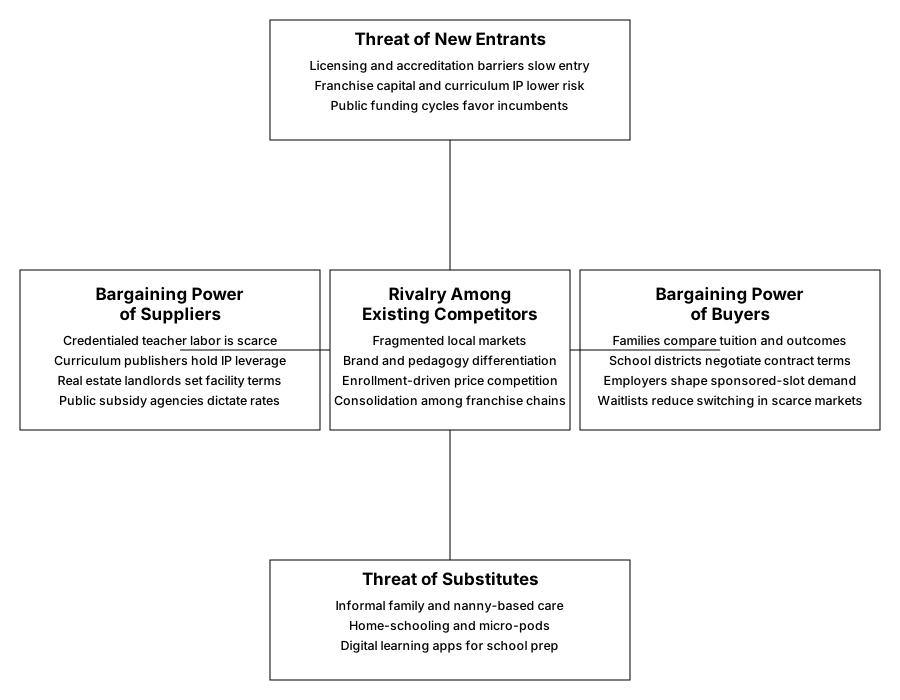
Porter's five forces framework clarifies why this industry remains structurally fragmented at the operating level even as funding and curriculum consolidate. Buyer power is bifurcated between price-sensitive private-pay families in markets with ample supply and increasingly powerful public payers who set reimbursement rates unilaterally. Supplier power centers overwhelmingly on credentialed teaching labor, a resource that is scarce, underpaid relative to comparable roles and difficult to substitute given ratio regulations. Rivalry stays intense locally but muted nationally because most markets are geographically bounded by commute distance. New entrants face real licensing and accreditation friction but can circumvent much of it by joining an existing franchise system. Substitutes, from informal family care to digital school-readiness apps, remain imperfect but exert pressure at the margins of the price-sensitive segment.
Bargaining power of buyers
Buyer power in early childhood services depends almost entirely on which payer sits across the table. Individual parents paying private tuition have meaningful power in markets with ample licensed capacity, since they can compare programs on price, curriculum philosophy and reputation and they switch providers relatively easily between infancy and kindergarten entry. That power collapses in supply-constrained markets, where waitlists routinely exceed a year for infant and toddler slots, effectively reversing the negotiation in the provider's favor. School districts and public agencies purchasing pre-kindergarten slots at scale carry far more structural power, because they set per-child reimbursement rates, dictate curriculum and staffing requirements as contract conditions and can shift volume between providers or in-house programs based on compliance performance. Employers sponsoring child-care benefits for staff retention purposes negotiate bulk-rate contracts with national providers and can walk away at renewal if outcomes or service levels disappoint. The clearest structural trend is that public payers are gaining leverage faster than any other buyer category, since expanding state pre-kindergarten appropriations mean a growing share of total industry revenue flows through negotiated government contracts rather than open-market tuition and providers who cannot meet public procurement and reporting requirements are effectively locked out of the fastest-growing demand pool.
| Buyer type | Source of leverage | Trend |
|---|---|---|
| Private-pay families | Price comparison and switching in high-supply markets | Weakening where waitlists persist |
| School districts and states | Rate-setting and contract volume | Strengthening steadily |
| Employers sponsoring benefits | Bulk contracts and renewal leverage | Stable to strengthening |
| Head Start grantee networks | Compliance-linked funding renewal | Strengthening with federal scrutiny |
Bargaining power of suppliers
The dominant supplier in this industry is not a materials vendor but the labor pool of credentialed early childhood educators and that labor pool holds outsized leverage precisely because it is chronically undersupplied. Median hourly pay for early educators sits near 13 dollars, far below the 31.80 dollars earned by elementary and middle school teachers and below 97 percent of other occupations nationally, a gap that drives persistent turnover and gives qualified teachers substantial mobility across employers competing for the same limited pool.4 Curriculum and instructional-materials publishers hold a different kind of leverage, rooted in intellectual property rather than scarcity, since a proprietary pedagogy with demonstrated outcomes becomes difficult for an operator to replace without disrupting classroom continuity and family trust built around that brand. Commercial real estate landlords hold meaningful leverage in dense urban and suburban markets where zoning restricts the supply of buildings that can meet licensing requirements for outdoor space, egress and classroom square footage per child. Public funding agencies function simultaneously as buyer and supplier of legitimacy, since accreditation and licensing approval from a state agency is itself an input the provider cannot obtain elsewhere and agencies can withhold or delay it as leverage over compliance. Credentialing bodies that issue the Child Development Associate certification and similar qualifications add a further layer of supplier power, since obtaining that credential typically requires the educator to pay out of pocket, which constrains the supply of newly credentialed teachers entering the workforce.
| Supplier category | Leverage mechanism | Constraint on operators |
|---|---|---|
| Credentialed teaching staff | Wage-driven scarcity and turnover | Direct constraint on classroom quality |
| Curriculum and materials publishers | Proprietary pedagogy and brand trust | Switching disrupts continuity |
| Commercial real estate landlords | Zoning-restricted licensed space | Limits site expansion pace |
| Credentialing and accreditation bodies | Gatekeeping of legal operating status | Controls market entry timing |
Rivalry among existing competitors
Competitive rivalry plays out almost entirely at the local level, since a family choosing a preschool compares options within a commute radius rather than across a metropolitan area, which keeps national market concentration low even as individual neighborhoods experience intense competition for enrollment. Franchise brands such as KinderCare, Bright Horizons, Primrose Schools and the Learning Care Group portfolio compete primarily on brand consistency, perceived academic rigor and amenity packages such as extended hours or STEM-branded curriculum add-ons, while independent operators compete on price flexibility, community ties and specialized pedagogical approaches including Montessori and Reggio Emilia models.5 Rivalry intensifies in markets where state-funded universal pre-kindergarten programs compete directly with private tuition-based providers for the same four-year-old population, since a free public option changes the competitive calculus for private operators whose entire value proposition may rest on marginal quality differences a price-sensitive family cannot easily verify. Consolidation pressure is building among franchise systems and private equity-backed platforms that acquire independent centers to convert them into branded, standardized operations with centralized purchasing and administrative overhead, a trend that reduces fragmentation gradually without eliminating the thousands of small independent operators that remain viable in less contested submarkets. The net effect is a market structure that behaves like a fragmented local-services industry at the transaction level while consolidating steadily at the ownership and brand level.
| Rivalry dimension | Characteristic | Direction |
|---|---|---|
| Geographic scope of competition | Local, commute-bound | Stable |
| Public versus private substitution | Free universal pre-K displacing tuition-paying enrollment | Increasing in expansion states |
| Franchise brand differentiation | Curriculum branding and consistency | Increasing |
| Ownership consolidation | Private equity and franchise roll-ups of independents | Increasing gradually |
Threat of new entrants
Entry barriers in early childhood services are moderate and highly uneven across the value chain, which is precisely why the industry supports both a long tail of small independent operators and a small number of large branded platforms simultaneously. Opening a standalone licensed center requires navigating state licensing requirements covering staff-to-child ratios, background checks, facility standards and curriculum approval, a process that typically takes months and demands working capital before a single tuition dollar arrives, which discourages casual entry but does not stop it, since thousands of small operators enter and exit local markets every year. Joining an established franchise system substantially lowers that barrier by providing pre-built curriculum, training systems, brand recognition and often assistance navigating licensing, in exchange for franchise fees and ongoing royalties, which explains why franchise conversion is a common entry path for operators who might otherwise struggle independently. Entry into the curriculum publishing or assessment technology segments carries a different barrier structure entirely, rewarding intellectual property and research credibility over capital, since a new curriculum must demonstrate learning outcomes before districts or franchise systems will adopt it at scale. Public program entry, such as becoming a Head Start grantee, is the most tightly gated path of all, since federal grant competitions are infrequent and existing grantees enjoy strong renewal advantages, making genuinely new entry into the federally funded segment rare regardless of an entrant's quality or capital position.
| Entry path | Primary barrier | Relative difficulty |
|---|---|---|
| Standalone independent center | Licensing, capital and staffing lead time | Moderate |
| Franchise conversion | Franchise fees and royalty commitments | Low to moderate |
| Curriculum or assessment technology | Research credibility and adoption cycles | Moderate to high |
| Head Start grantee status | Infrequent federal competitions and incumbent renewal | High |
Threat of substitutes
Substitution pressure in early childhood services is real but structurally limited, because the core product, a credentialed adult delivering a curriculum to a young child in a licensed setting, has few true equivalents. Informal family and neighbor-based care remains the most common substitute among lower-income and rural families who cannot access or afford formal programs and it competes primarily on cost and flexibility rather than instructional quality, which means it draws demand away from the industry without directly threatening the premium segment. Nanny and au pair arrangements substitute at the opposite end of the income spectrum, offering personalized attention that some affluent families value over group instruction, though they typically cost more than center-based tuition and lack the peer-socialization component that many parents specifically seek. Home-schooling and small parent-organized micro-pods, a trend that expanded during pandemic-era disruptions, persist as a niche substitute for families dissatisfied with available formal options or seeking specific pedagogical control. Digital learning applications marketed for school readiness and early literacy represent the newest substitution vector and while they cannot replace the social-emotional development and structured instruction a licensed program provides, they compete for a slice of the school-readiness assessment and supplemental-instruction budget that families and even some public programs allocate. None of these substitutes threaten to displace formal early childhood services at scale, since public policy increasingly treats center-based, credentialed instruction as the preferred model, but each exerts continuous pressure at the price-sensitive edges of the market.
| Substitute | Competes on | Structural limitation |
|---|---|---|
| Informal family or neighbor care | Cost and flexibility | No credentialed instruction |
| Nanny or au pair arrangements | Personalized attention | Higher cost, no peer socialization |
| Home-school micro-pods | Parental control over content | Limited scale and consistency |
| Digital readiness and literacy apps | Convenience and supplemental practice | Cannot replace in-person development |
Value chain and profit pools
The early childhood services value chain runs through six distinct stages, each with its own economics and competitive intensity. Upstream, curriculum design and instructional-materials development set the pedagogical foundation, produced by publishers and franchise systems who invest in research, teacher training content and assessment tools that they license downstream rather than deliver directly. Credentialing and teacher preparation forms a parallel upstream stage, run by community colleges, universities and credentialing bodies that certify the labor supply the entire industry depends on, a stage that is chronically underinvested relative to its importance. Facility development and licensing follows, covering real estate acquisition or leasing, build-out to meet regulatory standards and the multi-month approval process required before a center can legally enroll children.
Classroom delivery constitutes the operational core of the value chain, where credentialed teachers execute curriculum in licensed classrooms at fixed staff-to-child ratios and this is the stage that consumes the overwhelming majority of operating cost through wages and benefits. Enrollment, family engagement and billing form the customer-interface stage, increasingly digitized through enrollment management software, parent communication apps and automated tuition billing that reduce administrative overhead relative to fully manual processes. Assessment and outcome reporting closes the loop, particularly for publicly funded programs, where kindergarten readiness data feeds back into funding renewal decisions and increasingly into curriculum refinement, making this stage both an accountability requirement and, for vendors who supply the assessment tools, a genuine profit center. Enabling infrastructure threads through every stage, spanning compliance and licensing administration, payroll and benefits systems tailored to high-turnover hourly labor, and, for franchise systems, the corporate functions that maintain brand standards across a distributed network of independently owned sites.
Profit pool
Profit concentrates conspicuously away from the classroom. Curriculum publishers and franchisors capture the highest margins in the industry because they license intellectual property, brand and training systems across hundreds or thousands of sites without carrying the direct cost of classroom labor, the single largest expense in the entire value chain. Credentialing and assessment vendors occupy a similarly favorable position, selling software and certification services into districts, states and franchise networks on a per-seat or per-contract basis with limited marginal delivery cost once the product is built. Center-level operation, whether independent or franchised, runs on comparatively thin margins, typically in the single digits to low teens, because wages, facility cost and ratio-driven staffing consume the majority of revenue regardless of how efficiently a site is managed. Public and Head Start-type programs operate on a different logic entirely, since grant funding is designed to cover cost rather than generate surplus, meaning profit in the traditional sense does not exist at that layer, though grantee organizations can build institutional capacity and reserves over multiple funding cycles.
The organizations capturing durable margin in early childhood services are rarely the ones running the classrooms
This distribution has shifted over the past decade as public funding has expanded faster than private tuition growth, pulling profit pool weight toward vendors and platforms that can serve public payers at scale, including assessment providers whose tools are now embedded in state accountability systems and franchise systems sophisticated enough to win and administer government contracts alongside private tuition revenue. Operators without that dual capability increasingly find themselves squeezed between rising labor cost and a public funding stream they cannot access.
Industry economics and business models
Four business model patterns dominate this industry, each with distinct capital and margin profiles. The franchise licensing model, used by brands including KinderCare, Primrose Schools and the Learning Care Group portfolio, separates intellectual property ownership from operating risk, letting the parent company collect royalty and franchise fees while franchisees bear local labor cost, facility lease obligations and enrollment risk.6 The direct-tuition operating model, used by independent preschools and company-owned franchise sites, is asset-heavy in labor terms even where facilities are leased rather than owned, since staffing cost scales directly with enrollment and cannot be reduced below regulatory ratio minimums regardless of demand softness.
The public grant and contract model, governing Head Start, Early Head Start and state-funded pre-kindergarten programs, operates on appropriated funding tied to enrollment slots and compliance performance rather than market pricing, which insulates providers from demand volatility but exposes them fully to political and budgetary risk, illustrated starkly when a leaked federal budget document in 2025 proposed eliminating Head Start funding entirely before Congress ultimately maintained level funding.7 The business-to-business and business-to-government licensing model, used by curriculum publishers and assessment technology vendors, is the most asset-light pattern in the industry, generating revenue through per-site licensing fees, per-child assessment fees or subscription software contracts that scale without proportional cost growth, which explains why this segment consistently posts the industry's highest margins even though it represents a small share of total industry revenue.
Cost drivers and scalability
Labor cost dominates the cost structure of every operating segment in this industry, typically consuming 60 to 70 percent of center-level revenue once benefits are included, a ratio that is largely fixed by regulatory staff-to-child ratios rather than management discretion. This creates an unusual scalability problem: unlike software or many consumer services, adding capacity does not reduce marginal labor cost per unit, since each additional classroom of children requires a proportional increase in credentialed staff regardless of how many sites an operator already runs. Facility cost is the second largest driver, encompassing lease or ownership expense, utilities and the capital investment required to meet licensing standards for space, safety and outdoor access, costs that scale with square footage rather than enrollment efficiency.
Where genuine economies of scale exist, they concentrate in corporate and enabling functions rather than classroom operations: centralized curriculum development, shared enrollment and billing technology, bulk procurement of classroom materials and consolidated compliance and licensing administration all spread fixed cost across a larger site count. Franchise and multi-site operators capture these scale economies more effectively than single-site independents, which partly explains the steady, if gradual, consolidation trend toward branded systems. Utilization functions similarly to occupancy in hospitality, since a classroom operating below its licensed capacity still incurs nearly full staffing cost, making enrollment-fill rate the single most important unit-economic lever any operator controls, more consequential than tuition pricing itself in markets with real supply. Curriculum and assessment vendors experience the opposite dynamic, with genuinely low marginal cost per additional site or contract once the core product is built, which is precisely why that segment scales fastest and commands the highest margin in the industry.
Moats, advantages and strategic levers
Durable advantage in this industry rarely comes from facilities or even brand alone; it comes from three harder-to-replicate assets. Proprietary curriculum with demonstrated, data-backed learning outcomes creates a genuine differentiation moat, because switching curriculum disrupts classroom continuity, requires retraining staff and risks family trust built around a specific pedagogical identity, all of which raise switching costs for operators who have adopted a system and for the families enrolled under it. Workforce pipeline control forms a second moat, built by organizations that invest directly in teacher training, credentialing support and career pathways rather than simply competing for the existing scarce labor pool, since this reduces exposure to the wage-driven turnover that erodes quality and cost discipline across the rest of the industry.
Regulatory and relationship capital forms a third moat, particularly valuable for organizations that have built the compliance infrastructure and public-agency relationships needed to win and administer government contracts, since new entrants and smaller operators typically lack the reporting systems and track record public payers require. Data and learning advantages are emerging as a fourth, newer moat, as organizations with assessment and outcome data across large numbers of children can refine curriculum, demonstrate results to public payers and employers and command premium contract terms in ways that data-poor competitors cannot match. Brand recognition functions as a supporting advantage rather than a standalone moat, since it lowers customer acquisition cost and supports tuition premiums, but it erodes quickly if outcome or safety performance disappoints, making it dependent on the other three moats rather than a substitute for them.
Strategic levers
Operators and new entrants have five meaningful levers available and the right combination depends heavily on starting position and capital appetite. Customer segment focus is the most immediately actionable lever, since an organization can choose to specialize in public-funded populations, employer-sponsored benefit programs, or private-pay premium families, each requiring different capabilities and offering different margin and volatility profiles. Curriculum and pedagogy scope is a second lever, where an organization decides whether to build proprietary intellectual property, an expensive and slow path but one that creates the strongest long-term moat, or license an established curriculum, a faster path that trades margin for speed to market.
Vertical integration versus partnership represents a third lever, particularly relevant to the question of teacher credentialing, where an organization can build internal training academies to control its labor pipeline directly or partner with community colleges and credentialing bodies to access an external pipeline at lower fixed cost but less control. Geographic expansion strategy is a fourth lever and given the local nature of competitive rivalry, expansion decisions should weight local licensing regimes and public funding generosity as heavily as demographic demand, since a state with strong universal pre-kindergarten funding offers fundamentally different unit economics than one relying primarily on private tuition. Ecosystem orchestration is the fifth and most sophisticated lever, available mainly to larger platforms capable of connecting curriculum, assessment, credentialing and operating capacity into a single system that can serve public agencies, employers and families simultaneously, capturing margin at multiple value-chain stages rather than just one.
Structural risks, regulation and trends
The most consequential structural risk in this industry is chronic educator underpayment, since a median wage near 13 dollars an hour against comparable K-12 teaching roles earning more than double creates a persistent leak in classroom quality and curriculum fidelity that no amount of pedagogical innovation can fully offset.8 Regulatory risk runs in two directions simultaneously: expanding state pre-kindergarten mandates create demand tailwinds for providers positioned to serve public contracts, while credentialing requirements that impose out-of-pocket certification costs on individual teachers constrain the very labor supply the expansion depends on. Federal funding volatility adds a further layer of risk specific to the public-program segment, illustrated by the gap between a 2025 budget proposal that would have zeroed out Head Start entirely and the level funding Congress ultimately approved, a swing that underscores how exposed federally dependent providers remain to shifting political priorities.
Secular demand trends remain favorable overall, driven by growing recognition among policymakers that early cognitive and social development predicts long-run economic outcomes, evidenced by states such as Georgia becoming the first to combine universal pre-kindergarten access with all ten quality benchmarks tracked by the National Institute for Early Education Research.9 Supply-side trends favor consolidation among franchise and platform operators capable of navigating credentialing and public procurement complexity, while independent operators without that infrastructure face a widening competitiveness gap. Disruptive models remain limited relative to other education segments, since the in-person, ratio-regulated nature of quality early instruction resists the kind of technology-driven unbundling that has reshaped adjacent markets such as test preparation or supplemental tutoring.
For organizations considering entry, the strategic playbook depends on ambition and capital position. A niche entry focused on a specific pedagogical approach or underserved geography can succeed with modest capital by partnering into an existing franchise or curriculum system rather than building independently, while a broad entry ambition, particularly one targeting public contracts, requires either acquiring an established regulatory and grantee track record or building one patiently over several funding cycles, since public procurement rarely rewards first-time bidders regardless of quality. Regulatory strategy should be treated as a core competency rather than a compliance afterthought, since the organizations winning the largest share of public funding growth are those that invested early in reporting infrastructure and agency relationships. For incumbents, defending market position means investing directly in teacher retention and credentialing pipelines before competitors erode the labor pool further, expanding means pursuing the public-contract and employer-sponsored channels where demand growth is concentrated and deepening moats means converting assessment and outcome data into a genuine strategic asset rather than a compliance byproduct.
Caselet: Bright Horizons Family Solutions
Bright Horizons Family Solutions, a publicly traded provider founded in 1986 and headquartered in Massachusetts, illustrates how a company can build durable advantage in early childhood services by controlling curriculum, employer relationships and workforce development simultaneously rather than competing purely on classroom capacity. The company built its early growth not around retail tuition but around employer-sponsored child-care benefits, persuading corporations to fund on-site or near-site centers as an employee-retention tool, a business-to-business channel that gave it more stable, contracted revenue than competitors relying entirely on price-sensitive private-pay families.
Industry at a glance in practice
Bright Horizons today operates hundreds of centers across the United States and several other countries, serving families through both employer-sponsored slots and direct tuition enrollment, while its Discovery Driven Learning curriculum and Montessori program offerings demonstrate the industry pattern of owning proprietary pedagogy rather than renting it from a third party. The company's dual exposure to business-to-business employer contracts and business-to-consumer tuition gives it a funding mix considerably more diversified than either a pure public-program grantee or a purely private-pay independent operator, insulating it somewhat from the volatility either channel experiences in isolation.
Market structure in practice
Within its competitive set, which includes KinderCare, Primrose Schools and the Learning Care Group portfolio, Bright Horizons differentiates through its employer-relationship model rather than competing purely on local price or proximity, a strategy that reduces direct rivalry with community-based independent preschools that cannot offer the same corporate contracting infrastructure. The company's scale gives it negotiating leverage with commercial landlords and access to capital markets unavailable to independent operators, while its employer contracts function similarly to the public contracts other providers pursue, offering revenue visibility in exchange for service-level accountability.
Strategic levers in practice
The company's expansion strategy has leaned on geographic and channel diversification simultaneously, growing internationally while also broadening from pure center-based child care into adjacent services including educational advisory and back-up care, an ecosystem-orchestration approach that captures value across multiple points in the value chain rather than a single operating layer. Its investment in proprietary curriculum, including Montessori-aligned programming that licenses recognizable pedagogical materials into a broader instructional framework, exemplifies the differentiation moat that separates high-margin curriculum ownership from commodity center operation. The durability of that positioning depends on continued success recruiting and retaining credentialed teaching staff in a labor market where wage pressure remains the industry's most persistent constraint, a challenge that no scale advantage fully eliminates.
Structural risks and trends in practice
Bright Horizons' employer-sponsored model carries its own concentration risk, since a downturn in corporate benefits spending or shifts in employer real estate strategy following the rise of remote work could reduce demand for on-site or near-site center sponsorship faster than public-program demand would decline. The company's experience demonstrates both the opportunity and the constraint facing any large early childhood services platform:
diversified funding sources and proprietary curriculum build resilience, but the underlying labor-cost and credentialing dynamics that constrain the entire industry constrain even its best-capitalized participants
Bright Horizons' trajectory suggests that scale alone does not guarantee margin in this industry, but scale combined with proprietary pedagogy, diversified payer relationships and workforce investment produces a materially stronger competitive position than scale in classroom count alone would deliver.
Early childhood services convert public and parental spending into measurable school readiness and the industry's economics reward whoever owns the curriculum, the credential and the outcome data rather than whoever owns the most classrooms. Labor scarcity, subsidy-rate dependence and accreditation complexity keep the field fragmented at the operating level while consolidating at the intellectual-property level. The operators and public systems that will matter most over the next decade are the ones that treat teacher credentialing as a supply chain to be engineered, treat assessment data as a defensible asset and treat public funding relationships as a core competency rather than a compliance afterthought. Capital allocators should underwrite pedagogy and workforce pipelines before they underwrite real estate.
Citation
Cite this article
Sridharan, M. A. (2024, March 15). Industry Analysis: Early Childhood Services. Think Insights. https://thinkinsights.net/strategy/industry-analysis-early-childhood-services (Accessed [[ACCESS_DATE]])
Sridharan, Mithun A. "Industry Analysis: Early Childhood Services." Think Insights, 15 Mar. 2024, https://thinkinsights.net/strategy/industry-analysis-early-childhood-services. Accessed [[ACCESS_DATE]].
Mithun A. Sridharan, "Industry Analysis: Early Childhood Services," Think Insights, March 15, 2024, https://thinkinsights.net/strategy/industry-analysis-early-childhood-services. Accessed [[ACCESS_DATE]].
Sridharan, M.A. (2024) 'Industry Analysis: Early Childhood Services', Think Insights. Available at: https://thinkinsights.net/strategy/industry-analysis-early-childhood-services (Accessed: [[ACCESS_DATE]]).
M. A. Sridharan, "Industry Analysis: Early Childhood Services," Think Insights, 2024. [Online]. Available: https://thinkinsights.net/strategy/industry-analysis-early-childhood-services. [Accessed: [[ACCESS_DATE]]].
Sridharan MA. Industry Analysis: Early Childhood Services. Think Insights. Published March 15, 2024. Accessed [[ACCESS_DATE]]. https://thinkinsights.net/strategy/industry-analysis-early-childhood-services
Test Your Knowledge
Industry Analysis: Early Childhood Services
Challenge yourself on the concepts from this article and see how well you understood them.
Subscribers get weekly quizzes and insights — subscribe free
Sponsor this article
Partner with Think Insights
Reach 50,000+ business leaders, consultants, and strategists. Feature your brand alongside expert articles on strategy, leadership, and digital transformation.
Become a Sponsor