Industry Analysis: Cryptocurrency


Cryptocurrency has matured from a speculative retail hobby into a regulated financial market spanning exchanges, custodians, stablecoin issuers, market makers and exchange-traded funds. The market moves several trillion dollars in value and generates daily trading volume above one hundred billion dollars, yet profit has concentrated in a narrow set of positions: dominant exchanges with liquidity network effects, the two stablecoin issuers that together hold roughly four-fifths of that market and custodians now absorbing institutional balance-sheet demand. Bargaining power is shifting away from exchanges and toward asset managers, whose spot exchange-traded funds let institutions buy exposure without touching an exchange account at all. Executives evaluating this industry should treat regulatory licensing as the primary entry barrier, prioritize custody and compliance infrastructure over trading volume alone and recognize that the industry's next profit pool sits in tokenized real-world assets and regulated stablecoin payment rails rather than in spot trading fees.
Is cryptocurrency trading and custody attractive for new entrants?
Attractiveness depends heavily on which layer a new entrant targets. Spot exchange operation has become unattractive for undifferentiated players because licensing costs, banking relationships and liquidity network effects favor incumbents, while custody, compliance tooling and stablecoin-adjacent payment infrastructure still offer room for differentiated entrants with strong balance sheets and regulatory relationships.
Which parts of the value chain are most profitable?
Stablecoin issuance and institutional custody currently generate the highest margins because issuers earn interest income on reserve assets with minimal marginal cost and custodians charge recurring basis-point fees on assets under custody that scale without proportional headcount growth. Spot trading fees, by contrast, have compressed toward zero at the retail tier.
How is technology changing this industry?
Tokenization is moving traditional securities and money market instruments onto blockchain rails, exchange-traded funds have industrialized institutional access to digital assets without direct custody and artificial-intelligence-driven market-making has tightened bid-ask spreads across major trading pairs, all of which are compressing trading margins while expanding the addressable base of participants.
What capabilities are table stakes versus differentiators?
Table-stakes capabilities include cold-storage security, anti-money-laundering compliance, twenty-four-hour uptime and basic fiat on-ramp integration. Differentiators include regulatory licenses across multiple jurisdictions, institutional-grade custody insurance, proprietary liquidity depth during volatility spikes and distribution partnerships with banks or asset managers.
How should investors and consultants evaluate opportunities here?
Evaluation should weight regulatory license portfolio, revenue diversification beyond trading fees, custody asset growth relative to trading volume and exposure to stablecoin reserve income, since these factors predict resilience through the boom-bust volume cycles that have repeatedly compressed exchange valuations.
What role do stablecoins play in industry economics?
Stablecoins function as the settlement layer for the entire trading ecosystem and issuers now generate revenue primarily from interest earned on reserve holdings of short-term government securities rather than from transaction fees, making the largest issuers effectively money-market-fund operators built on blockchain rails.
Why are custodians gaining strategic importance?
Custodians are absorbing the institutional trust function once concentrated in exchanges, because asset managers, corporates and pension allocators require segregated, insured, audited storage that is legally distinct from a trading venue's balance sheet, a distinction that became existential after several exchange collapses.
How does regulation reshape competitive position?
Regulation increasingly acts as a moat rather than a burden for well-capitalized incumbents, since licensing regimes such as the Markets in Crypto-Assets framework in the European Union and the stablecoin statute in the United States raise fixed compliance costs that smaller and offshore competitors cannot absorb, pushing volume toward regulated venues.
What is the biggest structural risk facing this industry?
Custodial concentration risk is the most persistent structural threat, since a small number of exchanges and custodians hold outsized shares of global digital assets, meaning a single security failure or fraud event can trigger contagion across counterparties, as prior collapses have repeatedly demonstrated.
Where is the next profit pool likely to emerge?
The next profit pool is likely to form around tokenized real-world assets, including money market funds and private credit issued directly on blockchain rails, because this layer combines the yield economics of traditional asset management with the settlement efficiency of crypto infrastructure and it is attracting the same institutions that have already validated stablecoins and exchange-traded funds.
Cryptocurrency has moved from the margins of finance into its operating core. What began as a payments experiment following Bitcoin's 2009 launch is now a trading and custody ecosystem that intersects with banking, asset management and market infrastructure at nearly every point. Executives evaluating this industry are no longer asking whether digital assets deserve a place on the balance sheet; they are asking which layer of the value chain, from exchanges to custodians to stablecoin issuers, offers a defensible position as the industry consolidates around regulated incumbents.
Industry at a glance
The cryptocurrency trading and custody industry encompasses the infrastructure that lets participants buy, sell, store and settle digital assets: centralized exchanges, decentralized trading protocols, custodians, stablecoin issuers, market makers and the exchange-traded funds that now wrap crypto exposure for traditional portfolios. It excludes the underlying blockchain protocols and mining infrastructure that produce and validate the assets themselves, which form a distinct technology and infrastructure industry. The scope here is financial-market infrastructure:
the layer where an asset becomes tradable, custodial and investable rather than the layer where it is computationally created
Global cryptocurrency market capitalization has fluctuated between roughly two and four trillion dollars through 2026, with average daily trading volume exceeding one hundred billion dollars across spot and derivatives markets1. Bitcoin alone accounts for more than half of total market capitalization, concentrating risk and liquidity in a single asset even as the number of tradable tokens has grown past seventeen thousand. Customers span three distinct categories:
retail individuals trading through consumer apps, institutional investors including hedge funds, corporates and asset managers accessing the market through custodians and prime brokers and increasingly governments and sovereign entities exploring digital asset reserves and settlement rails, giving the industry a business-to-consumer, business-to-business and business-to-government footprint simultaneously
Revenue models vary by layer. Exchanges earn trading fees, typically a fraction of a percent per transaction, plus listing fees and interest on customer balances. Custodians charge basis-point fees on assets under custody, often between ten and fifty basis points annually. Stablecoin issuers earn the spread between reserve asset yield and the near-zero interest paid to token holders, a model that resembles a money market fund more than a payments company. Market makers earn the bid-ask spread and rebates for providing liquidity. Capital intensity is moderate to high, driven by custody insurance, cold-storage infrastructure and regulatory capital requirements, while labor intensity is comparatively low relative to trading volume, since much of the infrastructure operates as automated software. Regulatory intensity has risen sharply since 2023 and is now the dominant constraint on strategy, with licensing regimes in the United States, European Union and major Asian financial centers determining which firms can legally serve which customers.
Industry segmentation
The industry organizes into six segments defined primarily by position in the value chain and secondarily by customer type. Centralized exchanges, led by firms operating both spot and derivatives order books, remain the largest segment by revenue and handle the majority of retail and a meaningful share of institutional volume. Decentralized exchanges and automated market maker protocols form a parallel segment that removes the intermediary entirely, settling trades through smart contracts rather than a company-operated order book and this segment has grown fastest in percentage terms even though its absolute volume remains a minority of the total market.
Custodians constitute a segment increasingly separated from exchanges for regulatory and trust reasons, offering insured, segregated storage for institutional and increasingly retail assets; firms such as Coinbase Custody, BitGo and Anchorage Digital compete here on security certification, insurance coverage and banking charter status2. Stablecoin issuers form a distinct segment whose economics resemble a regulated money fund rather than a trading business; Tether and Circle together account for roughly four-fifths of the stablecoin market and generate revenue almost entirely from reserve asset yield rather than from transaction volume.
Market makers and liquidity providers, including firms such as Jump Trading and Wintermute, form a segment that operates behind the scenes to tighten spreads and absorb volatility, earning revenue from spread capture and exchange rebates rather than from customer-facing fees. Finally, the exchange-traded fund and asset-management wrapper segment has emerged as the fastest-growing customer interface since 2024, letting institutional and retail investors gain price exposure to Bitcoin, Ethereum and other assets through regulated brokerage accounts without touching a crypto-native exchange or custodian at all. This segment increasingly disintermediates the traditional exchange relationship, a dynamic explored further in the market structure section below.
Market structure
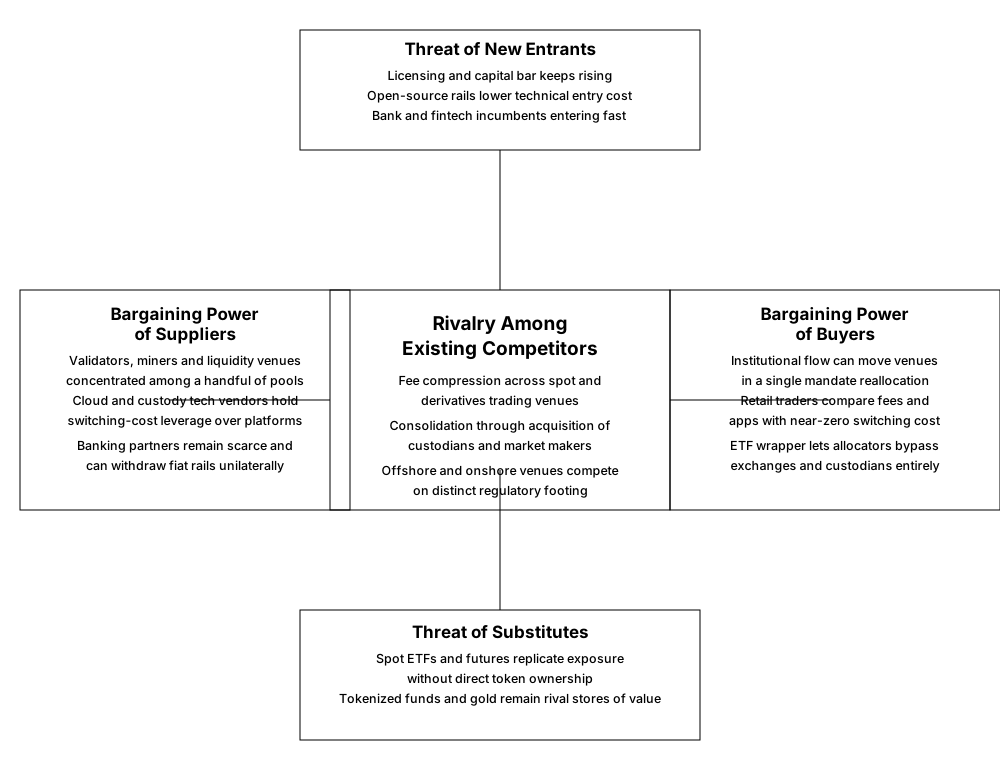
Applying a comprehensive five-forces lens to cryptocurrency trading and custody reveals an industry where buyer power has risen sharply through the arrival of exchange-traded products, supplier power remains concentrated among a small number of liquidity venues and banking partners, rivalry has intensified through fee compression and consolidation, entry barriers have risen due to licensing costs even as the technical barrier to launching a basic exchange has fallen and substitute products, particularly regulated wrappers, now compete directly with the core trading relationship. Each force is examined below.
Bargaining power of buyers
Buyer power in cryptocurrency trading has increased substantially since spot exchange-traded funds began trading in the United States in 2024. Institutional allocators, who previously needed a direct exchange account, custody arrangement and compliance review to gain Bitcoin exposure, can now buy a fund through any brokerage relationship, collapsing switching costs to near zero and forcing exchanges to compete on service quality rather than access alone. Retail traders exhibit similarly low switching costs, since most consumer applications support near-instant account opening and asset transfer and fee comparison across venues is now a routine part of the retail trading decision. Institutional trading desks that route large orders retain outsized negotiating leverage over fee schedules and can shift meaningful volume to a competing venue within a single reallocation cycle, particularly as prime brokerage relationships mature and firms build multi-venue execution capability. The net effect is that exchanges and custodians face persistent downward pressure on pricing from every customer tier simultaneously, a dynamic that has pushed trading fees toward the cost of capital and pushed differentiation toward custody trust, product breadth and execution quality rather than price.
| Buyer segment | Source of leverage | Effect on pricing |
|---|---|---|
| Institutional asset managers | Exchange-traded fund access bypasses direct exchange relationship | Downward pressure on custody and trading fees |
| Retail traders | Near-zero account switching cost across apps | Persistent fee compression at retail tier |
| Hedge funds and trading desks | Multi-venue execution and large order size | Negotiated fee discounts and rebates |
| Corporate treasuries | Selective adoption tied to regulatory comfort | Preference for insured, regulated custodians |
Bargaining power of suppliers
Suppliers to the trading and custody industry include blockchain validators and mining pools that settle transactions, liquidity venues that market makers depend on for hedging, technology vendors providing custody infrastructure and, critically, the banking partners that provide fiat on-ramp and off-ramp services. Banking access has proven to be the single most consequential supplier relationship in the industry's history, since a bank's decision to sever a crypto firm's account can effectively halt operations overnight, a risk realized repeatedly during periods of heightened regulatory scrutiny in the United States. Custody technology vendors, including firms offering multi-party computation and hardware security module infrastructure, hold moderate switching-cost leverage over exchanges and custodians that build on their platforms rather than developing proprietary systems. Validator and mining pool concentration on major blockchain networks gives a handful of large operators disproportionate influence over settlement reliability, though this affects the underlying protocol layer more than the trading layer directly. Overall, supplier power is concentrated in a small number of critical relationships rather than distributed across many substitutable vendors, making banking and infrastructure partnerships a strategic priority rather than a procurement afterthought.
| Supplier category | Concentration | Strategic implication |
|---|---|---|
| Banking and payment partners | Few willing partners in key jurisdictions | Banking relationship becomes competitive moat |
| Custody technology vendors | Moderate, several credible providers | Build versus buy decision shapes cost base |
| Liquidity and hedging venues | Concentrated among top derivatives exchanges | Market makers dependent on venue access |
| Cloud infrastructure providers | Oligopoly among major cloud platforms | Operational resilience tied to vendor terms |
Rivalry among existing competitors
Competitive rivalry is intense and has intensified further as trading fees compress across nearly every venue. Binance retains global leadership in spot trading volume with roughly thirty-nine percent share among top exchanges, while Coinbase holds the leading position among United States-regulated venues with a high single-digit percentage of global spot share3. Beneath these leaders, more than one hundred exchanges compete for a shrinking pool of undifferentiated trading fee revenue, pushing many toward derivatives, staking and lending products to sustain margin. Consolidation has accelerated, with larger platforms acquiring custodians, derivatives venues and market-making capability to diversify revenue and reduce dependence on volatile trading volume; Coinbase's acquisition of the derivatives exchange Deribit exemplifies this pattern. Rivalry also plays out along a regulatory axis, since offshore exchanges operating with lighter compliance burdens can offer higher leverage and lower fees than onshore, licensed competitors, creating two distinct competitive tiers that rarely compete head-to-head for the same customer. This bifurcation is likely to persist as licensing regimes mature, meaning the relevant competitive set for a given firm increasingly depends on its regulatory jurisdiction as much as its product offering.
| Competitive dimension | Pattern observed | Strategic consequence |
|---|---|---|
| Spot trading fees | Compressed toward near-zero for retail | Revenue diversification into other products |
| Derivatives and leverage products | Growing share of total exchange revenue | Differentiation through product breadth |
| Offshore versus onshore venues | Distinct regulatory tiers rarely overlap | Jurisdiction shapes competitive set |
| Consolidation activity | Acquisitions of custodians and derivatives platforms | Larger players build integrated stacks |
Threat of new entrants
Entry barriers have risen substantially even as the underlying technology to launch a basic exchange remains widely accessible through open-source software. Licensing has become the decisive barrier: obtaining money transmitter licenses across United States states, a Markets in Crypto-Assets authorization in the European Union, or a comparable license in Singapore or Hong Kong requires sustained legal investment and capital reserves that deter undercapitalized entrants. The stablecoin statute signed into law in the United States in 2025 illustrates this dynamic precisely, since issuers crossing a ten-billion-dollar market capitalization threshold must transition to a federal regulatory regime within a fixed window, formalizing a compliance bar that only well-capitalized issuers can clear4. Banking relationships present a second barrier, since new entrants without an established banking partner cannot offer fiat conversion, a service customers consider essential. At the same time, traditional financial institutions, including major banks and asset managers, are entering the industry with substantial existing capital, regulatory relationships and customer trust, representing the most credible new entrant category and one that crypto-native incumbents cannot easily out-compete on regulatory standing. The combined effect is an industry where genuine new entry is increasingly the province of well-capitalized incumbents from adjacent industries rather than venture-backed startups.
| Entry barrier | Trend direction | Who clears it |
|---|---|---|
| Regulatory licensing across jurisdictions | Rising steadily | Well-capitalized firms and bank entrants |
| Banking and fiat on-ramp access | Persistently scarce | Firms with existing banking relationships |
| Technical infrastructure cost | Falling due to open-source tools | Nearly any developer team |
| Customer trust and brand | Rising post-collapse of major platforms | Established or bank-affiliated brands |
Threat of substitutes
Substitute products have become the most consequential competitive threat to the traditional exchange and custody relationship. Spot exchange-traded funds now let investors gain price exposure to Bitcoin and other major assets through a standard brokerage account, with combined assets under management across the exchange-traded fund complex surpassing one hundred fifty billion dollars in early 2026, led by BlackRock's iShares Bitcoin Trust at roughly sixty-seven billion dollars5. These products substitute directly for the exchange account and custody relationship that previously formed the core customer touchpoint, redirecting fee revenue to asset managers rather than exchanges. Futures and derivatives products on regulated commodity exchanges offer a second substitute path, letting institutions gain synthetic exposure without holding the underlying asset at all. Tokenized money market funds and gold continue to compete as alternative stores of value for investors seeking a hedge against currency debasement, offering comparable properties to certain crypto assets without the custody and volatility profile. This proliferation of substitutes means the industry's addressable market for direct trading and custody relationships is narrower than headline market capitalization figures suggest, since a growing share of exposure now flows through wrapper products that bypass the core value chain entirely.
| Substitute category | Customer need addressed | Competitive pressure |
|---|---|---|
| Spot exchange-traded funds | Price exposure without custody burden | Redirects fees to asset managers |
| Regulated futures and derivatives | Synthetic exposure and hedging | Reduces direct exchange volume |
| Tokenized money market funds | Yield with lower volatility | Competes for treasury allocations |
| Gold and traditional stores of value | Inflation hedge and portfolio diversification | Competes for allocator mindshare |
Value chain and profit pools
The cryptocurrency trading and custody value chain spans five stages, beginning with asset origination, where tokens are created through mining, staking or issuance, a stage that sits largely outside this industry's scope but supplies its raw material. The second stage, liquidity provisioning, involves market makers and proprietary trading firms that hold inventory and quote prices across venues, absorbing volatility risk in exchange for spread capture. The third stage, trading execution, is where centralized and decentralized exchanges match buyers and sellers and where the industry's most visible fee revenue is generated, though this stage has experienced the sharpest margin compression of any link in the chain. The fourth stage, custody and settlement, has grown in strategic importance as institutions demand storage that is legally and operationally separate from any trading venue's balance sheet, a lesson learned expensively from prior exchange collapses. The fifth stage, distribution and customer interface, includes consumer applications, institutional prime brokerage desks and, increasingly, the exchange-traded fund wrapper that lets traditional asset managers become the customer's primary point of contact. A sixth, enabling layer runs beneath all of these:
compliance and regulatory infrastructure, including anti-money-laundering monitoring and licensing operations, which has become a cost center large enough to function as its own competitive battleground
Profit pool
Profit has migrated toward the stages of the value chain furthest from commoditized trading execution. Stablecoin issuance now represents one of the most profitable positions in the entire industry, since issuers hold reserve assets, primarily short-term United States government securities and earn the full yield on those reserves while paying token holders little to nothing in return, a model that scales almost costlessly as issuance grows6. Institutional custody has become the second concentrated profit pool, as recurring basis-point fees on growing assets under custody generate high-margin, sticky revenue that scales without proportional cost growth, a dynamic that has attracted both crypto-native custodians and traditional banks. Spot trading fees, by contrast, have become the least profitable stage of the chain for undifferentiated players, compressed by competition and by the rise of near-zero-fee retail applications, forcing exchanges to treat trading as a customer-acquisition function that feeds higher-margin custody, lending and derivatives products rather than as a standalone profit center. Market making retains healthy but volatile margins tied closely to trading volume and volatility, meaning its profitability rises during turbulent markets and falls during quiet periods, an inverse relationship to the steadier fee streams collected by custodians and stablecoin issuers.
Industry economics and business models
Three business model patterns dominate the industry. The first is the transaction-fee model characteristic of exchanges, where revenue scales directly with trading volume and is therefore highly cyclical, rising sharply during bull markets and falling during periods of low volatility and retail disengagement. This cyclicality has pushed most large exchanges to diversify into a second pattern, the recurring-fee model characteristic of custody and staking services, where revenue accrues as a steady percentage of assets under management regardless of trading activity, providing a counter-cyclical buffer against volume swings. The third pattern, the reserve-yield model unique to stablecoin issuers, resembles a money market fund wrapped in payment rails; issuers earn the spread between what their reserve assets yield and what they pay token holders, a spread that widens when interest rates rise and narrows when they fall, making stablecoin issuer profitability a function of monetary policy as much as of crypto adoption. A fourth, smaller pattern has emerged around the exchange-traded fund wrapper, where asset managers earn a management fee on assets under management that is materially lower than a typical custody fee but benefits from the scale and distribution advantages of an established asset management franchise, allowing firms such as BlackRock to compete on price while still generating substantial absolute revenue given the assets involved.
Cost drivers and scalability
Cost structure varies meaningfully by segment. Exchanges carry a relatively high fixed-cost base in compliance staffing, security infrastructure and licensing maintenance, while the marginal cost of processing an additional trade is close to zero, giving the business strong operating leverage once scale is achieved but exposing smaller players to a punishing fixed-cost burden during low-volume periods. Custodians face a similar dynamic, with fixed costs concentrated in insurance, security certification and audit, but revenue that scales with assets under custody rather than transaction count, producing more stable unit economics than trading-fee-dependent businesses. Stablecoin issuers enjoy perhaps the most favorable scalability profile in the industry, since managing a larger reserve pool requires only modestly more operational infrastructure than a smaller one, meaning incremental issuance flows almost directly to the bottom line. Customer acquisition cost has risen across the retail segment as marketing spend intensifies and regulatory advertising restrictions narrow available channels, while customer lifetime value depends heavily on whether a firm can cross-sell custody, staking or lending products beyond the initial trading relationship. Network effects reinforce scale advantages throughout the chain:
deeper liquidity attracts more trading volume, which tightens spreads, which in turn attracts further volume, a self-reinforcing loop that has consolidated volume among a small number of leading venues even as the long tail of exchanges continues to proliferate
Moats, advantages and strategic levers
Defensibility in this industry rests on four distinct foundations. Regulatory licensing has become the strongest and fastest-growing moat, since obtaining and maintaining licenses across multiple jurisdictions requires sustained legal investment that few firms can replicate quickly, effectively locking out undercapitalized competitors from serving regulated institutional and retail customers simultaneously. Liquidity network effects provide a second moat specific to trading venues, where deep order books attract more volume, which deepens the order book further, creating a self-reinforcing advantage that new entrants struggle to overcome without subsidizing liquidity at a loss. Custody trust functions as a third moat, built through insurance coverage, audit history and, increasingly, banking charter status, since institutional allocators treat custody selection as a due-diligence-intensive decision that favors established, proven providers over cheaper alternatives. Switching costs, though lower than in many traditional financial services industries, still matter at the institutional tier, where integration with a custodian's application programming interface, compliance workflow and reporting systems creates meaningful friction against moving assets elsewhere. Data and operational learning advantages, particularly in fraud detection and market surveillance, compound over time for firms with longer operating histories, giving incumbents a quiet but durable edge in risk management that is difficult for new entrants to replicate quickly.
Strategic levers
Firms operating in or entering this industry can pull several distinct levers to build position. Customer segment focus is the first: a firm can choose to serve retail traders with a low-cost, high-volume model, or institutions with a high-touch, compliance-intensive model and few firms succeed at both simultaneously given the differing cost structures and trust requirements each segment demands. Product scope is a second lever, where firms decide whether to remain a focused trading venue or expand into adjacent services such as custody, staking, lending and card products that increase revenue per customer and reduce dependence on trading fee cyclicality. Vertical integration versus partnership is a third lever, illustrated by Coinbase's acquisition of a derivatives exchange to internalize a previously outsourced capability, against BitGo's strategy of partnering with multiple external trading venues while keeping custody itself as its core specialization. Geographic and regulatory expansion forms a fourth lever, since securing licenses in additional jurisdictions expands the addressable customer base but requires meaningful, sustained legal investment that only compounds in value over a multi-year horizon. Finally, ecosystem orchestration, particularly around stablecoin issuance and distribution partnerships with banks and payment networks, allows firms to embed themselves into the broader financial system rather than remaining a standalone trading destination, a lever that Circle has pursued aggressively through its distribution partnership with Coinbase and its expanding bank integrations.
Structural risks, regulation and trends
The industry carries several structural risks that any strategic evaluation must weight heavily. Custodial concentration risk remains the most acute, since a small number of exchanges and custodians hold outsized shares of global digital assets, meaning a single security failure can trigger contagion across counterparties who held assets or credit exposure with the failed firm, a pattern demonstrated repeatedly by prior exchange collapses. Security risk compounds this concern: total crypto theft reached roughly three point four billion dollars in 2025, with a substantial share attributed to state-sponsored actors from North Korea targeting custodial infrastructure and privileged operational access rather than smart-contract code alone7. Regulatory risk, while increasingly a moat for compliant incumbents, remains a genuine threat for firms operating across jurisdictions with diverging rules, since a change in policy in any major market can abruptly restrict addressable customer base or require costly restructuring. Price and volume cyclicality represents a commodity-like risk specific to this industry, since exchange and market-maker revenue can swing by a wide margin between bull and bear market phases, straining firms that have not diversified into steadier fee streams.
Several secular trends are reshaping demand and competitive structure. Institutional adoption continues to broaden, with roughly three-quarters of large institutions surveyed by EY and Coinbase indicating plans to increase digital asset allocations in 2026, a demand driver that favors regulated custodians and exchange-traded product providers over offshore trading venues8. Tokenization of traditional assets, including money market funds and private credit, is expanding the definition of what counts as a tradable digital asset, pulling traditional asset managers deeper into the industry's value chain. Stablecoin regulation has matured from a gray area into a codified regime in both the United States and European Union, formalizing the industry's most profitable segment while raising the compliance bar for participation.
For firms considering entry, the strategic playbook diverges sharply by starting position. A firm without an existing regulatory license or banking relationship should pursue a narrow, defensible niche, such as institutional custody for a specific asset class or region, rather than attempting to compete broadly against licensed exchanges and should treat regulatory strategy as the first decision rather than an afterthought to product development. Build, partner or acquire decisions should favor partnership for capabilities such as banking access and liquidity provisioning, where trusted incumbents already exist, while reserving acquisition for capabilities central to long-term differentiation, such as custody or compliance technology. For incumbents, the playbook centers on defending trading volume through service quality and liquidity depth while expanding into custody, staking and stablecoin-adjacent revenue that diversifies away from cyclical fee income and deepening regulatory moats by securing licenses ahead of competitors in jurisdictions where digital asset frameworks are still forming.
Caselet: Coinbase's shift from exchange to financial infrastructure
Coinbase, founded in San Francisco in 2012 and publicly listed on the Nasdaq exchange in 2021, offers a clear illustration of how the industry's profit pool has moved away from pure trading fees toward custody, subscription and infrastructure revenue. The company built its early business almost entirely on retail trading commissions, a model that produced volatile results tightly correlated with crypto price cycles and that drew persistent criticism for overexposure to speculative retail volume. Quarterly revenue swung dramatically through the 2021 to 2023 period as trading activity surged during bull markets and collapsed during downturns, exposing the structural weakness of a single-revenue-stream model in an industry defined by cyclicality.
Coinbase responded by systematically diversifying its business toward the recurring-revenue segments of the value chain identified earlier in this analysis. Coinbase Custody grew into one of the largest institutional custody providers globally, reportedly storing roughly twelve percent of all crypto assets held in custody worldwide as of early 2026, generating steady basis-point fee revenue largely insulated from daily trading volume swings. The company launched a subscription product, Coinbase One, bundling reduced trading fees, staking rewards boosts and other benefits for a flat monthly fee, directly targeting the recurring-revenue model that characterizes the industry's most defensible positions. It also expanded into stablecoin distribution through its partnership with Circle, earning a share of reserve interest income generated by USDC balances held on its platform, effectively giving Coinbase indirect exposure to the industry's most profitable business model without becoming an issuer itself.
The company's acquisition of the derivatives exchange Deribit in 2025 represented a decisive vertical integration move, bringing an entire product category, options and futures trading, in house rather than continuing to cede that volume and fee revenue to competing venues. This acquisition also diversified Coinbase's revenue mix further into a segment less exposed to the retail trading cyclicality that had defined its earlier public-market performance. Despite these efforts, Coinbase's revenue still fell substantially in 2026, with first-quarter revenue of roughly one point four billion dollars declining thirty-one percent year over year and continuing to decline into the second quarter, underscoring that even a well-diversified incumbent remains exposed to broader market cycles and cannot fully insulate itself from crypto price volatility9.
Coinbase's trajectory illustrates the industry's broader strategic lesson precisely. A firm that began as a commoditized trading venue survived successive boom-bust cycles by deliberately moving up the value chain into custody, subscription and infrastructure revenue, the same segments this analysis identifies as the industry's structural profit pools. Its experience also demonstrates the limits of diversification:
even a company with a leading custody franchise, a derivatives business and a stablecoin distribution partnership remains meaningfully exposed to the cyclicality inherent in crypto trading volume, a reminder that no amount of business-model diversification fully decouples a firm from its underlying industry's structural volatility
The custodians that once operated quietly behind exchanges are now the ones institutions trust with the largest balances and that shift in trust is reshaping who captures the industry's margin
This dynamic, a slow but decisive migration of trust and margin from trading venues toward custodians, stablecoin issuers and diversified financial infrastructure providers, is likely to define the competitive landscape of cryptocurrency trading and custody for the remainder of the decade, favoring firms that treat regulatory credibility and balance-sheet trust as their primary strategic asset rather than trading volume alone.
Cryptocurrency trading and custody has settled into a two-tier structure: a small number of liquidity-dense exchanges and reserve-backed stablecoin issuers capture disproportionate margin, while thousands of smaller venues compete on fee compression alone. The industry depends on banking access, custody trust and regulatory license as much as on technology and capital intensity now rivals traditional finance. The decisive strategic levers are regulatory positioning, institutional custody credibility and distribution into adjacent financial products such as exchange-traded funds and tokenized assets. Incumbents that diversify revenue beyond trading fees into custody, staking and payment infrastructure are best positioned to withstand the volume cycles that have defined this industry since its inception, while new entrants without a licensing strategy face a structurally closing window.
Citation
Cite this article
Sridharan, M. A. (2023, July 14). Industry Analysis: Cryptocurrency. Think Insights. https://thinkinsights.net/strategy/industry-analysis-cryptocurrency (Accessed [[ACCESS_DATE]])
Sridharan, Mithun A. "Industry Analysis: Cryptocurrency." Think Insights, 14 July 2023, https://thinkinsights.net/strategy/industry-analysis-cryptocurrency. Accessed [[ACCESS_DATE]].
Mithun A. Sridharan, "Industry Analysis: Cryptocurrency," Think Insights, July 14, 2023, https://thinkinsights.net/strategy/industry-analysis-cryptocurrency. Accessed [[ACCESS_DATE]].
Sridharan, M.A. (2023) 'Industry Analysis: Cryptocurrency', Think Insights. Available at: https://thinkinsights.net/strategy/industry-analysis-cryptocurrency (Accessed: [[ACCESS_DATE]]).
M. A. Sridharan, "Industry Analysis: Cryptocurrency," Think Insights, 2023. [Online]. Available: https://thinkinsights.net/strategy/industry-analysis-cryptocurrency. [Accessed: [[ACCESS_DATE]]].
Sridharan MA. Industry Analysis: Cryptocurrency. Think Insights. Published July 14, 2023. Accessed [[ACCESS_DATE]]. https://thinkinsights.net/strategy/industry-analysis-cryptocurrency
Test Your Knowledge
Industry Analysis: Cryptocurrency
Challenge yourself on the concepts from this article and see how well you understood them.
Subscribers get weekly quizzes and insights — subscribe free
Sponsor this article
Partner with Think Insights
Reach 50,000+ business leaders, consultants, and strategists. Feature your brand alongside expert articles on strategy, leadership, and digital transformation.
Become a Sponsor