Industry Analysis: Computer Hardware


Computer hardware, the design, assembly and distribution of personal computers, servers and peripherals, remains a trillion-dollar-adjacent industry, yet the assemblers who put logos on the box capture the thinnest slice of it. Margin has migrated upstream, into memory, storage and processor supply, where a handful of Korean, American and Taiwanese firms now dictate pricing to the rest of the chain. A 2026 memory shortage, driven by Artificial Intelligence server demand crowding out conventional dynamic random access memory [DRAM] and NAND flash production, has pushed component costs up by 60 percent to 130 percent within two quarters and is forcing device makers to raise prices while shipments contract. The decision facing boards and operators is not whether to chase unit volume, it is whether to lock in supply contracts, shift toward services and enterprise contracts with pricing power, or accept structurally thinner margins until new fabrication capacity arrives after 2027.
Is computer hardware attractive for new entrants?
It depends on where in the chain a new entrant plays. Assembling and branding finished PCs is unattractive, given thin margins, scale disadvantages against Lenovo, HP and Dell and dependence on a handful of component suppliers. Niches such as ruggedized devices, specialized workstations, edge servers or repairable hardware offer more defensible entry points because they reward design differentiation over volume.
Which parts of the value chain are most profitable?
Component makers, particularly memory, storage and graphics processor suppliers, capture the highest margins, often exceeding 40 percent gross margin during tight supply cycles. Contract manufacturers serving AI server demand and enterprise service and support arms attached to hardware brands also outperform traditional consumer device assembly.
How is technology changing this industry?
Artificial Intelligence workloads have redirected memory and processor fabrication capacity toward data center accelerators, tightening supply for conventional PCs and consumer devices. This has turned server and workstation hardware into the fastest-growing segment while compressing consumer PC volumes and margins simultaneously.
What capabilities are table stakes vs differentiators?
Reliable global logistics, component sourcing relationships and basic assembly quality are table stakes that every credible competitor must have. Differentiators include long-term supply contracts with memory and processor makers, proprietary thermal and industrial design, enterprise service infrastructure and, increasingly, repairability and sustainability credentials that reduce total cost of ownership for large buyers.
How should investors or consultants evaluate opportunities here?
Evaluate exposure to the memory and component cycle first, since it swings hardware margins more than brand strategy does. Then assess customer mix, since enterprise, government and data center revenue carries more pricing power and stickiness than consumer retail. Finally, examine backward integration and contract manufacturing relationships as indicators of resilience against the next supply shock.
Why do PC brands earn lower margins than component suppliers?
Brands compete on price and market share in a commoditized product category with several credible substitutes on the shelf, while component suppliers, especially in memory, operate as an oligopoly that can restrict supply and set price. That structural asymmetry has held for two decades and reasserted itself sharply during the 2026 memory shortage.
What role do original design manufacturers play?
Original design manufacturers [ODMs] based largely in Taiwan design and build most of the world's laptops and an increasing share of servers, then let branded companies sell the finished product under their own name. This arrangement lets brands avoid capital-intensive manufacturing while ODMs absorb factory risk in exchange for volume, though their own margins remain slim outside specialized AI server lines.
Is the personal computer replacement cycle still a reliable demand driver?
The traditional three-to-five-year refresh cycle has weakened as devices last longer and remote work normalized, but forced upgrades tied to operating system end-of-life support and AI-capable processors have partially offset that decline. Enterprise fleet refresh remains more predictable than consumer upgrade behavior, which now responds more to price and necessity than novelty.
How exposed is this industry to geopolitical risk?
Heavily exposed, since final assembly concentrates in China, Taiwan, Vietnam and Mexico while advanced semiconductor fabrication concentrates in Taiwan and South Korea, both sitting near geopolitical flashpoints. Export controls on advanced chips and tariff policy shifts have already forced multi-year supply chain diversification programs across every major hardware brand.
What should a board ask before approving a large hardware capital or sourcing commitment?
Boards should ask how exposed the commitment is to memory and component price volatility, whether supply is contracted or spot-priced and how quickly the vendor can shift assembly geography if tariffs or export rules change. They should also ask whether the purchase is being justified by unit price alone or by total cost of ownership, since repairability and service terms often matter more over a multi-year hold.
Computer hardware is the physical layer beneath every digital transaction, cloud workload and office task, yet the industry that builds it operates on some of the thinnest margins in technology. Personal computers, servers, storage arrays and peripherals move through a supply chain stretching from Korean and American memory fabs to Taiwanese design houses to warehouses in Texas and Reynosa and at almost every step along that path, someone other than the company whose name appears on the box earns the larger share of the profit. Understanding where that value actually accumulates and how a 2026 memory supply shock has reshuffled it again, is the starting point for any serious strategic view of the sector.
Industry at a glance
Computer hardware covers the design, manufacturing, assembly and distribution of personal computers, laptops, servers, storage systems and peripheral devices such as monitors, printers, keyboards and networking equipment. It excludes the software, cloud services and semiconductor fabrication layers that sit above and below it in the technology stack, though it depends entirely on both. A server rack, for the purposes of this analysis, belongs to computer hardware, while the cloud platform running on top of it belongs to a different industry with different economics.
The global computer hardware market reached roughly 740 billion dollars in 2025 and is projected to approach 987 billion dollars by 2030, a compound annual growth rate near 6.1 percent1. Within that, servers are growing fastest, near 9 percent annually, pulled forward by AI infrastructure buildouts, while peripherals grow more modestly around 3 percent to 8 percent depending on category. The customer base splits across three groups:
business-to-business (B2B) sales to enterprises and system integrators, business-to-consumer (B2C) retail and direct-to-consumer sales of PCs and peripherals and business-to-government (B2G) procurement contracts that carry longer cycles and stricter compliance requirements but sturdier volumes
The industry is capital-intensive at the component level and comparatively capital-light at the assembly and brand level. Memory and processor fabrication requires tens of billions of dollars in fabrication plant investment with multi-year lead times, while PC and peripheral assembly can be outsourced entirely to contract manufacturers, which is precisely what most global brands do. Labor intensity concentrates in Asian assembly hubs, particularly China, Taiwan, Vietnam and increasingly India and Mexico, where wage costs remain low relative to the volumes handled. Regulatory intensity is moderate but rising, driven by export controls on advanced semiconductors, tariff policy, e-waste and right-to-repair legislation and data security requirements attached to government and enterprise procurement.
Revenue models remain predominantly transactional, built around unit sales of hardware, though enterprise and data center customers increasingly buy hardware bundled with multi-year service, warranty and financing agreements that smooth revenue and improve customer retention. A small but growing share of revenue comes from hardware-as-a-service arrangements, where businesses lease devices on subscription terms rather than purchasing outright, shifting some capital burden from buyer to seller.
Industry segmentation
The industry organizes cleanly around five segments, each shaped by a different combination of customer type, technology intensity and value chain position.
Personal computing devices, spanning desktops, laptops and workstations, remain the largest unit-volume segment and the most visible to consumers, though unit shipments have been declining for several years as replacement cycles lengthen. Server and data center hardware forms the fastest-growing segment, propelled by AI training and inference infrastructure that requires dense, power-hungry racks built around graphics processing units and high-bandwidth memory. Storage systems, including solid-state drives, hard disk arrays and enterprise storage arrays, sit adjacent to servers and have absorbed some of the sharpest price volatility during the 2026 memory shortage because NAND flash production competes directly with DRAM for fabrication capacity.
Peripherals and accessories, covering monitors, printers, keyboards, webcams and docking stations, form a lower-margin but higher-frequency-purchase segment that benefits from hybrid work arrangements and gaming demand. Networking hardware, including routers, switches and access points, sits at the edge of the traditional computer hardware definition but is typically grouped with it because the same contract manufacturers and component suppliers serve both categories. Finally, component and subsystem manufacturing, covering motherboards, power supplies, cooling systems and casings, functions as an upstream layer that feeds every other segment and is itself split between merchant component makers and captive supply arms of the larger brands.
These segments are dimensioned primarily by value chain position, since a company's position between raw component and finished, branded product determines its cost structure, customer relationships and exposure to commodity price swings far more than its geographic footprint does.
Market structure
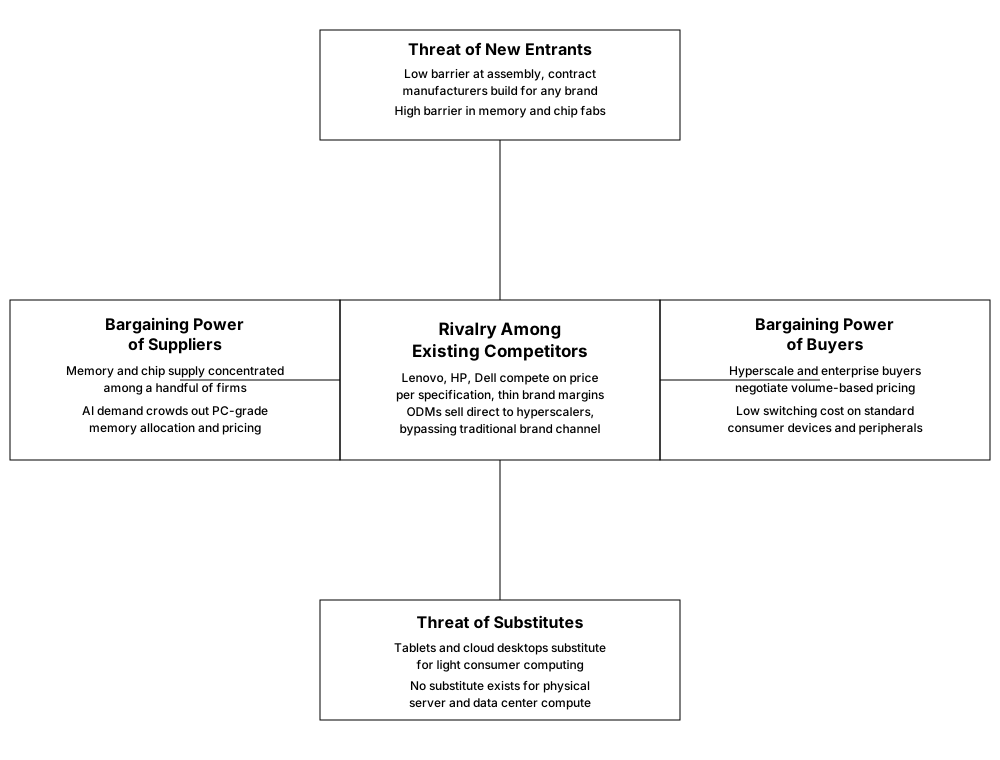
Industry structure in computer hardware is best understood through the five forces that shape competitive intensity and profit capture across the chain. Buyer power is substantial and rising because large enterprise and retail buyers can multi-source across several credible brands. Supplier power is even stronger, concentrated in a small number of memory, processor and display makers who can restrict output and dictate terms, as the 2026 shortage demonstrated starkly. Rivalry among branded assemblers is intense and margin-compressing, while new entrants face high barriers at the component level but low barriers at the assembly and brand level, a split that explains why so many niche PC brands exist despite thin unit economics. Substitutes exist unevenly, strong in some segments such as tablets displacing laptops for light use and weak in others such as servers, where no viable substitute exists for physical compute capacity.
Bargaining power of buyers
Buyers in computer hardware range from individual consumers purchasing a single laptop to hyperscale cloud operators procuring tens of thousands of servers a year and their bargaining power varies sharply across that range. Large enterprise and government buyers negotiate aggressively on price, service terms and customization and their purchasing volumes give them real leverage over brands competing for multi-year fleet contracts. Retail consumers individually carry little power, but aggregated demand through large retailers and e-commerce platforms transmits similar pressure back to manufacturers, who must meet price points set by comparison shopping. Component-level price transparency, driven by benchmarking sites and specification comparisons, has made it easy for any buyer segment to evaluate whether a premium price reflects genuine performance or brand markup, further compressing the room manufacturers have to charge above commodity levels. Switching costs for buyers are generally low for standard PCs and peripherals, since Windows and most peripheral standards work interchangeably across brands, though switching costs rise for specialized workstations, proprietary server architectures and large enterprise fleets tied to specific management software. The 2026 memory shortage has, paradoxically, strengthened supplier power more than it has weakened buyer power, because buyers facing higher prices across every brand cannot easily escape the cost increase by switching, they can only decide whether to defer purchases altogether.
| Buyer segment | Typical leverage | What drives it |
|---|---|---|
| Hyperscale and cloud data centers | Very high | Massive multi-year server volumes negotiated directly with ODMs |
| Enterprise IT and government procurement | High | Fleet-scale contracts, competitive bidding, long relationships |
| Large retailers and e-commerce platforms | Moderate to high | Aggregated consumer demand and shelf-space control |
| Individual consumers | Low | Price comparison tools but no volume leverage |
| Small and medium businesses | Low to moderate | Some negotiating room through value-added resellers |
Bargaining power of suppliers
Suppliers hold the strongest position of any force in this industry and the 2026 memory crisis is the clearest possible illustration of why. Dynamic random access memory and NAND flash production concentrate among three companies, Samsung, SK Hynix and Micron, who together control the overwhelming majority of global supply and when Artificial Intelligence infrastructure demand pulled fabrication capacity toward high-bandwidth memory, conventional memory supply tightened enough to push DRAM contract prices up by roughly 90 percent to 95 percent quarter over quarter and NAND flash prices up by a comparable amount within a single quarter of 20262. Processor supply carries similar concentration, with a small number of firms controlling central and graphics processing unit design and an even smaller number controlling advanced fabrication. Display panel supply, dominated by a handful of Korean, Chinese and Taiwanese manufacturers, shows less acute concentration but still enough to influence laptop and monitor pricing during cyclical shortages. Component suppliers can and do allocate scarce output preferentially to the highest-margin customers, typically data center and AI infrastructure buyers, leaving consumer PC and peripheral makers to absorb price increases they cannot fully pass through without losing volume. This dynamic has persisted through multiple cycles over the past two decades and each time, hardware assemblers have emerged with weaker relative bargaining position than the component makers who supply them.
| Supplier category | Concentration | Leverage over assemblers |
|---|---|---|
| Memory (DRAM and NAND) | Very high, three dominant firms | Extreme during shortage cycles |
| Processors (CPU and GPU) | High, few credible alternatives | High, especially for AI-capable silicon |
| Display panels | Moderate to high | Moderate, cyclical |
| Contract assembly and ODM capacity | Moderate | Low to moderate, brands can multi-source |
| Passive components and casings | Low | Low, largely commoditized |
Rivalry among existing competitors
Rivalry in the branded PC and server segment is intense, sustained by low switching costs for buyers, minimal product differentiation on core specifications and constant price competition. Lenovo, HP and Dell together account for a majority of global personal computer shipments, with Lenovo holding roughly 27 percent global share and HP close behind at around 21 percent and the gap between the top players and mid-tier competitors such as Acer, ASUS and Apple continues to narrow on volume even as it widens on margin3. In servers, competition splits between traditional branded vendors such as Dell, HPE and Lenovo and the original design manufacturers, led by Foxconn, that increasingly sell directly to hyperscale cloud operators without a brand intermediary, a channel shift that is quietly eroding the branded vendors' historical advantage. Price competition remains the primary lever because most buyers evaluate hardware on specification-per-dollar rather than brand loyalty, which forces manufacturers to compete on procurement efficiency and manufacturing scale rather than premium positioning, with rare exceptions such as Apple's integrated ecosystem. Rivalry intensifies further during component shortages, since brands unable to secure allocation lose shelf presence and market share to competitors with deeper supplier relationships, turning procurement into as much a competitive weapon as product design.
| Competitive dimension | Intensity | Primary battleground |
|---|---|---|
| Personal computer brands | High | Price per specification, retail channel presence |
| Enterprise server vendors | High | Total cost of ownership, service contracts |
| ODM direct-to-hyperscaler sales | Rising | Volume pricing, custom design for AI racks |
| Peripheral and accessory brands | Moderate | Feature differentiation, ecosystem lock-in |
| Premium and workstation segment | Lower | Performance, reliability, brand trust |
Threat of new entrants
Entry barriers vary enormously by value chain position, which is the single most important fact for anyone assessing this force. Building a new memory or advanced processor fabrication facility requires tens of billions of dollars and multiple years, effectively closing that layer to new entrants outside of state-backed industrial policy efforts. Assembling and branding finished PCs, by contrast, requires comparatively little capital because contract manufacturers in Taiwan, China and Vietnam will build to specification for any brand willing to commit to volume, which is exactly how newer entrants such as Framework have entered the market despite lacking their own factories. Brand trust and distribution access form a subtler barrier, since retailers and enterprise procurement teams favor established names with proven support infrastructure and building that trust takes years even when manufacturing itself is outsourced. Working capital requirements present another real barrier, because hardware brands must finance inventory and component purchases months ahead of revenue recognition, a burden that intensifies precisely when component prices spike, as they did through 2026. Niche entry remains genuinely viable in specialized categories such as ruggedized computing, repairable design or vertical-specific workstations, where smaller volumes and higher willingness to pay offset the scale disadvantage against Lenovo, HP and Dell.
| Entry factor | Barrier level | Notes |
|---|---|---|
| Component fabrication (memory, advanced chips) | Very high | Multi-billion-dollar fabs, years-long lead times |
| Finished device assembly | Low | Outsourced to contract manufacturers |
| Brand trust and enterprise channel access | Moderate to high | Years to build, critical for large contracts |
| Working capital for inventory | Moderate | Intensifies during component price spikes |
| Niche or vertical-specific hardware | Low to moderate | Viable entry path with differentiated design |
Threat of substitutes
Substitution pressure differs sharply by segment. Tablets and smartphones substitute for laptops in light consumer and some business use cases, a trend that flattened PC replacement demand through much of the previous decade before enterprise and AI-driven refresh cycles partially reversed it. Cloud-hosted virtual desktops substitute for locally owned computing power in some enterprise contexts, letting organizations shift capital spending on physical devices toward operating expenditure on cloud infrastructure, though this substitution still requires an underlying physical device to access the cloud service. In servers, no meaningful substitute exists for physical compute capacity, since cloud computing itself runs on server hardware rather than replacing the need for it, which is precisely why server demand has stayed resilient even as consumer PC volumes contract. Printers face substitution pressure from digital documents and cloud storage, a long-running secular decline that predates the current cycle. Peripheral categories such as monitors and keyboards face limited substitution risk because they remain necessary complements to any computing device regardless of form factor. On balance, substitution threat is moderate and concentrated in consumer-facing categories, while enterprise and infrastructure hardware remains largely insulated.
| Segment | Substitute | Threat level |
|---|---|---|
| Consumer laptops | Tablets and smartphones | Moderate |
| Enterprise desktops | Cloud-hosted virtual desktops | Low to moderate |
| Servers and data center hardware | None viable | Low |
| Printers | Digital documents and cloud storage | High |
| Monitors, keyboards and peripherals | None viable | Low |
Value chain and profit pools
The computer hardware value chain runs through six identifiable stages, each with a distinct economic profile. Upstream component supply, covering memory, processors, displays and passive components, sits closest to raw materials and semiconductor fabrication and it commands the highest bargaining power and, during tight cycles, the highest margins in the entire chain. Design and engineering, whether performed in-house by brands such as Apple or Dell or outsourced to Taiwanese original design manufacturers, translates components into a finished product architecture and represents a moderate-margin, intellectual-property-intensive stage. Assembly and manufacturing, dominated by contract manufacturers such as Foxconn, Quanta, Compal and Wistron, converts designs into physical units at enormous volume but on razor-thin margins historically in the low single digits4, though margins improve meaningfully for manufacturers building high-value AI server racks.
Distribution and logistics, covering freight, warehousing and channel partners, adds modest but essential margin and has grown more complex and costly as brands diversify manufacturing geography to manage tariff exposure. Customer interface, spanning retail, e-commerce, direct sales and value-added resellers, captures variable margin depending on whether the seller controls the brand relationship directly or resells another company's product, with direct-to-consumer channels generally preserving more margin for the brand. Enabling infrastructure, including warranty and repair services, financing and enterprise support contracts, has become one of the more attractive profit pools in the chain because it monetizes the relationship after the initial hardware sale and carries service-like margins rather than manufacturing-like margins.
Profit pool
Profit concentration in computer hardware has shifted decisively upstream over the past two decades and the 2026 memory shortage has only sharpened that pattern. Component suppliers, particularly in memory, now capture gross margins that can exceed 40 percent during supply-constrained periods, compared with mid-single-digit net margins typical of PC brand assemblers and even thinner margins for contract manufacturers handling standard consumer devices. This inversion, where the company closest to raw silicon earns more than the company whose logo the customer actually sees, reflects the oligopolistic structure of memory and advanced chip fabrication set against the fragmented, price-competitive structure of device assembly.
A second profit pool has opened at the intersection of contract manufacturing and AI infrastructure, where firms such as Foxconn and Quanta earn materially better margins building custom AI server racks for hyperscale cloud operators than they ever earned building standard laptops, because these builds require closer engineering collaboration and carry less commoditized pricing. A third profit pool sits in enterprise services wrapped around hardware, warranty extensions, managed device programs and financing arrangements, where brands such as HP and Dell have deliberately built out service revenue precisely because it carries higher and more predictable margin than the underlying box. The overall direction of travel favors companies that either control scarce upstream inputs or that successfully attach recurring service revenue to an otherwise commoditized product and it penalizes companies that compete purely on assembled-unit price.
Industry economics and business models
Three business model patterns dominate computer hardware today. The asset-light brand model, practiced by companies such as HP, Dell and most consumer electronics brands, outsources manufacturing entirely to contract manufacturers while the brand focuses on design specification, marketing, distribution and customer relationships, preserving flexibility and lower fixed capital commitment at the cost of dependence on manufacturing partners it does not control. The vertically integrated model, practiced most visibly by Apple and increasingly by Lenovo through its ownership stakes in manufacturing, internalizes more of design, supply chain negotiation and even some manufacturing control, trading capital intensity for tighter quality control and stronger negotiating leverage with component suppliers.
The transactional-plus-services model layers recurring revenue onto a one-time hardware sale through extended warranties, managed fleet services, financing plans and, in a smaller but growing segment, hardware-as-a-service subscriptions where enterprises pay a monthly fee for devices that are refreshed, maintained and eventually replaced by the vendor. This model appeals to enterprise buyers seeking predictable operating expenditure and appeals to vendors because it smooths revenue and deepens the customer relationship beyond a single purchase decision. A fourth, more specialized pattern applies to original design manufacturers, who operate a pure build-to-order model, carrying design and engineering cost but transferring brand risk and demand forecasting responsibility to the companies that commission their work.
Cost drivers and scalability
Cost structure in computer hardware skews heavily toward variable, component-driven costs rather than fixed manufacturing overhead, because most brands outsource the capital-intensive parts of production. Components, chiefly memory, storage, processors and displays, typically represent the largest single cost category for a finished device, often exceeding half of total unit cost, which is exactly why the 2026 memory price surge of 90 percent to 130 percent has forced device makers to raise consumer prices by 15 percent to 20 percent just to preserve already-thin margins5. Labor cost, concentrated in contract manufacturing facilities across Asia, remains modest relative to component cost but has been rising as manufacturers diversify away from China toward higher-wage locations such as Vietnam and Mexico in response to tariff policy.
Economies of scale operate powerfully in procurement, since larger buyers of memory, processors and displays negotiate meaningfully better unit pricing and, more importantly, better allocation priority during shortages, which explains why scale leaders such as Lenovo, HP and Dell weather component crunches more comfortably than smaller competitors. Economies of scope appear in shared component platforms across product lines and in shared distribution and service infrastructure, letting a single logistics and support network serve laptops, desktops and peripherals simultaneously. Unit economics hinge on inventory velocity and working capital efficiency more than on any single margin line, because hardware brands must commit cash to component purchases and finished inventory well ahead of sale and a slow-moving inventory position becomes acutely dangerous when component prices are falling, or acutely painful for the companies caught without adequate stock when prices are rising, as many were entering 2026.
Moats, advantages and strategic levers
Durable advantage in computer hardware rarely comes from the finished product itself, since specifications commoditize quickly and buyers compare them openly. It comes instead from three sources further up or further out from the box. Contracted access to scarce components, secured through long-term supply agreements or, in Apple's case, prepaid capacity commitments with fabrication partners, functions as a genuine moat because it guarantees supply and price stability precisely when competitors face allocation cuts and spot-market price spikes. Scale in procurement and logistics compounds this advantage, since the largest buyers extract better terms and faster allocation from component suppliers than smaller rivals can, a gap that widens rather than narrows during shortage cycles.
Switching costs matter more at the enterprise level than the consumer level, built through fleet management software, standardized configurations and long-term service contracts that make migrating thousands of devices to a competing brand operationally painful even when the competing brand's hardware is comparable or cheaper. Brand and ecosystem integration provide a narrower but potent moat for companies such as Apple, whose hardware, software and services reinforce one another closely enough that customers rarely evaluate components in isolation the way they do for Windows-based PCs. Design and repairability differentiation, still a minority strategy, is emerging as a genuine lever for a small set of competitors targeting sustainability-conscious enterprise and government buyers who increasingly weigh total lifecycle cost and e-waste obligations in procurement decisions.
The company that owns the supply contract owns the margin, not the company that owns the shelf space
Strategic levers
Five levers determine competitive outcomes for both incumbents and entrants in this industry. Customer segment focus separates companies chasing high-volume, low-margin consumer retail from those concentrating on enterprise, government or data center customers, where contracts run longer, pricing carries more discipline and relationships compound over multiple refresh cycles. Vertical integration versus partnering determines how much manufacturing, component sourcing and even chip design a company controls directly, trading capital intensity for negotiating leverage and quality control, a trade-off Apple has made aggressively and most Windows-based brands have avoided.
Supply contract depth, meaning the degree to which a company has locked in multi-year pricing and volume commitments with memory and processor suppliers rather than relying on the spot market, has become one of the clearest differentiators of resilience through the 2026 shortage, separating brands that absorbed cost shocks predictably from those forced into disruptive price increases. Geographic manufacturing diversification, spreading assembly across China, Vietnam, India and Mexico rather than concentrating in a single country, reduces tariff and geopolitical exposure at the cost of some coordination complexity and near-term efficiency loss. Ecosystem and services orchestration, wrapping hardware sales in financing, managed services, extended support and, for some categories, subscription refresh programs, converts a one-time transactional relationship into a recurring one and improves both margin and customer retention over the life of the account.
Structural risks, regulation and trends
Several structural risks bear directly on strategy in this industry and none of them are cyclical noise that will simply pass. Commodity price risk, made vivid by the 2026 memory shortage, remains the most immediate threat to margin, since memory and storage pricing is set by a concentrated supplier base responding primarily to AI infrastructure demand rather than to conditions in the PC or peripheral market6. Geopolitical and supply chain risk runs deep, given that advanced semiconductor fabrication concentrates in Taiwan and South Korea, both sitting near active geopolitical tension, while final assembly concentrates in China, exposing every major hardware brand to tariff policy shifts and export control changes with little notice. Regulatory risk is rising steadily through right-to-repair legislation, e-waste and extended producer responsibility rules and data security requirements attached to government procurement, all of which raise compliance cost but also open competitive opportunity for companies willing to build repairable, longer-lived hardware ahead of the regulatory curve.
Demand-side trends are reshaping the industry's center of gravity. Enterprise and AI infrastructure demand for servers is growing far faster than consumer PC demand, which is contracting for the first time in years, projected to fall roughly 10 percent in 2026 alone as memory-driven price increases push consumers to defer purchases7. Supply-side trends point toward diversified manufacturing geography, deeper vertical integration among the largest brands and a slow but real shift toward repairable, modular hardware design driven by both regulation and total-cost-of-ownership pressure from large enterprise buyers.
The strategic playbook diverges for entrants and incumbents. Entrants succeed by choosing a narrow, defensible niche, ruggedized devices, specialized workstations, repairable consumer hardware or vertical-specific enterprise gear, rather than competing head-on in commoditized consumer PCs and by partnering with existing contract manufacturers rather than building capital-intensive factories of their own. Regulatory strategy for entrants means getting ahead of right-to-repair requirements rather than reacting to them, since early compliance can become a marketing and procurement advantage with government and enterprise buyers. Incumbents, meanwhile, defend position by deepening long-term supply contracts to insulate margin from the next commodity shock, expand by shifting revenue mix toward enterprise services and data center hardware where pricing power is stronger and deepen moats by investing in proprietary design, sustainability credentials and fleet management software that raises switching costs for their largest customers.
Caselet: Framework Computer and the repairability bet
Framework Computer, founded in 2019 by former Oculus hardware engineer Nirav Patel, set out to prove that a mainstream laptop could be genuinely modular and repairable without sacrificing the performance or design quality that consumers expect from premium competitors. The company ships every laptop with a small screwdriver and spudger tucked inside the box, the only tool needed to remove and replace the screen, battery, keyboard, ports and even the mainboard and every component carries a QR code linking to step-by-step repair instructions8. The lineup now spans 12-inch, 13-inch and 16-inch models, each configurable with swappable ports, memory and storage that buyers can upgrade years after purchase rather than replacing the entire device.
This design philosophy sits directly against the dominant trend in the rest of the industry, where soldered memory, glued batteries and sealed chassis have become standard because they reduce manufacturing cost and thickness while making repair difficult or impossible outside authorized service centers. Framework's operating model outsources assembly to contract manufacturers, consistent with the asset-light pattern common across the industry, but differs sharply in its component sourcing philosophy, since the company designs every part to remain individually replaceable and commits to selling replacement parts directly to consumers rather than routing all repairs through paid service channels.
The company's position illustrates several forces described earlier in this analysis working simultaneously. It demonstrates that entry barriers at the assembly layer remain genuinely low, since Framework built a credible laptop brand without owning a single factory, relying instead on the same contract manufacturing capacity available to any competitor. It demonstrates the growing relevance of regulatory strategy as a competitive lever, since right-to-repair legislation spreading across multiple jurisdictions has turned Framework's founding design principle from a niche preference into a compliance advantage that larger competitors are now scrambling to retrofit. It also illustrates the limits of differentiation in a scale-driven industry, since despite years of favorable press coverage and a loyal following among enthusiasts and sustainability-minded buyers, Framework most likely accounts for less than 1 percent of global laptop shipments, a reminder that a genuinely better design does not automatically translate into volume against entrenched, scale-advantaged incumbents9.
Framework's exposure to the same component economics that govern the rest of the industry has not disappeared simply because its design philosophy differs. The company still buys memory, processors and displays from the same concentrated supplier base as Lenovo, HP and Dell and the 2026 memory shortage pressures its component costs identically. What differs is the company's argument to its customers, that a repairable, upgradeable device reduces the frequency and total cost of replacement over a multi-year hold, a total-cost-of-ownership pitch that resonates increasingly with enterprise and government buyers facing both budget pressure and tightening e-waste regulation. Whether that pitch scales into meaningful share against companies with vastly larger procurement leverage remains the open strategic question the rest of the industry is watching closely, since if repairability proves commercially durable rather than a niche enthusiast preference, it represents one of the few product-level differentiators left in an otherwise heavily commoditized market.
Framework's trajectory also offers a broader lesson about where new entrants can realistically compete in computer hardware. It did not attempt to out-manufacture Lenovo or out-negotiate Samsung on memory pricing, contests it would certainly lose. It instead built a defensible position around a design philosophy that larger, scale-optimized competitors structurally struggle to copy without disrupting their own cost models, which is precisely the kind of narrow, asymmetric entry point that this analysis identifies as the more viable path into an industry otherwise dominated by procurement scale and thin assembly margins.
- 1Global Computer Hardware Market Size
- 2DRAM And NAND Price Surge In 2026
- 3Global PC Vendor Market Share
- 4Contract Manufacturer Operating Margins
- 5Memory Shortage Impact On Device Prices
- 6Global Memory Supply Shortage Background
- 7PC Shipment Decline Forecast For 2026
- 8Framework's Repairable Laptop Design
- 9Framework's Market Share Versus Mainstream Laptop Brands
Computer hardware sits at the physical foundation of digital economies, converting semiconductor and electromechanical inputs into machines that businesses, governments and consumers depend on daily. Its economics reward scale in procurement, discipline in working capital and proximity to enterprise and AI infrastructure demand far more than they reward brand alone. Margin concentrates in components, contract manufacturing at the AI-server edge and services wrapped around the box, not in the box itself. The strategic levers that matter now are supply contracting depth, vertical integration into design and repairability and portfolio tilts toward data center and enterprise buyers who pay for reliability and support rather than price alone.
Citation
Cite this article
Sridharan, M. A. (2023, November 1). Industry Analysis: Computer Hardware. Think Insights. https://thinkinsights.net/strategy/industry-analysis-computer-hardware (Accessed [[ACCESS_DATE]])
Sridharan, Mithun A. "Industry Analysis: Computer Hardware." Think Insights, 1 Nov. 2023, https://thinkinsights.net/strategy/industry-analysis-computer-hardware. Accessed [[ACCESS_DATE]].
Mithun A. Sridharan, "Industry Analysis: Computer Hardware," Think Insights, November 1, 2023, https://thinkinsights.net/strategy/industry-analysis-computer-hardware. Accessed [[ACCESS_DATE]].
Sridharan, M.A. (2023) 'Industry Analysis: Computer Hardware', Think Insights. Available at: https://thinkinsights.net/strategy/industry-analysis-computer-hardware (Accessed: [[ACCESS_DATE]]).
M. A. Sridharan, "Industry Analysis: Computer Hardware," Think Insights, 2023. [Online]. Available: https://thinkinsights.net/strategy/industry-analysis-computer-hardware. [Accessed: [[ACCESS_DATE]]].
Sridharan MA. Industry Analysis: Computer Hardware. Think Insights. Published November 1, 2023. Accessed [[ACCESS_DATE]]. https://thinkinsights.net/strategy/industry-analysis-computer-hardware
Test Your Knowledge
Industry Analysis: Computer Hardware
Challenge yourself on the concepts from this article and see how well you understood them.
Subscribers get weekly quizzes and insights — subscribe free
Sponsor this article
Partner with Think Insights
Reach 50,000+ business leaders, consultants, and strategists. Feature your brand alongside expert articles on strategy, leadership, and digital transformation.
Become a Sponsor