Industry Analysis: Computer Games


Publishers should stop chasing new franchise launches as the primary growth lever and instead prioritize live-service depth in existing intellectual property, because retention economics now outperform acquisition economics across the industry. The computer games sector, spanning PC, console and mobile development and publishing, generates roughly 200 billion dollars a year and touches nearly half the world's population as players. Distribution platforms and engine vendors, not studios, capture the most durable margin, since they collect a toll on every transaction regardless of which title wins. Bargaining power is shifting toward players and content creators, who now decide a title's commercial fate within days of launch and away from publishers that once controlled marketing narratives. Executives allocating capital into this sector should favor live-service and platform-adjacent plays over one-off content bets.
Is the computer games industry attractive for new entrants?
Attractiveness depends heavily on segment choice. Mobile free-to-play development remains open to small teams because engines and app store distribution are cheap and self-service, though user acquisition costs have climbed sharply and organic discovery is scarce. AAA console and PC development, by contrast, requires capital in the hundreds of millions of dollars and multi-year development cycles, making it a poor fit for anyone without existing franchise equity or platform backing. The more attractive entry points sit adjacent to content creation, such as tools, middleware or live-service infrastructure, where margins are less dependent on any single title's commercial success.
Which parts of the value chain are most profitable?
Platform storefronts and engine providers capture the most consistent margin because they earn a percentage of nearly every transaction without carrying development risk. Live-service publishers with entrenched player bases, such as those running long-running multiplayer titles, also generate high returns once a title reaches steady state, since incremental content costs far less than the original build. Independent development studios without owned intellectual property capture the least value, because they typically work on contract or royalty terms set by better-capitalized publishers.
How is technology changing this industry?
Generative Artificial Intelligence tools are compressing the cost of asset production, from character models to dialogue and localization, letting smaller teams approach visual fidelity once reserved for hundred-million-dollar budgets. Cloud streaming is decoupling play from hardware ownership, though its commercial traction has lagged early predictions. Engine consolidation around a handful of dominant platforms has simultaneously lowered technical barriers to entry and concentrated a new layer of toll-collecting infrastructure above the studios themselves.
What capabilities are table stakes vs differentiators?
Competent use of a mainstream engine, cross-platform build pipelines and basic live operations tooling are table stakes that every serious studio now needs simply to compete for shelf space. Differentiators lie in original intellectual property with cross-media potential, data-driven live-service design that sustains engagement for years rather than months and community management capable of converting player sentiment into retention rather than backlash. Studios that treat community and data science as core disciplines, not support functions, consistently outperform peers on player lifetime value.
How should investors or consultants evaluate opportunities here?
Evaluate any target on the durability of its player relationships rather than the quality of its most recent release, since hit-driven revenue is inherently volatile and a poor basis for valuation multiples. Look for evidence of owned intellectual property, diversified platform exposure and a live-service or subscription revenue mix that reduces dependence on any single launch. Consultants advising publishers should also weight regulatory exposure around loot boxes and platform antitrust litigation, since both are actively reshaping monetization rules and distribution economics in real time.
What separates a hit from a commercial failure in this industry?
Production quality alone rarely explains the gap; distribution timing, marketing spend relative to genre saturation and word-of-mouth velocity in the first 72 hours after launch typically matter more. Many well-reviewed titles fail commercially because they launch into a crowded release calendar or lack a community-building period before release. Conversely, titles with modest budgets have succeeded by building visible communities on streaming and social platforms months ahead of launch, converting attention into day-one sales momentum.
Why do so many game studios get acquired rather than stay independent?
Independent studios face a structural cash flow mismatch: development cycles run two to five years with no revenue, while overhead, especially senior engineering and art talent, accrues monthly regardless of a title's eventual success. Publishers and platform owners offer capital certainty and distribution reach in exchange for equity or outright ownership, which is attractive to founders after one or two successful but financially exhausting release cycles. This dynamic has driven persistent consolidation, with a small number of publishers now controlling a disproportionate share of the top-grossing catalog.
How does mobile monetization differ from premium console and PC pricing?
Mobile titles overwhelmingly rely on free-to-play access paired with in-app purchases, where a small share of players, often called high-value spenders, generate the majority of revenue for any given title. Console and PC titles increasingly blend an upfront purchase price with downloadable content and seasonal passes, borrowing mobile's retention mechanics without abandoning the initial transaction entirely. This convergence means the meaningful distinction is no longer platform but business model, with pure premium, one-time-purchase titles becoming a shrinking minority of new releases.
What role does esports play in the broader industry's economics?
Esports functions as a marketing and retention layer for a handful of highly competitive multiplayer titles rather than an independent profit center in its own right, since most competitive leagues and tournament organizers operate at a loss or thin margin. Its real value to publishers lies in extending a title's cultural relevance and community engagement well beyond a typical content cycle, which supports the underlying live-service revenue. Treating esports as a standalone business line, rather than a demand-generation tool for a title's core economics, has been a recurring source of financial disappointment for publishers.
Where is regulatory risk concentrated in this industry?
Regulatory attention currently concentrates on loot box and randomized monetization mechanics, which several jurisdictions have classified as gambling-adjacent and subject to disclosure or age-gating requirements and on platform antitrust behavior tied to app store commission structures. Data privacy rules affecting younger players add a second layer of compliance cost, particularly for mobile titles with large under-18 audiences. Studios operating across multiple jurisdictions increasingly need dedicated compliance functions that most treated as an afterthought a decade ago.
Computer games occupy an unusual position in the modern economy: a creative medium that behaves, financially, like enterprise software. A studio writes code once and can sell it, license it or monetize it continuously to hundreds of millions of people with almost no incremental cost per additional player. That structural advantage draws capital from private equity, sovereign wealth funds and technology conglomerates that see gaming less as entertainment and more as a durable, high-margin distribution channel into consumer attention. Understanding how this industry actually creates and captures value, rather than how it is popularly portrayed through headline blockbuster releases, matters for anyone allocating capital, advising on transactions or setting strategy inside a media or technology portfolio.
Industry at a glance
The computer games industry covers the development, publishing and distribution of interactive software played on personal computers, consoles and mobile devices, along with the platforms, engines and monetization systems that support those titles. It excludes traditional tabletop and card games, sports betting and pure hardware manufacturing, though console makers such as Sony and Microsoft sit inside the industry's boundary because their storefront and services businesses function as publishing platforms. Esports, the organized competitive play of existing titles, is treated here as a demand-generation segment layered on top of core titles rather than a separate industry, since its revenue pools remain small relative to the underlying games it promotes.
Customers span three distinct groups with different economics. Individual consumers, the business-to-consumer (B2C) core of the industry, account for the overwhelming majority of revenue through purchases, subscriptions and in-game transactions. A smaller business-to-business (B2B) layer exists around engine licensing, middleware and outsourced development services sold between studios and vendors. Government and public-sector demand, the business-to-government (B2G) slice, is marginal and largely confined to simulation and training software adapted from commercial game engines, a niche adjacent to but distinct from the consumer industry proper.
The global games market generated roughly 201.6 billion dollars in 2025, an increase of about 9.1% over the prior year, with mobile contributing the largest share at approximately 103 billion dollars, or 55% of the total, followed by console at 45.9 billion dollars and personal computer [PC] gaming at 39.9 billion dollars.1 The worldwide player base reached an estimated 3.6 billion people in 2025, meaning close to half of humanity engages with interactive software in some form, a reach few other entertainment categories can claim. Revenue models split broadly between upfront purchase, subscription access and free-to-play with in-game purchases, with the latter now dominant across mobile and increasingly present even in traditionally premium console and PC releases.
Capital intensity varies enormously by segment. A top-tier console or PC title from a major publisher now routinely costs between 100 million and 300 million dollars to develop and market, rivaling mid-budget feature films, while a mobile free-to-play title can reach market for a few hundred thousand dollars, though sustaining it against user-acquisition costs afterward often costs far more than the build itself. Labor intensity is high and specialized, with engineering, art, design and increasingly data science and live-operations talent all in persistent short supply relative to demand. Regulatory intensity has risen from a low base, driven by loot box and gambling-adjacent monetization scrutiny, data privacy rules protecting minors and antitrust actions targeting platform commission structures, though the industry remains far less regulated than adjacent sectors such as financial services or broadcasting.
Industry segmentation
The industry divides most usefully along value chain position and platform, since those two dimensions explain most of the variance in economics, cycle times and competitive intensity. Development studios sit at the creative and technical core, ranging from independent teams of a handful of people to internal studios inside publishers employing thousands. Publishers finance, market and distribute titles and increasingly own the studios that make them, a shift that has consolidated creative and commercial decision-making under fewer roofs than a decade ago. Platform storefronts, including console makers' digital stores, PC distribution services and mobile app stores, control discoverability and take a commission on nearly every transaction that passes through them. Engine and middleware providers supply the underlying technology stack that studios build on, occupying a position closer to enterprise software vendor than entertainment company. A fifth segment, live-service operators, has emerged as titles increasingly function as ongoing platforms rather than shipped products, requiring dedicated teams for content updates, community management and monetization tuning long after initial release.
Platform, the more commonly cited dimension, splits the market into mobile, console and PC, each with distinct customer demographics, monetization norms and competitive structures. Mobile skews toward casual and mid-core players, relies almost entirely on free-to-play mechanics and is dominated by a small number of publishers who have mastered user-acquisition economics at scale. Console gaming concentrates around three hardware ecosystems, each functioning as a closed platform with its own certification, discovery and monetization rules and favors narrative-driven and multiplayer titles sold at premium prices with growing downloadable content attachment. PC gaming sits between the two, historically the home of the most technically demanding titles and modding communities, now increasingly served by the same free-to-play and live-service models that built mobile's economics. A useful fourth lens, business model, cuts across all three platforms:
premium one-time purchase, subscription access to a title library and free-to-play with microtransactions each carry fundamentally different customer acquisition and retention economics regardless of which hardware a player uses
Market structure
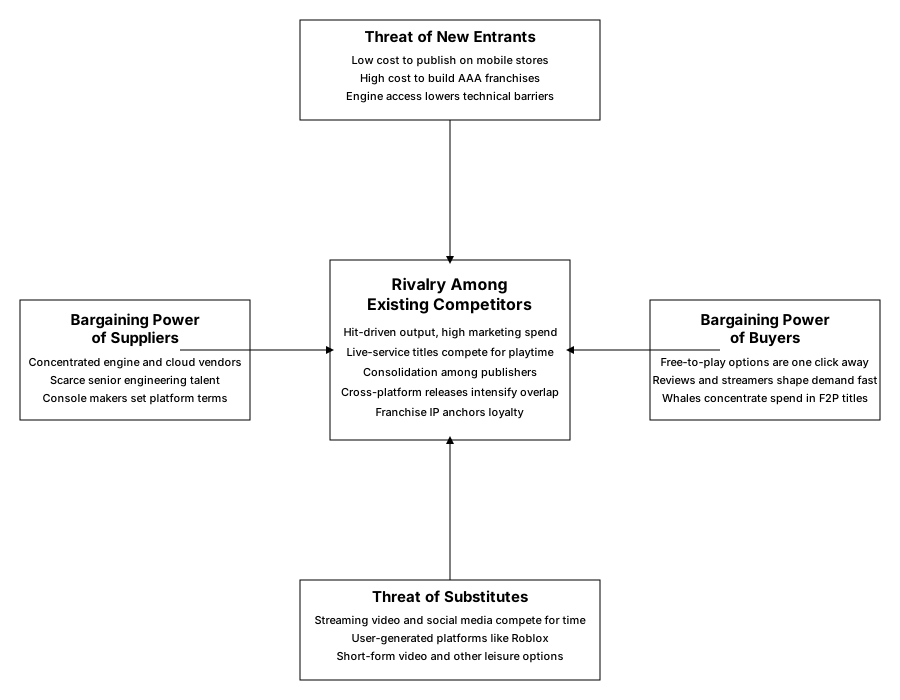
Five structural forces shape competitive intensity and profit capture across the games industry and they interact in a distinctive way here because the same companies often occupy multiple roles simultaneously, as both competitor and gatekeeper. A console maker, for instance, competes with third-party publishers for player time while also taking a commission on those publishers' sales through its own storefront, a dual role that concentrates power in ways rarely seen in less vertically entangled industries.
Bargaining power of buyers
Player bargaining power has grown substantially over the past decade, driven by the near-zero switching cost of abandoning one free-to-play title for another and by the transparency that review aggregators, streamers and social platforms now provide before a purchase decision is made. A poorly received launch can be identified and broadcast within hours, compressing the window publishers once had to correct course through patches before reputational damage set in. At the same time, buyer power is not uniform:
within free-to-play titles, a small cohort of high-spending players, sometimes called whales, generates a disproportionate share of revenue and effectively subsidizes the free experience of everyone else, giving that narrow segment outsized influence over monetization design decisions
Premium console and PC buyers retain meaningful power through pre-release information availability, since demo periods, press coverage and community sentiment ahead of launch allow informed purchase timing, including waiting for price reductions or bundled editions. Subscription services have partially reduced per-title buyer power by shifting the purchase decision from individual titles to a platform-level commitment, though this trades one form of buyer leverage for another, since subscribers can cancel entirely if perceived value declines. Corporate and licensing buyers, such as companies purchasing engine licenses or middleware, negotiate more traditional enterprise contracts with meaningful leverage tied to deal size and multi-year commitments.
| Buyer segment | Switching cost | Price sensitivity | Influence mechanism |
|---|---|---|---|
| Free-to-play casual players | Very low | High | Abandon title for a competing app instantly |
| High-spending free-to-play players | Low | Low on preferred title | Concentrated spend gives design influence |
| Premium console and PC purchasers | Moderate | Moderate | Wait for reviews, sales or bundles |
| Subscription service members | Low to moderate | High at renewal | Cancel if perceived catalog value falls |
| Enterprise engine and middleware licensees | High once integrated | Moderate | Multi-year contract negotiation leverage |
Bargaining power of suppliers
Supplier power concentrates around a small number of critical inputs: game engines, cloud infrastructure, console platform access and specialized senior talent. Two engine providers effectively set the technical foundation for a large share of the industry's output, giving them meaningful pricing and policy power over royalty structures and feature access, a dynamic that became publicly contentious when one major engine attempted a retroactive runtime fee change that developers viewed as a unilateral rewrite of the economic relationship.2 Cloud infrastructure providers similarly hold leverage over live-service publishers who depend on their compute and storage for persistent online titles, though multi-cloud strategies have modestly diluted this concentration.
Console platform holders function as suppliers of a different kind, controlling the certification, discoverability and commercial terms that third-party publishers must accept to reach their hardware's installed base. This gives them leverage disproportionate to a typical supplier relationship, since refusal to comply effectively forecloses access to tens of millions of potential customers. Talent, particularly senior engineering, technical art and live-operations expertise, remains persistently scarce relative to demand, giving skilled individuals and specialized outsourcing studios meaningful wage and project-selection leverage, especially in competitive labor markets concentrated around a handful of global development hubs.
| Supplier category | Concentration | Switching difficulty | Leverage source |
|---|---|---|---|
| Game engine providers | High | High once a title is built | Sets royalty terms and technical roadmap |
| Cloud and server infrastructure | Moderate to high | Moderate | Critical for live-service uptime |
| Console platform holders | High | Very high | Controls certification and store access |
| Senior engineering and art talent | Low supply relative to demand | High | Wage premiums and project selectivity |
| Voice, music and licensed IP partners | Moderate | Moderate | Contract terms tied to title's commercial risk |
Rivalry among existing competitors
Competitive rivalry is intense and structurally hit-driven, since a small number of top-selling titles capture a disproportionate share of both revenue and player attention in any given release window, while the majority of titles underperform their budgets. This dynamic pushes publishers toward heavy marketing spend concentrated around launch, sequel-driven franchise strategies that de-risk creative bets and an arms race in production values that has steadily raised the capital required to compete at the top tier. Consolidation has reduced the number of major publishers capable of financing AAA-scale titles, most visibly through Microsoft's 69 billion dollar acquisition of Activision Blizzard, the largest transaction in the industry's history, which concentrated several of the medium's most durable franchises under a single corporate owner.3
Live-service titles have shifted the nature of rivalry from competing for a purchase decision to competing for ongoing player time, since a successful live-service game effectively removes its most engaged players from the addressable market for competing titles for months or years at a stretch. This has made player retention, rather than unit sales alone, the primary battleground among the largest publishers and has pushed content update cadence and community management into core competitive disciplines rather than post-launch afterthoughts. Cross-platform releases, now standard practice for most major titles, have simultaneously widened the addressable audience for any given release and intensified direct competition, since titles no longer compete only within a single hardware ecosystem but across the entire player base regardless of device.
| Competitive dimension | Intensity | Primary driver | Typical response |
|---|---|---|---|
| AAA franchise releases | High | Concentrated hit-driven revenue | Sequel and franchise-extension strategy |
| Live-service player retention | Very high | Ongoing engagement determines lifetime value | Continuous content and season pass cadence |
| Mobile free-to-play acquisition | High | Rising user-acquisition cost per install | Aggressive performance marketing spend |
| Cross-platform release competition | Rising | Shared audience across hardware ecosystems | Simultaneous multi-platform launches |
| Independent and mid-budget titles | Moderate | Niche audience differentiation | Distinct creative positioning over budget scale |
Threat of new entrants
Entry barriers vary sharply by segment rather than applying uniformly across the industry. Mobile and PC indie development carry genuinely low technical barriers, since mainstream engines are available free or at low cost until a title generates meaningful revenue and self-publishing through app stores or PC storefronts requires no gatekeeper approval beyond basic content standards. This has produced a steady stream of new studios and titles, most of which fail commercially due to discoverability challenges rather than production quality, since app stores and storefronts list far more titles than any player can realistically evaluate.
AAA console and PC development, by contrast, presents formidable barriers, requiring capital in the hundreds of millions of dollars, multi-year development timelines and access to console certification processes that favor established publisher relationships. New entrants at this tier almost always arrive through acquisition of an existing studio or through backing by a well-capitalized publisher or technology company, rather than organic bootstrap growth, since the cash flow gap between development spend and revenue realization is simply too large for most independent operators to bridge. Generative Artificial Intelligence tools are gradually narrowing this gap by compressing asset production costs, potentially allowing smaller, better-capitalized teams to approach production values once exclusive to the largest studios, though this shift remains early and unevenly distributed across genres.
| Entry pathway | Capital requirement | Typical barrier | Trend |
|---|---|---|---|
| Mobile and PC indie self-publishing | Low | Discoverability, not production cost | Increasingly saturated |
| AAA console and PC development | Very high | Capital, multi-year timelines, certification | Consolidating toward fewer new entrants |
| Acquisition-led entry by technology firms | High | Requires buying existing studio capability | Active, driven by platform strategy |
| Engine and middleware vendors | Moderate to high | Requires broad developer adoption | Concentrated among incumbents |
| AI-tooling-enabled small studios | Low to moderate | Compressed asset production cost | Emerging and expanding |
Threat of substitutes
Substitution risk comes less from other forms of interactive software and more from the broader competition for discretionary leisure time, since games ultimately compete against streaming video, social media, short-form content and other entertainment categories for a finite pool of hours. This competition has intensified as short-form video platforms have proven capable of absorbing attention in the exact micro-session windows, such as commutes or brief breaks, that mobile games once claimed almost exclusively. User-generated content platforms represent a more direct structural substitute, since platforms allowing players to build and monetize their own experiences within a shared environment blur the line between playing a game and creating one, capturing both consumption and creation demand within a single product.
Cloud gaming and subscription libraries pose a more modest substitution threat to individual title purchases, since they substitute for a specific transaction rather than for gaming itself, redirecting spend toward platform subscriptions instead of discrete purchases. Traditional substitutes such as tabletop games, sports and other offline leisure activities remain present but have not meaningfully eroded the industry's growth trajectory, since digital and offline leisure appear to coexist within most consumers' time allocation rather than substitute directly for one another. The more consequential long-term substitution risk lies in the possibility that a future entertainment medium, potentially building on augmented or virtual reality, could redefine interactive entertainment altogether, though current adoption of those formats remains a small fraction of the core industry's scale.
| Substitute category | Directness of competition | Trend | Affected segment |
|---|---|---|---|
| Streaming video and short-form content | High | Growing, especially among younger players | Mobile and casual gaming |
| User-generated content platforms | High | Growing rapidly among younger demographics | Mobile and PC casual segments |
| Social media platforms | Moderate | Stable to growing | All platforms, attention competition |
| Traditional offline leisure activities | Low | Stable | Broad, minimal direct erosion |
| Emerging immersive media formats | Low today, uncertain long term | Early stage | Long-term structural watch item |
Value chain and profit pools
The industry's value chain runs from creative and technical inputs through production, distribution, the customer-facing experience and the infrastructure that underpins all of it. Upstream inputs include intellectual property, whether original or licensed, along with the engines, art tools and outsourced production services studios draw on to build a title. Production is the core development phase, where design, engineering, art and audio teams convert a concept into a playable product, typically spanning two to five years for a substantial title and requiring the tightest coordination of any stage in the chain. Quality assurance and localization, often treated as a sub-stage of production, have grown in importance as titles ship simultaneously across dozens of languages and regions rather than staggering international releases as was once standard practice.
Distribution has consolidated around a small number of digital storefronts that have almost entirely displaced physical retail, fundamentally changing the economics of reaching players, since digital distribution eliminates manufacturing and shelf-space constraints but introduces a persistent commission on every transaction. The customer interface stage, encompassing marketing, community management and live operations, has grown from a launch-adjacent function into an ongoing discipline that runs for the entire life of a title, particularly for live-service products where continuous engagement directly drives revenue. Enabling infrastructure, spanning cloud hosting, anti-cheat systems, payment processing and analytics, has become a specialized layer of its own, increasingly outsourced to dedicated vendors rather than built in-house even by large publishers.
Profit pool
Profit concentration in this industry has shifted decisively toward infrastructure and distribution over the past fifteen years, away from the studios that create the underlying creative content. Platform storefronts capture a commission, historically 30% and now under competitive and legal pressure in some cases, on nearly every digital transaction that flows through them, generating high-margin revenue with minimal marginal cost regardless of which specific titles succeed.4 This toll-collector position means storefront operators profit from industry-wide volume rather than from any individual title's creative success, insulating them from the hit-driven volatility that defines studio-level economics.
Engine providers occupy a similarly durable position, earning ongoing royalties across a broad base of licensees regardless of which individual titles built on their technology succeed commercially. Live-service publishers with entrenched, long-running titles capture outsized margin once a game reaches steady state, since incremental content updates cost far less than the original production investment while continuing to generate recurring revenue from an established player base. Development studios without owned intellectual property, working instead on contract or royalty terms set by publishers, sit at the opposite end of the profit pool, absorbing much of the industry's creative and financial risk while capturing the smallest share of its eventual returns. This asymmetry explains the persistent trend of successful independent studios either building owned franchises or accepting acquisition by better-capitalized publishers.
Industry economics and business models
Four business model patterns now dominate the industry and most large publishers operate several simultaneously rather than committing to a single approach. Premium, one-time purchase remains the traditional model, particularly for narrative-driven console and PC titles, though it increasingly incorporates downloadable content and expansion passes that extend revenue well beyond the initial sale. Free-to-play with in-game purchases dominates mobile and has spread substantially into PC and console, relying on a large free player base to generate engagement and social proof while a smaller paying cohort funds the majority of revenue, an asymmetric model that requires sophisticated behavioral and pricing analytics to sustain.
Subscription access, whether to a single title's ongoing content or to a broader library of games, has grown as publishers and platform holders seek more predictable recurring revenue than transaction-driven models provide, trading per-unit margin for retention stability. Two-sided platform economics apply most directly to storefronts and engine providers, who earn from both developers, through commissions or royalties and players, through subscriptions or direct purchases, giving them revenue diversification that single-sided studios lack. The industry's broader trajectory favors business models that convert a title from a discrete transaction into an ongoing relationship, since player lifetime value, when successfully cultivated, dwarfs the economics of a single purchase.
Cost drivers and scalability
Development cost is overwhelmingly fixed and front-loaded, concentrated in salaries for engineering, art and design teams that must be paid regardless of a title's eventual commercial performance, a structure that makes the industry inherently risky at the studio level despite low marginal distribution cost once a title ships. Marketing spend, increasingly weighted toward the launch window and the months preceding it, functions as a second major fixed cost that has risen steadily as competition for player attention has intensified, with user-acquisition costs in mobile free-to-play climbing to levels that now rival or exceed development budgets for some titles. Live-service titles convert some of this fixed-cost profile into an ongoing variable cost structure, since sustaining a title's content pipeline requires continuous investment tied to the size of the active player base being served.
Economies of scale operate strongly at the distribution and infrastructure layer, where a storefront or cloud provider's fixed technology investment spreads across an ever-larger transaction volume, but operate more weakly at the individual studio level, where a larger budget does not reliably translate into proportionally larger commercial returns given the hit-driven nature of consumer demand. Unit economics for free-to-play titles center on the relationship between customer acquisition cost [CAC] and player lifetime value [LTV], where a title becomes sustainably profitable only once average LTV meaningfully exceeds blended CAC across its full player cohort, a threshold that has grown harder to clear as acquisition costs rise across nearly every major platform. Successful live-service titles benefit from a genuine growth loop, where engaged players generate word-of-mouth and user-generated content that lowers acquisition cost for new players, creating a flywheel that compounds a title's advantage the longer it sustains an active community.
Moats, advantages and strategic levers
Defensibility in this industry rests less on any single technical advantage and more on a combination of owned intellectual property, entrenched player communities and platform positioning. Franchise intellectual property functions as the closest equivalent to a durable brand moat, since an established franchise carries built-in audience trust and lowers the marketing cost of each subsequent release relative to an unproven new title. Network effects operate powerfully within multiplayer and live-service titles, where a larger existing player base makes the experience more valuable to new and existing players alike, creating a self-reinforcing advantage that is difficult for a later entrant to replicate even with a technically superior product.
Switching costs, while generally low for free-to-play titles at the point of a single decision to try a competing game, rise substantially once a player has invested significant time, social connections and in-game progress or purchases into a specific title, a form of behavioral lock-in that publishers actively design for through progression systems and social features. Platform holders possess a distinct regulatory-adjacent moat rooted in their control over certification and storefront access, a form of structural gatekeeping that smaller competitors cannot replicate regardless of capital. Data and learning advantages compound over time for publishers running multiple live-service titles, since behavioral data on player spending, retention and churn patterns from one title informs monetization and content design decisions across an entire portfolio, a benefit that grows with the number and scale of titles a publisher operates simultaneously.
Strategic levers
Publishers and studios have several concrete levers available depending on their starting position and ambitions. Customer segment focus, choosing deliberately between mass-market casual audiences and dedicated core gaming audiences, shapes nearly every downstream decision from monetization model to marketing channel and attempting to serve both simultaneously within a single title frequently dilutes a product's design coherence. Product scope, deciding whether to build a single deep flagship title or a broader portfolio of smaller releases, trades concentration risk against diversification, with portfolio approaches better suited to publishers with the operational infrastructure to support multiple live-service titles at once.
Vertical integration versus partnering shapes control over the value chain, since publishers who own their distribution, whether through a proprietary storefront or direct-to-consumer sales, retain margin that would otherwise flow to a third-party platform, though building that infrastructure requires capital and scale most mid-sized studios lack. Geographic expansion remains a meaningful lever given how unevenly game consumption and monetization patterns vary across regions, with markets in Asia often monetizing free-to-play mechanics more heavily than Western markets, creating opportunities for publishers willing to adapt content and pricing regionally rather than applying a single global template. Ecosystem orchestration, building a title or platform that other developers build on top of, whether through user-generated content tools or licensing, offers the highest long-run leverage of any strategy, since it converts a publisher from a single content producer into a platform capturing value from an entire community of creators, though few companies possess the technical and community-management capability to execute this successfully.
Structural risks, regulation and trends
Structural risk in this industry clusters around four areas that deserve board-level attention rather than treatment as routine operational matters. Regulatory risk has intensified around loot boxes and other randomized monetization mechanics, which several jurisdictions now treat as gambling-adjacent, requiring disclosure of odds or outright restrictions on sale to minors, a trend likely to continue expanding into new markets rather than reverse. Platform antitrust exposure has become concrete rather than theoretical, evidenced by ongoing litigation challenging storefront commission structures and most-favored-nation pricing clauses that plaintiffs argue suppress competition among distribution platforms.5 Technology disruption risk centers on generative Artificial Intelligence's uncertain long-term effect on both production economics and creative differentiation, since tools that lower production cost for everyone simultaneously reduce the competitive advantage that capital-intensive production values once provided to well-funded incumbents. Geopolitical and supply chain risk, while less acute than in physical goods industries, still affects console hardware manufacturing and shapes market access, since several major markets maintain content approval regimes that can delay or block a title's release entirely.
Secular demand trends remain broadly favorable, with the global player base still expanding as gaming penetrates demographics and regions where smartphone access continues to grow and as gaming increasingly functions as a primary social and entertainment activity for younger generations rather than a niche hobby. Supply-side trends point toward continued platform and engine consolidation alongside a parallel proliferation of small independent studios enabled by cheaper production tools, a barbell dynamic that is squeezing mid-sized studios lacking either franchise scale or the agility of a small independent team. Cloud gaming, despite years of investment, has not yet achieved the transformative market share early predictions suggested, though it continues to expand steadily as a complementary access method rather than a wholesale replacement for local hardware.
Entry strategy for new participants should weight niche focus over broad competition, since attempting to compete directly against entrenched franchises with a first release is rarely viable, while a differentiated niche position, whether a specific genre, audience or platform, offers a more defensible foothold. Partnering with an established publisher for distribution and marketing, rather than attempting to build that capability independently, remains the more capital-efficient path for most new studios, reserving full vertical independence for teams that have already proven commercial traction. Incumbent strategy should center on deepening moats around existing franchises through sustained live-service investment, expanding into adjacent platforms and geographies where existing intellectual property has been underexploited and maintaining disciplined portfolio diversification so that no single title's underperformance threatens overall financial stability.
The industry has moved from selling a product once to renting attention continuously and that shift explains nearly every strategic decision publishers make today
Caselet: Valve Corporation and the Steam platform
Valve Corporation offers a distinctive illustration of how platform control, rather than content production alone, generates durable competitive advantage in this industry. Founded in 1996 as a game development studio, Valve built early credibility through titles including Half-Life and Counter-Strike, franchises that established the company's technical and creative reputation within the PC gaming community. The pivotal strategic decision, however, was not a game but a distribution platform:
Steam, launched in 2003 initially as an update-delivery mechanism for Valve's own titles, evolved into the dominant digital storefront for PC gaming, a transformation that fundamentally changed the company's economic position within the industry
Steam's growth accelerated as Valve opened the platform to third-party publishers, initially reluctant participants who came to see digital distribution's cost advantages over physical retail as compelling enough to accept Valve's standard commission terms. That commission, historically 30% on most transactions with graduated reductions at higher revenue thresholds, became an industry benchmark that other platforms have both matched and, more recently, undercut in competitive response. Steam today holds an estimated 72% to 75% share of PC digital game distribution, a level of concentration that has drawn direct antitrust scrutiny, including litigation alleging that Valve's commission structure and pricing-parity requirements have suppressed competition from rival storefronts.6
Valve's operating model reveals the profit-pool dynamics described earlier in this analysis with unusual clarity. The company remains privately held and has never disclosed detailed financials, but industry estimates place Steam's half-year 2026 revenue above 11 billion dollars, a figure that dwarfs the revenue of most individual game publishers despite Valve developing relatively few games itself in recent years. This underscores a structural point: Valve profits from the success of thousands of third-party titles flowing through its platform, insulating it from the hit-driven volatility that defines studio-level economics elsewhere in the industry. Every transaction, regardless of which specific title generates it, contributes to Valve's commission revenue, giving the company a diversified and remarkably stable earnings base built on aggregate market volume rather than any single creative bet.
The competitive response to Steam's dominance illustrates the difficulty of displacing an entrenched platform even with meaningfully better economic terms for developers. Epic Games launched its own storefront in 2018, offering a substantially lower 12% commission alongside exclusive title arrangements and direct financial incentives to publishers, yet has captured only a low single-digit percentage of PC distribution market share years later. This gap demonstrates that platform switching costs accrue primarily to players, not developers, since a player's game library, social connections, achievement history and purchased content all remain locked within Steam's ecosystem, creating exactly the behavioral lock-in described earlier as a defining moat in this industry. Developers who might prefer Epic's more favorable commission structure still default to releasing on Steam because that is where the addressable player base with existing purchasing habits resides.
Valve's position also illustrates the regulatory risk facing dominant platforms industry-wide. The ongoing antitrust litigation against the company centers on allegations that its most-favored-nation pricing requirements, which restrict publishers from offering lower prices on competing platforms, have entrenched its market position beyond what competition on the merits would otherwise sustain. Plaintiffs' economic analysis in that litigation estimates a competitive commission rate closer to 17% to 18% rather than the prevailing 30%, implying developer overcharges exceeding 3 billion dollars before any statutory damages multiplier. Regardless of that litigation's outcome, Valve's trajectory from a single-studio developer to the industry's dominant distribution infrastructure demonstrates, more clearly than any competitor's history, how control over the customer interface and transaction layer generates more durable value than content production alone within this industry's structure.
Computer games sit at the intersection of entertainment, software and platform economics, generating value through code that, once written, can be sold to a billion people at near-zero marginal cost. The industry's economics reward those who own distribution, own engines, or own live-service relationships with players, more than those who merely make good games. Studios that treat a title as a product with a five-year revenue tail, rather than a one-time release, capture disproportionate value. The strategic levers that matter most going forward are live-service retention, platform diversification away from single storefronts and disciplined use of Artificial Intelligence tooling to compress production cost without eroding creative differentiation.
Citation
Cite this article
Sridharan, M. A. (2023, February 22). Industry Analysis: Computer Games. Think Insights. https://thinkinsights.net/strategy/industry-analysis-computer-games (Accessed [[ACCESS_DATE]])
Sridharan, Mithun A. "Industry Analysis: Computer Games." Think Insights, 22 Feb. 2023, https://thinkinsights.net/strategy/industry-analysis-computer-games. Accessed [[ACCESS_DATE]].
Mithun A. Sridharan, "Industry Analysis: Computer Games," Think Insights, February 22, 2023, https://thinkinsights.net/strategy/industry-analysis-computer-games. Accessed [[ACCESS_DATE]].
Sridharan, M.A. (2023) 'Industry Analysis: Computer Games', Think Insights. Available at: https://thinkinsights.net/strategy/industry-analysis-computer-games (Accessed: [[ACCESS_DATE]]).
M. A. Sridharan, "Industry Analysis: Computer Games," Think Insights, 2023. [Online]. Available: https://thinkinsights.net/strategy/industry-analysis-computer-games. [Accessed: [[ACCESS_DATE]]].
Sridharan MA. Industry Analysis: Computer Games. Think Insights. Published February 22, 2023. Accessed [[ACCESS_DATE]]. https://thinkinsights.net/strategy/industry-analysis-computer-games
Test Your Knowledge
Industry Analysis: Computer Games
Challenge yourself on the concepts from this article and see how well you understood them.
Subscribers get weekly quizzes and insights — subscribe free
Sponsor this article
Partner with Think Insights
Reach 50,000+ business leaders, consultants, and strategists. Feature your brand alongside expert articles on strategy, leadership, and digital transformation.
Become a Sponsor