Industry Analysis: Commercial Real Estate


Commercial real estate converts land, capital and construction into leasable space that businesses and households pay to occupy, spanning office, retail, industrial and multifamily assets. The global asset class is valued in the trillions of dollars and remains a core allocation for pension funds, sovereign wealth funds and insurers, making capital discipline the decisive variable for returns. Margin has migrated away from generic ownership toward operators who control scarce, well-located, technology-enabled assets and toward specialized capital providers who price risk correctly through the cycle. Tenants, particularly large corporate occupiers, have gained bargaining power as hybrid work and e-commerce reshape demand, forcing landlords to compete on service and flexibility rather than square footage alone. The immediate decision for boards and investors is where in the value chain and in which property type and geography, to deploy capital now that cheap debt no longer masks weak underwriting.
Is commercial real estate attractive for new entrants?
Attractiveness depends heavily on where in the value chain a new entrant intends to compete. Direct ownership demands large amounts of equity and debt capital, deep underwriting expertise and patience through multi-year cycles, which keeps most institutional capital concentrated among established operators and REITs. Asset-light segments such as brokerage, property management technology and data analytics are far more accessible, since they require relationship capital and software rather than balance sheet and several proptech entrants have built meaningful positions in the past decade. The more realistic path for a new entrant is a specialized niche, such as cold storage logistics or purpose-built student housing, where incumbents have not yet built scale advantages.
Which parts of the value chain are most profitable?
Development and value-add repositioning historically generate the highest returns because they capture the spread between construction or renovation cost and stabilized asset value, though they also carry the highest execution risk. Specialized operating platforms in logistics and multifamily, which combine ownership with in-house leasing, property management and data systems, now capture a growing share of profit because they compound operating expertise across hundreds of assets. Debt and structured finance, including mezzanine lending and commercial mortgage-backed securities, remain consistently profitable for capital providers who price risk correctly, particularly as bank lending has pulled back from certain property types.
How is technology changing this industry?
Artificial Intelligence and proprietary data are shifting underwriting from static appraisal toward continuous, sensor-driven asset monitoring, letting operators price rent, forecast vacancy and predict maintenance needs with far greater precision than a decade ago. Building management systems, tenant-facing apps and automated leasing platforms have also compressed the labor intensity of property operations, allowing scaled owners to manage more square footage per employee. The technology shift favors owners with enough scale to justify data infrastructure investment, which is widening the gap between sophisticated institutional platforms and smaller, undercapitalized landlords.
What capabilities are table stakes vs differentiators?
Basic capabilities such as lease administration, routine maintenance and compliance with building codes and environmental rules are table stakes that every credible operator must execute reliably. Differentiation now comes from underwriting sophistication, access to off-market deal flow, in-house construction and leasing capability and the ability to reposition or redevelop obsolete assets faster than competitors. Operators who can also secure preferential financing terms through scale or sponsor reputation gain a durable cost-of-capital advantage that compounds across a portfolio.
How should investors and consultants evaluate opportunities here?
Investors should evaluate opportunities on the durability of underlying demand for the specific property type and submarket, not on broad asset-class sentiment, since office, industrial, retail and multifamily are now following genuinely different cycles. Consultants advising owners should stress test assumptions about occupancy, rent growth and exit capitalization rates against realistic supply pipelines and financing costs rather than trend extrapolation. Both should weigh the operator's platform capability, since execution quality on leasing, capital expenditure and tenant retention increasingly separates winning portfolios from stagnant ones within the same property type and market.
What is driving the divergence between office and industrial performance?
Office demand has been structurally reduced by hybrid work, which lowered the amount of square footage large occupiers need per employee, while industrial demand has been structurally increased by e-commerce fulfillment and supply chain reconfiguration. This divergence means capital that once treated commercial real estate as a single asset class now underwrites each property type on its own demand curve. The result is a bifurcated market where trophy office towers in top locations retain value while older office stock in secondary markets faces functional obsolescence.
Why do REITs trade at discounts or premiums to net asset value?
Real estate investment trusts trade relative to net asset value based on investor expectations for future cash flow growth, balance sheet leverage and management's capital allocation record, not simply the appraised value of underlying buildings. A REIT trading at a premium signals the market believes management can create value through development, acquisitions or operating improvements beyond the static portfolio. A persistent discount usually reflects concern about a stagnant property type, elevated leverage or governance that has not aligned incentives between management and shareholders.
How does interest rate policy affect commercial real estate returns?
Interest rates set both the cost of debt used to finance acquisitions and the discount rate investors apply to future rental income, so rate moves affect commercial real estate values more directly than most other industries. Rising rates compress valuations by raising capitalization rates and refinancing costs simultaneously, which is why the rate cycle beginning in 2022 triggered a sharp repricing across property types. Falling or stable rates support valuation recovery, but only where underlying rental demand is also intact, which is why industrial and multifamily have recovered faster than office.
What role does environmental regulation play in asset value?
Building performance standards that mandate emissions reductions or energy efficiency upgrades are increasingly material to asset value, particularly in gateway cities that have adopted binding carbon limits on large buildings. Owners of older, energy-inefficient stock face capital expenditure requirements or financial penalties that can erode net operating income if not planned for in advance. This regulatory pressure is accelerating the divide between well-capitalized owners who can fund retrofits and smaller owners who cannot, effectively acting as a forced consolidation mechanism.
Where is capital flowing within the industry right now?
Institutional capital has concentrated in industrial and logistics, multifamily housing and data center-adjacent real estate, reflecting confidence in demand drivers tied to e-commerce, population growth and digital infrastructure. Retail capital has become selective, favoring grocery-anchored and open-air centers with limited new supply over enclosed malls. Office capital remains the most cautious segment, with allocators distinguishing sharply between trophy, amenity-rich towers and commodity space that faces genuine obsolescence risk.
Commercial real estate is the business of converting land, capital and construction into space that other organizations pay to occupy and then extracting income and appreciation from that space over years or decades. It sits at the intersection of finance, construction and operations and its performance shapes lending markets, municipal tax bases, retirement portfolios and the daily working lives of hundreds of millions of people who occupy offices, warehouses, shops and apartments. The industry does not sell a single product; it sells rights to use physical space, priced through rent and it sells the space itself, priced through capitalization rates and expected cash flow growth. Understanding where profit concentrates in this system and how that concentration is shifting, is now a genuinely different question for each property type rather than a single answer for the asset class as a whole.
Industry at a glance
Commercial real estate covers non-residential and multifamily investment property built and held for income generation, spanning four core property types: office, retail, industrial and logistics and multifamily housing. It excludes owner-occupied single-family homes and raw land held purely for speculation without an income or development thesis, though land banking for future development sits at the industry's upstream edge. The customer base is overwhelmingly business-to-business, since tenants are corporations, retailers, logistics operators and institutions signing multi-year leases, though multifamily serves individual households directly and government tenancies add a meaningful business-to-government component in office and specialized-use assets.
The industry depends heavily on adjacent sectors for its health: construction and building materials set development cost, banking and capital markets set the cost and availability of debt and the broader economy sets tenant demand through employment, consumer spending and freight volume. Revenue models split between rental income under lease contracts, which dominates operating cash flow and capital gains realized on sale or refinancing, which dominates total return over a holding period. Capital intensity is extreme, since acquiring or developing an asset typically requires financing 50% to 70% of value through debt and labor intensity is comparatively low once a building is stabilized, concentrated instead in leasing, property management and asset management functions rather than large in-house workforces. Regulatory intensity varies sharply by segment, running from light-touch in most industrial development to heavy in urban office and multifamily, where zoning, rent regulation, environmental permitting and building codes all constrain what an owner can build or do with an asset.
The scale of the asset class is difficult to pin down precisely because estimates vary by methodology, but credible market sizing places the global commercial real estate market in the range of 5.8 trillion dollars to more than 7 trillion dollars in value terms for 2026, with North America holding roughly 37% of that share on the strength of deep capital markets and mature real estate investment trust, or REIT, structures.1
Industry segmentation
The industry organizes most naturally around property type, since each type has its own tenant base, lease structure, capital expenditure profile and cycle timing, even though the underlying business of owning and operating buildings is structurally similar across all of them. Office assets house knowledge-work tenants under leases typically running five to fifteen years and the segment has bifurcated sharply between trophy, amenity-rich towers in top locations and commodity space that now struggles against reduced post-pandemic space demand per employee. Retail spans enclosed malls, which have faced sustained pressure from e-commerce and open-air, grocery-anchored centers, which have proven far more resilient because they serve non-discretionary, delivery-resistant spending.
Industrial and logistics assets, including warehouses, distribution centers and last-mile fulfillment facilities, have become the sector's structural growth story, driven by e-commerce penetration and supply chain reconfiguration toward inventory redundancy. Multifamily housing, covering apartment communities financed and operated for rental income, serves individual households on shorter one-year leases and benefits from population growth, household formation and, in many markets, a persistent undersupply of new housing units relative to demand. A fifth cross-cutting segment, specialized and alternative property types such as data centers, life science labs, self-storage and senior housing, has grown from a niche into a meaningful allocation for institutional capital precisely because these assets carry demand drivers uncorrelated with the traditional four food groups of the asset class.
Segmentation also runs along the value chain, separating developers who create new supply, owner-operators and REITs who hold and manage stabilized assets, brokerages who intermediate leasing and sales transactions and asset and property managers who run day-to-day operations on behalf of capital owners. A single large institutional platform often participates across several of these roles simultaneously, which is itself a strategic choice about vertical integration rather than a structural feature of the industry.
Market structure
Porter's five forces framework, applied to commercial real estate, reveals an industry where rivalry is intense but fragmented, buyer power has shifted meaningfully toward large corporate tenants, supplier power sits with land owners and capital providers, entry barriers are high for direct ownership but low for intermediary services and substitution threats have become structural rather than cyclical. The overall picture is one of a mature, capital-intensive industry where competitive advantage now depends less on simply owning buildings and more on operating them with superior data, financing terms and tenant relationships.
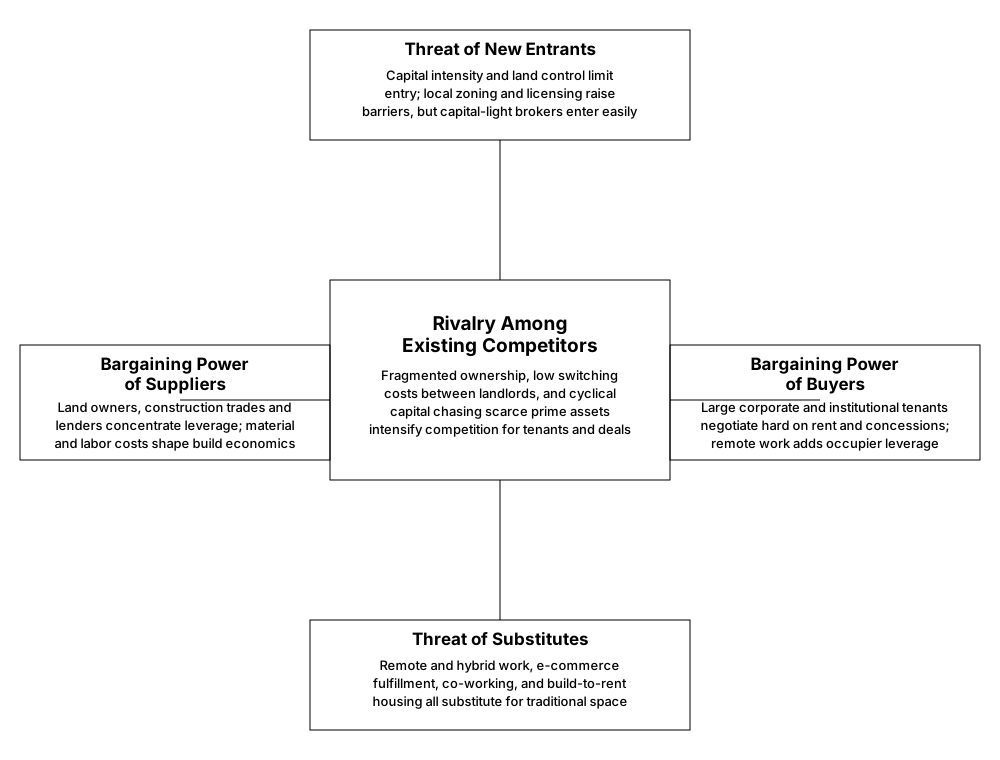
Bargaining power of buyers
Tenants across every property type have gained leverage over the past several years, though the degree varies by segment and by the tenant's own scale. Large corporate office occupiers now negotiate aggressively on rent, tenant improvement allowances and lease flexibility because hybrid work has genuinely reduced how much space they need, giving them credible walk-away options that did not exist a decade ago. Major retailers and e-commerce fulfillment operators similarly extract concessions from industrial landlords when committing to large-footprint leases, since a single anchor tenant can materially affect an owner's occupancy and financing terms. Individual households renting apartments have comparatively less leverage, since multifamily leases are shorter and more standardized, though markets with abundant new supply temporarily hand renters more negotiating power through concessions such as free months of rent. Government and institutional tenants, common in specialized office and certain retail formats, bring long-term lease commitments but also rigorous procurement processes that compress landlord pricing power. The general trend is that buyer power concentrates with scale:
the largest tenants, whether corporate occupiers or big-box retailers, can credibly threaten to relocate or consolidate space, while smaller tenants remain price takers
| Buyer type | Source of leverage | Trend |
|---|---|---|
| Large corporate office occupiers | Reduced space needs from hybrid work | Increasing |
| National retail and logistics anchors | Scale of footprint committed | Increasing |
| Individual apartment renters | Local supply conditions | Variable by market |
| Government and institutional tenants | Long-term commitments, procurement rigor | Stable |
| Small and mid-size businesses | Limited alternatives in tight submarkets | Decreasing |
Bargaining power of suppliers
Suppliers to the industry include land owners, construction contractors and skilled trades, building material producers and crucially, capital providers such as banks, insurance companies and bond markets that finance acquisition and development. Land in supply-constrained, high-demand locations carries enormous pricing power because location cannot be replicated, which is why infill sites in dense metros command premiums that dwarf comparable land elsewhere. Construction costs have risen meaningfully over the past several years due to labor shortages in skilled trades and tariff-affected material costs, giving contractors and suppliers leverage that squeezes development margins even when completed asset values hold steady. Capital providers arguably hold the most consequential supplier power in the industry, since access to debt at reasonable spreads determines whether a deal pencils at all and banks pulling back from certain property types, particularly office, has forced borrowers toward more expensive private credit and mezzanine financing. Labor unions in construction-heavy markets add further leverage in specific metros, while specialized subcontractors for systems such as elevators, HVAC and building automation hold niche pricing power due to limited competition. Overall, supplier power in this industry is concentrated and structural rather than diffuse, which means owners with strong lender relationships and in-house construction capability retain a durable cost advantage.
| Supplier category | Leverage source | Trend |
|---|---|---|
| Land owners in constrained submarkets | Location scarcity | Increasing |
| Construction contractors and trades | Skilled labor shortages | Increasing |
| Banks and institutional lenders | Control of debt capital access | Increasing for riskier segments |
| Building material producers | Tariff and commodity exposure | Volatile |
| Specialized systems subcontractors | Narrow competitive set | Stable |
Rivalry among existing competitors
Ownership of commercial real estate remains highly fragmented globally, with millions of individual buildings held by everyone from small private investors to sovereign wealth funds, which keeps direct price competition for tenants fierce in most markets even though a handful of large institutional platforms dominate headline transaction volume. Landlords compete primarily on rent, location, building quality and increasingly on amenities and technology-enabled tenant experience, since switching costs for tenants, while real, are not prohibitive once a lease term expires. Cyclicality intensifies rivalry, because falling interest rates and abundant capital, as seen in the years leading up to 2022, pull new supply and aggressive underwriting into every property type simultaneously, compressing returns for everyone once that supply delivers. Property types now diverge sharply in competitive intensity: industrial rivalry centers on securing well-located land ahead of competitors, multifamily rivalry centers on operational efficiency and amenity differentiation and office rivalry has become a battle for a shrinking pool of tenants willing to sign new leases, concentrating leasing activity in the newest, best-located towers. Consolidation among REITs and institutional operators has increased scale advantages in operations and financing, but has not eliminated fragmentation at the asset level, since local and regional owners still control a substantial share of stock in most metros. The net effect is an industry where rivalry is real but plays out asset by asset and submarket by submarket rather than through a small number of national competitors setting prices.
| Rivalry dimension | Description | Trend |
|---|---|---|
| Ownership concentration | Millions of assets held by fragmented owners | Slowly consolidating |
| Basis for competition | Rent, location, amenities, technology | Intensifying |
| Supply cyclicality | New development responds to cheap capital with a lag | Persistent |
| Property type divergence | Industrial, multifamily, office on different cycles | Increasing |
| Institutional scale advantage | Larger platforms secure better financing and data | Increasing |
Threat of new entrants
Direct ownership and development of commercial real estate carries formidable barriers to entry, starting with the sheer amount of equity and debt capital required to acquire or build even a single meaningful asset, which excludes most individual investors from institutional-grade opportunities without pooling capital through a fund or REIT. Zoning approvals, environmental permitting and local political relationships needed to entitle new development take years to build and effectively protect incumbent developers who already have those relationships in a given jurisdiction. Underwriting expertise is also a genuine barrier, since mispricing risk in this industry destroys capital on a scale that is difficult to recover from and lenders scrutinize sponsor track records heavily before extending credit to new entrants. Against these barriers, asset-light segments of the industry are comparatively easy to enter: brokerage requires licensing and relationships rather than balance sheet and proptech software and data analytics ventures have proliferated because they need far less capital than owning buildings. Private equity real estate funds have also made it easier for new capital to enter indirectly, aggregating institutional and even retail money into vehicles managed by experienced operators, which lowers the entry barrier for capital without lowering it for operating expertise. The result is an industry where entry into ownership remains genuinely hard, while entry into services and technology layers around ownership has become progressively easier.
| Entry pathway | Barrier level | Trend |
|---|---|---|
| Direct asset ownership and development | High, capital and entitlement intensive | Stable to increasing |
| Institutional or private equity fund vehicles | Moderate, capital pooled but expertise still required | Increasing accessibility |
| Brokerage and transaction services | Low, licensing and relationships | Stable |
| Proptech and data analytics ventures | Low to moderate, software capital only | Increasing |
| Specialized niches such as cold storage or labs | Moderate, requires domain expertise | Attractive to sophisticated entrants |
Threat of substitutes
Substitution in commercial real estate rarely means a tenant stops needing space entirely; it means the tenant needs less space, different space, or accesses space through a different structure than a traditional long-term lease. Hybrid and remote work is the clearest example, substituting home offices and shared collaboration spaces for dedicated desks, which has structurally reduced office space demand per employee across most white-collar industries. Flexible and co-working operators offer another substitute within the office category itself, letting tenants access space on shorter, more flexible terms that compete directly with traditional multi-year leases, particularly for smaller occupiers and satellite offices. E-commerce substitutes physical retail square footage with fulfillment infrastructure, though this substitution has been a net positive for the industrial segment even as it erodes demand for traditional store space. Build-to-rent single-family housing communities substitute for traditional multifamily apartments among renter households who want more space and privacy, drawing demand away from conventional apartment product in some markets. Self-storage and modular or manufactured space provide substitutes at the margin for both retail and light industrial users seeking lower-cost alternatives to traditional leased space. Substitution pressure is therefore uneven across the industry, concentrated heavily in office and enclosed retail and comparatively muted in industrial and multifamily, which explains much of the valuation divergence between property types.
| Substitute | Property type affected | Trend |
|---|---|---|
| Hybrid and remote work arrangements | Office | Structural, increasing |
| Flexible and co-working space | Office | Increasing |
| E-commerce fulfillment | Traditional retail | Structural, increasing |
| Build-to-rent single-family communities | Multifamily | Increasing in Sun Belt markets |
| Self-storage and modular space | Retail, light industrial | Moderate |
Value chain and profit pools
The commercial real estate value chain begins with land acquisition and entitlement, where developers secure sites and navigate zoning, environmental review and community approval processes that can take longer than construction itself in dense or politically sensitive markets. Design and construction follow, translating entitled land and capital into a physical asset through architecture, engineering and general contracting, a stage exposed directly to labor availability and material cost volatility. Financing runs parallel to and through every stage, since construction loans, permanent debt and equity capital determine whether a project proceeds at all and shape the return profile once it stabilizes.
Leasing and tenant acquisition convert a completed building into an income-producing asset, requiring brokerage relationships, market intelligence and increasingly, marketing and digital tools to reach prospective tenants efficiently. Property and asset management then operate the building day to day, covering maintenance, capital expenditure planning, tenant relations and the ongoing optimization of net operating income over the holding period. Disposition, whether through outright sale, refinancing or a public offering via a REIT structure, realizes the capital gain component of total return and recycles capital back into new acquisitions or development. A final enabling layer, spanning data and analytics providers, building technology vendors and specialized insurance and legal services, supports every other stage without directly owning assets and this layer has grown disproportionately as the industry has digitized its underwriting and operations.
Profit pool
Profit in commercial real estate has historically concentrated in development and value-add repositioning, where an operator captures the spread between the cost of creating or improving an asset and its stabilized market value, a spread that can run into the double digits as a percentage return when execution goes well. That remains true, but the profit pool has been reshaped by two forces over the past decade. First, specialized operating platforms, particularly in industrial and multifamily, have captured a growing share of profit by combining ownership with in-house leasing, property management and data capability across hundreds of assets, letting them extract operational efficiencies that a single-asset owner cannot replicate. Second, capital provision itself has become more profitable as traditional bank lending retreated from higher-risk property types, particularly office and construction financing, opening space for private credit funds and mezzanine lenders to earn returns that were previously captured mostly by banks at lower risk-adjusted spreads.
Brokerage and transaction services capture comparatively thin margins per deal but benefit from high transaction volume and low capital requirements, making them a durable if unglamorous profit source through market cycles. The weakest segment of the current profit pool is undifferentiated, aging office and enclosed mall product, where owners face negative or barely positive returns after accounting for capital expenditure needed to retain tenants, effectively transferring value away from that stock toward the newer, better-located assets tenants are migrating to.
The buildings capturing rent growth today are not simply the newest ones, they are the ones whose owners invested in data, amenities and flexibility years before demand shifted
Industry economics and business models
Three business models dominate the industry and they carry meaningfully different risk and return profiles. The core ownership model, whether held privately or through a publicly traded REIT, is asset-heavy and generates returns through a combination of rental income yield and capital appreciation, financed substantially with debt to amplify equity returns. This model rewards patient capital and underwriting discipline and it is the model most exposed to interest rate cycles because both the cost of debt and the discount rate applied to future cash flows move directly with rates.
A second model, the operating platform, layers active management, in-house leasing and increasingly proprietary data and technology on top of ownership, aiming to compound operational advantages across a large portfolio rather than simply collecting rent passively. This model has proven particularly powerful in multifamily and industrial, where operational excellence in leasing velocity, expense control and tenant retention meaningfully affects returns at scale. A third model, fee-based services spanning brokerage, property management contracts and development management, is comparatively asset-light and generates revenue through commissions and management fees rather than balance sheet exposure, trading lower capital intensity for lower absolute returns per transaction. Institutional capital increasingly blends these models, with large managers running proprietary operating platforms while also earning fee income managing capital on behalf of pension funds and other limited partners, a structure that diversifies revenue away from pure asset appreciation.2
Cost drivers and scalability
The cost structure of a stabilized commercial property is dominated by fixed and semi-fixed costs, including debt service, property taxes, insurance and base-level maintenance, which do not scale down proportionally when occupancy falls, making vacancy the single most damaging variable an owner faces. Variable costs, primarily tenant improvement allowances, leasing commissions and utility expenses tied to occupancy, fluctuate with leasing activity and tenant turnover and they have risen meaningfully in office as landlords compete harder for a smaller pool of tenants willing to relocate. Insurance costs specifically have climbed sharply in regions exposed to climate risk, adding a new and growing line item to operating expenses that owners in coastal and wildfire-prone markets must now underwrite explicitly rather than treat as a rounding error.
Economies of scale appear most clearly in property management and financing, where a platform managing hundreds of assets spreads corporate overhead, negotiates better insurance and financing terms and justifies investment in data infrastructure that a single-asset owner cannot. Unit economics in this industry center on occupancy and net effective rent, the actual rent collected after concessions and tenant improvement costs are amortized, rather than headline asking rent, which can overstate true asset performance considerably during periods of aggressive leasing concessions. A flywheel dynamic operates at the platform level, where superior data on tenant behavior and market pricing improves underwriting accuracy, which improves acquisition returns, which funds further data infrastructure investment, compounding advantage for scaled operators over time.
Moats, advantages and strategic levers
Defensibility in commercial real estate rests on a narrower set of true moats than the industry's size might suggest. Location remains the purest form of durable advantage, since prime land in supply-constrained submarkets cannot be replicated by a competitor regardless of capital available, which is why trophy assets in gateway cities retain pricing power even during downturns. Cost of capital functions as a genuine and compounding advantage for the largest, best-capitalized platforms, who secure debt at tighter spreads and equity at lower required returns than smaller competitors, letting them win competitive bids that would not pencil for a less well-financed buyer.
Operational data built up over years of managing a large portfolio, covering tenant behavior, maintenance patterns and local market pricing, has become a genuine learning advantage for scaled operators, since it improves underwriting and operating decisions in ways a new entrant cannot replicate quickly. Regulatory relationships and entitlement expertise create a durable moat in development, particularly in politically complex, high-barrier markets where navigating zoning and community approval requires years of accumulated local relationships. Switching costs for tenants are real but moderate, tied primarily to relocation disruption and remaining lease term rather than any structural lock-in, which limits how much pricing power a landlord can exercise over a captive tenant base. The strongest platforms combine several of these advantages simultaneously, pairing prime locations with low-cost capital and proprietary operating data, which explains why scale has become increasingly correlated with return performance across the largest institutional owners.3
Strategic levers
An operator or investor entering or expanding within this industry has several genuine levers available and the right combination depends heavily on capital base and risk appetite. Focusing on a specific property type and building deep operating expertise within it, rather than spreading capital thinly across office, retail, industrial and multifamily simultaneously, has consistently produced better risk-adjusted returns for specialized platforms than diversified generalist strategies. Vertical integration, bringing development, leasing and property management in-house rather than outsourcing to third parties, captures margin that would otherwise leak to intermediaries, though it requires building organizational capability that takes years to mature and is only worthwhile at sufficient portfolio scale.
Geographic expansion into supply-constrained, demographically growing markets offers a more straightforward lever, particularly in multifamily and industrial, where population and freight flow data provide relatively reliable demand signals years ahead of committing capital. Ecosystem orchestration, where an operator builds a platform connecting tenants, service providers and capital sources through shared technology infrastructure, is an emerging lever most visible among the largest institutional managers who now offer data and analytics services to their own limited partners as a differentiator in fundraising. Finally, regulatory strategy, meaning proactive investment in energy efficiency and emissions compliance ahead of mandatory deadlines, has become a genuine lever for avoiding forced capital expenditure and stranded-asset risk in markets adopting binding building performance standards.
Structural risks, regulation and trends
Interest rate sensitivity is the industry's most consequential structural risk, since commercial real estate values are a function of both financing cost and the discount rate applied to future income, meaning rate increases compress valuations through two channels simultaneously, a dynamic the market experienced sharply during the 2022 to 2023 tightening cycle. Refinancing risk compounds this exposure, since a meaningful share of commercial mortgage debt matures on a rolling basis and must be refinanced at prevailing rates regardless of whether those rates are favorable, creating periodic stress points even absent a broader economic downturn. Technology-driven demand disruption, principally hybrid work's effect on office and e-commerce's effect on traditional retail, represents a structural rather than cyclical risk, meaning the affected property types will not simply recover their prior demand levels once economic conditions improve.
Environmental regulation adds a growing compliance burden, as more jurisdictions adopt building performance standards mandating emissions reductions on large existing buildings, forcing owners of older stock into capital expenditure decisions that directly affect asset value and financing terms. Climate risk itself, through rising insurance costs and physical exposure in coastal and wildfire-prone regions, has moved from a peripheral underwriting consideration to a first-order factor in acquisition pricing in affected markets. On the demand side, population growth, household formation and the persistent housing undersupply in many metros continue to support multifamily fundamentals, while e-commerce penetration and supply chain reconfiguration toward inventory resilience continue to support industrial demand, giving these two property types the most durable secular tailwinds in the industry.
For new entrants, the more viable strategy is rarely to compete broadly across property types against well-capitalized incumbents, but instead to specialize in a niche where domain expertise, not balance sheet size, determines success, such as cold storage logistics, life science laboratory space or purpose-built senior housing and to partner with established capital providers rather than attempting to build lending relationships from scratch. Incumbents, by contrast, face a defend-and-deepen agenda:
defending core positions in resilient property types by investing in operating data and tenant experience, expanding selectively into adjacent, structurally supported segments such as data center-adjacent real estate and deepening moats through proactive capital expenditure on energy efficiency ahead of regulatory deadlines rather than reacting to them once mandated4, 5, 6
Caselet: Prologis and the industrial platform model
Prologis illustrates how a specialized operating platform captures disproportionate profit within a single property type rather than spreading capital across the whole asset class. The company traces its roots to Security Capital Industrial Trust, founded in the early 1990s and it grew through a series of mergers, most notably its 2011 combination with AMB Property Corporation, into the largest owner and operator of logistics real estate globally, with a portfolio concentrated in warehouses and distribution centers near major population centers and transportation infrastructure. The company operates as a publicly traded REIT, giving it access to public equity and investment-grade debt markets at a cost of capital that smaller, private logistics owners cannot match and it has used that advantage to acquire and develop facilities ahead of e-commerce-driven demand growth rather than reacting to it.
What distinguishes the company's operating model is its investment in data and customer relationships beyond simple ownership. It built an internal research function that tracks supply chain trends, tenant space utilization and logistics network design, giving it underwriting insight into where warehouse demand will emerge before competitors identify the same opportunity. It has also cultivated relationships with the largest logistics tenants, including major retailers and third-party logistics providers, who value the ability to lease space across multiple markets from a single counterparty with consistent building specifications and service standards, a form of switching cost the company has built deliberately rather than inherited from location alone.
The company's scale also lets it participate meaningfully in development, not just acquisition, building new facilities on land it controls and capturing the development spread between construction cost and stabilized value that smaller operators without in-house construction capability cannot access as reliably. This vertical integration, spanning land sourcing, development, leasing and property management, mirrors the strategic lever available to any sufficiently scaled operator in the industry and it has let the company compound returns across economic cycles rather than depending purely on rental rate growth in any single period. During the interest rate tightening cycle that began in 2022, the company's access to lower-cost, investment-grade debt provided a meaningful advantage over smaller, private industrial owners who faced sharply higher refinancing costs on floating-rate construction loans.
The company's experience also demonstrates the risk embedded in even the industry's strongest structural growth story. As e-commerce-driven leasing demand normalized after its pandemic-era surge and a wave of new industrial supply delivered across major markets, vacancy rates in logistics real estate rose from historically tight levels, illustrating that even the property type with the most durable secular tailwind remains cyclical and subject to overbuilding when capital floods a sector simultaneously. The company's response, slowing its own development starts and prioritizing build-to-suit commitments with creditworthy tenants over speculative construction, reflects the broader industry lesson that scale and data advantages reduce risk but do not eliminate the fundamental cyclicality of matching new supply to real demand. This combination of financing advantage, proprietary data, vertical integration and disciplined capital deployment through the cycle is precisely the pattern that separates the profit pool's winners from generalist owners across the broader industry.7
Commercial real estate remains the physical infrastructure on which commerce, logistics and housing depend and its economics still rest on the same three levers: location scarcity, cost of capital and operating discipline. What has changed is who wins those levers. Scale operators with proprietary data, embedded lenders and specialized logistics and multifamily platforms now capture disproportionate returns, while generalist owners of aging, undifferentiated space absorb structural risk. Technology has moved from back-office convenience to a genuine source of underwriting and operating advantage. The strategic task ahead is to concentrate capital in property types with durable demand, extend control over financing and operations and treat obsolescence as a planning variable rather than a surprise.
Citation
Cite this article
Sridharan, M. A. (2023, February 28). Industry Analysis: Commercial Real Estate. Think Insights. https://thinkinsights.net/strategy/industry-analysis-commercial-real-estate (Accessed [[ACCESS_DATE]])
Sridharan, Mithun A. "Industry Analysis: Commercial Real Estate." Think Insights, 28 Feb. 2023, https://thinkinsights.net/strategy/industry-analysis-commercial-real-estate. Accessed [[ACCESS_DATE]].
Mithun A. Sridharan, "Industry Analysis: Commercial Real Estate," Think Insights, February 28, 2023, https://thinkinsights.net/strategy/industry-analysis-commercial-real-estate. Accessed [[ACCESS_DATE]].
Sridharan, M.A. (2023) 'Industry Analysis: Commercial Real Estate', Think Insights. Available at: https://thinkinsights.net/strategy/industry-analysis-commercial-real-estate (Accessed: [[ACCESS_DATE]]).
M. A. Sridharan, "Industry Analysis: Commercial Real Estate," Think Insights, 2023. [Online]. Available: https://thinkinsights.net/strategy/industry-analysis-commercial-real-estate. [Accessed: [[ACCESS_DATE]]].
Sridharan MA. Industry Analysis: Commercial Real Estate. Think Insights. Published February 28, 2023. Accessed [[ACCESS_DATE]]. https://thinkinsights.net/strategy/industry-analysis-commercial-real-estate
Test Your Knowledge
Industry Analysis: Commercial Real Estate
Challenge yourself on the concepts from this article and see how well you understood them.
Subscribers get weekly quizzes and insights — subscribe free
Sponsor this article
Partner with Think Insights
Reach 50,000+ business leaders, consultants, and strategists. Feature your brand alongside expert articles on strategy, leadership, and digital transformation.
Become a Sponsor