Industry Analysis: Coal Mining


Coal mining is no longer one global story but two regional ones: structural decline across North America and Europe and continued expansion across China, India and Southeast Asia. Capital should follow this split rather than treat coal as a uniformly shrinking asset class. Margin concentrates in metallurgical coal tied to steel demand and in low-cost export basins with rail and port access, not in high-cost legacy thermal mines. Bargaining power is shifting toward utility and steel-mill buyers in mature markets, while suppliers of mining equipment, rail capacity and port terminals gain leverage as fewer new assets get built. The decision facing operators and investors is whether to hold and harvest cash from existing thermal assets, or redeploy capital toward metallurgical coal and export logistics where growth and pricing power still exist. Standing still in the middle is the least defensible position.
Is coal mining attractive for new entrants?
Attractiveness depends entirely on geography and coal grade. Greenfield thermal coal projects in mature markets face permitting resistance, financing exclusion from mainstream banks and demand that is contracting, making entry unattractive. Metallurgical coal projects in established export basins with rail and port access, or thermal projects serving captive industrial demand in South and Southeast Asia, still attract capital because buyers commit to long-dated offtake and financing gaps are narrower.
Which parts of the value chain are most profitable?
Export-oriented mining paired with owned rail and port logistics captures the largest share of margin, because it controls the bottleneck between low-cost reserves and buyers willing to pay a landed price premium. Metallurgical coal processing and washing plants also retain healthy margins given the specialized quality requirements of blast furnace operators. Pure trading and brokerage layers capture comparatively little once contracts move to index-linked pricing.
How is technology changing this industry?
Autonomous haul trucks, remote operating centers and predictive maintenance have cut unit costs at large open-cut mines by reducing labor intensity and downtime. Digital twins and real-time ore-tracking improve blending accuracy, which matters more as buyers demand tighter quality specifications. None of this changes coal's fundamental substitutability in power generation, but it does help low-cost producers extend their advantage over higher-cost peers.
What capabilities are table stakes vs differentiators?
Safe, permitted extraction and basic quality control are table stakes; without them a mine cannot legally operate or sell into export markets. Differentiators are control over low-cost, long-life reserves, secured rail and port capacity and the ability to blend and certify coal to the precise specifications utilities and steel mills require, which supports premium pricing and contract renewal.
How should investors and consultants evaluate opportunities here?
Evaluate coal exposure by separating thermal from metallurgical assets and by mapping each asset's cost position on the global cost curve, since only producers in the lowest cost quartile survive prolonged price troughs. Assess logistics access as a distinct asset, not an afterthought, because landlocked reserves without rail or port capacity are effectively stranded regardless of geological quality.
What is driving the decline of coal in developed markets?
Utility-scale renewables have become cheaper than new coal generation in most OECD markets and carbon pricing or emissions regulation raises the effective cost of running coal plants. Aging coal fleets in the United States and Europe are retiring faster than replacement capacity is built, but the retirements are being absorbed by gas and renewables rather than new coal.
Why does coal demand keep growing in Asia despite the energy transition?
China and India still rely on coal for grid reliability and industrial energy security and both countries continue to add coal-fired capacity even while scaling renewables aggressively. Electricity demand growth in these markets, driven by manufacturing, cooling load and electrification, has outpaced the rate at which renewables and grid infrastructure can absorb it.
What role does metallurgical coal play separately from thermal coal?
Metallurgical coal, also called coking coal, is a chemical input for blast furnace steelmaking rather than a fuel substitute for gas or renewables, which insulates its demand from the power sector's transition. Steel demand tied to construction and infrastructure in Asia keeps metallurgical coal pricing structurally firmer than thermal coal, even as both face long-run pressure from hydrogen-based steel production.
How exposed is the industry to geopolitical and trade disruption?
Export flows are concentrated through a small number of choke points, including Australian and Indonesian ports and specific rail corridors, making the industry sensitive to sanctions, shipping disruptions and bilateral trade restrictions. Russia's redirection of coal exports toward Asia after Western sanctions illustrated how quickly established trade routes can be reshaped.
What should an incumbent miner do differently over the next five years?
Incumbents should actively high-grade their portfolios toward metallurgical coal and low-cost, long-life thermal assets serving durable Asian demand, while accelerating closure and rehabilitation planning for higher-cost thermal mines before financing conditions deteriorate further. Reinvesting free cash flow into logistics control, rather than new mine capacity, tends to protect margin longer than expanding output volume.
Coal mining remains one of the largest industrial sectors on the planet and it is also one of the most misunderstood by executives outside the resources sector. The common narrative treats coal as a single, uniformly declining asset class on its way to irrelevance. That narrative is wrong in a way that matters for capital allocation. Coal mining today is better understood as two distinct industries sharing a name: a mature, contracting thermal coal business tied to power generation in developed economies and a still-expanding thermal and metallurgical coal business tied to electrification and steelmaking across Asia. Executives evaluating exposure to this industry, whether as investors, suppliers, or advisers to utilities and steelmakers, need to treat these as separate markets with separate economics, separate risk profiles and separate strategic playbooks.
Industry at a glance
Coal mining covers the extraction, processing and preparation of thermal coal, used as fuel for electricity generation and some industrial heat applications and metallurgical coal, also known as coking coal, used as a chemical reductant in blast furnace steelmaking. The industry's scope includes surface and underground mine operations, coal washing and preparation plants that upgrade raw coal to sellable specifications and increasingly the rail and port logistics that connect mines to buyers. It excludes coal-fired power generation itself, downstream steelmaking and coal-to-chemicals conversion, all of which sit in adjacent industries that consume coal as an input rather than produce it.
The global coal market is valued at roughly 1.09 trillion dollars in 2026, split between a larger thermal coal segment, worth around 210 billion dollars and holding close to 80% of volume and a smaller but higher-value metallurgical coal segment worth around 131 billion dollars.1 Customers are almost entirely business-to-business (B2B) and business-to-government (B2G): electric utilities, independent power producers, integrated steel mills and, in several major producing countries, state-owned power and industrial conglomerates that buy under long-term contracts. Direct business-to-consumer (B2C) demand is negligible outside small residential heating markets in a handful of countries.
Economically, the industry depends heavily on two downstream sectors: electricity generation, which absorbs the bulk of thermal coal volume and steel production, which is the sole meaningful consumer of metallurgical coal. This dependence means coal mining's fortunes track electricity demand growth and industrial construction activity more closely than they track any dynamic internal to mining itself. Revenue models are overwhelmingly commodity-sale based, priced either through long-term bilateral contracts indexed to published benchmarks or through spot and forward markets for export cargoes. Capital intensity is high, given the fixed investment required for mine development, processing plants and, in export-oriented operations, dedicated rail and port infrastructure. Labor intensity varies sharply between mechanized surface mines, which employ relatively few workers per tonne and underground operations, which remain far more labor intensive. Regulatory intensity is severe and rising, covering mine safety, environmental permitting, land rehabilitation obligations, water management and, increasingly, carbon and emissions policy that indirectly constrains thermal coal's addressable market.
Industry segmentation
The clearest way to segment coal mining is by coal type and end use, since that split determines demand drivers, pricing mechanisms and long-run trajectory more than any other variable. Thermal coal, sold to power utilities and industrial boiler operators, represents the largest volume segment and is the one most exposed to renewable energy competition and carbon policy. Metallurgical coal, sold to integrated steel mills operating blast furnaces, is a smaller but structurally different segment because steel demand, not power sector substitution, drives its trajectory.
A second useful dimension is extraction method: surface mining, typically open-cut or strip mining, dominates in geologically favorable basins such as Australia's Bowen Basin, Indonesia's Kalimantan deposits and much of the United States Powder River Basin and tends to produce lower-cost coal because it avoids the fixed costs of underground ventilation, roof support and longer haulage. Underground mining, still significant in China, India, parts of Europe and Appalachian regions of the United States, generally carries higher per-tonne costs but can access higher-quality seams, particularly for metallurgical coal, that surface deposits do not offer.
A third dimension separates producers by market orientation: export-oriented producers, concentrated in Australia, Indonesia, Russia, Colombia and South Africa, sell primarily into seaborne trade and are exposed to freight costs, currency movements and global benchmark pricing. Domestic-market producers, dominant in China, India and the United States, sell primarily to captive or nearby utilities and industrial buyers under contracts less exposed to shipping economics but more exposed to domestic energy policy. Finally, ownership structure matters as a segmentation lens in its own right:
state-owned or state-controlled miners such as Coal India Limited and China Shenhua Energy operate with energy security mandates that can override pure profit maximization, while diversified private miners such as BHP, Glencore and Peabody Energy allocate capital more strictly against shareholder return targets, producing meaningfully different competitive behavior within the same geographic markets
Market structure
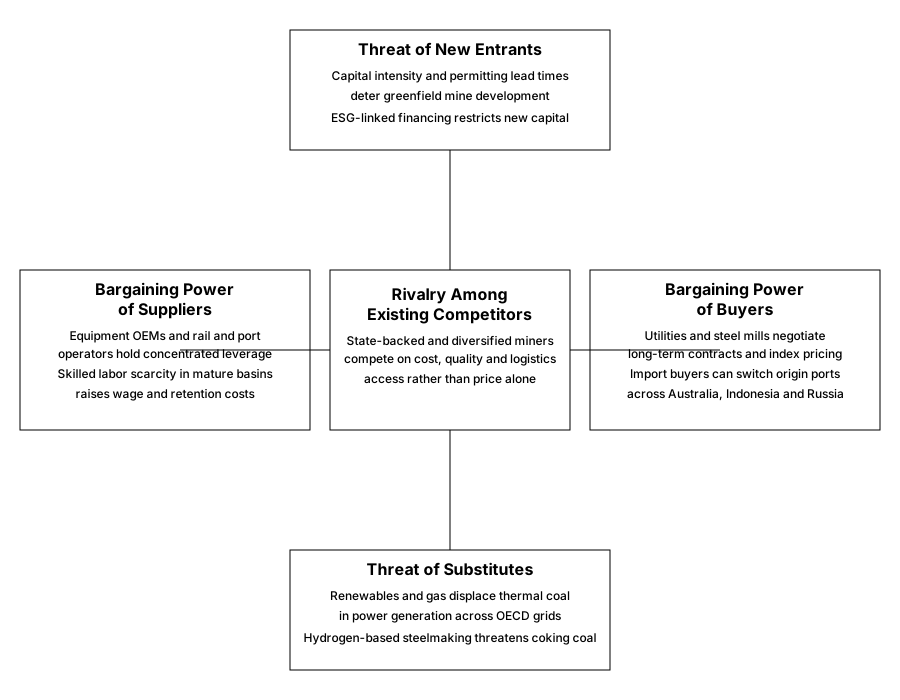
Coal mining's competitive structure is shaped by a fundamental split in demand trajectory, by geographic concentration of low-cost reserves and by the logistics bottlenecks that separate landlocked coal from paying buyers. Applying Porter's five forces framework to the industry surfaces where power actually sits:
buyers in mature markets have gained leverage as coal becomes one option among several, suppliers of specialized mining equipment and logistics capacity have gained leverage as fewer new assets get built and rivalry increasingly plays out on cost position and logistics access rather than headline price
Bargaining power of buyers
Buyer power in coal mining diverges sharply between mature and growth markets. In the United States and Europe, utility buyers hold substantial leverage because they have credible substitutes in natural gas and renewables and because coal-fired capacity is retiring rather than expanding, giving utilities little incentive to lock in new long-term coal commitments. This has pushed contract durations shorter and pricing terms more favorable to the buyer in these markets. In China and India, the picture is more balanced:
state and provincial utilities negotiate hard on price and large industrial buyers of metallurgical coal, particularly steel conglomerates, use their scale to secure preferential terms, but demand growth in these markets means buyers cannot walk away from coal the way developed-market utilities increasingly can
Seaborne export buyers, including Japanese, South Korean and Indian utilities and steel mills, hold meaningful power because they can source from multiple exporting countries, switching between Australian, Indonesian, Russian, Colombian and South African cargoes based on delivered price and quality specification. This substitutability across supply origins caps the pricing power of any single exporting nation or company. Domestic captive buyers in producing countries, by contrast, often have less switching flexibility, particularly where rail infrastructure ties a utility to a specific coalfield, which shifts leverage back toward the miner in those bilateral relationships.
Quality specification requirements add a further wrinkle: steel mills buying metallurgical coal require tight consistency in coking properties, ash content and sulfur levels and switching suppliers can require costly blast furnace recalibration, which reduces buyer power for mills already qualified on a specific supplier's coal. Thermal coal buyers face fewer switching costs since power plants can typically blend coal from multiple sources with less operational disruption.
| Buyer segment | Switching flexibility | Primary leverage driver |
|---|---|---|
| Developed-market utilities | High | Substitute fuels and retiring capacity |
| Asian growth-market utilities | Moderate | Demand growth outpacing alternatives |
| Integrated steel mills | Low to moderate | Quality qualification and blast furnace fit |
| Seaborne export buyers | High | Multiple exporting country options |
| Domestic captive industrial buyers | Low | Rail and geographic lock-in |
Bargaining power of suppliers
Coal mining's supplier base includes heavy equipment manufacturers, explosives and consumables providers, skilled labor markets, and, critically, the rail and port operators that move coal to buyers. Equipment suppliers such as Caterpillar and Komatsu hold meaningful leverage because large-scale mining equipment, particularly autonomous haul trucks and draglines, requires specialized servicing relationships and long replacement cycles that lock miners into a small set of vendors. This leverage has grown as automation technology becomes a differentiator for cost position, giving equipment OEMs (original equipment manufacturers) pricing power over the software and service layer even where the machines themselves are commoditized.
Rail operators and port terminal owners frequently hold the most consequential supplier leverage in the industry, because export coal is worthless without a path to a ship. In several major basins, a single rail line or a small number of port terminals serve multiple competing mines, giving the infrastructure owner effective control over how much coal reaches market regardless of mine-level production capacity. Where miners own their own rail and port assets, as several large Australian and Indonesian producers do, this dynamic flips, turning what would otherwise be a supplier dependency into a competitive moat.
Labor supply has tightened in several mature mining regions as the workforce ages and fewer new entrants choose mining careers, given the industry's declining long-term reputation in developed markets. This has pushed wage costs upward in the United States and Australia even as overall industry employment shrinks, a combination that raises unit labor costs precisely when producers need cost discipline most.
| Supplier category | Leverage level | Basis of power |
|---|---|---|
| Mining equipment OEMs | High | Specialized servicing and long replacement cycles |
| Rail infrastructure operators | High | Sole access route to port for many mines |
| Port terminal owners | High | Capacity constraints at key export hubs |
| Skilled mining labor | Moderate to high | Aging workforce and shrinking talent pipeline |
| Explosives and consumables providers | Low to moderate | Multiple qualified vendors available |
Rivalry among existing competitors
Rivalry in coal mining centers on cost position rather than product differentiation, since thermal coal is largely a commodity distinguished mainly by calorific value and ash content, while metallurgical coal differentiates more on coking quality. Producers compete to sit in the lowest-cost quartile of the global cost curve, because commodity price cycles regularly push benchmark prices below the marginal cost of higher-cost producers, forcing temporary or permanent shutdowns. This dynamic has consolidated production toward large, low-strip-ratio open-cut mines in Australia, Indonesia and the Powder River Basin and away from higher-cost underground operations in mature basins across Europe and parts of the United States.
State-owned producers such as Coal India and China Shenhua Energy compete differently from private diversified miners, since energy security mandates can lead them to sustain production even at thinner margins than a purely commercial operator would accept. This creates asymmetric competitive pressure:
private miners cannot always assume that high-cost state producers will exit the market when prices fall, which complicates capacity rationalization that would otherwise occur in a purely market-driven industry
Export-oriented rivalry increasingly plays out on logistics reliability as much as price, since buyers value consistent delivery timing and quality certification, particularly for metallurgical coal feeding continuous blast furnace operations. Producers that have integrated rail and port ownership, or secured long-term take-or-pay logistics contracts, can compete on reliability in a way that pure mine operators cannot easily replicate.
| Competitive dimension | Intensity | Notes |
|---|---|---|
| Cost curve position | High | Determines survival through price troughs |
| Logistics reliability | High | Increasingly decisive for export contract retention |
| Coal quality and blending capability | Moderate | Matters most for metallurgical grades |
| State-backed versus private capital discipline | High | Distorts capacity rationalization |
| Geographic basin cost advantage | High | Powder River, Bowen and Kalimantan basins set the floor |
Threat of new entrants
New entry into coal mining faces some of the steepest barriers of any extractive industry and those barriers have grown rather than shrunk over the past decade. Mine development requires years of geological exploration, environmental permitting and community consultation before first production and permitting timelines have lengthened in most jurisdictions as environmental scrutiny of new coal projects intensifies. Financing access has also narrowed considerably:
a growing number of global banks and institutional investors have adopted policies excluding new thermal coal mine financing, which pushes prospective entrants toward a shrinking pool of specialized lenders and state financing vehicles
Capital requirements for a competitive-scale mine, particularly one requiring dedicated rail and port infrastructure, run into the hundreds of millions to billions of dollars, a threshold that few new entrants can clear without backing from an existing diversified miner or a state-linked entity. Existing producers also benefit from established rail and port access agreements that can take years to negotiate or replicate, giving incumbents a durable logistics advantage over any new entrant attempting to break into export markets.
The picture differs somewhat in metallurgical coal, where steel demand growth in Asia has occasionally justified new mine development and in captive domestic supply arrangements, where a state or provincial government may sponsor new mine capacity to serve a specific power plant or industrial complex regardless of broader market entry barriers. Even here, though, entry tends to come from existing miners expanding within known basins rather than genuinely new competitors entering the industry.
| Entry barrier | Severity | Trend direction |
|---|---|---|
| Permitting and environmental approval | High | Rising |
| Access to project financing | High | Rising, as lenders exit thermal coal |
| Capital cost of mine and logistics development | High | Stable to rising |
| Incumbent rail and port access agreements | High | Rising |
| Government-sponsored captive supply projects | Moderate | Stable, concentrated in Asia |
Threat of substitutes
Substitution risk is the defining structural force in thermal coal and a secondary but growing force in metallurgical coal. In power generation, utility-scale solar and wind, backed by falling battery storage costs, have become cheaper than new coal generation across most of the Organisation for Economic Co-operation and Development [OECD] economies and natural gas remains a flexible substitute wherever pipeline infrastructure exists. This substitution pressure explains most of the coal plant retirements across the United States and Europe over the past decade and it continues to constrain how much new coal capacity even growth markets are willing to add relative to renewable capacity.
Metallurgical coal faces a slower-moving but consequential substitution threat from hydrogen-based direct reduced iron steelmaking, which several European and Asian steelmakers have begun piloting as an alternative to blast furnace production. This technology remains commercially immature and capital intensive relative to established blast furnace routes, which limits its near-term impact on metallurgical coal demand, but it represents the clearest long-run threat to the segment that has otherwise proven more resilient than thermal coal.
Electric arc furnace steelmaking, which uses recycled scrap steel rather than coal-derived coke, has also expanded its share of global steel production, particularly in markets with mature scrap supply chains such as the United States. This shift reduces metallurgical coal's addressable market gradually, even without a dramatic technology breakthrough, simply through the ongoing growth of scrap-based steel capacity relative to new blast furnace construction.
| Substitute | Threat level | Adoption stage |
|---|---|---|
| Utility-scale solar and wind with storage | High | Mature and scaling |
| Natural gas generation | High | Mature, regionally constrained by pipelines |
| Hydrogen-based direct reduced iron steelmaking | Moderate | Early pilot stage |
| Electric arc furnace steelmaking with scrap | Moderate | Mature, expanding share |
| Nuclear power generation | Low to moderate | Mature, constrained by build timelines |
Value chain and profit pools
The coal mining value chain begins with exploration and reserve development, where geologists and engineers identify economically viable coal seams and secure the mineral rights and permits needed to develop them. This stage carries high risk and requires patient capital, since exploration success rates are uneven and permitting can take years before a company knows whether a deposit will ever become a producing mine. From there, the chain moves into mine construction and extraction, the capital-intensive core of the industry, covering the equipment, infrastructure and workforce needed to physically remove coal from surface or underground deposits.
Processing and preparation follows extraction, where raw run-of-mine coal is washed, crushed and blended to meet buyer specifications for calorific value, ash content and, for metallurgical coal, coking properties. This stage adds meaningful value because unprocessed coal often cannot meet the quality thresholds buyers require and processing capacity itself can become a bottleneck during periods of strong demand. Distribution and logistics, covering rail transport from mine to port or directly to domestic buyers and port handling and shipping for export cargoes, represents the stage most prone to bottleneck economics, since fixed rail and port capacity cannot expand quickly in response to short-term demand swings.
The customer interface stage covers contracting, quality certification and relationship management with utilities and steel mills, an area that has grown more sophisticated as buyers demand tighter specification guarantees and more flexible delivery scheduling. Finally, enabling infrastructure spans the specialized equipment manufacturing, explosives supply, financing and insurance services that support every other stage of the chain, along with the environmental rehabilitation and mine closure obligations that increasingly represent a long-tail cost commitment extending decades beyond a mine's productive life.
Profit pool
Profit concentrates most heavily in low-cost export mining paired with owned or contractually secured logistics, a combination that lets a producer capture the full landed price premium a buyer pays over domestic alternatives, rather than surrendering that premium to a third-party rail or port operator. This explains why the most profitable coal companies globally, including several large Australian and Indonesian producers, have invested deliberately in rail and port ownership rather than treating logistics as an outsourced commodity service.
Processing and washing plants for metallurgical coal retain a healthy share of margin because the specialized quality requirements of blast furnace steelmaking reward producers who can consistently deliver tightly specified coking coal, a capability that not every miner can replicate. This has pushed some producers to prioritize metallurgical coal development over thermal coal expansion even where thermal reserves are larger, purely because the margin structure favors it.
The profit pool has shifted measurably over the past fifteen years, moving away from pure extraction margin and toward control of scarce logistics capacity and long-life, low-strip-ratio reserves. In the industry's earlier growth decades, simply having coal in the ground and a buyer nearby was often sufficient to generate strong returns. Today, with financing access constrained and permitting slower, the scarcity has shifted to already-permitted, already-connected assets, meaning the market rewards existing low-cost producers with logistics access far more than it rewards exploration of new reserves.
Industry economics and business models
Three business model patterns dominate coal mining. The first and most common among large diversified miners, is the asset-heavy integrated producer model, where a company owns mining operations, processing plants and often rail or port logistics as a single vertically coordinated business. This model demands substantial upfront capital but captures margin at every stage of the value chain and provides resilience against logistics bottlenecks controlled by third parties.
The second pattern is the contract-mining or pure extraction model, common among smaller and mid-sized operators, where a company focuses solely on extraction and processing while relying on third-party rail, port and sometimes marketing services. This model requires less capital and can enter production faster, but it surrenders margin to logistics providers and leaves the operator more exposed to bottleneck pricing during periods of constrained rail or port capacity.
The third pattern, most visible among state-owned producers such as Coal India, blends commercial coal sales with an explicit energy security mandate, prioritizing consistent domestic supply over profit maximization during periods when market signals might otherwise favor production cuts. Coal India produced 781 million metric tons in the 2024-25 fiscal year, supplying roughly 80% of India's domestic coal output and underpinning about 70% of the country's electricity generation, illustrating how a state mandate model can dominate a national market even as private, profit-driven miners operate the majority of global seaborne export volume.2
Cost drivers and scalability
Coal mining's cost structure splits between substantial fixed costs, covering mine development, processing plant construction and dedicated logistics infrastructure and variable costs tied to labor, fuel, explosives and equipment maintenance that scale with production volume. The ratio between these varies significantly by extraction method:
large surface mines carry lower variable cost per tonne because mechanized equipment moves overburden and coal efficiently, while underground mines carry higher variable costs tied to ventilation, roof support and generally more labor-intensive extraction methods
Economies of scale matter enormously in this industry, since the fixed costs of rail lines and port terminals amortize across whatever volume moves through them, rewarding producers who can fill logistics capacity consistently. This dynamic pushes the industry toward large-scale basin development rather than dispersed smaller operations and it explains why a handful of mega-basins, including Australia's Bowen and Galilee basins, Indonesia's East Kalimantan region and the United States Powder River Basin, account for a disproportionate share of global seaborne export volume.
Unit economics center on the cash cost per tonne extracted and delivered to the buyer, a figure that determines where a producer sits on the global cost curve and, consequently, how it fares through commodity price cycles. Strip ratio, the volume of overburden that must be removed to access each tonne of coal in surface mining, is the single most important geological determinant of cost position, since a low strip ratio dramatically reduces the earthmoving cost per tonne of coal recovered. Producers with favorable strip ratios and short rail hauls to port sustain profitability through price troughs that force higher-cost competitors to idle capacity, which is why cost curve position, more than revenue scale, determines long-run survival in this industry.
Moats, advantages and strategic levers
The most durable competitive advantage in coal mining is control of low-cost, long-life reserves combined with secured logistics access, a combination that is extraordinarily difficult for a competitor to replicate given permitting timelines and financing constraints on new infrastructure. This functions as a genuine geological and infrastructure moat rather than a brand or customer-relationship moat, since coal itself carries little differentiation beyond quality specification.
Regulatory moats also play a meaningful role, somewhat counterintuitively, because the same permitting difficulty that constrains incumbents from expanding also blocks new entrants from establishing competing capacity, protecting incumbent volume in basins where further development has become politically or environmentally difficult. Switching costs provide a secondary but real advantage in metallurgical coal, where steel mills that have qualified a specific supplier's coal for their blast furnace chemistry face real operational risk and cost in switching suppliers, creating a form of relationship stickiness uncommon in commodity industries.
Learning and scale advantages accrue to large, established operators through decades of accumulated geological data, optimized blending techniques and, increasingly, automation expertise that smaller or newer operators cannot easily match. BHP's position as the world's largest metallurgical coal producer, built on decades of Bowen Basin operation and integrated rail and port infrastructure, illustrates how scale, geology and logistics control compound into a durable structural advantage rather than a temporary pricing edge.
Strategic levers
Operators and investors evaluating this industry have several concrete levers available, though few of them involve pursuing broad, undifferentiated growth. Portfolio high-grading toward metallurgical coal and away from higher-cost thermal assets represents the clearest lever for diversified miners, since it redirects capital toward the segment with a more durable demand base while reducing exposure to the segment most threatened by renewable substitution and carbon policy.
Vertical integration into rail and port logistics offers a second lever, particularly for export-oriented producers, since owning the bottleneck between mine and buyer converts a variable cost and third-party dependency into a controlled asset that captures additional margin. Geographic focus on low-cost basins, rather than attempting to sustain production across a geographically dispersed and cost-heterogeneous portfolio, allows a producer to concentrate capital where cost curve position is strongest and to accept faster closure of higher-cost assets elsewhere.
A fourth lever, particularly relevant for producers serving developed markets, involves disciplined capital return over expansion: rather than reinvesting cash flow into new thermal capacity with a shrinking addressable market, mature-market operators increasingly favor returning capital to shareholders while managing existing assets toward an orderly, well-funded closure. Finally, contract structuring toward longer-dated, quality-guaranteed offtake agreements with Asian utilities and steel mills gives producers revenue visibility that supports financing access even as broader capital markets grow more cautious about the sector.
Structural risks, regulation and trends
Coal mining faces several structural risks that compound rather than operate independently. Regulatory risk is the most pervasive, spanning mine safety enforcement, environmental permitting requirements, water management rules and, most consequentially, carbon and emissions policy that indirectly caps thermal coal's addressable market by raising the cost of coal-fired generation relative to alternatives. Technology disruption operates on two timelines:
near-term automation and digital tools that improve incumbent cost position and longer-term substitution risk from renewable generation and hydrogen-based steelmaking that could eventually erode both major demand segments
Commodity price risk remains acute given coal's historically volatile pricing cycles, driven by weather-related demand swings, supply disruptions and shifting utility procurement patterns and this volatility punishes higher-cost producers disproportionately during downturns. Geopolitical and supply chain risk has grown more visible following Russia's redirection of coal exports toward Asian buyers after Western sanctions restricted its traditional European markets, demonstrating how quickly established trade flows can be redrawn by policy decisions outside the industry's control.3
On the demand side, the defining secular trend remains the bifurcation between developed and developing markets: global coal demand is expected to plateau near 8.85 billion metric tons before declining modestly over the following several years, with China's demand stabilizing and India's continuing to grow as electricity consumption expands faster than renewable capacity can absorb it.4 On the supply side, production has concentrated further into low-cost basins as higher-cost mines in mature markets close, a trend reinforced by financing institutions that have progressively restricted lending to new thermal coal projects.5
For companies considering entry into this industry, the strategic playbook depends heavily on which segment and geography are in play. A narrow entry focused on metallurgical coal in an established, low-cost export basin, pursued through acquisition of an existing permitted asset rather than greenfield development, offers the most defensible path given financing constraints on new thermal coal projects. Partnering with or acquiring an existing operator that already holds rail and port access typically proves more capital efficient than attempting to build parallel logistics infrastructure from scratch. Regulatory strategy matters as much as commercial strategy in this industry:
engaging early and transparently with permitting authorities and communities, rather than treating regulatory approval as a formality, materially affects both timeline and long-run social license to operate
For incumbents, the playbook centers on defending cost position in core low-cost basins, expanding selectively into metallurgical coal and Asian export relationships where demand remains durable and deepening logistics control as the clearest available moat against both commodity price volatility and third-party bottleneck pricing. Incumbents that continue treating coal as a single undifferentiated commodity business, rather than actively managing the split between a declining thermal segment and a more resilient metallurgical segment, are the ones most likely to see capital misallocated toward assets that will not generate acceptable returns over their intended operating life.
Caselet: BHP and the economics of metallurgical coal leadership
BHP, headquartered in Melbourne and listed on both the Australian and London stock exchanges, offers a useful window into how a diversified global miner has positioned coal within a broader portfolio rather than treating it as a standalone bet on the commodity's future. The company traces its coal operations to decades of development in Queensland's Bowen Basin, one of the world's premier metallurgical coal deposits, where favorable geology, established rail corridors and proximity to the port of Hay Point and Dalrymple Bay give BHP's operations a durable cost advantage over higher-cost metallurgical coal producers elsewhere in the world.
Rather than diversifying broadly across thermal coal, BHP has progressively concentrated its coal exposure toward metallurgical coal, exiting or divesting several thermal coal assets over the past decade while continuing to invest in its Queensland metallurgical coal joint ventures, including its long-standing partnership structure with Mitsubishi Development. This portfolio decision reflects precisely the high-grading lever described earlier in this analysis:
rather than holding a broad coal portfolio exposed equally to both the declining thermal segment and the more resilient metallurgical segment, BHP chose to concentrate capital where steel demand, not power sector substitution, drives the underlying market
Operations and cost position
BHP's Queensland metallurgical coal operations benefit from a combination of favorable strip ratios, established rail infrastructure connecting mines to dedicated export terminals and decades of accumulated operating expertise that smaller producers in the same basin have struggled to match. This cost position matters enormously given metallurgical coal's price volatility, which tracks steel production cycles in China, India and other major steel-producing economies; BHP's lower-cost position allows it to sustain profitability through price troughs that force higher-cost competitors, including some smaller Australian and North American producers, to curtail production or exit entirely.
The company has also invested in automation and digital operating capability across its mining portfolio, applying technology developed across its broader iron ore and copper operations to improve consistency and reduce cost in its coal business as well. This cross-portfolio technology transfer illustrates a subtler advantage available to diversified miners:
capability built in one commodity can be redeployed across others, giving a diversified operator an edge over single-commodity coal specialists that must develop equivalent capability independently
Strategic positioning and market signal
BHP's continued investment in metallurgical coal, even as many financial institutions have grown cautious about coal-sector lending broadly, sends a clear market signal about how sophisticated capital allocators distinguish between coal segments. The company has publicly maintained that metallurgical coal, given its role as a steelmaking input without a commercially mature large-scale substitute, differs fundamentally from thermal coal in its long-run demand outlook.
Steelmaking will require a source of high-quality metallurgical coal for decades to come and the highest-quality basins will retain their value even as the broader energy transition reshapes global coal demand
This positioning does not insulate BHP from metallurgical coal's own price volatility or from the longer-run threat posed by hydrogen-based steelmaking, but it does illustrate a coherent response to the industry's bifurcated structure:
rather than exiting coal entirely or holding an undifferentiated portfolio, BHP chose to concentrate on the segment and basin where its cost position and logistics control provide the most durable competitive advantage
Lessons for the broader industry
BHP's trajectory demonstrates that surviving and prospering in coal mining today requires an explicit segment choice rather than a passive continuation of legacy operations. The company's willingness to exit thermal coal assets while doubling down on metallurgical coal and its parallel investment in cost position and logistics control within its chosen segment, mirrors precisely the strategic levers that separate resilient operators from those managing a slow-motion decline. Smaller producers without BHP's diversified balance sheet or decades of basin-specific expertise face a harder version of the same choice, but the underlying logic, concentrate where demand is durable and cost position is defensible, applies regardless of company size.
Coal mining extracts and processes thermal and metallurgical coal, converting a geological resource into fuel for power utilities and input for steelmakers. Its economics rest on capital-intensive extraction, thin and cyclical margins and a bifurcated demand base: shrinking in developed economies, expanding across Asia. Operators that win control low-cost reserves, own or contract reliable rail and port capacity and match production mix to buyers who still need coal for decades, not years. The strategic levers that matter most are portfolio high-grading toward metallurgical coal, disciplined capital allocation away from stranded thermal assets and logistics integration that turns a commodity business into a service relationship with utilities and mills.
Citation
Cite this article
Sridharan, M. A. (2024, February 25). Industry Analysis: Coal Mining. Think Insights. https://thinkinsights.net/strategy/industry-analysis-coal-mining (Accessed [[ACCESS_DATE]])
Sridharan, Mithun A. "Industry Analysis: Coal Mining." Think Insights, 25 Feb. 2024, https://thinkinsights.net/strategy/industry-analysis-coal-mining. Accessed [[ACCESS_DATE]].
Mithun A. Sridharan, "Industry Analysis: Coal Mining," Think Insights, February 25, 2024, https://thinkinsights.net/strategy/industry-analysis-coal-mining. Accessed [[ACCESS_DATE]].
Sridharan, M.A. (2024) 'Industry Analysis: Coal Mining', Think Insights. Available at: https://thinkinsights.net/strategy/industry-analysis-coal-mining (Accessed: [[ACCESS_DATE]]).
M. A. Sridharan, "Industry Analysis: Coal Mining," Think Insights, 2024. [Online]. Available: https://thinkinsights.net/strategy/industry-analysis-coal-mining. [Accessed: [[ACCESS_DATE]]].
Sridharan MA. Industry Analysis: Coal Mining. Think Insights. Published February 25, 2024. Accessed [[ACCESS_DATE]]. https://thinkinsights.net/strategy/industry-analysis-coal-mining
Test Your Knowledge
Industry Analysis: Coal Mining
Challenge yourself on the concepts from this article and see how well you understood them.
Subscribers get weekly quizzes and insights — subscribe free
Sponsor this article
Partner with Think Insights
Reach 50,000+ business leaders, consultants, and strategists. Feature your brand alongside expert articles on strategy, leadership, and digital transformation.
Become a Sponsor