Industry Analysis: Cloud Computing


Three companies control roughly two thirds of global cloud infrastructure spending and that concentration has held steady even as the market has roughly quadrupled since 2020. The decision facing boards is no longer whether to move workloads to the cloud but how to avoid single-vendor dependence while capturing Artificial Intelligence [AI] economics that increasingly favor whichever platform hosts the largest share of a company's data. Margin is migrating away from raw infrastructure, which is becoming a commodity priced near cost and toward the platform and AI services layered on top of it. Buyers with genuine multi-cloud leverage and clean data architectures capture more value than those locked into a single provider's proprietary tooling. Executives should treat cloud vendor selection as a governance decision with decade-long consequences, not a procurement exercise.
Is cloud computing attractive for new entrants?
Attractiveness depends on where in the stack a company enters. Building general-purpose infrastructure to rival the hyperscalers is now nearly impossible given capital requirements exceeding $100 billion a year for the largest players. Narrow platform-as-a-service [PaaS] niches, specialized Artificial Intelligence [AI] infrastructure providers and vertical software-as-a-service [SaaS] built atop hyperscaler rails remain genuinely attractive, particularly where incumbents have neglected a workload or geography.
Which parts of the value chain are most profitable?
Managed platform services, developer tooling and AI model-serving layers carry the highest margins because they combine proprietary software with high switching costs. Commodity infrastructure-as-a-service [IaaS], by contrast, has been compressed by years of price competition and increasingly resembles a utility business with thinner, though still healthy, margins.
How is technology changing this industry?
Artificial Intelligence has reset the competitive map twice over: it is the single largest driver of new infrastructure demand and it is reshaping how customers consume cloud services, shifting spend from raw virtual machines toward managed AI platforms, inference endpoints and data pipelines that increase vendor stickiness.
What capabilities are table stakes versus differentiators?
Reliable uptime, geographic coverage, basic compute and storage pricing parity and security certifications are table stakes that every credible provider must offer. Differentiation now comes from proprietary AI models and tooling, vertical-specific compliance packages, network performance for latency-sensitive workloads and the depth of an ecosystem of partners and independent software vendors built around the platform.
How should investors or consultants evaluate opportunities here?
Evaluate exposure to the layer of the stack rather than the label of "cloud" itself, since commodity infrastructure and differentiated platform services carry very different margin trajectories. Assess customer concentration, capital intensity relative to revenue growth and whether a company's moat rests on switching costs and data gravity or merely on temporary price advantage.
Why do multi-cloud strategies matter to enterprise buyers?
Multi-cloud reduces vendor concentration risk, strengthens negotiating leverage on contract renewal and lets companies match specific workloads to whichever platform performs best, though it adds operational complexity and often duplicates skills and tooling investments across teams.
What role do egress fees and data transfer costs play in competition?
Historically, egress fees functioned as a soft lock-in mechanism, making it expensive to move data out of a provider's network once it accumulated there. Regulatory pressure, particularly the European Union's Data Act, is now compressing this lever, forcing providers to compete more directly on service quality rather than on the cost of leaving.
Is cloud computing capital intensive or labor intensive?
It is overwhelmingly capital intensive at the infrastructure layer, with data centers, custom silicon and networking equipment consuming enormous fixed investment, while the platform and services layers built on top of that infrastructure lean more heavily on software engineering talent and customer-facing technical staff.
How exposed is the industry to regulation?
Exposure is rising quickly through data sovereignty rules, antitrust scrutiny of bundling practices, sector-specific rules for financial services and healthcare workloads and export controls on the advanced semiconductors that power AI infrastructure, all of which now shape where and how providers can operate.
What distinguishes cloud computing from data center or colocation services?
Cloud computing sells a managed, software-defined service, metered by consumption and abstracted away from any physical facility, while data center and colocation businesses lease physical space, power and cooling for equipment that customers or their cloud providers own and operate themselves.
Cloud computing has quietly become the substrate on which most digital commerce, enterprise software and increasingly Artificial Intelligence now run. What began as a way to rent spare server capacity has matured into a layered industry spanning raw infrastructure, managed platforms and software delivered entirely over the internet, generating hundreds of billions of dollars in annual revenue concentrated among a small number of providers with outsized capital reserves. Understanding how this industry creates and captures value requires separating the commodity economics of infrastructure from the far more defensible economics of the platform and AI services increasingly layered on top.
Industry at a glance
Cloud computing, for the purposes of this analysis, covers the delivery of computing resources, software platforms and application-enabling infrastructure over the internet on a metered or subscription basis. That includes infrastructure-as-a-service [IaaS], where customers rent virtual compute, storage and networking; platform-as-a-service [PaaS], where providers manage the underlying operating environment so developers can focus on applications; and the infrastructure layer that enables software-as-a-service [SaaS] products, including multi-cloud and hybrid-cloud tooling that lets enterprises span providers. Physical data center construction, colocation leasing and the real estate economics of housing servers sit outside this analysis, since they represent a distinct industry built around facilities rather than managed services.
The customer base spans the full range of institutional buyers. Enterprises across every sector rent compute to run internal systems and customer-facing applications, representing the largest share of spend. Software companies build entire products atop cloud platforms rather than owning infrastructure, effectively making cloud computing a business-to-business (B2B) input into a much larger business-to-consumer (B2C) economy. Governments increasingly procure cloud services for citizen-facing systems and, in a fast-growing segment, for sovereign and classified workloads that demand domestic data residency. This breadth of dependency makes the industry a foundational input to nearly every other sector of the economy, from banking to manufacturing to media, which is precisely why its concentration among a handful of providers draws regulatory attention.
Revenue models center on consumption-based pricing, where customers pay for compute, storage and data transfer actually used, supplemented by reserved-capacity discounts that reward multi-year commitments and subscription pricing for platform and software tiers. Global cloud infrastructure spending reached $129 billion in a single quarter of 2026, up 35% year over year, the fastest quarterly growth rate since late 2021, while Gartner projects worldwide public cloud end-user spending will hit $850 billion for the full year, a 21.3% increase from 2025.1 Capital intensity sits at the extreme end of the spectrum for infrastructure providers, with the four largest hyperscalers collectively planning roughly $725 billion in capital expenditure for 2026 alone, up 77% from the prior year's already record spending, most of it directed at AI-optimized data centers, custom silicon and power procurement.2 Labor intensity is comparatively low relative to revenue at the infrastructure layer, though it rises substantially in platform engineering, sales and professional services. Regulatory intensity has increased sharply, driven by data sovereignty requirements, antitrust scrutiny of bundling and switching practices and sector-specific compliance mandates in finance and healthcare.
Industry segmentation
The cloud computing industry divides naturally along the layer of the technology stack a provider serves, which also roughly corresponds to how much differentiation and pricing power that layer commands. Infrastructure-as-a-service sits at the base, supplying raw virtual compute, block and object storage and networking capacity that customers configure and manage themselves; this segment behaves most like a utility, competing heavily on price and reliability. Platform-as-a-service sits above it, offering managed databases, container orchestration, developer tooling and application runtimes that abstract away operational overhead in exchange for a moderate premium and meaningfully higher switching costs.
A third segment, AI and machine learning infrastructure, has emerged as the fastest-growing and most strategically contested category, encompassing GPU-accelerated compute, managed model training environments and inference-serving platforms that host both proprietary and open-source foundation models. A fourth segment, SaaS-enabling infrastructure, covers the specialized hosting, billing, identity and compliance tooling that software companies rely on to build multi-tenant applications without owning any physical infrastructure themselves. A fifth segment, multi-cloud and hybrid-cloud management, has grown alongside enterprise anxiety about vendor concentration, comprising the orchestration, cost-management and portability tools that let large organizations run workloads across two or more providers or blend public cloud with private, on-premises capacity.
These segments can also be dimensioned by customer sophistication rather than technology alone. Large enterprises and governments typically consume across all five segments simultaneously, negotiating enterprise agreements that bundle infrastructure, platform services and dedicated support. Independent software vendors and digital-native companies concentrate spend in PaaS and AI infrastructure, since their competitive advantage depends on shipping features quickly rather than managing servers. Small and medium-sized businesses remain the most price-sensitive segment, often defaulting to whichever provider their software vendor or system integrator recommends, which gives channel partners disproportionate influence over provider selection at that end of the market.
Market structure
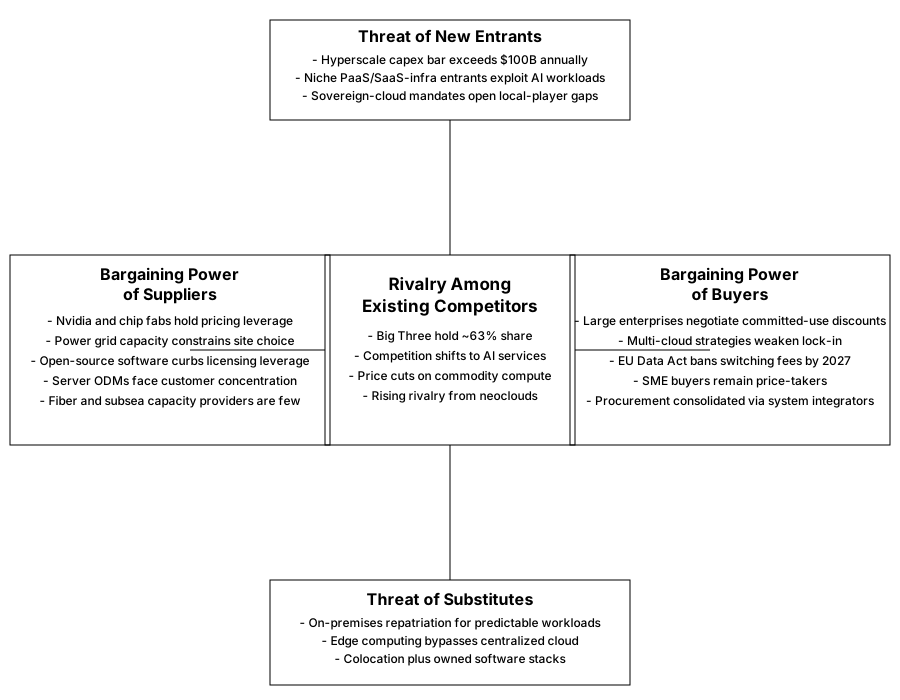
The cloud computing industry displays a distinctive structural pattern: extraordinarily high barriers to entry at the infrastructure layer coexisting with genuine openness to new entrants at the platform and application layers built on top of it. Rivalry among the three dominant hyperscalers remains intense but has settled into a stable oligopoly rather than a price war, with competition increasingly fought over AI capability rather than commodity compute pricing. Suppliers of advanced semiconductors and electrical power now hold unusual leverage over even the largest cloud providers, while buyers, particularly large enterprises pursuing multi-cloud strategies, have gained negotiating power as switching-cost regulation tightens. The overall picture is one of concentrated market power at the base of the stack, tempered by genuine competitive dynamism everywhere above it.
Bargaining power of buyers
Buyer power in cloud computing varies enormously by customer size and technical sophistication, producing one of the more polarized power distributions in any technology industry. Large enterprises that consume tens of millions of dollars in annual cloud spend can negotiate substantial committed-use discounts, custom service-level agreements and dedicated support arrangements and increasingly use credible multi-cloud architectures as leverage in renewal negotiations even when most workloads ultimately stay with a single primary provider. This leverage has strengthened further as regulators move to eliminate the switching fees that once made changing providers prohibitively expensive; the European Union's Data Act will prohibit cloud switching charges, including data egress fees, from January 2027, directly targeting the mechanism providers used to raise the cost of buyer mobility.
Small and medium-sized enterprises sit at the opposite end of this spectrum, typically accepting list pricing or standard discount tiers with little room to negotiate and often selecting a provider based on the recommendation of a software vendor or systems integrator rather than independent evaluation. Independent software vendors occupy a middle position: they carry meaningful volume leverage but also face high technical switching costs once their applications are architected around a specific provider's proprietary services, which softens their bargaining position considerably compared with their raw spending power. Government buyers increasingly wield a different kind of power, using sovereignty and data-residency requirements to compel providers to build in-country infrastructure or partner with domestic operators, effectively forcing concessions that market economics alone would not produce.
| Buyer segment | Typical leverage | Primary constraint |
|---|---|---|
| Large multinational enterprise | High, via committed spend and multi-cloud posture | Architectural lock-in on proprietary services |
| Independent software vendor | Moderate, via volume | Deep technical integration with one platform |
| Small and medium-sized business | Low | Limited technical resources to evaluate alternatives |
| Government and public sector | High, via sovereignty mandates | Long procurement cycles and security certification needs |
Bargaining power of suppliers
Suppliers to the cloud computing industry have gained unusual leverage over the past several years, a reversal from the earlier era when hyperscalers dictated terms to nearly every vendor in their supply chain. The clearest example sits in advanced semiconductors, where a small number of chip designers and foundries control the graphics processing units [GPUs] and custom silicon that power AI workloads, giving them substantial pricing power and allocation control even over customers as large as the hyperscalers themselves. Electrical utilities and grid operators have become a second critical supplier constraint, since data center site selection now depends as much on available power capacity as on land or connectivity and utilities in many regions cannot expand generation and transmission fast enough to match demand.
Server and networking equipment manufacturers retain some leverage but less than chipmakers, since hyperscalers increasingly design their own custom silicon and networking hardware to reduce dependence on any single vendor, a strategy that trades supplier risk for higher fixed capital investment. Open-source software communities function as an unusual supplier category: they reduce licensing leverage for commercial software vendors but create a different dependency, since providers that build commercial offerings on open-source foundations must continue contributing to and maintaining compatibility with fast-moving upstream projects. Fiber-optic network and subsea cable operators round out the supplier landscape, controlling the physical connectivity that links data center regions together, a segment with high capital barriers and limited competitive alternatives on many international routes.
| Supplier category | Leverage driver | Trend |
|---|---|---|
| Advanced semiconductor designers and foundries | Concentrated supply of AI-optimized chips | Leverage rising as AI demand outpaces fab capacity |
| Electrical utilities and grid operators | Finite power capacity in prime markets | Increasingly binding constraint on new capacity |
| Server and networking hardware makers | Moderate concentration, some customization | Hyperscalers building custom silicon to reduce reliance |
| Open-source software maintainers | Community-governed, low direct pricing power | Growing indirect influence via ecosystem standards |
| Subsea and long-haul fiber operators | High capital barriers, few alternative routes | Stable but strategically important |
Rivalry among existing competitors
Rivalry at the infrastructure layer has consolidated into a stable three-way contest rather than the fragmented competition typical of earlier-stage industries. Amazon Web Services [AWS], Microsoft Azure and Google Cloud Platform [GCP] together account for roughly 63% of global cloud infrastructure spending, a share that has held remarkably steady even as the underlying market has expanded several times over, with AWS reporting $37.6 billion in quarterly revenue in early 2026, Azure sustaining growth above 38% for three consecutive quarters and Google Cloud posting 63% year-over-year growth in its fastest quarter on record. This stability suggests the three leaders are absorbing new demand roughly in proportion to their existing scale rather than taking share from one another through price competition, a pattern consistent with an oligopoly that has moved past its land-grab phase.
The nature of competition has shifted decisively toward Artificial Intelligence capability rather than commodity compute pricing, with each hyperscaler racing to offer proprietary foundation models, managed inference infrastructure and AI development tooling that differentiate their platforms beyond basic virtual machine pricing, which has become largely comparable across providers. Below the Big Three, a second tier of competitors, including Oracle Cloud Infrastructure, Alibaba Cloud and IBM Cloud, competes for specific workloads or geographies where the leaders have weaker footholds, often winning on price, sovereign-cloud positioning or deep integration with legacy enterprise software. A newer category of specialized "neocloud" providers has also emerged, offering GPU-dense infrastructure purpose-built for AI training and inference at lower cost than the hyperscalers, intensifying rivalry specifically within the AI infrastructure segment even as the broader IaaS market remains concentrated.
| Competitive dimension | Current dynamic | Strategic implication |
|---|---|---|
| Core infrastructure pricing | Largely converged across leading providers | Differentiation shifting away from price |
| AI platform capability | Intense investment race among all major players | Primary battleground for enterprise wallet share |
| Geographic and sovereign positioning | Regional and specialized players gaining share | Opens niches for non-hyperscaler competitors |
| GPU-dense specialized infrastructure | Rapid entry by neocloud providers | Compresses margin on AI compute specifically |
Threat of new entrants
Entry into general-purpose cloud infrastructure has become close to prohibitive given the capital scale now required, with the four largest hyperscalers alone planning roughly $725 billion in combined 2026 capital expenditure, a bar no new entrant could plausibly clear without an alternative source of massive, patient capital. This capital barrier compounds with a set of related advantages incumbents already hold:
existing global data center footprints, years of accumulated operational reliability, deep partner and reseller ecosystems and enormous installed customer bases that create powerful data gravity, since moving petabytes of existing enterprise data to a new provider is itself a significant undertaking regardless of price
The threat of entry looks entirely different one layer up the stack. Building a specialized platform-as-a-service offering, a vertical-specific AI tool, or a narrow infrastructure niche such as GPU rental for AI training requires a fraction of the capital and can succeed by renting underlying infrastructure from a hyperscaler rather than building it, a strategy several successful neocloud and AI infrastructure companies have used to scale quickly. Sovereign-cloud requirements have also opened a distinct entry path for regional and national players, since governments in Europe, the Middle East and Asia increasingly mandate domestic infrastructure ownership or control that global hyperscalers cannot always satisfy on their own, creating protected space for local operators, sometimes in partnership with the hyperscalers themselves.
| Entry pathway | Capital requirement | Realistic viability |
|---|---|---|
| General-purpose hyperscale infrastructure | Extremely high, tens of billions annually | Effectively closed to new entrants |
| Specialized AI or GPU infrastructure provider | Moderate to high, but scalable incrementally | Viable, several recent successful entrants |
| Vertical platform-as-a-service built on hyperscaler rails | Low to moderate | Highly viable, common entry point |
| Sovereign or regionally mandated cloud provider | High, but often subsidized or protected | Viable where regulation creates a moat |
Threat of substitutes
The most direct substitute for public cloud computing remains on-premises infrastructure and a meaningful minority of enterprises have pursued selective workload repatriation in recent years, moving predictable, steady-state applications back to owned infrastructure once the total cost of running them in the cloud exceeded the cost of owning equipment outright over a multi-year horizon. This repatriation trend has not reversed the broader shift to cloud, but it has forced providers to compete more seriously on cost transparency for stable, high-utilization workloads, since those are precisely the workloads where owning infrastructure can beat renting it.
Edge computing represents a more structural substitute for a specific category of workload, processing data closer to where it is generated rather than routing it to a centralized cloud region, which matters increasingly for latency-sensitive applications in manufacturing, autonomous systems and telecommunications. Colocation paired with self-managed software stacks offers a third substitute path, letting companies rent physical space and power while retaining full control over their infrastructure software, a model that appeals to organizations with strict data-control requirements but the technical staff to manage their own systems. None of these substitutes threatens to displace cloud computing broadly, since the operational simplicity and elastic scalability of managed cloud services remain difficult to replicate, but each chips away at specific workload categories where cloud's core value proposition matters less.
| Substitute | Workload profile favoring it | Constraint limiting adoption |
|---|---|---|
| On-premises repatriation | Stable, predictable, high-utilization workloads | Loses elasticity and requires capital and staff |
| Edge computing | Latency-sensitive, distributed data generation | Limited to specific use cases, not general-purpose |
| Colocation with self-managed stack | Strict data control and compliance needs | Requires in-house infrastructure expertise |
| Legacy managed hosting | Simple, low-complexity applications | Lacks elasticity and modern platform tooling |
Value chain and profit pools
The cloud computing value chain begins with upstream inputs that few customers ever see directly: semiconductor design and fabrication, server and networking hardware manufacturing and the land, power and construction contracts required to build physical data centers. This stage is the most capital-intensive in the entire chain and increasingly the most supplier-constrained, given the tight global supply of advanced AI chips and the growing difficulty of securing sufficient electrical power in prime data center markets.
The second stage, infrastructure operation, converts those physical inputs into rentable compute, storage and networking capacity, requiring continuous investment in facility maintenance, energy efficiency and security hardening. Above that sits the platform and services layer, where providers build managed databases, container orchestration, AI model hosting and developer tools that abstract raw infrastructure into higher-level, easier-to-consume products; this is where most software engineering investment concentrates and where providers embed the proprietary features that create switching costs.
Distribution in this industry looks different from physical goods, since delivery is instantaneous over the internet, but a substantial go-to-market layer still exists in the form of direct enterprise sales teams, cloud marketplaces and a vast ecosystem of resellers, systems integrators and managed service providers who package cloud services for customers who lack the technical staff to buy and configure them directly. The customer interface stage covers account management, billing, support and the developer experience surrounding documentation and tooling, which matters more than it might appear, since a confusing or unreliable developer experience can undo the technical advantages of an otherwise strong platform. Finally, an enabling layer of security, identity management, compliance certification and cost governance runs across the entire chain, increasingly sold as a distinct set of products rather than bundled invisibly into infrastructure pricing.
Profit pool
Profit concentration in cloud computing has shifted decisively upward through the stack over the past decade. Raw infrastructure-as-a-service, the segment that first defined the industry, now carries the thinnest margins of any layer, compressed by years of aggressive price competition among the hyperscalers and increasingly commoditized as virtual machine and storage pricing converges across providers. Margin has instead concentrated in managed platform services, developer tooling and, most recently, AI model hosting and inference, where proprietary software and genuine performance differences justify premium pricing that customers accept because switching away from an embedded platform is technically painful and operationally risky.
This shift explains why every major hyperscaler now describes itself less as an infrastructure company and more as an AI and platform company, since that framing reflects where profit actually accumulates rather than where the industry's revenue historically originated. A useful way to think about this is that infrastructure has become the loss-leading or low-margin foundation that earns the right to sell the much higher-margin services built on top of it, a dynamic not unlike how retailers once used low-margin staple goods to draw customers toward higher-margin discretionary purchases.
The provider that captures a customer's data gains a durable claim on that customer's future AI and platform spending, which is why data gravity, not compute pricing, has become the industry's real battleground
Systems integrators and managed service providers capture a smaller but meaningful slice of the profit pool, particularly for mid-market customers who lack the technical depth to design and operate cloud architecture themselves and this segment has grown as AI adoption creates fresh demand for implementation expertise that outstrips what internal enterprise teams can supply.
Industry economics and business models
Four business model patterns dominate cloud computing, each with distinct economics. Consumption-based infrastructure pricing, the model most associated with the industry's origins, charges customers for exactly the compute, storage and data transfer they use, which minimizes upfront customer commitment but creates revenue volatility for providers and depends heavily on usage growing over time to offset the fixed cost of building capacity ahead of demand. Reserved and committed-use pricing modifies this model by trading customer discounts for multi-year revenue certainty, a trade providers actively encourage because it improves capacity planning and locks in customer relationships well before contract renewal conversations begin.
Subscription-based platform and software pricing, more common in the PaaS and SaaS-enabling layers, charges a recurring fee for access to a managed service regardless of exact usage, which smooths revenue and typically carries higher gross margin than pure consumption pricing since the underlying infrastructure cost is a smaller share of the price customers pay. A fourth pattern, increasingly important as AI reshapes the industry, is usage-metered AI services priced per token, per inference call or per unit of model training compute, a hybrid that behaves like consumption pricing but commands premium unit economics because the underlying models represent genuine intellectual property rather than commodity infrastructure. Marketplace and ecosystem revenue-sharing models round out the picture, where hyperscalers take a percentage of sales made by third-party software vendors listed on their cloud marketplaces, extending the platform's reach without requiring the hyperscaler to build every application itself.
Cost drivers and scalability
Cloud computing's cost structure sits at the extreme fixed-cost end of the spectrum, dominated by data center construction, server and networking hardware and increasingly by the electrical power contracts required to run AI-optimized facilities. Once that fixed infrastructure exists, the marginal cost of serving an additional customer or an additional unit of compute is comparatively small, which is exactly why the industry rewards scale so aggressively:
a provider that fills its data centers to high utilization spreads enormous fixed costs across a larger revenue base than a smaller competitor with the same facilities running at lower occupancy
This scale dynamic produces genuine economies of scale in purchasing power for hardware and energy, in the ability to spread research and development investment for AI models across a vastly larger customer base and in negotiating leverage with chip suppliers that smaller providers simply cannot replicate. It also produces a powerful growth loop: greater scale funds more capital investment in infrastructure and AI capability, which attracts more customers and workloads, which generates more usage data to improve AI services, which in turn strengthens the platform's appeal to the next wave of customers. Utilization functions as the single most important unit-economics metric in this industry, since underused infrastructure destroys returns on some of the largest capital commitments any company makes, which is why hyperscalers now discuss data center utilization and power efficiency with the same intensity that airlines discuss load factor.
Moats, advantages and strategic levers
Defensibility in cloud computing rests on several overlapping foundations rather than any single source of advantage. Cost advantage from scale remains real but has become table stakes among the three leading hyperscalers rather than a differentiator, since all three can access capital and negotiate hardware pricing at levels smaller competitors cannot match. Switching costs provide a far more durable moat, arising from the deep technical integration between a customer's applications and a provider's proprietary services, the operational risk and cost of migrating large volumes of data and the retraining required when engineering teams have built expertise around one provider's specific tooling.
Data gravity functions as a related but distinct advantage: once a company's data accumulates within a provider's ecosystem, the provider gains a durable advantage in selling AI and analytics services that depend on proximity to that data, since moving data to run computation elsewhere often costs more than simply buying the incremental service where the data already sits. Network effects operate at the ecosystem level rather than the classic two-sided marketplace level, since a larger base of third-party developers and independent software vendors building on a platform makes that platform more valuable to enterprise customers seeking a rich partner ecosystem, which in turn attracts more developers. Regulatory moats have begun to matter as well, particularly for providers that have invested early in the security certifications and sovereign-cloud infrastructure that government and regulated-industry customers require, since those certifications take years to earn and cannot be shortcut by well-funded new entrants.
Strategic levers
Providers and challengers alike can pull several distinct levers to build or defend position in this industry. Customer segment focus allows a company to win by serving a specific buyer type exceptionally well, whether that means small businesses needing simplicity, regulated industries needing compliance depth, or AI-native startups needing the cheapest possible GPU access, rather than trying to serve every segment at once the way the hyperscalers must. Product scope decisions separate providers that pursue horizontal breadth, offering every service a customer might conceivably need, from those that pursue narrow depth in a single category, such as AI inference or database management, betting that focused excellence beats broad mediocrity.
Vertical integration versus partnering represents a third lever, visible in the hyperscalers' growing push into custom silicon design to reduce chip supplier dependence, against the alternative strategy of partnering closely with chip and software vendors to move faster without carrying the capital burden of building everything internally. Geographic expansion remains a meaningful lever specifically because of sovereign-cloud requirements, rewarding providers willing to build regional infrastructure and local partnerships even in markets too small to justify a full-scale hyperscale investment. Ecosystem orchestration, the fifth lever, involves actively cultivating the third-party developers, independent software vendors and systems integrators who extend a platform's reach, since a provider that orchestrates a thriving partner ecosystem captures value it never has to build directly itself.
Structural risks, regulation and trends
Regulatory risk has intensified from multiple directions simultaneously. Data sovereignty rules across the European Union, Middle East and parts of Asia increasingly require that certain categories of data remain within national borders under domestic legal control, forcing providers to build regionally isolated infrastructure that raises operating costs and fragments the economies of scale that make the industry profitable. The European Union's Data Act, which bans cloud switching fees including data egress charges from January 2027, directly targets a lock-in mechanism providers have relied on for years and similar scrutiny of bundling and self-preferencing practices continues under broader digital-market competition rules.3 Export controls on advanced semiconductors add a geopolitical risk layer specific to this industry, since AI infrastructure buildout depends on chips whose international sale is now subject to national security review in several major markets.
Technology disruption risk centers overwhelmingly on Artificial Intelligence, which is simultaneously the industry's largest growth driver and its greatest source of competitive volatility, since a provider that falls behind in model quality or inference efficiency risks losing the AI workloads that increasingly determine which platform a customer chooses as its primary provider. Commodity price risk remains concentrated in the infrastructure layer, where continued price convergence across providers threatens to compress margins further unless providers successfully migrate customers toward higher-margin platform and AI services. Power availability has emerged as an underappreciated structural constraint, since data center growth in several major markets is now gated by grid capacity rather than capital, land or hardware availability, a bottleneck likely to shape where new capacity gets built over the coming decade.
Secular demand trends remain broadly favorable, driven by continued enterprise digital transformation, accelerating AI adoption across every industry vertical and a wave of application modernization as companies retire legacy systems in favor of cloud-native architecture. On the supply side, the industry is trending toward greater specialization, with neocloud providers, sovereign operators and vertical platform companies carving out defensible niches around the hyperscaler core rather than attempting to compete head-on with it.
For companies considering entry, the viable playbook runs through narrow specialization rather than broad competition: building a defensible position in a specific workload, geography or regulatory niche, choosing carefully between building proprietary infrastructure and renting hyperscaler capacity to reach the market faster and treating regulatory compliance as a competitive asset in sovereign and regulated-industry markets rather than merely a cost of doing business. For incumbents, the playbook centers on deepening the switching costs and data gravity that already protect their position, expanding aggressively into the AI services layer where margin is concentrating and using scale advantages in capital and chip procurement to maintain a cost position that smaller rivals cannot match even as they lose share in commodity infrastructure pricing.
Caselet: Snowflake and the platform layer's independent path
Snowflake offers a useful window into how a company can build a highly profitable business squarely inside the cloud computing value chain without owning any of the underlying infrastructure that defines the hyperscalers. Founded in 2012 and built from the outset to run entirely on top of AWS and later Azure and Google Cloud as well, Snowflake specialized in a single, well-defined problem: making it dramatically easier for enterprises to store, query and share large volumes of data without managing the underlying database infrastructure themselves. Rather than competing with the hyperscalers on infrastructure, the company positioned itself as a tenant of all three simultaneously, a decision that shaped its entire competitive strategy from the beginning.
That multi-cloud posture became one of Snowflake's clearest differentiators. Enterprise customers wary of deepening dependence on a single hyperscaler could adopt Snowflake's data platform and run it on whichever underlying cloud infrastructure they already used, or split workloads across more than one, without changing how they interacted with their data day to day. This let Snowflake capture a share of enterprise spend that might otherwise have gone directly to a hyperscaler's own managed database products, illustrating how a platform-layer company can insert itself between infrastructure providers and end customers by offering something the infrastructure providers, as multi-cloud-averse competitors of one another, structurally could not:
genuine cross-cloud portability
Snowflake's business model also demonstrates the industry's broader shift toward consumption-based pricing at the platform layer. Rather than charging a flat subscription, the company bills customers based on the compute and storage they actually consume running queries against their data, a model that ties Snowflake's revenue directly to how deeply embedded it becomes in a customer's daily operations. This consumption model produces the kind of expansion revenue dynamic that platform businesses prize:
existing customers naturally increase spend over time as they run more workloads through the platform, without requiring an entirely new sales cycle, since usage growth happens organically as data volumes and query complexity increase
The company's evolution since its 2020 initial public offering also tracks the industry-wide pivot toward Artificial Intelligence. Snowflake has layered AI and machine learning tooling directly into its data platform, letting customers build and query AI models against data that already sits inside Snowflake rather than exporting it to a separate AI infrastructure provider, a strategic response to the same data-gravity dynamic that favors hyperscalers at the infrastructure layer. This positioning reflects a broader lesson for platform-layer competitors across the industry:
the durable defense against hyperscaler encroachment is not competing on infrastructure scale, which is unwinnable, but building deep enough integration with a customer's data and workflows that switching away becomes operationally painful regardless of which cloud infrastructure sits underneath
Snowflake's experience also illustrates the risks facing platform-layer companies in this industry. Because it depends entirely on renting capacity from the hyperscalers it partly competes with for platform revenue, its cost structure remains exposed to infrastructure pricing decisions outside its control and its addressable market inevitably shrinks wherever a hyperscaler's own native database and AI tooling closes the capability gap that originally justified paying for a separate platform layer. That tension, building genuine differentiation on top of infrastructure controlled by potential competitors, defines much of the strategic challenge facing every company that operates in the platform layer of cloud computing rather than at its infrastructure base.
Cloud computing has become the operating substrate for global business, converting capital-intensive computing into a metered utility that any company can rent by the hour. Its economics reward scale relentlessly: fixed infrastructure costs spread across millions of tenants, while proprietary services and data gravity keep customers from leaving even when raw compute prices fall. The center of gravity is shifting from commodity infrastructure toward AI-native platform services, where differentiation and pricing power both live. Incumbents defend position by deepening integration between compute, data and models, while new entrants win by attacking narrow, underserved workloads that hyperscalers serve poorly. For boards, the strategic lever that matters most is architectural: keeping enough workload portability to negotiate seriously, without sacrificing the integration benefits that make a primary platform valuable in the first place.
Citation
Cite this article
Sridharan, M. A. (2023, October 1). Industry Analysis: Cloud Computing. Think Insights. https://thinkinsights.net/strategy/industry-analysis-cloud-computing (Accessed [[ACCESS_DATE]])
Sridharan, Mithun A. "Industry Analysis: Cloud Computing." Think Insights, 1 Oct. 2023, https://thinkinsights.net/strategy/industry-analysis-cloud-computing. Accessed [[ACCESS_DATE]].
Mithun A. Sridharan, "Industry Analysis: Cloud Computing," Think Insights, October 1, 2023, https://thinkinsights.net/strategy/industry-analysis-cloud-computing. Accessed [[ACCESS_DATE]].
Sridharan, M.A. (2023) 'Industry Analysis: Cloud Computing', Think Insights. Available at: https://thinkinsights.net/strategy/industry-analysis-cloud-computing (Accessed: [[ACCESS_DATE]]).
M. A. Sridharan, "Industry Analysis: Cloud Computing," Think Insights, 2023. [Online]. Available: https://thinkinsights.net/strategy/industry-analysis-cloud-computing. [Accessed: [[ACCESS_DATE]]].
Sridharan MA. Industry Analysis: Cloud Computing. Think Insights. Published October 1, 2023. Accessed [[ACCESS_DATE]]. https://thinkinsights.net/strategy/industry-analysis-cloud-computing
Test Your Knowledge
Industry Analysis: Cloud Computing
Challenge yourself on the concepts from this article and see how well you understood them.
Subscribers get weekly quizzes and insights — subscribe free
Sponsor this article
Partner with Think Insights
Reach 50,000+ business leaders, consultants, and strategists. Feature your brand alongside expert articles on strategy, leadership, and digital transformation.
Become a Sponsor