Industry Analysis: Clinical Research CROs


Sponsors should treat contract research organization [CRO] selection as a capital allocation decision, not a procurement exercise, because the CRO controls trial timelines and data quality that determine whether a molecule ever reaches a regulator. The industry sits at roughly 90 to 100 billion dollars in annual revenue, growing near 8 to 9% a year, propelled by biotech's structural reliance on variable-cost development capacity. Margin concentrates with large, full-service CROs that own global site networks, proprietary data platforms and late-phase and post-approval capabilities, not with commodity site-management or staffing providers. Bargaining power is shifting toward sponsors that consolidate spend into strategic partnerships and toward technology-enabled decentralized trial platforms that erode the site-visit model. Incumbents that fail to invest in Artificial Intelligence-driven patient recruitment and real-world data integration risk losing share to leaner, therapeutic-area specialists.
Is the clinical research and CRO industry attractive for new entrants?
It is attractive in narrow slices and forbidding at the broad end. A generalist trying to build a full-service, multi-therapeutic global CRO from scratch faces prohibitive capital requirements, a decade-long trust-building cycle with sponsors and an entrenched set of five to six scaled incumbents. A specialist targeting one therapeutic area, one trial phase, or one region can enter profitably, because sponsors actively seek smaller partners who move faster than the majors and because private equity continues to fund founder-led niche CROs for eventual roll-up.
Which parts of the value chain are most profitable?
Late-phase and post-approval services, data management and biostatistics and regulatory affairs consulting carry the highest margins because they combine scarce expertise with recurring sponsor relationships. Site-level patient recruitment and monitoring, by contrast, remain the most labor-intensive and margin-thin segment, since sites and site-management organizations absorb much of the operational risk without capturing the pricing power that sits upstream with the CRO managing the overall program.
How is technology changing this industry?
Artificial Intelligence and decentralized trial platforms are compressing the two costliest variables in drug development, which are patient recruitment time and site monitoring labor. Electronic health record mining now identifies eligible patients in hours instead of weeks, remote monitoring reduces on-site visits and predictive analytics flag underperforming sites before they jeopardize a trial's timeline, collectively reshaping where CROs invest their margin.
What capabilities are table stakes versus differentiators?
Good Clinical Practice compliance, regulatory submission experience and a functioning global site network are table stakes that every credible CRO must offer. Differentiation now comes from proprietary data assets built across thousands of past trials, therapeutic-area depth in complex modalities such as cell and gene therapy and decentralized trial technology that measurably shortens enrollment timelines for sponsors under pressure to preserve patent-protected exclusivity.
How should investors and consultants evaluate opportunities in this industry?
Evaluate exposure to biotech funding cycles first, since small and mid-cap biotech spending is the most volatile source of CRO demand, while large pharma contracts are comparatively stable. Then examine backlog quality and book-to-bill ratio as leading indicators of revenue durability, assess therapeutic-area concentration risk and weigh whether a target's technology stack is proprietary or licensed, because licensed decentralized trial tools rarely produce a defensible advantage.
Why do pharmaceutical companies outsource clinical trials rather than build in-house capability?
Outsourcing converts a largely fixed internal cost structure into a variable, program-linked one, letting sponsors scale trial capacity up or down without carrying permanent headcount and infrastructure between drug programs. It also gives sponsors, particularly smaller biotechs, immediate access to global site networks and regulatory expertise that would take years and hundreds of millions of dollars to replicate internally.
What role does private equity play in the CRO industry?
Private equity has become a dominant owner of mid-sized and niche CROs, financing both organic expansion and the roll-up of smaller specialist firms into scaled platforms it can later sell to strategic acquirers or take public. This ownership structure has accelerated consolidation and injected additional capital into decentralized trial technology, but it has also raised sponsor concerns about service consistency during ownership transitions.
How does the shift to decentralized and hybrid trials affect the traditional site-based model?
Decentralized elements do not eliminate physical sites so much as reduce the frequency and burden of in-person visits, shifting some monitoring and data-collection value from site staff to remote platforms and telehealth vendors. Site-management organizations that fail to integrate these tools risk being disintermediated, while sites that embrace hybrid protocols can run more trials concurrently and improve their economics.
What is the biggest structural risk facing the industry over the next decade?
Overreliance on small and mid-cap biotech funding is the most immediate risk, because financing downturns can cause sponsors to pause or cancel trials with limited notice, directly hitting CRO backlogs. Over a longer horizon, the risk is technological displacement, where Artificial Intelligence-driven simulation and synthetic control arms reduce the number of enrolled patients and therefore the volume of billable services, that a given trial requires.
Where is patient recruitment and site geography heading?
Trial sponsors are expanding into Latin America, Eastern Europe and parts of Asia where patient populations are treatment-naive, recruitment costs are lower and regulatory frameworks have matured enough to support International Council for Harmonisation-aligned Good Clinical Practice standards. This geographic diversification lowers per-patient costs but adds operational complexity, data harmonization burden and geopolitical exposure that sponsors must manage through their CRO partners.
The pharmaceutical industry spends more to prove a new medicine works than it does to invent the medicine in the first place and most of that proof-generating work is no longer performed inside the companies that own the drug. It is performed by a distinct services industry: contract research organizations [CROs], site management organizations that recruit and operate the physical or virtual locations where patients participate in studies, clinical data management specialists and decentralized trial platforms that let patients contribute data from home. This industry does not discover drugs, own intellectual property or take on the commercial risk of a failed molecule. It sells the operational machinery, the regulatory literacy and the data infrastructure that turn a scientific hypothesis into a Food and Drug Administration or European Medicines Agency approval and it captures a growing share of every dollar spent on drug development in the process.
Industry at a glance
The industry's core service is running clinical trials and adjacent services, on behalf of pharmaceutical, biotechnology and medical device companies that either lack the internal capacity or prefer not to carry the fixed cost of doing so themselves. What falls inside the industry's scope: protocol design support, patient recruitment and site management, clinical monitoring, data management and biostatistics, regulatory affairs and submission support, pharmacovigilance and increasingly the software platforms that enable decentralized or hybrid trial models. What falls outside:
drug discovery and preclinical research performed by sponsors or specialized discovery contractors, manufacturing and supply chain services provided by contract development and manufacturing organizations and the commercial launch and marketing functions that begin only after approval
Customers are almost exclusively business-to-business, spanning large multinational pharmaceutical companies, mid-cap and small biotechs, medical device manufacturers and, to a lesser degree, government and academic research institutions running publicly funded trials. Demand is structurally tethered to two upstream sectors: pharmaceutical research and development spending, which sets the overall volume of trials commissioned and biotech venture and public-market financing, which determines how much of that volume comes from smaller, cash-constrained sponsors who almost universally outsource rather than build internal trial capability. More than 80% of clinical trials worldwide now involve a CRO in some capacity, a penetration rate that reflects how thoroughly outsourcing has become the default rather than the exception1.
The economics are dominated by service-fee and fee-for-service contracting, typically structured around fixed-price, cost-plus or milestone-based arrangements tied to enrollment and data-lock milestones, supplemented by functional service provider agreements where a sponsor embeds a CRO's specialists directly into its own team rather than outsourcing an entire trial. The industry is labor-intensive at its core, with monitors, data managers, biostatisticians and regulatory specialists constituting the majority of cost, though the largest players increasingly layer technology platforms, Artificial Intelligence-enabled analytics and proprietary data assets on top of that labor base to widen margins. Regulatory intensity is exceptionally high: every activity a CRO performs is governed by Good Clinical Practice [GCP] standards set through the International Council for Harmonisation and the 2025 update to ICH E6(R3) explicitly reaffirms that sponsors, not CROs, bear ultimate responsibility for trial quality and data integrity even when work is delegated. Capital intensity varies sharply by segment, from asset-light staffing and data management businesses to the far more capital-intensive laboratory, biorepository and specimen-analysis operations that sit within some diversified players.
Industry segmentation
The industry divides into six segments that differ in value chain position, customer type and the technology intensity required to compete. Full-service CROs sit at the top of the market, offering end-to-end trial management across all phases and therapeutic areas for large pharmaceutical sponsors that want a single accountable partner. Functional service provider firms sell discrete capabilities, such as data management, biostatistics or pharmacovigilance, as embedded extensions of a sponsor's own team, appealing to sponsors that want to retain overall trial control while filling specific capacity gaps.
Site management organizations occupy a distinct position closer to the patient, owning or coordinating networks of physical investigator sites and handling the recruitment, consent and day-to-day operational burden that a CRO subcontracts to them. Clinical data management and biostatistics specialists form a technology-heavy segment focused on the collection, cleaning, analysis and regulatory-grade documentation of trial data, a segment where accuracy errors carry outsized consequences and where demand has grown fastest alongside trial complexity. Decentralized and hybrid trial technology platforms represent the newest segment, selling software and connected devices, electronic patient-reported outcomes tools, telehealth integration and remote monitoring capability that reduce sponsors' reliance on physical site visits. Finally, laboratory and central testing services, spanning bioanalytical testing, biomarker analysis and specimen management, form a capital-intensive segment often bundled into diversified life-science tools conglomerates rather than operated as standalone businesses.
Market structure
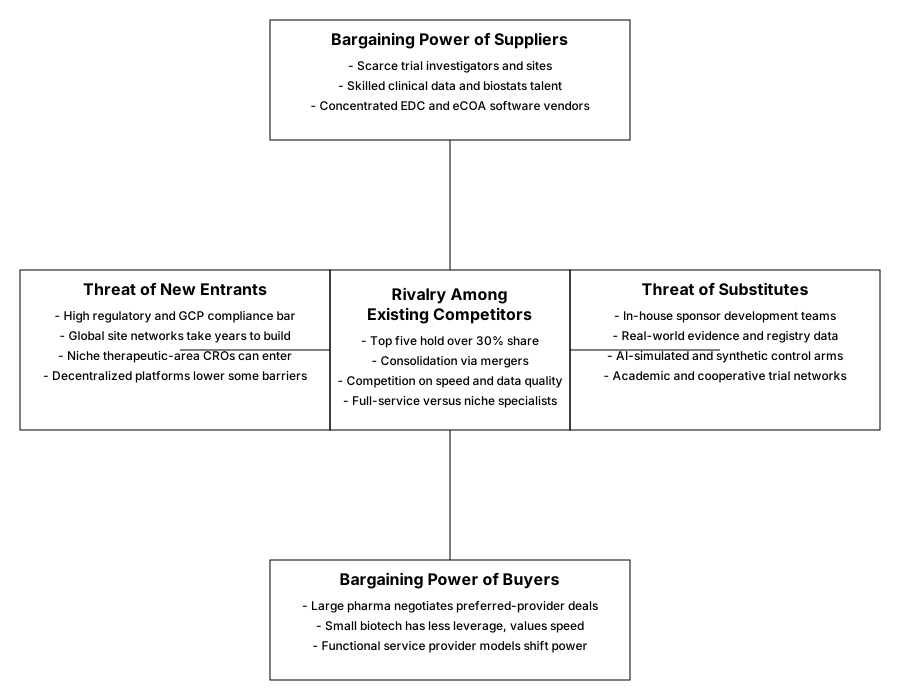
Industry structure is shaped by a small number of scaled, full-service incumbents competing against a long tail of therapeutic and functional specialists, with consolidation steadily narrowing the gap between the two tiers. Buyers, particularly large pharmaceutical companies, increasingly concentrate spend with two or three preferred providers, giving them meaningful leverage, while suppliers of scarce specialized labor, principal investigators and certain software platforms retain pricing power of their own. Entry barriers are formidable at the full-service end but far more permeable for niche players and substitution pressure is building steadily from in-house sponsor capability, real-world evidence and increasingly credible synthetic and Artificial Intelligence-simulated trial arms.
Bargaining power of buyers
Large pharmaceutical companies wield considerable leverage over their CRO partners because they represent enormous, repeatable volumes of trial work and because they have increasingly consolidated spend into strategic partnership agreements with two or three preferred providers rather than spreading contracts across dozens of vendors. This concentration lets a handful of top-20 pharmaceutical accounts negotiate preferential pricing, service-level guarantees and dedicated capacity, effectively converting what should be a fragmented buyer base into a set of a few hundred accounts that matter disproportionately to CRO revenue. Small and mid-cap biotechs sit at the opposite end of the spectrum:
they typically lack the volume to negotiate meaningful discounts and instead prioritize speed, therapeutic expertise and the CRO's ability to help them stretch limited cash runway, which gives CROs somewhat more pricing latitude on this side of the customer base even as these sponsors remain highly price-sensitive in absolute terms
The rise of functional service provider contracting has further shifted power toward buyers, since it lets sponsors disaggregate a CRO's services, retain control over the overall trial architecture and benchmark individual functions such as data management or monitoring against multiple vendors rather than committing to one full-service relationship. Switching costs, while real, are lower than they once were because standardized electronic data capture platforms and interoperable clinical trial management systems have reduced the friction of moving a program, or a functional workstream, from one provider to another mid-cycle. Buyers also increasingly evaluate CROs on measurable enrollment speed and data quality metrics rather than relationship history alone, forcing providers to compete on demonstrable performance.
| Buyer segment | Primary leverage source | Effect on pricing |
|---|---|---|
| Top-tier pharmaceutical companies | Consolidated multi-year strategic partnerships | Preferential rates, volume discounts |
| Mid-cap biotech sponsors | Moderate volume, high urgency | Balanced negotiating position |
| Small biotech and virtual sponsors | Low volume, high price sensitivity | Limited leverage, favors CRO |
| Government and academic sponsors | Budget-constrained, procurement rules | Fixed-price, competitive bidding |
Bargaining power of suppliers
The industry's most consequential supplier constraint is not a physical input but a human one: qualified principal investigators, experienced clinical research coordinators and specialized biostatisticians remain in persistently short supply relative to the volume of trials being commissioned, particularly in complex modalities such as cell and gene therapy where the pool of experienced investigators is genuinely small. This scarcity gives skilled personnel and the site networks that employ them real bargaining power, since a CRO or sponsor cannot substitute an inexperienced investigator into a complex oncology or rare-disease trial without risking data quality and regulatory scrutiny. Site-level supplier power is compounded by the fact that patient populations for many trials, especially in rare diseases, are themselves scarce, making the sites and academic medical centers that have access to those populations disproportionately powerful negotiating counterparts.
Software and technology suppliers form a second important category, where electronic data capture, electronic patient-reported outcomes and clinical trial management system vendors have consolidated enough that a handful of platforms now underpin much of the industry's data infrastructure, giving those vendors meaningful pricing power over CROs that have standardized their operations around a particular system. Laboratory reagents, biomarker assay kits and specialized testing equipment represent a more conventional supplier category with moderate concentration, though few single suppliers hold outsized leverage in this segment. Overall supplier power sits at a moderate-to-high level, concentrated specifically in human capital and core software infrastructure rather than commodity inputs.
| Supplier category | Concentration level | Leverage dynamic |
|---|---|---|
| Principal investigators and specialists | High in complex therapeutic areas | Investigators can set terms, choose sponsors |
| Clinical research coordinators | Moderate, regionally variable | Wage inflation pressure on site costs |
| EDC and eCOA software vendors | High, few dominant platforms | Vendor lock-in raises switching costs |
| Laboratory and reagent suppliers | Low to moderate | Limited pricing power |
Rivalry among existing competitors
Competitive intensity is high and has been actively reshaped by a decade of consolidation that began with the 2016 merger forming QuintilesIMS and continued through the 2021 combination of ICON and PRA Health Sciences and Thermo Fisher's acquisition of PPD, followed by Parexel's various ownership changes, the 2023 Fortrea spin-off from Labcorp, the Syneos Health take-private transaction and further 2026 deals including Thermo Fisher's acquisition of Clario Holdings and Worldwide Clinical Trials' purchase of Catalyst Clinical Research. The result is a market where the top five providers, principally IQVIA, ICON, Thermo Fisher Scientific, Labcorp and Medpace, collectively hold over 30% share, while the remainder of the market fragments across dozens of mid-sized and specialist competitors2.
Rivalry plays out along several dimensions simultaneously: full-service scale and global site reach, therapeutic-area depth in complex modalities, speed of patient enrollment, quality and defensibility of proprietary data assets and increasingly the sophistication of decentralized trial technology a provider can offer. Because switching a mid-trial CRO carries real operational risk for sponsors, competition is often won or lost at the proposal stage for a new program rather than through mid-contract displacement, which puts a premium on reputation, past performance data and relationship depth with a sponsor's development leadership. Private equity ownership of several mid-sized players has intensified rivalry further by injecting capital for aggressive bolt-on acquisitions aimed at building therapeutic-area or geographic credibility quickly rather than organically.
| Competitive dimension | How it plays out | Relative importance |
|---|---|---|
| Global site network scale | Full-service majors dominate large multinational trials | High for large pharma accounts |
| Therapeutic-area specialization | Niche CROs win complex or rare-disease programs | High and growing |
| Decentralized trial technology | Differentiator in enrollment speed and cost | Increasingly decisive |
| Price competitiveness | Matters most for straightforward, high-volume trials | Moderate, segment-dependent |
Threat of new entrants
Entry into the full-service, multi-therapeutic, globally scaled tier of this industry is genuinely difficult, requiring years to build the site relationships, regulatory track record and sponsor trust that large pharmaceutical accounts demand before committing a major program to a new provider. Good Clinical Practice compliance infrastructure, quality-management systems capable of surviving a regulatory audit and the working capital to fund program delivery well ahead of milestone-based payment are all costly and slow to establish and a new entrant without a credible track record faces a chicken-and-egg problem where it cannot win large trials without prior large-trial experience.
The picture looks different at the narrower end of the market. Therapeutic-area specialists, regional CROs focused on a single geography and decentralized trial technology companies face materially lower barriers, since sponsors, particularly smaller biotechs, actively seek smaller partners who can move faster and offer more senior attention than an overstretched major provider. Private equity has been an active financier of exactly this kind of entry, funding founder-led specialist CROs with the expectation of eventual consolidation into a larger platform. Decentralized trial platforms in particular have lowered the capital threshold for entering parts of the value chain that previously required a physical site network, since a software-enabled remote monitoring or eConsent offering can be built and sold without owning bricks-and-mortar clinical infrastructure.
| Entry pathway | Barrier level | Typical entrant profile |
|---|---|---|
| Full-service global CRO | Very high | Requires years, scale capital, sponsor trust |
| Therapeutic-niche specialist | Moderate | Founder-led firms, often private equity-backed |
| Regional or single-country CRO | Moderate | Local operators leveraging cost and access advantages |
| Decentralized trial technology vendor | Low to moderate | Software-first entrants without physical site assets |
Threat of substitutes
Substitution pressure comes from several directions rather than a single competing business model. The most direct substitute is a sponsor building internal clinical development capability rather than outsourcing, an option that remains viable for the largest pharmaceutical companies with the balance sheet to carry permanent trial-operations headcount, but one that most biotechs reject precisely because it converts a variable cost into a fixed one they cannot afford to carry across a volatile drug pipeline. Real-world evidence drawn from electronic health records, insurance claims data and patient registries represents a second, growing substitute, letting sponsors answer some regulatory and post-approval questions without commissioning a traditional prospective trial at all.
The most consequential emerging substitute is technological: Artificial Intelligence-driven trial simulation and synthetic control arms, which use historical patient data to model a comparator group rather than enrolling and monitoring an actual placebo cohort, directly reduce the volume of billable patient-enrollment and monitoring work a trial requires. Academic and cooperative research networks, along with government-funded trial consortia, offer a further partial substitute for certain therapeutic areas, particularly oncology and rare disease, where public funding and academic infrastructure can absorb some trial volume that would otherwise go to commercial CROs. None of these substitutes threatens to displace outsourced trial management wholesale in the near term, but each chips away at specific, historically lucrative components of the traditional service model.
| Substitute | Mechanism | Near-term threat level |
|---|---|---|
| In-house sponsor development teams | Fixed-cost internal capability | Low, limited to largest pharma |
| Real-world evidence and registries | Reduces need for some prospective trials | Moderate and growing |
| AI-simulated and synthetic control arms | Cuts enrolled-patient volume per trial | Moderate, rising quickly |
| Academic and cooperative trial networks | Publicly funded alternative capacity | Low to moderate, therapy-specific |
Value chain and profit pools
The value chain begins upstream with protocol design and feasibility assessment, where a CRO or its regulatory affairs team helps a sponsor translate a scientific hypothesis into a study design that will satisfy regulators while remaining operationally executable, a stage that requires deep therapeutic and regulatory expertise but consumes relatively little of the total trial budget. The second stage, site identification and activation, involves selecting and qualifying the physical or virtual locations where a trial will run, negotiating with investigators and getting institutional review board approval, work typically performed jointly by the CRO and any site management organization it engages.
Patient recruitment and enrollment forms the third stage and historically the single largest source of timeline risk, since a trial that cannot recruit enough eligible patients quickly enough delays a sponsor's entire development program and, by extension, its path to revenue; this is also the stage most directly being reshaped by Artificial Intelligence-driven electronic health record mining and decentralized recruitment tools. Trial execution and monitoring, the fourth stage, covers the ongoing conduct of the study, including on-site and remote visits, adverse event tracking and protocol compliance and represents the most labor-intensive and cost-heavy portion of the chain, one where accountability for quality sits legally with the sponsor even though the CRO performs the work day to day3. Data management and biostatistics, the fifth stage, transforms raw trial data into a regulatory-grade dataset and statistical analysis, a stage that commands premium pricing because errors here can invalidate an entire trial. The sixth stage, regulatory submission and pharmacovigilance, carries the work through to approval and beyond, while the final stage, enabling infrastructure, spans the technology platforms, quality systems and global operations backbone that make every preceding stage possible at scale.
Profit pool
Margin in this industry has migrated decisively toward the stages that combine scarce expertise with proprietary data and long-term sponsor relationships and away from stages that are purely labor-intensive and increasingly commoditized. Data management, biostatistics and regulatory affairs consulting now command the strongest margins, because the specialists who perform this work are scarce, the output is difficult to substitute without regulatory risk and CROs that have run thousands of prior trials can reuse proprietary benchmarking data and statistical models across new engagements in a way that smaller competitors cannot replicate. Late-phase and post-approval services, including real-world evidence generation and pharmacovigilance, have become a second significant profit pool as sponsors extend their engagement with development partners well beyond initial approval to support label expansions and safety monitoring.
By contrast, site-level patient recruitment and monitoring, historically viewed as the operational heart of the industry, has become the thinnest margin segment, since site management organizations absorb much of the execution risk and labor cost without capturing the pricing power that sits with the CRO managing the overall program above them. This bifurcation explains why the largest players have pushed aggressively into data, technology and late-phase services through acquisition, while site-level operations increasingly get subcontracted to lower-margin regional specialists. Decentralized trial technology represents the newest and still-evolving profit pool, one that could either reinforce the position of incumbents who successfully integrate it or erode traditional site-based revenue if it proves genuinely substitutive rather than complementary.
Industry economics and business models
Three business models dominate the industry, each suited to a different combination of sponsor need and provider capability. The full-service, fee-for-service model, used by the largest CROs, bundles protocol design through data delivery into a single accountable contract, typically priced through a combination of fixed fees for defined deliverables and milestone payments tied to enrollment or database lock and it suits sponsors that want to transfer maximum operational risk to a single partner. The functional service provider model instead prices individual capabilities, such as monitoring or biostatistics, on a time-and-materials or full-time-equivalent basis, embedding CRO staff directly into a sponsor's own governance structure, an approach favored by large pharmaceutical companies that want to retain overall program control while filling specific capacity gaps flexibly.
A third and growing model centers on platform and subscription-based decentralized trial technology, where providers license software for electronic consent, remote data capture and patient engagement on a per-trial or per-patient basis rather than billing purely for labor hours, a structure that behaves more like a technology business than a traditional services business and carries meaningfully different margin dynamics. Many of the largest diversified players now blend all three models within a single organization, cross-selling data platform subscriptions on top of traditional fee-for-service trial delivery, which both raises switching costs for sponsors and smooths revenue volatility across the underlying business.
Cost drivers and scalability
Labor dominates the industry's cost structure, with monitors, coordinators, data managers, biostatisticians and regulatory specialists collectively accounting for the majority of operating expense at any full-service CRO, which makes personnel utilization, essentially the proportion of staff time billed to active client programs rather than sitting idle between engagements, the single most important unit economic in the business. High utilization compounds directly into margin, which is why the largest players invest heavily in workforce planning systems and cross-training staff across therapeutic areas to keep utilization rates high even as individual trial demand fluctuates. Fixed costs are concentrated in quality-management infrastructure, regulatory compliance systems and increasingly the technology platforms underpinning decentralized trial capability, all of which get amortized more efficiently across a larger volume of trials, giving scaled players a structural cost advantage that smaller specialists cannot easily replicate.
Economies of scale operate powerfully at the site-network level, since a CRO that already maintains relationships with thousands of qualified investigator sites globally can activate a new trial faster and more cheaply than a competitor building site relationships from scratch for each new program, an advantage that helps explain why the overall market is projected to keep expanding toward roughly 134 billion dollars by 2035 even as individual competitors consolidate share4. Economies of scope operate at the data level, where a CRO with a large historical trial database can reuse statistical benchmarks, site-performance data and patient-recruitment predictive models across new engagements, directly improving both speed and cost for the sponsor while widening the CRO's own margin. This is a genuine flywheel:
more trials generate more proprietary data, which improves recruitment prediction and site selection, which shortens timelines and improves win rates on future proposals, which in turn generates still more trials and data, reinforcing the advantage of already-scaled incumbents over new entrants who lack a comparable historical dataset
Moats, advantages and strategic levers
The industry's most durable moat is regulatory and reputational trust accumulated over years of audited, successful trial delivery, since a sponsor betting hundreds of millions of dollars on a drug program will not hand that program to a provider without a credible track record, making incumbency itself a powerful, self-reinforcing advantage. Proprietary data assets built across thousands of historical trials constitute a second significant moat, letting scaled CROs predict site performance, patient enrollment rates and protocol risk with an accuracy that a new entrant, lacking comparable historical data, simply cannot match regardless of how sophisticated its underlying technology may be.
Switching costs, while lower than in some other business services categories thanks to standardized data platforms, remain meaningful mid-trial, since moving an active program to a new provider risks data continuity, timeline delays and regulatory scrutiny, all of which sponsors go to considerable lengths to avoid once a trial is underway. Global site network breadth functions as a scale-based moat that is genuinely difficult to replicate quickly, since building trusted relationships with thousands of investigators across dozens of countries requires years of consistent engagement rather than capital alone. Therapeutic-area depth, particularly in complex and fast-growing modalities such as cell and gene therapy, oncology and rare disease, provides a differentiation-based moat for specialist players, since sponsors in these areas will pay a premium for a provider whose staff have genuinely run comparable trials before rather than one learning on the job.
Strategic levers
An entrant or a challenger incumbent has several credible levers available and the right combination depends heavily on starting position and capital access. Focusing deliberately on one therapeutic area or trial phase rather than competing broadly lets a smaller player build genuine expertise and win sponsor trust faster than trying to match a full-service major's breadth and this focus strategy has been the most consistent path for private equity-backed entrants over the past decade. Choosing where to sit on the vertical integration spectrum matters just as much:
a provider can build its own proprietary decentralized trial technology, acquire it, or partner with an independent platform vendor and each choice carries a different capital intensity and speed-to-market trade-off that should map to the firm's existing balance sheet strength
Geographic expansion into markets with lower patient recruitment costs and treatment-naive populations, particularly parts of Latin America, Eastern Europe and Asia, offers a genuine cost advantage for sponsors and a growth avenue for CROs willing to invest in the regulatory relationships and quality infrastructure those markets require. Ecosystem orchestration, where a CRO positions itself as the integrator of a fragmented set of decentralized trial vendors, laboratory partners and data platforms rather than trying to own every capability itself, offers a capital-light path to breadth that several mid-sized players have pursued successfully as an alternative to outright acquisition.
Structural risks, regulation and trends
The industry's most immediate structural risk is its exposure to small and mid-cap biotech funding cycles, since a financing downturn can cause sponsors to pause, delay or cancel trials on short notice, directly compressing CRO backlogs even though large pharmaceutical demand tends to remain comparatively stable through the same cycle. A second, longer-horizon risk is technological displacement, where continued advances in Artificial Intelligence-driven trial simulation and synthetic control arms could gradually reduce the number of enrolled patients and therefore the volume of billable monitoring and site work, that a given regulatory approval requires. Regulatory risk cuts in a more nuanced direction:
while the 2025 update to ICH E6(R3) reinforces sponsor accountability rather than loosening it, evolving global harmonization of Good Clinical Practice standards is gradually making it easier to run trials across multiple jurisdictions simultaneously, which favors scaled global CROs over regionally confined competitors
On the demand side, secular growth remains firmly intact. The global clinical trials market is projected to expand from roughly 135 billion dollars in 2026 to more than 176 billion dollars by 2030, driven by rising trial complexity, an aging population generating more chronic-disease research and the continued growth of biopharmaceutical pipelines in oncology, rare disease and cell and gene therapy5. The CRO services market specifically is projected to grow from roughly 93 billion dollars in 2026 to 140 billion dollars by 2031, a compound annual growth rate near 8.6%. North America still accounts for roughly half of global CRO services revenue, though Asia-Pacific is expanding at a notably faster clip, projected near an 11% compound annual growth rate through 2031, reflecting both lower-cost patient recruitment and maturing local regulatory infrastructure6. Decentralized clinical trial technology, still a comparatively small 8.5 billion dollar market, is attracting outsized investment attention because Artificial Intelligence applications are directly addressing the industry's two most persistent inefficiencies, patient recruitment delay and site monitoring cost.
For a new entrant, the sensible playbook is narrow rather than broad: pick a therapeutic niche or a single geography, build genuine expertise and a credible track record there and resist the temptation to compete head-on with a full-service major until that foundation is proven, since the capital and trust required to compete broadly from day one are simply too high for most new entrants to sustain. Partnering with, rather than building, decentralized trial technology is often the more capital-efficient regulatory strategy for a new entrant, since the technology layer is evolving quickly enough that owning it outright risks becoming an expensive, rapidly depreciating asset. For incumbents, the playbook centers on deepening the data and technology moat that already separates the top five providers from the rest of the market, expanding selectively into faster-growing therapeutic areas such as cell and gene therapy rather than defending share uniformly across a broad portfolio and continuing to acquire specialist capability where organic development would take too long relative to the pace of sponsor demand.
The CRO that treats a sponsor's molecule with the same urgency the sponsor feels is the CRO that wins the next program, regardless of how large its global footprint already is
Caselet: ICON plc and the economics of scaled consolidation
ICON plc offers a useful window into how consolidation reshapes economics in this industry, because the company's trajectory over the past decade traces almost every structural force described above. Founded in Dublin in 1990, ICON began as a modest contract research provider focused on the European market and grew steadily through the 1990s and 2000s by building out therapeutic expertise and a global site network, eventually establishing itself among the mid-tier of publicly traded CROs, well behind the scale of Quintiles or Covance at the time.
The defining moment in ICON's modern history came in 2021, when it completed its acquisition of PRA Health Sciences, a transaction that roughly doubled its revenue base and vaulted it into the industry's top tier alongside IQVIA and the Thermo Fisher-owned PPD franchise. The logic behind the deal illustrates the profit pool dynamics discussed earlier: PRA brought particular strength in late-phase and real-world evidence services, exactly the higher-margin segment where the industry's economics have concentrated, while ICON contributed complementary early-phase and site-network capability. Combining the two created a full-service platform capable of competing for the largest, most complex global trial programs that neither company could credibly pursue alone, while also giving the combined entity enough scale to amortize its technology and quality infrastructure investments across a substantially larger revenue base.
ICON's subsequent strategy has leaned heavily on the strategic levers available to a scaled incumbent rather than a challenger. The company has continued smaller, targeted acquisitions to deepen specific therapeutic and technology capabilities rather than pursuing another transformational merger, reflecting the incumbent playbook of deepening moats selectively rather than expanding uniformly. It has also invested visibly in decentralized trial and Artificial Intelligence-enabled recruitment technology, recognizing that the largest full-service players cannot afford to cede this ground to smaller, more nimble platform vendors, even though building genuinely differentiated technology inside a services-heavy organization remains organizationally difficult.
ICON's experience also illustrates the industry's persistent exposure to biotech funding cycles, since the company, like its full-service peers, has had to manage revenue volatility tied to smaller sponsors delaying or canceling trials during financing downturns, even as its large pharmaceutical relationships have provided a comparatively stable revenue floor. This dual exposure, stable large-account demand cushioning volatile smaller-sponsor demand, mirrors the buyer-power dynamics described earlier in this analysis and explains why ICON, like its major competitors, has continued pushing to deepen strategic partnership agreements with its largest pharmaceutical accounts even as it courts emerging biotech sponsors for future growth.
The company's scale has also given it negotiating leverage with the supplier side of its own value chain, particularly around site network relationships and technology platform licensing, in ways that smaller regional CROs cannot replicate. That combination of buyer-side stability from large accounts and supplier-side leverage from scale is precisely the structural position that Porter's framework predicts should generate superior, more defensible margins over time and ICON's post-merger financial performance has broadly borne that prediction out, reinforcing why consolidation has remained the dominant strategic logic across the industry's top tier rather than a one-time event.
Frequently overlooked dynamic worth naming
One dynamic that rarely receives adequate attention in popular commentary on this industry is that the CRO business model quietly depends on sponsors continuing to prefer variable-cost outsourcing over fixed-cost internal capability, an assumption that has held for decades but is not immutable. Should Artificial Intelligence-driven trial simulation mature to the point where a meaningful share of comparator and safety data can be generated computationally rather than through live patient enrollment, the fundamental unit of billable work in this industry, the enrolled and monitored patient, would shrink even as the number of approved drugs kept rising. That scenario would not eliminate the industry, since regulatory bodies remain conservative about accepting purely simulated evidence for pivotal safety and efficacy claims, but it would compress the labor-intensive core of the value chain faster than most current market forecasts appear to assume, rewarding the CROs that have already begun repositioning around data and technology rather than headcount.
The clinical research and CRO sector converts the pharmaceutical industry's fixed regulatory burden into a variable, outsourced cost, a structural role that keeps demand resilient even when biotech funding cycles turn. Economics favor scale in global site access, data infrastructure and therapeutic depth, while margin has migrated from transactional staffing toward integrated, technology-enabled full-service delivery. The decisive levers for any player are functional specialization within a defensible therapeutic niche, ownership of decentralized trial and Artificial Intelligence-driven recruitment technology and disciplined geographic expansion into markets where patient recruitment costs remain low. Consolidation will continue, buyers will keep concentrating spend with fewer preferred providers and the organizations that make regulatory compliance a source of speed rather than friction will keep capturing disproportionate value from an industry underwritten by the world's persistent demand for new medicines.
Citation
Cite this article
Sridharan, M. A. (2023, June 17). Industry Analysis: Clinical Research CROs. Think Insights. https://thinkinsights.net/strategy/industry-analysis-clinical-research-cros (Accessed [[ACCESS_DATE]])
Sridharan, Mithun A. "Industry Analysis: Clinical Research CROs." Think Insights, 17 June 2023, https://thinkinsights.net/strategy/industry-analysis-clinical-research-cros. Accessed [[ACCESS_DATE]].
Mithun A. Sridharan, "Industry Analysis: Clinical Research CROs," Think Insights, June 17, 2023, https://thinkinsights.net/strategy/industry-analysis-clinical-research-cros. Accessed [[ACCESS_DATE]].
Sridharan, M.A. (2023) 'Industry Analysis: Clinical Research CROs', Think Insights. Available at: https://thinkinsights.net/strategy/industry-analysis-clinical-research-cros (Accessed: [[ACCESS_DATE]]).
M. A. Sridharan, "Industry Analysis: Clinical Research CROs," Think Insights, 2023. [Online]. Available: https://thinkinsights.net/strategy/industry-analysis-clinical-research-cros. [Accessed: [[ACCESS_DATE]]].
Sridharan MA. Industry Analysis: Clinical Research CROs. Think Insights. Published June 17, 2023. Accessed [[ACCESS_DATE]]. https://thinkinsights.net/strategy/industry-analysis-clinical-research-cros
Test Your Knowledge
Industry Analysis: Clinical Research CROs
Challenge yourself on the concepts from this article and see how well you understood them.
Subscribers get weekly quizzes and insights — subscribe free
Sponsor this article
Partner with Think Insights
Reach 50,000+ business leaders, consultants, and strategists. Feature your brand alongside expert articles on strategy, leadership, and digital transformation.
Become a Sponsor