Industry Analysis: Civic and Social Organizations


Civic and social organizations convert dues, donations and grants into services that governments and markets underprovide, from advocacy and mutual aid to fellowship and community infrastructure. The sector generates tens of billions in reported revenue annually in the United States alone and sits inside a broader nonprofit economy worth trillions, growing faster than gross domestic product even as federal funding volatility reshapes who survives. Margin, such as it exists, concentrates in organizations that own a proprietary constituency, a licensing asset or a government contract renewal, not in those that merely deliver programs. Bargaining power is shifting away from institutional funders and toward large membership bases and toward technology intermediaries that control payment rails and donor data. Executives evaluating this space should prioritize organizations with recurring, diversified revenue and defensible constituency data over those dependent on a single grant relationship or a single federal contract.
Is the civic and social organization sector attractive for new entrants?
It depends heavily on niche selection. Broad-based advocacy and membership categories are saturated and dominated by incumbents with decades of brand trust and donor lists, which makes entry costly in time even though capital requirements are modest. Narrow, underserved causes or geographies still offer room, particularly where an entrant can use fiscal sponsorship to launch without building back-office infrastructure from scratch.
Which parts of the value chain are most profitable?
Constituency ownership and licensing sit at the top of the margin stack, illustrated by membership associations that monetize their member base through royalty arrangements with insurers, financial services firms or affinity marketers. Government contracting for service delivery can also generate reliable surplus when an organization has scale and renewal history, while pure program delivery for a single grant tends to run at breakeven or below.
How is technology changing this industry?
Digital fundraising platforms, customer relationship management systems built for donor management and Artificial Intelligence tools for grant writing and case management have compressed the cost of donor acquisition and back-office administration. At the same time, these platforms extract processing fees and increasingly own the donor relationship data, shifting some bargaining power away from the organizations that generate the underlying goodwill.
What capabilities are table stakes versus differentiators?
Basic fundraising infrastructure, financial transparency reporting and a functioning volunteer or chapter network are table stakes that funders and members now expect as a baseline. Differentiation comes from proprietary outcome data, a defensible brand around a specific cause and the ability to convert one-time donors into recurring members or sustained major donors.
How should investors and consultants evaluate opportunities here?
Because civic and social organizations are overwhelmingly nonprofit, direct equity investment is not the typical entry point, so evaluation centers on advising, vendor partnerships, or program-related investment structures. The most useful diligence questions concern revenue concentration by donor or grant, renewal rates on government or institutional contracts and whether the organization owns its constituency data or rents it through a third-party platform.
What distinguishes a membership association from an advocacy group?
Membership associations sell defined benefits, professional credentials, insurance access or fellowship, in exchange for recurring dues, while advocacy groups mobilize supporters and donors around a cause with no transactional benefit beyond participation. The distinction matters commercially because membership associations have more predictable, benefit-linked revenue, while advocacy groups depend more heavily on emotional salience and news cycles to sustain giving.
Why do foundations function as suppliers rather than customers in this sector's value chain?
Foundations supply capital, much like a raw material input and attach conditions to that capital through restricted grants, reporting requirements and program officer relationships. Framing them as suppliers, rather than customers, better reflects how their terms shape what a civic organization can build and how much operating flexibility survives after the grant is spent.
What role does government play beyond regulation?
Government functions simultaneously as regulator, through tax-exemption rules and lobbying restrictions and as a major customer, through service contracts for programs the state chooses to outsource to nonprofit deliverers. This dual role means that a shift in government appropriations can act as both a demand shock and a policy shock in the same budget cycle, which happened broadly across the sector in 2025.
How exposed is the sector to donor concentration risk?
Individual small-dollar donors remain the largest aggregate funding source across the charitable sector, but any single civic organization can carry meaningful concentration risk if a handful of major donors, one government contract or one corporate royalty partner accounts for a disproportionate share of revenue. Diversification across donor segments and revenue types is one of the clearest predictors of organizational resilience during funding shocks.
What is the realistic growth outlook for the sector through the rest of this decade?
Industry revenue for civic and social organizations has been forecast to grow at roughly a five percent compounded annual rate through 2029, ahead of broader economic growth, even as federal funding volatility and shifting donor behavior introduce year-to-year unevenness. Growth is likely to concentrate among organizations that diversify funding sources and invest in digital engagement, while single-funder-dependent organizations face a harder path.
Civic and social organizations occupy a strange middle ground in the American economy. They are not quite businesses, because most cannot distribute profit to owners and they are not quite government, because they depend on voluntary contributions and membership rather than tax authority. Yet they behave like both at different moments: an advocacy group runs a media operation to shift public opinion the way a corporation runs marketing and a membership association negotiates insurance royalty contracts with the discipline of a private equity portfolio company. Understanding this sector requires treating it as a genuine industry, with buyers, suppliers, competitors and margin pools, even though the vocabulary of Michael Porter's five forces framework was built for firms that keep what they earn. This article adapts that framework deliberately:
donors, members and government funders behave as buyers because they choose where to direct scarce resources, foundations and major donors behave as suppliers because they provide capital on negotiated terms and organizations chasing the same cause categories compete for that capital the way firms compete for customer spend
Industry at a glance
The civic and social organization category, as defined by North American Industry Classification System [NAICS] code 8134, covers membership-based associations, fraternal and service organizations, advocacy groups, civic leagues and grantmaking foundations that operate as funders rather than direct service providers. It excludes religious congregations, labor unions, business and professional associations organized primarily for their members' commercial interests and direct human-service providers such as hospitals or schools, even though all of these categories overlap functionally with civic organizations in the broader nonprofit economy. Within the narrower NAICS definition, the industry comprises roughly 23,000 to 25,000 organizations in the United States, employing around 364,000 workers and generating between $21 billion and $27 billion in annual revenue, depending on the data source and year measured.1 That figure sits inside a far larger nonprofit economy: Candid and the Bureau of Labor Statistics estimate roughly 1.8 million to 1.9 million registered nonprofit and philanthropic organizations in the country, employing more than 12 million workers and generating an estimated $3.7 trillion in aggregate annual revenue across health care, education, human services, arts and civic causes combined.2
The industry's customer base is best described as a hybrid of business-to-consumer (B2C), business-to-government (B2G) and business-to-business (B2B) relationships operating simultaneously. Individual members and donors represent the B2C dimension, providing dues and small-dollar gifts that fund day-to-day operations. Government agencies represent the B2G dimension, contracting with civic organizations to deliver services the state has chosen not to run directly, from disaster response to community health outreach. Corporations and foundations represent a B2B-like dimension, providing sponsorship, cause-marketing dollars and grant capital in exchange for association with a cause or access to a member base. This triangulated customer structure means civic organizations rarely depend on a single demand source, but it also means they must maintain three distinct relationship-management competencies at once, which smaller organizations often cannot afford to build well.
Economically, the sector is labor-intensive rather than capital-intensive. A typical civic or social organization operates from a single location, employs a modest staff, often supplemented heavily by volunteers and generates under $1 million in annual revenue, according to industry benchmarking data.3 Contributions, gifts and grants remain the single largest funding source, accounting for roughly a quarter of aggregate industry revenue, with membership dues, program service fees, special event income and investment returns filling out the remainder. Regulatory intensity is high relative to headcount: organizations must maintain tax-exempt status under section 501[c] of the Internal Revenue Code, file detailed public disclosures and in the case of 501c advocacy organizations, navigate restrictions on political activity and lobbying that do not apply to ordinary commercial firms. Capital intensity is low, since the primary assets are reputation, donor relationships, staff expertise and, in some cases, licensed intellectual property such as a membership brand.
Industry segmentation
The industry divides most usefully along the dimension of how an organization converts resources into constituency value, since that determines its revenue mix, cost structure and growth ceiling more than its cause area does. Six segments capture the meaningful variation.
Membership and professional associations sell defined, tangible benefits, credentials, group insurance access, networking events and publications, in exchange for recurring annual dues. These organizations behave the most like subscription businesses in the broader economy, with predictable renewal cycles and a direct incentive to expand member-facing services.
Fraternal and service organizations, such as lodges, veterans' groups and community service clubs, combine dues-based membership with a strong local chapter structure and a mutual-aid or fellowship orientation. Revenue tends to be smaller per organization but highly stable, anchored in long-standing local relationships rather than national brand marketing.
Advocacy and cause organizations mobilize public opinion and lobby policymakers around a specific issue, funded primarily through individual donations, major gifts and, for some, foundation grants. These organizations are the most exposed to news-cycle volatility, since giving tends to spike around moments of public salience and decline in quieter periods.
Civic leagues and community improvement organizations focus on place-based work, neighborhood associations, community development groups and civic betterment leagues, often blending private donations with municipal or county government contracts.
Grantmaking foundations function as funders rather than direct-service providers, deploying endowment income or annual contributions into grants that support the rest of the ecosystem. Independent, corporate and community foundations differ in governance and payout obligations, but all sit structurally upstream of the operating organizations described above.
International and disaster-response organizations blend elements of several segments, running large-scale program delivery funded by a mix of individual giving, corporate partnership and government grants, often across national borders, which introduces additional currency and regulatory complexity not present in domestically focused organizations.
Market structure
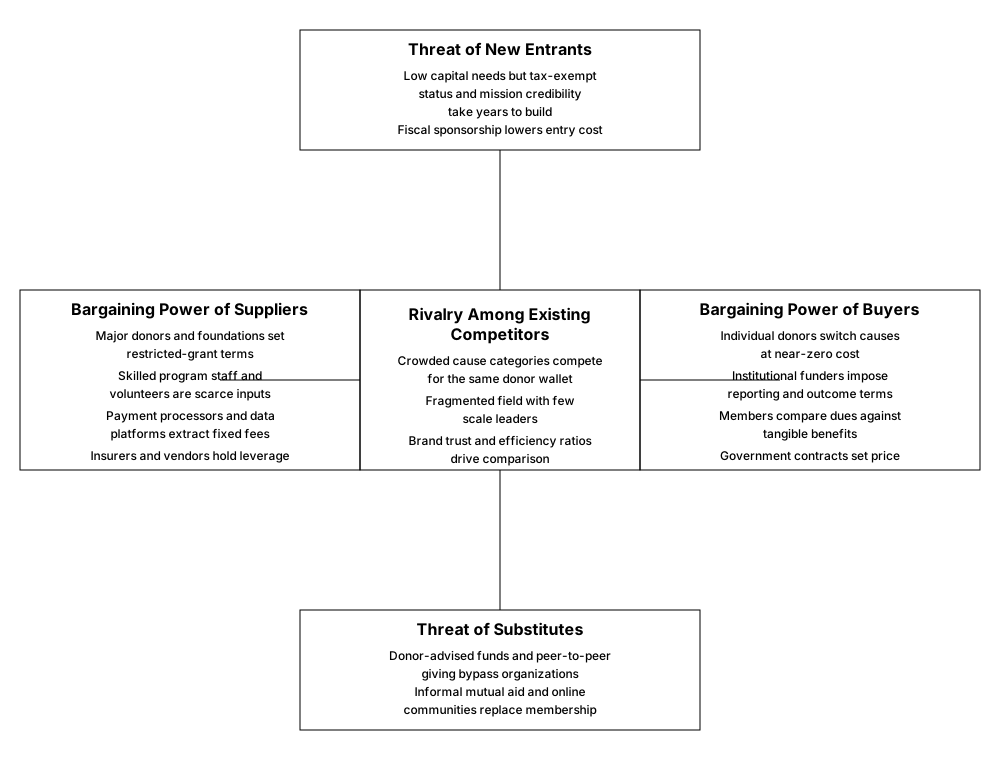
Applying Porter's five forces to a nonprofit sector requires a reframing that this analysis makes explicit throughout: buyers are donors, members and government funders who allocate scarce discretionary resources, suppliers are the foundations, major donors and specialized talent that provide the inputs an organization cannot generate internally and rivalry plays out as competition for the same finite pool of charitable capital and volunteer attention rather than for consumer spending on substitutable products. Applied this way, the framework holds up analytically, because civic organizations do compete, do face supplier leverage and do confront entry and substitution dynamics, even though the mechanism is grant capital and goodwill rather than product margin.
Bargaining power of buyers
Individual donors hold significant aggregate power because switching costs are essentially zero. A donor who gives to one environmental organization this year can redirect that gift to another cause entirely next year without any transaction friction and organizations know this, which is why donor retention has become as closely tracked a metric in this sector as customer retention is in subscription software. Institutional funders, including foundations, corporate giving programs and government agencies, hold a different and often stronger form of power, because they can attach conditions to their capital: restricted grants that specify how funds must be spent, reporting requirements that consume staff time and multi-year commitments that can be withdrawn if outcome metrics disappoint. Government, in particular, exercises buyer power through contract structure, often reimbursing costs after the fact and setting per-unit rates for service delivery that organizations must accept or decline in full. Membership associations occupy a slightly different position, since members evaluate dues against a concrete basket of benefits, insurance access, credentialing, events and will lapse if that value proposition weakens relative to alternatives, including informal online communities that replicate some networking value for free. The overall effect is a sector where the party providing the money almost always retains more leverage than the party requesting it, a dynamic sharpened in 2025 by federal funding disruptions that gave government buyers outsized power to reshape nonprofit budgets with little notice.4
| Buyer type | Source of leverage | Typical constraint on the organization |
|---|---|---|
| Individual donors | Zero-cost switching between causes | Requires continuous engagement and storytelling |
| Government agencies | Contract terms and appropriation cycles | Reimbursement timing and compliance burden |
| Foundations | Restricted grant conditions | Reporting overhead and mission drift risk |
| Corporate sponsors | Brand-alignment requirements | Reputational sensitivity to sponsor conduct |
| Members | Dues-to-benefit comparison | Requires visible, renewable value delivery |
Bargaining power of suppliers
Foundations and major donors function as suppliers of capital in this adapted framework and they hold considerable power because concentrated wealth means a small number of funders can represent a large share of an organization's budget. Total charitable giving in the United States reached an estimated $617.2 billion in 2025, but that aggregate figure masks significant volatility at the foundation level, where grantmaking giving fell more than 16 percent in 2025 after a sharp surge the prior year, illustrating how dependent individual organizations can be on funding cycles set by a handful of large institutions.5 Skilled staff and experienced volunteer leadership represent a second class of supplier constraint, since nonprofit compensation typically trails comparable private-sector roles, making senior talent, particularly in finance, grant management and digital fundraising, genuinely scarce relative to demand. Technology vendors, including donor management platforms, payment processors and email marketing systems built specifically for nonprofit use, have become a third supplier category with growing leverage, since many charge percentage-based transaction fees or tiered subscription pricing that scales with an organization's growth rather than shrinking with it. Insurance carriers and financial-services partners that underwrite affinity products for membership associations hold particularly concentrated power in that sub-segment, since a single carrier relationship can represent the majority of an association's revenue, as the royalty-dependent structure of large membership organizations demonstrates. Data and list-rental intermediaries add a final layer of supplier dependency for organizations that have not built proprietary donor databases.
| Supplier type | Nature of leverage | Effect on organization |
|---|---|---|
| Foundations and major donors | Concentration of discretionary capital | Budget volatility tied to grant cycles |
| Skilled program and finance staff | Scarcity relative to nonprofit pay scales | Elevated turnover and recruitment cost |
| Donor management and payment platforms | Percentage-based transaction fees | Rising cost as fundraising scales |
| Insurance and financial-services partners | Concentrated royalty relationships | Revenue dependent on partner retention |
| List and data intermediaries | Control of prospect data | Higher acquisition cost without proprietary data |
Rivalry among existing competitors
Competitive intensity in this sector is unusually high in absolute numbers but diffuse in its expression, because tens of thousands of organizations compete for the same pool of charitable dollars without ever directly interacting the way commercial rivals do. Two organizations addressing the same cause, homelessness in a given city, for instance, rarely compete on price the way firms do, but they compete intensely for the same major donor's calendar, the same foundation program officer's attention and the same pool of volunteer hours. This produces a rivalry pattern closer to attention competition in media than to price competition in commodity markets and it explains why storytelling, brand distinctiveness and measurable outcome reporting have become the primary competitive weapons rather than cost leadership. The industry remains highly fragmented, with tens of thousands of small local organizations coexisting alongside a much smaller number of national-scale associations and advocacy groups that command outsized shares of aggregate revenue, a structure that limits any single organization's ability to set terms across the category. Consolidation pressure has been building gradually, with smaller organizations increasingly folding into fiscal sponsorship arrangements or merging with larger peers rather than closing outright, a trend accelerated by the funding disruptions of 2025.6 Efficiency ratios, particularly the share of expenses directed to programs versus administration and fundraising, have become a widely used, if imperfect, comparison metric that watchdog organizations and increasingly sophisticated donors use to differentiate among otherwise similar-sounding causes.
| Rivalry dimension | Manifestation in this sector | Strategic implication |
|---|---|---|
| Donor attention | Competing narratives for the same wallet share | Storytelling becomes a core capability |
| Foundation relationships | Competing proposals for the same grant cycle | Program officer relationships matter disproportionately |
| Volunteer capacity | Competing for the same local labor pool | Volunteer experience quality drives retention |
| Efficiency benchmarking | Public comparison via program-to-overhead ratios | Cost discipline becomes a trust signal |
| Consolidation | Mergers and fiscal sponsorship absorption | Scale advantages compound over time |
Threat of new entrants
Forming a new civic or social organization carries low financial barriers, since incorporation and initial tax-exempt filing require modest cost and fiscal sponsorship arrangements now let founders operate under an established nonprofit's legal and financial infrastructure before ever filing for independent tax-exempt status. This structural ease of entry means the sector adds new organizations continuously and it partly explains why the total population of nonprofits in the country has grown steadily even as any individual cause category becomes more crowded. Real barriers exist nonetheless and they are reputational and relational rather than financial. Donor trust takes years to establish, foundation program officers favor organizations with a demonstrated track record and government contracting bodies typically require prior performance history before awarding meaningful service contracts, all of which mean a new entrant faces a long runway before it can access the largest funding pools even if it can legally exist within weeks. Established organizations also benefit from accumulated donor lists and brand recognition that a new entrant cannot replicate quickly, creating a soft moat around the largest, most trusted names in any given cause category. The practical effect is a bifurcated threat picture:
entry into small, local, volunteer-driven civic work remains genuinely easy, while entry into large-scale advocacy or national membership association territory remains difficult regardless of how cheap the initial paperwork is
| Entry factor | Effect on barrier height | Illustrative dynamic |
|---|---|---|
| Incorporation and tax-exemption cost | Low barrier | Modest filing fees and fiscal sponsorship options |
| Donor trust accumulation | High barrier | Multi-year track record expected by major donors |
| Foundation grant eligibility | High barrier | Preference for organizations with prior grant history |
| Government contract eligibility | High barrier | Past-performance requirements in procurement |
| Brand and list ownership | Moderate to high barrier | Incumbents hold accumulated donor relationships |
Threat of substitutes
The clearest substitution threat comes from disintermediated giving vehicles, particularly donor-advised funds, which let individuals set aside charitable capital and direct it to causes over time without ever routing money through a traditional operating nonprofit's fundraising apparatus and peer-to-peer giving platforms, which let individuals raise money directly for a cause or a specific need without a registered organization as an intermediary. Both mechanisms substitute for the traditional role civic organizations have played as the trusted collection point for charitable capital and both have grown steadily as digital platforms make direct giving frictionless. Informal mutual aid networks, often coordinated through social media groups or messaging apps rather than incorporated entities, substitute for the fellowship and support functions that fraternal and service organizations have traditionally provided, particularly among younger demographics less inclined toward formal membership structures. Government direct-service expansion can substitute for civic organizations in specific policy areas when public budgets grow, just as government contraction can substitute in the other direction by pushing more responsibility onto nonprofit deliverers. Corporate social responsibility programs and environmental, social and governance-driven business initiatives have also begun absorbing some advocacy functions internally, as companies increasingly fund and staff their own cause-related initiatives rather than exclusively channeling resources through external civic organizations. None of these substitutes fully replicates the accumulated expertise, accountability infrastructure and tax-exempt status of an established civic organization, but each chips away at a specific function the sector once held close to exclusively.
| Substitute | Function it replaces | Degree of threat |
|---|---|---|
| Donor-advised funds | Charitable capital intermediation | Moderate and growing |
| Peer-to-peer giving platforms | Direct fundraising for specific needs | Moderate and growing |
| Informal mutual aid networks | Fellowship and community support | Moderate, concentrated among younger donors |
| Direct government service provision | Program delivery in specific policy areas | Low to moderate, cyclical |
| Corporate social responsibility programs | Advocacy and cause funding | Low but rising |
Value chain and profit pools
The value chain in this sector runs from capital origination through to constituency impact and it looks different from a commercial value chain because the person paying and the person receiving the service are often not the same party. Upstream, capital origination covers the work of securing donations, grants, dues and government contracts, the functional equivalent of raw-material sourcing in a manufacturing chain, since nothing downstream happens without it. Program design and development follows, where organizations translate mission intent into specific interventions, advocacy campaigns, service programs, credentialing systems and this stage carries the intellectual property that differentiates one organization's approach from another's. Program delivery and operations represents the labor-intensive core of the chain, where staff and volunteers execute services, run events, produce publications or conduct advocacy outreach, consuming the largest share of headcount and daily operating cost. Constituent interface and engagement covers the relationship-management layer, communications, member services, donor stewardship, that determines whether a one-time donor becomes a recurring supporter or a member renews for another year. Measurement and reporting has become an increasingly distinct stage in its own right, as funders demand outcome data rather than activity counts, requiring organizations to build monitoring and evaluation capability that barely existed a generation ago. Enabling infrastructure, encompassing finance, compliance, technology systems and governance, sits underneath all of the above, invisible to most external stakeholders but essential to sustaining trust and tax-exempt status.
Profit pool
Surplus, the nonprofit equivalent of profit, concentrates disproportionately in organizations that own a renewable, monetizable constituency rather than those that deliver programs on a project-by-project grant basis. Membership associations that have built large, loyal member bases can license access to that base through royalty arrangements with insurers, financial-services firms and affinity marketers, a model exemplified at extreme scale by large membership organizations, where royalty income now dwarfs membership dues as a share of total revenue. Organizations with renewable, multi-year government service contracts capture a second concentration of surplus, since renewal history reduces both procurement risk and the marketing cost of constantly acquiring new institutional funders. By contrast, organizations dependent on a single restricted grant or a single major donor relationship tend to operate at or below breakeven, since restricted funding rarely covers full overhead and program delivery consumes most of what it does provide. Endowed grantmaking foundations occupy a distinct position in this pool: their surplus derives from investment returns on accumulated capital rather than from operating activity, which insulates them from the fundraising competition described above but exposes them fully to capital-markets volatility. The shift over the past two decades has been toward organizations that treat constituency data, member relationships, donor histories, outcome metrics, as a proprietary asset to be actively managed, mirroring how commercial firms treat customer data, rather than as a byproduct of program delivery.
Industry economics and business models
Four business model patterns dominate the sector and most organizations blend more than one rather than relying on a single pattern exclusively. The membership-fee model resembles a subscription business, charging recurring dues in exchange for defined benefits and it produces the most predictable revenue of any pattern in the sector, provided the organization continues delivering visible value against the dues price. The grant and contract model resembles a project-based services business, securing time-limited, often restricted funding to deliver a specific program and it produces revenue that is plentiful in aggregate but unstable at the individual organization level, since any single grant typically expires within one to three years. The donation and major-gift model resembles a demand-generation business built on storytelling and relationship cultivation, converting emotional or values-based appeal into recurring and one-time gifts and it is the most sensitive of the four patterns to news cycles, economic conditions and donor sentiment. The licensing and royalty model, though used by only a subset of large membership organizations, generates the highest-margin revenue in the sector by monetizing a proprietary member base through third-party commercial partnerships, effectively functioning as an affinity marketing platform wrapped inside a nonprofit structure. Most mid-sized and large organizations run a blended model, using dues or program fees to fund baseline operations, grants to fund specific initiatives and major-gift campaigns to fund capital projects or endowment growth, a diversification strategy that has become the clearest predictor of organizational resilience during periods of funding disruption.
Cost drivers and scalability
Labor represents the dominant cost line for virtually every organization in this sector, typically consuming well over half of total expense, since program delivery, member services and advocacy work are fundamentally people-intensive activities that resist automation more than commercial service industries do. Fixed costs, office space, core administrative staff, technology infrastructure and insurance, must be covered regardless of program volume, which creates real operating leverage once an organization exceeds its fixed-cost breakeven point, but that leverage cuts in both directions during funding downturns. Variable costs scale more directly with program activity: event costs, program supplies and the direct expenses tied to service delivery rise and fall with volume in a way overhead costs do not. Economies of scale exist but manifest differently than in commercial industries, appearing primarily in shared back-office infrastructure, one finance and compliance team supporting multiple program lines and in donor acquisition cost, where a larger, more recognized brand generates new donors and members more cheaply per acquisition than a smaller, unknown organization can. Chapter-based and franchise-style organizations, common among fraternal and service groups, achieve a distinct form of scope economy, since a national brand and shared operating playbook let local chapters launch with lower marginal setup cost than an entirely independent organization would face. The nonprofit equivalent of a growth loop appears most clearly in membership-based models, where satisfied members become the primary recruitment channel for new members and in advocacy organizations, where successful campaigns generate media coverage that lowers the cost of the next donor acquisition cycle.
Moats, advantages and strategic levers
Durable advantage in this sector rests on four foundations that mirror commercial moats even though the mechanism differs. Brand trust functions as the closest analog to differentiation in a commercial market, since donors and members choose among near-substitutable causes largely based on perceived credibility and track record and that trust compounds slowly but erodes quickly if financial scandal or mission drift becomes public. Proprietary constituency data functions as a genuine data and learning advantage, since an organization that has tracked donor giving patterns, member engagement and program outcomes over many years can target its acquisition and retention efforts far more efficiently than a newer competitor working without that history. Regulatory and relational barriers function as a soft moat around government contracting relationships, since incumbent service providers with strong past-performance records face materially less competitive pressure in contract renewal cycles than new bidders do. Network effects appear most visibly in membership associations and chapter-based organizations, where the value of joining rises with the size and activity of the existing member base, creating a self-reinforcing growth dynamic once an organization reaches sufficient scale in a given profession or community.
Trust, once extended by a donor or a member, behaves like a credit line that an organization can draw down quickly but must rebuild slowly
Switching costs, while lower here than in most commercial industries, are not zero:
a member who has built professional credentials, a network and years of engagement history with an association faces real friction in abandoning that relationship, even if a rival association offers comparable nominal benefits
Strategic levers
Five levers give both incumbents and new entrants meaningful room to shape their competitive position within this sector. Constituency segment focus determines how narrowly or broadly an organization defines its member or donor base and evidence across the sector suggests that sharply defined causes or professional niches sustain stronger loyalty and higher renewal rates than broadly defined, diffuse mission statements. Revenue diversification across dues, grants, contracts and major gifts reduces exposure to any single funding source's volatility, a lesson reinforced sharply by the federal funding disruptions of 2025, when organizations dependent on a single government revenue stream faced far more severe budget shocks than those with blended funding models. Vertical integration versus partnership shapes how an organization builds capability: some associations choose to build proprietary technology, data and insurance-underwriting capability in-house, while others partner with specialized vendors and accept a smaller share of the resulting economics in exchange for lower operating complexity. Geographic and chapter expansion offers a scale lever, particularly for fraternal, service and advocacy organizations that can replicate a proven local model in new communities without redesigning the underlying program. Ecosystem orchestration, positioning an organization as the convening hub for a broader coalition of smaller, aligned groups, has become an increasingly visible lever among the largest advocacy organizations, which now often function less as sole executors of a cause and more as coordinators of a distributed network of aligned local and issue-specific groups.
Structural risks, regulation and trends
The most immediate structural risk facing the sector is government funding volatility, illustrated starkly by the abrupt federal funding adjustments that disrupted nonprofit and association budgets across 2025, forcing many organizations to find replacement revenue or cut programs with little advance notice.7 Regulatory risk compounds this exposure, since changes to tax-exemption rules, lobbying restrictions or reporting requirements can raise compliance cost or narrow permissible activity for advocacy-oriented organizations with little lead time to adapt. Technology disruption presents a subtler but growing risk, as donor-advised funds, peer-to-peer platforms and Artificial Intelligence-driven personal philanthropy tools increasingly let individuals direct charitable capital with less reliance on traditional organizational intermediaries. Donor behavior itself is shifting structurally, with younger demographics showing lower rates of formal membership participation and a preference for episodic, cause-specific giving over sustained organizational loyalty, a trend that pressures the recurring-revenue assumptions many associations have historically relied upon.
On the demand side, the aggregate outlook remains constructive: industry revenue for civic and social organizations has been projected to grow at roughly a five percent compounded annual rate through the back half of this decade, ahead of broader economic growth, even as year-to-year performance stays uneven.8 Supply-side trends point toward consolidation among small, undifferentiated organizations and continued proliferation at the niche, cause-specific end of the market, a bifurcation pattern consistent with what has occurred in other fragmented service industries as scale advantages in back-office infrastructure and donor acquisition become harder for small players to ignore.
For entrants, the strategic playbook favors starting narrow rather than broad, since a sharply defined cause or professional niche builds donor and member loyalty faster than a diffuse mission statement can and it favors partnering through fiscal sponsorship or established coalition structures over building independent back-office infrastructure in the earliest years. Entrants should also treat regulatory strategy as a first-order design decision rather than an afterthought, choosing the appropriate tax-exempt structure, 501c for charitable and educational work, 501c for advocacy with fewer restrictions on lobbying, before building programs around it, since retrofitting a legal structure after donor and program commitments are in place is costly and slow.
For incumbents, the playbook centers on defending constituency ownership by investing in proprietary data infrastructure rather than depending on third-party platforms for donor and member relationships, expanding through adjacent causes or underserved geographies where existing brand trust transfers cleanly and deepening moats by converting episodic donors into recurring members or sustainers wherever the underlying cause allows for that transition. Incumbents with government contracting relationships should also treat diversification away from any single agency or funding stream as an active risk-management priority rather than a background consideration, given how sharply appropriations can shift within a single political cycle.
Caselet: AARP and the economics of a membership giant
AARP, originally the American Association of Retired Persons, was founded in 1958 by Ethel Percy Andrus, a retired educator who had earlier founded the National Retired Teachers Association, with the initial purpose of providing group health insurance access to older Americans who could not easily obtain individual coverage at the time. The organization has grown into the largest membership association in the United States and its financial evolution over the following decades illustrates almost every dynamic described in this analysis, from constituency ownership to the shift of profit pools toward licensing and royalty income.
Industry at a glance applied to AARP
AARP operates as a nonprofit under section 501c of the tax code, which permits broader advocacy and lobbying activity than a traditional charity structure allows, while its charitable arm and its for-profit-adjacent subsidiaries handle different pieces of its sprawling operations. Its customer base spans all three dimensions described earlier in this article:
individual members who pay modest annual dues, corporate partners, most notably insurers, who pay substantial royalties for access to its brand and member base and government relationships through its extensive advocacy work on Social Security, Medicare and related policy issues
Business model and profit pool
AARP's revenue structure demonstrates starkly how far the profit pool in this sector has shifted toward licensing over the pure membership-dues model most people associate with the organization. In 2024, AARP reported total operating revenue of roughly $10.97 billion, an extraordinary figure for a membership association, driven overwhelmingly by royalty payments rather than dues, including a reported $9 billion payment tied to its long-running relationship with UnitedHealthcare around Medicare product distribution.9 This is a significant evolution from the organization's earlier revenue mix: in 2005, royalties represented roughly 40 percent of total revenue and membership dues represented roughly 27 percent, a far more balanced split than exists today, where royalties have historically represented well over half of total revenue in various reported years and dues a much smaller share.10
Regulatory scrutiny and structural tension
AARP's scale and its licensing-heavy revenue model have drawn sustained regulatory and political attention. The organization settled a dispute with the Internal Revenue Service in 1994 over whether its insurance-related income constituted unrelated business income subject to taxation, paying $135 million to resolve the matter. A 2011 congressional investigation examined AARP's financial relationship with the health insurance industry during the debate over the Affordable Care Act, concluding that the organization's current cost structure would be difficult to sustain without the hundreds of millions of dollars in annual royalty revenue those insurance partnerships generate. This tension, between AARP's stated advocacy mission on behalf of older Americans and its deep financial dependence on the very insurance industry its advocacy sometimes scrutinizes, illustrates a structural risk that applies more broadly across the sector wherever an organization's largest revenue source and its advocacy mandate touch the same industry.
Strategic lesson
AARP's trajectory demonstrates that in this sector, the organizations capturing the most durable surplus are those that treat their constituency as a licensable asset rather than solely as a donor base to be solicited repeatedly and that this strategy, while financially powerful, invites a level of regulatory and reputational scrutiny that dues-dependent or grant-dependent peers rarely face at the same intensity. The lesson generalizes:
constituency ownership is the strongest lever available in this industry, but monetizing it commercially through third-party partnerships changes an organization's risk profile as much as it changes its revenue
Conclusion in practice
Executives evaluating this sector, whether as consultants, board members, philanthropic partners or potential funders, should weigh three considerations above all others. First, revenue concentration by donor, grant or contract predicts fragility more reliably than any other single metric available in public nonprofit filings. Second, constituency ownership, whether expressed through a proprietary donor database, a licensable member base or a renewable government relationship, is the clearest source of durable advantage in an industry where capital intensity offers little protection. Third, the sector's growth trajectory remains genuinely favorable in aggregate even as individual organizations face real funding volatility, which means the strategic opportunity lies less in questioning whether to engage with this sector and more in identifying which organizations have built the diversification and constituency ownership to convert aggregate sector growth into their own durable resilience.
- 1Civic And Social Organizations Industry Statistics
- 2How Big Is The Nonprofit Sector
- 3Civic And Social Organizations Market Size
- 4Nonprofit Advocacy In 2025
- 5Giving USA 2026 Annual Report
- 6Nonprofit Trends For 2026
- 7Nonprofit Outlook For 2026
- 8Civic And Social Organizations Market Research Report
- 9How Revenue Is Spent At AARP
- 10AARP Business Model Overview
Civic and social organizations occupy the space markets and governments leave open, turning collective membership and donated capital into advocacy, mutual aid and community infrastructure. Revenue concentrates around dues, royalties, contracts and major gifts and the organizations that compound advantage are those that own a renewable constituency rather than a single funding relationship. Diversification across donor segments, ownership of data and licensing assets and disciplined program-to-overhead ratios separate resilient incumbents from those exposed to a single grant or contract shock. The strategic levers that matter most going forward are constituency ownership, revenue diversification and disciplined expansion into adjacent causes or geographies without diluting the trust that membership and donor bases have already extended.
Citation
Cite this article
Sridharan, M. A. (2023, July 28). Industry Analysis: Civic and Social Organizations. Think Insights. https://thinkinsights.net/strategy/industry-analysis-civic-and-social-organizations (Accessed [[ACCESS_DATE]])
Sridharan, Mithun A. "Industry Analysis: Civic and Social Organizations." Think Insights, 28 July 2023, https://thinkinsights.net/strategy/industry-analysis-civic-and-social-organizations. Accessed [[ACCESS_DATE]].
Mithun A. Sridharan, "Industry Analysis: Civic and Social Organizations," Think Insights, July 28, 2023, https://thinkinsights.net/strategy/industry-analysis-civic-and-social-organizations. Accessed [[ACCESS_DATE]].
Sridharan, M.A. (2023) 'Industry Analysis: Civic and Social Organizations', Think Insights. Available at: https://thinkinsights.net/strategy/industry-analysis-civic-and-social-organizations (Accessed: [[ACCESS_DATE]]).
M. A. Sridharan, "Industry Analysis: Civic and Social Organizations," Think Insights, 2023. [Online]. Available: https://thinkinsights.net/strategy/industry-analysis-civic-and-social-organizations. [Accessed: [[ACCESS_DATE]]].
Sridharan MA. Industry Analysis: Civic and Social Organizations. Think Insights. Published July 28, 2023. Accessed [[ACCESS_DATE]]. https://thinkinsights.net/strategy/industry-analysis-civic-and-social-organizations
Test Your Knowledge
Industry Analysis: Civic and Social Organizations
Challenge yourself on the concepts from this article and see how well you understood them.
Subscribers get weekly quizzes and insights — subscribe free
Sponsor this article
Partner with Think Insights
Reach 50,000+ business leaders, consultants, and strategists. Feature your brand alongside expert articles on strategy, leadership, and digital transformation.
Become a Sponsor