Industry Analysis: Carbon Management


Carbon management is consolidating around three interlocking layers: measurement software that turns emissions into an auditable ledger, markets that price the right to emit or remove a tonne and removal technology that manufactures new supply. The industry is worth well over a trillion dollars in traded compliance allowances alone, growing on the back of mandatory disclosure rules in the European Union, the United Kingdom and California. Margin is concentrating in registries, verification bodies and enterprise software vendors that own the data layer, not in commodity offset origination, which remains capital-intensive and reputationally fragile. Bargaining power is shifting toward large corporate buyers and regulators, who increasingly dictate credit quality standards and away from small-scale project developers. Executives entering this space should prioritize positions in measurement infrastructure and high-integrity removal supply and treat legacy avoidance-based offset trading as a shrinking, low-margin segment.
Is carbon management attractive for new entrants?
Attractiveness depends on the layer. Carbon accounting software remains open to well-capitalized entrants because switching costs are still forming and enterprise buyers are actively evaluating vendors, but registries and verification bodies are effectively closed, protected by accreditation and incumbency. Removal technology is attractive for entrants with genuine engineering differentiation and patient capital, since durable removal supply is scarce relative to corporate demand, but it requires multi-year development timelines before revenue materializes.
Which parts of the value chain are most profitable?
Verification and registry services carry the highest structural margins because they are natural chokepoints with limited competitors and fee-based, asset-light economics. Enterprise measurement software is the second most profitable layer once a vendor reaches scale, since gross margins resemble typical software-as-a-service economics. Offset origination and trading carry the thinnest margins, exposed to commodity pricing and reputational risk from quality controversies.
How is technology changing this industry?
Satellite monitoring, remote sensing and machine learning are replacing self-reported activity data with independently verified measurement, which is compressing the credibility gap that has plagued voluntary offsets. Artificial Intelligence is also automating Scope 3 supply chain emissions estimation, a task that was previously too labor-intensive for most companies to perform rigorously. On the removal side, engineering advances in direct air capture and mineralization are lowering cost per tonne, though costs remain far above nature-based alternatives.
What capabilities are table stakes vs differentiators?
Table stakes include Scope 1 and Scope 2 emissions calculation, basic regulatory reporting templates and integration with common enterprise resource planning systems. Differentiators include Scope 3 supply chain data automation, audit-grade assurance that satisfies external auditors, proprietary measurement-to-market execution and access to durable, high-integrity removal supply that competitors cannot easily replicate.
How should investors or consultants evaluate opportunities here?
Evaluate opportunities by asking where a company sits relative to the mandatory disclosure wave, since regulation is the primary demand driver, not voluntary corporate ambition. Assess whether the target owns a data or verification chokepoint versus operating in the more commoditized origination and trading layer. For removal technology, weigh cost curve trajectory, permanence and measurement rigor against nature-based alternatives that remain far cheaper per tonne today.
What separates carbon management from the broader climate technology sector?
Carbon management is narrower and more infrastructural, focused specifically on measuring, pricing and removing carbon dioxide, whereas climate technology spans the full venture landscape of clean energy, mobility, materials and industrial decarbonization. Carbon management companies sell measurement, verification, trading and removal as their core product, while climate technology companies often use carbon reduction as an outcome of an unrelated core technology, such as battery chemistry or grid software.
Why are compliance markets more important than voluntary markets?
Compliance markets are backed by government mandate, which creates durable, non-discretionary demand measured in the hundreds of billions of dollars annually, dwarfing voluntary market volumes. Voluntary markets depend on corporate discretionary spending on reputation and net-zero pledges, a budget line that has proven vulnerable to economic cycles and credibility scandals. Compliance market price signals, particularly from the European Union Emissions Trading System, now set the reference point that voluntary market pricing increasingly tracks.
What role does the Carbon Border Adjustment Mechanism play in industry economics?
The Carbon Border Adjustment Mechanism extends the European Union's carbon price to imported goods, effectively exporting compliance market economics to trading partners outside Europe. This forces manufacturers in exporting countries to measure and report embedded emissions accurately, creating new demand for carbon accounting software well beyond companies with direct European Union operations. It also raises the strategic value of accurate, defensible emissions data, since misreporting now carries direct tariff consequences.
Is nature-based removal or engineered removal the better investment thesis?
Nature-based removal, such as reforestation and soil carbon projects, is cheaper per tonne today and dominates current volume, but it faces persistent criticism over permanence, additionality and measurement accuracy. Engineered removal, including direct air capture and mineralization, costs substantially more per tonne but offers verifiable, long-duration storage that increasingly satisfies the highest-integrity corporate buyers and emerging compliance frameworks. The better thesis depends on time horizon, since engineered removal cost curves are expected to compress over the next decade as deployment scales.
How vulnerable is this industry to political and regulatory reversal?
The industry carries meaningful political risk, illustrated by shifting United States federal policy toward carbon regulation and periodic retrenchment of subsidies for capture technology. Europe's compliance framework provides more durable footing because it is embedded in law across many member states, though even there, free allowance allocations and price ceilings remain subject to political negotiation. Diversifying revenue across jurisdictions, particularly toward the European Union, United Kingdom and expanding Asian compliance schemes, reduces single-market regulatory exposure.
Carbon management has moved from a corporate social responsibility afterthought to a mainstream financial and regulatory discipline over the past five years. What began as voluntary offset purchasing by consumer brands seeking reputational credit has broadened into a full industry stack spanning emissions measurement software, compliance and voluntary trading markets and an emerging removal technology sector building the physical infrastructure to pull carbon dioxide out of the atmosphere. Understanding how this industry creates and captures value requires separating three distinct businesses that are frequently and incorrectly, treated as one.
Industry at a glance
Carbon management, as analyzed here, covers three connected but economically distinct activities. The first is carbon accounting and measurement software, which calculates an organization's greenhouse gas emissions across direct operations, purchased energy and supply chain activity and formats that data for regulatory or investor disclosure. The second is carbon markets, both compliance systems created by government mandate, such as the European Union Emissions Trading System (EU ETS) and voluntary markets where companies purchase offset credits to counterbalance emissions they have not eliminated. The third is carbon capture and removal technology, encompassing direct air capture, bioenergy with carbon capture and storage, mineralization, biochar and nature-based removal projects that generate the physical supply of removed carbon dioxide underlying many credits. This analysis excludes the broader climate technology venture ecosystem, including clean energy generation, electric mobility and industrial decarbonization equipment, which is covered separately.
Customers span all three procurement categories. Business-to-business (B2B) demand dominates, with large corporations buying accounting software licenses and offset credits to satisfy investor expectations, customer requirements and internal net-zero commitments. Business-to-government (B2G) demand comes from regulated entities purchasing compliance allowances and from public sector procurement of removal credits for national climate targets. Business-to-consumer (B2C) activity is comparatively small, limited to niche retail offset products sold alongside flights or consumer goods. The industry depends heavily on adjacent sectors:
energy markets set the marginal cost of abatement that determines offset demand, financial services provide the trading infrastructure and custody for carbon credits and heavy industry, aviation and shipping generate the compliance obligations that anchor the largest revenue pools
The overall compliance and voluntary credit market, taken broadly across allowances and offsets, is now valued well into the hundreds of billions of dollars annually and continues expanding as more jurisdictions adopt mandatory carbon pricing.1 Revenue models differ sharply by layer. Accounting software follows conventional software-as-a-service [SaaS] subscription pricing, typically tiered by emissions scope coverage and company size, with enterprise contracts reaching six figures annually. Carbon markets generate revenue through transaction fees, registry listing fees and bid-ask spreads captured by brokers and exchanges, alongside the underlying commodity value of the credits or allowances themselves. Removal technology companies sell forward purchase agreements and offtake contracts, often years before a facility becomes operational, a financing structure closer to industrial project finance than typical technology sales. Capital intensity rises sharply as one moves from software toward physical removal: a measurement platform can be built with venture-scale capital, while a commercial direct air capture facility requires hundreds of millions of dollars and multi-year construction timelines. Regulatory intensity follows a similar gradient, with compliance markets entirely dependent on government rule-making and removal technology increasingly reliant on subsidy regimes and emerging measurement, reporting and verification [MRV] standards.
Industry segmentation
The industry divides into six segments defined primarily by value chain position and secondarily by customer type. Carbon accounting and measurement software forms the first segment, comprising platforms such as Persefoni, Watershed and Sweep that calculate Scope 1, Scope 2 and Scope 3 emissions and generate disclosure-ready reports.2 The second segment is compliance carbon markets, the government-mandated cap-and-trade systems including the EU ETS, the United Kingdom Emissions Trading Scheme, California's cap-and-trade program and China's national emissions trading system, where regulated emitters buy and sell allowances to meet legal caps.
The third segment is the voluntary carbon market, where corporations purchase offset credits certified by standards bodies such as Verra and Gold Standard to counterbalance emissions outside any compliance obligation. The fourth segment covers carbon removal and capture technology, split between nature-based approaches such as afforestation and soil carbon sequestration and engineered approaches such as direct air capture, bioenergy with carbon capture and storage and mineralization. The fifth segment is registry, verification and assurance services, the accreditation bodies and independent auditors that certify emissions data and credit quality, functioning as the industry's trust infrastructure. The sixth segment is carbon market infrastructure and brokerage, the exchanges, trading desks and data providers, including entities like Xpansiv and CBL, that provide price discovery and settlement for both compliance and voluntary instruments. Engineered removal specifically is projected to grow at a double-digit compound annual rate over the coming decade as corporate offtake commitments accumulate faster than commercial capacity comes online.3
These segments are dimensioned differently along the value chain. Measurement software and registries sit upstream, generating the data and certification that downstream trading depends on. Markets and brokerage sit in the middle, converting certified data into a priced, transferable financial instrument. Removal technology sits both upstream, as a physical supply source and downstream, as a category of credit that trades within voluntary and increasingly compliance markets. A company's position along this chain determines its exposure to commodity price volatility versus recurring software revenue and this distinction matters more to profitability than company size or geography.
Market structure
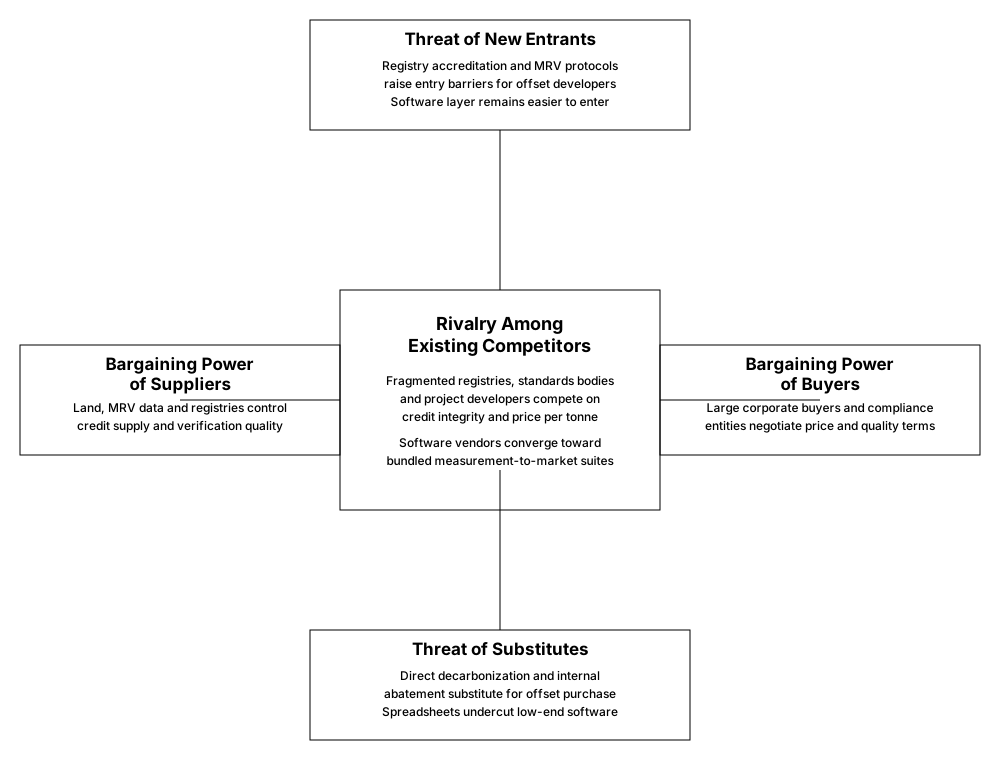
Industry dynamics reflect a market still consolidating around trust and regulatory legitimacy rather than mature competitive equilibrium. Buyers, largely large corporations and regulated emitters, have grown more discerning after voluntary market credibility controversies, pushing power toward high-integrity suppliers. Suppliers of measurement data, land and verification hold increasing leverage as regulation tightens quality requirements. Rivalry is fragmented across hundreds of registries, standards bodies and software vendors, none of which yet commands durable global scale. New entrants continue to arrive in software but face steep accreditation barriers in registries and capital barriers in removal technology. Substitutes, chiefly direct operational decarbonization, compete with every layer of this industry by reducing the emissions that create demand for measurement, trading and offsetting in the first place.
Bargaining power of buyers
Buyer power in carbon management has strengthened considerably as the market has matured and consolidated around a smaller set of sophisticated purchasers. Large corporations with net-zero commitments, financial institutions managing portfolio emissions and compliance-obligated industrial emitters now negotiate directly with software vendors and credit originators, extracting volume discounts and quality guarantees that smaller buyers cannot command. Enterprise software buyers increasingly run competitive procurement processes across multiple carbon accounting vendors, treating the purchase as a standard enterprise technology decision rather than a sustainability donation, which compresses vendor pricing power. On the credit side, corporate sustainability teams have become more technically literate following high-profile media investigations into offset quality and they now demand independent verification, vintage transparency and additionality proof before committing budget.
Compliance market buyers, by contrast, hold less discretionary power because participation is legally mandated rather than optional, though large emitters still negotiate favorable terms through banking allowances and hedging strategies. The concentration of corporate carbon budgets among a relatively small number of Fortune 500 and multinational buyers means that losing a single major account can materially affect a mid-sized vendor's revenue, giving these buyers outsized influence over product roadmaps and pricing structures. Consulting firms and auditors acting as intermediaries for smaller buyers further aggregate purchasing power, negotiating platform-wide licensing deals on behalf of client portfolios. This buyer sophistication has effectively bifurcated the market between vendors who can satisfy audit-grade rigor demanded by large buyers and lower-cost platforms serving smaller companies with lighter compliance obligations.
| Buyer type | Source of leverage | Effect on suppliers |
|---|---|---|
| Multinational corporations | Large multi-year software contracts and bulk credit purchases | Price discounts, custom integration demands |
| Regulated industrial emitters | Legally mandated participation with hedging sophistication | Allowance banking, forward pricing pressure |
| Financial institutions | Portfolio-wide emissions reporting requirements | Preference for audit-grade, assurance-ready data |
| Consulting and audit intermediaries | Aggregated purchasing across client rosters | Platform-wide licensing negotiation |
| Small and mid-size enterprises | Limited individual leverage, price sensitive | Push toward lower-cost, templated offerings |
Bargaining power of suppliers
Suppliers in this industry include the registries and standards bodies that certify credits, the landholders and project developers who generate offset supply, the satellite and remote-sensing data providers who verify activity and the specialized engineering firms that build removal infrastructure. Registries such as Verra and Gold Standard hold outsized power because they control the accreditation gateway that determines whether a credit can be sold at all and switching a project's registry affiliation is costly and slow. This chokepoint position lets registries set methodology requirements that ripple through the entire value chain, effectively acting as the industry's de facto regulators even though they are private organizations.
Land-based project developers hold moderate power individually but face collective competition from thousands of similar projects, limiting their ability to extract premium pricing except for scarce, high-integrity credit types. Data and remote-sensing providers, including satellite monitoring firms, have gained leverage as buyers demand independent verification rather than self-reported activity data, making these providers increasingly indispensable rather than optional. Engineering suppliers for removal technology, particularly specialized equipment manufacturers for direct air capture and mineralization, hold considerable power due to limited competition and long lead times, since only a handful of firms can supply the specialized contactors, sorbents and processing equipment these facilities require. Labor supply, particularly technical MRV specialists and carbon accounting professionals, remains tight relative to demand, pushing up compensation costs across the industry.
| Supplier type | Source of leverage | Effect on the value chain |
|---|---|---|
| Credit registries and standards bodies | Sole accreditation gateway for tradable credits | Sets methodology, controls market access |
| Land-based project developers | Fragmented but essential supply of nature-based credits | Limited pricing power except for scarce credit types |
| Satellite and remote-sensing data firms | Independent verification increasingly required by buyers | Rising fees for monitoring services |
| Specialized removal equipment manufacturers | Few qualified suppliers for capture technology | Long lead times, premium equipment pricing |
| Technical MRV and accounting talent | Skills shortage relative to demand growth | Elevated compensation, retention pressure |
Rivalry among existing competitors
Competitive intensity varies sharply by segment but is generally rising as regulatory tailwinds attract new capital and existing players race to establish scale before consolidation. In carbon accounting software, dozens of vendors, from well-funded platforms like Watershed and Persefoni to regional specialists like Sweep and Normative, compete on breadth of emissions scope coverage, integration depth with enterprise resource planning systems and the credibility of their audit trail. None has yet achieved category-defining dominance and price competition has intensified as buyers treat these platforms as substitutable commodities for baseline compliance functionality, reserving premium pricing tolerance for differentiated Scope 3 capabilities.
In carbon markets, rivalry centers on credit quality and registry reputation rather than pure price competition, since buyers increasingly discount low-integrity credits regardless of headline price. Voluntary market participants compete to establish premium positioning around durable, verifiable removal credits, while a large tail of lower-quality avoidance credits competes purely on cost, creating a bifurcated competitive structure within the same market. Compliance markets exhibit different dynamics entirely, since the EU ETS and similar systems function more like regulated utilities than competitive markets, with price discovery driven by allowance auctions and secondary trading rather than vendor competition. Removal technology rivalry is nascent but intensifying, with direct air capture developers such as Climeworks and Heirloom competing on cost per tonne and permanence guarantees, while a broader set of engineered and nature-based approaches jockey for corporate offtake commitments ahead of proven commercial scale.
| Competitive dimension | Where rivalry concentrates | Strategic response observed |
|---|---|---|
| Software feature breadth | Scope 3 supply chain coverage | Rapid integration partnerships, acquisitions |
| Credit quality perception | Durable removal versus avoidance credits | Premium pricing for verified permanence |
| Registry reputation | Accreditation rigor and buyer trust | Tightened methodology standards |
| Cost per tonne removed | Direct air capture and mineralization | Aggressive cost-curve investment |
| Offtake agreement volume | Long-term corporate purchase commitments | Multi-year forward contracts before scale |
Threat of new entrants
New entrant threat differs enormously by segment, ranging from low barriers in basic software to near-prohibitive barriers in registries and physical removal infrastructure. Carbon accounting software remains relatively easy to enter, since the core technical requirements, emissions factor databases and calculation logic, are increasingly well documented and cloud infrastructure lowers the capital needed to launch a minimum viable product. This has produced a steady stream of new entrants, particularly regional and industry-specific platforms targeting segments underserved by the larger generalist vendors, though customer acquisition costs and enterprise sales cycles create meaningful friction even here.
Registries and verification bodies present the opposite case, functioning as an effectively closed market protected by decades of accumulated credibility, regulatory recognition and network effects among project developers who need buyer trust. A new entrant attempting to launch a competing registry faces the near-impossible task of convincing both credit buyers and project developers to adopt an unproven standard simultaneously. Compliance market participation is similarly restricted, since entry depends entirely on government designation as a regulated entity or approved trading participant, leaving no meaningful competitive entry point for new firms. Removal technology entry requires the most capital of any segment, often hundreds of millions of dollars before a single commercial-scale facility operates, though the scarcity of proven durable removal supply relative to corporate demand continues to attract well-funded new entrants willing to accept multi-year development risk.
| Entry barrier type | Segment most affected | Severity |
|---|---|---|
| Accreditation and trust networks | Registries and standards bodies | Very high |
| Government designation requirements | Compliance market participation | Very high |
| Capital intensity for physical infrastructure | Removal and capture technology | High |
| Enterprise sales cycle and integration complexity | Accounting software | Moderate |
| Technical talent scarcity | MRV and verification services | Moderate |
Threat of substitutes
The most significant substitute across the entire industry is direct emissions reduction, since a company that redesigns its operations to avoid generating carbon dioxide in the first place needs no measurement software, no offset credits and no removal technology to address that particular tonne. This substitution dynamic makes carbon management structurally different from most industries, where the core product faces competition from alternative products rather than from the underlying problem simply disappearing. As energy efficiency, renewable procurement and process electrification become cheaper, the addressable market for offsetting and removal shrinks at the margin, even as total demand for measurement software continues growing because disclosure obligations persist regardless of abatement progress.
Within the software segment, generic spreadsheet-based tracking and low-cost consulting-delivered emissions inventories substitute for dedicated platforms among smaller companies with modest compliance obligations, capping the addressable premium software market until disclosure thresholds tighten further. Within carbon markets, internal carbon pricing mechanisms, where companies apply a shadow price to emissions in capital allocation decisions without ever transacting an external credit, substitute for offset purchasing by achieving similar behavioral effects without market participation. Within removal technology, cheaper nature-based approaches substitute for expensive engineered removal for buyers prioritizing volume over permanence, though this substitution runs in both directions as buyers seeking durability increasingly favor engineered removal despite the cost premium.
| Substitute | What it replaces | Constraint limiting adoption |
|---|---|---|
| Direct operational decarbonization | Offset and removal credit purchases | Requires capital investment and time |
| Spreadsheet and manual tracking | Dedicated accounting software | Inadequate for complex, audited disclosures |
| Internal carbon pricing without transactions | External credit purchasing | Lacks external verification and market signal |
| Nature-based removal | Engineered removal technology | Weaker permanence guarantees |
| Renewable energy certificates | Scope 2 offsetting via credits | Addresses only electricity-related emissions |
Value chain and profit pools
The carbon management value chain runs through five identifiable stages. Upstream, data generation and land or project origination anchor the chain, encompassing satellite monitoring, activity data collection and the physical land or industrial sites where emissions reduction, avoidance or removal actually occurs. This stage requires deep domain expertise in measurement science and, for nature-based projects, long-term land tenure or partnership agreements that take years to establish credibly.
The second stage is verification and certification, where independent auditors and registries confirm that reported emissions data or generated credits meet methodology standards. This stage functions as the trust chokepoint of the entire industry, since every downstream transaction depends on the credibility established here. The third stage is aggregation and market-making, performed by exchanges, brokers and trading platforms that pool supply, provide price discovery and enable transaction settlement between originators and buyers. The fourth stage is enterprise software and analytics, the measurement, reporting and decision-support layer that translates raw emissions data into usable corporate intelligence and regulatory filings. The fifth stage is the customer interface, comprising the sustainability, finance and procurement functions within buying organizations that select vendors, evaluate credit quality and integrate carbon data into broader financial and operational reporting.
Profit pool
Profit concentrates disproportionately in the verification and certification stage and in enterprise software, both of which benefit from chokepoint economics and recurring revenue structures. Registries earn fees on every credit issued and every transaction recorded, a toll-booth model that scales with market volume without requiring proportional cost increases, generating structurally higher margins than physical credit origination. Enterprise software vendors that achieve scale enjoy conventional SaaS economics, with gross margins in the range typical of business software once customer acquisition costs are amortized across a multi-year contract.
Origination, whether nature-based project development or early-stage removal technology, remains the least profitable stage today, weighed down by high upfront capital costs, long payback periods and reputational risk from quality controversies that can strand an entire project's credit inventory. This profit distribution has shifted meaningfully over the past three years: capital that once flowed toward offset origination, chasing voluntary market growth, has redirected toward measurement software and high-integrity removal technology, as buyers grew skeptical of low-quality avoidance credits following well-documented media investigations into overstated forest conservation claims. Brokerage and trading capture moderate, spread-based margins, more resembling commodity trading desks than either software or verification economics.
Industry economics and business models
Three business models dominate the industry, each with materially different economics. The first is the subscription software model used by carbon accounting platforms, characterized by asset-light operations, high gross margins once scale is reached and revenue predictability through annual or multi-year contracts. This model rewards rapid customer acquisition and low churn and its unit economics resemble any enterprise SaaS business, with customer lifetime value needing to substantially exceed acquisition cost to justify the sales investment required for complex enterprise deals.
The second model is transaction and fee-based trading, used by exchanges, brokers and registries, where revenue scales with market volume and price rather than customer count. This model benefits from operating leverage during periods of high trading activity but suffers when volumes contract, as occurred across parts of the voluntary market following credibility concerns. The third model is asset-heavy project development and infrastructure, used by removal technology developers and large-scale nature-based project originators, which requires substantial upfront capital, generates revenue through long-term offtake agreements rather than spot sales and resembles project finance more than either software or trading. Some large players are beginning to blend these models, with software vendors adding transaction capabilities and removal developers securing forward software partnerships, suggesting the industry may consolidate toward vertically integrated players over the next decade.
Cost drivers and scalability
Cost structures differ substantially across the three business models. Software platforms carry primarily fixed costs concentrated in engineering, data infrastructure and enterprise sales, with variable costs limited mainly to cloud computing and customer support that scale sub-linearly with customer count, producing strong economies of scale once a platform passes its break-even customer threshold. Customer acquisition cost relative to lifetime value is the critical unit economic here and vendors serving large enterprise accounts face long sales cycles that raise acquisition cost but are offset by higher contract values and lower churn than smaller accounts.
Trading and brokerage operations carry lower fixed costs but face variable costs tied to compliance, market-making capital and regulatory reporting, with scalability driven by transaction volume rather than customer count, similar to financial exchange economics. Removal technology and project development carry the heaviest fixed cost burden, dominated by capital expenditure on physical infrastructure, land and specialized equipment, with variable costs concentrated in energy consumption, particularly significant for direct air capture facilities that require substantial power inputs. Economies of scale in removal technology are still being proven, since only a small number of commercial-scale facilities exist globally, but early evidence suggests unit costs decline meaningfully as facility size and cumulative deployment increase, following a pattern common to other capital-intensive energy infrastructure.
Moats, advantages and strategic levers
Defensibility in this industry rests on four distinct sources and the strongest competitors typically combine more than one. Regulatory moats protect registries and compliance market participants most powerfully, since accreditation and legal designation cannot be replicated through capital or technology alone, only through sustained credibility built over years. Data and learning advantages accrue to software vendors and remote-sensing providers that accumulate proprietary emissions factor libraries and verification datasets, making their calculations more accurate and defensible over time in ways competitors cannot easily replicate without similar data accumulation.
Switching costs matter significantly in enterprise software, where a company that has integrated a carbon accounting platform into its financial close process, trained staff on its interface and built multi-year historical baselines faces real friction in migrating to a competitor, even one offering marginally better features. Cost advantage matters most in removal technology, where firms that move down the manufacturing learning curve fastest, through repeated facility construction and process refinement, can offer lower cost per tonne than later entrants, echoing the cost dynamics seen in solar photovoltaic and battery manufacturing. Network effects remain relatively weak across the industry compared with typical platform businesses, though registries exhibit a mild version, since buyers and project developers both gravitate toward the registry with the deepest existing participation.
The credibility of a tonne of carbon dioxide removed is now as commercially valuable as the tonne itself
Strategic levers
Executives evaluating positions in this industry can pull several distinct levers depending on whether they are entering fresh or defending an incumbent position. Customer segment focus represents the first lever, since vendors that concentrate on either large enterprise accounts with complex Scope 3 needs or small and mid-size businesses with templated compliance requirements build more coherent products and sales motions than those trying to serve both simultaneously. Vertical integration versus partnership is the second lever and the industry shows both models succeeding:
some software vendors have integrated forward into credit brokerage and removal offtake, while others deliberately stay software-only and partner with registries and project developers to avoid diluting focus
Geographic expansion ahead of regulatory rollout constitutes a third meaningful lever, since companies that establish credibility and customer relationships in the European Union ahead of its Carbon Border Adjustment Mechanism [CBAM] implementation, or in jurisdictions where mandatory disclosure is imminent but not yet enforced, secure durable first-mover positioning before competitive intensity rises. Ecosystem orchestration is a fourth lever available primarily to well-capitalized incumbents, who can bundle measurement, verification partnerships and removal offtake into a single client relationship, raising switching costs and capturing value across multiple stages of the value chain simultaneously. Finally, disciplined technology selection within removal, favoring approaches with defensible permanence and measurement rigor over the cheapest available credit type, positions a company to capture premium pricing as buyer sophistication continues rising industry-wide.
Structural risks, regulation and trends
Structural risk in carbon management is dominated by regulatory volatility, since demand for nearly every product in this industry traces back to a government mandate or a corporate response to anticipated regulation. Policy reversal risk is real and has already materialized in parts of the United States, where federal support for carbon capture incentives has fluctuated with changing administrations, creating planning uncertainty for developers with decade-long project horizons. The EU ETS provides more durable footing, with prices averaging around eighty-five euros per tonne in 2025 and projected to approach triple digits as the system tightens.4 Technology disruption risk centers on the possibility that a breakthrough in direct decarbonization, such as dramatically cheaper industrial electrification or hydrogen substitution, could shrink the addressable market for offsetting faster than removal technology costs decline, compressing the entire industry's growth runway.
Commodity price risk affects both compliance allowances, which fluctuate with energy prices and economic activity and voluntary credits, whose pricing has proven volatile amid quality controversies that have periodically collapsed demand for entire credit categories. Geopolitical and supply chain risk touches removal technology specifically, since specialized equipment manufacturing for direct air capture and similar processes depends on a small number of suppliers concentrated in a handful of countries. On the demand side, the secular trend is unambiguous: mandatory climate disclosure regulation is expanding globally, from the EU's Corporate Sustainability Reporting Directive to the U.S. Securities and Exchange Commission's climate rules and similar frameworks emerging across Asia, structurally increasing demand for measurement software regardless of voluntary market sentiment.5 Supply-side trends favor consolidation, as smaller registries and software vendors merge or exit under the weight of rising accreditation and audit-grade compliance requirements that only well-capitalized players can sustain.
The strategic playbook for new entrants depends heavily on chosen segment. A niche entry strategy, focusing on an underserved vertical such as agriculture-specific emissions accounting or a single geography ahead of regulatory rollout, offers a more capital-efficient path than attempting a broad horizontal platform against entrenched incumbents. Partnering rather than building is generally the sounder approach for entrants seeking registry or verification credibility, since building trust from zero takes years that most venture-backed timelines cannot accommodate, whereas partnering with an established registry accelerates market access considerably. Regulatory strategy matters enormously here:
entrants that engage early with standard-setting bodies and regulators to shape methodology requirements gain durable influence over the rules that will govern their eventual competitors
Incumbent strategy divides between defending existing positions and expanding into adjacent stages of the value chain. Defensive incumbents should deepen data and integration moats, making their platforms increasingly difficult to displace through accumulated historical baselines and workflow embedding within customer finance functions. Expansionary incumbents, particularly well-capitalized software vendors, are increasingly moving into credit brokerage and removal offtake facilitation, seeking to capture value across the full customer relationship rather than ceding downstream transaction revenue to specialized competitors. Both strategies share a common thread:
the winners over the next decade will be organizations that treat carbon data integrity as a core competitive asset rather than a compliance cost to be minimized
Caselet: Climeworks and the commercial reality of direct air capture
Climeworks, a Swiss company founded in 2009 by two mechanical engineering graduates from ETH Zurich, offers a useful window into the economics and challenges facing engineered carbon removal specifically. The company built its reputation on direct air capture technology, which uses large fan-driven collector units to pull ambient air through a filter material that binds carbon dioxide, then heats the filter to release a concentrated stream of carbon dioxide for permanent underground storage. Climeworks opened its first commercial-scale facility, Orca, in Iceland in 2021, followed by a larger facility, Mammoth, designed to remove significantly more carbon dioxide annually, taking advantage of Iceland's abundant geothermal energy and favorable basalt rock geology that permits mineralization storage, where injected carbon dioxide reacts with rock to form stable minerals within a few years.
The company's business model illustrates the offtake-driven economics typical of removal technology. Rather than selling into spot voluntary carbon markets, Climeworks secures multi-year forward purchase agreements with corporate buyers, including companies such as Microsoft, that commit to purchasing a specified volume of removal credits at a fixed price ahead of facility construction or expansion. This structure functions similarly to power purchase agreements in renewable energy, giving the developer revenue visibility needed to justify capital investment while giving buyers early access to scarce, high-integrity removal supply and a hedge against future price increases as demand outstrips capacity. Microsoft's climate team has been among the most active corporate purchasers of engineered removal credits generally, reflecting a broader pattern where technology companies with substantial balance sheet capacity and public net-zero commitments are willing to pay premium prices for durability that nature-based credits cannot match.
Climeworks' cost trajectory also demonstrates the central economic challenge facing the entire engineered removal segment. Direct air capture costs have historically run into the hundreds of dollars per tonne, dramatically above nature-based alternatives that can cost a fraction of that amount, meaning engineered removal has depended heavily on buyers willing to pay for permanence and measurement certainty rather than pursuing lowest-cost abatement. The company has stated ambitions to reduce costs substantially over the coming years through larger facility scale, modular manufacturing and process efficiency improvements, following a cost curve logic similar to what solar and battery manufacturing experienced over the past two decades, though direct air capture remains earlier in that maturation process and its ultimate cost floor is not yet proven at commercial scale.
Climeworks also illustrates the operational realities of scaling physical infrastructure in a young industry. The company has faced questions about whether its actual annual removal volumes have kept pace with its stated capacity targets, a challenge common across early-stage physical infrastructure businesses where commissioning new facilities involves technical debugging periods longer than initial projections suggested. This gap between announced capacity and delivered removal has become a recurring theme across the direct air capture sector broadly, reinforcing why sophisticated corporate buyers increasingly demand verified, delivered-tonne contracts rather than paying purely on projected capacity. The company's continued ability to raise substantial private capital, alongside government support through mechanisms like the U.S. Department of Energy's direct air capture hubs program, suggests investors remain convinced of the long-term thesis even as near-term delivery execution remains the primary operational risk facing the business and the broader engineered removal segment it represents.
The Climeworks case demonstrates several structural features of removal technology economics discussed throughout this analysis: the offtake-driven revenue model resembling project finance rather than product sales, the premium pricing durable removal commands over nature-based alternatives, the geographic advantages of favorable energy and geology and the execution risk inherent in scaling novel physical infrastructure. It also demonstrates why corporate buyer sophistication, exemplified by companies like Microsoft demanding delivered rather than merely contracted tonnes, has become the primary quality-control mechanism disciplining this segment of the industry, arguably more effective than any single regulatory standard imposed to date.
Carbon management sits at the intersection of regulation, finance and industrial engineering, converting a physical externality into a tradable, auditable corporate obligation. Revenue concentrates in three places: software that renders emissions data investment-grade, registries and verifiers that certify legitimacy and removal developers that control durable, physically verifiable supply. Compliance markets, not voluntary ones, now drive the economics, with the European Union Emissions Trading System setting the reference price and the Carbon Border Adjustment Mechanism extending its reach globally. The strategic levers that matter are vertical integration between measurement and transaction, geographic positioning ahead of new compliance regimes and disciplined selection of removal technologies with defensible permanence claims. Incumbents that treat carbon data as core financial infrastructure, rather than a sustainability add-on, will capture the durable share of this industry's growth.
Citation
Cite this article
Sridharan, M. A. (2023, April 27). Industry Analysis: Carbon Management. Think Insights. https://thinkinsights.net/strategy/industry-analysis-carbon-management (Accessed [[ACCESS_DATE]])
Sridharan, Mithun A. "Industry Analysis: Carbon Management." Think Insights, 27 Apr. 2023, https://thinkinsights.net/strategy/industry-analysis-carbon-management. Accessed [[ACCESS_DATE]].
Mithun A. Sridharan, "Industry Analysis: Carbon Management," Think Insights, April 27, 2023, https://thinkinsights.net/strategy/industry-analysis-carbon-management. Accessed [[ACCESS_DATE]].
Sridharan, M.A. (2023) 'Industry Analysis: Carbon Management', Think Insights. Available at: https://thinkinsights.net/strategy/industry-analysis-carbon-management (Accessed: [[ACCESS_DATE]]).
M. A. Sridharan, "Industry Analysis: Carbon Management," Think Insights, 2023. [Online]. Available: https://thinkinsights.net/strategy/industry-analysis-carbon-management. [Accessed: [[ACCESS_DATE]]].
Sridharan MA. Industry Analysis: Carbon Management. Think Insights. Published April 27, 2023. Accessed [[ACCESS_DATE]]. https://thinkinsights.net/strategy/industry-analysis-carbon-management
Test Your Knowledge
Industry Analysis: Carbon Management
Challenge yourself on the concepts from this article and see how well you understood them.
Subscribers get weekly quizzes and insights — subscribe free
Sponsor this article
Partner with Think Insights
Reach 50,000+ business leaders, consultants, and strategists. Feature your brand alongside expert articles on strategy, leadership, and digital transformation.
Become a Sponsor