Industry Analysis: Capital Markets


Capital markets intermediation is consolidating around scale, data and balance sheet, not around advice alone. The banks and exchanges that control order flow, clearing infrastructure and proprietary data now capture disproportionate margin, while pure advisory shops survive on niche expertise and relationships. Boards evaluating this sector should treat technology spend and regulatory capital as strategic weapons, not overhead: electronic execution has compressed trading margins by roughly half over a decade, private credit has pulled a growing share of large-company financing away from banks entirely and fee pools are shifting toward equity underwriting and advisory work tied to mega-deals. The decision facing incumbents is whether to defend flow-based scale economics or specialize in high-touch advisory niches; the decision facing entrants is whether to compete on technology and data rather than balance sheet, since balance sheet is now a commodity that private capital providers can match or beat.
Is capital markets attractive for new entrants?
Attractiveness depends on the segment. Full-service investment banking is largely closed to new entrants because of licensing costs, balance sheet requirements and relationship capital built over decades. Execution technology, data and analytics and direct lending are far more open, since a well-capitalized entrant with superior technology or underwriting discipline can win share from incumbents without a banking license.
Which parts of the value chain are most profitable?
Equity underwriting, mergers and acquisitions advisory and proprietary data and analytics carry the highest margins because they depend on judgment, relationships or unique information rather than commoditized execution. Cash equities trading and plain-vanilla debt distribution earn thin margins because electronic competition has driven pricing toward marginal cost.
How is technology changing this industry?
Electronic and algorithmic execution has replaced human market-making in liquid instruments, cloud infrastructure has lowered the cost of running trading and risk systems and Artificial Intelligence is now used for trade surveillance, credit underwriting and research synthesis. The net effect has been margin compression in execution and margin creation in data services built on top of the same infrastructure.
What capabilities are table stakes vs differentiators?
Regulatory licensing, basic execution connectivity and risk management systems are table stakes that every serious participant must have. Differentiators are proprietary deal flow, balance sheet capacity to commit capital in stressed markets and data assets that clients cannot replicate elsewhere, such as post-trade analytics or private company benchmarking.
How should investors or consultants evaluate opportunities here?
Evaluate a target by asking where its revenue sits on the spectrum from commoditized execution to scarce advisory judgment, how much of its revenue depends on capital markets cyclicality versus recurring fee income and whether its technology stack is an asset that could be sold or licensed separately. Firms with recurring, non-cyclical revenue streams such as data licensing or custody typically command higher multiples than pure trading or underwriting franchises.
What distinguishes capital markets from retail and commercial banking?
Capital markets serves corporations, governments, institutional investors and other financial firms rather than individual depositors and borrowers and it earns fees and trading spreads rather than net interest margin on loans. The two businesses share a parent company inside universal banks but face different regulatory regimes, cyclicality and competitive sets.
Why do fee pools swing so sharply year to year?
Advisory and underwriting fees are tied to transaction volume, which depends on corporate confidence, interest rate direction and equity market valuations, so a rate-driven slowdown in deal-making can cut fee pools by a third or more within a year. Trading revenue is somewhat less cyclical because volatility itself, not just direction, generates flow.
Are exchanges still capital markets intermediaries or something else?
Exchanges have evolved from matching venues into diversified data and technology companies and in several cases market data and post-trade services now generate a larger share of profit than transaction fees. This shift has made exchange operators some of the most durable, high-margin businesses in the entire capital markets ecosystem.
How does private credit threaten traditional capital markets players?
Private credit funds now originate large corporate loans directly, competing with banks for financing mandates that once flowed through syndicated loan and high-yield bond desks and this has shifted origination volume and advisory relationships toward asset managers rather than banks. Banks have responded by partnering with or investing in private credit vehicles rather than competing head on.
What is the biggest strategic risk facing incumbent investment banks over the next five years?
The biggest risk is margin erosion from two directions at once, with electronic and artificial-intelligence-driven execution compressing trading revenue while private capital providers disintermediate financing relationships, leaving fewer high-margin activities that only a licensed, balance-sheet-heavy bank can perform.
Capital markets is the infrastructure through which companies, governments and institutional investors raise money, trade financial instruments and manage risk. It sits at the center of the global financial system, converting savings into investment and connecting issuers of securities with the investors who buy them. The industry is distinct from retail and commercial banking, which serves individual depositors and small borrowers through net interest income; capital markets instead serves corporations, governments, pension funds, insurers and other financial institutions, earning revenue through fees, commissions and trading spreads rather than the interest rate spread on loans.
Industry at a glance
Capital markets encompasses investment banking advisory, equity and debt underwriting, securities trading and market-making, exchange and clearing infrastructure and the institutional-facing side of asset management, including prime brokerage and custody. It excludes consumer banking, insurance underwriting and pure asset management fund performance, though all three intersect with capital markets through financing, hedging and distribution relationships. The customer base is almost entirely business-to-business and business-to-government:
corporations issuing equity or debt, governments financing deficits through sovereign bonds, pension funds and insurers investing pooled assets, hedge funds seeking leverage and execution and other banks needing to hedge or offload risk
The industry's revenue models split into three broad categories. Advisory and underwriting fees are earned for services rendered on a per-transaction basis, typically a percentage of deal value and are heavily cyclical because they depend on the pace of mergers, acquisitions, initial public offerings and bond issuance. Trading revenue comes from bid-ask spreads and principal risk-taking and depends more on volatility and volume than on market direction. Recurring revenue, including custody fees, market data subscriptions, clearing fees and prime brokerage financing charges, is the smallest but steadiest slice and it has become the segment investors reward most highly because it does not swing with the deal cycle.
Global investment banking revenue, the advisory and underwriting slice of the industry, was estimated at roughly 110 billion to 130 billion dollars in 2025 depending on scope, with projections pointing toward continued high single-digit annual growth through the early 2030s.1 The broader capital markets ecosystem, including trading, exchanges and post-trade infrastructure, is several multiples larger once trading revenue at the major banks and exchange group revenues are included. The industry is capital-intensive for trading and market-making businesses, which must hold regulatory capital against inventory risk and labor-intensive for advisory businesses, which depend on scarce, relationship-driven talent. Regulatory intensity is exceptionally high:
participants operate under securities law, bank capital rules, market conduct regulation and, in many jurisdictions, systemic-risk oversight that constrains balance sheet use and compensation structures
Industry segmentation
The industry divides into six segments defined primarily by position in the value chain and by the type of risk being intermediated. Investment banking advisory covers mergers and acquisitions counsel, restructuring advice and strategic counsel to corporate boards, earning fees independent of balance sheet commitment. Equity and debt underwriting covers the origination, structuring, pricing and distribution of new securities, requiring the underwriter to commit capital and reputational risk to guarantee an issuer's proceeds. Sales and trading covers secondary market execution across equities, fixed income, currencies and commodities, split further between agency execution on behalf of clients and principal market-making using the firm's own balance sheet.
Exchanges and market infrastructure form a distinct segment, operating the venues, clearinghouses and data feeds that make trading possible; this segment has increasingly separated itself economically from the banks that trade on its venues. Asset management's institutional interface, including prime brokerage, custody and securities lending, connects capital markets desks to the buy side and generates steady, less cyclical fee income. Finally, private capital markets, comprising private equity funds, private credit lenders and direct lending platforms, has emerged as a parallel channel that increasingly competes with, rather than merely complements, traditional bank-intermediated financing. Private credit assets under management stood near 3 trillion dollars at the start of 2025, roughly half again the level of 2020 and forecasts point toward roughly 4.5 trillion dollars by the end of the decade.2
Market structure
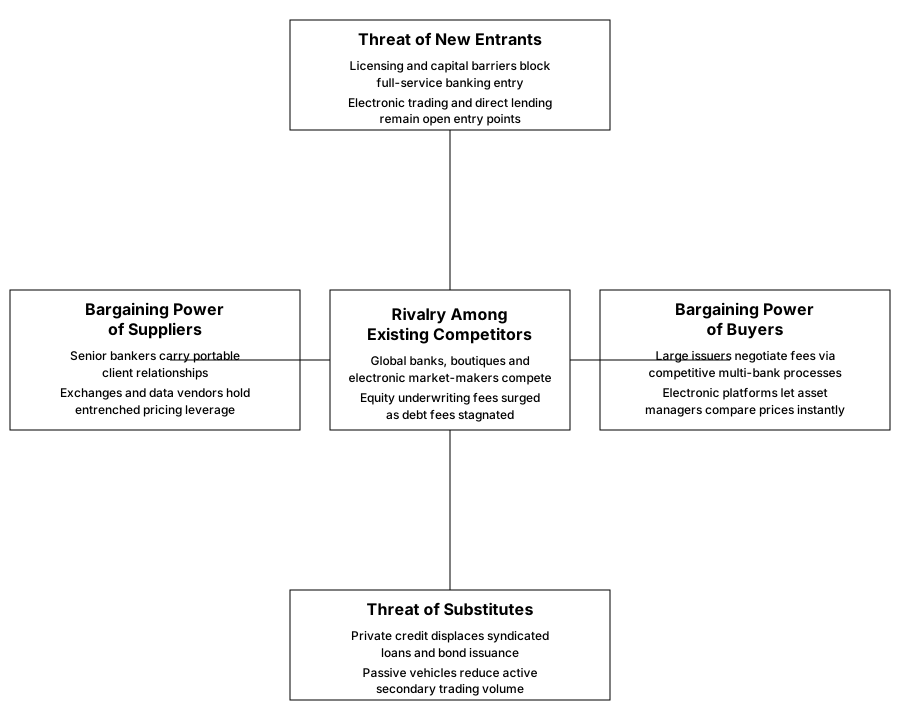
Porter's Five Forces frames capital markets as an industry where supplier and buyer power are unusually symmetric, because the largest clients are often also the largest counterparties and sources of talent. Rivalry is intense among a small number of global banks that compete simultaneously across advisory, underwriting and trading, while new entrants face steep regulatory and capital barriers except in narrow technology-enabled niches. Substitution pressure comes less from outside the industry than from within it, as private capital and direct financing displace intermediated capital markets activity.
Bargaining power of buyers
Buyers in capital markets are corporations issuing securities, institutional investors executing trades and governments financing debt and their power varies sharply by size and sophistication. Large corporate issuers and the biggest asset managers wield substantial leverage because they generate enormous fee and commission volume, can credibly threaten to switch banks or execution venues and increasingly negotiate fee schedules directly rather than accepting posted rates. Sovereign wealth funds and the largest pension systems go further, sometimes bypassing intermediaries entirely for simple transactions or demanding co-investment rights as a condition of business. Mid-sized corporate issuers and smaller institutional investors have far less leverage, since they lack the volume to negotiate meaningfully and depend on relationship bankers for market access and execution quality.
The rise of electronic trading platforms and multi-dealer request-for-quote systems has further shifted power toward buyers by making price comparison across banks nearly instantaneous for standardized instruments. Asset managers can now split order flow across a dozen counterparties within a single trading session, forcing spread compression that would have been unthinkable when trading relationships were opaque and voice-brokered. Buyer power is weakest in complex, bespoke transactions, such as large mergers, structured financings or distressed restructurings, where advisory judgment and execution certainty matter more than price and where only a handful of banks have the balance sheet and expertise to execute credibly.
| Buyer segment | Source of leverage | Constraint on leverage |
|---|---|---|
| Large corporate issuers | High deal volume, ability to run competitive processes | Need for execution certainty in large or complex deals |
| Institutional asset managers | Electronic multi-dealer platforms, volume-based fee negotiation | Dependence on liquidity providers during volatile markets |
| Sovereign and pension funds | Scale, direct market access, co-investment demands | Limited internal capacity for complex structuring |
| Mid-market corporates | Occasional switching threat | Reliance on relationship bankers for access and advice |
Bargaining power of suppliers
The primary suppliers to capital markets firms are skilled talent, market data and technology providers and the exchanges and clearinghouses that provide execution and settlement infrastructure. Talent is the most consequential supplier because advisory and trading revenue depends directly on individual bankers' relationships and traders' risk-taking judgment and senior professionals can and do move firms, taking client relationships with them. This dynamic gives top-tier talent extraordinary bargaining power, reflected in compensation structures that remain the highest of any major industry relative to headcount.
Exchanges and data vendors have also gained supplier power as their businesses consolidated. A small number of exchange groups and data providers control the reference data, market data feeds and connectivity that every trading desk needs and because switching data providers requires costly systems integration, these suppliers can raise prices with limited pushback. Clearinghouses occupy a similarly entrenched position, since post-trade infrastructure exhibits strong network effects that make it costly and risky for a bank to route trades elsewhere. Cloud infrastructure providers are an emerging supplier category with growing leverage, as banks increasingly depend on a handful of hyperscale computing platforms for the infrastructure that runs trading and risk systems, concentrating operational dependency in ways regulators have begun to scrutinize directly.
| Supplier category | Source of leverage | Constraint on leverage |
|---|---|---|
| Senior bankers and traders | Portable client relationships, scarce risk judgment | Non-compete and garden-leave provisions, deferred compensation |
| Market data and reference data vendors | Consolidated ownership, integration switching costs | Regulatory pressure on data pricing transparency |
| Exchanges and clearinghouses | Network effects, mandatory clearing requirements | Competition from alternative trading venues in liquid products |
| Cloud and technology infrastructure providers | Concentration among few hyperscale platforms | Regulatory scrutiny of operational concentration risk |
Rivalry among existing competitors
Rivalry concentrates among a small set of global, full-service banks, a slightly larger set of regional and boutique advisory firms and an expanding group of exchanges and technology-driven trading firms. Global banks compete on the strength of their balance sheets, global footprint and ability to offer a full suite of advisory, underwriting and trading services under one roof, allowing them to win mandates through existing lending relationships that boutiques cannot match. Boutique advisory firms compete instead on independence and senior banker attention, positioning themselves as free of the conflicts that arise when a bank both advises on and finances the same transaction.
Fee pools in 2025 illustrated how unevenly rivalry plays out across product lines. Equity underwriting fees rose sharply, up roughly half compared with the prior year on a resurgence in initial public offerings and follow-on issuance, while debt capital markets fees were roughly flat to modestly down as issuers increasingly financed directly through private credit rather than syndicated or public bond markets.3 This divergence forces every competitor to decide where to concentrate scarce senior banker capacity, since a firm strong in debt origination but weak in equity underwriting now finds its franchise mix working against it. Trading rivalry has taken a different shape, with electronic market-making firms that specialize in speed and technology increasingly capturing flow in liquid instruments that used to belong to bank trading desks, compressing margins for everyone still competing in cash equities and highly standardized fixed income.
| Competitive dimension | Leading approach | Strategic tension |
|---|---|---|
| Full-service global banks | Balance sheet plus advisory bundled with lending | Conflicts of interest, higher capital cost |
| Independent advisory boutiques | Senior attention, conflict-free positioning | Limited financing capability, narrower product range |
| Electronic market-making firms | Speed, technology, thin-margin high-volume execution | Vulnerable to volatility spikes and regulatory scrutiny |
| Regional and emerging-market banks | Local relationships and regulatory familiarity | Limited cross-border distribution reach |
Threat of new entrants
Entry into full-service investment banking is exceptionally difficult because it requires a banking license, substantial regulatory capital and years of relationship-building that cannot be purchased quickly. Capital requirements under Basel-style prudential frameworks mean that any new entrant seeking to run a trading book must hold significant regulatory capital before it can compete for meaningful flow and the compliance infrastructure needed to operate across multiple jurisdictions represents a further multi-year, multi-hundred-million-dollar investment. These barriers have kept the roster of truly global, full-service investment banks essentially unchanged for two decades, with growth coming from within incumbents rather than from new global entrants.
Narrower entry points exist and have proven far more permeable. Electronic trading and market-making firms have entered successfully by focusing purely on execution technology in liquid, standardized instruments, avoiding the licensing burden of full-service banking while still capturing meaningful trading margin. Private credit funds have entered corporate financing even more aggressively, since asset managers can originate loans without a banking charter, relying instead on their existing fund structures and investor capital. Financial technology firms have also entered adjacent segments such as trade settlement, collateral management and post-trade reconciliation, competing on cost and speed rather than trying to replicate a bank's balance sheet or advisory relationships.
| Entry pathway | Barrier level | Recent evidence |
|---|---|---|
| Full-service global investment bank | Very high, licensing and capital intensive | No new global entrant in two decades |
| Electronic market-making in liquid instruments | Moderate, technology and capital intensive | Non-bank firms now handle a large share of equity volume |
| Direct lending and private credit origination | Moderate, fund structure rather than banking license | Assets under management roughly doubled since 2020 |
| Post-trade technology and infrastructure | Low to moderate, software-driven | Multiple fintech entrants targeting settlement and collateral |
Threat of substitutes
The most consequential substitute for bank-intermediated capital markets activity is direct financing through private capital, which allows a corporate borrower to bypass syndicated loan and public bond markets entirely by negotiating directly with a private credit fund. This substitution has accelerated because banks retreated from balance-sheet-heavy lending under tighter capital regulation, leaving room for less-regulated asset managers to step in and lend directly, often on faster timelines and with fewer public disclosure requirements. For a corporate treasurer choosing between a syndicated loan and a private credit facility, the private option increasingly offers comparable pricing with greater speed and confidentiality, eroding a business that once belonged squarely to banks.
Passive investment vehicles represent a second substitute, reducing the trading volume that would otherwise flow through active bank desks as institutional and retail capital increasingly tracks indices rather than trading individual securities actively. Corporate direct listings and at-the-market equity programs offer a milder substitute within equity issuance, letting some issuers avoid the traditional underwritten offering process altogether, though this remains a small share of total issuance. Peer-to-peer and blockchain-based settlement experiments represent a longer-horizon substitute threat to post-trade infrastructure, though adoption at meaningful scale remains limited relative to established clearing systems.
| Substitute | What it replaces | Adoption trajectory |
|---|---|---|
| Private credit direct lending | Syndicated loans, high-yield bond issuance | Assets under management growing toward roughly 4.5 trillion dollars by 2030 |
| Passive and index-tracking vehicles | Active secondary trading volume | Steadily increasing share of institutional and retail assets |
| Direct listings and at-the-market issuance | Traditional underwritten equity offerings | Small but persistent share of issuance activity |
| Distributed ledger settlement pilots | Traditional clearing and settlement infrastructure | Early stage, limited scale adoption |
Value chain and profit pools
The capital markets value chain runs from origination through distribution and into ongoing servicing. Origination is where a bank or fund identifies and structures a financing or advisory opportunity, translating a client's need, whether raising equity, issuing debt or executing a merger, into a specific transaction. Structuring and underwriting follow, where the bank prices the risk of the transaction, commits its own capital or reputation to guarantee proceeds to the issuer and prepares the legal and regulatory documentation required for the offering.
Distribution is the stage where securities move from the underwriter to the ultimate investor base, drawing on the bank's sales force and its relationships with institutional buyers to place the offering at the best achievable price. Secondary trading and market-making follow issuance, providing the ongoing liquidity that makes an instrument attractive to hold in the first place, since investors demand the ability to exit a position before they will buy it. Clearing and settlement sit beneath all trading activity, providing the infrastructure that confirms and finalizes every transaction, a function increasingly concentrated in a small number of specialized clearinghouses. Finally, custody and ongoing servicing complete the chain, holding assets on behalf of institutional owners and providing the reporting, collateral management and securities lending services that keep portfolios operating smoothly.
Profit pool
Profit concentrates unevenly across this chain and the concentration has shifted meaningfully over the past fifteen years. Advisory and equity underwriting retain the highest margins because they depend on judgment and reputation that cannot be automated and equity capital markets fees rose roughly 50 percent year over year through 2025 as issuance activity recovered.4 Secondary trading in liquid, standardized instruments such as large-cap equities has moved the opposite direction, with margins compressed close to marginal cost as electronic execution and algorithmic strategies now handle roughly a third to a half of overall equity volume.5
Clearing, custody and data services have quietly become some of the most profitable parts of the chain precisely because they are recurring and largely non-cyclical, unlike advisory fees that can collapse when deal-making slows. Exchange groups in particular have transformed their economics by building data and analytics businesses on top of their trading infrastructure, so that market data licensing now contributes a disproportionate share of profit relative to transaction fees alone. Private credit origination represents the newest profit pool of consequence, drawing origination fees and net interest margin that would previously have accrued to bank syndication desks and its rapid growth signals a durable rebalancing of where capital markets profit is earned rather than a temporary cyclical shift.
Industry economics and business models
Three business models dominate capital markets. The advisory and underwriting model is fee-based and transaction-driven, earning revenue as a percentage of deal value with essentially no revenue in the absence of a closed transaction, which makes it inherently lumpy and dependent on deal-cycle timing. The trading and market-making model is spread-based and volume-driven, earning revenue on the difference between buy and sell prices multiplied by transaction volume and it benefits from volatility regardless of market direction, which somewhat offsets its correlation with the advisory cycle.
The infrastructure and data model, exemplified by exchanges, clearinghouses and custodians, is subscription and usage-based, earning steady recurring revenue from market data licenses, clearing fees and custody charges that scale with assets under administration rather than transaction count alone. This model has become the most highly valued of the three by public market investors precisely because its revenue does not swing with deal activity the way advisory and underwriting revenue does. A fourth, hybrid model has emerged in private credit, where asset managers combine origination economics similar to bank lending with asset management-style management fees charged to the fund's own investors, effectively capturing margin at two points in the chain that a traditional bank would have captured only once.
Cost drivers and scalability
Cost structures differ sharply across the three core business models. Advisory and underwriting businesses are labor-intensive, with compensation representing the dominant cost line and scaling closely with headcount rather than transaction volume, meaning that a slow deal year still carries most of the prior year's fixed compensation base until a firm actively cuts staff. Trading businesses are technology and capital-intensive instead, requiring continuous investment in low-latency infrastructure, risk systems and regulatory capital, but once that infrastructure is built, incremental transactions carry very low marginal cost, creating strong economies of scale for the largest electronic trading operations.
Infrastructure businesses such as exchanges and clearinghouses exhibit the strongest scale economics of all, since the fixed cost of building and maintaining a trading venue or clearing system is largely independent of transaction volume, so additional volume flows through at very high incremental margin. This scale advantage is a central reason exchange operators have historically traded at higher valuation multiples than banks despite operating in what looks superficially like the same industry. Unit economics for advisory businesses resemble professional services more than finance, tracked through metrics such as revenue per senior banker and deal-closure rates, while trading businesses track metrics closer to manufacturing, such as cost per trade and infrastructure utilization across market hours.
Moats, advantages and strategic levers
Defensibility in capital markets comes from several sources that rarely all belong to the same firm at once. Regulatory licensing is the deepest moat in full-service banking, since the multi-year process of obtaining and maintaining banking and broker-dealer licenses across major jurisdictions deters all but the most well-capitalized entrants. Balance sheet scale provides a second moat, particularly during periods of market stress, when only banks with substantial capital can commit to underwriting a large offering or providing liquidity when other market participants are pulling back.
Network effects protect exchanges and clearinghouses especially strongly, because liquidity attracts more liquidity and a trading venue that already hosts the deepest order book in an instrument becomes progressively harder for a rival venue to dislodge. Data and learning advantages are becoming more important across the industry as firms accumulate proprietary transaction and analytics data that improves pricing models and client insights over time, an advantage that compounds the longer a firm has been active in a given market. Switching costs matter most in custody, clearing and prime brokerage relationships, where migrating assets and operational workflows to a new provider is costly and risky enough that institutional clients tolerate meaningfully higher fees rather than switch providers.
Strategic levers
Firms competing in capital markets can pull several distinct levers depending on their starting position. Customer segment focus allows a firm to concentrate on a specific client type, such as mid-market corporates or sovereign wealth funds, building deep expertise and relationships that a generalist competitor cannot easily replicate. Product scope decisions determine whether a firm pursues the full-service model spanning advisory, underwriting and trading, or specializes narrowly in one product line where it can build genuine differentiation rather than mediocre presence everywhere.
Vertical integration versus partnering is a particularly live decision in the current environment, as banks weigh whether to build private credit capabilities internally, acquire an asset manager, or simply partner with existing private credit funds to retain origination relationships without taking the associated balance sheet risk. Geographic expansion remains a lever primarily available to the largest global banks, since building genuine local execution and regulatory capability market by market requires resources smaller firms cannot deploy. Ecosystem orchestration, the strategy of becoming the platform other participants build on top of, has proven most successful for exchanges and data providers and increasingly for technology-forward banks that license their trading and risk infrastructure to smaller institutions rather than treating it purely as internal cost.
Structural risks, regulation and trends
Regulatory risk sits at the top of the list for every capital markets participant, since capital requirements, market conduct rules and systemic-risk oversight can change the profitability of entire business lines with a single rule change, as happened when post-crisis capital rules pushed banks out of certain balance-sheet-heavy lending activities and opened the door to private credit. Technology disruption represents a second structural risk, as Artificial Intelligence-driven execution and analytics continue to compress margins in commoditized activities while simultaneously raising the bar for the data and technology investment required just to remain competitive. Geopolitical risk has grown more salient as sanctions regimes, capital controls and trade tensions increasingly shape where capital can flow and which counterparties banks can legally serve, forcing constant compliance investment and occasionally cutting off entire markets overnight.
Several secular trends will shape the industry's trajectory over the coming decade. Demand for capital markets services continues to grow with global gross domestic product and corporate financing needs, but the channel through which that demand is met keeps shifting toward private and direct alternatives rather than traditional public markets. Supply-side consolidation continues among banks and exchanges, as scale economics reward the largest players and squeeze mid-sized firms that lack either true global reach or genuine niche specialization. Artificial Intelligence adoption is moving from back-office efficiency into front-office judgment functions such as credit underwriting and research synthesis, a shift that will eventually test which parts of advisory work truly require human relationship capital and which can be augmented or replaced.
For firms considering entry, the playbook depends heavily on ambition and capital availability. A niche entry strategy, focused on a single product line such as electronic market-making, direct lending, or post-trade technology, offers a realistic path with a multi-year rather than multi-decade timeline to profitability. A broad, full-service entry strategy is essentially unavailable to new players and only remains open to already-licensed banks expanding their existing footprint through acquisition. Partnering with an established bank or exchange to access licensing and distribution, rather than building or buying a license outright, has proven the fastest route for technology firms seeking to enter regulated segments of the industry.
For incumbents, the playbook centers on deepening moats before they erode further. Defending existing franchises means continuing to invest in execution technology even in low-margin businesses, since ceding that ground entirely removes a source of client relationship and flow data that supports higher-margin advisory work. Expanding means following clients into the fastest-growing pools of profit, particularly private credit and data services, either by building capability internally or by acquiring or partnering with specialists already established there. Deepening moats means treating regulatory compliance, balance sheet strength and data assets as strategic capital to be actively managed and invested in, rather than as costs to be minimized, since these three assets increasingly determine which firms survive the next cycle of margin compression.
Caselet: Goldman Sachs and the full-service model under pressure
Goldman Sachs traces its origins to 1869, when Marcus Goldman began a commercial paper trading business in New York and it grew over the following century and a half into one of the small handful of banks that can credibly claim a full-service global capital markets franchise spanning advisory, underwriting, trading and, more recently, asset and wealth management. The firm's history offers a useful lens on how the industry's economics have shifted, because Goldman itself has repeatedly reorganized around exactly the pressures described throughout this analysis:
fee-pool volatility, electronic trading margin compression and the rise of private capital as both a threat and an opportunity
Goldman's core investment banking business, spanning advisory and underwriting, remains the segment most closely associated with its brand and the firm has consistently ranked among the top firms globally in merger and acquisition advisory league tables for more than two decades.6 That leadership reflects the moat described earlier around relationship capital and balance sheet scale, since the largest, most complex transactions still gravitate toward a small number of banks capable of committing capital and coordinating execution across multiple jurisdictions simultaneously. In the third quarter of 2025, Goldman reported investment banking fees up sharply year over year, driven by strength in both advisory and underwriting, illustrating how quickly fee pools can recover once deal confidence returns after a slow period.
The firm's trading business tells a more complicated story about where the industry's profit pool has moved. Goldman has invested heavily in electronic trading infrastructure precisely because competitors, including specialized electronic market-making firms, have captured share in liquid instruments that used to generate comfortable margins for bank trading desks. Rather than cede this ground, Goldman chose to compete directly in electronic execution while shifting its principal risk-taking increasingly toward more complex, less commoditized instruments where balance sheet and structuring expertise still command a premium. This mirrors the broader industry pattern in which banks defend low-margin flow business for its relationship and data value while chasing genuine margin in more bespoke activity.
Goldman's response to the growth of private credit is equally instructive. Rather than treating private credit purely as a competitive threat to its lending and debt underwriting franchise, the firm built out its own alternative investment and private credit capabilities within its asset and wealth management division, positioning itself to earn fees on both sides of the disintermediation trend: advising and underwriting for clients who still use public markets, while also originating and managing private credit for clients and its own funds who prefer the private route. This dual positioning reflects the vertical integration lever available to well-capitalized incumbents, allowing the firm to participate in the fastest-growing segment of the industry rather than watching that growth accrue entirely to independent asset managers.
The firm's periodic strategic pivots, including its retreat from a consumer banking expansion it pursued in the previous decade, also illustrate a broader discipline relevant across the industry: capital markets economics reward firms that concentrate resources where their moat is genuine, rather than diversifying into adjacent businesses where scale or relationship advantages do not transfer. Goldman's return of focus toward its core investment banking, trading and asset and wealth management franchises after that experience underscores a lesson applicable well beyond one firm, namely that capital markets profitability depends on matching business model choice to genuine structural advantage rather than chasing revenue growth wherever it appears available.
Goldman's trajectory captures the industry's central tension in miniature. A firm with genuine scale, licensing and relationship advantages can defend and even expand its position even as individual product lines face relentless margin pressure from technology and private capital, provided it continually redeploys capital and talent toward the parts of the value chain where those advantages still command a premium.
Capital markets exist to match savers with borrowers and issuers with investors, pricing the risk in between. The industry's economics reward scale in execution and data and reward scarcity in advisory judgment and balance sheet commitment during stress. Margin has migrated toward equity underwriting, data and analytics and private credit origination and away from cash equities trading and plain-vanilla debt distribution. Incumbents defend their position by controlling clearing, data and regulatory licenses simultaneously, while new entrants succeed by attacking a single link in the chain, typically execution technology or direct lending, rather than trying to replicate the full-service model. The strategic question for any participant is which combination of balance sheet, license and data advantage it can sustain once technology has commoditized the rest.
Citation
Cite this article
Sridharan, M. A. (2023, April 30). Industry Analysis: Capital Markets. Think Insights. https://thinkinsights.net/strategy/industry-analysis-capital-markets (Accessed [[ACCESS_DATE]])
Sridharan, Mithun A. "Industry Analysis: Capital Markets." Think Insights, 30 Apr. 2023, https://thinkinsights.net/strategy/industry-analysis-capital-markets. Accessed [[ACCESS_DATE]].
Mithun A. Sridharan, "Industry Analysis: Capital Markets," Think Insights, April 30, 2023, https://thinkinsights.net/strategy/industry-analysis-capital-markets. Accessed [[ACCESS_DATE]].
Sridharan, M.A. (2023) 'Industry Analysis: Capital Markets', Think Insights. Available at: https://thinkinsights.net/strategy/industry-analysis-capital-markets (Accessed: [[ACCESS_DATE]]).
M. A. Sridharan, "Industry Analysis: Capital Markets," Think Insights, 2023. [Online]. Available: https://thinkinsights.net/strategy/industry-analysis-capital-markets. [Accessed: [[ACCESS_DATE]]].
Sridharan MA. Industry Analysis: Capital Markets. Think Insights. Published April 30, 2023. Accessed [[ACCESS_DATE]]. https://thinkinsights.net/strategy/industry-analysis-capital-markets
Test Your Knowledge
Industry Analysis: Capital Markets
Challenge yourself on the concepts from this article and see how well you understood them.
Subscribers get weekly quizzes and insights — subscribe free
Sponsor this article
Partner with Think Insights
Reach 50,000+ business leaders, consultants, and strategists. Feature your brand alongside expert articles on strategy, leadership, and digital transformation.
Become a Sponsor