Industry Analysis: Business Process Outsourcing


Enterprises should treat Business Process Outsourcing [BPO] not as a cost line to negotiate down but as a capability decision that determines who owns customer data, process intellectual property and the automation roadmap. The industry processes hundreds of billions of dollars in outsourced customer support, finance, HR and back-office work every year, growing at close to 10% annually as digital operations replace voice-heavy contact centers. Margin is migrating away from headcount-based delivery toward firms that own platforms, proprietary automation and vertical domain expertise; buyers increasingly capture value once held by vendors because Artificial Intelligence lets them insource routine work cheaply. The decision facing boards is whether to lock in outcome-based, technology-enabled partnerships now or risk paying a premium later for capabilities competitors have already absorbed.
Is Business Process Outsourcing [BPO] attractive for new entrants?
Attractiveness depends heavily on where an entrant plays. Broad, voice-based delivery is unattractive because incumbents already operate at scale and margins are thin, but narrow, vertical-specific or AI-native niches, such as claims automation for regional insurers or bookkeeping for small accounting firms, remain open because domain depth and technology differentiation matter more than headcount.
Which parts of the value chain are most profitable?
Consulting-led transformation, platform and automation licensing and data and analytics services carry the highest margins, typically in the high teens to mid-twenties on an operating basis, while high-volume, low-complexity transaction processing and entry-level voice support sit at the bottom, often in the single digits.
How is technology changing this industry?
Generative Artificial Intelligence and intelligent automation are compressing the labor-intensive core of the industry by handling routine queries, document extraction and rules-based decisioning directly, pushing providers to reposition as technology integrators and outcome guarantors rather than pure staffing arbitrage vendors.
What capabilities are table stakes vs differentiators?
Multichannel delivery, basic workforce management and standard service-level compliance are table stakes that every credible vendor must offer, while true differentiators are proprietary automation intellectual property, vertical regulatory expertise, data security certifications trusted by regulated industries and the ability to redesign a client's process rather than merely execute it.
How should investors or consultants evaluate opportunities here?
Evaluate providers on the mix of revenue coming from digital and automation-enabled work versus pure labor arbitrage, the durability of client relationships measured by contract tenure and expansion rates, geographic diversification beyond a single low-cost hub and evidence that management is cannibalizing its own headcount-based revenue before a client or competitor forces the issue.
Why do multinational companies still outsource instead of building in-house shared services?
Shared services capture savings but require capital, management attention and a multi-year build, while outsourcing converts that investment into a variable, contractible expense and gives access to specialized talent pools and technology platforms that would take years to replicate internally.
What role do government incentives play in shaping delivery locations?
Special economic zones, tax holidays and export-processing incentives in countries such as the Philippines, India and various Eastern European states materially affect where providers build capacity and shifts in these policies can reroute investment faster than wage differentials alone would predict.
Is the Philippines' dominance in voice-based outsourcing at risk?
Voice work concentrated in the Philippines faces the most direct exposure to AI-driven automation because it is precisely the conversational, script-heavy work that large language models now handle competently, though the country's cultural affinity with Western customers and deep bench of trained agents provide some insulation for complex, empathy-driven interactions.
How do outcome-based contracts differ from traditional full-time-equivalent pricing?
Full-time-equivalent pricing bills clients for headcount regardless of output, which rewards vendors for adding staff, while outcome-based contracts tie fees to resolved tickets, processed transactions or business metrics such as reduced churn, aligning vendor incentives with automation and efficiency rather than labor volume.
What distinguishes a resilient BPO provider from a vulnerable one heading into the next decade?
Resilience comes from a diversified revenue mix across geographies and verticals, a credible automation and AI product layer that clients pay for directly, long-tenured contracts with embedded switching costs and a demonstrated willingness to shrink low-value headcount proactively rather than defend it until clients or competitors force the change.
Business Process Outsourcing, commonly abbreviated as BPO, describes the practice of contracting a third-party provider to perform business functions that a company would otherwise run internally, spanning customer support, finance and accounting, human resources administration, procurement and industry-specific back-office processing. The industry sits at the intersection of labor economics, enterprise technology and global trade policy and it has quietly become one of the largest employers of skilled and semi-skilled labor outside traditional manufacturing. What began decades ago as a straightforward exercise in wage arbitrage has evolved into a far more layered business, where the companies capturing the most value are no longer simply the ones with the cheapest seats but the ones that own automation platforms, proprietary data and the trust of regulated industries.
Industry at a glance
The BPO industry sells execution capacity for defined business processes, typically under multi-year contracts that specify service levels, pricing per transaction or per full-time equivalent and increasingly, outcome-based metrics tied to the client's own performance goals. Included within the industry's scope are customer experience management (voice, chat and email support), finance and accounting outsourcing covering accounts payable, accounts receivable and financial close, human resources outsourcing covering payroll and benefits administration, procurement and supply chain support and industry-specific processing such as insurance claims adjudication, mortgage underwriting support and healthcare revenue cycle management. Excluded from this scope, though frequently confused with it, are pure information technology outsourcing engagements focused solely on infrastructure or application development and management consulting engagements that advise on strategy without taking on operational delivery, even though the largest diversified players increasingly blend all three.
Customers are overwhelmingly business-to-business, since the provider's client is almost always a corporation, though the work performed frequently touches millions of end consumers indirectly through customer service interactions, meaning quality failures surface publicly even though the contracting relationship is invisible to the public. A smaller but growing share of demand comes from government agencies outsourcing citizen services, benefits processing and tax administration support, introducing a business-to-government dimension with distinct procurement and compliance requirements. The industry's economic role is fundamentally a derivative one:
demand rises and falls with the health of the sectors it serves, most heavily banking and financial services, telecommunications, healthcare, retail and technology, so a slowdown in enterprise spending or a wave of in-house automation investment by clients has an outsized effect on providers relative to their own standalone growth drivers
Revenue models rest on three broad structures. Full-time-equivalent or staffing-based pricing bills clients for the labor supplied, transaction-based pricing charges per unit of work completed such as per call, per claim or per invoice processed and outcome-based pricing ties fees to business results such as reduced customer churn or faster claims cycle time. The industry is moderately labor-intensive but decreasingly so, with people costs still representing the majority of direct delivery expense at most providers, while capital intensity is comparatively low relative to manufacturing or infrastructure sectors, since the primary fixed assets are office space, technology licenses and training infrastructure rather than heavy machinery. Regulatory intensity varies sharply by segment:
healthcare and financial services BPO carry substantial compliance burden tied to data privacy and industry-specific rules, while general customer support carries comparatively light direct regulation, though data protection statutes increasingly apply across the board regardless of sector
Independent market research firms estimate the global BPO market at roughly 350 billion to 385 billion dollars in 2026, with most forecasts converging on a compound annual growth rate near 9% to 10% through the early 2030s1. North America remains the largest single regional market, accounting for well over a third of global revenue, reflecting both the scale of the region's corporate base and its historical role as the primary buyer of offshore delivery capacity2.
Industry segmentation
The industry divides most usefully along value chain position, since different segments require different capabilities, carry different margins and face different competitive dynamics. Customer experience management, encompassing voice, chat, email and social media support, remains the largest segment by headcount and revenue and it is also the segment facing the most direct exposure to automation because much of its work is conversational and rules-based. Finance and accounting outsourcing covers transactional accounting, accounts payable and receivable, financial close support and increasingly higher-value functions such as financial planning and analysis and it commands stronger margins than voice work because errors carry financial and regulatory consequences that justify premium pricing.
Human resources outsourcing spans payroll processing, benefits administration, recruitment process outsourcing and employee helpdesk support and it has consolidated around a smaller number of specialist providers because payroll compliance varies enormously by jurisdiction and errors expose clients to legal liability. Procurement and supply chain outsourcing, a smaller but fast-growing segment, covers indirect procurement management, supplier onboarding and logistics coordination, benefiting from renewed corporate attention to supply chain resilience since the pandemic-era disruptions. Industry-specific or vertical BPO, covering functions like insurance claims processing, mortgage servicing support and healthcare revenue cycle management, commands the highest margins of all because it demands regulatory knowledge and domain expertise that general-purpose providers cannot easily replicate, creating durable competitive separation from commodity segments.
A second useful dimension is delivery geography, distinguishing offshore delivery from low-cost countries such as India and the Philippines, nearshore delivery from countries geographically and culturally proximate to the client such as Mexico serving the United States or Poland serving Western Europe and onshore delivery retained in the client's home country for functions requiring cultural nuance, language precision or strict data residency. Each geography carries a distinct cost and risk profile and most large enterprise buyers now deliberately blend all three rather than concentrating delivery in a single location, a shift accelerated by the supply chain and geopolitical shocks of the past several years.
Market structure
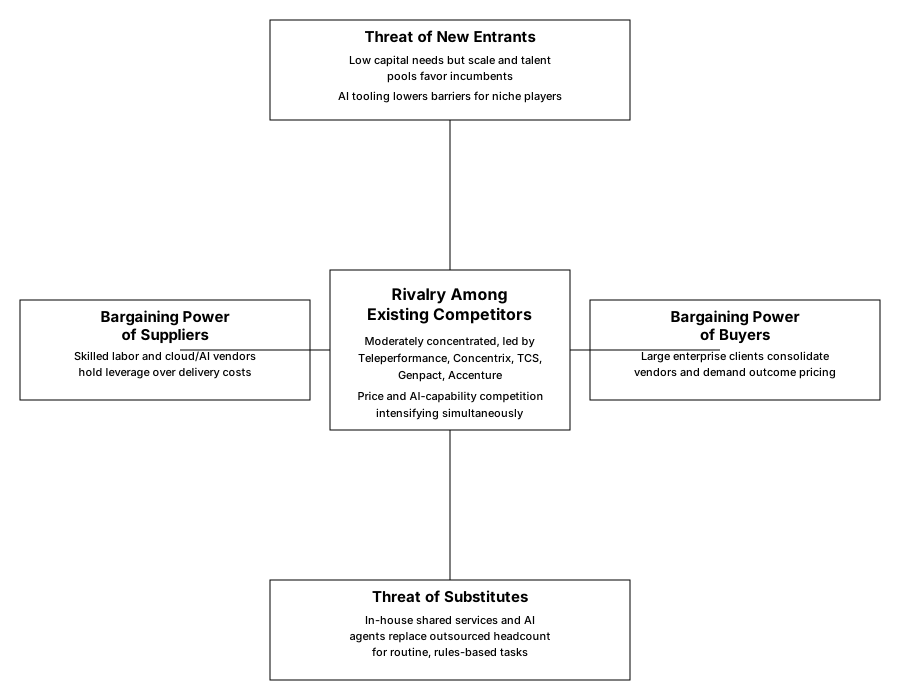
Competitive intensity in Business Process Outsourcing [BPO] is shaped by a market that is moderately concentrated at the top, fragmented at the bottom and increasingly defined by technology capability rather than pure labor cost. A handful of large diversified players, including Teleperformance, Concentrix, Genpact, Tata Consultancy Services, Accenture, Infosys BPM and Wipro, compete for the largest enterprise contracts, while thousands of smaller regional and boutique firms serve mid-market clients and specialized niches. The five forces below describe how value is created, contested and captured across this structure.
Bargaining power of buyers
Enterprise buyers in Business Process Outsourcing [BPO] hold substantial and growing leverage, a dynamic that has intensified rather than eased as the market has matured. Large multinational clients typically run competitive tenders across three to five qualified vendors, use standardized service-level frameworks to benchmark performance across providers and increasingly consolidate spend with fewer partners to extract volume pricing while demanding broader capability across geographies and functions. Because switching an entire outsourced function carries real transition cost and risk, buyers rarely churn vendors outright, but they routinely use the credible threat of switching, combined with contract renegotiation clauses tied to productivity commitments, to compress pricing year over year. The rise of generative Artificial Intelligence has sharpened this leverage further, since buyers can now credibly threaten to insource routine work that a chatbot or automation script can handle, a threat that did not exist with comparable force five years ago.
Large buyers also increasingly demand outcome-based and gain-sharing pricing structures rather than simple staffing-based fees, effectively transferring productivity risk onto the vendor and forcing providers to fund their own automation investment out of shrinking per-unit margins. Mid-market and smaller buyers carry less individual leverage given lower contract volumes, but aggregators and outsourcing advisory firms increasingly represent their interests collectively, narrowing the power gap between large and small clients. Vendors that fail to demonstrate continuous productivity improvement, typically expressed as annual unit cost reduction targets embedded directly into contracts, lose renewal leverage regardless of service quality, because buyers treat cost discipline as a baseline expectation rather than a differentiator.
| Buyer characteristic | Effect on provider leverage |
|---|---|
| Multi-year contracts with embedded productivity clauses | Forces continuous margin compression on vendors |
| Growing vendor consolidation by large enterprises | Concentrates volume but increases dependency risk for winners |
| Credible in-house automation alternative | Weakens vendor pricing power on routine transactional work |
| Outcome-based and gain-sharing contract structures | Transfers delivery risk from client to provider |
| Advisory firms representing mid-market buyers | Narrows power gap between large and small clients |
Bargaining power of suppliers
Suppliers to the Business Process Outsourcing [BPO] industry include the skilled labor pool that performs the work, the technology vendors that provide cloud infrastructure, automation software and Artificial Intelligence tooling and real estate providers in delivery hub cities. Labor supply is the most consequential of these and its power varies significantly by skill tier and geography. Entry-level voice and transactional roles draw from large, relatively undifferentiated labor pools in delivery hubs such as Manila, Bengaluru and Krakow, giving providers meaningful leverage over wages at that tier, but specialized talent, including certified accountants, licensed insurance adjusters and bilingual technical support agents, is scarcer and commands rising wages that providers struggle to pass through fully to price-sensitive clients.
Technology suppliers hold a disproportionate and growing share of power because the leading cloud infrastructure providers and enterprise software vendors that supply customer relationship management platforms, contact center software and generative Artificial Intelligence models are themselves highly concentrated, giving them pricing leverage over BPO firms that depend on their platforms to deliver services. Several major providers have responded by building proprietary automation layers atop third-party infrastructure to reduce dependency, though few have achieved genuine independence from the hyperscale cloud and large language model providers that underpin modern delivery. Real estate and facilities suppliers hold comparatively limited power given the fungibility of office space across most delivery hub cities, though special economic zones with favorable tax treatment create some lock-in once a provider has built substantial fixed infrastructure in a particular location.
| Supplier category | Leverage dynamic |
|---|---|
| Entry-level, high-volume labor pools | Low individual leverage given abundant regional supply |
| Certified or licensed specialist talent | Rising leverage as demand for regulated-process expertise grows |
| Cloud infrastructure and AI model providers | High and increasing leverage due to concentrated supply |
| Contact center and workforce software vendors | Moderate leverage, partially offset by proprietary provider tools |
| Special economic zone landlords and authorities | Moderate leverage once fixed infrastructure investment is sunk |
Rivalry among existing competitors
Competitive rivalry sits at a moderate but rising intensity, concentrated among a set of global scale players while remaining fragmented across a long tail of regional and niche specialists. Teleperformance, Concentrix and Accenture lead the customer experience segment by revenue, while Genpact, Tata Consultancy Services, Infosys BPM and Wipro compete most directly in finance, accounting and technology-enabled operations and the boundaries between these groupings continue to blur as diversified players expand across segments through acquisition3. Rivalry historically centered on price per seat and geographic cost arbitrage, but the basis of competition has shifted decisively toward Artificial Intelligence capability, with buyers now evaluating vendors on the depth of their automation intellectual property and their ability to demonstrate measurable productivity gains rather than simply the lowest hourly rate.
This shift has raised the stakes of rivalry considerably, because providers that invested early in proprietary automation platforms, data analytics capability and vertical domain expertise can defend margin even as headcount growth slows, while providers that competed purely on labor cost face compounding pressure as that basis of competition erodes. Merger and acquisition activity remains a persistent feature of rivalry, as scaled players acquire specialized boutiques to acquire vertical expertise or automation technology rather than build it internally and this consolidation trend is likely to continue as the capital required to build credible generative Artificial Intelligence capability rises beyond what smaller regional players can fund independently.
Differentiation now depends on AI depth, outcome-based contracts and global delivery reach, rather than headcount scale alone
| Competitive dimension | Current dynamic |
|---|---|
| Price per seat or per transaction | Still relevant for commodity work but declining as sole differentiator |
| Automation and AI capability depth | Increasingly the primary basis of vendor selection |
| Vertical domain expertise | Commands premium pricing and higher retention |
| Merger and acquisition activity | Consolidation continues as scale funds AI investment |
| Global delivery footprint breadth | Reduces geopolitical and wage-inflation concentration risk |
Threat of new entrants
Barriers to entry in Business Process Outsourcing [BPO] are lower than they appear at first glance for narrow, technology-enabled niches, even though they remain formidable for anyone attempting to compete broadly against scaled incumbents. Starting a boutique provider focused on a single vertical, such as dental practice billing or e-commerce returns processing, requires comparatively modest capital and cloud-based contact center and automation tools have removed much of the technology infrastructure barrier that once favored large incumbents exclusively. This has produced a steady stream of new entrants at the specialized, small-contract end of the market, particularly firms built natively around Artificial Intelligence agents rather than human headcount, some of which are reshaping cost expectations for narrowly defined use cases faster than incumbents can respond.
Competing for large enterprise contracts remains far harder, because winning them requires demonstrated scale, multi-geography delivery redundancy, security and compliance certifications that take years to obtain and reference relationships with comparable global brands that new entrants simply do not have. Client switching costs for large, complex outsourced functions are substantial, involving lengthy transition periods, knowledge transfer risk and potential service disruption, all of which favor incumbents once a contract is won. The net effect is a barbell pattern:
intense new-entrant pressure at the bottom of the market from AI-native specialists and durable incumbent advantage at the top of the market where scale, trust and compliance history remain decisive
| Entry consideration | Effect on new entrant viability |
|---|---|
| Cloud-based delivery infrastructure availability | Lowers technology barrier for narrow use cases |
| Enterprise security and compliance certification requirements | Raises barrier significantly for large regulated contracts |
| Reference-account requirements from large buyers | Favors incumbents with established brand trust |
| AI-native, low-headcount business models | Enables cost-competitive entry into narrow niches |
| Multi-geography delivery redundancy expectations | Difficult for new entrants to replicate quickly |
Threat of substitutes
The most consequential substitute for outsourced business processes is not another outsourcing vendor but the client's own capability, whether built as an in-house shared services center or increasingly automated away entirely through Artificial Intelligence agents and robotic process automation. Large enterprises with sufficient scale have long had the option of building captive shared services centers rather than outsourcing and this option has become more attractive again as generative Artificial Intelligence lowers the technology investment required to run such a center effectively, narrowing the cost gap that historically favored external providers. For rules-based, high-volume transactional work such as password resets, order status queries and basic data entry, Artificial Intelligence agents now represent a direct and rapidly improving substitute for outsourced human labor and this threat is the most immediate structural risk facing the industry's traditional voice and transactional segments.
Enterprise software platforms themselves increasingly embed workflow automation that reduces the volume of work requiring either internal staff or external vendors in the first place, a subtler but equally corrosive substitution effect, since it shrinks total addressable demand rather than simply redirecting it. Substitution risk is lowest for complex, judgment-intensive and regulated processes, such as intricate claims adjudication or specialized financial reporting, where human expertise combined with process-specific knowledge remains difficult to fully automate, giving providers in these segments more durable protection against substitution than their counterparts in commodity transactional work.
| Substitute type | Exposure level |
|---|---|
| In-house shared services centers | Rising as AI lowers the internal build cost |
| AI agents for rules-based queries and transactions | High and immediate for voice and simple back-office work |
| Embedded workflow automation within enterprise software | Structural, shrinks total outsourceable volume over time |
| Robotic process automation for repetitive data tasks | High for structured, high-volume processes |
| Judgment-intensive, regulated process expertise | Low, difficult to substitute without specialized human oversight |
Value chain and profit pools
The Business Process Outsourcing [BPO] value chain runs from talent sourcing and training through service design, delivery execution, quality assurance and account management, with a supporting infrastructure layer of technology and real estate underpinning every stage. Talent sourcing and training forms the upstream input stage, where providers recruit, screen and train the workforce that will execute client processes and the quality of this stage determines both service quality and attrition, which remains one of the industry's most persistent operational challenges given annual attrition rates that frequently exceed 30% in voice-heavy delivery centers.
Service design and transition sits next, encompassing the work of mapping a client's existing process, redesigning it for outsourced delivery and migrating knowledge and systems access, a stage that increasingly determines contract profitability because poorly designed transitions generate rework and service credits that erode margin for years afterward. Delivery execution, the core production stage, is where the actual work of handling calls, processing transactions or managing accounts occurs, typically organized around shift-based operations in delivery centers and this stage remains the most labor-intensive and margin-thin part of the chain because it competes most directly on cost per unit.
Quality assurance and continuous improvement forms a distinct value chain stage in mature providers, involving monitoring, coaching and process refinement that both protects service levels and generates the productivity gains clients increasingly demand as a contractual condition of renewal. Account management and client relationship stewardship, though often underappreciated, functions as the distribution and customer interface stage of the chain, since it is where contract expansion, renewal negotiation and escalation management occur and providers with strong account management consistently expand wallet share within existing clients faster than they win new logos. The enabling infrastructure layer, spanning cloud platforms, automation software, cybersecurity and real estate, cuts across every other stage and has become the primary site of competitive differentiation as providers invest to reduce their dependence on pure headcount.
Profit pool
Profit concentration within Business Process Outsourcing [BPO] has shifted markedly over the past decade, moving away from raw delivery execution and toward the stages that sit above and around it. A decade ago, the largest share of industry profit accrued to providers with the lowest delivery cost base, effectively rewarding wage arbitrage above all else, but that pool has thinned considerably as clients captured most of the labor cost savings through competitive bidding and as wage inflation in traditional hub cities like Manila and Bengaluru narrowed the arbitrage advantage relative to newer, lower-cost locations. Today, the deepest profit pools sit in three places:
automation and platform intellectual property that providers license or embed into delivery, consulting-led process transformation work that commands premium day rates because it requires scarce expertise and vertical-specific regulated processing where domain knowledge creates real switching costs for clients
Genpact's own disclosed shift toward digital operations, which the company reports now represents more than half of total revenue, illustrates this migration concretely, since technology-enabled and analytics-driven work carries materially higher margin than comparable headcount-based transaction processing4. Pure transactional delivery, by contrast, has become closer to a commodity, with operating margins compressed into the mid-single digits for providers that have not diversified into higher-value services, a trend that is likely to continue as Artificial Intelligence further erodes the value of undifferentiated headcount. Consultancies and technology integrators that historically stood apart from traditional BPO, including major systems integrators and strategy firms building managed services arms, are increasingly capturing profit pools once reserved for pure-play outsourcers, blurring the competitive boundary between outsourcing, consulting and enterprise software.
Industry economics and business models
Three business model patterns dominate the industry today, each carrying distinct economics and risk profiles. The staffing-intensive, asset-light model remains the most common, particularly among mid-sized regional providers and it generates revenue primarily through full-time-equivalent or per-transaction pricing while keeping fixed asset investment low relative to revenue, since the primary cost is variable labor rather than capital equipment. This model scales roughly linearly with headcount, meaning revenue growth requires proportional workforce growth, a structural constraint that increasingly limits its long-run margin potential as automation reduces the labor content of routine work.
The platform and automation-enabled model, pursued most aggressively by the largest diversified players, invests heavily in proprietary software, robotic process automation and Artificial Intelligence tooling that reduces the labor required per unit of output, effectively converting a portion of variable labor cost into fixed technology investment. This model requires meaningfully more upfront capital and carries execution risk if automation investment fails to deliver the promised productivity gains, but it produces structurally higher margins once achieved, because incremental volume can be served with a smaller proportional increase in headcount. The consulting-led transformation model, a smaller but fast-growing pattern, sells advisory and redesign services alongside or instead of pure execution, billing at premium day rates for scarce expertise in process reengineering and it carries the highest margin of the three but the smallest addressable volume, since transformation engagements are inherently episodic rather than continuous like steady-state delivery contracts.
A fourth, emerging pattern worth noting separately is the outcome-based or gain-sharing model, in which fees are tied directly to client business metrics rather than labor input, a structure that inverts the traditional incentive by rewarding providers for reducing headcount and cycle time rather than maximizing them and this model is likely to become the dominant contracting standard within the next several years as clients push harder for measurable return on their outsourcing spend.
Cost drivers and scalability
Labor remains the single largest cost line for most providers, typically representing 60% to 70% of direct delivery cost in traditional voice and transactional segments, though this share falls meaningfully for providers with mature automation platforms. Facilities and infrastructure, including delivery center real estate, technology licensing and network connectivity, form the next largest cost category and these costs carry more fixed-cost characteristics than labor, since leased office space and enterprise software licenses do not flex down as quickly as headcount when volume declines. Attrition-driven recruitment and training cost represents an underappreciated but significant expense, since high annual attrition in voice-heavy delivery centers forces continuous rehiring and retraining cycles that erode the productivity gains from experienced staff.
Economies of scale operate powerfully in this industry, primarily through shared infrastructure, procurement leverage over technology vendors and the ability to spread fixed automation investment across a larger revenue base, which is why the largest providers can sustain lower unit costs than smaller regional competitors even when wage rates are comparable. Economies of scope also matter increasingly, as clients favor providers who can deliver multiple functions, such as customer support and back-office finance processing, under a single relationship, reducing the client's own vendor management overhead and creating natural cross-selling opportunities for the provider. Unit economics center on utilization, the share of paid labor hours actively deployed against billable client work and providers that sustain utilization above roughly 85% typically outperform peers on margin regardless of headcount scale, making workforce management and demand forecasting a genuine source of competitive advantage rather than a back-office afterthought.
The industry's growth loop increasingly runs through automation reinvestment rather than pure headcount expansion:
productivity gains captured from automating one client engagement fund the technology investment needed to win and automate the next, creating a compounding advantage for providers that commit early to this cycle and a widening gap for those that delay it, since deferred automation investment must eventually be funded from a shrinking margin base rather than a growing one
Moats, advantages and strategic levers
Durable competitive advantage in Business Process Outsourcing [BPO] rests on a narrower set of factors than the industry's historical reputation for commodity competition might suggest. Cost advantage remains relevant but has become necessary rather than sufficient, since near-parity wage rates across major delivery hubs mean that cost alone rarely wins or retains large contracts any longer. Switching costs provide the most durable protection for incumbents holding complex, multi-year contracts, because migrating a deeply integrated finance or claims processing function to a new vendor involves substantial transition risk, knowledge transfer effort and potential service disruption that clients are reluctant to absorb absent a compelling reason.
Data and learning advantages are emerging as a genuine moat for providers who have accumulated years of process-specific data across many clients within a vertical, since that data trains more accurate automation models and creates a virtuous cycle that is difficult for new entrants to replicate quickly, even if they can match the underlying technology stack. Regulatory and compliance moats matter disproportionately in healthcare, financial services and government-adjacent work, where security certifications, data residency compliance and industry-specific licensing take years to build and materially narrow the field of credible competitors for regulated contracts. Differentiation through vertical domain expertise, meanwhile, functions as a softer but real moat, since deep familiarity with, for instance, insurance claims regulation or mortgage servicing compliance allows a provider to command premium pricing and higher retention than a generalist competitor lacking that depth.
Strategic levers
Providers and prospective entrants have several concrete levers available to build or defend position. Focusing on a specific customer segment or vertical, rather than competing broadly, allows a provider to build defensible domain expertise and premium pricing power that a generalist cannot match and this focus strategy has proven particularly effective for mid-sized firms unable to compete with the largest players on scale alone. Expanding the scope of services offered to existing clients, moving from single-function delivery toward multi-process relationships, increases switching costs and account tenure while reducing the cost of client acquisition relative to constantly pursuing new logos.
Decisions between vertical integration and partnership, particularly around Artificial Intelligence and automation technology, represent a consequential strategic fork: providers can build proprietary automation capability internally, accepting slower development but full intellectual property ownership, or partner with specialized automation and AI vendors, accepting faster time to market but reduced differentiation and margin capture. Geographic diversification across multiple delivery hubs, rather than concentration in a single low-cost country, reduces exposure to wage inflation, currency volatility and geopolitical disruption in any one location, a lesson reinforced repeatedly by disruptions ranging from currency shocks to regional political instability over the past decade. Finally, ecosystem orchestration, positioning the provider as an integrator that combines its own delivery capability with best-of-breed third-party automation and AI tools rather than insisting on proprietary technology in every layer, allows faster capability expansion than a purely build-everything approach, at the cost of somewhat reduced control over the technology roadmap.
Structural risks, regulation and trends
The most consequential structural risk facing the industry is technology disruption from generative Artificial Intelligence, which threatens to automate away a meaningful share of the routine, conversational and rules-based work that has historically formed the volume base of the industry, particularly in voice-based customer support and simple transaction processing. This risk is compounded by a genuine strategic tension for incumbents: providers that aggressively automate their own delivery reduce billable headcount and near-term revenue even as they improve long-run competitiveness, creating an incentive to delay automation that ultimately disadvantages providers who wait too long relative to those who act early. Regulatory risk centers on data privacy and cross-border data transfer rules, which have tightened steadily across major markets and increasingly require providers to demonstrate data residency and security compliance as a condition of winning regulated-industry contracts, raising the compliance cost of entry for smaller and newer providers.
Geopolitical and concentration risk remains material given the industry's historical concentration in a small number of delivery hub countries and trade policy shifts, immigration and work-visa restrictions and regional political instability can each disrupt delivery capacity with limited notice, which is precisely why geographic diversification has become a board-level risk management priority rather than a purely operational decision. On the demand side, several secular trends continue to support underlying growth even as the industry's composition shifts: enterprises facing sustained cost pressure and skilled-labor shortages in their home markets continue to look outward for execution capacity and the growing complexity of regulatory compliance across finance, healthcare and data protection creates steady demand for specialized processing expertise that most companies would rather buy than build. On the supply side, the maturation of nearshore delivery hubs in Latin America and Eastern Europe is diversifying the geographic base of the industry away from its historical concentration in South and Southeast Asia, a shift driven partly by client demand for time-zone alignment and cultural proximity.
Entry strategy for a prospective new player should favor a narrow, defensible niche over broad competition against scaled incumbents, since attempting to match Teleperformance or Concentrix on breadth invites a cost battle that new entrants are structurally unlikely to win. A build-partner-buy decision framework applies well here: build proprietary technology only where it directly creates defensible differentiation, partner with established automation and cloud vendors for commodity infrastructure and acquire specialized capability or client relationships when speed to market matters more than cost of capital. Regulatory strategy should be proactive rather than reactive, since obtaining security and compliance certifications ahead of client demand shortens sales cycles considerably in regulated verticals. Incumbent strategy divides along three complementary tracks:
defend existing relationships by embedding deeper into client workflows and raising switching costs through multi-process integration, expand into adjacent verticals and geographies to diversify revenue concentration and deepen moats by converting proprietary automation intellectual property into a licensable product line that generates margin independent of headcount growth, effectively hedging the core business against its own long-run labor substitution risk
Caselet: Genpact's journey from captive unit to independent technology-led operator
Genpact offers an unusually clean illustration of how the profit pools within Business Process Outsourcing [BPO] have shifted over a quarter century, because the company's own history traces almost exactly the arc the broader industry has followed. The company began in 1997 as GE Capital International Services, an internal captive unit that General Electric established in Gurgaon, India, to process back-office work such as car loans and credit card transactions for the parent company's own operations5. By 2004, the unit was managing roughly 700 distinct business processes migrated from the United States to India and generating more than 400 million dollars in annual revenue, a scale that demonstrated the captive model's cost advantage clearly enough that General Electric decided to monetize it rather than keep it purely internal.
In January 2005, General Electric spun the unit off as an independent company, selling a majority stake to private equity firms General Atlantic and Oak Hill Capital Partners while retaining a minority interest and the newly independent entity renamed itself Genpact, shorthand for generating business impact. This transition mattered strategically because it forced the company to compete for external clients rather than simply execute a captive mandate, immediately exposing it to the same competitive pressures, pricing negotiations and service-level scrutiny that every other BPO vendor faced. The company listed on the New York Stock Exchange in August 2007, giving it public-market capital access that funded further expansion and Bain Capital's investment in 2012 provided additional strategic capital as the company sought to broaden beyond its GE-derived client base.
The more instructive part of Genpact's story for understanding industry economics is its more recent repositioning. Rather than continuing to compete primarily on the scale and cost of transaction processing, the company has pushed deliberately into what it calls advanced technology solutions and digital operations, applying Artificial Intelligence, machine learning and data analytics to finance, procurement, supply chain and human resources functions rather than simply executing them with human labor. According to the company's own disclosures, its advanced technology solutions division generated over 2 billion dollars in 2024, close to half of total company revenue, while digital operations more broadly accounted for a majority share of revenue, marking a decisive shift away from the pure labor-arbitrage model the company was built on6.
This repositioning reflects precisely the profit pool migration described earlier in this analysis: the company has moved from being a pure executor of client processes toward being a firm that re-engineers those processes and sells the resulting intellectual property and automation platform alongside, or instead of, raw headcount. Genpact now operates across 35 countries with more than 140,000 employees, a scale that still depends heavily on human delivery capacity, but the company's public statements and investment pattern make clear that management views continued technology investment, not additional headcount, as the primary lever for future margin expansion. The lesson generalizes well beyond this single company:
providers who treat their captive-era or founding-era cost advantage as a permanent moat eventually lose ground to competitors who reinvest that advantage into automation and domain expertise, while those who make the same transition Genpact has made position themselves to capture a growing, rather than shrinking, share of client spend even as total industry headcount growth slows
Genpact's trajectory also underscores a broader point about industry structure: the boundary between a BPO vendor and a technology or consulting firm has become genuinely difficult to draw, since a company that began purely as an execution arm for outsourced transactions now competes directly with systems integrators and boutique analytics consultancies for the same transformation-oriented client budgets. That blurring is likely to intensify across the industry as more providers follow a similar path and it suggests that the most useful long-run competitive benchmark for a BPO provider is no longer simply another BPO provider, but any firm, regardless of its historical label, capable of credibly redesigning and automating a client's core business processes.
Business Process Outsourcing [BPO] remains the mechanism by which enterprises convert fixed labor costs into variable ones and access specialized process expertise without owning it. Its economics reward scale in delivery, but the real profit pools have shifted toward automation platforms, data assets and consulting-led transformation work that sits above execution. Buyers hold growing leverage because Artificial Intelligence lets them replicate routine outsourced tasks internally, forcing vendors to reposition around outcomes, domain depth and augmentation rather than headcount. The winning strategic posture blends selective vertical specialization, disciplined geographic diversification and early, credible investment in AI-native delivery models, because providers that delay this shift will compete on price in a market that is rapidly commoditizing anything reducible to a script.
Citation
Cite this article
Sridharan, M. A. (2024, May 9). Industry Analysis: Business Process Outsourcing. Think Insights. https://thinkinsights.net/strategy/industry-analysis-business-process-outsourcing (Accessed [[ACCESS_DATE]])
Sridharan, Mithun A. "Industry Analysis: Business Process Outsourcing." Think Insights, 9 May 2024, https://thinkinsights.net/strategy/industry-analysis-business-process-outsourcing. Accessed [[ACCESS_DATE]].
Mithun A. Sridharan, "Industry Analysis: Business Process Outsourcing," Think Insights, May 9, 2024, https://thinkinsights.net/strategy/industry-analysis-business-process-outsourcing. Accessed [[ACCESS_DATE]].
Sridharan, M.A. (2024) 'Industry Analysis: Business Process Outsourcing', Think Insights. Available at: https://thinkinsights.net/strategy/industry-analysis-business-process-outsourcing (Accessed: [[ACCESS_DATE]]).
M. A. Sridharan, "Industry Analysis: Business Process Outsourcing," Think Insights, 2024. [Online]. Available: https://thinkinsights.net/strategy/industry-analysis-business-process-outsourcing. [Accessed: [[ACCESS_DATE]]].
Sridharan MA. Industry Analysis: Business Process Outsourcing. Think Insights. Published May 9, 2024. Accessed [[ACCESS_DATE]]. https://thinkinsights.net/strategy/industry-analysis-business-process-outsourcing
Test Your Knowledge
Industry Analysis: Business Process Outsourcing
Challenge yourself on the concepts from this article and see how well you understood them.
Subscribers get weekly quizzes and insights — subscribe free
Sponsor this article
Partner with Think Insights
Reach 50,000+ business leaders, consultants, and strategists. Feature your brand alongside expert articles on strategy, leadership, and digital transformation.
Become a Sponsor