Industry Analysis: Building Materials


Producers that own logistics and local supply position, not the biggest factories, capture the durable margin in building materials. Cement, aggregates and ready-mix concrete generate the strongest returns because their weight-to-value ratio caps how far a rival plant can profitably ship product, effectively handing incumbents a geographic monopoly within a couple hundred kilometers. Steel and lumber, by contrast, trade globally and see margins compressed by tariffs and cyclical swings. Executives evaluating this roughly two-trillion-dollar sector should prioritize acquiring quarry and rail-linked assets in growing metro corridors, invest in carbon-capture and alternative-fuel capability ahead of tightening border carbon rules and resist the temptation to chase scale in segments where transport economics, not manufacturing skill, decide who wins the customer.
Is building materials attractive for new entrants?
Attractiveness depends heavily on the segment. Local aggregates, ready-mix concrete and cement carry steep capital and permitting barriers that protect incumbents but also create durable, high-return franchises for anyone who already holds the quarry rights. Nationally traded segments such as steel, lumber and glass are far more open to new capacity, but margins there are thinner and more cyclical, so entrants need genuine cost or technology advantages rather than capital alone to earn a return above their cost of capital.
Which parts of the value chain are most profitable?
Local distribution and the last mile of aggregates, cement and ready-mix concrete generate the highest and steadiest margins because transport costs insulate them from distant competitors. Specialty and value-added products, such as engineered insulation, architectural glass and precast components, also earn superior margins by substituting formulation know-how for tonnage. Commodity upstream processing, such as basic steel and softwood lumber milling, earns the lowest and most volatile returns because it competes on global price with limited differentiation.
How is technology changing this industry?
Digital batching and telematics have tightened logistics scheduling in ready-mix concrete, reducing truck idle time and improving margin per load. Carbon capture, alternative fuels and clinker-substitution chemistry are reshaping cement production economics and, increasingly, its regulatory standing under carbon border rules. Building information modeling and offsite prefabrication are shifting some value from onsite installation back toward the materials producer, particularly for precast concrete and engineered wood panels.
What capabilities are table stakes vs differentiators?
Reliable plant uptime, safety compliance and a functioning distribution network are table stakes; without them a producer cannot hold onto contractor relationships, let alone win new ones. Differentiators include control of low-cost raw material sources, proprietary low-carbon product lines that qualify for green building credits and logistics density that lets a company serve a metro market at lower delivered cost than anyone else. Financial discipline through the commodity cycle, particularly maintaining a strong balance sheet through downturns, separates survivors from consolidators.
How should investors or consultants evaluate opportunities here?
Investors should map any target's plants and distribution terminals against population and infrastructure spending growth within their realistic shipping radius, since that radius defines the addressable market and pricing power more than national market share does. Consultants advising in this space should weight embodied-carbon exposure heavily, since regulatory cost curves are shifting fast enough to change relative competitiveness within a single capital cycle. Both should treat working capital and cyclicality discipline as a first-order screen, because building materials companies that overextend leverage near a peak rarely survive the following downturn intact.
What separates the winners from the rest in a downturn?
Companies that keep leverage low heading into a construction slowdown can acquire distressed assets from overextended rivals at favorable prices, turning a downturn into a consolidation opportunity rather than a survival exercise. Vertical integration from quarry through distribution also cushions margin compression because captive raw material supply removes one layer of price risk during a demand shock.
Why do local and national competitors coexist in the same industry?
Heavy, low-value materials such as aggregates and ready-mix concrete cannot be shipped efficiently beyond roughly 150 to 300 kilometers, which naturally segments the market into local monopolies or oligopolies even when the overall industry looks fragmented on a national basis. Lighter, higher-value materials such as specialty steel products, architectural glass and insulation trade nationally or globally because their value density supports longer shipping distances.
What role does regulation play beyond environmental rules?
Building codes, seismic standards and fire-safety requirements determine which materials qualify for a given structure type, effectively creating captive demand pools for producers whose products are already code-approved in a jurisdiction. Trade policy, including antidumping duties and tariffs on imported steel and cement, materially shifts competitive positioning between domestic and import-exposed producers, sometimes overnight.
How exposed is this industry to macroeconomic cycles?
Demand tracks residential and non-residential construction starts closely, making the industry cyclical and sensitive to interest rates, since higher borrowing costs slow both new construction and renovation activity. Infrastructure spending, funded mostly through government budgets, provides a partial counterweight because it follows multi-year public spending plans rather than short-term credit conditions.
What does consolidation logic look like in this industry?
Acquirers pursue bolt-on purchases of aggregates quarries, ready-mix plants and building materials distributors within existing service radii to add density without adding meaningful new capacity to the market, preserving local pricing discipline. This logic explains why the largest global players, despite their scale, still behave like a collection of regional businesses rather than a single integrated global operation.
Building materials manufacturing and distribution supplies the physical substance of construction: the cement, concrete, steel, lumber, glass, roofing, insulation and aggregates that become buildings, roads, bridges and utilities. It sits one step removed from the construction sites and contractors that assemble those materials into finished structures and that positioning shapes almost everything about how the industry makes money. Executives evaluating this sector need a framework that separates its local, transport-constrained segments from its globally traded ones, because the two behave like entirely different businesses wearing the same label.
Industry at a glance
The industry manufactures and distributes the physical inputs to construction without performing the construction itself; general contracting, engineering and project management sit in an adjacent industry with different economics. Scope includes cement and clinker production, ready-mix and precast concrete, crushed stone and sand aggregates, structural and reinforcing steel, softwood and engineered lumber, flat and architectural glass, roofing systems, insulation and the wholesale and retail distribution that moves these products from plant to jobsite. It excludes finishing trades, equipment rental and pure-play contracting revenue, even though those businesses depend heavily on materials producers for their own input costs.
Customers span three distinct buyer types, each with different purchasing behavior. Homebuilders and general contractors represent the largest business-to-business channel, buying in volume against project schedules and negotiating rebates tied to annual spend. Government agencies form a business-to-government channel through infrastructure and public works contracts, often governed by multi-year capital budgets and domestic-content requirements. Retail and professional trade customers, served through home-improvement chains and building material dealers, represent a smaller but stable business-to-consumer-adjacent channel for renovation and repair demand. The industry's fortunes track residential and non-residential construction starts closely, along with public infrastructure appropriations and analysts estimate the global construction materials market at roughly 1.5 trillion dollars in 2026 with growth in the high single digits annually as urbanization and infrastructure renewal continue1.
Capital intensity varies sharply by segment but sits high across the board relative to most manufacturing industries. A single integrated cement plant can require several hundred million dollars of upfront investment and decades to earn back that capital, while steel mills and glass float lines carry similarly long asset lives. Labor intensity is comparatively low in upstream processing, where automation dominates, but rises meaningfully in distribution, where drivers, yard staff and sales representatives account for a large share of headcount. Regulatory intensity has increased steadily, driven by environmental permitting for quarries and kilns, workplace safety rules for heavy industrial operations and a fast-growing layer of carbon accounting requirements tied to embodied emissions in construction materials.
Industry segmentation
Six segments capture the major economic logic of the industry, dimensioned primarily by value chain position and, within that, by how far a given product can travel profitably before transport costs erase its margin. Cement and clinker production anchors the upstream end, involving high-temperature kiln processing of limestone into the binding agent used in nearly all concrete; this segment is capital-heavy, energy-intensive and geographically concentrated around limestone reserves.
Aggregates and ready-mix concrete form the most locally constrained segment, since crushed stone, sand and mixed concrete are heavy relative to their value and cannot economically travel more than roughly 150 to 300 kilometers from quarry or batch plant to jobsite. Structural steel and rebar constitute a globally traded, price-competitive segment shaped by scrap availability, energy costs and trade policy, with far less geographic protection than cement or aggregates. Lumber and engineered wood products, including softwood dimensional lumber and mass timber panels, form a segment tied closely to forestry economics, sawmill capacity and increasingly to substitution demand from carbon-conscious building codes.
Glass, insulation and building envelope products make up a specialty manufacturing segment where formulation know-how, energy performance ratings and code compliance create differentiation beyond raw material cost. Distribution and wholesale, spanning building material dealers, specialty distributors and large retail chains, forms the customer-facing segment that aggregates products from multiple manufacturers and often captures a disproportionate share of relationship value with contractors and builders, even though it manufactures nothing itself.
Market structure
Porter's Five Forces analysis reveals an industry defined by a split personality: locally constrained segments behave like regional oligopolies with real pricing power, while globally traded segments behave like classic commodity businesses with thin, cyclical margins. Buyer power concentrates in the hands of large national homebuilders and contractors, but atomizes into near-irrelevance among small renovation customers. Supplier power sits with energy providers, scrap steel dealers and quarry rights holders and it has grown as energy costs have become a larger share of production cost. Rivalry stays moderate in local markets, protected by transport economics, but intensifies sharply in globally traded segments exposed to import competition and overcapacity, particularly from Chinese steel and cement production. New entrants face genuinely high barriers in capital-heavy, permit-constrained segments, but comparatively low barriers in distribution and light manufacturing. Substitutes, from mass timber to recycled aggregates to alternative cement chemistries, are gaining share faster than at any point in decades, driven by carbon regulation and cost pressure simultaneously.
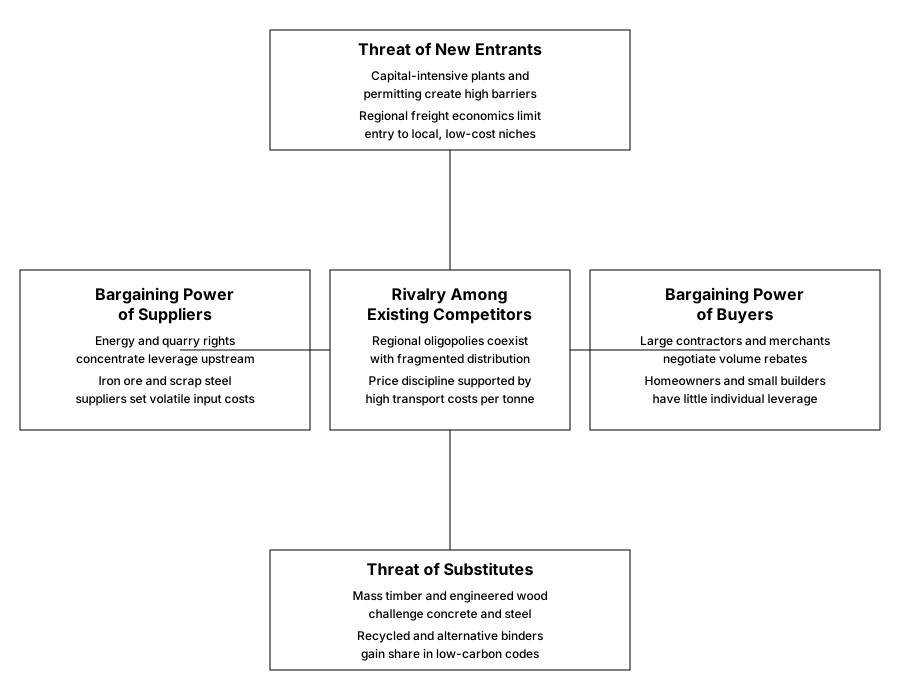
Bargaining power of buyers
Buyer power in building materials varies more by customer type than almost any other force in the analysis, which makes blanket statements about the industry misleading. Large national homebuilders, general contractors and infrastructure agencies place enormous, recurring orders and can credibly threaten to shift volume between suppliers, dual-source critical materials, or negotiate rebate structures tied to annual spend commitments. These buyers also increasingly specify low-carbon materials in procurement criteria, effectively forcing suppliers to compete on emissions performance in addition to price. Distribution intermediaries, including large building material dealer networks and home-improvement retail chains, wield similar leverage because they aggregate purchasing volume across many manufacturers and can play suppliers against one another for shelf space and delivery priority.
At the other end of the spectrum, small contractors, individual renovation customers and owner-builders have almost no individual bargaining power; they buy at list or near-list price through retail or dealer channels and rarely negotiate meaningfully. This bifurcation means the average building materials producer faces genuine pricing pressure from perhaps twenty or thirty percent of its customer base by volume, while the rest pays close to posted pricing. The practical effect is that producers protect margin by segmenting their commercial approach: dedicated account teams and volume contracts for large buyers, standard pricing and simpler terms for fragmented retail and small-contractor demand. Government buyers add a further wrinkle, since public procurement rules often require competitive bidding and domestic-content compliance, which caps pricing flexibility but also provides revenue visibility tied to multi-year capital budgets that private buyers cannot match.
| Buyer segment | Typical leverage | Primary negotiation lever |
|---|---|---|
| National homebuilders and large contractors | High | Volume rebates and dual-sourcing threat |
| Government and infrastructure agencies | Moderate to high | Competitive bidding and domestic-content rules |
| Building material dealers and retail chains | High | Aggregated purchasing across suppliers |
| Regional and small contractors | Low to moderate | Limited to price comparison at order time |
| Individual homeowners and renovators | Low | Effectively price takers |
Bargaining power of suppliers
Suppliers to building materials producers fall into a small number of categories, but each carries disproportionate leverage because building materials manufacturing depends on inputs that are either geographically fixed, cyclically scarce or subject to volatile global pricing. Energy suppliers sit at the top of this list; cement kilns and steel mills are among the most energy-intensive processes in all of manufacturing and natural gas, coal and electricity price swings translate directly into production cost swings that producers can only partially pass through to customers in the short term. Limestone, sand and gravel reserves, while abundant globally, are geographically fixed and subject to permitting constraints that can take years to clear, giving landowners and permit holders meaningful leverage over where and whether new capacity can be built.
Scrap steel dealers and iron ore miners hold considerable power over steel producers, since scrap and ore prices move on global commodity cycles largely outside any single producer's control and switching between suppliers does little to insulate a mill from price volatility that is structural to the input market itself. Equipment manufacturers for kilns, crushers and mills represent a smaller but still meaningful supplier category, since specialized industrial equipment comes from a concentrated set of global manufacturers and long lead times for replacement parts create switching costs once a plant is built around a particular equipment platform. Labor, particularly skilled trades such as heavy equipment operators and kiln technicians, has also gained leverage in several markets as experienced workforces age out faster than replacements enter the trade.
| Supplier category | Source of leverage | Producer's typical response |
|---|---|---|
| Energy providers | Structural cost share and volatility | Long-term contracts and alternative fuel investment |
| Quarry and mineral rights holders | Geographic fixity and permitting delay | Multi-decade reserve acquisition ahead of need |
| Scrap steel and iron ore suppliers | Global commodity cycle exposure | Vertical integration or long-term offtake agreements |
| Specialized equipment manufacturers | Concentrated global supply base | Multi-year maintenance and parts contracts |
| Skilled trade labor | Aging workforce and training lag | In-house training programs and retention incentives |
Rivalry among existing competitors
Competitive intensity in building materials depends almost entirely on whether a segment is geographically constrained or globally traded and this split explains most of the confusion around whether the industry is consolidated or fragmented. In cement, aggregates and ready-mix concrete, the effective competitive set within any metro area is small, often three to five meaningful players, because transport costs of roughly 150 to 300 kilometers cap how far a rival plant can ship product profitably. This creates something close to regional oligopoly behavior, with pricing discipline that would be impossible in a nationally contested market, even though the same producer might report intense competition in a different city entirely.
The top ten global cement producers, including Holcim, CRH, Anhui Conch Cement, HeidelbergCement and Cemex, together account for more than half of global production capacity, reflecting decades of consolidation that began in Europe in the 1970s and continued through the United States and Asia in subsequent decades2. Steel and lumber tell a different story; both trade on global or continental markets, exposing producers to import competition, overcapacity from state-supported Chinese steel production and currency-driven price swings that regional cement operators rarely face. Rivalry in these segments is fierce, cyclical and margin-compressing, particularly during periods when global steel overcapacity forces producers to sell below full cost just to maintain utilization. Distribution adds a further layer of rivalry, as building material dealers compete on service level, delivery speed and credit terms as much as on the underlying manufacturer's brand.
| Competitive dimension | Local segments example | Globally traded segments example |
|---|---|---|
| Effective competitor count | Three to five per metro area | Dozens across import and domestic supply |
| Primary competitive lever | Delivery reliability and price | Landed cost and trade policy exposure |
| Consolidation trend | Ongoing bolt-on acquisition | Periodic mega-mergers and capacity closures |
| Price volatility | Low to moderate | High and cyclical |
| Import exposure | Minimal | Significant |
Threat of new entrants
Entry barriers in building materials range from nearly prohibitive to relatively modest, again depending on segment and this variance is the single most important nuance for any investor or strategist assessing the industry. Building a new cement plant or an integrated steel mill requires several hundred million to well over a billion dollars of capital, multi-year environmental permitting and secure access to raw material reserves that are often already claimed by incumbents. These barriers, combined with the local nature of demand for heavy materials, mean genuinely new greenfield entrants in cement and aggregates are rare events, concentrated mostly in fast-growing emerging markets where demand is outrunning existing capacity.
Distribution and light manufacturing segments present a starkly different picture. Opening a building material dealership or a small specialty manufacturing operation, such as an insulation cut-and-fabrication facility, requires modest capital and no exotic permitting, which explains why distribution remains far more fragmented than production. Private equity and regional entrepreneurs have exploited this gap for decades, building and selling distribution platforms without ever touching the higher-barrier manufacturing side of the business. Trade policy adds another layer of entry friction for import-based entrants specifically; antidumping duties and tariffs on steel and cement imports, imposed periodically by governments protecting domestic producers, can eliminate the cost advantage that would otherwise let overseas capacity enter a market.
| Entry barrier factor | Cement and aggregates | Distribution and light manufacturing |
|---|---|---|
| Capital requirement | Very high | Low to moderate |
| Permitting timeline | Multi-year | Weeks to months |
| Raw material access | Often already claimed | Not applicable |
| Trade policy exposure | Moderate, tariff-dependent | High for imported product lines |
| Realistic new entrant profile | Emerging-market greenfield builds | Regional entrepreneurs and private equity |
Threat of substitutes
Substitution pressure has intensified faster in building materials over the past decade than in almost any prior period, driven by a convergence of carbon regulation, cost pressure and genuine technological progress in alternative materials. Mass timber and cross-laminated engineered wood panels now compete directly with concrete and steel in mid-rise commercial and residential construction, offering faster assembly times and lower embodied carbon and a growing number of building codes have been updated specifically to permit taller timber structures than were previously allowed. Recycled and supplementary cementitious materials, including fly ash, slag and calcined clay, substitute for a portion of clinker in concrete mixes, reducing both cost and emissions simultaneously, which gives them a rare combination of economic and regulatory tailwind.
Alternative binder chemistries, still early in commercial adoption, threaten to substitute for traditional portland cement altogether in select applications, though scale-up remains limited by production cost and code approval timelines. Steel faces substitution pressure from both directions, with timber displacing it in lighter structures and higher-strength concrete displacing it in some infrastructure applications, while aluminum and composite materials chip away at niche architectural uses. The common thread across all these substitution vectors is that carbon accounting, not just raw material cost, has become a genuine driver of specification decisions, particularly in jurisdictions with embodied-carbon building codes or procurement requirements.
| Substitute category | Displaces | Primary adoption driver |
|---|---|---|
| Mass timber and engineered wood | Concrete and steel framing | Speed of assembly and lower embodied carbon |
| Supplementary cementitious materials | Portland clinker | Cost reduction and emissions compliance |
| Alternative binder chemistries | Traditional cement | Emerging low-carbon procurement mandates |
| High-strength concrete formulations | Structural steel in some uses | Reduced material volume per structure |
| Recycled aggregates | Virgin quarried aggregates | Cost and quarry permitting constraints |
Value chain and profit pools
The building materials value chain runs through five distinct stages, each with different economics and different sources of advantage. Upstream inputs come first, covering limestone, sand, gravel, iron ore, scrap steel, timber and the energy that powers extraction and processing; this stage rewards ownership of geographically fixed reserves and long-term energy contracting more than operational excellence. Production and processing follows, where raw inputs become finished or semi-finished materials through kilns, mills, mixers and fabrication lines; this stage is where most of the industry's fixed capital sits and where scale economies matter most.
Distribution and logistics forms the third stage, moving finished materials from plant to jobsite through a combination of owned fleets, third-party freight and wholesale distribution networks; because many building materials are heavy relative to their value, this stage often determines whether a producer can serve a given customer profitably at all. Customer interface comes next, spanning direct sales to large contractors, dealer and retail channels for smaller buyers and increasingly digital ordering and delivery-scheduling platforms that reduce transaction friction. Enabling infrastructure closes the chain, including the rail lines, ports, terminals and specialized handling equipment that make long-distance movement of otherwise local materials economically viable when a producer needs to serve markets beyond its immediate radius.
Profit pool
Margin concentration in building materials has shifted meaningfully over the past two decades, moving away from pure upstream production and toward the combination of local distribution density and specialty, differentiated product lines. Cement and aggregates production in a well-positioned local market still generates the industry's strongest returns on capital, precisely because transport economics grant near-monopoly pricing power within a defined radius; this remains the most attractive profit pool in the industry despite its high upfront capital requirement. Ready-mix concrete, which combines cement, aggregates and water into a perishable product that must be delivered within roughly ninety minutes of mixing, captures a further layer of margin because its short shelf life makes distribution logistics themselves a genuine competitive moat.
Commodity steel and softwood lumber sit at the opposite end of the profit pool, generating the thinnest and most cyclical margins in the industry because global trade exposes them to price competition that local aggregates producers never face. Distribution, historically viewed as a low-margin pass-through business, has become a more attractive profit pool as consolidators have built scale advantages in purchasing, inventory management and service level that let them earn healthier margins than the fragmented, mom-and-pop model that preceded them. Specialty and value-added products, including architectural glass, high-performance insulation and precast concrete components, occupy a growing and increasingly attractive profit pool because they substitute engineering and formulation know-how for raw tonnage, insulating margins from commodity price swings in ways that basic materials cannot replicate.
Industry economics and business models
Three business model patterns dominate building materials and most large companies operate a blend of all three across their portfolio. The asset-heavy manufacturing model, characteristic of cement, steel and glass production, requires enormous upfront capital in plants and equipment, generates revenue through transaction-based sales of finished or semi-finished materials and earns returns primarily through capacity utilization and operating leverage over multi-decade asset lives. This model rewards patient capital and disciplined cycle management far more than it rewards rapid growth, since overbuilding capacity ahead of demand destroys returns for an entire local market, not just the overbuilder.
The distribution and merchant model, run by building material dealers and specialty distributors, is comparatively asset-light, generating revenue through transaction margins on products sourced from multiple manufacturers and it competes on service, credit terms and delivery reliability rather than on manufacturing cost position. This model scales through acquisition of adjacent distribution territories and through purchasing leverage that improves as volume grows, making roll-up consolidation a persistent and rational strategy across the segment. A third, smaller but growing model centers on specialty and engineered products, where producers earn a premium through formulation know-how, code certification and brand reputation for performance consistency, closer in economic logic to a branded industrial goods business than to a commodity producer, even though the end product still physically resembles a bag of insulation or a pane of glass.
Cost drivers and scalability
Fixed costs dominate the cost structure in production-stage building materials, with plant depreciation, maintenance and a baseline energy load representing the largest components regardless of output volume; this makes capacity utilization the single most important operating metric in the industry, since a cement kiln or steel mill running below roughly seventy-five percent utilization struggles to cover its fixed cost base at competitive pricing. Variable costs, dominated by energy, raw materials and freight, fluctuate with both output volume and external commodity markets and producers with long-term energy contracts or captive raw material sources gain a meaningful and durable cost advantage over those buying both on spot markets.
Economies of scale operate differently across the value chain. In production, scale reduces per-unit fixed cost and supports investment in more efficient, lower-emission process technology, but scale benefits taper sharply once a plant serves its full addressable local market, since transport cost caps the incremental market a larger plant can reach. In distribution, economies of scale come primarily from purchasing leverage and route density rather than from any single large facility, which is why the most successful distribution consolidators grow through many small, geographically clustered acquisitions rather than through building large central facilities. Unit economics in ready-mix concrete illustrate the industry's distinctive scalability constraint particularly well:
because the product must reach a jobsite within roughly ninety minutes of mixing, a batch plant's addressable market is a fixed geographic radius regardless of how much capital a producer is willing to spend, which caps growth to either adding more plants or increasing throughput at existing ones, never to serving a wider area from a single larger facility
Moats, advantages and strategic levers
Defensibility in building materials rests on a narrower and more concrete set of advantages than in most industries, which makes the sources of moat unusually easy to identify even if they are hard to replicate. Ownership of low-cost, well-located raw material reserves forms the strongest and most durable advantage in the industry, since a producer sitting on decades of limestone reserves near a growing metro area holds a position that a competitor simply cannot buy or build without acquiring that same land. Logistics density functions as a second, closely related moat; a producer with more batch plants, terminals or distribution yards within a service area can serve customers faster and at lower delivered cost than a rival trying to reach the same customers from farther away and this advantage compounds as urban areas grow and travel times within them lengthen.
Regulatory and permitting moats have strengthened in recent years, since new quarry permits, kiln construction approvals and emissions permits take years to secure in most developed markets, meaning incumbents with existing, grandfathered permits hold a real advantage over anyone trying to build new capacity from scratch. Switching costs matter less at the individual transaction level, since a contractor can generally source cement or steel from a different supplier for the next order, but they matter considerably more at the relationship level, where large builders value supply reliability and technical support enough to maintain multi-year purchasing relationships rather than bid every order independently.
Companies that own the quarry and the last mile to the jobsite hold a position that capital alone cannot replicate quickly
Learning and process advantages play a smaller but still meaningful role, particularly in specialty and low-carbon product lines, where producers who have invested earliest in alternative fuel systems, carbon capture pilots or novel binder chemistries accumulate operational knowledge that is difficult for a fast-follower to shortcut, even with comparable capital.
Strategic levers
Four levers stand out for both incumbents and would-be entrants navigating this industry. Vertical integration from raw material ownership through distribution and, in some cases, into adjacent construction services represents the most consequential lever, since it captures the margin at multiple stages simultaneously and insulates a producer from price volatility at any single stage; CRH's decades-long expansion from Irish cement and aggregates production into a global building materials and solutions group illustrates how far this integration can extend when executed consistently over time3.
Geographic expansion through disciplined, bolt-on acquisition of local production and distribution assets forms a second lever, particularly valuable given the industry's fundamentally regional demand structure; this approach lets a company grow scale nationally or globally while preserving the local pricing power that comes from staying within efficient shipping radii in any given market. A third lever centers on decarbonization capability as a genuine commercial differentiator rather than a compliance cost, since carbon border adjustment mechanisms and green procurement requirements are beginning to reward producers who can document lower embodied emissions with real pricing and contract-award advantages4. Product and customer segment focus forms a fourth lever, particularly for smaller players who cannot compete on scale; specializing in a defensible niche, such as high-performance insulation or architectural glass for a specific building code segment, lets a focused producer earn returns that scale players cannot easily replicate without diluting their broader commodity economics.
Structural risks, regulation and trends
Structural risk in building materials clusters around four areas that every strategist evaluating the industry needs to weigh together rather than in isolation. Regulatory risk has intensified as embodied-carbon accounting moves from voluntary disclosure toward binding requirement in a growing number of jurisdictions and the European Union's carbon border adjustment mechanism, which requires importers to purchase certificates reflecting the embedded carbon in imported cement starting in 2026, previews a policy direction likely to spread to other major markets over time5. Technology disruption risk centers on the pace of alternative material adoption, particularly mass timber and low-carbon cement chemistries, which could erode demand for traditional materials faster than incumbent producers can adapt their asset base.
Commodity and price risk remains structural to globally traded segments, particularly steel, where overcapacity from state-supported production in some markets periodically depresses global pricing well below the cost structure of higher-cost domestic producers. Geopolitical and supply chain risk has grown more salient as governments increasingly use tariffs and domestic-content requirements as tools of industrial policy, which can favor domestic producers in the short term but also raises input costs and complicates cross-border investment planning for multinational producers.
Secular demand drivers remain broadly favorable despite these risks. Urbanization continues in emerging markets, infrastructure renewal is accelerating in developed markets with aging road, bridge and utility networks and housing shortages in many major economies point toward sustained multi-year construction demand even as short-term interest rate cycles create periodic slowdowns. Supply-side trends favor consolidation in distribution and continued regional concentration in production, while disruptive models, including offsite prefabrication and 3D-printed concrete structures, remain early-stage but are attracting serious capital and could meaningfully alter demand patterns for traditional materials within a decade.
For entrants, the practical playbook depends heavily on segment choice. A niche entry strategy, focused on a defensible specialty product line or an underserved local market, offers a realistic path to attractive returns without competing head-on against capital-intensive incumbents. A broader entry strategy, attempting to build scale across production and distribution simultaneously, generally requires acquisition rather than greenfield build, given how long organic capacity development takes to reach competitive scale. Regulatory strategy matters enormously either way; entrants that align product development with tightening carbon rules ahead of competitors position themselves to benefit from, rather than absorb the cost of, the regulatory shift already underway.
For incumbents, the defend-and-expand playbook centers on deepening existing local moats through continued reserve acquisition and logistics investment, expanding into adjacent geographies through disciplined bolt-on consolidation rather than large, integration-risky mergers and treating decarbonization investment as an offensive rather than defensive move, since the producers who move first on lower-carbon product lines are positioned to win specification battles as procurement standards tighten across both public and private construction markets.
Caselet: CRH and the economics of building a global platform from local roots
CRH traces its origins to a 1970 merger of two Irish companies, Cement Limited and Roadstone Limited, combining cement manufacturing with aggregates and asphalt production under a single corporate structure6. What began as a domestically focused Irish materials business has grown, primarily through decades of disciplined acquisition rather than organic greenfield expansion, into one of the largest building materials companies in the world, with operations spanning aggregates, cement, ready-mixed concrete, asphalt, precast concrete and architectural glass across dozens of countries.
Industry at a glance in practice
CRH's own business mix mirrors the industry's structural bifurcation almost exactly. Its aggregates and cement operations behave like the regional, transport-protected businesses this analysis describes throughout, generating steady returns from local market positions that competitors cannot easily contest given the shipping economics of heavy materials. Its broader portfolio, spanning architectural products and building envelope solutions, reflects the specialty and value-added profit pool that has grown more attractive as commodity-only production has become more cyclical and margin-compressed.
Market structure in practice
The company's growth strategy has consistently targeted markets where it could establish a leading local or regional position rather than chasing broad national presence for its own sake, a pattern consistent with the industry's Five Forces dynamics around local rivalry and entry barriers. Its acquisition strategy through the 2001 to 2008 period in particular expanded the company from a primarily European operation into a genuinely international one, adding production and distribution assets across North America in a sequence of bolt-on deals rather than a small number of transformative mega-mergers.
Strategic levers in practice
CRH's most consequential recent strategic decision was moving its primary stock listing from the London Stock Exchange to the New York Stock Exchange in September 2023, a move the company linked explicitly to seeking valuation and capital access more aligned with its North American revenue base, which by that point represented the majority of group earnings7. The decision illustrates a broader lesson for building materials executives:
capital markets increasingly reward producers whose geographic revenue mix, balance sheet discipline and decarbonization credibility align with where growth and regulatory tailwinds are strongest, rather than rewarding scale or history alone
Structural risks and trends in practice
CRH's exposure mirrors the sector's structural risks closely, including cyclical sensitivity to construction starts across its major markets and a growing need to demonstrate credible progress on embodied-carbon reduction as procurement standards tighten in both Europe and North America. Its response, continued investment in lower-carbon cement production and in value-added, higher-margin building envelope products, reflects the strategic lever this analysis identifies as most consequential going forward:
treating decarbonization and product differentiation as growth investments rather than defensive costs, positioning the company to compete on more than delivered tonnage as the industry's economics continue to evolve
- 1Global Construction Materials Market Size
- 2Cement Industry Consolidation And Top Producers
- 3CRH History Of Expansion Through Acquisition
- 4Carbon Border Adjustment Mechanism And Cement
- 5EU Carbon Border Adjustment Mechanism And Cement Imports
- 6CRH Corporate History
- 7CRH Primary Listing Move To New York Stock Exchange
Building materials sits upstream of nearly every structure built and its economics reward proximity over scale. Cement, aggregates and concrete reward companies that control local quarry rights and logistics; steel and lumber reward those that manage commodity cycles and trade exposure. Regulation on embodied carbon is becoming a genuine profit lever, not just a compliance cost, favoring producers who move early on cleaner kilns and alternative binders. The strategic playbook ahead centers on vertical integration from quarry to jobsite, disciplined bolt-on consolidation in fragmented distribution and carbon capability as a source of differentiated pricing rather than a defensive expense.
Citation
Cite this article
Sridharan, M. A. (2023, September 15). Industry Analysis: Building Materials. Think Insights. https://thinkinsights.net/strategy/industry-analysis-building-materials (Accessed [[ACCESS_DATE]])
Sridharan, Mithun A. "Industry Analysis: Building Materials." Think Insights, 15 Sep. 2023, https://thinkinsights.net/strategy/industry-analysis-building-materials. Accessed [[ACCESS_DATE]].
Mithun A. Sridharan, "Industry Analysis: Building Materials," Think Insights, September 15, 2023, https://thinkinsights.net/strategy/industry-analysis-building-materials. Accessed [[ACCESS_DATE]].
Sridharan, M.A. (2023) 'Industry Analysis: Building Materials', Think Insights. Available at: https://thinkinsights.net/strategy/industry-analysis-building-materials (Accessed: [[ACCESS_DATE]]).
M. A. Sridharan, "Industry Analysis: Building Materials," Think Insights, 2023. [Online]. Available: https://thinkinsights.net/strategy/industry-analysis-building-materials. [Accessed: [[ACCESS_DATE]]].
Sridharan MA. Industry Analysis: Building Materials. Think Insights. Published September 15, 2023. Accessed [[ACCESS_DATE]]. https://thinkinsights.net/strategy/industry-analysis-building-materials
Test Your Knowledge
Industry Analysis: Building Materials
Challenge yourself on the concepts from this article and see how well you understood them.
Subscribers get weekly quizzes and insights — subscribe free
Sponsor this article
Partner with Think Insights
Reach 50,000+ business leaders, consultants, and strategists. Feature your brand alongside expert articles on strategy, leadership, and digital transformation.
Become a Sponsor