Industry Analysis: Beauty and Personal Care Services


Beauty and personal care services, the industry that delivers hair, skin, nail, wax and aesthetic treatments through salons, spas, barbershops and medical spas, has grown into a market worth well over 300 billion dollars globally and is compounding faster than most consumer categories as injectable and laser procedures move from luxury to routine. Margin no longer sits with the operator who owns the chair; it sits with whoever owns the recurring relationship, whether that is a franchisor collecting royalties, a booking platform taking a cut of every appointment, or a med-spa chain selling annual membership plans. Executives evaluating this space should prioritize asset-light, membership-based models with proprietary scheduling and client data over traditional single-site ownership and should treat labor retention, not real estate, as the binding constraint on growth.
Is beauty and personal care services attractive for new entrants?
Yes, at the single-location level, because licensing costs and equipment needs are modest compared with most consumer businesses, but profitable scale is hard to reach because talent scarcity and thin location-level margins cap growth without a franchise or membership model behind it.
Which parts of the value chain are most profitable?
Franchising and platform layers capture the highest margins, since royalty and subscription fees scale without proportional labor cost, while the physical service delivery layer, the salon or spa floor itself, runs on thin single-digit-to-low-teens operating margins.
How is technology changing this industry?
Booking and scheduling software has shifted bargaining power toward consumers by making price and availability transparent across providers, while Artificial Intelligence-assisted diagnostics and inventory forecasting are beginning to reduce no-shows and improve chair utilization, the industry's core scarce resource.
What capabilities are table stakes vs differentiators?
Clean, licensed operations, reliable scheduling and consistent service quality are table stakes; differentiators are a trained and retained talent bench, a membership or subscription program that locks in repeat visits and proprietary client data that supports personalized retention marketing.
How should investors or consultants evaluate opportunities here?
Evaluate the ratio of recurring, membership-linked revenue to one-off transactional revenue, the average tenure and productivity of service providers and whether the business owns the customer relationship directly or depends on a third-party marketplace for client acquisition.
Why are medical spas growing faster than traditional salons?
Medical spas combine higher price points for injectables, laser and body-contouring procedures with membership-based repeat visits and they benefit from a cultural shift that has normalized cosmetic maintenance as a routine health and wellness expense rather than an occasional indulgence.
What role does private equity play in this industry?
Private equity firms have been consolidating fragmented single-location salons and med-spas into regional and national platforms, applying shared back-office systems, group purchasing and standardized training to lift margins that independent operators cannot achieve alone.
How do booking platforms change competitive dynamics among salons?
Platforms such as Fresha, Vagaro and Mindbody aggregate supply and expose price and availability across competitors in a single search, which increases consumer switching and forces salons to compete more directly on price, reviews and loyalty programs than on geographic convenience alone.
Is the booth-rental model still viable for salon owners?
Booth rental remains viable for owners who prioritize low management overhead and stable rent income over control of service quality, but it caps upside because the salon owner does not participate in the productivity gains of star stylists, unlike the commission model.
What is the biggest structural risk facing the industry over the next decade?
Persistent scarcity of licensed cosmetology and aesthetic talent is the most binding constraint, since demand growth, especially in medical aesthetics, is outpacing the supply of trained practitioners far more than it is outpacing consumer willingness to spend.
Beauty and personal care services sits at an unusual intersection of high-touch craft labor and increasingly sophisticated platform economics. A haircut, a facial or a neurotoxin injection still requires a trained human being working with their hands, yet the way that appointment gets booked, priced, marketed and retained increasingly runs through software built by companies that never touch a client. Understanding who profits in this industry requires separating the physical act of service delivery, which remains stubbornly artisanal and labor-constrained, from the layers of franchising, membership and booking infrastructure that have been built on top of it and that now capture a disproportionate share of the economics.
Industry at a glance
Beauty and personal care services covers hair salons and barbershops, day spas and wellness spas, nail studios, waxing and threading studios, medical spas offering injectables and laser treatments and the franchise systems and booking platforms that support them. It excludes the manufacturing and wholesale of cosmetics, skincare and personal care products, which forms a distinct consumer packaged goods industry with different economics, capital intensity and competitive structure. The professional beauty services market, spanning hair, skin, nail and related treatments, is projected to reach roughly 247.6 billion dollars in 2026 and grow toward 432.6 billion dollars by 2034, according to market research aggregated by Fortune Business Insights, while the narrower medical spa segment alone was valued near 24.2 billion dollars in 2025 and is forecast to approach 78.2 billion dollars by 2033 given compound annual growth above 15 percent.1
The customer base is overwhelmingly business-to-consumer, with individual consumers paying out of pocket for discretionary or semi-discretionary grooming and aesthetic services, though a meaningful business-to-business layer exists where franchisors sell territory rights and equipment vendors sell to operators rather than end consumers. Regulatory intensity is moderate to high, since most jurisdictions require individual practitioner licensing for cosmetology, esthetics and especially injectable procedures and medical spas in particular must navigate physician-oversight rules that vary by state or country. Capital intensity at the individual location level is low relative to most physical retail formats, since a salon chair or spa treatment room requires modest buildout compared with, say, a restaurant kitchen or a manufacturing line, but labor intensity is exceptionally high because service delivery cannot be automated away from the practitioner. Revenue models range from pure transactional, pay-per-visit service, to increasingly common membership and subscription structures that lock in recurring monthly payments regardless of visit frequency, a shift that has become the industry's single most important economic development over the past decade.
Industry segmentation
The industry breaks into six segments defined primarily by service type and secondarily by ownership structure. Hair care services, encompassing cuts, color, styling and treatments delivered through salons and barbershops, remain the largest segment by revenue and are projected to hold roughly 77 percent share of the broader beauty services market in 2026, reflecting the near-universal, recurring nature of hair maintenance across demographics.2 Skin and spa services, covering facials, body treatments and traditional day-spa offerings, form the second segment and skew toward higher price points but lower visit frequency than hair care.
Medical and aesthetic spa services constitute a fast-growing third segment, combining physician-supervised or physician-delegated procedures such as neurotoxin injections, dermal fillers, laser hair removal and body contouring, delivered through facilities that blend medical licensing with retail-style consumer marketing. Nail care services form a distinct fourth segment, characterized by lower average ticket prices, shorter service times and a business structure that often leans more heavily on independent contractor and booth-rental arrangements than hair salons do. Waxing, threading and hair removal studios make up a fifth, narrower segment built around single-service specialization and high-frequency repeat visits, exemplified by chains built entirely around one procedure category. Finally, the enabling infrastructure segment, comprising booking and scheduling platforms, point-of-sale and payroll software, franchise systems and professional product distributors, sits adjacent to direct service delivery but increasingly determines how value is captured across the other five segments, since these platforms control client acquisition, retention data and payment flow for a large share of the industry's physical locations.
Market structure
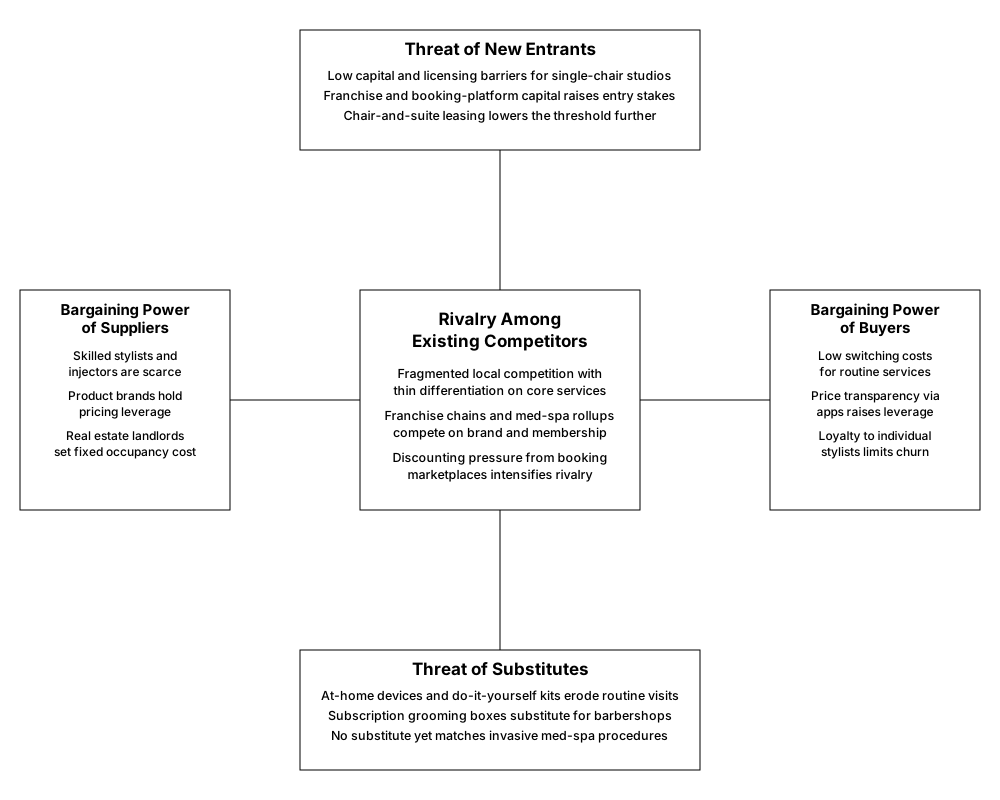
Porter's five forces framework clarifies why this industry produces such uneven profitability, rewarding scale, brand and recurring-revenue structures while leaving the median single-location operator with thin, cyclical margins. Buyer power has risen steadily as booking apps make prices and open slots transparent across competing providers, while supplier power concentrates in the hands of scarce, skilled practitioners rather than product vendors. Rivalry is intense at the local level because differentiation on core services like a haircut or a manicure is genuinely difficult, entry barriers are low enough that new single-chair operators appear constantly and no close substitute exists yet for procedures requiring licensed hands, even as at-home devices chip away at the most routine, lowest-skill services.
Bargaining power of buyers
Consumer bargaining power in beauty and personal care services has increased meaningfully over the past decade, driven almost entirely by the proliferation of booking and marketplace platforms that expose price, availability and reviews for competing providers within a few taps. A client searching for a blowout or a facial in most metropolitan areas can now compare a dozen nearby options on price and next-available slot in under a minute, a level of transparency that did not exist when word of mouth and yellow-pages listings governed discovery. This transparency compresses pricing power for undifferentiated, routine services and forces operators to compete on convenience, loyalty incentives and reputation rather than relying on geographic proximity alone. At the same time, buyer power is meaningfully checked by relationship stickiness: clients who have built trust with a specific stylist, esthetician or injector over multiple visits are reluctant to switch even when a competitor offers a modestly lower price, because the risk of a bad haircut or a poorly placed filler carries real personal cost that a price comparison cannot capture. Corporate and franchise buyers, such as national chains negotiating supply contracts, exert more concentrated power over product vendors than individual consumers exert over service providers and membership and subscription structures further dilute buyer power once a client has committed to a recurring plan, since switching then requires actively canceling a commitment rather than simply choosing a different provider for the next visit.
| Buyer segment | Source of leverage | Constraint on that leverage |
|---|---|---|
| Individual walk-in or app-booked consumers | Price and availability transparency across providers | Personal risk of switching for trust-sensitive services |
| Membership or subscription clients | Ability to cancel recurring plans | Sunk enrollment fees and habit formation |
| Corporate wellness or event-based buyers | Bulk negotiating power on group bookings | Limited scale relative to total industry demand |
| Insurance-adjacent medical spa clients | Comparison shopping across licensed providers | Physician trust and safety concerns for invasive procedures |
Bargaining power of suppliers
The most consequential supplier in this industry is not a product vendor but the skilled labor pool itself, since licensed stylists, estheticians, nail technicians and, in medical spas, nurse injectors and physicians hold outsized leverage given a persistent shortage of trained practitioners relative to consumer demand. More than half of salons report ongoing difficulty filling skilled positions and average compensation for hair stylists in the United States hovers around 35,000 dollars annually, a figure low enough relative to training costs and licensing requirements that it discourages new entrants into the profession even as demand for services climbs.3 Star performers, the stylists and injectors with loyal client followings, can effectively dictate terms to salon owners, since their departure often takes a meaningful share of revenue with them, a dynamic that has pushed many operators toward commission structures generous enough to retain top talent.
Product and equipment suppliers hold secondary but still meaningful power, particularly professional hair color, skincare device and injectable pharmaceutical manufacturers that control distribution tightly and require salons or med-spas to purchase through authorized channels at fixed price points. Commercial real estate landlords function as a third supplier category with rising leverage in dense urban markets, where lease rates directly determine whether a location model remains viable and booking-platform operators themselves increasingly act as suppliers of client acquisition, extracting commission on new-client bookings that can reach roughly 20 percent of the first transaction value on major marketplaces.4
| Supplier category | Leverage mechanism | Effect on operator economics |
|---|---|---|
| Licensed stylists and injectors | Scarce, portable skill with loyal client following | Wage and commission inflation |
| Professional product and device manufacturers | Controlled distribution and brand exclusivity | Fixed input cost pressure |
| Commercial real estate landlords | Location scarcity in high-traffic retail corridors | Rising fixed occupancy cost |
| Booking and marketplace platforms | Control of new-client discovery | Commission on first transactions |
Rivalry among existing competitors
Local competitive intensity in beauty and personal care services is high because the core service offering, a haircut, a manicure or a basic facial, is difficult to differentiate meaningfully between one licensed provider and another and because the capital required to open a modest single-location salon or studio remains low enough that new competitors enter constantly in any growing neighborhood. This dynamic keeps the industry fragmented at the base, with independent single- and multi-chair operations still representing the large majority of physical locations globally, even as national franchise brands and private-equity-backed rollups have expanded their footprint meaningfully over the past decade. Rivalry plays out less on price for most established operators, since deep discounting risks signaling lower quality to a clientele that associates price with skill and trust and more on brand consistency, membership program design and the ability to retain a stable roster of skilled practitioners that clients want to keep returning to.
Franchise systems and medical spa chains compete on a different axis entirely, using national marketing budgets, standardized training and membership pricing to build scale advantages that individual operators cannot match, which has intensified pressure on independents in categories like waxing and injectables where franchised competitors have grown fastest. Booking platforms add a further layer of rivalry by aggregating competing salons into a single searchable marketplace, which increases the salience of price and review comparisons at the exact moment a consumer is deciding where to book, a dynamic that did not exist when discovery ran through personal referral alone. The net effect is an industry where rivalry is fierce at the unit-economics level but where the more successful competitive strategy has shifted from simply undercutting nearby operators toward building brand loyalty, membership lock-in and talent retention systems that are harder for a new entrant to replicate quickly.
| Competitive dynamic | Manifestation | Strategic response |
|---|---|---|
| Fragmented independent supply | Large base of single-location operators | Local reputation and community ties |
| Franchise and chain expansion | National brands like European Wax Center scaling territory | Standardized training and marketing scale |
| Marketplace-driven price visibility | Consumers comparing providers within one app | Membership and loyalty program design |
| Talent-based differentiation | Client loyalty tied to specific practitioners | Retention incentives and career pathing |
Threat of new entrants
Entry into beauty and personal care services at the smallest scale, a single practitioner renting a chair or a suite, remains genuinely easy, since licensing requirements, while real, are attainable through community college or vocational cosmetology programs and the capital outlay for basic tools and a rented space is modest compared with almost any other physical services business. Salon suite concepts, which lease fully equipped individual rooms to independent practitioners on a weekly basis, have lowered this barrier even further by removing the need for a new entrant to build out a location at all, effectively turning entry into a real estate decision rather than a business-formation decision. This ease of entry at the bottom of the market keeps the industry perpetually fragmented and ensures that any single operator, however skilled, faces constant potential competition from a newly licensed practitioner willing to undercut on price while building a client base.
Entry becomes considerably harder above the single-chair level, where building a multi-location brand, a franchise system or a medical spa network requires meaningful capital, operational systems and, in the case of medical aesthetics, physician relationships and regulatory compliance infrastructure that a first-time operator is unlikely to assemble quickly. Medical spas in particular face a rising bar to entry as more jurisdictions tighten physician-oversight and delegation rules for injectable procedures, which favors operators who can afford compliance infrastructure and deters purely opportunistic entrants chasing the segment's high margins. Booking platforms and franchise systems have also raised effective entry barriers indirectly, since a new independent operator now competes for visibility not only against nearby salons but against well-funded chains with dedicated marketing budgets and app-based loyalty programs that a solo entrant cannot match without significant early investment.
| Entry pathway | Barrier level | Primary constraint |
|---|---|---|
| Single-chair or booth-rental practitioner | Low | Cosmetology licensing and modest startup capital |
| Independent multi-chair salon or spa | Moderate | Working capital, staffing and lease commitments |
| Regional or national franchise brand | High | Capital, systems and territory development |
| Medical spa network | High and rising | Physician oversight and regulatory compliance |
Threat of substitutes
Substitution pressure in this industry varies sharply by service category, running from severe for the most routine, lowest-skill services to nearly nonexistent for procedures that require licensed medical judgment. At-home hair coloring kits, do-it-yourself gel manicure systems and consumer-grade laser hair removal and skincare devices have all improved in quality and ease of use, giving price-sensitive or time-constrained consumers a genuine alternative to a salon visit for the most basic maintenance tasks and this substitution risk is highest precisely in the segments, like basic manicures and root touch-ups, that generate the highest visit frequency and therefore the most revenue for independent operators.
Subscription grooming and shaving product boxes have similarly substituted for a portion of routine barbershop visits among cost-conscious consumers, though barbershops have defended share by emphasizing the social and experiential elements of an in-person visit that a mail-order product cannot replicate. At the opposite end of the spectrum, medical aesthetic procedures such as injectable neurotoxins, dermal fillers and body contouring face essentially no viable substitute, since no at-home product or alternative delivery method can replicate a physician-supervised injection or a clinically calibrated laser treatment, which is part of why this segment commands the industry's highest and most defensible margins. Wellness and self-care spending more broadly also competes indirectly for the same discretionary consumer dollar, meaning gym memberships, therapy subscriptions and wellness retreats function as loose substitutes for spa and self-care spending during periods of tightened household budgets.
| Substitute category | Affected service segment | Severity of threat |
|---|---|---|
| At-home color and styling kits | Routine hair maintenance | High |
| Consumer laser and skincare devices | Basic hair removal and facials | Moderate to high |
| Subscription grooming products | Routine barbershop visits | Moderate |
| Physician-administered injectables and lasers | Medical aesthetic procedures | Low |
Value chain and profit pools
The value chain in beauty and personal care services runs across five connected stages, beginning with upstream training and licensing, the vocational schools, apprenticeship programs and continuing-education systems that produce the credentialed practitioners the entire industry depends on. This stage is chronically underfunded relative to the demand it needs to satisfy, since cosmetology and aesthetic training programs have not scaled fast enough to match the growth of medical spa and premium salon demand, which is the root cause of the labor scarcity that shapes so much of the industry's competitive dynamics further downstream.
The second stage, product and equipment supply, covers professional hair color, skincare formulations, injectable pharmaceuticals and treatment devices, sold through controlled distribution channels directly to licensed operators rather than through general retail. The third stage, service delivery infrastructure, encompasses the physical salons, spas, barbershops and med-spa clinics themselves, along with the real estate, buildout and equipment that make each location operational, a stage that carries the industry's highest fixed cost burden relative to the revenue any single location generates. The fourth stage, customer interface and retention, has grown the most in strategic importance over the past decade, comprising booking platforms, membership programs, loyalty apps and the marketing infrastructure that determines whether a client returns for a second visit or drifts to a competitor. The fifth and final stage, franchising and brand orchestration, sits above individual locations entirely, licensing a proven operating system, brand identity and marketing engine to independent franchisee-operators in exchange for royalty payments, a model that several of the industry's most consistently profitable public companies have built their entire business around.
Profit pool
Profit in this industry has migrated steadily away from the physical service-delivery stage and toward the stages that control recurring customer relationships and brand, a shift that mirrors what has happened in many other fragmented consumer services categories. A single independent salon or spa location typically operates on thin margins, often in the high single digits to low teens as a share of revenue, once rent, payroll and product costs are accounted for, because labor costs, the largest single expense line, scale almost linearly with revenue and leave little room for operating leverage. Franchisors, by contrast, capture royalty and marketing fees, commonly in the range of 6 to 9 percent of franchisee gross sales, without bearing the labor and occupancy risk that weighs on the underlying locations, which produces materially higher and more stable margins at the franchisor level than at any individual franchised unit.
Booking and scheduling platforms have carved out a growing share of the profit pool by inserting themselves at the point of client acquisition and taking a commission, often around 20 percent, on new-client transactions routed through their marketplace, a toll that did not exist a generation ago and that now represents a meaningful and rising cost line for operators who depend on these platforms for discovery. Medical spas represent the profit pool's fastest-growing pocket, since injectable and laser procedures command premium pricing with gross margins that can exceed those of traditional hair and nail services by a wide margin, reflecting both the specialized skill required and the lower price sensitivity of a clientele treating the spend as a health and wellness priority rather than a discretionary indulgence. The overall pattern is one where scale, brand and recurring-revenue structures increasingly out-earn the craft labor that remains the industry's indispensable input, a tension that will likely continue defining strategic decisions across the sector.
Industry economics and business models
Four business model patterns dominate the industry today, each with distinct economics and risk profiles. The traditional single-location, transactional model, still the most common structure globally, charges per visit, bears full labor and occupancy cost directly and generates revenue that rises and falls with foot traffic and appointment volume, making it the most exposed to seasonal and economic cycles among the four patterns. The booth-rental or independent-contractor model shifts labor risk away from the location owner entirely, converting the salon into a real estate and shared-services business that collects fixed weekly rent from independent practitioners regardless of how much revenue those practitioners generate, trading upside for predictability.
The franchise model, exemplified by chains built around a single specialized service such as waxing or express haircuts, separates brand ownership and systems development from location operation, collecting royalty and marketing fees from a network of franchisee-operators who bear the local labor and real estate risk in exchange for a proven playbook and national marketing support; this model has proven durable enough that several franchisors have gone public, with system-wide sales for one major waxing franchise exceeding 1 billion dollars in 2024 against company-level revenue of roughly 250 million dollars.5 Finally, the membership and subscription model, increasingly layered on top of any of the other three, converts irregular transactional visits into predictable recurring revenue, whether through unlimited-service passes at waxing and fitness-adjacent chains or through monthly injectable and skincare maintenance plans at medical spas and this model has become the clearest lever for improving both revenue predictability and customer lifetime value across the industry.
Cost drivers and scalability
Labor is by far the dominant cost line in this industry, typically consuming 40 to 60 percent of revenue depending on whether staff are employed on commission or salary, which caps operating leverage in a way that distinguishes beauty services from most technology-enabled consumer businesses. Rent and occupancy form the second-largest fixed cost, particularly acute in dense urban and suburban retail corridors where beauty and personal care operators compete with other retail categories for prime, high-foot-traffic locations and this cost is largely fixed regardless of how fully booked a location's chairs are on any given day.
Because so much cost is fixed at the location level, chair or treatment-room utilization functions as the industry's core unit-economics lever, directly analogous to load factor in airlines or occupancy in hotels and small improvements in the percentage of available appointment slots that are actually booked translate disproportionately into location-level profit. This is precisely why booking software and no-show reduction tools have become such a significant investment priority for operators, since even a five-point improvement in utilization can meaningfully change a location's economics without adding a single new chair. Economies of scale exist but concentrate above the single-location level, primarily through group purchasing power on products and equipment, shared back-office systems across multiple locations under common ownership and the ability to spread marketing spend across a larger revenue base, which is exactly the logic that has driven private equity consolidation of fragmented regional salon and med-spa chains. Membership models introduce a flywheel dynamic worth noting:
predictable recurring revenue improves an operator's ability to staff consistently, consistent staffing improves service quality and retention and improved retention in turn strengthens the membership base further, a virtuous loop that transactional-only operators cannot access to the same degree
Moats, advantages and strategic levers
Defensibility in this industry rarely comes from any single structural advantage and instead accumulates from several reinforcing sources. Brand and trust function as the most durable moat for franchise systems and med-spa chains, since consumers making decisions about their appearance and, in medical aesthetics, their physical safety place disproportionate weight on a recognizable, reputationally vetted brand over an unknown independent alternative, a preference that strengthens with the invasiveness of the procedure. Switching costs, while individually modest for any single transaction, compound meaningfully once a client has committed to a membership plan or has built a multi-year relationship with a specific practitioner, since both the financial structure of a subscription and the personal trust in a stylist or injector discourage casual defection to a competitor.
Talent-based advantage represents a distinctive moat in this industry relative to most consumer services, since a scarce, well-trained and well-retained roster of practitioners is genuinely difficult for a competitor to replicate quickly, particularly for medical spas where recruiting and retaining licensed injectors under credible physician supervision requires both capital and clinical relationships that take years to build. Regulatory moats matter most in the medical aesthetics segment, where jurisdictions requiring physician oversight for injectable procedures create a compliance barrier that favors well-capitalized operators over informal or under-licensed competitors, effectively filtering out low-quality entrants in the segment with the highest margins. Data and learning advantages are still emerging in this industry but growing quickly, as booking platforms and larger chains accumulate client history, preference and retention data that smaller independent operators cannot match, allowing more sophisticated personalized marketing and staffing optimization over time.
Strategic levers
Operators and investors evaluating this industry can pull several distinct levers depending on their starting position and ambitions. Customer segment focus, choosing deliberately between mass-market routine services, premium experiential positioning, or the high-margin medical aesthetics tier, shapes almost every other strategic decision, from pricing architecture to real estate footprint to the credentialing of staff required. Vertical integration versus partnering represents a second major lever, particularly visible in the choice medical spa operators face between employing physicians directly, partnering with independent physician groups for required oversight, or operating under a medical director model that satisfies regulatory requirements with minimal direct employment cost.
Geographic expansion strategy, whether through direct company-owned growth, franchising to independent operators, or licensing territory rights to regional partners, determines how quickly a brand can scale and how much capital risk the parent company retains along the way, a decision the most successful beauty franchise systems have resolved firmly in favor of asset-light franchising. Ecosystem orchestration, building or partnering with booking platforms, membership infrastructure and loyalty programs rather than treating them as a pure cost of client acquisition, has become an increasingly important lever, since operators who own their client relationship and data directly retain more pricing power and marketing efficiency than those who remain dependent on third-party marketplaces for discovery. Finally, workforce development as a deliberate strategic investment, building internal training academies or apprenticeship pipelines rather than simply competing for scarce existing talent, has emerged as a lever that the most forward-looking operators are using to solve the labor scarcity problem structurally rather than merely bidding up wages against competitors chasing the same finite pool of licensed practitioners.
Structural risks, regulation and trends
The most binding structural risk facing this industry is the persistent shortage of licensed practitioners relative to demand growth, a constraint that limits how quickly even well-capitalized operators can expand and that puts continuous upward pressure on labor costs across every segment. Regulatory risk concentrates most heavily in medical aesthetics, where the rules governing physician oversight, nurse injector scope of practice and delegation of procedures vary significantly across jurisdictions and are subject to periodic tightening as regulators respond to safety incidents, creating compliance uncertainty for operators expanding across multiple states or countries. Commodity and input-cost risk is comparatively modest in this industry relative to manufacturing-heavy sectors, though professional product and injectable pharmaceutical pricing can still move meaningfully based on manufacturer supply decisions, as has been visible periodically in neurotoxin and filler pricing.
Several secular trends are reshaping demand and competitive structure simultaneously. The normalization of medical aesthetic maintenance as a routine wellness expense rather than an occasional luxury indulgence continues to expand the addressable market for injectables and laser procedures well beyond the demographic that historically drove that spending. Membership and subscription adoption is spreading from its origins in waxing and fitness-adjacent categories into mainstream hair and skin services, a shift that improves revenue predictability for operators willing to redesign their pricing architecture around it. Booking platform consolidation continues, concentrating client discovery and scheduling infrastructure into a smaller number of dominant marketplaces, which raises the strategic importance of owning a direct client relationship that does not depend entirely on a third party for new business. For new entrants, the clearest playbook favors a narrow niche focus, whether a single specialized service or a defined premium segment, paired with a partnership rather than full build approach to regulatory-heavy capabilities like medical oversight and a deliberate regulatory strategy that treats compliance infrastructure as a competitive moat rather than a cost to minimize. For incumbents, the defensible path combines deepening membership penetration among the existing client base, expanding into adjacent high-margin service categories such as medical aesthetics from a traditional spa base and investing directly in workforce training pipelines to reduce dependence on a labor market that shows no sign of loosening.
Caselet: European Wax Center
European Wax Center offers a clean illustration of how franchising and membership economics reshape a fragmented, single-service category within beauty and personal care services. Founded in Florida in 2004 and beginning to franchise in 2006, the company built its entire business around a single specialized procedure, body and facial waxing, rather than attempting to compete as a full-service salon offering hair, nail and skin treatments under one roof.6 That narrow focus allowed the company to standardize training, product formulation and pricing far more tightly than a general-purpose salon could, since every franchisee location delivers a smaller, more repeatable set of services rather than the broad menu a traditional salon must manage.
The company scaled almost entirely through franchising rather than company-owned growth, expanding to more than 1,000 locations across 45 states by relying on independent franchisee-operators to fund and staff individual centers while the parent company focused on brand development, national marketing and training systems. This asset-light structure shows clearly in the revenue split: system-wide sales across the franchise network exceeded 1 billion dollars in 2024, yet the parent company's own reported revenue was closer to 250 million dollars, reflecting royalty fees calculated at roughly 6 percent of franchised location sales plus a marketing and advertising fee near 3 percent, rather than the company collecting the full transaction value itself. More than 65 percent of European Wax Center franchise owners operate multiple locations, indicating that the franchise model has proven attractive enough to encourage significant reinvestment from within its existing franchisee base rather than depending entirely on recruiting new operators to fuel growth.
The company's Unlimited Wax Pass, a monthly membership plan that gives clients a fixed number of waxing services for a flat recurring fee, functions as the primary engine behind its revenue predictability and exemplifies the industry-wide shift toward subscription economics described earlier in this analysis. By converting what would otherwise be an irregular, occasional service purchase into a recurring monthly commitment, the membership program smooths demand across the calendar, reduces the revenue volatility that plagues purely transactional beauty businesses and gives franchisees a predictable base of committed clients to plan staffing around, directly addressing the chair-utilization challenge that constrains profitability at the individual location level across the broader industry.
European Wax Center's public listing in 2021 gave outside investors direct visibility into a beauty services business built entirely on the franchisor economics this analysis has described: high-margin royalty and marketing fee collection, minimal direct labor and real estate exposure at the parent level and a membership program engineered specifically to solve the utilization and retention problems that limit profitability for independent, non-membership operators. The company's trajectory demonstrates that even within a category defined by craft labor and fragmented local competition, a single-service specialization combined with franchised scale and recurring membership revenue can produce an economically distinct and considerably more profitable business than the median independent salon or spa achieves on its own.
Beauty and personal care services turns human skill into a recurring, largely non-discretionary spend that has proven resilient across income levels and economic cycles. Profit concentrates away from the physical chair and toward whoever controls scheduling, membership and brand: franchisors collecting royalties, platforms clipping transaction fees and med-spa networks selling subscriptions to injectables. The industry rewards operators who convert one-time visits into recurring commitments, who solve the chronic scarcity of licensed talent through training pipelines and who use technology to compress the gap between an open chair and a booked one. Capital allocators should weight labor economics and membership retention as heavily as square footage when underwriting growth in this category.
Citation
Cite this article
Sridharan, M. A. (2023, August 3). Industry Analysis: Beauty and Personal Care Services. Think Insights. https://thinkinsights.net/strategy/industry-analysis-beauty-and-personal-care-services (Accessed [[ACCESS_DATE]])
Sridharan, Mithun A. "Industry Analysis: Beauty and Personal Care Services." Think Insights, 3 Aug. 2023, https://thinkinsights.net/strategy/industry-analysis-beauty-and-personal-care-services. Accessed [[ACCESS_DATE]].
Mithun A. Sridharan, "Industry Analysis: Beauty and Personal Care Services," Think Insights, August 3, 2023, https://thinkinsights.net/strategy/industry-analysis-beauty-and-personal-care-services. Accessed [[ACCESS_DATE]].
Sridharan, M.A. (2023) 'Industry Analysis: Beauty and Personal Care Services', Think Insights. Available at: https://thinkinsights.net/strategy/industry-analysis-beauty-and-personal-care-services (Accessed: [[ACCESS_DATE]]).
M. A. Sridharan, "Industry Analysis: Beauty and Personal Care Services," Think Insights, 2023. [Online]. Available: https://thinkinsights.net/strategy/industry-analysis-beauty-and-personal-care-services. [Accessed: [[ACCESS_DATE]]].
Sridharan MA. Industry Analysis: Beauty and Personal Care Services. Think Insights. Published August 3, 2023. Accessed [[ACCESS_DATE]]. https://thinkinsights.net/strategy/industry-analysis-beauty-and-personal-care-services
Test Your Knowledge
Industry Analysis: Beauty and Personal Care Services
Challenge yourself on the concepts from this article and see how well you understood them.
Subscribers get weekly quizzes and insights — subscribe free
Sponsor this article
Partner with Think Insights
Reach 50,000+ business leaders, consultants, and strategists. Feature your brand alongside expert articles on strategy, leadership, and digital transformation.
Become a Sponsor