Industry Analysis: Banking and Mortgage


Retail and commercial banks still control the cheapest funding available anywhere in the economy, insured deposits and that funding advantage remains the industry's real moat, not branches or brand. The decision facing any bank chief executive or new entrant is where to deploy that funding edge: broad-based deposit banking, fee-heavy wealth and payments, or mortgage origination and servicing, each with sharply different capital intensity and cyclicality. Mortgage origination is a volume business with wafer-thin, rate-sensitive margins, while mortgage servicing rights and wealth management throw off steadier fee income and deserve more strategic weight than origination volume alone. Capital allocators should overweight servicing, treasury management and deposit franchises over pure origination scale, because bargaining power is shifting toward whoever controls low-cost, sticky funding and long-duration fee streams, not whoever closes the most loans.
Is banking and mortgage attractive for new entrants?
Attractiveness depends heavily on which layer an entrant targets. Chartered deposit banking carries steep capital, licensing and compliance barriers that discourage de novo entry, while mortgage origination and loan servicing technology have lower barriers and have attracted fintech and private equity capital for years. Full-service banking remains structurally unattractive for greenfield entry, but narrow, technology-enabled niches within mortgage origination, servicing analytics and embedded lending remain genuinely open.
Which parts of the value chain are most profitable?
Mortgage servicing rights, wealth management and treasury or cash management services generate the steadiest margins because they bill on assets or relationships rather than one-time transactions. Loan origination itself is typically the least profitable stage on a standalone basis, since it is commoditized, rate-sensitive and expensive to staff, while the deposit-gathering function that funds the balance sheet quietly captures the largest share of net interest income.
How is technology changing this industry?
Artificial Intelligence and machine learning are compressing underwriting cycle times, automating income and asset verification and reshaping fraud detection, with both Fannie Mae and Freddie Mac publishing governance frameworks in 2025 and 2026 specifically for AI-assisted origination and servicing. Cloud-native core banking platforms and open banking application programming interfaces are also lowering the cost of switching and comparison shopping for consumers, which pressures net interest margins industry-wide.
What capabilities are table stakes vs differentiators?
Regulatory compliance, fraud and anti-money-laundering controls and basic digital account opening are table stakes that every credible competitor must have simply to operate. Differentiation comes from proprietary underwriting data, low-cost deposit gathering at scale, integrated origination-to-servicing technology stacks and the ability to cross-sell wealth, insurance or treasury products into an existing relationship.
How should investors or consultants evaluate opportunities here?
Evaluate targets on the stability and cost of their funding base first, since a bank or lender that depends on wholesale or warehouse funding carries materially more cyclical risk than one funded by low-cost core deposits. Beyond funding, look at fee income diversification, mortgage servicing rights portfolio size relative to originations, credit loss history through at least one full rate cycle and the efficiency ratio trend, since these indicators separate durable franchises from originators that only look good when volume is high.
What makes mortgage lending different from other consumer credit businesses?
Mortgage loans are long-duration, collateralized and heavily standardized around government-sponsored enterprise guidelines, which both simplifies underwriting and concentrates interest-rate risk over a much longer horizon than credit cards or auto loans. That standardization is also what allows the loans to be securitized and sold, separating the economics of origination from the economics of holding the credit risk.
Why do mortgage origination volumes swing so dramatically?
Origination volume is a function of two variables that both move with interest rates, home purchase activity and refinance incentive and when rates rise quickly, refinance volume can fall by more than half within a year while purchase volume adjusts more slowly. This volatility is why lenders that rely solely on origination fees see far more earnings variability than those with meaningful servicing or deposit revenue.
Who actually bears the credit risk on most US mortgages?
A large share of conforming mortgages ultimately sit in mortgage-backed securities guaranteed by Fannie Mae or Freddie Mac, meaning the government-sponsored enterprises and, implicitly, taxpayers bear much of the credit risk on conventional loans, while originating banks and nonbanks retain the operational and reputational risk of underwriting quality. Jumbo and non-qualified mortgage loans, by contrast, are more often held on originating banks' own balance sheets, concentrating credit risk with the lender.
How do interest rate cycles reshape competitive position within the industry?
Rising rates widen net interest margin for deposit-funded banks holding variable-rate assets but simultaneously shrink mortgage refinance volume and increase the risk of deposit outflows to higher-yielding alternatives. Falling rates do the reverse, compressing margins on existing loan books while reviving refinance activity, which is why banks with diversified revenue between net interest income and fee income tend to outperform pure-play lenders across a full cycle.
What role does regulation play in shaping who can compete?
Regulation sets both the price of entry, through capital and licensing requirements and the shape of competition, through rules on capital adequacy, consumer protection and underwriting standards that apply differently to banks than to nonbank mortgage companies. This asymmetry has allowed nonbank originators, which face lighter prudential capital rules but no deposit insurance, to capture a majority of mortgage origination volume even as banks retain dominance in deposit-taking and balance-sheet lending.
Banking and mortgage lending sit at the center of how capital moves through an economy, taking in savings from households and businesses and redeploying that capital as credit for homes, working capital and long-term investment. The industry looks unified from the outside, a single sector regulators and analysts group together, but it actually comprises several distinct businesses with different economics, different capital requirements and different competitive dynamics. Understanding where value is created and more importantly where it is captured, requires separating the deposit-taking, credit-intermediation core of banking from the more specialized, securitization-dependent world of mortgage origination and servicing.
Industry at a glance
Banking, in its core form, is the business of taking deposits, extending credit and managing payments, activities protected and constrained by prudential regulation that exists because bank failures carry systemic consequences. Commercial and retail banks serve businesses, individuals and, through public deposits and municipal finance, government entities, making the industry simultaneously business-to-business, business-to-consumer and business-to-government in its customer mix. Mortgage lending is a specialized credit product within this broader system, distinguished by long duration, real estate collateral and a secondary market that allows originators to sell loans rather than hold them, which decouples origination economics from balance sheet economics in a way most other lending does not.
The industry's revenue model rests on two pillars, net interest income earned on the spread between what a lender pays for funding and what it charges for credit and fee income earned on services such as account maintenance, wealth management, payments processing and loan origination. Global bank net income rose 7% to 1.3 trillion dollars in 2025 and net interest income worldwide is projected to reach roughly 9.22 trillion dollars in 2026, underscoring how much of the industry's profit still depends on the basic function of intermediating between savers and borrowers rather than fee generation alone.1 Within the United States mortgage market specifically, total single-family mortgage originations reached an estimated 1.94 trillion dollars in 2025, a figure that moves substantially year to year based on interest rate levels and home sale volume.2
Capital intensity in banking is unusually high relative to most industries, since regulators require banks to hold specified levels of common equity against risk-weighted assets, directly limiting how much lending a given amount of capital can support. Labor intensity has fallen steadily as digital channels replace branch staff for routine transactions, though underwriting, relationship management, compliance and risk functions remain people-intensive and difficult to automate fully. Regulatory intensity is the defining feature that separates this industry from nearly every other sector examined in this series, touching capital adequacy, consumer protection, anti-money-laundering controls, fair lending and, increasingly, the governance of Artificial Intelligence used in credit decisions.
Industry segmentation
The industry divides most usefully along value chain position and customer type rather than product category alone, because a single institution, such as a large regional bank, often participates in multiple segments simultaneously. Retail deposit and consumer lending banking serves individual households with checking accounts, savings products, credit cards and personal loans, competing primarily on convenience, digital experience and, increasingly, deposit rates as rate transparency tools proliferate. Commercial and corporate banking serves businesses with working capital lines, treasury management, trade finance and syndicated lending, where relationship depth and balance sheet capacity matter more than digital polish.
Mortgage origination is its own segment, encompassing both depository banks that originate loans to hold or sell and independent mortgage bankers, often called nonbank lenders, that originate loans purely for sale into the secondary market without taking deposits. Mortgage servicing is a distinct segment again, collecting payments, managing escrow and handling delinquency on loans regardless of who originated them, a business increasingly separated from origination and concentrated among specialized servicers. The secondary mortgage market and securitization infrastructure, anchored by Fannie Mae and Freddie Mac in the United States, forms an enabling segment that determines liquidity and standardization for the entire mortgage chain. Wealth management, payments and other fee-based financial services round out the picture as a sixth segment, increasingly bundled into universal banks but also served by dedicated non-bank competitors.
Market structure
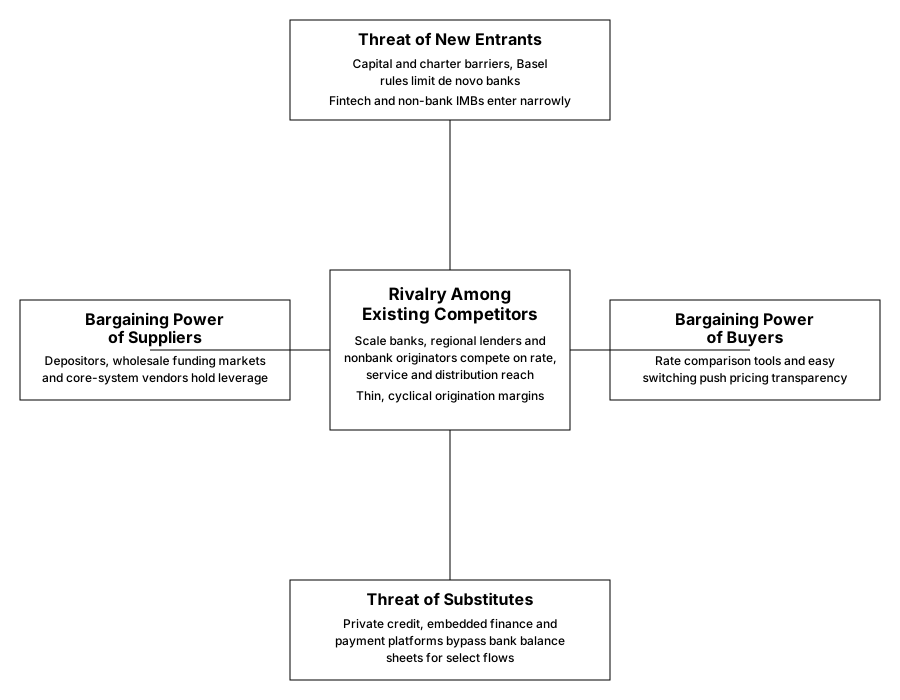
Competitive intensity in banking and mortgage varies sharply by segment, but five structural forces shape strategy across the industry as a whole. Regulatory barriers keep new full-service bank entry rare, buyer power has risen sharply as digital comparison tools erode information asymmetry, supplier power sits with depositors and wholesale funding markets, rivalry stays intense despite consolidation and substitutes chip away at specific product lines without threatening the core deposit franchise.
Bargaining power of buyers
Buyer power in retail banking has increased substantially over the past decade as digital rate-comparison platforms, aggregator apps and open banking application programming interfaces have made switching costs far more visible than they used to be. Deposit customers can now compare yields across hundreds of institutions in minutes and many high-yield savings and certificate of deposit products live entirely outside the branch network that once anchored customer loyalty. Mortgage borrowers exhibit similarly high price sensitivity because loan officers and online marketplaces routinely present competing rate quotes and government-sponsored enterprise standardization means a conforming loan from one lender is functionally interchangeable with one from another. Commercial banking clients, by contrast, retain lower switching propensity because treasury management integrations, credit facility covenants and long-standing relationship banking create real friction, giving corporate relationship managers more pricing latitude than their retail counterparts enjoy. The net effect is a bifurcated power structure:
retail depositors and mortgage shoppers behave like commodity buyers, while corporate and high-net-worth clients remain relationship-bound and less price-driven
| Buyer segment | Switching friction | Primary leverage point |
|---|---|---|
| Retail depositors | Low | Yield comparison apps and neobank onboarding |
| Mortgage borrowers | Low to moderate | Rate quote transparency and loan marketplaces |
| Small business clients | Moderate | Bundled credit and cash management ties |
| Corporate and institutional clients | High | Covenant structures and relationship depth |
Bargaining power of suppliers
The most important suppliers to a bank are not vendors in the traditional sense but the depositors who provide funding and their collective bargaining power shows up as the interest rate a bank must offer to retain balances rather than lose them to competitors or money market funds. When short-term rates rise, deposit competition intensifies because customers can earn meaningfully more elsewhere and banks with less diversified or less sticky deposit bases face pressure to raise rates faster than their net interest margin can absorb comfortably. Wholesale funding markets, including the Federal Home Loan Bank system and repurchase agreement markets, act as a secondary supplier group that smaller or faster-growing institutions lean on when core deposits cannot keep pace with loan growth, though this funding typically costs more and carries less stability than retail deposits. Core banking software vendors and payment network operators also hold meaningful leverage, since switching a bank's core processing system is a multi-year, high-risk undertaking that vendors know limits realistic negotiating pressure from clients. Talent, particularly in risk, compliance and technology, functions as a further constrained input, with specialized underwriting and regulatory expertise commanding premium compensation in a labor market that has not kept pace with demand.
| Supplier category | Concentration | Leverage mechanism |
|---|---|---|
| Retail depositors | Fragmented but rate-sensitive | Yield competition and deposit flight risk |
| Wholesale and Federal Home Loan Bank funding | Moderate | Higher cost, collateral requirements |
| Core banking and loan origination software vendors | Highly concentrated | Multi-year switching costs |
| Risk, compliance and underwriting talent | Scarce | Wage premiums and retention risk |
Rivalry among existing competitors
Rivalry in retail and commercial banking remains intense despite decades of consolidation, because scale advantages in funding cost compete against nimbleness advantages held by community banks, credit unions and digital-only challengers. Large national banks leverage lower cost of capital and broad product suites to win share, while community institutions compete on localized relationships and faster decision cycles that larger bureaucracies struggle to match. In mortgage specifically, rivalry is unusually fierce because loan products are largely standardized around Fannie Mae and Freddie Mac guidelines, leaving price, speed of closing and loan officer relationships as the primary differentiators available to originators. The top ten mortgage originators in 2025 controlled roughly a quarter of total origination volume in the United States, with the top two lenders alone accounting for close to fifteen percent of every loan originated nationally, showing that scale matters even in a fragmented market with thousands of active lenders.3 Fintech-driven lending competition has also compressed margins directly, with research on commercial lending rates showing that a one standard deviation increase in fintech competition exposure corresponds to a meaningful reduction in average lending rates charged by incumbent banks.
| Rivalry dimension | Characteristic | Strategic implication |
|---|---|---|
| National scale banks | Low-cost funding, broad distribution | Compete on breadth and balance sheet capacity |
| Community banks and credit unions | Local relationships, faster decisions | Compete on service and underwriting flexibility |
| Independent mortgage bankers | Origination specialization | Compete on speed and rate at thin margins |
| Digital-only and fintech lenders | Technology-first acquisition | Compete on convenience and narrow rate cuts |
Threat of new entrants
Full-service banking is one of the hardest industries in the economy to enter from scratch, since a de novo bank charter requires meeting capital adequacy thresholds, satisfying multiple regulators and building the compliance infrastructure needed to survive an examination cycle before writing a single loan at scale. These barriers have kept de novo bank formation in the United States at historically low levels for over a decade, concentrating industry structure among existing charters even as those charters change hands through mergers. Mortgage origination presents a lower barrier because a company can operate as a nonbank lender, originating loans for sale rather than holding deposits, which avoids the heaviest prudential capital rules while still requiring state licensing and warehouse lending relationships to fund loans before sale. This asymmetry explains why nonbank, independent mortgage bankers have grown to dominate origination volume even though banks retain overwhelming dominance in deposit-taking, since the entry barrier for the former is materially lower than for the latter. Technology-enabled entrants, including embedded finance providers and banking-as-a-service platforms, are lowering the effective barrier further by letting non-bank brands offer banking products through a partner bank's charter, though this model concentrates real regulatory risk with the sponsor bank rather than eliminating it.
| Entry path | Barrier level | Typical entrant profile |
|---|---|---|
| De novo bank charter | Very high | Rare, well-capitalized founding groups |
| Nonbank mortgage origination | Moderate | Private equity-backed lenders, fintech platforms |
| Banking-as-a-service partnership | Low to moderate | Consumer fintech and embedded finance brands |
| Credit union or community bank acquisition | Moderate | Regional consolidators and investor groups |
Threat of substitutes
Substitution risk in banking is uneven across product lines, concentrated where technology has created genuine alternatives to a bank balance sheet rather than merely a different interface for the same product. Payments have seen the most substitution pressure, as peer-to-peer transfer apps and card network wallets increasingly intermediate everyday transactions without routing meaningfully through a bank's own product, even though the underlying funds usually still sit in a bank account somewhere in the chain. Private credit funds and direct lending vehicles have substituted for bank balance sheets in leveraged and middle-market corporate lending, a shift accelerated by post-financial-crisis capital rules that made certain loan categories less attractive for banks to hold. In mortgage specifically, substitution is more limited because government-sponsored enterprise financing and Federal Housing Administration programs offer pricing advantages that private alternatives, such as portfolio lenders, rarely match for a standard conforming borrower. Buy-now-pay-later products and fintech installment lenders substitute for a narrow slice of consumer credit card and personal loan demand, but they have not meaningfully displaced deposit accounts, which remain the substitution-resistant core of retail banking.
| Substitute category | Product line affected | Depth of threat |
|---|---|---|
| Peer-to-peer payment apps | Everyday transaction routing | Moderate, funds still bank-sourced |
| Private credit and direct lending funds | Corporate and leveraged lending | High in specific loan categories |
| Buy-now-pay-later and installment fintechs | Consumer credit card and personal loans | Moderate, narrow product overlap |
| Portfolio and private mortgage lenders | Non-conforming mortgage segments | Low, GSE pricing advantage persists |
Value chain and profit pools
The banking and mortgage value chain begins with funding sourcing, the stage where institutions gather retail deposits, wholesale funding and, for public companies, equity capital that anchors the entire lending operation. Underwriting and origination follow, where credit analysts and loan officers evaluate borrower risk, price the loan and structure terms, a stage that has become the primary battleground for automation as machine learning models increasingly assist or replace manual income and asset verification. Funding and closing come next, the operational stage where loans are formally extended, documentation finalized and, for mortgages, real estate transactions closed in coordination with title companies and settlement agents.
Distribution splits into two distinct paths depending on the institution's business model, either the loan stays on the originating bank's balance sheet, generating net interest income over its life, or it moves into the secondary market, sold to investors or securitized through Fannie Mae, Freddie Mac or private-label channels, generating an immediate gain on sale instead. Servicing forms its own stage, running for the life of the loan regardless of which path distribution took, collecting payments, managing escrow accounts and handling delinquency or default, a function increasingly outsourced to specialized subservicers even when the mortgage servicing right itself remains an asset on an originator's books. Customer interface, spanning branches, call centers, mobile apps and loan officer relationships, cuts across every other stage and increasingly determines acquisition cost more than product pricing does. Enabling infrastructure, including core banking systems, payment rails, compliance technology and cybersecurity, underpins the entire chain and has become a larger share of operating cost as regulatory and technology demands have both intensified.
Profit pool
Profit concentration in this industry has shifted decisively away from the origination moment and toward the stages that generate recurring, fee-based revenue over time. Origination itself, whether for deposits or mortgages, is typically a low or negative margin activity on a fully loaded basis once marketing, staffing and technology costs are allocated, because competitive pressure and standardized products leave little room for pricing power at the point of sale. Mortgage servicing rights, by contrast, generate a steady annuity of fee income for the life of a loan and institutions that retain servicing rather than releasing them at origination capture a profit pool that compounds over years rather than evaporating the moment a loan closes.
Wealth management and treasury or cash management services represent the other major profit concentration, since both bill on assets under management or relationship depth rather than one-time transaction volume, insulating them somewhat from interest rate cycles that whipsaw net interest income and mortgage origination volume alike. Deposit franchises themselves are arguably the single largest hidden profit pool in the industry, because the spread between what an institution pays depositors and what it earns lending or investing those funds, even after accounting for credit losses, still generates the bulk of net interest income at most banks. This explains why acquisitive banks consistently pay premiums for deposit-rich franchises even when the acquired institution's loan book looks unremarkable, since the funding base itself is the asset being purchased.
Industry economics and business models
Three business model patterns dominate the industry, each with distinct capital and risk characteristics. The traditional balance-sheet banking model holds deposits as liabilities and loans as assets, earning net interest margin on the spread and bearing full credit risk on whatever it chooses to retain, a model that rewards disciplined underwriting and low-cost funding above all else. The originate-to-distribute model, dominant among nonbank mortgage lenders, earns fee income on origination and gain on sale by moving loans off the books quickly into the secondary market, trading lower capital intensity for near-total dependence on origination volume and secondary market liquidity. The fee-based advisory and servicing model, spanning wealth management, treasury services and mortgage servicing, earns revenue on assets managed or loans serviced rather than loans originated or held, producing the most stable margins of the three but requiring years to build meaningful scale.
Most large, diversified institutions blend all three models deliberately, using balance-sheet lending to anchor customer relationships, originate-to-distribute mechanics to keep mortgage capital requirements manageable and fee-based services to smooth earnings across interest rate cycles. Smaller, more specialized players tend to concentrate in one model, which raises their earnings volatility but also lets them compete aggressively within a narrower scope without the overhead of managing three distinct risk profiles simultaneously.
Cost drivers and scalability
Fixed costs dominate the cost structure of chartered banking, encompassing branch networks, core technology systems, compliance infrastructure and the risk management staff required regardless of transaction volume, which means scale advantages accrue heavily to larger institutions able to spread these costs across a bigger asset base. Variable costs, by contrast, are concentrated in loan origination, where commission-based loan officer compensation and marketing spend flex directly with volume, a structure that lets mortgage originators scale staffing up during refinance booms and down during rate-driven slowdowns far more readily than a deposit-taking bank can adjust its branch footprint.
Economies of scale show up most clearly in funding cost, since larger institutions generally access cheaper wholesale funding and can spread fixed compliance costs across a larger balance sheet and in technology, where the cost of building fraud detection, underwriting automation and core banking platforms is largely fixed regardless of how many accounts run through them. Economies of scope appear where an institution cross-sells multiple products into a single customer relationship, since acquiring a mortgage customer who also opens a checking account and later a wealth management relationship generates far more lifetime value than a single-product customer at roughly similar acquisition cost. Efficiency ratio, the proportion of revenue consumed by operating expense, functions as the industry's core unit economics metric and institutions that push this ratio below fifty percent typically demonstrate the scale and discipline that separates structurally advantaged competitors from the rest of the field.
Moats, advantages and strategic levers
Regulatory licensing forms the deepest and most durable moat in banking, since a chartered institution operates under legal protections, including deposit insurance, that no unlicensed competitor can replicate regardless of technology sophistication or capital available. Low-cost deposit funding compounds this moat, because an institution with a large base of low-interest checking and savings balances enjoys a persistent cost-of-funds advantage over competitors that must rely on higher-cost wholesale funding or aggressive rate offers to attract deposits. Switching costs reinforce customer stickiness once a relationship is established, particularly for small businesses whose treasury management, payroll integration and credit facilities are deeply embedded in daily operations and expensive to migrate.
Data and underwriting learning advantages are growing in importance as institutions with longer credit histories and larger loan portfolios can train more accurate risk models, a advantage that compounds over time and is difficult for new entrants to replicate quickly regardless of how much capital they raise. Brand trust, while less quantifiable, still matters meaningfully in a business where customers hand over their life savings and institutions that have weathered previous financial crises without failure carry a credibility premium that newer entrants cannot simply purchase through marketing spend.
The banks that will win the next decade are not the ones with the flashiest apps, they are the ones that never lose sight of what a deposit actually is: the cheapest, most patient capital any lender will ever get
Strategic levers
Institutions and entrants alike can pull several distinct levers to build or defend position within this industry. Customer segment focus, choosing to specialize in small business, high-net-worth, or mass-market retail rather than serving everyone, allows an institution to tailor underwriting, service model and pricing more precisely than a generalist competitor can. Product scope decisions, particularly whether to build proprietary mortgage servicing capability or outsource it to a subservicer, directly shape whether an institution captures the recurring fee income that servicing generates or cedes that profit pool to a specialist partner.
Vertical integration versus partnership represents a third major lever, visible in the choice nonbank lenders face between building warehouse lending relationships and secondary market execution capability in-house versus partnering with correspondent channels that handle distribution on their behalf. Geographic expansion remains relevant primarily for regional and community banks weighing organic branch growth against acquisition, since acquiring an existing deposit franchise is almost always cheaper than building comparable scale from scratch given how slowly organic deposit growth typically accrues. Ecosystem orchestration, embedding banking products into non-financial platforms through banking-as-a-service arrangements, offers a final lever that lets chartered institutions monetize their regulatory license without building consumer-facing brands themselves, though it requires accepting compliance risk for activity conducted by a partner outside direct operational control.
Structural risks, regulation and trends
Regulatory risk sits at the top of any structural risk assessment for this industry, since capital requirements, consumer protection rules and examination intensity can shift meaningfully with changes in the political and macroeconomic environment, directly affecting how much lending capacity an institution can deploy. Technology disruption risk is concentrated in two areas, Artificial Intelligence reshaping underwriting economics faster than governance frameworks can keep pace and open banking infrastructure making it easier for non-bank platforms to intermediate customer relationships that banks previously owned outright. Both Fannie Mae and Freddie Mac issued formal governance frameworks for Artificial Intelligence and machine learning use in loan origination and servicing during 2025 and 2026, signaling that regulators expect this technology shift to accelerate rather than plateau.4
Interest rate risk functions almost like a commodity price risk for this industry, since both net interest margin and mortgage origination volume move in response to rate changes that no individual institution controls, making rate cycle positioning a central strategic question rather than a peripheral treasury function. Geopolitical and macroeconomic risk affects the industry primarily through credit quality, since a recession or regional economic shock raises default rates precisely when funding costs and capital requirements tend to tighten simultaneously, compressing profitability from both directions at once.
On the demand side, generational wealth transfer and continued household formation support long-term credit demand, though affordability constraints in many housing markets have kept purchase mortgage volume below levels that would otherwise be expected given demographic trends. On the supply side, nonbank mortgage lenders have continued gaining origination share from depository banks, a trend visible in 2025 data showing the largest nonbank originators controlling meaningfully more origination volume than any single depository competitor.5 Disruptive models worth tracking include fully digital mortgage platforms that compress closing timelines and banking-as-a-service arrangements that let non-bank brands distribute deposit and lending products without holding a charter themselves.
For entrants, the strategic playbook depends heavily on which layer of the value chain is being targeted. A niche entry strategy, focused on a specific underserved segment such as small business lending or a particular geography, generally outperforms a broad entry attempt, because broad entry into chartered banking requires capital and regulatory approval that few new entrants can secure quickly. Partnering with an existing chartered institution through a banking-as-a-service arrangement offers the fastest path to market for a technology-first entrant, though it trades speed for dependence on a partner bank's risk appetite and compliance posture. Building full banking infrastructure from scratch remains the slowest and most capital-intensive path, appropriate mainly for well-funded entrants with a multi-year time horizon and a genuinely differentiated underwriting or distribution model.
For incumbents, the playbook centers on three parallel motions. Defending the deposit franchise requires continued investment in digital account opening, rate competitiveness and fraud protection, since deposit attrition is now far easier for customers to execute than it was even five years ago. Expanding fee income, particularly wealth management, treasury services and retained mortgage servicing, reduces earnings dependence on interest rate cycles and origination volume that no single institution controls. Deepening moats through proprietary underwriting data and selective technology partnership, rather than attempting to build every capability internally, allows incumbents to keep pace with fintech innovation without diluting focus on the core deposit and credit franchise that remains their most durable source of advantage.
Rocket Companies and the mortgage-technology bet
Rocket Companies, the parent of Rocket Mortgage, built its position by treating mortgage origination as a technology and marketing problem rather than a branch-network problem, a bet that took shape well before most competitors recognized the shift. The company grew out of Quicken Loans, founded in Detroit in 1985 and transformed itself over the following decades into the largest retail mortgage originator in the United States by originating loans almost entirely online and by phone rather than through a traditional branch network. That structural choice let Rocket scale origination capacity up and down with interest rate cycles far more efficiently than a branch-heavy competitor, since call center and technology capacity flex more easily than physical real estate commitments.
Rocket's core economics illustrate the volatility inherent in an origination-heavy business model even for the largest player in the industry. The company's volume and profitability move sharply with refinance activity, since a large share of its historical origination mix has come from refinancing existing mortgages rather than financing new home purchases, a mix that leaves earnings unusually exposed to interest rate direction compared to lenders more weighted toward purchase mortgages. In the 2025 origination cycle, Rocket led competitor United Wholesale Mortgage in total loan count with roughly 429,000 loans and a 6.33% market share, but trailed in total dollar volume because United Wholesale's purchase-mortgage focus carries larger average loan balances than Rocket's mix of refinances and second liens.6 That distinction matters strategically, since dollar volume drives gain-on-sale revenue more directly than loan count alone and it shows how two lenders pursuing similar scale ambitions can end up with meaningfully different revenue profiles depending on customer mix.
The company has responded to origination volatility by pushing further into adjacent, less cyclical revenue streams, including mortgage servicing, title insurance and, through a series of acquisitions, real estate and personal finance data platforms intended to capture customers earlier in the home-buying journey and retain them longer after closing. This mirrors the broader industry-wide profit pool shift described earlier in this analysis, away from origination fees and toward recurring servicing and adjacent fee income and Rocket's own public commentary has increasingly framed the company as a platform for the entire homeownership lifecycle rather than a pure mortgage originator. Retaining servicing rights on a large share of originated loans gives Rocket a recurring revenue base that partially offsets the swings in origination volume tied to refinance cycles, though the company remains far more origination-dependent than a diversified bank with a large deposit franchise.
Rocket's structural position also illustrates the entry barrier asymmetry discussed earlier in this analysis. As a nonbank mortgage company, Rocket does not hold a bank charter or take insured deposits, which let it scale origination volume without the capital and prudential requirements that constrain depository banks, but it also means Rocket depends on warehouse lending facilities and secondary market execution through Fannie Mae, Freddie Mac and private investors to fund and distribute the loans it originates. That dependence exposes the company to secondary market liquidity conditions in a way that a deposit-funded bank is partially insulated from, a trade-off the company has managed successfully across multiple rate cycles but one that remains structurally embedded in the nonbank origination model regardless of how sophisticated any individual operator's technology and risk management become.
Competitive pressure from United Wholesale Mortgage, which built its position through mortgage brokers rather than direct-to-consumer origination and from bank competitors re-investing in digital mortgage capability, keeps pricing pressure on Rocket's core origination business persistent rather than episodic. The company's scale, brand recognition built through sustained marketing investment and integrated technology stack spanning origination through servicing represent its clearest competitive advantages, but none of these fully insulate it from the interest-rate sensitivity that defines mortgage origination economics for every participant in the segment, regardless of size.
- 1Net Interest Income Projected At 9.22 Trillion Dollars In 2026
- 2US Single-Family Mortgage Originations Estimated At 1.94 Trillion Dollars In 2025
- 3Top Ten Mortgage Originators Controlled Nearly A Quarter Of 2025 Volume
- 4Freddie Mac And Fannie Mae Issued AI Governance Frameworks For Mortgage Lenders
- 5Nonbank Mortgage Originators Continued Gaining Share Of 2025 Originations
- 6Rocket Led Loan Count While United Wholesale Led Dollar Volume In 2025
Banking and mortgage lending convert household and business savings into credit, using insured deposits as the cheapest funding source in the economy and distributing that credit through balance sheets that carry regulatory capital charges. The economics reward scale in funding cost, discipline in credit underwriting and patience in fee-based servicing over pure origination volume, which swings hard with interest rates. Winners defend deposit franchises, extend into adjacent fee businesses such as wealth management and treasury services and treat compliance infrastructure as a genuine cost advantage rather than a burden. Entrants and incumbents alike should pull the levers of funding cost discipline, servicing scale and selective technology partnership rather than chasing origination share for its own sake, because the industry's profit pools sit downstream of the loan closing, not at it.
Citation
Cite this article
Sridharan, M. A. (2023, January 28). Industry Analysis: Banking and Mortgage. Think Insights. https://thinkinsights.net/strategy/industry-analysis-banking-and-mortgage (Accessed [[ACCESS_DATE]])
Sridharan, Mithun A. "Industry Analysis: Banking and Mortgage." Think Insights, 28 Jan. 2023, https://thinkinsights.net/strategy/industry-analysis-banking-and-mortgage. Accessed [[ACCESS_DATE]].
Mithun A. Sridharan, "Industry Analysis: Banking and Mortgage," Think Insights, January 28, 2023, https://thinkinsights.net/strategy/industry-analysis-banking-and-mortgage. Accessed [[ACCESS_DATE]].
Sridharan, M.A. (2023) 'Industry Analysis: Banking and Mortgage', Think Insights. Available at: https://thinkinsights.net/strategy/industry-analysis-banking-and-mortgage (Accessed: [[ACCESS_DATE]]).
M. A. Sridharan, "Industry Analysis: Banking and Mortgage," Think Insights, 2023. [Online]. Available: https://thinkinsights.net/strategy/industry-analysis-banking-and-mortgage. [Accessed: [[ACCESS_DATE]]].
Sridharan MA. Industry Analysis: Banking and Mortgage. Think Insights. Published January 28, 2023. Accessed [[ACCESS_DATE]]. https://thinkinsights.net/strategy/industry-analysis-banking-and-mortgage
Test Your Knowledge
Industry Analysis: Banking and Mortgage
Challenge yourself on the concepts from this article and see how well you understood them.
Subscribers get weekly quizzes and insights — subscribe free
Sponsor this article
Partner with Think Insights
Reach 50,000+ business leaders, consultants, and strategists. Feature your brand alongside expert articles on strategy, leadership, and digital transformation.
Become a Sponsor