Industry Analysis: Automotive Services


Independent multi-shop operators and parts distributors, not dealerships, now capture the fastest-growing share of automotive service margin and the shift is accelerating as private equity consolidates a $1 trillion-plus global repair and maintenance market. The decision facing operators and investors is not whether to enter this industry but where along the value chain to concentrate capital: diagnostic and calibration capability for advanced driver assistance systems [ADAS] and electric vehicles [EVs] is becoming the entry ticket, while undifferentiated oil-change volume is being commoditized. Buyers hold growing information power through online price transparency, yet the technical complexity of modern vehicles is pushing bargaining power back toward shops and distributors that control calibration equipment, certified labor and OEM data access. Executives evaluating this space should prioritize scale in labor recruitment, telematics-enabled diagnostics and data access over simple geographic footprint expansion.
Is automotive services and maintenance attractive for new entrants?
It is attractive at the shop level because startup capital for a single bay is modest and demand is non-discretionary, but the attractive economics belong to operators who can reach scale quickly. A single independent shop faces thin margins and technician scarcity, while a multi-shop platform backed by growth capital can spread technology investment, purchasing power and brand trust across dozens of locations. New entrants without a clear path to scale or a technical specialty, such as ADAS calibration or fleet contracts, face a crowded, low-differentiation market.
Which parts of the value chain are most profitable?
Parts distribution and specialty diagnostic or calibration services carry the highest margins, followed by branded multi-shop retail chains that combine purchasing scale with consistent labor pricing. Single-bay general repair, particularly commoditized routine maintenance such as oil changes, generates the thinnest margins because price transparency and low switching costs compress what shops can charge. Collision repair sits in between, benefiting from insurance-directed volume but constrained by insurer-negotiated rates.
How is technology changing this industry?
Vehicles have become rolling software platforms and that shift is redefining what a repair shop needs to operate. Advanced driver assistance systems require calibration equipment and trained technicians that most small shops lack, telematics enables predictive maintenance that shifts demand from reactive repair to scheduled service and diagnostic software increasingly requires OEM-controlled data access. Shops that cannot make these investments are being squeezed out of higher-value repair categories.
What capabilities are table stakes vs differentiators?
Basic diagnostic scan tools, certified technician staffing and digital scheduling are now table stakes across the industry. Differentiators include ADAS calibration capability, EV battery and high-voltage system expertise, fleet and insurance direct-repair relationships and proprietary customer retention systems that convert one-time visits into recurring maintenance relationships. Operators without at least one differentiator are exposed to margin erosion as commoditized services get priced down.
How should investors or consultants evaluate opportunities here?
Evaluate targets on technician retention and utilization rates first, since labor availability is the binding constraint on growth in almost every segment. Second, assess exposure to electric vehicle penetration in the target's local market, because EVs reduce routine maintenance revenue per vehicle even as they raise diagnostic complexity. Third, examine whether the business has genuine purchasing scale in parts procurement or is simply aggregating small shops without integrating back-office and supply functions, since the latter rarely holds valuation multiples over time.
What is driving private equity interest in this industry?
Private equity is drawn to the combination of recurring, non-discretionary demand, a highly fragmented ownership base ripe for roll-up economics and clear paths to margin expansion through centralized purchasing, shared back-office functions and cross-selling. The collision repair and general repair segments in particular have seen a wave of multi-shop operator consolidation because owner-operators nearing retirement provide a steady pipeline of acquisition targets at reasonable multiples.
Why are dealerships losing service market share to independent shops?
Dealership service bays have historically relied on warranty work and new-vehicle service contracts, but as vehicles stay on the road longer and warranties expire, owners increasingly shop on price and convenience rather than brand loyalty. Independent shops and quick-lube chains have also invested in the same diagnostic technology that once was a dealer-only advantage, narrowing the technical gap while retaining a price advantage.
How are electric vehicles reshaping the economics of this industry?
Electric vehicles have roughly a tenth of the moving parts of an internal combustion vehicle and eliminate entire maintenance categories such as oil changes, cutting routine service revenue per vehicle substantially over its life. In exchange, EVs create new revenue pools in battery diagnostics, high-voltage system repair and software-related service, but these require different technician training and equipment, favoring operators who invest early over those who wait.
What regulatory issues matter most to industry participants?
Right-to-repair legislation, which governs independent shop access to OEM diagnostic data, telematics feeds and repair software, is the single most consequential regulatory question facing the industry, because it determines whether independents can service increasingly software-defined vehicles at all. Environmental rules on refrigerants, used oil disposal and shop emissions also shape compliance costs, particularly for larger multi-shop operators subject to more regulatory scrutiny than single-location shops.
Can this industry sustain its current growth rate through the shift to electric vehicles?
Aggregate industry revenue is likely to keep growing because the vehicle population continues to expand and age and complexity-driven service categories are replacing volume-driven routine maintenance, but growth will not be evenly distributed. Operators concentrated in commoditized routine maintenance without an EV or ADAS strategy face a shrinking addressable market even as the industry total expands.
Every vehicle on the road today represents a claim on future labor and parts spending and the automotive services and maintenance industry exists to capture that claim, one appointment at a time. It is a business built on depreciating assets that owners are legally and practically obligated to keep functional, which gives the industry a demand floor that few consumer-facing sectors enjoy. Yet beneath that stability sits a structure in flux:
dealerships, independent shops, quick-lube chains and parts distributors are competing for a shrinking set of routine tasks even as vehicle complexity creates entirely new categories of high-value work
Industry at a glance
Automotive services and maintenance covers the repair, upkeep and parts supply chain that keeps in-use passenger and commercial vehicles operational, encompassing independent repair shops, dealership service departments, quick-lube and tire chains, collision repair operators and the parts distributors and suppliers that feed all of them. It excludes vehicle manufacturing and new-vehicle sales, which sit in a separate value chain governed by different economics and capital intensity. The industry is overwhelmingly business-to-consumer (B2C) at the point of service, though a meaningful share of revenue flows through business-to-business (B2B) channels such as fleet maintenance contracts, insurance-directed collision work and dealer-to-distributor parts purchasing, with a smaller business-to-government (B2G) segment tied to municipal and public fleet servicing.
The global automotive repair and maintenance services market is valued at roughly 1,027 billion dollars in 2026, with projections putting it near 1,583 billion dollars by 2030, implying a compound annual growth rate near 8.7%.1 The narrower aftermarket parts segment, which strips out labor and service revenue to isolate replacement components, is estimated at several hundred billion dollars depending on scope definitions, reflecting how much of total industry revenue is generated by labor rather than product sale. Revenue models across the industry are predominantly fee-for-service and transactional, priced per repair order, though fleet contracts and some quick-lube memberships introduce subscription-like recurring billing. Capital intensity is moderate at the shop level, dominated by real estate, lifts and diagnostic equipment, but rises sharply for operators investing in ADAS calibration bays or EV-specific tooling. Labor intensity is high throughout and regulatory exposure spans environmental compliance, consumer protection, insurance direct-repair program rules and, increasingly, data access mandates tied to vehicle telematics.
Industry segmentation
The industry divides most usefully along value chain position and customer relationship rather than by vehicle type, since the economics of a segment depend more on who owns the customer relationship than on what is being repaired. Independent repair shops, typically single-location or small multi-shop operations, handle general mechanical repair and maintenance and compete primarily on price, trust and convenience, representing the largest single pool of shop locations though not necessarily the largest revenue pool. Dealership service departments operate as an extension of new-vehicle sales, historically anchored by warranty work and factory-trained technicians, but increasingly compete on the same routine maintenance tasks as independents once vehicles age past warranty coverage.
Quick-lube and specialty maintenance chains focus narrowly on high-frequency, low-complexity services such as oil changes, tire rotation and basic inspections, competing on speed and convenience rather than diagnostic depth and have historically enjoyed strong same-store economics because of high visit frequency. Collision repair operators form a distinct segment shaped heavily by insurance direct-repair program relationships, where insurers steer volume to preferred shops in exchange for negotiated labor rates, creating a different competitive dynamic than mechanical repair. Parts distribution and wholesale, spanning national distributors down to local jobbers, supplies every other segment and captures margin on both branded and private-label components, often with more consistent profitability than the labor-intensive segments it serves. A final, fast-growing segment covers diagnostic technology and telematics-enabled service providers, including software platforms that convert vehicle sensor data into predictive maintenance alerts, a segment still small in absolute revenue but disproportionately important to where the industry's profit pool is heading.
Market structure
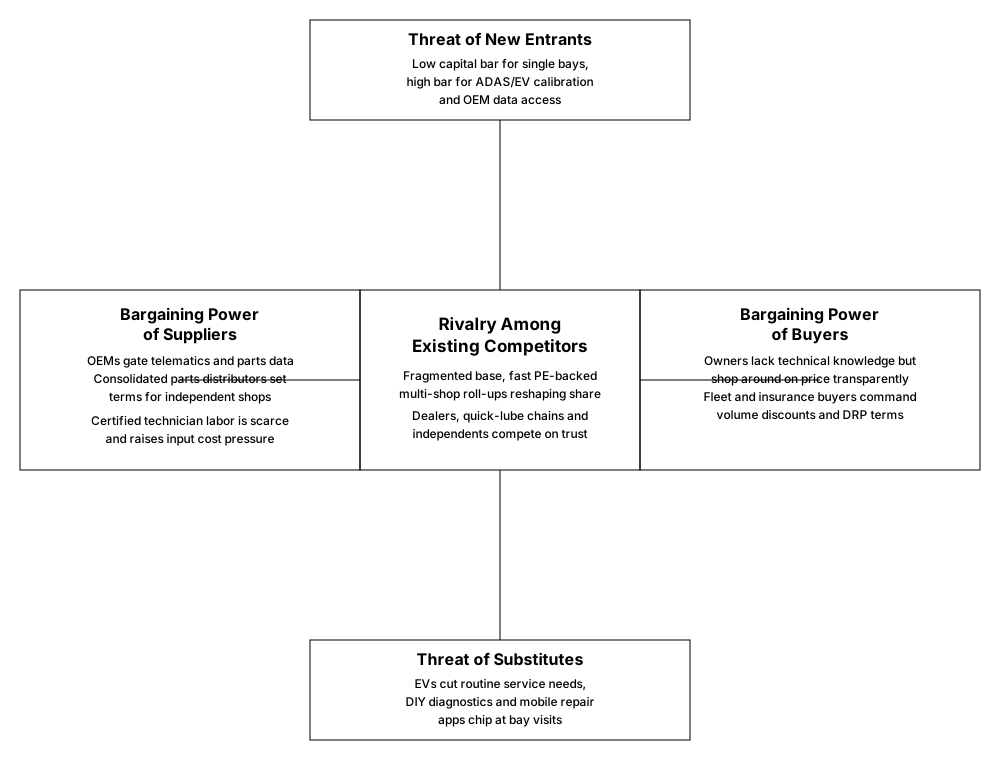
Porter's Five Forces framework clarifies why this industry rewards scale and technical specialization more than brand alone. Buyer power is rising through price transparency but constrained by information asymmetry on technical matters, supplier power is concentrating around OEM-controlled data and consolidated parts distribution, rivalry is intensifying as private equity accelerates consolidation of a historically fragmented base, entry barriers are bifurcating between low-cost general repair and high-cost technical specialties and substitution pressure is building from vehicle electrification and do-it-yourself diagnostic tools.
Bargaining power of buyers
Vehicle owners individually hold limited power over any single repair transaction because switching shops mid-repair is impractical and most owners lack the technical knowledge to challenge a diagnosis. That asymmetry has historically let shops price with some discretion, particularly for diagnostic-heavy work where the customer cannot easily verify the scope of the problem. Online price comparison tools, review platforms and franchise pricing transparency have chipped away at this advantage over the past decade, giving retail buyers more leverage on routine, easily specified services such as oil changes, tire replacement and brake pads, where price shopping is straightforward.
Fleet operators and insurance companies represent a different category of buyer entirely, commanding real negotiating power because they control high volumes of repeat business and can direct that volume toward shops willing to accept negotiated labor rates. Insurance-directed collision repair programs are the clearest example, where insurers effectively set pricing parameters for participating shops in exchange for referral volume, transferring meaningful margin from shop to payer. Dealerships retain some insulation from buyer power on warranty and recall work, since that business is contractually routed to them regardless of price, but this insulation shrinks as the vehicle parc ages and warranty coverage lapses. On balance, buyer power is moderate and segment-dependent, strongest on routine and collision work, weakest on urgent or highly technical repairs where the customer has little choice but to trust the shop's assessment.
| Buyer segment | Source of leverage | Constraint on leverage |
|---|---|---|
| Individual vehicle owners | Price comparison apps and review sites | Cannot verify diagnostic accuracy, urgency limits shopping |
| Fleet operators | High repeat volume, contract negotiation | Locked into service quality and uptime requirements |
| Insurance companies | Control referral volume to collision shops | Need certified shops for OEM-compliant repairs |
| Extended warranty administrators | Set reimbursement caps on covered repairs | Limited to warranty-eligible vehicle population |
Bargaining power of suppliers
Suppliers to this industry split into two categories with very different leverage: parts and equipment suppliers and original equipment manufacturers [OEMs] that control vehicle design and increasingly the data needed to service it. Parts distribution has consolidated meaningfully over the past two decades, giving large distributors pricing power over smaller independent shops that lack the purchasing scale to negotiate favorable terms, while larger multi-shop operators and franchise networks can extract volume discounts that shrink the gap.
The more consequential supplier dynamic involves OEMs, who increasingly gate access to the diagnostic software, telematics data and calibration procedures needed to service modern vehicles properly. As vehicles have become more software-defined, this data has become as essential an input as a physical part and OEMs have structural incentive to route that access preferentially toward their own dealer networks. Over 60% of independent repair facilities report difficulty completing even routine repairs because of OEM data access barriers, a dynamic that right-to-repair legislation is directly aimed at correcting.2 Skilled technician labor functions as a third, increasingly binding supply constraint, since certified technicians capable of handling ADAS calibration or high-voltage EV systems are scarce relative to demand, giving that labor pool real bargaining power over wages and working conditions industry-wide.
| Supplier type | Leverage mechanism | Effect on shop economics |
|---|---|---|
| National parts distributors | Consolidated purchasing scale | Sets wholesale pricing floor for independents |
| Vehicle manufacturers | Controls diagnostic data and calibration access | Can restrict independent shop service capability |
| Certified technicians | Scarce skill relative to demand | Drives up labor cost and recruitment spend |
| Specialty equipment makers | Few certified ADAS and EV tooling providers | High upfront capital requirement for shops |
Rivalry among existing competitors
Rivalry in this industry has intensified sharply as capital has entered a historically fragmented, owner-operator-dominated base. Independent shops still outnumber every other format, but private equity-backed multi-shop operators are acquiring them at a pace that is visibly consolidating the collision and general repair segments, with more than 130 private equity firms actively engaged in collision repair alone and over 9 billion dollars of capital deployed since 2023.3 This consolidation is shifting the competitive basis from purely local reputation toward brand consistency, standardized processes and centralized purchasing power, advantages that scaled operators can deploy against standalone shops.
Dealerships and independents compete most directly on routine maintenance and general repair and the data shows dealerships losing ground: their share of service visits fell from about 35% in 2021 to roughly 30% in 2023, even as dealers continue to charge a meaningful premium, with customers paying about 36% more for comparable repairs at dealer service departments.4 Quick-lube chains compete on convenience and speed within a narrow service band, largely insulated from direct price comparison with full-service shops because the transaction is fast and low-consideration. Rivalry is most acute where switching costs are lowest, meaning commoditized maintenance categories face the sharpest price competition while diagnostic-heavy or technically demanding repairs retain more pricing discipline because fewer competitors can perform them credibly.
The independent aftermarket has been quietly taking share from dealership service bays for a decade and the gap is now wide enough that dealers are treating it as a strategic problem rather than a cyclical blip
| Competitive format | Primary basis of competition | Trend in relative position |
|---|---|---|
| Independent general repair shops | Price, trust, local reputation | Gaining share from dealerships |
| Dealership service departments | Warranty work, factory technician training | Losing share as vehicles age past warranty |
| Quick-lube and tire chains | Speed and convenience on routine service | Stable but exposed to EV-driven volume decline |
| Private equity-backed multi-shop operators | Scale, standardized process, purchasing power | Rapidly gaining share through acquisition |
Threat of new entrants
Entry barriers in this industry are genuinely bifurcated and that split is becoming more pronounced each year. Opening a general repair bay remains relatively low-cost, requiring modest real estate, standard lifts and basic diagnostic tools, which keeps the door open to owner-operators and explains why the shop count remains so fragmented despite ongoing consolidation. This low barrier at the general-repair end means new entrants continue to appear steadily, particularly in underserved local markets, even as scaled operators absorb existing shops.
The picture changes entirely for entrants targeting higher-value technical work. ADAS calibration equipment, high-voltage EV service certification and OEM-level diagnostic software access all require significant upfront capital and specialized training that a new, undercapitalized entrant cannot easily assemble. Roughly 47% of repair shops report having to turn away ADAS-related repairs in the past year because they lack the necessary capability, with insufficient calibration equipment cited as the leading cause.5 This creates a structural filter: new entrants can compete freely for commoditized, low-margin work but face a real capital and expertise barrier if they want access to the segments of the industry where margin is expanding. Brand and franchise systems offer one path around this barrier, letting new operators license established processes, training pipelines and purchasing relationships rather than building technical capability from scratch.
| Entry pathway | Capital and expertise required | Resulting competitive exposure |
|---|---|---|
| Independent general repair bay | Low, standard lifts and hand tools | High competition on commoditized services |
| ADAS-capable diagnostic shop | High, calibration equipment and certified training | Limited competition, premium pricing potential |
| EV-specialized service center | High, high-voltage certification and safety infrastructure | Early-mover advantage as EV parc grows |
| Franchise or branded multi-shop entry | Moderate, franchise fee plus shared systems | Faster ramp but shared margin with franchisor |
Threat of substitutes
The most consequential substitution threat facing this industry is not a competing service model but a change in the underlying product: the electric vehicle. EVs carry roughly a tenth of the moving parts of an internal combustion engine vehicle and eliminate entire maintenance categories outright, including oil changes, which alone represent close to a quarter of all maintenance transactions in the United States market.6 Estimates suggest EVs generate 40% to 60% less service revenue than a comparable internal combustion vehicle over a similar ownership period, a structural headwind for any operator whose revenue mix is concentrated in routine maintenance rather than diagnostics or collision work.
Beyond electrification, do-it-yourself diagnostic tools and consumer-facing scan devices have made basic fault identification accessible without a shop visit, though this substitution effect remains limited to diagnosis rather than actual repair for most consumers. Mobile repair services, which bring a technician to the vehicle rather than the vehicle to a shop, represent a smaller but growing substitute for routine and minor repair categories, particularly in dense urban markets where parking and drop-off logistics are a genuine friction point for traditional shops. None of these substitutes threaten to eliminate demand for professional service outright, since vehicles will always require expert repair for safety-critical systems, but they do compress the addressable market for the lowest-complexity, highest-volume service categories that have historically anchored shop profitability.
| Substitute | Nature of threat | Segment most exposed |
|---|---|---|
| Electric vehicle powertrains | Eliminates or reduces routine maintenance categories | Quick-lube and general maintenance shops |
| Consumer diagnostic tools and apps | Reduces need for shop-based fault diagnosis | Routine diagnostic visits |
| Mobile and at-home repair services | Bypasses fixed-location shop visits for minor work | Urban general repair shops |
| Extended vehicle lifespan and reliability gains | Fewer repairs needed per vehicle-year over time | Volume-dependent maintenance chains |
Value chain and profit pools
The value chain begins upstream with component manufacturing and parts sourcing, where original equipment and aftermarket parts makers produce the physical inputs every downstream service depends on, ranging from commodity items such as filters and fluids to precision components such as sensors and control modules. From there, parts move through distribution and logistics, a layer that has consolidated significantly and now functions as a genuine gatekeeper, since a shop's ability to source the right part quickly determines how fast it can turn a repair order and how much inventory risk it carries.
The service delivery layer, comprising the shop floor itself, is where labor is applied to diagnosis, repair and installation and it is here that technician skill, equipment quality and bay utilization determine unit economics most directly. Customer interface functions, including scheduling, estimating, communication and payment, sit adjacent to service delivery and increasingly run through digital platforms that shape customer retention as much as the repair quality itself. Enabling infrastructure spans the diagnostic software, telematics data feeds and OEM technical documentation that every other layer depends on and this layer has grown from a background utility into a genuine strategic battleground as vehicles have become software-defined. Insurance and warranty administration forms a final, adjacent layer that governs how much of certain repair categories, particularly collision work, get paid and at what rate, exerting real influence over shop-level margin without directly touching the vehicle at all.
Profit pool
Profit concentration in this industry has shifted meaningfully away from where it sat two decades ago. Routine maintenance, once a reliable margin generator because of its high frequency and low complexity, has been squeezed by price transparency and, more recently, by the volume decline that comes with vehicle electrification. Parts distribution has held its margin position well, benefiting from consolidation among distributors and the fact that shops of every format still depend on reliable, fast parts sourcing regardless of how competitive the labor side of the business becomes.
The clearest emerging profit pool sits in diagnostic and calibration services tied to ADAS and EV systems, where technical complexity limits the competitive set and allows operators with the right equipment and certification to command premium labor rates. Collision repair, particularly within insurance direct-repair programs, generates a stable if not exceptional margin because insurer-negotiated rates cap upside even as volume stays predictable. Multi-shop operators capture an additional layer of profit unavailable to single-location shops, arising from centralized purchasing, shared back-office systems and the ability to allocate technician talent across locations to smooth utilization. The overall trajectory favors scaled, technically capable operators and specialized distributors over undifferentiated single-bay general repair, a shift that mirrors what has happened in other fragmented, labor-intensive service industries as they mature and consolidate.
Industry economics and business models
Three business model patterns dominate the industry today. The first is the traditional fee-for-service repair model, still the largest by revenue, in which a shop bills for labor hours and marked-up parts on a per-repair-order basis, with profitability driven almost entirely by technician utilization and effective labor rate. The second is the high-frequency, low-ticket transactional model used by quick-lube and tire chains, which trades lower per-visit margin for much higher visit frequency and relies on locational convenience and speed to drive volume rather than technical differentiation.
The third and fastest-growing pattern is the platform or multi-shop operating model, in which a central management company owns or franchises a network of locations and captures margin not from any single repair but from the operating leverage of shared purchasing, shared technology and standardized processes applied across many sites. Fleet and insurance-directed contract models represent a fourth, smaller pattern layered across all three, converting what would otherwise be one-off transactional revenue into contracted, recurring volume in exchange for negotiated pricing, trading margin for predictability. None of these models has moved meaningfully toward subscription or usage-based pricing in the way other service industries have, largely because vehicle repair demand is inherently episodic and tied to unpredictable failure events rather than continuous consumption, though telematics-enabled predictive maintenance programs are beginning to introduce more scheduled, plannable revenue into an otherwise reactive business.
Cost drivers and scalability
Labor is the dominant cost line in this industry, typically representing the largest single expense category for a repair shop and technician compensation has been rising steadily as certified talent becomes scarcer relative to the technical demands of modern vehicles. Real estate and equipment form the primary fixed-cost base, with bay count effectively capping how much revenue a single location can generate regardless of demand, which makes utilization, the share of available bay-hours actually billed to customers, the single most important unit economic in the business. Parts cost is a significant variable cost but one shops can partially control through supplier negotiation and inventory management, particularly at scale.
Economies of scale in this industry come less from any single location growing larger and more from a multi-shop operator spreading fixed costs, primarily technology, marketing and back-office administration, across many locations. Purchasing scale in parts procurement is a genuine and durable scale advantage, since larger operators can negotiate meaningfully better wholesale terms than a standalone shop ever could. There is a modest network effect in fleet and insurance contracting, where a multi-location footprint makes an operator more attractive to national fleet customers seeking consistent service quality across geographies, creating a mild flywheel where scale begets access to larger, stickier contracts that in turn support further scale. Unlike asset-light digital businesses, however, marginal expansion still requires real capital for each additional bay, keeping this a fundamentally asset-heavy industry even as its most successful operators behave increasingly like disciplined multi-site retail chains.
Scope economies matter almost as much as scale economies in this business, because a shop capable of handling both routine maintenance and complex diagnostic work spreads its fixed technician and equipment costs across a wider revenue base than a narrowly specialized competitor. A shop limited to oil changes, for instance, can only monetize its bay during the brief window a given vehicle needs that specific service, while a broader-capability shop can fill the same bay-hour with whatever repair need happens to arrive that day. This is one reason the industry's most resilient operators tend to build broad diagnostic and repair competence even when a narrower quick-service format might look more efficient on paper, since flexibility in what a bay can produce turns out to matter more than the theoretical efficiency of specialization once real-world demand variability is taken into account.
Moats, advantages and strategic levers
Defensibility in this industry rests on a narrower set of levers than in many consumer-facing sectors and the strongest of them is increasingly technical rather than purely relational. Access to OEM diagnostic data and calibration procedures is becoming a genuine regulatory-adjacent moat, since operators who invest early in ADAS and EV capability gain access to a widening pool of repair work that undercapitalized competitors simply cannot perform, a moat that right-to-repair legislation is designed to erode but has not yet fully dismantled. Certified technician talent functions as a scarce-resource advantage in its own right and operators with superior recruiting, training and retention systems can sustain service capacity that smaller rivals cannot match, particularly in specialties like high-voltage EV repair where the qualified labor pool remains thin.
Purchasing scale in parts procurement offers a durable cost advantage for multi-shop operators, compounding over time as volume grows and supplier relationships deepen. Local trust and reputation remain meaningful at the individual shop level, functioning as a switching-cost moat since consumers are reluctant to change repair providers once they trust a shop's diagnostic honesty, but this advantage does not scale beyond a single location or a tightly managed regional brand. Data accumulated through digital scheduling and telematics integration is an emerging, still-underexploited advantage, since operators who can predict a customer's next service need before a failure occurs can convert one-time transactions into recurring relationships, a capability that most of the fragmented independent base has not yet built.
Strategic levers
Operators and investors evaluating this industry have several concrete levers available and the right combination depends heavily on starting position. Customer segment focus is the most immediate lever: a shop or platform can choose to specialize in fleet and commercial accounts, which trade lower per-unit margin for volume predictability, or in retail consumers, which offer higher per-transaction margin but less predictable demand. Vertical integration versus partnering represents a second, higher-stakes decision, particularly around parts sourcing, where an operator can either build owned distribution capacity to capture that margin layer or partner with established distributors and accept thinner margin in exchange for lower capital commitment and inventory risk.
Geographic expansion through acquisition, the lever most aggressively pursued by private equity-backed consolidators, works best when paired with genuine back-office and purchasing integration rather than simple roll-up aggregation, since the latter rarely sustains the valuation multiples that justified the acquisitions in the first place. Technical specialization, particularly building ADAS calibration or EV service capability ahead of local demand, is a forward-leaning lever that requires upfront capital but positions an operator to capture premium-margin work as the vehicle parc shifts, a bet that rewards early movers disproportionately given the capability gap most competitors currently face. A final lever, ecosystem orchestration through telematics and predictive maintenance partnerships, remains underused across the industry but offers a path to converting reactive repair relationships into planned, recurring service relationships, a shift that would meaningfully improve the predictability of an inherently episodic business.
Structural risks, regulation and trends
The single largest structural risk facing this industry is the pace and shape of electric vehicle adoption, since it directly reduces the volume of routine maintenance work that has historically anchored shop profitability, forcing operators to either build new technical capability or accept a shrinking addressable market. Right-to-repair regulation represents the most consequential regulatory variable, because the outcome of ongoing legislative efforts will determine whether independent shops retain meaningful access to the diagnostic data and calibration procedures needed to service modern vehicles, or whether that access consolidates further around OEM-affiliated dealer networks. Labor supply is a second structural risk of comparable weight, since the technician pipeline has not kept pace with the technical demands of ADAS and EV systems and any operator's growth ambitions are ultimately bounded by how many qualified technicians it can recruit and retain.
Macro demand drivers remain broadly favorable despite these risks, since the average vehicle age in most developed markets continues to climb, extending the total service life over which a vehicle generates repair and maintenance revenue even as any single vehicle's annual service intensity may change with electrification. Private equity-driven consolidation is the dominant supply-side trend, reshaping ownership structure faster than any technology shift and is likely to continue as owner-operators nearing retirement provide a steady pipeline of acquisition targets. Telematics-enabled predictive maintenance is the most disruptive emerging model, since it threatens to shift demand from reactive, walk-in repair toward scheduled, data-triggered service appointments, a change that favors operators with the digital infrastructure to act on that data over those without it.
For new entrants, the sound strategic playbook depends on ambition and capital availability: a niche entry focused on a technical specialty, such as EV or ADAS service, offers a defensible position with lower initial competitive intensity, while a broad general-repair entry requires a clear path to multi-location scale to avoid being squeezed on price. Partnering with an existing franchise system or distributor network lowers the capital and expertise bar for a build-from-scratch entrant, while an acquisition-led entry, the path favored by most institutional capital entering the space today, requires disciplined integration to avoid simply overpaying for a fragmented base without capturing the operating synergies that justify the premium. Regulatory strategy matters more than in most consumer service industries, given the direct bearing right-to-repair outcomes have on independent shop viability, making active engagement with industry associations a legitimate strategic investment rather than a peripheral compliance function.
Incumbent dealerships face a genuine defend-or-expand decision: defending the existing service base by emphasizing warranty work and OEM-certified diagnostics has a natural ceiling as vehicles age out of warranty coverage, while expanding into independent-style competitive pricing risks undermining the premium positioning that has historically justified higher dealer labor rates. Independent multi-shop operators, by contrast, are largely in expansion mode and their central task is deepening moats, primarily through technician development pipelines and technical capability investment, before consolidation compresses the pool of attractive acquisition targets and before electrification further erodes the maintenance categories that have funded their growth to date.
Geopolitical and supply chain risk adds a further layer of complexity that operators cannot fully control but must actively manage. Aftermarket parts sourcing depends heavily on cross-border manufacturing networks and tariff shifts or trade disruptions can move component costs quickly enough to compress margin on fixed-price repair estimates issued before the parts are actually procured. Operators with diversified sourcing relationships and enough purchasing scale to absorb short-term cost volatility are better positioned to weather these disruptions than single-location shops operating on thin working capital, reinforcing why scale has become such a decisive strategic variable across nearly every dimension of this industry's competitive structure.
Caselet: Driven Brands and the multi-shop operating model
Driven Brands, the parent company behind Take 5 Oil Change, Meineke Car Care Centers, Maaco and a portfolio of other automotive service brands, illustrates how a multi-brand, multi-format operating platform captures the scale advantages that standalone shops cannot reach on their own. The company built its position primarily through acquisition and franchising rather than organic single-brand growth, assembling a portfolio that spans quick-lube, general repair, collision and specialty categories under one corporate umbrella while keeping most individual locations independently owned and operated through franchise agreements. This structure lets the parent company concentrate on the functions where scale genuinely matters, centralized marketing, national account relationships, supply chain purchasing and back-office systems, while leaving day-to-day shop operations to franchisees who retain local market knowledge and customer relationships.
The Take 5 Oil Change brand within the portfolio demonstrates the quick-lube segment's core economics clearly: a narrow service offering focused on speed and convenience, stay-in-your-car service formats designed to minimize customer wait time and heavy reliance on repeat visit frequency rather than high per-transaction margin. Meineke, by contrast, operates in general repair and competes more directly with independent shops on a broader service menu, illustrating how a single corporate parent can run genuinely different competitive playbooks across its brand portfolio depending on the segment each brand targets. This multi-brand approach lets Driven Brands capture customers across different service occasions and price points without forcing every location to compete on the same basis, a structural advantage a single-brand operator cannot replicate as easily.
The company's growth strategy has leaned heavily on acquisition, both of independent shop groups being folded into existing brands and of adjacent service categories being added to the portfolio outright, mirroring the broader private equity-driven consolidation trend reshaping the wider industry. This acquisition-led growth has required consistent integration discipline, since the value of adding new locations depends on successfully migrating them onto shared purchasing agreements, standardized training programs and common technology platforms rather than simply expanding the count of locations under a shared brand umbrella. Where that integration has worked, it has delivered the purchasing and operating leverage that smaller operators structurally cannot access.
The company's experience also illustrates the industry's exposure to the structural risks discussed earlier in this analysis. A quick-lube-heavy revenue mix carries real exposure to the volume decline that comes with electric vehicle adoption, since oil changes represent one of the categories EVs eliminate outright, pushing the company and comparable operators toward diversifying service mix over time to include categories less exposed to powertrain shifts. The franchise model, while capital-efficient for the parent company, also means service quality consistency depends heavily on franchisee execution, a genuine operating risk for any multi-brand platform built primarily through acquisition and franchising rather than direct company ownership of every location. Taken together, the Driven Brands portfolio offers a clear illustration of how scale, brand segmentation and acquisition discipline combine to build a defensible position in an industry where no single lever is sufficient on its own.
The broader lesson for strategists evaluating this industry is that platform-level advantages, purchasing scale, shared technology and multi-brand segmentation, matter more than any single location's local reputation once an operator reaches meaningful scale, even though local trust remains the deciding factor for any individual customer's first visit to a given shop.
Automotive services and maintenance exists to keep a depreciating, safety-critical asset roadworthy and it does so through a labor-intensive, fragmented network that is consolidating faster than most observers expected. Utilization of bays and technicians, not square footage, drives the economics and the profit pool is migrating from routine maintenance toward diagnostics, calibration and parts distribution as vehicles grow more software-defined. The operators that will win the next decade are those that treat technician capacity as the binding constraint, invest ahead of the ADAS and EV service transition and use data access as a genuine strategic lever rather than a defensive afterthought.
Citation
Cite this article
Sridharan, M. A. (2023, November 20). Industry Analysis: Automotive Services. Think Insights. https://thinkinsights.net/strategy/industry-analysis-automotive-services (Accessed [[ACCESS_DATE]])
Sridharan, Mithun A. "Industry Analysis: Automotive Services." Think Insights, 20 Nov. 2023, https://thinkinsights.net/strategy/industry-analysis-automotive-services. Accessed [[ACCESS_DATE]].
Mithun A. Sridharan, "Industry Analysis: Automotive Services," Think Insights, November 20, 2023, https://thinkinsights.net/strategy/industry-analysis-automotive-services. Accessed [[ACCESS_DATE]].
Sridharan, M.A. (2023) 'Industry Analysis: Automotive Services', Think Insights. Available at: https://thinkinsights.net/strategy/industry-analysis-automotive-services (Accessed: [[ACCESS_DATE]]).
M. A. Sridharan, "Industry Analysis: Automotive Services," Think Insights, 2023. [Online]. Available: https://thinkinsights.net/strategy/industry-analysis-automotive-services. [Accessed: [[ACCESS_DATE]]].
Sridharan MA. Industry Analysis: Automotive Services. Think Insights. Published November 20, 2023. Accessed [[ACCESS_DATE]]. https://thinkinsights.net/strategy/industry-analysis-automotive-services
Test Your Knowledge
Industry Analysis: Automotive Services
Challenge yourself on the concepts from this article and see how well you understood them.
Subscribers get weekly quizzes and insights — subscribe free
Sponsor this article
Partner with Think Insights
Reach 50,000+ business leaders, consultants, and strategists. Feature your brand alongside expert articles on strategy, leadership, and digital transformation.
Become a Sponsor