Industry Analysis: Arts and Crafts


Arts and crafts is a consumer products and specialty retail industry that turns fabric, yarn, paper and paint into a recurring hobby purchase, built on a footprint of big-box stores, independent shops and online marketplaces. The category is worth roughly 50 billion dollars globally and growing mid-single digits, propelled by home-based hobbies, personalization and gifting. Bargaining power is consolidating into two private retailers, Hobby Lobby and Michaels, after JOANN's 2025 liquidation removed a third national chain, while Etsy captures the handmade long tail online. Margin sits with private-label sourcing, category curation and owned-brand manufacturing, not with commodity material production. Executives evaluating this space should target private-label penetration, tariff-resilient sourcing and platform curation rather than store count, since the winners are consolidating supply chains and differentiating on assortment control, not square footage.
Is arts and crafts attractive for new entrants?
Selectively. Category-specific online sellers and marketplace-native brands can enter with modest capital, since Etsy, Amazon Handmade and Shopify storefronts remove the need for physical stores. National big-box retail is far less attractive to enter, because real estate, private-label manufacturing relationships and scale procurement took Michaels and Hobby Lobby decades to build and JOANN's 2025 liquidation shows how quickly an undercapitalized generalist can be pushed out.
Which parts of the value chain are most profitable?
Private-label product development and retail curation capture the most margin, followed by platform intermediation fees on marketplaces like Etsy. Raw material manufacturing, particularly commodity textile and paper inputs sourced from fragmented Asian suppliers, earns thin margin because of oversupply and buyer concentration among a handful of large retail purchasers.
How is technology changing this industry?
Generative design tools, print-on-demand manufacturing and AI-assisted product discovery are compressing the time between a craft idea and a finished, purchasable product. Marketplaces increasingly use recommendation algorithms and search personalization to route buyers toward sellers, shifting competitive advantage from physical shelf placement toward digital discoverability and content marketing.
What capabilities are table stakes vs differentiators?
Reliable multi-channel fulfillment, seasonal inventory planning and basic e-commerce presence are table stakes that most competitors now have. Differentiators include proprietary private-label brands, tariff-diversified sourcing networks, community and content programming that drives repeat engagement and curation algorithms that surface relevant handmade or personalized goods faster than generic search.
How should investors or consultants evaluate opportunities here?
Investors should weigh private-label gross margin contribution, customer repeat-purchase frequency and channel mix between physical and digital, since store-heavy models carry lease and inventory risk that JOANN's bankruptcy exposed. Consultants advising incumbents should focus engagements on sourcing diversification away from single-country tariff exposure and on data-driven category management rather than blanket store expansion.
What caused JOANN's collapse and what does it signal?
JOANN entered bankruptcy protection twice within a year before liquidating all stores by mid-2025, a result of private-equity leverage, underinvestment in e-commerce and an inability to match Michaels and Hobby Lobby on private-label pricing. It signals that scale and balance-sheet discipline now matter more than store count or category breadth in specialty craft retail.
Why does private ownership matter so much in this industry?
Hobby Lobby and Michaels' post-liquidation dominance sits in private hands, which removes quarterly earnings pressure and allows longer investment horizons in real estate and private label. It also means less public disclosure for benchmarking, so competitors and analysts must rely on foot-traffic data, supplier reports and occasional debt filings to gauge performance.
How exposed is this industry to tariffs and trade policy?
Heavily exposed, since yarn, fabric, ribbon, findings and seasonal décor are overwhelmingly sourced from China and other Asian manufacturing hubs. Tariff increases and the removal of the de minimis import exemption raise landed costs for both large retailers and small independent sellers, though scaled buyers can renegotiate supplier terms more easily than single-person marketplace sellers.
Is the handmade marketplace model still defensible against Temu and Shein?
Etsy's defensibility rests on curation, personalization and its association with originality rather than price, since it cannot compete with Temu or Shein on unit cost. The model remains viable as long as buyers pay a premium for provenance and craftsmanship, but growth has stalled recently, suggesting the premium is narrowing as bargain platforms improve product quality and delivery speed.
What role does seasonality play in industry economics?
Seasonality is structural rather than cyclical, with holiday, back-to-school and event-driven categories such as wedding and party crafts generating outsized quarters that require precise inventory timing. Retailers that mistime seasonal buys carry markdown risk that erodes annual margin, making demand forecasting and supplier lead-time management a core operating discipline rather than a peripheral function.
Arts and crafts sits at the intersection of specialty retail, light manufacturing and a fast-growing creator economy, selling the raw material and inspiration behind hobbies that range from quilting to scrapbooking to home décor projects. It is a business built less on necessity than on discretionary time, yet it has proven remarkably resilient through recessions, pandemics and now a structural retail shakeout that eliminated one of its three national chains within a single year. Understanding where this industry creates value and where that value is being captured, requires separating the commodity material supply chain from the branded, curated retail and marketplace layer that actually earns durable margin.
Industry at a glance
The arts and crafts industry covers the design, manufacture, distribution and retail sale of materials and tools used for hobbyist and semi-professional creative projects, spanning fabric and sewing, yarn and needlework, paper crafting and scrapbooking, painting and fine art supplies, jewelry making, framing and seasonal or holiday décor crafting. It excludes adjacent categories such as professional art supply for working artists sold through dedicated fine-art channels, industrial textile manufacturing for apparel and toy and game products, though the boundaries blur where products like kids' craft kits straddle both toy and craft classification. The industry's customer base is overwhelmingly business-to-consumer (B2C), with a smaller business-to-business (B2B) tail supplying schools, event planners, florists and small-batch handmade sellers who resell finished goods and negligible business-to-government (B2G) exposure outside occasional institutional arts education procurement.
Economically, the category depends on discretionary household spending, home ownership and renovation cycles and event-driven demand from weddings, holidays and school projects, making it sensitive to consumer confidence but less cyclical than big-ticket durable goods because individual project purchases are small. Global market size estimates cluster around 47 billion to 56 billion dollars for 2025 and 2026, with most forecasts pointing to mid-single-digit compound annual growth through the early 2030s, driven by hobby adoption, personalization demand and expanding online and marketplace access1. Revenue models split between physical retail margin on wholesale-to-retail markup, marketplace take-rate and advertising fees for platforms like Etsy and manufacturing margin for branded material producers who sell into both retail and direct channels. Capital intensity is moderate for retailers, driven by real estate and inventory carrying cost, while marketplaces are comparatively capital-light and asset-light and manufacturing sits closer to traditional consumer packaged goods economics with meaningful fixed cost in mills and converting plants. Labor intensity is high at the retail store level, where headcount for merchandising, checkout and seasonal staffing dominates operating cost and regulatory intensity is generally low relative to food, pharmaceuticals or financial services, though product safety standards for children's craft kits and flammability rules for textile products impose targeted compliance obligations.
Industry segmentation
The industry organizes into six segments defined primarily by value chain position and customer channel. Big-box specialty retail, led by Hobby Lobby and Michaels, operates large-format stores carrying broad assortments across fabric, yarn, paper craft, framing, seasonal décor and floral and captures the largest single share of category revenue through both everyday and promotional pricing. Independent and regional craft and fabric shops serve a smaller, more specialized customer base, often built around a single material category such as quilting cotton or yarn and compete on expertise, community classes and curated assortment rather than price. Online handmade and craft supply marketplaces, dominated by Etsy along with smaller players such as Amazon Handmade, connect independent makers and small material suppliers directly to consumers, monetizing through listing fees, transaction commissions and advertising rather than owning inventory. Craft materials manufacturing, spanning yarn spinners, fabric mills, paper converters and paint and adhesive producers, supplies both retail channels and direct-to-consumer brands and increasingly competes on private-label contract manufacturing for the big retailers rather than on branded shelf presence. Mass and general merchandise retail, including Walmart, Target and Amazon's first-party craft assortment, competes at the value end of the category with a narrower but high-velocity selection. Finally, a growing digital tools and content segment, including pattern and design marketplaces, print-on-demand services and craft-adjacent content creators on video platforms, monetizes inspiration and instruction rather than physical material and increasingly functions as a demand-generation layer that feeds purchases into the other five segments.
Market structure
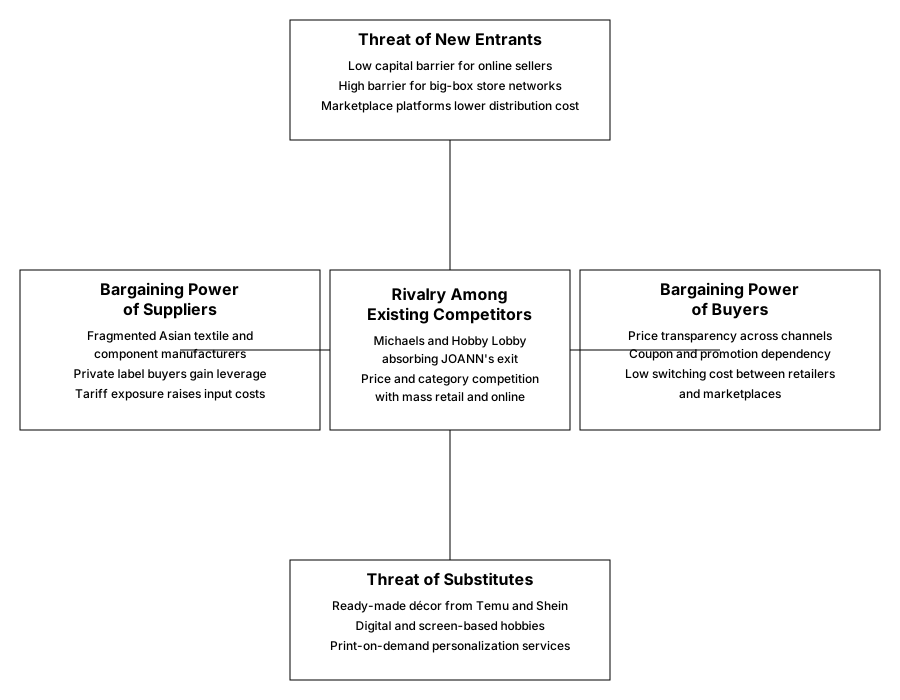
Porter's Five Forces framework clarifies why this industry rewards scale and private-label control more than it rewards broad category presence. Buyer power is elevated because switching between a craft retailer, a mass merchant and an online marketplace costs the consumer almost nothing and price comparison is instant. Supplier power is moderate and uneven, concentrated where niche natural materials or branded tools create scarcity, but generally weak given a fragmented global base of textile and paper manufacturers competing for retailer contracts. Rivalry has intensified sharply following JOANN's 2025 liquidation, which removed a national competitor and left Hobby Lobby and Michaels to fight over its customer base while both also face mass-merchant and marketplace competition. Entry barriers are bifurcated: trivially low for an online seller listing on Etsy, but high for anyone attempting to replicate a national store network and private-label supply chain. Substitute threats are rising fastest from ultra-low-cost platforms like Temu and Shein, which now sell finished décor and craft-adjacent goods at prices that undercut the raw-material-plus-labor cost of making the item at home.
Bargaining power of buyers
Craft retail buyers hold meaningful leverage because the category sells largely undifferentiated commodity inputs, cotton fabric, acrylic yarn, cardstock, where one retailer's product substitutes easily for another's. Price transparency across store, marketplace and mass-merchant channels lets shoppers compare a spool of ribbon or a bag of yarn in seconds and heavy reliance on coupons and loyalty promotions, a hallmark of the category since the days of forty-percent-off single-item coupons, has trained consumers to expect discounting as the default rather than the exception. This dynamic forces retailers to compete on promotional depth as much as on assortment, compressing achievable margin on commodity items even as it drives foot traffic. Buyers also increasingly split purchases across channels for the same project, buying fabric at a physical store for tactile inspection while buying notions or patterns online, which fragments any single retailer's share of wallet and makes customer retention harder to sustain purely through assortment breadth.
Where buyer power weakens is in project-specific or emotionally driven purchases, such as a wedding centerpiece kit, a memorial scrapbook, or a personalized gift, where the consumer values curation, instruction or brand trust enough to accept a price premium and reduce comparison shopping. Marketplace buyers on platforms like Etsy exhibit somewhat different behavior, valuing provenance and originality, which softens pure price competition but still leaves room for switching if a comparable handmade item appears from a different seller at a lower price.
| Buyer segment | Primary purchase driver | Price sensitivity |
|---|---|---|
| Everyday hobbyist restocking | Convenience and habit | High |
| Project or event-driven shopper | Curation and completeness | Moderate |
| Marketplace gift buyer | Originality and personalization | Moderate to low |
| Small-batch resale maker | Input cost control | High |
Bargaining power of suppliers
Suppliers to the arts and crafts industry are fragmented across thousands of textile mills, yarn spinners, paper converters and component manufacturers, the large majority based in China and other Asian manufacturing hubs, which limits any individual supplier's pricing leverage against large retail buyers2. Hobby Lobby and Michaels, buying at national scale for private-label programs, can negotiate favorable unit costs and shift order volume between suppliers with relative ease, which keeps most raw material categories closer to a buyer's market than a seller's market. This dynamic reverses for specialized inputs, such as branded sewing machines, proprietary adhesive formulations, or premium natural fiber yarns, where a smaller number of manufacturers hold genuine differentiation and can command better terms.
Trade policy has become the dominant swing factor in supplier leverage over the past two years. Tariff increases on Chinese textile and craft goods, combined with the elimination of the de minimis exemption for low-value imports starting in late 2025, have raised landed costs across the board and smaller retailers and independent marketplace sellers lack the scale to renegotiate supplier contracts the way Michaels or Hobby Lobby can3. This has effectively increased supplier bargaining power against smaller buyers even as it left large retailers' relative position largely intact, widening the cost gap between scaled and unscaled players.
| Supplier category | Concentration | Leverage trend |
|---|---|---|
| Commodity textile and yarn mills | Highly fragmented | Weakening |
| Paper and cardstock converters | Fragmented | Stable |
| Branded tool and machine manufacturers | Concentrated | Strengthening |
| Component and findings suppliers | Fragmented, tariff-exposed | Strengthening against small buyers |
Rivalry among existing competitors
Competitive intensity has risen sharply since JOANN, once a top-three national craft chain, filed for bankruptcy protection twice and liquidated all of its roughly 800 remaining stores by mid-2025, leaving Hobby Lobby and Michaels as the primary national physical retail competitors4. Both companies have absorbed meaningful customer migration, with survey data suggesting roughly three in four former JOANN shoppers redirected purchases to one of the two remaining chains and both have posted consistent year-over-year visit growth since the liquidation completed. This consolidation reduces the intensity of price-based rivalry between the two survivors somewhat, since fewer national competitors mean less need to match every promotional cycle, but it increases pressure on both to capture share quickly before consumer habits fully re-settle.
Rivalry extends beyond the two specialty leaders to mass merchants like Walmart and Target, which compete on convenience and price for everyday craft basics and to Amazon, which competes on selection and speed. Michaels' acquisition of JOANN's intellectual property and private-label brands after the liquidation signals that competitive advantage in this segment increasingly comes from owning recognizable in-house brands rather than simply having more shelf space and that scaled private-label development has become a primary battleground alongside store footprint and online fulfillment capability.
| Competitor type | Representative players | Primary basis of competition |
|---|---|---|
| National specialty craft chains | Michaels, Hobby Lobby | Private label, assortment breadth, promotions |
| Mass and general merchandise | Walmart, Target, Amazon | Price, convenience, adjacency to other shopping |
| Independent and regional shops | Local quilt, yarn and fabric stores | Expertise, community, curated niche assortment |
| Online handmade marketplaces | Etsy, Amazon Handmade | Originality, personalization, discovery |
Threat of new entrants
Entry economics diverge sharply depending on which layer of the industry a new competitor targets. Launching a craft-focused online store or marketplace storefront requires minimal upfront capital, since platforms like Etsy and Shopify handle payments, hosting and much of the discovery infrastructure, which explains the steady inflow of small independent sellers into the handmade and personalized goods niche. This low barrier at the marketplace-seller level keeps competitive pressure high on price and differentiation within any single product category, since a buyer can find dozens of near-identical listings within minutes.
Building a national physical retail competitor to Michaels or Hobby Lobby is a fundamentally different proposition, requiring real estate commitments across hundreds of markets, private-label manufacturing relationships built over years, warehousing and logistics infrastructure and enough purchasing scale to compete on price against two well-capitalized private incumbents. JOANN's own trajectory, from established national chain to full liquidation within roughly a year of its second bankruptcy filing, illustrates how quickly an undercapitalized or overleveraged entrant, even an established one, can be forced out once it falls behind on private-label economics and e-commerce investment. A new large-format entrant would also face the challenge of differentiating in a category where the two remaining leaders already have decades of customer trust and vendor relationships.
| Entry path | Capital requirement | Realistic barrier level |
|---|---|---|
| Marketplace seller or niche online brand | Low | Low |
| Category-specific direct-to-consumer brand | Moderate | Moderate |
| Regional multi-store retail chain | High | High |
| National big-box store network | Very high | Very high |
Threat of substitutes
The most consequential substitute threat now comes from ultra-low-cost cross-border e-commerce platforms such as Temu and Shein, which sell finished décor, apparel accessories and gift items at prices that frequently undercut the combined cost of raw materials and the shopper's own time to make the equivalent item at home5. This shifts the calculus for a meaningful share of would-be crafters, particularly younger consumers with less disposable time, away from the traditional buy-materials-and-make-it model toward simply buying the finished good, which structurally caps demand growth for basic materials even as demand for premium, personalized and instructional craft experiences continues to grow.
A second substitute vector comes from digital and screen-based leisure activities competing for the same discretionary time budget that crafting occupies, though this threat has proven less severe than many predicted, since crafting's tactile, screen-free appeal has if anything strengthened as a counter-reaction to digital fatigue. Print-on-demand and custom manufacturing services represent a third, more nuanced substitute, allowing consumers to design a personalized item digitally and have it manufactured and shipped without touching raw materials themselves, which substitutes for the crafting process while still monetizing the underlying demand for personalization that the traditional industry also serves.
| Substitute category | Consumer segment most affected | Structural threat level |
|---|---|---|
| Ultra-low-cost finished goods platforms | Price-sensitive, time-constrained buyers | High |
| Digital and screen-based leisure | Younger, discretionary-time-limited consumers | Moderate |
| Print-on-demand and custom manufacturing | Personalization-focused buyers | Moderate |
| Professional or service-based creation | Buyers valuing convenience over involvement | Low to moderate |
Value chain and profit pools
The arts and crafts value chain runs through five broad stages, beginning with upstream raw material production, encompassing raw fiber, paper pulp, plastic resin and pigment sourcing, largely commoditized and geographically concentrated in Asian manufacturing regions. The second stage, material conversion and finished-goods manufacturing, transforms raw inputs into sellable craft products such as spun yarn, printed cardstock, cut fabric bolts and packaged kits and is where private-label contract manufacturing has become an increasingly important sub-layer as retailers push to own more of their branded assortment. The third stage, wholesale distribution and logistics, moves finished goods from manufacturers to retail distribution centers or directly to marketplace sellers and has become more capital-intensive as omnichannel fulfillment requires faster, more granular shipping than traditional bulk pallet distribution. The fourth stage, customer interface, spans physical retail stores, e-commerce sites and online marketplaces and is where brand trust, curation and promotional strategy directly shape conversion and basket size. A fifth, increasingly important stage covers enabling infrastructure and demand generation, including instructional content, design software, pattern marketplaces and social media creators who effectively market the entire category by inspiring specific projects that then drive material purchases.
Profit pool
Profit concentrates most heavily in private-label product development and retail curation, where Hobby Lobby and Michaels earn superior margin on owned brands compared with third-party branded products carrying the same shelf space, because private label removes a layer of manufacturer margin and lets the retailer control both price and perceived exclusivity. This is the single clearest structural shift of the past decade:
retailers have moved from being passive distributors of manufacturer brands to active product developers and Michaels' post-liquidation acquisition of JOANN's private-label intellectual property reinforces that owning recognizable in-house brands, not simply stocking more square footage, is now the primary profit lever in physical retail
Marketplace intermediation is the second concentrated profit pool, where Etsy earns commission, payment processing and advertising revenue without carrying inventory risk, a structurally more attractive economic position than either manufacturing or physical retail, even though Etsy's own growth has recently stalled as competition from low-cost platforms intensifies6. Raw material manufacturing sits at the bottom of the profit pool, since fragmented Asian suppliers compete primarily on cost and lack the branding or customer relationship to command premium pricing, leaving this stage exposed to margin compression from both buyer concentration and tariff volatility. Independent and regional retail, while often profitable at the individual store level, generally lacks the purchasing scale to match national chains' private-label cost advantage, which structurally caps how much profit that segment can generate relative to its revenue base.
Industry economics and business models
Three business models dominate the category. The first, asset-heavy specialty retail, exemplified by Hobby Lobby and Michaels, combines owned or leased real estate, large seasonal inventory positions and private-label manufacturing partnerships, generating revenue through markup on both branded and owned-label merchandise, with promotional and clearance pricing used aggressively to manage seasonal inventory turnover. This model rewards scale because fixed real estate and distribution costs spread across more stores and higher same-store sales and it is capital-intensive enough that private ownership, as both leading chains maintain, provides a strategic advantage by removing quarterly earnings pressure that might otherwise force short-term promotional decisions at the expense of long-term private-label investment7.
The second model, the two-sided marketplace, exemplified by Etsy, is comparatively asset-light, monetizing through listing fees, transaction commissions and seller advertising rather than owning inventory, which produces structurally higher gross margin but exposes revenue to marketplace-wide GMS growth rather than any single retailer's execution. The third model, contract and private-label manufacturing, sells primarily business-to-business into the large retail chains and marketplace sellers, earning thinner unit margin but benefiting from predictable, large-volume orders once a manufacturer secures a private-label relationship with a national retailer. A smaller but growing fourth pattern, direct-to-consumer craft kit and subscription models, bundles materials with instructional content and charges a premium for curation and convenience, monetizing time-starved hobbyists willing to pay for a finished project experience rather than assembling materials themselves.
Cost drivers and scalability
Physical retail cost structure is dominated by fixed costs in real estate leases, store labor and seasonal inventory carrying cost, meaning profitability is highly sensitive to same-store sales volume and inventory turnover discipline; a store operating below its breakeven traffic threshold destroys value quickly given the fixed nature of rent and base staffing. Scale economies are meaningful here because national purchasing volume lowers unit cost on both branded and private-label goods and because distribution center density improves inventory turns and reduces markdown risk from seasonal overstock, giving Hobby Lobby and Michaels a durable cost advantage over independent and regional competitors.
Marketplace economics follow a different logic closer to digital platform businesses, where the marginal cost of adding another seller listing or transaction is near zero and profitability scales with GMS growth relative to largely fixed platform, engineering and trust-and-safety costs. Customer acquisition cost has become a growing pressure point for marketplaces as paid search and social advertising costs rise, making organic discovery, repeat purchase rate and seller-driven marketing increasingly important to sustaining favorable unit economics. Across the industry, seasonal demand concentration around holidays, back-to-school and event seasons creates a structural underutilization problem in slower months, which retailers manage through markdown cycles, category diversification into everyday décor and increasingly through class and workshop programming designed to smooth footfall across the calendar rather than concentrating it entirely around peak seasons.
Moats, advantages and strategic levers
The strongest moat in this industry is cost advantage built through private-label scale, since a retailer that can develop, source and price its own branded materials at volumes independent shops and mid-size chains cannot match effectively locks in a structural margin gap that promotional competition alone cannot close. A second durable advantage is real estate and distribution density, since the fixed cost of a well-located national store network, once built, is extremely expensive for a challenger to replicate, which is precisely why JOANN's failure removed a competitor permanently rather than simply weakening it temporarily. Switching costs for individual consumers are low, but switching costs for marketplace sellers who have built reputation, reviews and search ranking on a specific platform like Etsy are meaningfully higher, creating a mild network effect that favors incumbency once a marketplace reaches sufficient buyer density.
Data and learning advantages are emerging as a newer moat category, particularly for marketplaces that use purchase and search behavior to refine product recommendations and seller matching and for large retailers that use loyalty program data to time promotions and manage private-label assortment more precisely than smaller competitors can. Brand trust built through decades of community presence, particularly for Hobby Lobby's values-oriented positioning and Michaels' craft-education programming, functions as a softer but still meaningful differentiation lever that protects against pure price competition from mass merchants and low-cost import platforms.
Strategic levers
Executives operating in or entering this industry have several concrete levers available. Customer segment focus, choosing between broad hobbyist coverage and deep specialization in a single category such as quilting, fine art or personalized gifting, determines whether a competitor plays a scale game or a curation game and mid-size players attempting to straddle both, as JOANN did, face the greatest strategic risk. Vertical integration into private-label manufacturing, rather than relying purely on third-party branded merchandise, is now close to table stakes for any retailer above a minimum scale threshold, since the margin gap between owned and third-party brand has become too large to ignore.
Geographic and channel expansion remains relevant but must now weigh physical footprint against online and marketplace investment rather than defaulting to more stores, given that both surviving national chains have shown online growth outpacing physical store growth. Ecosystem orchestration, building instructional content, classes and community programming around a retail or marketplace presence, has become an important demand-generation lever that extends customer lifetime value beyond a single transactional purchase. Finally, supply chain diversification away from single-country tariff exposure is no longer optional risk management but a direct margin lever, since retailers who diversified sourcing ahead of recent tariff increases protected gross margin more effectively than those who did not.
Structural risks, regulation and trends
Trade policy represents the most immediate structural risk facing the industry, since the overwhelming majority of craft material inputs originate in China and other tariff-exposed manufacturing regions and both the general tariff escalation of the past two years and the elimination of the de minimis import exemption have raised landed costs for retailers and independent sellers alike8. Regulatory risk beyond trade policy is comparatively modest, limited mainly to product safety standards for children's craft kits and flammability requirements for certain textile products, though these remain a meaningful compliance cost for manufacturers and private-label developers.
Technology disruption is reshaping demand generation and discovery more than it is reshaping the physical product itself, with AI-assisted design tools, algorithmic marketplace search and short-form video content increasingly determining which projects and products gain traction, shifting competitive advantage toward digital marketing sophistication. Secular demand drivers remain broadly favorable, supported by continued interest in home-based hobbies, personalization as a gifting and self-expression trend and a generational rediscovery of tactile crafting as a counterbalance to screen-heavy leisure time, though this demand increasingly competes with finished-goods substitutes from low-cost import platforms that erode the traditional buy-and-make model.
For entrants, the more defensible strategy is niche depth rather than broad category coverage, building a marketplace-native brand or direct-to-consumer offering around a specific craft community where curation and content can substitute for the scale a new entrant cannot match against Michaels or Hobby Lobby. A partner-first approach, selling through Etsy or Amazon rather than building proprietary distribution, reduces capital risk substantially and is the more sensible default for the large majority of new entrants given how steep the barrier to national physical retail has become. Regulatory strategy for entrants is comparatively low-stakes but should still include early attention to product safety certification if targeting children's craft categories, since compliance failures can trigger costly recalls disproportionate to a small company's revenue base.
For incumbents, the playbook centers on defending private-label margin through continued sourcing diversification, expanding digital and marketplace presence to capture the growing share of craft spending that has moved online and deepening moats through loyalty data, community programming and category curation that mass merchants and low-cost import platforms cannot easily replicate. The clearest strategic risk for an incumbent is repeating JOANN's trajectory, allowing e-commerce investment to lag physical footprint while private-label development stalls, a combination that proved fatal even for an established national chain.
Caselet: Michaels absorbs the JOANN exit
Michaels Companies, founded in 1973 and headquartered in Irving, Texas, has spent five decades building the largest specialty arts and crafts retail network in North America, operating more than 1,250 stores across the United States and Canada. The company has moved through several ownership structures, including a period as a publicly traded company and, more recently, private equity ownership, which has allowed it to make longer-horizon capital decisions around store format, private-label development and e-commerce infrastructure without the quarterly earnings pressure that constrains many public retailers.
Strategic positioning before the JOANN collapse
Heading into 2025, Michaels already competed directly with JOANN and Hobby Lobby across fabric, yarn, paper craft and seasonal décor, differentiating primarily through a broader private-label portfolio and stronger digital fulfillment capability than JOANN had managed to build. Michaels had invested steadily in omnichannel infrastructure, including buy-online-pickup-in-store functionality and a growing e-commerce assortment, positioning the company to capture share if a competitor faltered, which is precisely what unfolded when JOANN entered its second bankruptcy filing in as many years.
Capturing the JOANN customer base
When JOANN began liquidating its roughly 800 remaining stores in early 2025, closing the last locations by the end of May, Michaels moved quickly on two fronts. First, it captured a substantial share of displaced foot traffic, with visit data showing consistent year-over-year growth at Michaels locations following JOANN's closures, consistent with survey findings that a large majority of former JOANN shoppers redirected spending to Michaels or Hobby Lobby. Second and more strategically significant, Michaels acquired JOANN's intellectual property and private-label brand portfolio, allowing it to absorb recognizable JOANN-associated product lines directly into its own assortment rather than simply hoping displaced customers would default to its existing private-label offering.
Operational lessons from the transition
Michaels' response illustrates several dynamics core to this industry's economics. The company's private ownership structure allowed it to move decisively on the intellectual property acquisition without needing board or shareholder approval cycles that might have slowed a public competitor's response. Its pre-existing investment in digital fulfillment meant it could absorb online demand overflow from JOANN's closure immediately, rather than needing to build that capability reactively. And its scale meant it could negotiate favorable terms with suppliers left searching for replacement volume after losing JOANN as a customer, reinforcing the buyer-side leverage that scaled retailers hold over a fragmented manufacturing base.
Outlook and remaining questions
Michaels now faces the more difficult second phase of this transition: converting a one-time traffic surge into durable customer retention, particularly since Hobby Lobby captured a comparable share of JOANN's displaced customers and the two chains will increasingly compete directly for the same expanded customer base rather than coexisting alongside a third national player. The company's next strategic test is whether its private-label integration of JOANN's acquired brands can convert short-term market share gains into the kind of long-term private-label margin advantage that defines profitability leadership in this industry, or whether the gains prove temporary as displaced customers eventually redistribute across Michaels, Hobby Lobby, mass merchants and online marketplaces based on longer-term price and assortment preferences rather than simple proximity to a closed store.
Arts and crafts monetizes discretionary time as much as material need, converting hobby engagement into repeat basket purchases across fabric, yarn, paper craft and seasonal décor. Economics favor scaled retailers that control private-label sourcing and real estate and platforms like Etsy that aggregate long-tail handmade supply without holding inventory. JOANN's 2025 exit concentrated brick-and-mortar power in Hobby Lobby and Michaels, both privately held, which insulates strategy from quarterly capital markets pressure but also limits public benchmarking. The durable levers are supply chain control against tariff volatility, category curation that beats commodity substitutes from Temu and Shein and community-driven demand generation through classes, content and marketplace discovery that keeps hobbyists returning rather than lapsing after a single project.
Citation
Cite this article
Sridharan, M. A. (2023, March 30). Industry Analysis: Arts and Crafts. Think Insights. https://thinkinsights.net/strategy/industry-analysis-arts-and-crafts (Accessed [[ACCESS_DATE]])
Sridharan, Mithun A. "Industry Analysis: Arts and Crafts." Think Insights, 30 Mar. 2023, https://thinkinsights.net/strategy/industry-analysis-arts-and-crafts. Accessed [[ACCESS_DATE]].
Mithun A. Sridharan, "Industry Analysis: Arts and Crafts," Think Insights, March 30, 2023, https://thinkinsights.net/strategy/industry-analysis-arts-and-crafts. Accessed [[ACCESS_DATE]].
Sridharan, M.A. (2023) 'Industry Analysis: Arts and Crafts', Think Insights. Available at: https://thinkinsights.net/strategy/industry-analysis-arts-and-crafts (Accessed: [[ACCESS_DATE]]).
M. A. Sridharan, "Industry Analysis: Arts and Crafts," Think Insights, 2023. [Online]. Available: https://thinkinsights.net/strategy/industry-analysis-arts-and-crafts. [Accessed: [[ACCESS_DATE]]].
Sridharan MA. Industry Analysis: Arts and Crafts. Think Insights. Published March 30, 2023. Accessed [[ACCESS_DATE]]. https://thinkinsights.net/strategy/industry-analysis-arts-and-crafts
Test Your Knowledge
Industry Analysis: Arts and Crafts
Challenge yourself on the concepts from this article and see how well you understood them.
Subscribers get weekly quizzes and insights — subscribe free
Sponsor this article
Partner with Think Insights
Reach 50,000+ business leaders, consultants, and strategists. Feature your brand alongside expert articles on strategy, leadership, and digital transformation.
Become a Sponsor