Industry Analysis: Aquaculture


Farmed fish, shrimp and shellfish now supply more than half the seafood people eat and the industry crossed 100 million tonnes of output in 2024, worth roughly 371 billion dollars at the farm gate. Growth is fastest in shrimp, tilapia and Atlantic salmon and demand keeps climbing as wild catch stays flat. Margin does not sit with pond-level growers, who absorb feed, disease and weather risk for thin returns. It sits with feed formulators, genetics and hatchery suppliers and vertically integrated processors who control the chain from egg to plate. Bargaining power is shifting toward large retail and food-service buyers who dictate certification standards and toward the handful of feed and genetics firms whose inputs no farm can substitute away from. Executives evaluating this sector should target the feed-genetics-processing chokepoints or the retail-facing branded layer, not commodity grow-out and should treat biosecurity and traceability as the entry ticket rather than a differentiator.
Is aquaculture attractive for new entrants?
Attractiveness depends heavily on where in the chain an entrant plays. Commodity grow-out of shrimp or tilapia carries low entry barriers in emerging markets but delivers thin, volatile returns exposed to disease and price swings. Feed formulation, genetics and branded processing carry far higher entry barriers, capital intensity and regulatory complexity, but reward entrants with pricing power and recurring revenue. A new entrant with differentiated genetics, a novel feed ingredient or a recirculating aquaculture system [RAS] platform targeting premium urban markets has a more credible path than one entering open grow-out.
Which parts of the value chain are most profitable?
Feed formulation and genetics consistently earn the highest margins because they combine scientific intellectual property with recurring, non-substitutable demand from every farm downstream. Branded, value-added processing that reaches retail and food service captures the next tier of margin through differentiation and shelf placement. Grow-out, the pond or net-pen stage, earns the thinnest and most volatile margin because it is commoditized and directly exposed to biological and weather risk.
How is technology changing this industry?
Genomic selection is compressing growth cycles and improving disease resistance in salmon and shrimp broodstock. Recirculating aquaculture systems and offshore submersible pens are decoupling production from fragile coastal ecosystems and enabling farming closer to consumption centers. Sensor-based water quality monitoring, computer vision for feeding optimization and blockchain-based traceability are becoming standard requirements from large retail buyers rather than optional upgrades.
What capabilities are table stakes vs differentiators?
Basic biosecurity protocols, feed conversion efficiency near industry benchmarks and certification against standards such as the Aquaculture Stewardship Council are now table stakes for any serious commercial operation. Differentiators include proprietary genetics with demonstrated growth and disease-resistance advantages, vertically integrated cold chains that preserve freshness to end markets and site or technology platforms, such as offshore or RAS, that reduce exposure to sea lice, algal blooms and coastal conflict.
How should investors or consultants evaluate opportunities here?
Investors should weight biological risk, regulatory permitting timelines and feed-cost exposure as heavily as they weight demand growth, because a single disease outbreak or algal bloom can erase a year of earnings. The strongest opportunities sit where a company controls a chokepoint, genetics, feed formulation, or branded distribution, rather than owning undifferentiated grow-out capacity. Consultants advising incumbents should focus engagements on cost-of-production benchmarking, disease and biosecurity systems and channel strategy toward retail and food-service buyers who increasingly dictate specification and price.
What is the difference between aquaculture and commercial fishing?
Aquaculture is the farming of aquatic animals and plants under controlled conditions, from hatchery through harvest, giving producers control over genetics, feed and stocking density. Commercial fishing harvests wild populations from oceans, rivers and lakes, a supply that is capped by natural biomass and increasingly constrained by quotas. The two sectors sell into overlapping seafood markets but operate under entirely different cost structures, risk profiles and regulatory regimes.
Why has shrimp farming grown so much faster than salmon farming?
Shrimp farming benefits from lower capital intensity, warmer-water geography spread across many developing economies and shorter production cycles that let farmers turn over capital faster than salmon, which needs cold water and multi-year grow cycles. Ecuador, India, Vietnam and Indonesia have expanded shrimp pond capacity rapidly because land and coastal access costs are lower than the licensed marine sites salmon farming requires. Salmon farming remains concentrated in a small number of cold-water countries, which caps its volume growth even as its per-tonne value stays high.
What role does genetics play in competitive advantage?
Selective breeding programs that improve growth rate, feed conversion and disease resistance compound over generations, giving early movers a widening biological advantage that competitors cannot copy quickly. Companies that control proprietary broodstock lines effectively sell an annuity, because every farm using their genetics must keep buying eggs or juveniles each cycle. This makes genetics one of the few durable moats in an otherwise commoditized farming business.
How exposed is the industry to disease and environmental shocks?
Heavily exposed. Sea lice infestations, early mortality syndrome in shrimp, harmful algal blooms and rising water temperatures have each wiped out significant regional production in individual years. Operators respond by diversifying sites across geographies, investing in vaccines and functional feeds and increasingly shifting toward closed or semi-closed systems that limit contact with open water pathogens.
Where is regulation likely to tighten next?
Regulators in Europe and North America are moving toward stricter limits on net-pen siting, effluent discharge and antibiotic use, favoring operators who can demonstrate low environmental footprint or who shift toward land-based and offshore systems. Traceability and labeling requirements are also tightening as retailers respond to consumer demand for verified sourcing, raising compliance costs but also raising barriers that favor larger, better-capitalized incumbents.
Aquaculture has quietly become the primary engine of global seafood supply, overtaking wild capture fisheries in volume for the first time in 2022 and continuing to widen that lead every year since. It sits at the intersection of agriculture, biotechnology and food manufacturing and it increasingly behaves like each of those industries at different points in its value chain: a commodity input business at the feed stage, a biotech-driven genetics business at the hatchery stage and a branded consumer goods business at the retail stage. Understanding where value concentrates within that chain and why bargaining power keeps drifting toward a small set of players, is the central task for any executive assessing this sector.
Industry at a glance
Aquaculture is the farming of finfish, crustaceans, mollusks and aquatic plants under controlled or semi-controlled conditions, spanning freshwater ponds, coastal net pens, offshore cages and increasingly land-based tanks. The scope explicitly includes hatcheries that produce juveniles, feed mills that formulate diets and processing operations that convert live or fresh harvest into packaged product, but it excludes wild-capture fishing, even though the two industries share distribution channels, retail shelf space and, in the case of fishmeal, a supply relationship. The global industry crossed 100 million tonnes of aquatic animal output in 2024 for the first time, valued at roughly 371 billion dollars at the farm gate, with China, Indonesia, India, Vietnam, Bangladesh, the Philippines, South Korea, Norway, Egypt and Chile together producing close to 90% of global supply.1
The customer base spans three distinct layers. At the farm gate, customers are almost entirely business-to-business (B2B), meaning processors, feed companies and export traders. Downstream, the industry sells into business-to-consumer (B2C) channels through retail seafood counters, frozen aisles and restaurant menus and into business-to-government (B2G) channels where public procurement, school feeding programs and food security stockpiling matter in several Asian and African markets. Aquaculture is heavily dependent on adjacent sectors for its cost base:
on agricultural commodity markets for soy, corn and fishmeal that go into feed, on the pharmaceutical industry for vaccines and antiparasitics and on cold-chain logistics infrastructure that determines how far fresh product can travel before quality degrades
The industry's economics are capital-intensive at the production end and comparatively asset-light at the trading and distribution end. Farm-level capital expenditure covers pond construction, net-pen infrastructure, hatchery facilities and increasingly RAS tanks, with payback periods that stretch across multiple production cycles given biological growth constraints that cannot be compressed by spending more money. Regulatory intensity is high and rising, covering site licensing, effluent discharge, animal health, food safety and increasingly environmental impact assessments tied to coastal zoning. Labor intensity varies sharply by segment:
shrimp and tilapia grow-out in Asia remains labor-heavy, while automated salmon farming and modern RAS facilities are shifting toward capital and technology substitution for labor
Industry segmentation
The industry breaks into segments along both species type and value chain position and the two dimensions interact in ways that shape competitive dynamics differently across each combination. Finfish farming, dominated by salmon, trout, tilapia and carp, represents the largest volume category and spans the widest range of production intensity, from extensive pond systems in Southeast Asia to highly automated marine net-pen operations in Norway and Chile. Crustacean farming, overwhelmingly shrimp, is the fastest-growing major segment by value, driven by strong export demand from Ecuador, India, Vietnam and Indonesia into United States and European Union [EU] markets.
Mollusk farming, covering oysters, mussels, clams and scallops, occupies a distinct economic niche because these species filter-feed on naturally occurring plankton rather than requiring formulated feed, which keeps input costs low but also limits the pace at which production can scale beyond what a coastal ecosystem can support. Seaweed and algae cultivation, concentrated in China, Indonesia and South Korea, is smaller in dollar value but growing quickly as demand rises for food, hydrocolloid and biostimulant applications.
Layered on top of species segmentation is a value chain segmentation that matters more for strategy than species choice alone. Input supply, covering feed, genetics and hatchery juveniles, is a distinct competitive arena from grow-out, which is itself distinct from processing and cold-chain distribution. A company's competitive position depends far more on which of these value chain layers it occupies than on which species it farms, because the economics of feed formulation look similar whether the feed goes to salmon or shrimp, while the economics of grow-out are brutally specific to each species' biology, disease exposure and regulatory environment.
Market structure
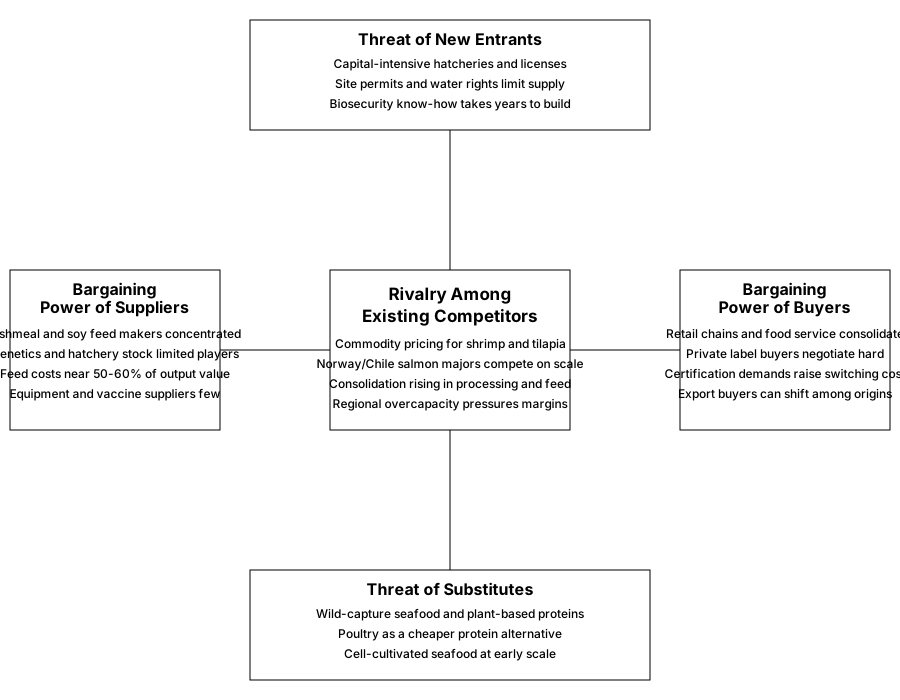
Porter's Five Forces framework clarifies why margin in this industry concentrates upstream and downstream of the farm rather than at the farm itself. Grow-out operations face intense rivalry, powerful buyers and powerful suppliers simultaneously, a genuinely difficult competitive position, while genetics, feed and branded processing each enjoy at least one structural advantage that grow-out lacks. The overall picture is one of a fragmented, low-barrier core surrounded by a handful of consolidated, high-barrier chokepoints.
Bargaining power of buyers
Buyer power in aquaculture is concentrated and rising, driven by consolidation among the retail chains, food-service distributors and export traders that stand between farms and end consumers. A small number of global retailers and food-service groups now account for a large share of purchases in mature markets such as the United States and the EU, giving them leverage to negotiate price, dictate certification requirements and demand traceability documentation that raises compliance costs for suppliers. Farmers and even mid-sized processors typically cannot pass through cost increases quickly, because buyers can shift sourcing across countries of origin when price or quality moves against them, particularly for commodity species like shrimp and tilapia where product is largely interchangeable.
Species with stronger brand identity, such as Norwegian or Scottish salmon, or with geographic indication protections, give producers somewhat more leverage because buyers cannot substitute origin as easily without disappointing end consumers. Even so, large grocery chains increasingly run private-label seafood programs that squeeze branded premiums and food-service buyers negotiate multi-year contracts that lock in price well below spot market peaks. The direction of travel favors buyers further, as retail consolidation continues and as sustainability certification becomes a purchasing prerequisite that adds cost without necessarily adding negotiating power for the supplier providing it.
| Buyer type | Source of leverage | Constraint on producers |
|---|---|---|
| Global retail chains | Purchase volume and private label | Price and certification dictated |
| Food-service distributors | Multi-year contract structure | Locked pricing below spot peaks |
| Export commodity traders | Multiple origin countries available | Easy substitution across suppliers |
| Branded premium buyers | Willingness to pay for provenance | Limited to differentiated species |
Bargaining power of suppliers
Supplier power is high and arguably the most structurally durable force in the industry, because feed, genetics and juvenile stock are inputs that no commercial farm can meaningfully substitute away from. Feed alone represents roughly 50% to 60% of total production cost in most farmed species and the global feed market is dominated by a handful of large formulators with proprietary nutritional science, scale purchasing of fishmeal, fish oil and plant protein and long-standing customer relationships that create switching friction.2 Genetics suppliers occupy an even narrower competitive field in salmon and shrimp, where a small number of breeding companies control broodstock lines refined over decades of selective breeding for growth rate and disease resistance, effectively selling farmers a recurring input they cannot replicate independently.
Fishmeal and fish oil supply, sourced substantially from wild-capture reduction fisheries off Peru and Chile, adds a further layer of supplier concentration and price volatility tied to factors entirely outside any farmer's control, including El Nino weather cycles that periodically collapse anchovy catches. Equipment suppliers for net pens, RAS systems and processing lines are similarly concentrated among a handful of specialized manufacturers. The net effect is that farm-level operators sit between powerful suppliers on one side and powerful buyers on the other, which explains why grow-out margins stay structurally thin even when end consumer demand is strong.
| Supplier category | Concentration level | Cost or dependency impact |
|---|---|---|
| Feed formulators | High, few global scale players | 50-60% of production cost |
| Genetics and broodstock | Very high, narrow field per species | Recurring, non-substitutable input |
| Fishmeal and fish oil sources | High, tied to reduction fisheries | Volatile, weather-dependent pricing |
| Equipment and RAS technology | Moderate to high | Capital lock-in once installed |
Rivalry among existing competitors
Rivalry varies sharply by species and geography, but the overall pattern is one of commodity price competition at the grow-out level and consolidating scale competition at the processing and feed level. Shrimp and tilapia farming remain highly fragmented globally, with thousands of independent producers across Asia and Latin America competing largely on cost, which keeps prices tethered closely to production economics and vulnerable to oversupply cycles when favorable weather or disease-free seasons encourage broad expansion. Salmon farming operates under a different dynamic, concentrated among a smaller set of large, vertically integrated Norwegian, Chilean, Scottish and Canadian companies that compete more on operational efficiency, site access and biological performance than on raw price.
Consolidation is accelerating in feed and processing, where scale economies in formulation science and cold-chain infrastructure reward larger players, while grow-out capacity keeps adding new entrants in emerging markets whenever export prices spike. Regional overcapacity has repeatedly compressed margins in shrimp farming, most visibly when Ecuador's rapid expansion pressured prices for Asian producers competing in the same export markets. Disease outbreaks periodically reset competitive positioning entirely, since a single early mortality syndrome or infectious salmon anemia event can remove a meaningful share of regional supply within a season, temporarily easing rivalry before recovery investment reignites it.
| Competitive dynamic | Segment most affected | Typical outcome |
|---|---|---|
| Commodity price competition | Shrimp and tilapia grow-out | Thin, cyclical margins |
| Scale-driven consolidation | Feed and processing | Rising concentration ratios |
| Regional overcapacity | Shrimp export markets | Periodic price collapses |
| Disease-driven supply shocks | Salmon and shrimp alike | Temporary price spikes |
Threat of new entrants
Entry barriers differ enormously depending on where in the value chain a prospective entrant targets, which is one of the most important nuances for anyone assessing this industry. Grow-out entry in shrimp or tilapia farming in emerging markets carries relatively modest capital requirements and light regulatory friction in some jurisdictions, which is exactly why these segments stay fragmented and price-competitive. Entry into salmon farming or any marine net-pen operation is far harder, requiring scarce coastal site licenses, multi-year environmental permitting and capital commitments that can run into hundreds of millions of dollars before first harvest.
Entry into feed formulation or genetics is harder still, requiring proprietary nutritional and breeding science accumulated over years, together with the scale purchasing relationships needed to source fishmeal, soy and specialty ingredients competitively. Newer entry paths are opening through RAS and offshore technology platforms, which sidestep coastal site scarcity but substitute a different barrier, namely high capital intensity and unproven operating economics at commercial scale. Overall, the threat of new entrants is asymmetric:
high in commodity grow-out, low in the upstream and downstream chokepoints that actually capture durable margin
| Entry path | Capital and regulatory barrier | Relative attractiveness |
|---|---|---|
| Commodity pond or cage grow-out | Low to moderate | High entrant volume, thin returns |
| Marine net-pen licensed farming | High, scarce site permits | Restricted to well-capitalized players |
| RAS or offshore platform | Very high capital, unproven economics | Emerging, technology-dependent |
| Feed or genetics formulation | High scientific and scale barrier | Rare, defensible entry |
Threat of substitutes
Substitution pressure comes from three directions: other animal proteins, plant-based alternatives and increasingly early-stage cell-cultivated seafood. Poultry remains the most significant substitute on a cost basis in price-sensitive markets, since chicken production has lower feed conversion costs and a shorter, less biologically risky production cycle than most farmed fish species, giving it a persistent price advantage that farmed seafood struggles to match outside premium categories. Wild-capture seafood competes directly with farmed product on the same retail shelf and restaurant menu and in species like shrimp and salmon, consumers frequently treat wild and farmed as interchangeable, particularly when wild supply is abundant in a given season.
Plant-based seafood alternatives remain a small share of the market but are growing in select urban, health-conscious segments, while cell-cultivated seafood remains commercially immature, constrained by production cost and regulatory approval pathways that have moved slowly relative to cultivated meat more broadly. The most credible substitution threat over the medium term is less about a wholesale shift away from seafood and more about intra-category substitution, where consumers trade down from higher-value farmed species like salmon toward lower-cost farmed species like tilapia or pangasius during periods of economic pressure, a dynamic that compresses value even without losing volume.
| Substitute category | Competitive basis | Near-term threat level |
|---|---|---|
| Poultry and other land animal protein | Lower cost, shorter cycle | High in price-sensitive segments |
| Wild-capture seafood | Perceived quality parity | Moderate, season-dependent |
| Plant-based seafood alternatives | Health and sustainability positioning | Low but growing |
| Cell-cultivated seafood | Novel production technology | Low, early commercial stage |
Value chain and profit pools
The aquaculture value chain runs through six distinct stages, each with its own cost structure, competitive intensity and capital profile. Upstream genetics and hatchery operations produce broodstock and juveniles, applying selective breeding programs that compound advantages in growth rate, feed conversion and disease resistance across successive generations. Feed manufacturing sits alongside genetics as a second upstream chokepoint, formulating diets that blend fishmeal, fish oil, soy, corn and increasingly insect or algae-based proteins to hit precise nutritional targets for each species and life stage.
Grow-out, the farming stage itself, converts juveniles and feed into market-weight animals across ponds, net pens, cages or tanks and is where the industry's biological risk concentrates most heavily, since disease, water quality, weather and predation all strike at this stage. Processing transforms live or fresh harvest into filleted, packaged or value-added product, a stage that increasingly captures margin as consumers shift toward convenience formats like pre-portioned fillets and ready meals rather than whole fish. Distribution and cold-chain logistics move product from processing facilities to export markets or domestic retail, requiring temperature-controlled transport that adds cost but also creates a barrier that protects incumbents with established logistics networks.
Distribution and retail interface, covering the wholesalers, retail chains and food-service operators who reach the end consumer, captures value through brand positioning, private label programs and control over shelf space. Enabling infrastructure, spanning veterinary services, water treatment technology, certification bodies and financing, supports every stage above without directly touching the product, but increasingly determines which operators can compete at all given the growing weight of certification and traceability requirements demanded by large buyers.
Profit pool
Margin in aquaculture concentrates disproportionately at the two ends of the value chain, upstream genetics and feed and downstream branded processing and distribution, while the grow-out stage in the middle absorbs the bulk of the industry's biological and financial risk for comparatively thin reward. This pattern has intensified over the past decade as feed and genetics companies have consolidated globally, gaining pricing power over increasingly fragmented and commoditized grow-out operations, particularly in shrimp and tilapia farming across Asia and Latin America.
Salmon farming stands somewhat apart because the largest players, companies such as Mowi, are vertically integrated across feed, farming and sales, which lets them internalize the margin that would otherwise flow to an external feed supplier and capture value at multiple stages simultaneously rather than being squeezed by an upstream supplier they do not control.3 The shift toward this integrated model is itself a signal of where the industry believes durable margin sits: not in owning more grow-out capacity, but in owning the chokepoints that grow-out cannot function without. Processing and branded distribution have also gained share of profit pool as retail buyers pay premiums for traceability, convenience formats and sustainability certification, rewarding processors who can document their supply chain over those who simply sell into commodity export channels.
Industry economics and business models
Four business model patterns dominate the sector, each suited to a different position in the value chain and a different risk appetite. The first is asset-heavy vertical integration, exemplified by large salmon farming groups that own hatcheries, feed mills, farming sites and processing facilities simultaneously, internalizing margin across stages at the cost of enormous capital commitment and direct exposure to biological risk at every link in the chain they control. The second is asset-light input supply, where feed and genetics companies sell recurring, high-margin inputs to a fragmented base of independent farmers without ever taking on grow-out risk themselves, a model that resembles a razor-and-blade economics structure where the farm is locked into repeat purchases each production cycle.
The third model is contract or toll farming, common in shrimp and increasingly emerging in RAS-based operations, where a farm produces under contract for a processor or buyer who supplies juveniles or feed and guarantees offtake at a pre-agreed price, shifting price risk away from the farmer in exchange for giving up upside. The fourth model is commodity export trading, where independent grow-out operations sell into spot or short-contract export markets without vertical integration, capturing the full upside of favorable price cycles but bearing complete exposure to disease, weather and price collapse without any hedge. Most large, durable industry players blend elements of the first two models, owning genetics and feed capability while contracting out some grow-out capacity to spread biological risk across a wider geographic base than a single company's own farms could achieve alone.
Cost drivers and scalability
Feed dominates the cost structure of nearly every farmed species, typically representing 50% to 60% of total production cost, which makes feed conversion ratio, the amount of feed required per unit of body weight gained, the single most important operating metric across the industry. A feed conversion ratio near 1.2 for well-managed operations, meaning 1.2 kilograms of feed produces one kilogram of body mass, separates efficient operators from marginal ones and even small improvements compound significantly across large production volumes.4 Beyond feed, labor, site leases or licenses, juvenile stock, energy and, for RAS operations specifically, water treatment and electricity represent the next largest cost categories, with electricity alone sometimes reaching 40% of revenue in early-stage RAS operations before scale efficiencies kick in.
Economies of scale operate differently across value chain stages. Feed manufacturing benefits enormously from scale, since formulation research, ingredient purchasing leverage and manufacturing throughput all improve with volume, which is why the feed segment has consolidated fastest. Grow-out scale economies are more limited and site-specific, because biological carrying capacity of a given pond, cage or tank caps how much a single site can produce regardless of capital invested, forcing growth through additional sites rather than expansion of existing ones. This structural ceiling on per-site scale is precisely why grow-out stays fragmented even as feed and processing consolidate. RAS technology partially breaks this pattern by allowing higher stocking densities and better environmental control, improving feed efficiency and enabling year-round production independent of ambient water temperature, though at meaningfully higher fixed capital and energy cost than open systems.
Moats, advantages and strategic levers
The most durable competitive advantage in aquaculture is proprietary genetics, because selective breeding gains compound across generations and cannot be replicated quickly by a competitor starting from a different broodstock base. A company controlling superior genetics effectively sells an annuity to every farm that adopts its stock, since farmers must keep purchasing eggs or juveniles each cycle rather than being able to breed comparable performance internally. Feed formulation science provides a related but distinct moat, built on accumulated nutritional research and ingredient sourcing relationships that a new entrant cannot assemble quickly, particularly for specialty functional feeds that improve disease resistance or reduce environmental impact.
Site access represents a regulatory moat specific to marine and coastal farming, since licensed net-pen locations are finite, environmentally constrained and often subject to political opposition that makes new permits increasingly difficult to obtain in mature markets like Norway, Scotland and British Columbia. This scarcity protects incumbent site holders from new entrant competition regardless of how much capital a challenger raises. Vertical integration itself functions as a strategic lever rather than a pure cost advantage, because it lets a company smooth earnings across a business cycle:
when feed costs spike, an integrated player captures that margin internally rather than paying it away and when grow-out margins compress, feed and processing earnings partially offset the loss
The companies that have thrived longest in this industry are the ones that stopped thinking of themselves as farmers and started thinking of themselves as integrated protein manufacturers
Certification and traceability increasingly function as a moat for larger, better-capitalized operators, since the cost of maintaining Aquaculture Stewardship Council or similar certification, along with the documentation systems large retail buyers now require, is easier to absorb at scale than for a small independent farm, effectively raising the bar for credible participation in premium export channels.
Strategic levers
Executives assessing entry or expansion in this industry have five levers available and the right combination depends heavily on starting position and risk appetite. Vertical integration versus partnering is the most consequential choice: integrating across genetics, feed, farming and processing internalizes margin and smooths cyclicality but requires enormous capital and management complexity, while partnering or contract farming lets a company scale faster with less capital at the cost of giving up margin to whichever partner controls the chokepoint stages. Geographic diversification spreads disease and regulatory risk across regions with different pathogen profiles and climate conditions, a lesson the industry has learned repeatedly after regional disease outbreaks wiped out concentrated single-region operations.
Technology platform choice, particularly the decision to invest in RAS, offshore submersible pens or traditional open systems, shapes both cost structure and regulatory exposure for years, since these are largely irreversible capital commitments once made. Species and segment focus matters too: a company can choose to compete in commodity export categories like shrimp, where scale and cost discipline matter most, or in differentiated categories like premium salmon or branded value-added products, where marketing, certification and traceability investment pay off more directly. Finally, ecosystem orchestration, building relationships with certification bodies, retail buyers and financing partners before capacity is even built, increasingly determines which new entrants can secure offtake agreements and financing on favorable terms, since buyers now often specify supplier standards years ahead of harvest.
Structural risks, regulation and trends
Aquaculture carries four distinct categories of structural risk that any strategic assessment must weight heavily. Regulatory risk is rising across mature markets, where stricter rules on net-pen siting, effluent discharge and antibiotic use are increasing compliance costs and, in some jurisdictions such as British Columbia, have led to outright farming bans in sensitive coastal areas. Technology disruption risk cuts in the industry's favor as often as against it, since RAS and offshore systems are opening new production geography even as they demand capital commitments that could strand poorly timed investments if the economics do not scale as projected.
Commodity and price risk stems directly from feed cost exposure, since fishmeal, fish oil, soy and corn prices are set in global agricultural commodity markets entirely outside any individual farmer's control and a spike in any of these inputs compresses grow-out margin immediately given how large a share of cost feed represents. Geopolitical and supply chain risk shows up in trade policy, since major exporting countries like Ecuador, India and Vietnam depend heavily on tariff-favorable access to United States and EU markets and any disruption to that access reshapes competitive positioning across the entire global shrimp trade almost overnight.
On the demand side, secular growth remains intact and arguably underappreciated: global protein demand keeps rising with population and income growth, wild-capture supply has been essentially flat for decades due to biological limits on ocean fish stocks and aquaculture is the only segment of the seafood supply that can actually expand to meet that gap.5 Supply-side trends favor consolidation and technology adoption, as certification requirements and capital intensity both rise, squeezing out smaller, undercapitalized producers over time in favor of larger integrated players.
For entrants, the playbook depends on ambition and capital availability. A niche entry strategy targeting a specific technology platform, species or geography, such as RAS-based premium salmon near a major urban consumption center, avoids direct competition with entrenched commodity players and allows a smaller company to build a defensible position before scaling. A broader entry strategy requires either significant capital to build integrated capacity from scratch or a partnership and acquisition approach that buys existing genetics, feed or processing capability rather than building it organically, given how long proprietary breeding and formulation advantages take to accumulate. Regulatory strategy deserves early attention regardless of entry path, since site permitting timelines in mature markets can exceed the capital planning horizon most investors are comfortable with, making regulatory relationships and site banking a genuine strategic asset rather than a compliance afterthought.
For incumbents, the defend-expand-deepen framework applies cleanly. Defending existing positions means protecting genetics and feed formulation intellectual property while managing the disease and environmental risks that periodically threaten even well-run operations. Expanding means pursuing geographic diversification and technology platform adoption ahead of regulatory tightening rather than in reaction to it. Deepening moats means accelerating vertical integration where capital allows and where it does not, at minimum securing long-term contracts with genetics and feed suppliers that lock in favorable terms before consolidation among those suppliers erodes negotiating leverage further.
Case study: Mowi and the economics of vertical integration in salmon farming
Mowi, headquartered in Bergen, Norway and listed on the Oslo Stock Exchange, offers the clearest publicly documented example of how vertical integration reshapes aquaculture economics. The company traces its structure to a 2006 merger that combined Norwegian salmon farming assets into a single group, later rebranded from Marine Harvest to Mowi in 2019 to align its corporate identity with its best-known consumer brand. Today it stands as the world's largest producer of farmed Atlantic salmon, generating revenue of 5.62 billion euros in 2024 on roughly 502,000 tonnes harvested, with operations spanning Norway, Scotland, Canada, the Faroe Islands, Ireland and Chile.6
What distinguishes Mowi strategically is not scale alone but the deliberate structure of its business around three integrated areas: feed, farming and sales and marketing, supplemented by a value-added processing unit that prepares branded consumer products distributed to more than 70 countries. This structure means Mowi captures margin at the feed formulation stage that a non-integrated farmer would otherwise pay away to an external supplier and it captures margin again at the processing and branding stage that a commodity exporter would otherwise leave with a downstream buyer. When feed costs rise industry-wide, Mowi's farming division pays more internally, but that cost increase flows back as revenue to its own feed division rather than disappearing entirely into a third party's margin, a structural hedge that non-integrated competitors do not have.
The company's geographic spread across six countries also functions as a deliberate response to the industry's biological risk profile. Salmon farming is vulnerable to sea lice infestations, algal blooms and localized disease outbreaks that can devastate a single region's harvest in a season and Mowi's presence across cold-water farming zones on three continents means a setback in one geography, such as regulatory pressure in British Columbia or an algal bloom event in Chile, does not threaten the group's overall production the way it would threaten a single-country operator. This geographic diversification mirrors the strategic lever available to any company assessing expansion in this industry and it explains why the largest, most resilient aquaculture companies rarely concentrate all production in one country regardless of how favorable that country's initial cost structure appears.
Mowi's scale has not been immune to the industry's structural pressures, however. The company has faced regulatory scrutiny and site access challenges in multiple markets, including sustained opposition to open net-pen farming in British Columbia that has constrained expansion in that region specifically. This illustrates a broader truth about the industry: even the largest, best-capitalized, most vertically integrated player cannot fully escape the regulatory and environmental exposure inherent to marine farming, it can only diversify and manage that exposure more effectively than smaller, single-site competitors. Mowi's approach, combining upstream feed control, downstream branded processing and geographic risk spreading, represents the closest publicly documented template for how a company captures durable margin in an industry where grow-out alone offers very little of it.
The lesson for strategists evaluating this sector is that Mowi's advantage did not come from being the largest fish farmer in tonnage terms alone. It came from refusing to let any single external party control the inputs or the outputs surrounding its farming operations, a structural choice that took years and enormous capital to build but that now insulates the company from the margin compression that squeezes non-integrated grow-out operators across the industry every cycle.
- 1Global Aquaculture Production Reaches A New Record High
- 2Feed Represents The Largest Component Of Aquaculture Production Costs
- 3Mowi's Business Areas Span Feed, Farming And Sales
- 4Feed Conversion Ratio Benchmarks For Farmed Fish
- 5Aquaculture Surpassed Capture Fisheries For The First Time In 2022
- 6Mowi 2024 Revenue And Harvest Volume
Aquaculture converts water, feed and biological risk into the fastest-growing source of animal protein on the planet, already exceeding wild capture in volume. The economics reward control over genetics, formulated feed and cold-chain distribution far more than control over ponds or net pens, because grow-out is commoditized and exposed to disease, weather and price cycles that integrated players can hedge away. The durable strategic levers are vertical integration from broodstock to branded product, geographic diversification across disease and regulatory zones and early adoption of recirculating and offshore systems that reduce environmental exposure. Investors and operators who chase grow-out capacity without owning an upstream or downstream chokepoint will keep discovering that scale alone does not protect margin in a business this exposed to nature.
Citation
Cite this article
Sridharan, M. A. (2023, November 24). Industry Analysis: Aquaculture. Think Insights. https://thinkinsights.net/strategy/industry-analysis-aquaculture (Accessed [[ACCESS_DATE]])
Sridharan, Mithun A. "Industry Analysis: Aquaculture." Think Insights, 24 Nov. 2023, https://thinkinsights.net/strategy/industry-analysis-aquaculture. Accessed [[ACCESS_DATE]].
Mithun A. Sridharan, "Industry Analysis: Aquaculture," Think Insights, November 24, 2023, https://thinkinsights.net/strategy/industry-analysis-aquaculture. Accessed [[ACCESS_DATE]].
Sridharan, M.A. (2023) 'Industry Analysis: Aquaculture', Think Insights. Available at: https://thinkinsights.net/strategy/industry-analysis-aquaculture (Accessed: [[ACCESS_DATE]]).
M. A. Sridharan, "Industry Analysis: Aquaculture," Think Insights, 2023. [Online]. Available: https://thinkinsights.net/strategy/industry-analysis-aquaculture. [Accessed: [[ACCESS_DATE]]].
Sridharan MA. Industry Analysis: Aquaculture. Think Insights. Published November 24, 2023. Accessed [[ACCESS_DATE]]. https://thinkinsights.net/strategy/industry-analysis-aquaculture
Test Your Knowledge
Industry Analysis: Aquaculture
Challenge yourself on the concepts from this article and see how well you understood them.
Subscribers get weekly quizzes and insights — subscribe free
Sponsor this article
Partner with Think Insights
Reach 50,000+ business leaders, consultants, and strategists. Feature your brand alongside expert articles on strategy, leadership, and digital transformation.
Become a Sponsor