Industry Analysis: Apparel and Fashion


Apparel and fashion is no longer won on product alone; it is won on the speed at which a brand converts cultural signal into inventory and the discipline with which it defends full price. Boards should treat brand equity and supply chain velocity as the two levers that matter most and should resist chasing scale for its own sake. Margin has migrated toward mid-market brands with strong direct-to-consumer channels and away from both discount fast fashion and stretched luxury houses that priced beyond what value-conscious consumers will pay. The industry moves roughly 1.8 trillion dollars a year, touches nearly every consumer on the planet and remains structurally fragmented, which means bargaining power is shifting toward platforms, resale markets and the consumer, not toward any single brand.
Is apparel and fashion attractive for new entrants?
It depends on where an entrant plays. Launching a direct-to-consumer label on a marketplace or social commerce platform requires modest capital and can reach customers within weeks, but building a brand durable enough to survive beyond one trend cycle is difficult and expensive. The attractive entry point is a sharply defined niche with a distinctive point of view, not a broad assortment competing head to head with incumbents.
Which parts of the value chain are most profitable?
Brand ownership, design and merchandising capture the largest share of margin, followed by direct retail and e-commerce channels that own the customer relationship. Contract manufacturing and textile production, by contrast, operate on thin, competitively bid margins despite carrying most of the capital and labor intensity.
How is technology changing this industry?
Artificial Intelligence is compressing design-to-shelf timelines, improving demand forecasting and personalizing marketing at a scale previously reserved for the largest retailers. Computer vision and generative design tools are also reshaping how collections get created, tested and priced before a single unit is cut.
What capabilities are table stakes vs differentiators?
Reliable sourcing, basic e-commerce infrastructure and omnichannel fulfillment are now table stakes that every credible brand must have. Differentiation comes from brand storytelling, trend forecasting accuracy, merchandising discipline that avoids markdown spirals and increasingly, a credible resale or circularity offer.
How should investors and consultants evaluate opportunities here?
Investors should scrutinize full-price sell-through rates, inventory turnover and the proportion of revenue flowing through owned channels rather than wholesale, since these metrics reveal pricing power more reliably than headline revenue growth. Consultants advising incumbents should focus engagements on supply chain velocity and direct-to-consumer economics rather than product design, where internal teams retain the deepest expertise.
Where does most industry revenue actually originate?
Womenswear and menswear apparel form the largest revenue pools, with footwear and accessories contributing meaningfully higher margins per unit despite smaller volumes. Mid-market and mass-market segments generate the highest absolute revenue, while luxury generates disproportionate profit per unit sold.
Why do so many fashion brands struggle with inventory?
Long lead times between design commitment and shelf arrival force brands to forecast demand months in advance and misjudging a trend results in markdowns that erode margin and brand perception simultaneously. Brands that shorten this cycle, as fast fashion pioneers have done, convert forecasting risk into a structural advantage.
Is sustainability regulation a real threat to margins?
Extended producer responsibility rules and mandatory environmental disclosure requirements, particularly across the European Union, are raising compliance costs and will likely accelerate consolidation among brands that lack the scale to absorb them. Brands that treat these rules as a design constraint rather than an afterthought are more likely to convert compliance into a differentiator rather than a tax.
How does resale affect brand economics?
Resale can extend brand reach to new, often younger customers and reinforce perceived value, but only if the brand participates directly rather than ceding the transaction and the customer data to third-party platforms. Brands that ignore resale risk losing visibility into a growing share of the value their products create after the first sale.
What separates a fashion house from a fashion retailer strategically?
A fashion house builds equity around a designer's point of view and controls scarcity to sustain pricing power, while a fashion retailer competes on assortment breadth, price and convenience across many brands. The strategic playbooks diverge sharply: houses protect exclusivity, retailers optimize throughput and choice.
Apparel and fashion sits at the intersection of manufacturing efficiency and cultural interpretation, converting textiles into garments that customers buy as much for identity and belonging as for warmth or coverage. The industry spans everything from ultra-luxury fashion houses selling exclusivity at extraordinary markups to fast fashion retailers turning over entire collections in weeks and understanding it requires separating the economics of making clothes from the economics of building the brands that sell them. This article focuses on brand, design, retail and the commercial architecture of fashion, deliberately setting aside the factory floor economics covered separately under apparel manufacturing.
Industry at a glance
Apparel and fashion, for the purposes of this analysis, covers the design, branding, marketing, merchandising and retail of clothing, footwear and accessories, whether sold through wholesale, owned retail, or e-commerce channels. It excludes the contract manufacturing and textile production that physically produce garments, since those activities belong to apparel manufacturing and operate under a distinct cost and margin structure. The industry's customer base is overwhelmingly business-to-consumer, though a meaningful business-to-business layer exists in wholesale distribution to department stores, multi-brand boutiques and off-price retailers and a smaller business-to-government layer supplies uniforms and institutional apparel.
Global apparel spending is estimated at roughly 1.8 trillion dollars for 2026, with growth forecasts across research firms ranging from about 2.6 percent to 5.5 percent annually through the early 2030s, reflecting genuine disagreement about how much value-conscious consumer behavior will persist1. The industry depends heavily on adjacent sectors: cotton and synthetic fiber markets set input costs, ocean freight and logistics networks determine how quickly product reaches shelves and social media platforms increasingly determine which trends gain traction before a brand even ships an item. Revenue models split between wholesale, where brands sell in bulk to retailers at a discount to the eventual retail price and direct retail, where brands sell at full retail price but absorb the cost of running stores, websites and customer acquisition.
Capital intensity in the brand and retail layer is moderate rather than extreme, concentrated in real estate for physical stores, technology for e-commerce and supply chain systems and inventory that must be financed months before it converts to cash. Labor intensity is significant in retail operations and design teams but far lower than in manufacturing, since most brands outsource production. Regulatory intensity has risen sharply in recent years, with product safety standards, labeling requirements and a growing set of environmental disclosure and extended producer responsibility rules, particularly in the European Union, adding compliance cost that smaller brands struggle to absorb.
Industry segmentation
The apparel and fashion industry divides most usefully along four dimensions: price and positioning tier, distribution channel, product category and geographic market. Luxury sits at the top of the price tier, built on scarcity, craftsmanship narrative and pricing power that has let major houses raise prices an average of 61 percent between 2019 and 20252, though that pricing has begun to outrun what even affluent consumers will tolerate. Premium and contemporary brands occupy the middle tier, competing on design credibility and quality without luxury's scarcity mechanics and this tier is currently the fastest-growing value creator in the industry as consumers trade down from luxury without abandoning brand-conscious purchasing altogether.
Mass market and value apparel form the largest segment by unit volume, competing primarily on price and availability, while fast fashion operates as a distinct hybrid, offering trend-driven design at mass-market prices through extraordinarily compressed production cycles. Athletic and performance apparel constitutes a separate, fast-growing segment that blends fashion aesthetics with functional claims, benefiting from the broader cultural shift toward casual and athleisure dressing that has outlasted the pandemic conditions that first accelerated it.
Distribution channel provides a second useful lens: wholesale through department stores and multi-brand retailers, owned direct-to-consumer retail through physical stores and brand websites, e-commerce marketplaces and platforms and off-price and resale channels that absorb excess inventory and extend product life cycles. Each channel carries a different margin structure and a different relationship to the customer and brands increasingly compete on how well they orchestrate all of them rather than excelling in just one.
Market structure
Porter's five forces framework clarifies why margin in apparel and fashion concentrates so unevenly. Buyer power is generally high given low switching costs and abundant price transparency online, but brands with genuine loyalty or scarcity can blunt it. Supplier power is moderate and fragmented, since contract manufacturers compete intensely for orders even as raw material producers hold more concentrated leverage. Rivalry is intense across nearly every price tier, entry barriers are lower than commonly assumed for niche players but steep for anyone seeking scale and substitutes ranging from resale to reduced discretionary spending exert real pressure on demand.
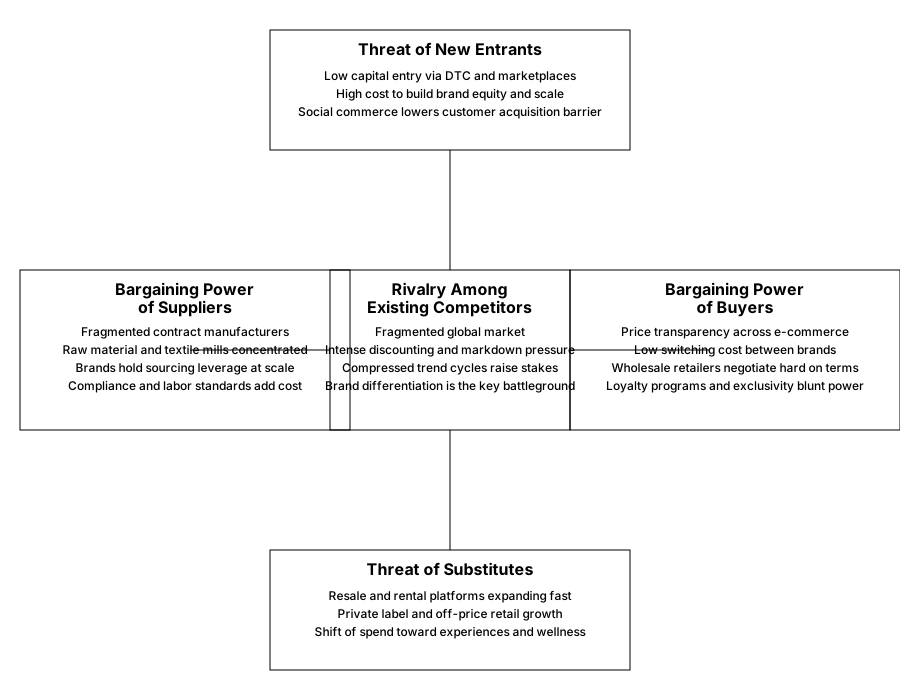
Bargaining power of buyers
Consumers hold substantial power in apparel and fashion because switching between brands costs almost nothing and price comparison across retailers and marketplaces takes seconds. Social media has amplified this power further by giving consumers visibility into a far larger set of alternatives than a physical store ever could and by letting them broadcast dissatisfaction publicly in ways that damage brand reputation quickly. Wholesale buyers, meaning the department stores and multi-brand retailers that purchase from brands in bulk, hold even more concentrated power, since a handful of large retail chains can dictate terms, demand markdown allowances and threaten to delist a brand that fails to perform.
Brands counter this power through loyalty programs, exclusive product drops and direct-to-consumer channels that remove the wholesale intermediary altogether, letting the brand control both pricing and the customer relationship. Scarcity marketing, where a brand deliberately limits supply relative to demand, is one of the few reliable tools for suppressing buyer power in a market otherwise defined by abundant choice. The rise of resale platforms has added a further complication, since a consumer who can resell a garment at a favorable price effectively gains negotiating leverage on the original purchase, treating the item partly as an asset rather than pure consumption.
| Dimension | Description |
|---|---|
| Switching cost | Minimal, since most apparel carries no functional lock-in |
| Price transparency | High across e-commerce and marketplace listings |
| Wholesale concentration | A small number of large retail chains hold outsized leverage |
| Loyalty mechanisms | Membership programs and exclusive drops partially offset power |
| Resale optionality | Consumers increasingly value resale value at time of purchase |
Bargaining power of suppliers
Suppliers to apparel and fashion brands split into two distinct groups with very different leverage: contract manufacturers, who are numerous and compete intensely for orders and raw material producers, particularly for specialty fibers and technical fabrics, who hold more concentrated positions. The manufacturing base is geographically diversified across South and Southeast Asia, which gives brands significant sourcing flexibility and the ability to shift production in response to cost, tariff or labor conditions. This flexibility keeps most contract manufacturers price takers rather than price setters, since a brand can generally find an alternative factory within a reasonable time frame.
Raw material suppliers hold more power where a fiber or fabric carries proprietary technology or certification, such as recycled or traceable materials increasingly demanded by sustainability-conscious brands, since fewer suppliers can meet those specifications at scale. Compliance and labor standards, including audits for working conditions and environmental practices, add a further layer of complexity that favors larger, more established manufacturers able to absorb certification costs, gradually consolidating supplier power upward even within a fragmented base. Tariff policy has recently become one of the most disruptive variables in this relationship, with the majority of fashion executives citing tariffs as the defining commercial issue of 20263.
| Dimension | Description |
|---|---|
| Manufacturing concentration | Fragmented and geographically diversified |
| Switching flexibility for brands | High, factories compete for order volume |
| Specialty material leverage | Concentrated where certification or proprietary fiber applies |
| Compliance cost | Rising, favors scaled manufacturers over small operators |
| Tariff exposure | Increasingly volatile and central to sourcing decisions |
Rivalry among existing competitors
Competitive intensity in apparel and fashion is structurally high because the market is fragmented, product differentiation erodes quickly once a trend is copied and fixed costs in retail real estate and marketing create pressure to keep selling through inventory even at reduced margin. Fast fashion retailers compete on speed, cutting the interval between design and shelf to a matter of weeks and, in some cases, days, which forces slower-moving competitors to either match that cadence or retreat into segments where speed matters less, such as luxury or highly technical performance wear. Zara's parent company Inditex, for example, turns inventory roughly twelve times a year against an industry average closer to three to four turns, converting supply chain speed directly into a competitive weapon rather than a mere operational metric4.
Discounting remains endemic across the mass and mid-market tiers, since brands routinely overproduce relative to actual demand and then rely on markdowns to clear inventory, a pattern that trains consumers to wait for sales and erodes full-price realization industry-wide. Luxury brands have historically avoided this dynamic by controlling supply tightly, but recent price increases that outpaced consumer willingness to pay have softened demand even at the top of the market, showing that pricing power is never permanent. The rivalry is ultimately fought less on product specification, since most apparel is imitable within a season and more on brand narrative, retail experience and the discipline to avoid the markdown spiral that erodes margin across an entire category.
| Dimension | Description |
|---|---|
| Market fragmentation | Highly fragmented globally with no dominant single player |
| Speed to market | Ranges from a few days to several months depending on segment |
| Discounting behavior | Widespread across mass and mid-market tiers |
| Differentiation basis | Brand narrative and retail experience more than product specification |
| Luxury pricing discipline | Weakening as price increases outpace consumer tolerance |
Threat of new entrants
Entry barriers in apparel and fashion vary enormously depending on ambition. Launching a niche direct-to-consumer brand through a marketplace or social commerce platform requires comparatively little capital, since a founder can outsource production to a contract manufacturer, list on an existing e-commerce platform and market through social media without ever operating a physical store. This low barrier has produced a steady stream of new entrants, particularly in categories like activewear, sustainable basics and streetwear, where a distinctive point of view can substitute for scale.
Building a brand durable enough to survive beyond a single trend cycle, however, requires a level of marketing investment, supply chain reliability and customer trust that few new entrants achieve, which is why the apparent ease of entry masks a much higher failure rate than headline statistics suggest. Scaling into a broad, multi-category retailer competing directly with established mass-market or luxury incumbents requires capital, real estate access and supplier relationships that take years to build, effectively closing that path to all but the best-funded challengers. Artificial Intelligence tools are lowering some of these barriers further by letting small brands access trend forecasting, design generation and demand planning capabilities that were once available only to large retailers, narrowing the operational gap even as the brand-building gap remains wide.
| Dimension | Description |
|---|---|
| Capital required for niche entry | Low, largely limited to inventory financing and marketing |
| Capital required for scale entry | High, requiring retail footprint and supplier relationships |
| Brand-building timeline | Multi-year investment with uncertain payoff |
| Technology access | Increasingly democratized through Artificial Intelligence tools |
| Survival rate beyond initial trend cycle | Low relative to the volume of new brand launches |
Threat of substitutes
Substitution in apparel and fashion takes several forms that operate simultaneously rather than as isolated threats. Resale and rental platforms substitute directly for first-hand purchases and the secondhand fashion and luxury market is forecast to grow two to three times faster than the first-hand market through 2027, a pace that reflects a genuine shift in how consumers, particularly younger ones, think about ownership5. Off-price retail and private label offerings from grocery and general merchandise retailers substitute at the value end of the market, capturing consumers who prioritize price over brand affiliation.
A less obvious substitution threat comes from the reallocation of discretionary spending away from apparel entirely, toward experiences, travel and health and wellness categories, a shift that has been well documented across consumer surveys and that structurally caps apparel's share of household budgets regardless of how compelling any individual collection might be. Rental subscription models for special-occasion and premium apparel represent a smaller but growing substitute, particularly for infrequently worn categories like formalwear, where ownership carries limited utility relative to cost. None of these substitutes eliminates demand for apparel, since clothing remains a functional necessity, but each one erodes the premium that brands can charge for novelty and exclusivity.
| Dimension | Description |
|---|---|
| Resale and rental growth | Outpacing first-hand market growth significantly |
| Off-price and private label | Capturing price-sensitive segments of demand |
| Discretionary spend reallocation | Shifting toward experiences and wellness categories |
| Occasion-based rental | Growing in formalwear and infrequently worn categories |
| Overall demand elasticity | Functional necessity limits total substitution risk |
Value chain and profit pools
The apparel and fashion value chain begins with design and trend forecasting, where creative teams and, increasingly, Artificial Intelligence tools interpret cultural signals into concepts for an upcoming season or continuous release cycle. This stage carries disproportionate influence over eventual profitability, since a design decision made months before production determines both the cost structure and the demand the finished garment will generate. From there, the chain moves into sourcing and production planning, where brands select contract manufacturers, negotiate pricing and lock in capacity, a stage this analysis treats as adjacent rather than core, since the manufacturing economics themselves belong to a separate industry.
Distribution and logistics follow, encompassing freight, customs clearance and warehousing, a stage that has become strategically important as brands compress lead times to match faster design cycles and as tariff volatility forces more frequent rerouting of supply chains. The customer interface stage, spanning wholesale accounts, owned retail stores, e-commerce platforms and marketplaces, is where brands capture the largest share of the final selling price and where the relationship with the end customer actually lives. Marketing and merchandising sit alongside this stage as an enabling function, determining how effectively a brand converts awareness into purchase and, critically, how much of the collection sells at full price rather than through markdown.
Enabling infrastructure closes the chain, covering the technology systems for inventory management, demand forecasting and customer data that increasingly determine which brands can execute the faster cycles that competition now demands. Profit concentrates heavily in the customer interface and brand ownership stages, moderately in distribution and logistics for firms that operate it efficiently at scale and only thinly in production, which operates on competitively bid margins regardless of how essential it is to the finished product.
Profit pool
Profit in apparel and fashion has migrated steadily toward the stages that control the customer relationship and the brand narrative, away from the stages that simply move goods. LVMH's fashion and leather goods segment posted an operating margin near 35 percent in 2025 and Hermès reported an operating margin above 41 percent in the first half of 2026, figures that illustrate how concentrated profitability becomes once a brand achieves genuine pricing power and controls its own retail distribution6. Contract manufacturing, by contrast, typically operates on single-digit margins even at scale, since manufacturers compete on price against a large and geographically dispersed set of alternatives.
The mid-market has become an increasingly important profit pool in its own right, drawing consumers who are trading down from luxury without abandoning brand-conscious purchasing, a shift McKinsey and Business of Fashion research identifies as the primary source of new value creation in the current cycle rather than luxury, which had dominated profit growth for the preceding decade7. Fast fashion occupies an unusual middle position:
Inditex converts high inventory turnover into a net profit margin around 15 percent, well above the low single digits that pure-play fast fashion competitors like Shein have historically posted, showing that speed alone does not guarantee margin without disciplined execution across the rest of the model
Resale and secondhand platforms represent an emerging profit pool that brands have been slow to capture directly, often ceding the transaction, the customer data and a meaningful share of long-term brand equity to third-party resale marketplaces. Brands that build owned resale or trade-in programs are beginning to recapture some of this value, both by protecting brand perception and by generating incremental revenue from products that would otherwise generate no further return after the first sale.
Industry economics and business models
Three business model patterns dominate apparel and fashion. Wholesale-led models sell primarily through department stores and multi-brand retailers, sacrificing margin and customer data in exchange for reach and reduced capital intensity, since the wholesale partner bears the cost of retail operations and inventory risk beyond the initial purchase order. This model has weakened structurally over the past decade as department store footfall has declined and as brands have recognized how much value they surrender by not owning the customer relationship.
Direct-to-consumer models, whether through owned stores, brand websites or a combination, capture the full retail margin but require the brand to absorb marketing, fulfillment and inventory carrying costs directly, a trade that rewards brands with strong enough demand to sustain full-price sell-through. Fast fashion represents a distinct variant of this model, built around extremely short design-to-shelf cycles and small initial production runs that get scaled up only after real demand signals emerge, converting the forecasting risk inherent in traditional apparel into a manageable, data-driven process. Marketplace and platform models, where brands sell through Amazon, Zalando and comparable multi-brand digital platforms, offer a middle path, providing reach without the capital intensity of owned retail but ceding meaningful margin and customer data to the platform operator in exchange.
Cost drivers and scalability
Fixed costs in apparel and fashion concentrate in retail real estate, brand marketing and core technology infrastructure, while variable costs concentrate in inventory, production and the marketing spend that scales with promotional activity. Economies of scale operate primarily through purchasing leverage with manufacturers and through the fixed cost of brand marketing being spread across a larger revenue base, which is why larger brands can sustain marketing intensity that a smaller competitor cannot match proportionally. Economies of scope also matter considerably, since a brand that has already built design, sourcing and marketing capability can extend into adjacent categories, such as footwear or accessories, at a much lower incremental cost than a new entrant building those capabilities from scratch.
Unit economics in apparel hinge on full-price sell-through rate, meaning the proportion of a collection sold before markdown, since every unit that sells at full price contributes far more to margin than one cleared at a discount. Inventory turnover functions as the closest analogue to a growth flywheel in this industry: faster turnover reduces markdown risk, frees working capital sooner and lets a brand respond to emerging trends before a slower competitor can react, compounding advantage over successive seasons. Customer acquisition cost has risen sharply across digital channels as paid social advertising has become more expensive and more competitive, pushing brands toward retention and loyalty economics, where the lifetime value of a repeat customer increasingly outweighs the cost of acquiring a new one.
Moats, advantages and strategic levers
Brand equity remains the most durable moat in apparel and fashion, built over years through consistent design point of view, cultural relevance and, for luxury brands, deliberate scarcity that sustains pricing power well above what raw material and labor costs would otherwise justify. Supply chain speed constitutes a second, increasingly important moat, since brands that compress the design-to-shelf cycle can react to real demand signals rather than forecasting months in advance, converting what has historically been the industry's largest source of risk into a competitive advantage that is genuinely difficult for slower incumbents to replicate quickly.
Data advantages are compounding for brands that own their customer relationship through direct-to-consumer channels, since first-party purchase and browsing data enables sharper demand forecasting, more personalized marketing and better assortment decisions than brands relying solely on wholesale distribution can achieve. Switching costs for end consumers remain low in absolute terms, but loyalty programs, sizing and fit data and community-building around a brand's identity create meaningful behavioral stickiness that functions similarly to a switching cost even without a formal lock-in mechanism. Regulatory moats are emerging rather than established, as brands that invest early in sustainability compliance and supply chain traceability position themselves to absorb tightening regulation more easily than competitors who treat it as an afterthought, effectively converting compliance cost into a barrier against less prepared rivals.
Strategic levers
An entrant or incumbent in apparel and fashion has several distinct levers available and the right combination depends heavily on starting position. Customer segment focus, meaning a deliberate choice to serve a narrow, well-defined audience rather than a broad market, remains the single most reliable lever for a new brand, since it allows marketing spend and product development to concentrate rather than dilute across a wide and undifferentiated assortment. Product scope expansion, moving from a single category into adjacent ones such as footwear, accessories or home goods, lets an established brand extend its equity into new revenue streams, though it carries real risk of diluting the brand if the extension feels disconnected from the original point of view.
Vertical integration versus partnering represents a genuine strategic choice rather than an obvious default: brands that own more of their supply chain gain control over speed and quality but absorb capital intensity and operational complexity, while brands that partner extensively with contract manufacturers preserve flexibility and asset-light economics at the cost of some control. Geographic expansion offers substantial upside given how fragmented apparel demand remains across regions, but it requires genuine localization in sizing, marketing and channel strategy rather than simple export of a domestic playbook, a mistake that has undermined more than one otherwise strong brand's international push. Ecosystem orchestration, meaning a brand's ability to coordinate its own retail, wholesale, marketplace and resale presence into a coherent whole rather than a set of disconnected channels, has become an increasingly important lever as the number of viable distribution channels has multiplied.
Structural risks, regulation and trends
Apparel and fashion faces several structural risks simultaneously. Tariff policy has become acutely disruptive, with a substantial majority of industry executives naming it the defining commercial issue of 2026, forcing rapid resourcing decisions that strain supplier relationships and compress margins in the short term8. Regulatory risk is rising steadily through extended producer responsibility rules and mandatory sustainability disclosure requirements, particularly across the European Union, which will raise compliance costs disproportionately for smaller brands lacking the scale to absorb them efficiently. Commodity price volatility in cotton and synthetic fiber inputs continues to introduce cost uncertainty that brands can only partially hedge through forward purchasing agreements and geopolitical tension affecting key manufacturing regions in Asia adds a further layer of supply chain risk that has become impossible to ignore in sourcing strategy.
Demand-side trends are equally significant. Consumers are reallocating discretionary spending toward health, wellness and experiences, a pattern that structurally caps how much of household budgets apparel can capture regardless of how compelling any individual brand's offering is. Nearly half of fashion executives expect industry conditions to worsen in 2026, an increase of eight percentage points over the prior year, reflecting genuine anxiety about the combined effect of tariffs, softening luxury demand and cautious consumer spending9. Artificial Intelligence stands out as the trend executives view most positively, with more than a third already using generative tools in customer service, image creation, copywriting and product discovery, suggesting the technology is moving from experimentation to embedded operational practice faster than most other recent innovations in the industry.
For entrants, the sound strategy is niche focus paired with a partner-heavy operating model, since building broad scale and vertical integration simultaneously is rarely achievable without the capital reserves of an established player. A build approach makes sense only where a genuinely differentiated capability, such as proprietary sustainable materials or a novel direct-to-consumer distribution model, cannot be accessed through partnership on reasonable terms. Regulatory strategy should treat compliance investment as an accelerant rather than a cost center, since early movers on traceability and sustainability disclosure are positioned to absorb tightening rules more comfortably than competitors scrambling to catch up later.
Incumbents face a different playbook centered on defending core brand equity while expanding into adjacent categories and channels with discipline rather than opportunism. Deepening moats means investing further in supply chain speed and first-party data capability, both of which compound in value over time and are genuinely difficult for a new entrant to replicate quickly. The incumbents most likely to sustain margin through the current period of turbulence are those willing to treat resale, Artificial Intelligence-driven forecasting and tariff-resilient sourcing as core strategic priorities rather than peripheral initiatives layered onto an otherwise unchanged operating model.
Caselet: Inditex and the Zara model
Inditex, the Spanish parent of Zara, offers one of the clearest illustrations of how supply chain speed converts into sustained competitive advantage in apparel and fashion. Founded by Amancio Ortega in 1975 with the opening of the first Zara store in A Coruna, the company grew from a single Spanish retailer into the world's largest fashion group by revenue, operating Zara alongside sister brands including Massimo Dutti, Bershka and Pull&Bear. Unlike most global apparel competitors, Inditex kept a meaningful share of production close to its home market in Spain, Portugal and North Africa rather than outsourcing entirely to lower-cost manufacturing regions in Asia, a decision that sacrifices some unit cost advantage in exchange for dramatically shorter lead times.
That trade-off underpins the company's defining operational capability: a design-to-shelf cycle that compresses new styles into stores within two to three weeks of a trend emerging, compared with a traditional industry cycle that can stretch to six months or longer. Inditex reinforces this speed with an inventory turnover rate of roughly twelve times a year, several multiples above the broader apparel industry average of three to four turns, which means the company carries far less markdown risk than competitors who must commit to production volumes months ahead of actual demand. Rather than forecasting a full season's demand upfront, Zara produces small initial batches, monitors real sell-through in stores and online and rapidly replenishes or discontinues styles based on that live signal, effectively substituting operational responsiveness for the forecasting accuracy that most of the industry still depends on and frequently gets wrong.
This model has translated into financial performance that stands out even among successful apparel competitors. Inditex has reported net profit margins around 15 percent in recent fiscal years, well above both the broader apparel retail average and above pure-play digital fast fashion competitor Shein, whose margins have historically sat closer to 3.5 to 5 percent despite an even faster, AI-driven design cycle. The comparison is instructive: Shein compresses its design-to-shelf cycle to as little as seven days and launches around 2,000 new styles daily, a pace that exceeds even Zara's, yet Inditex's more moderate but disciplined turnover, combined with a physical retail and brand experience that Shein largely lacks, produces meaningfully stronger profitability. Speed alone, in other words, does not guarantee margin; it must be paired with pricing discipline and a retail experience that sustains fuller-price selling.
Inditex's approach also demonstrates the limits of vertical integration as a strategy. The company owns a larger share of its production than most competitors, giving it control over speed that outsourced rivals cannot easily match, but this control comes with real capital intensity and geographic concentration risk that a fully outsourced competitor avoids. The company has continued investing in this model even as digital-native competitors like Shein have emerged with even faster cycles, betting that the combination of physical retail presence, brand consistency and moderate but reliable margins will prove more durable than a pure speed and price play. Inditex's trajectory over the coming years, as it navigates tariff volatility and continued digital competition, will offer a useful signal for whether disciplined vertical integration remains a viable strategic anchor in an industry increasingly defined by asset-light, digitally native challengers.
Inditex's story matters strategically because it shows that the industry's most consequential competitive battles are fought over operational cadence and pricing discipline rather than product design in isolation, a lesson directly relevant to any brand or investor evaluating where durable advantage actually lives in apparel and fashion.
- 1Apparel Market Size Projections
- 2Luxury Pricing Trends 2019 To 2025
- 3Tariffs As Top Fashion Executive Concern
- 4Inditex Inventory Turnover Versus Industry Average
- 5Secondhand Market Growth Forecast
- 6LVMH And Hermès Operating Margins
- 7Mid-Market Overtaking Luxury As Value Creator
- 8Tariff Disruption In Fashion Sourcing
- 9Executive Sentiment On 2026 Conditions
Apparel and fashion converts textiles, design judgment and marketing into garments that signal identity as much as they provide utility. The industry's economics reward brands that control the customer relationship, move inventory quickly and protect pricing discipline over those that chase volume through discounting. Capital intensity sits with manufacturers and logistics providers, while the most durable margins accrue to brand owners who outsource production but keep design, merchandising and data in-house. Looking ahead, the decisive levers are direct-to-consumer economics, Artificial Intelligence-driven trend forecasting and credible participation in resale and circularity. Incumbents that treat these as bolt-ons rather than core strategy will keep losing share to leaner, faster-moving challengers.
Citation
Cite this article
Sridharan, M. A. (2023, September 3). Industry Analysis: Apparel and Fashion. Think Insights. https://thinkinsights.net/strategy/industry-analysis-apparel-and-fashion (Accessed [[ACCESS_DATE]])
Sridharan, Mithun A. "Industry Analysis: Apparel and Fashion." Think Insights, 3 Sep. 2023, https://thinkinsights.net/strategy/industry-analysis-apparel-and-fashion. Accessed [[ACCESS_DATE]].
Mithun A. Sridharan, "Industry Analysis: Apparel and Fashion," Think Insights, September 3, 2023, https://thinkinsights.net/strategy/industry-analysis-apparel-and-fashion. Accessed [[ACCESS_DATE]].
Sridharan, M.A. (2023) 'Industry Analysis: Apparel and Fashion', Think Insights. Available at: https://thinkinsights.net/strategy/industry-analysis-apparel-and-fashion (Accessed: [[ACCESS_DATE]]).
M. A. Sridharan, "Industry Analysis: Apparel and Fashion," Think Insights, 2023. [Online]. Available: https://thinkinsights.net/strategy/industry-analysis-apparel-and-fashion. [Accessed: [[ACCESS_DATE]]].
Sridharan MA. Industry Analysis: Apparel and Fashion. Think Insights. Published September 3, 2023. Accessed [[ACCESS_DATE]]. https://thinkinsights.net/strategy/industry-analysis-apparel-and-fashion
Test Your Knowledge
Industry Analysis: Apparel and Fashion
Challenge yourself on the concepts from this article and see how well you understood them.
Subscribers get weekly quizzes and insights — subscribe free
Sponsor this article
Partner with Think Insights
Reach 50,000+ business leaders, consultants, and strategists. Feature your brand alongside expert articles on strategy, leadership, and digital transformation.
Become a Sponsor