Industry Analysis: Animation


Animation is no longer a niche craft feeding children's television; it is a global production and licensing engine worth several hundred billion dollars, growing near 7% a year on the back of streaming demand, franchise merchandising and gaming crossover. The value is not captured evenly. Studios that own intellectual property and control distribution keep the durable margin, while the artists and outsourced studios that do the frame-by-frame work operate on thin, competitive rates. Generative Artificial Intelligence and offshore production hubs are now shifting bargaining power further away from labor and toward platforms and IP owners. Executives entering or investing in this industry should prioritize owning or co-owning franchisable characters, securing distribution or licensing leverage and treating production capacity as a variable cost to be sourced globally rather than a fixed asset to be built in-house.
Is animation attractive for new entrants?
It depends on where an entrant plays. Building a production studio from scratch is capital intensive and margin-thin because buyers, mainly streamers and studios, hold pricing power over commissioned work. It is far more attractive to enter as an IP originator or a specialized technology or outsourcing vendor, where returns come from owning characters or from serving the industry's cost pressure rather than competing directly against incumbent studios for commissions.
Which parts of the value chain are most profitable?
Intellectual property ownership and licensing sit at the top of the profit pool, followed by distribution platforms that control audience access. Production and post-production, especially outsourced animation labor, are the least profitable segments because they compete on price in a globally fragmented supplier market with limited differentiation.
How is technology changing this industry?
Generative Artificial Intelligence is compressing the cost and time of in-between frames, background generation, dubbing and localization, effectively turning what was skilled manual labor into a software-assisted process. Real-time rendering engines, originally built for gaming, are also collapsing production cycles for episodic content, while cloud rendering removes the need for on-premises infrastructure.
What capabilities are table stakes vs differentiators?
Technical animation skill, rendering pipelines and basic production management are table stakes available from many vendors worldwide. Differentiators are original character and story development, franchise management across merchandising and gaming and the ability to secure premium distribution slots on platforms with committed marketing budgets.
How should investors or consultants evaluate opportunities here?
Evaluate opportunities by asking where cash flow originates beyond the first release window: merchandising, gaming, theme parks and streaming residuals compound value over a decade, while a single commissioned production does not. Favor targets with owned or co-owned IP, diversified buyer relationships and a cost base that can flex with generative tools rather than one locked into fixed headcount.
What separates a profitable animation studio from an unprofitable one?
Profitable studios control at least one scarce asset, whether that is a beloved character portfolio, a distribution relationship, or a cost advantage from global production sourcing. Unprofitable ones are typically pure production shops dependent on a small number of commissioning buyers who can walk away or renegotiate each cycle.
Why are streaming platforms both customers and competitors in animation?
Streamers commission animated content from studios, making them buyers, but they increasingly build in-house animation teams and acquire studios outright, making them direct competitors for both talent and audience attention. This dual role gives platforms outsized influence over pricing, release strategy and creative direction.
How exposed is animation to Artificial Intelligence displacement?
A 2025 assessment commissioned by the animation workers' union estimated that roughly 29% of animation jobs face meaningful disruption risk from generative tools over a multiyear horizon, concentrated in in-betweening, background art and rough layout roles rather than lead character design or direction.
Does animation depend heavily on other industries?
Yes, it is structurally linked to streaming and broadcast media for distribution, to gaming for engine technology and crossover intellectual property, to toys and consumer products for merchandising revenue and to theme parks and live experiences for high-margin brand extension.
What is the biggest strategic risk incumbents face right now?
The biggest risk is treating animation as a cost center to be minimized through outsourcing and automation while competitors treat it as a franchise engine, investing the savings from cheaper production into original IP development and cross-platform licensing that compounds value long after any individual release.
Animation has quietly become one of the more consequential creative industries in the modern economy, sitting at the crossroads of media, gaming, consumer products and, increasingly, Artificial Intelligence. What was once viewed as a children's programming category or a supporting craft within film production now functions as a standalone industrial system, generating several hundred billion dollars in annual value and expanding faster than the broader media sector. For executives evaluating where to allocate capital or how to defend an existing position, understanding how value moves through this industry and who actually captures it, matters more than understanding how animation is made.
Industry at a glance
Animation, for the purposes of this analysis, covers the creation of moving images through hand-drawn, digitally illustrated, computer-generated or stop-motion techniques, spanning feature films, television and streaming series, short-form social video, advertising and the animated components of video games. It excludes live-action visual effects work that does not involve fully animated characters or environments, though the boundary between the two has blurred as real-time rendering tools converge across disciplines. The industry serves three distinct customer types. Business-to-consumer demand comes through theatrical releases, streaming subscriptions and merchandise purchases. Business-to-business demand comes from studios and platforms commissioning production work from specialized animation houses, as well as advertisers commissioning animated marketing content. Business-to-government demand is smaller but real, including public information campaigns and educational content procurement.
The global animation market was valued at roughly $460 billion in 2025, with credible industry forecasts placing compound annual growth in the range of 6.9% to 7.5% through the early 2030s, driven primarily by streaming demand and the proliferation of animated content across advertising and corporate communication.1 North America retains the largest regional share, close to 34%, owing to its concentration of major studios and platform spending, though production activity itself has migrated substantially toward Asia. The industry's revenue models are varied by segment: theatrical box office and merchandising licensing for feature franchises, subscription-supported commissioning for streaming series, advertising-supported models for social and broadcast short-form content and fee-for-service contracts for outsourced production work. Capital intensity is moderate and technology-driven rather than physical-asset-driven; the primary fixed costs are software licenses, rendering infrastructure and, above all, skilled labor, which remains the industry's dominant cost line even as automation tools spread. Regulatory intensity is comparatively low relative to other media segments, concentrated mainly in content standards for children's programming, labor law governing unionized production and the still-forming rules around use of generative Artificial Intelligence and performer likeness.
Industry segmentation
The animation industry divides into six segments defined primarily by technology and end use rather than by geography. Feature film animation covers theatrically released and streaming-exclusive films built around original or licensed intellectual property, typically produced over two to four years with budgets running from tens of millions to well over $200 million for tentpole releases. Television and streaming series animation covers episodic content commissioned by broadcasters and platforms, ranging from premium adult animation to long-running children's franchises that can run for a decade or more once established. Advertising and branded content animation serves corporate and agency clients seeking short-form animated marketing material, a segment growing quickly because production costs have fallen enough to make animation competitive with live-action shoots for many campaigns.
Game cinematics and in-game animation form a distinct segment, increasingly significant because gaming studios now employ animation techniques and, in many cases, animation talent pools that overlap directly with film and television production, particularly as real-time engines blur the line between cinematic and interactive content. Stop-motion and specialty craft animation remains a small but commercially durable niche, sustained by studios whose brand equity rests on a distinctive visual technique that resists full automation. Finally, animation outsourcing and services covers the specialized production houses, concentrated in India, the Philippines, South Korea and increasingly Vietnam and Eastern Europe, that perform contracted work, from full-episode production to specific tasks like in-betweening, color and compositing, for studios headquartered elsewhere.2 These segments are not mutually exclusive in practice; a single major studio typically operates across feature, television and licensing simultaneously, but the segmentation is useful because each has distinct competitive dynamics, buyer relationships and margin profiles.
Market structure
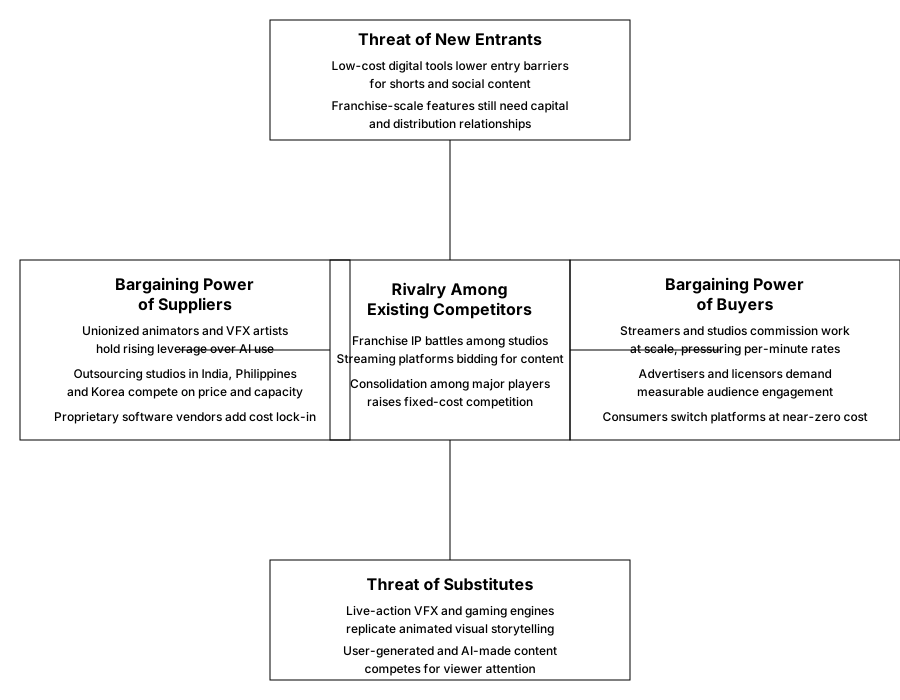
Animation's competitive structure is shaped by a persistent tension between creative scarcity and production abundance. Original, well-loved characters and stories remain scarce and command premium economics, while the technical labor of rendering those stories into finished frames has become progressively more abundant and price-competitive as outsourcing networks matured and generative tools entered production pipelines. That tension underlies every one of the five forces described below and it explains why the industry rewards intellectual property ownership so much more generously than production execution.
Bargaining power of buyers
Buyers in animation split into two distinct groups with very different leverage. Streaming platforms and major studios that commission production work hold considerable power because they control large, recurring volumes of business and can play a globally fragmented supplier base against itself, extracting favorable per-minute or per-episode rates from outsourced studios competing on cost. Netflix alone is projected to spend close to $20 billion on content in 2026 and its ability to redirect volume toward Korean, Japanese or other regional partners at short notice gives it substantial pricing leverage over any single production vendor.3 Consumer-facing buyers, by contrast, hold power of a different kind: near-zero switching costs between streaming platforms and an abundance of free or low-cost animated content on social platforms mean audience attention is contestable at any moment, forcing content owners to compete continuously rather than resting on a single successful release. Advertisers commissioning branded animated content likewise have many vendors to choose from and negotiate accordingly. The net effect is that buyer power sits firmly with whoever aggregates the largest, most flexible pool of production or viewing demand, leaving individual production studios and even individual consumers as price takers in most transactions.
| Buyer type | Source of leverage | Constraint on studios |
|---|---|---|
| Streaming platforms | Large recurring commission volume | Can shift work across global vendor pool |
| Theatrical distributors | Control over release slots and marketing spend | Approve or reject projects before greenlight |
| Advertisers and brands | Multiple vendor options for short-form work | Compress fees through competitive bidding |
| Consumers | Near-zero platform switching cost | Force continuous content investment |
Bargaining power of suppliers
Suppliers to the animation industry include unionized creative and technical labor, specialized software and rendering technology vendors and the outsourced production studios that increasingly perform a large share of actual frame work. Labor power has been rising, not falling, despite automation fears, because unions such as the Animation Guild have secured formal consultation rights over Artificial Intelligence deployment and organized new bargaining units at major streamers and studios through 2025, giving skilled animators more structural leverage than the raw job-displacement statistics might suggest.4 Outsourced production studios in India, the Philippines and South Korea, by contrast, hold comparatively little pricing power individually, since there are hundreds of comparable vendors and buyers can and do shift volume between them, though the largest and most specialized among them have begun to build proprietary pipelines that create some differentiation. Software vendors supplying rendering engines, rigging tools and now generative AI plug-ins hold moderate power, concentrated among a handful of dominant platforms whose tools become embedded in a studio's workflow and are costly to replace once adopted. Overall supplier power in this industry is bifurcated sharply between creative talent, which is consolidating leverage through collective bargaining and production capacity, which remains commoditized and price-competitive.
| Supplier type | Concentration | Leverage trend |
|---|---|---|
| Unionized animators and directors | Moderate, geographically concentrated | Rising, through collective bargaining |
| Outsourced production studios | Highly fragmented globally | Flat to declining, price competition |
| Rendering and pipeline software vendors | Concentrated among few platforms | Rising, due to workflow lock-in |
| Voice talent and performers | Moderate | Rising, over likeness and AI use rights |
Rivalry among existing competitors
Competitive rivalry in animation is intense and has intensified further as streaming platforms built in-house animation capability rather than relying solely on external studios, turning former customers into direct competitors for both audiences and talent. Major players including Disney, Warner Bros Discovery, Universal, Netflix Animation, Sony Pictures Animation and a deep bench of Japanese anime studios all compete for the same premium release windows, award recognition and merchandising partnerships and the fixed costs of a tentpole feature mean studios cannot easily retreat from competing at scale once committed. Consolidation has been a persistent theme, with platforms acquiring or building animation units to secure exclusive content rather than compete for the same limited pool of independent studio output. Rivalry is compounded by the fact that success is unevenly distributed and difficult to predict in advance; a handful of franchises capture disproportionate box office and licensing revenue each year, while the majority of releases underperform their production cost, sustaining pressure on every competitor to keep greenlighting new content in search of the next durable franchise. This dynamic pushes budgets upward even as per-project economics remain uncertain, a combination that keeps rivalry sharp across every segment of the industry.
| Competitive dimension | Current dynamic |
|---|---|
| Major studio franchise slates | Concentrated around a handful of proven IP families |
| Streaming platform in-house production | Growing, reducing reliance on external commissions |
| Anime studio international expansion | Accelerating, driven by global streaming demand |
| Talent competition | Intense for senior directors and technical leads |
Threat of new entrants
Entry barriers vary enormously by segment. At the high end, launching a competitive feature animation studio capable of tentpole-scale output requires hundreds of millions of dollars in cumulative investment, years of pipeline development and access to distribution relationships that are not easily built from scratch, which explains why the same handful of major studios has dominated theatrical animation for decades. At the low end, the barriers have collapsed. Affordable software, cloud rendering and now generative AI tools let small teams or even individual creators produce broadcast-quality short-form animation for social platforms and advertising clients at a fraction of historical cost and this segment has seen genuine new-entrant activity from independent studios and freelance collectives. The middle tier, episodic television and streaming series production, sits between these extremes: capital requirements are lower than features but still meaningful and new entrants typically succeed by specializing narrowly, whether in a particular animation style, a specific regional market, or as a services vendor to established studios rather than as a direct content competitor. Regulatory barriers are minimal industry-wide, which means the primary constraint on new entry is access to capital, distribution and proven creative talent rather than compliance or licensing hurdles.
| Entry pathway | Capital requirement | Realistic new-entrant success |
|---|---|---|
| Tentpole feature studio | Very high | Rare, dominated by incumbents |
| Streaming series production | Moderate | Achievable with niche specialization |
| Short-form and branded content | Low | Common, aided by generative tools |
| Outsourced production services | Low to moderate | Common, especially in emerging hubs |
Threat of substitutes
Animation faces substitution pressure from adjacent content forms that compete for the same viewer attention and, in some cases, the same production budgets. Live-action content enhanced by advanced visual effects can now achieve some of the same fantastical storytelling that once required full animation, giving studios a substitute production method for certain genres. Video games, particularly those with cinematic-quality real-time rendering, increasingly substitute for passive animated viewing by offering interactive storytelling within similar visual worlds, a trend accelerated by the technical convergence between game engines and animation pipelines. User-generated and short-form content on social platforms substitutes for professionally produced animation in capturing audience time, even though its production values are lower, simply because it is abundant, free and algorithmically distributed. Generative AI tools now allow brands and individual creators to produce animated-style content without engaging a traditional studio at all, a substitution vector that barely existed five years ago and is expanding quickly. None of these substitutes fully replace premium franchise animation, which retains a distinct emotional and cultural role, but collectively they compress the addressable attention and advertising budgets available to traditional animated content, particularly in the short-form and mid-budget segments.
| Substitute | Degree of overlap | Trend |
|---|---|---|
| Live-action with heavy visual effects | Partial, genre-dependent | Stable |
| Interactive gaming content | Growing, especially among younger audiences | Rising |
| User-generated short-form video | High for attention share | Rising sharply |
| AI-generated animated content | Emerging, low quality ceiling today | Rising quickly |
Value chain and profit pools
The animation value chain runs through five stages, each with a distinct role and margin profile. Development and intellectual property creation sits upstream, encompassing story development, character design and the securing of rights, whether original or licensed from books, games or existing franchises; this stage carries high risk but also the greatest long-run reward, since a successful character can generate revenue for decades after the originating production ends. Pre-production and production follow, covering storyboarding, voice recording, animation, rigging and rendering, the most labor-intensive stage and the one most exposed to global cost competition and, increasingly, automation. Post-production, including editing, sound design, color and compositing, is technically demanding but has become progressively more efficient through software tooling, compressing both its cost and its share of overall project budgets. Distribution follows, covering theatrical release, streaming platform placement, broadcast licensing and international syndication, a stage controlled overwhelmingly by a small number of platforms and distributors that decide which content reaches audiences and on what terms. Finally, monetization and brand extension capture the downstream value:
merchandising, licensing, theme park attractions, gaming tie-ins and consumer product lines, which for a successful franchise routinely generate revenue many multiples larger than the originating film or series itself
Enabling infrastructure runs alongside all five stages, comprising the software platforms, cloud rendering capacity and increasingly the generative AI tools that studios license to support production, along with the specialized outsourcing networks that supply flexible capacity during peak periods. This infrastructure layer does not touch the finished product directly but shapes the cost structure of every stage above it and vendors operating in this layer have grown in strategic importance as studios seek to variabilize costs that were once fixed in-house headcount.
Profit pool
Profit concentrates overwhelmingly at the two ends of the value chain, intellectual property ownership and downstream monetization, while the middle stages of production and distribution capture comparatively thin margins despite absorbing the bulk of activity and headcount. A studio that owns a character outright, rather than working for hire, can license that character across toys, games, apparel, theme parks and dozens of other categories for years after the original production and these licensing streams typically carry gross margins well above 50%, since the incremental cost of licensing an existing design is minimal compared with the cost of the original creative investment.5 Distribution platforms capture the next largest share of value, not through direct production margin but through subscriber retention and advertising revenue enabled by exclusive or first-window access to popular animated content, which is why platforms have moved aggressively to own or co-own IP rather than simply license finished content.
Production and post-production, by contrast, generate revenue proportional to labor and rendering hours delivered, with margins compressed further each year by the combination of global outsourcing competition and generative tooling that reduces the billable hours required for a given output. This has produced a structural shift over the past decade: the studios and platforms that once treated production as their core business have increasingly repositioned themselves as IP developers and licensors, outsourcing the labor-intensive middle of the chain to specialized vendors precisely because that stage no longer commands premium economics. Investors and consultants assessing opportunities in this industry should weight targets accordingly, favoring exposure to IP and licensing over exposure to pure production capacity.
Industry economics and business models
Four business model patterns dominate animation today. The franchise licensing model, exemplified by major studios and character-driven properties, treats the originating film or series as a marketing investment that unlocks a long tail of merchandising, gaming and experiential revenue; profitability here depends far less on the box office performance of any single release than on the durability and breadth of the character portfolio built over time. The subscription-funded commissioning model, used by streaming platforms, treats animated content as a retention and acquisition tool rather than a standalone profit center, meaning individual series are evaluated on subscriber impact and engagement rather than direct production economics, which has allowed platforms to fund ambitious content that would not clear a traditional theatrical return threshold.
The fee-for-service production model, used by outsourced studios and specialized vendors, operates on straightforward contract economics, billing for delivered output against agreed rates and timelines, with profitability driven by utilization, pipeline efficiency and the ability to secure repeat business from a small number of large commissioning clients. Finally, the advertising and branded content model, growing quickly in the short-form segment, generates revenue either directly from client fees for commissioned work or indirectly through advertising placement around freely distributed animated content on social and video platforms, an increasingly important pathway for smaller studios and independent creators who lack access to traditional distribution. Each model carries a different risk profile:
franchise licensing offers the highest long-run reward but requires patient capital and creative risk-taking, while fee-for-service production offers steady but thin margins with limited upside
Cost drivers and scalability
Labor remains the dominant cost line across the industry, typically representing the largest single expense category in any animated production budget, though the proportion varies by technique and by how much work is outsourced versus retained in-house. Fixed costs are relatively modest compared with capital-intensive industries; the major fixed investments are software licensing, core creative and technical staff and studio facilities, while the variable cost of scaling a production up or down largely tracks headcount and outsourced capacity, which can be flexed quickly given the global availability of production vendors. This cost structure gives the industry meaningful economies of scale in one specific sense:
studios that produce a continuous slate of content can spread software licensing, technology development and core creative leadership costs across many projects, while a single-project studio bears the full weight of those fixed investments alone
Economies of scope matter as much as economies of scale in this industry, because a studio with an established character portfolio can amortize marketing, brand management and licensing infrastructure across multiple properties simultaneously and can cross-promote new releases through existing franchise audiences at minimal incremental cost. Unit economics for a franchise property should be assessed on a multiyear basis rather than per release, since the fixed cost of character development is sunk after the first success and subsequent licensing, sequel and spin-off revenue arrives at high marginal margin. Generative AI tools are beginning to alter this cost structure meaningfully by reducing the labor hours required for lower-skill tasks such as in-betweening and background generation, which should lower the marginal cost of production over time, though the pace of that shift remains constrained by union agreements and by quality thresholds that automated tools have not yet consistently met for premium content.
Moats, advantages and strategic levers
The strongest moat in animation is intellectual property ownership combined with proven audience affinity, since a beloved character cannot be replicated by a competitor regardless of how much capital or technical talent that competitor deploys; this is why franchise portfolios built over decades, rather than any single hit, define the most durable studios in the industry. Distribution relationships form a second significant moat, particularly for platforms that control the algorithmic and editorial placement audiences use to discover content, since a strong distribution position lets a studio extract better terms and marketing support than a comparable studio without that access. Switching costs matter at the production infrastructure level too:
once a studio has built its creative and technical pipeline around a particular software ecosystem, migrating to alternative tools carries real retraining and productivity costs, which creates modest but real lock-in favoring incumbent technology vendors
Data and learning advantages are emerging as a newer source of defensibility, particularly for platforms that can observe viewing and engagement patterns across their full content library and use that information to guide commissioning decisions with far greater precision than a studio operating without that visibility. Regulatory moats are largely absent in this industry, though labor agreements function as a partial substitute, since studios that have negotiated stable, long-term arrangements with unionized talent secure a degree of workforce continuity that non-union competitors and offshore vendors cannot always match, particularly for premium projects where consistency of creative voice matters across a multiyear franchise arc.
Strategic levers
Executives operating in or entering this industry have several concrete levers available. The first is customer segment focus: rather than competing broadly, a studio can build deep specialization in a single audience segment, whether premium adult animation, preschool education content or branded advertising work, where narrower focus allows for more efficient talent development and more predictable buyer relationships than chasing every commissioning opportunity. The second lever is product scope, specifically the decision of how much intellectual property to own outright versus how much work-for-hire production to accept, a decision that trades near-term revenue certainty against long-run margin potential.
The third lever is vertical integration versus partnership, particularly around production capacity; studios increasingly choose to partner with established outsourcing hubs rather than build in-house production teams, freeing capital for creative development while accepting some loss of control over execution quality. The fourth lever is geographic expansion, both in terms of sourcing production from lower-cost regions and in terms of targeting audience growth in markets such as India, Southeast Asia and Latin America where animated content consumption is expanding faster than in mature Western markets. The fifth lever and increasingly the most consequential, is ecosystem orchestration:
coordinating a character or franchise across film, television, gaming, merchandising and live experiences in a deliberately sequenced way, rather than treating each channel as an afterthought once the originating production succeeds, which is the approach that has generated the largest and most durable franchise value across the industry
Structural risks, regulation and trends
The most significant structural risk facing the industry is technological displacement through generative Artificial Intelligence, which threatens to compress both headcount and per-project cost in ways that could destabilize the outsourcing hubs and mid-tier production studios that currently absorb a large share of global animation labor. A commissioned assessment for the animation workers' union estimated that roughly 29% of jobs in the field carry meaningful disruption risk from these tools within a multiyear horizon, concentrated in lower-skill technical roles rather than lead creative positions.6 Regulatory risk is comparatively modest but rising, concentrated on emerging rules governing AI training data, performer likeness rights and children's content standards across different jurisdictions, which creates compliance complexity for studios operating globally rather than a single dominant regulatory threat. Geopolitical and supply chain risk is real but indirect, since the industry depends on stable operating conditions in key outsourcing regions and on continued cross-border content licensing arrangements that could be disrupted by trade or content restriction policies.
Several macro trends are reshaping demand and supply simultaneously. On the demand side, streaming platforms have normalized animated content for adult and general audiences, not just children, expanding the addressable market well beyond its historical core. Gaming crossover continues to deepen, with animated adaptations of game franchises and game-quality rendering techniques entering television production, blurring what were once separate industries. On the supply side, production capacity continues to migrate toward established and emerging outsourcing hubs, while generative tools promise to further lower the cost floor for entry-level content creation. For new entrants, the most viable strategy is a niche approach: rather than competing broadly against incumbent studios, successful entrants typically specialize either in original IP development within a defined genre or audience, or in becoming a best-in-class production or technology vendor serving the broader industry, since attempting to compete across the full value chain from a standing start rarely succeeds against established franchise portfolios. For incumbents, the defensible playbook is to deepen franchise moats through deliberate cross-platform expansion, to variabilize production cost through disciplined use of global outsourcing and automation rather than resisting it and to negotiate labor relationships that secure creative continuity rather than treating every cost line as equally compressible.
Caselet: Studio Ghibli and the economics of patient franchise building
Studio Ghibli, founded in Tokyo in 1985 by directors Hayao Miyazaki and Isao Takahata alongside producer Toshio Suzuki, offers an instructive case in how a relatively small animation studio built outsized and durable economic value through deliberate franchise and licensing discipline rather than scale of output. The studio has released a modest number of feature films over four decades compared with major Western studios, yet its catalog, including titles such as "My Neighbor Totoro", "Spirited Away" and "Princess Mononoke", generates ongoing revenue that today rivals or exceeds many studios with far larger production slates.
Origins and creative model
Ghibli's founders were initially reluctant merchandisers, wary that licensing character goods would dilute the studio's creative identity and the company's early culture prioritized directorial control and hand-drawn craft over rapid content output. This slower, director-led production cadence, producing roughly one major feature every one to two years, stands in sharp contrast to the high-volume slate strategies of larger competitors and it forced the studio to extract more value from each release rather than relying on a continuous pipeline to average out underperformers.
Licensing and merchandising evolution
The turning point came when Ghibli allowed merchandising for "My Neighbor Totoro" and the character quickly became the studio's largest revenue generator, with millions of plush toys sold in the character's first year alone.7 Following Miyazaki's announced and later reversed, retirement in 2014, the studio deliberately expanded its merchandising and retail operations to sustain revenue during a period without new feature releases, building an online store and physical retail network that today offers thousands of distinct licensed products. This expansion demonstrated a strategic principle applicable well beyond animation:
a strong character portfolio can generate revenue independent of new production output, provided the studio invests in the retail and licensing infrastructure needed to monetize it continuously
Financial performance and current position
Studio Ghibli's merchandising revenue has grown to exceed ¥10 billion annually, a figure that in recent years has approached or surpassed the studio's film production revenue itself, illustrating how thoroughly the profit pool has shifted toward brand extension relative to the originating creative work.8 The studio reported net income of roughly ¥4.9 billion in its most recent disclosed fiscal year, a healthy figure for an organization that releases new feature films only intermittently, underscoring how effectively its licensing model has decoupled profitability from production cadence.
Strategic lessons
Ghibli's trajectory illustrates three principles relevant to any animation studio's strategy. Patient, director-led creative development can produce franchise value that outlasts and outperforms high-volume competitive strategies, provided the resulting characters achieve genuine cultural resonance. Licensing infrastructure, once built, becomes a durable and largely self-sustaining revenue stream that requires far less ongoing investment than new production. Finally, a studio's willingness to control its own merchandising and retail presence, rather than licensing that function away entirely, allows it to capture a larger share of the downstream profit pool than studios that outsource brand extension to third-party licensees. The lesson for executives across the industry is that the economics ultimately reward studios willing to treat character development as a long-horizon asset-building exercise rather than a short-cycle content commission.
- 1Animation Market Forecasts And Growth Drivers
- 2Animation Outsourcing Hub Dynamics
- 3Netflix Content Spending Trajectory
- 4Animation Labor Union AI Provisions
- 5Character Licensing Revenue Structure
- 6AI Job Disruption Assessment In Animation
- 7Studio Ghibli Merchandising History
- 8Studio Ghibli Financial Performance
Animation sits at the intersection of craft labor, technology platforms and intellectual property law, converting drawn and rendered frames into franchises that outlive any single film or season. Its economics reward owners of characters and distribution far more than owners of production capacity and that imbalance is widening as generative tools compress the cost of frames while streaming platforms consolidate buying power. The durable strategic levers are IP ownership, licensing breadth and disciplined use of global production networks rather than vertically integrated studios. Incumbents that treat animation purely as content spend, without building franchise and merchandising loops, will keep losing margin to platforms and toy, game and theme park partners who monetize the same characters more efficiently across more channels.
Citation
Cite this article
Sridharan, M. A. (2023, December 20). Industry Analysis: Animation. Think Insights. https://thinkinsights.net/strategy/industry-analysis-animation (Accessed [[ACCESS_DATE]])
Sridharan, Mithun A. "Industry Analysis: Animation." Think Insights, 20 Dec. 2023, https://thinkinsights.net/strategy/industry-analysis-animation. Accessed [[ACCESS_DATE]].
Mithun A. Sridharan, "Industry Analysis: Animation," Think Insights, December 20, 2023, https://thinkinsights.net/strategy/industry-analysis-animation. Accessed [[ACCESS_DATE]].
Sridharan, M.A. (2023) 'Industry Analysis: Animation', Think Insights. Available at: https://thinkinsights.net/strategy/industry-analysis-animation (Accessed: [[ACCESS_DATE]]).
M. A. Sridharan, "Industry Analysis: Animation," Think Insights, 2023. [Online]. Available: https://thinkinsights.net/strategy/industry-analysis-animation. [Accessed: [[ACCESS_DATE]]].
Sridharan MA. Industry Analysis: Animation. Think Insights. Published December 20, 2023. Accessed [[ACCESS_DATE]]. https://thinkinsights.net/strategy/industry-analysis-animation
Test Your Knowledge
Industry Analysis: Animation
Challenge yourself on the concepts from this article and see how well you understood them.
Subscribers get weekly quizzes and insights — subscribe free
Sponsor this article
Partner with Think Insights
Reach 50,000+ business leaders, consultants, and strategists. Feature your brand alongside expert articles on strategy, leadership, and digital transformation.
Become a Sponsor