Industry Analysis: Alternative Dispute Resolution


Businesses facing rising litigation costs and unpredictable court dockets should route more disputes into arbitration and mediation clauses, but only after auditing where fee structures now favor the claimant side. Alternative dispute resolution [ADR] is a services industry built on institutional credibility rather than physical assets and it is growing at roughly 7% a year as governments, insurers and technology platforms push conflict away from courts. Margin does not sit with the arbitral institutions, which operate as thin administrative layers; it concentrates among elite independent arbitrators, specialist counsel and, increasingly, third-party funders who price disputes as an asset class. Corporate buyers now hold more leverage over fees and panel selection than at any point in the past decade, while mass arbitration tactics have flipped that leverage back toward claimant firms in specific consumer and employment segments. Decision-makers should treat arbitration clause design, panel selection rights and funder relationships as strategic levers, not boilerplate.
Is alternative dispute resolution attractive for new entrants?
Selectively. Institutional administration is capital-light and profitable at scale, but incumbents such as the American Arbitration Association, the International Chamber of Commerce and JAMS hold decades of case law, panel rosters and corporate relationships that are difficult to replicate. New entrants succeed by targeting underserved niches, such as sector-specific online dispute resolution [ODR] or regional mediation, rather than competing head-on for cross-border commercial arbitration.
Which parts of the value chain are most profitable?
Independent arbitrator and mediator services carry the highest margins because pricing is tied to individual reputation and scarce expertise rather than institutional overhead. Third-party litigation funding has also become a high-margin adjacent business, since funders price disputes like structured financial assets and capture a share of the award. Institutional case administration itself runs on comparatively thin fees.
How is technology changing this industry?
Online dispute resolution platforms, Artificial Intelligence-assisted case triage and virtual hearing infrastructure have cut administrative cost and widened access for lower-value consumer and business-to-business disputes. Institutions such as the American Arbitration Association have layered generative-AI clause-drafting tools onto their filing systems and virtual hearings, normalized during the pandemic, remain standard for procedural conferences.
What capabilities are table stakes vs differentiators?
Neutral panel rosters, procedural rules and enforcement credibility under international conventions are table stakes for any institution seeking cross-border relevance. Differentiators are sector expertise, arbitrator diversity and availability, case-management technology and the ability to manage mass-claim volume without collapsing under administrative fee exposure.
How should investors or consultants evaluate opportunities here?
Evaluate an ADR opportunity by its exposure to recurring contractual mandates, such as embedded arbitration clauses in financial services or technology contracts, rather than one-off dispute volume. Assess fee structures for asymmetric exposure to mass claims and weigh adjacent revenue pools, particularly funding and mediation technology, against the low-margin core of case administration.
What drives demand for arbitration over litigation?
Predictability, confidentiality and cross-border enforceability under treaties such as the New York Convention drive corporate preference for arbitration in international contracts. Court backlogs and rising litigation costs push both consumer and commercial parties toward mediation and arbitration as faster, cheaper alternatives.
Why has mass arbitration become a strategic risk for companies?
Mandatory arbitration clauses that once shielded companies from class actions now expose them to thousands of individually filed claims, each triggering separate filing fees that the business, not the claimant, must pay. Plaintiffs' firms have industrialized this filing process, turning a defensive contract clause into a source of settlement pressure.
Do arbitral institutions compete mainly on price?
Not directly; institutions compete on credibility, enforceability and panel quality, since price sensitivity mainly affects filing and administrative fees rather than the underlying value of a binding, enforceable award. Reputation and precedent, built over decades, function as the primary competitive currency.
How concentrated is the arbitrator and mediator talent pool?
Highly concentrated at the top end of complex commercial and investor-state arbitration, where a small group of senior practitioners sits on a disproportionate share of high-value tribunals. This concentration has drawn criticism over diversity and availability, prompting institutions to actively expand and diversify their rosters.
What role do governments and regulators play in this industry?
Governments set the legal architecture that makes arbitration awards enforceable, through treaties and national arbitration statutes and regulators increasingly scrutinize mandatory consumer arbitration clauses for fairness. Judicial rulings, such as the U.S. Supreme Court's Concepcion decision, have materially reshaped how companies can use arbitration clauses against class litigation.
Alternative dispute resolution sits at the intersection of law, finance and institutional trust, offering companies and individuals a contractually binding path to settle conflict without stepping into a courtroom. It is a services industry with almost no physical footprint, built instead on procedural rules, enforceable awards and the credibility of the people who sit on tribunals. Understanding where value concentrates in this industry requires looking past the household names, such as the International Chamber of Commerce [ICC] or the American Arbitration Association [AAA], toward the individual arbitrators, funders and technology layers that increasingly determine who actually captures the margin.
Industry at a glance
Alternative dispute resolution [ADR] covers arbitration, mediation, conciliation and, increasingly, online dispute resolution [ODR], all of which resolve disputes outside conventional court litigation. Arbitration produces a binding decision issued by one or more private adjudicators, enforceable under international treaties such as the New York Convention; mediation and conciliation instead facilitate a negotiated settlement without imposing a ruling. The industry excludes court-annexed settlement conferences run by public judiciaries and excludes informal negotiation that never engages a neutral third party, though the boundary between formal ADR and negotiated settlement is porous in practice.
Customers span three distinct buyer types. Business-to-business (B2B) demand dominates, driven by commercial contracts, construction disputes, joint ventures and cross-border trade agreements that embed arbitration clauses as standard practice. Business-to-consumer (B2C) demand comes from arbitration clauses buried in employment contracts, financial services agreements and consumer terms of service, a segment that has become contentious as mass arbitration tactics have proliferated. Business-to-government (B2G) demand arises from investor-state dispute settlement, where foreign investors challenge sovereign actions under bilateral investment treaties, a niche but exceptionally high-value segment.
The industry's economics run on fee-for-service and case-administration revenue rather than product margins. Institutions charge filing fees and administrative fees scaled to claim value, while individual arbitrators and mediators bill hourly or per-diem rates that can run into thousands of dollars a day for senior practitioners in complex commercial matters. Capital intensity is low since the core asset is human expertise and institutional reputation, not infrastructure, though case-management technology and secure hearing platforms now require meaningful ongoing investment. Labor intensity is high, concentrated among lawyers, retired judges and subject-matter experts who sit on panels part-time alongside other legal practice. Regulatory intensity varies sharply by jurisdiction and segment:
cross-border commercial arbitration operates under relatively stable, treaty-backed rules, while consumer and employment arbitration in the United States faces recurring legislative and judicial scrutiny over fairness and access
The global alternative dispute services market was estimated at roughly 8.6 billion dollars in 2024, with projections pointing to expansion toward 17.5 billion dollars by the mid-2030s, implying a compound annual growth rate near 7%1. Growth is broad-based across geographies but concentrated in jurisdictions with strong contract enforcement infrastructure, including the United States, the United Kingdom, Singapore and Hong Kong, which have built reputations as preferred seats for international arbitration.
Industry segmentation
The industry divides most usefully along five segments, each with distinct economics and competitive dynamics. Commercial arbitration handles business-to-business contract disputes, spanning construction, energy, technology licensing and joint-venture disagreements and represents the largest and most mature segment by revenue. International and investor-state arbitration addresses cross-border commercial disputes and disputes between foreign investors and sovereign states, a smaller-volume but exceptionally high-value niche where individual cases can involve billions of dollars in claims.
Consumer and employment arbitration covers disputes arising from mandatory arbitration clauses embedded in terms of service, employment contracts and financial agreements, a segment defined less by dispute complexity than by volume and by the political controversy surrounding forced arbitration. Mediation and conciliation services, offered both independently and as an adjunct to arbitration, facilitate negotiated settlements across commercial, family, workplace and community disputes, typically at lower cost per case than binding arbitration. Online dispute resolution, the newest segment, uses digital platforms to resolve lower-value business-to-consumer and peer-to-peer disputes, particularly e-commerce and marketplace disagreements, largely without human arbitrators for routine cases.
These segments are dimensioned along two axes that matter for strategy: dispute value and process formality. High-value, high-formality disputes, such as international commercial and investor-state arbitration, reward institutional prestige and elite individual arbitrators. Low-value, high-volume disputes, such as e-commerce ODR, reward process efficiency and technology investment instead. Providers rarely compete effectively across both ends of this spectrum simultaneously, which is why the competitive landscape looks fragmented despite a handful of dominant institutional brands.
Market structure
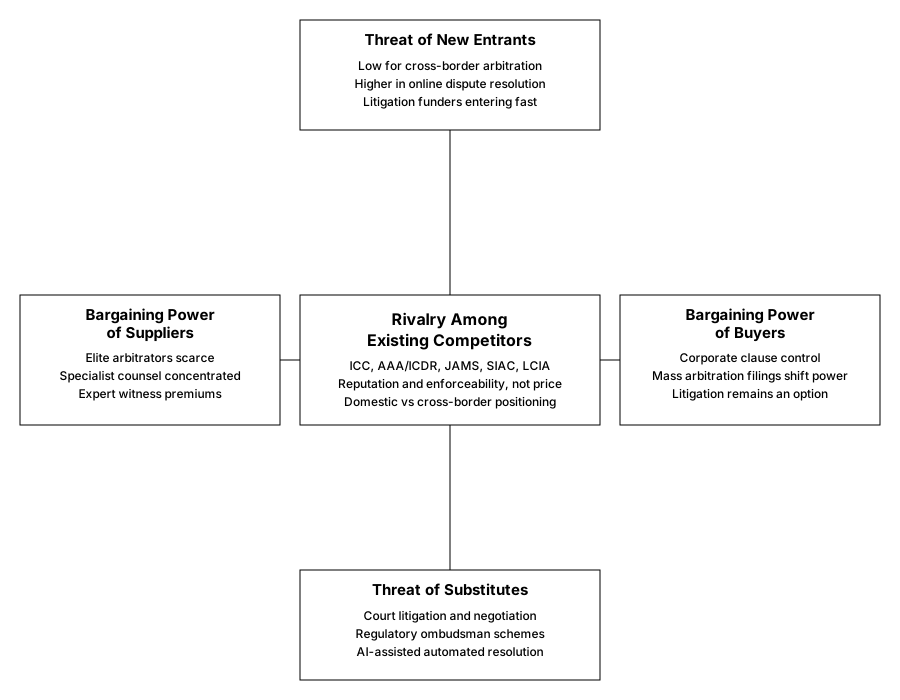
Porter's Five Forces framework clarifies why ADR institutions themselves earn modest margins while individual arbitrators, senior counsel and funders capture disproportionate value. Buyer power has risen as corporate legal departments professionalize procurement of arbitration services and negotiate panel composition directly into contracts. Supplier power, concentrated among elite arbitrators and expert witnesses, remains structurally strong because reputation cannot be manufactured quickly. Rivalry among institutions is intense on reputation and jurisdictional reach but muted on price, since fee schedules are publicly benchmarked and rarely used as a primary competitive weapon. Threat of new entry is low for cross-border commercial arbitration, given the decades required to build enforceable-award credibility, but meaningfully higher in digital ODR and niche domestic mediation. Threat of substitutes is real and growing, as litigation funding, negotiated settlement platforms and, in some jurisdictions, faster specialized courts pull volume away from traditional ADR channels.
Bargaining power of buyers
Corporate buyers, particularly general counsel at large multinationals, have gained meaningful leverage over the past decade by negotiating arbitration clauses that specify institution, seat, governing rules and even panel qualifications before any dispute arises. Repeat corporate users generate a large share of institutional case volume, giving them informal influence over administrative fee schedules and procedural timelines that occasional individual claimants cannot replicate. Insurance companies and financial institutions, as high-frequency users of arbitration for claims and contract disputes, similarly negotiate favorable terms directly with institutions or steer business toward preferred arbitrator panels.
Consumers and individual employees sit at the opposite end of this spectrum, typically bound by arbitration clauses they did not negotiate and cannot avoid, which historically left them with minimal power. That dynamic has partially inverted through mass arbitration, where plaintiffs' firms file thousands of near-identical individual claims simultaneously, forcing companies to pay filing fees on each one regardless of merit, creating settlement pressure that mirrors class-action leverage without the certification hurdles2. This has pushed institutions such as the AAA to adopt supplementary mass-arbitration rules that change fee allocation once claim volume crosses a threshold, altering the buyer-power calculus mid-relationship.
Government and sovereign buyers in investor-state disputes bring their own asymmetric power, since they can decline to consent to arbitration altogether or negotiate bespoke treaty terms that limit exposure. Across all buyer types, the credible alternative of litigation caps how far ADR institutions can push fees, since courts remain a viable, if slower, substitute for parties willing to accept that trade-off.
| Buyer type | Source of leverage | Constraint on leverage |
|---|---|---|
| Large corporate legal departments | High repeat case volume, clause-drafting control | Still bound by treaty and enforcement norms |
| Insurers and financial institutions | High-frequency filer relationships | Regulatory scrutiny of preferred-panel practices |
| Individual consumers and employees | Mass arbitration filing tactics | No control over original clause terms |
| Sovereign states | Treaty consent and negotiation | Reputational cost of withdrawing consent |
Bargaining power of suppliers
The most consequential suppliers in this industry are not vendors in a conventional sense but individual arbitrators, mediators and expert witnesses whose reputational capital cannot be substituted quickly. A small cohort of senior practitioners, often retired judges or veteran commercial litigators, sits on a disproportionate share of high-value international tribunals, giving this group considerable pricing power and scheduling influence over institutions eager to retain them3. Institutions have responded by actively expanding and diversifying rosters, but reputational trust takes years to establish, which limits how quickly new supply can be onboarded.
Specialist counsel representing parties in arbitration constitute a second supplier group with meaningful power, since complex commercial and investor-state matters require deep sector expertise that only a limited number of law firms credibly offer. Expert witnesses in technical fields, such as construction engineering, valuation or intellectual property, similarly command premium rates because institutions and parties cannot easily verify quality without relying on established reputational signals.
Technology vendors providing case-management systems, secure virtual hearing platforms and, increasingly, Artificial Intelligence-assisted document review represent a growing but still secondary supplier category. Their power remains moderate today because institutions can switch platforms without disrupting the underlying legal process, though this could shift as AI-native tools become embedded more deeply into case workflows. Overall, supplier power in this industry is unusually concentrated in individual human expertise rather than in physical inputs or capital equipment, a structural feature that keeps institutional margins thin even as overall industry revenue grows.
| Supplier type | Basis of power | Trend |
|---|---|---|
| Senior arbitrators and mediators | Scarce reputational capital | Institutions actively expanding rosters |
| Specialist arbitration counsel | Sector-specific expertise | Growing demand in technology and energy disputes |
| Technical expert witnesses | Verification difficulty for buyers | Stable, high per-case rates |
| Case-management technology vendors | Emerging workflow integration | Rising relevance with AI adoption |
Rivalry among existing competitors
Institutional rivalry centers on reputation, enforceability track record and jurisdictional reach rather than aggressive price competition. The ICC, the AAA and its International Centre for Dispute Resolution [ICDR], the London Court of International Arbitration [LCIA], the Singapore International Arbitration Centre [SIAC] and Hong Kong International Arbitration Centre [HKIAC] compete primarily for designation in cross-border contract clauses, a decision made years before any dispute arises and rarely revisited. Recent caseload data shows the ICDR posting consecutive years of double-digit case growth, closing the gap with the ICC as a preferred forum for cross-border commercial disputes, illustrating how competitive position can shift meaningfully even in a mature, reputation-driven market4.
Domestically within the United States, Judicial Arbitration and Mediation Services [JAMS] and the AAA compete intensely for commercial and consumer arbitration volume, with JAMS carrying a larger overall domestic caseload while remaining smaller internationally than the AAA's ICDR division. This bifurcation, domestic scale against international reach, defines much of the competitive positioning among leading institutions, since few providers credibly compete on both dimensions.
Rivalry intensifies in adjacent, lower-barrier segments such as ODR and workplace mediation, where regional and boutique providers compete on price, speed and sector specialization rather than global brand recognition. Because institutional switching costs are low for parties without existing clauses, this segment sees more frequent price and service-level competition than the entrenched commercial arbitration core. Across the industry, rivalry rarely erodes pricing directly but shows up instead in investment in technology, arbitrator roster quality and marketing toward corporate counsel and law firms who influence clause drafting.
| Competitive dimension | Leading players | Basis of rivalry |
|---|---|---|
| Global cross-border commercial arbitration | ICC, AAA/ICDR, LCIA, SIAC, HKIAC | Reputation, enforceability record |
| U.S. domestic commercial and consumer arbitration | AAA, JAMS | Roster depth, case volume |
| Investor-state dispute settlement | ICSID, ICC, permanent court of arbitration | Treaty designation, precedent |
| Online and lower-value dispute resolution | Regional and sector-specific ODR platforms | Speed, cost, technology |
Threat of new entrants
Barriers to entry are formidable in cross-border commercial and investor-state arbitration, where credibility rests on decades of enforceable awards, treaty recognition and an established roster of trusted arbitrators that cannot be assembled overnight. A new institution seeking to compete for major cross-border contract designations faces a chicken-and-egg problem: corporate counsel will not select an unproven forum and arbitrators of sufficient stature are reluctant to lend their reputation to an unproven institution. This dynamic has kept the top tier of the industry stable for decades, with the same handful of institutional names recurring across contract clauses globally.
Entry barriers are considerably lower in mediation, workplace conflict resolution and online dispute resolution, where technology-enabled platforms can launch with modest capital and compete on service speed for lower-value disputes. This segment has attracted venture-backed entrants building ODR tools for e-commerce marketplaces and business-to-consumer platforms, since the underlying dispute value and complexity do not require the same institutional gravitas as complex commercial arbitration. Regulatory requirements also vary:
some jurisdictions require minimal formal accreditation for mediators, while others impose licensing standards that raise entry costs
Litigation funders represent a distinct and more recent entrant category, competing not for administration fees but for a share of case economics and their entry has been comparatively rapid because it requires capital rather than institutional trust built over decades. Overall, the threat of new entry is bifurcated sharply:
negligible at the top of the market, meaningful in low-value, technology-enabled segments
| Entry barrier | Height | Segment most affected |
|---|---|---|
| Institutional reputation and precedent | Very high | Cross-border commercial and investor-state |
| Treaty and enforcement recognition | High | International arbitration |
| Technology platform development cost | Low to moderate | Online dispute resolution |
| Capital requirements for funders | Moderate | Litigation and arbitration funding |
Threat of substitutes
Traditional court litigation remains the most persistent substitute for arbitration and mediation and its relative attractiveness shifts with court backlog, procedural cost and jurisdiction-specific reforms. In jurisdictions where specialized commercial courts have improved speed and predictability, some corporate parties have reduced their reliance on arbitration clauses, narrowing the cost and time advantage that once justified ADR almost automatically. Direct negotiation and informal settlement, requiring no institutional involvement at all, continue to resolve the majority of commercial disagreements before they ever reach a formal ADR process, capping the addressable market for the industry.
Third-party litigation funding has emerged as a more disruptive substitute dynamic, not by replacing arbitration itself but by changing who controls the decision to pursue a claim and on what terms, with funders increasingly treating disputes as a financial asset class independent of the traditional adversarial process5. Specialized regulatory ombudsman schemes, particularly in financial services and telecommunications in Europe, offer a free or low-cost substitute for consumer disputes that would otherwise route into arbitration, eroding volume in that segment.
Artificial Intelligence-assisted negotiation and settlement tools, still nascent, pose a longer-horizon threat by automating the resolution of high-volume, low-complexity disputes without human arbitrators or mediators at all. For now, this substitute threat remains concentrated in low-value consumer and e-commerce disputes, but its trajectory bears close monitoring given how quickly generative Artificial Intelligence tools have moved into adjacent legal workflows.
| Substitute | Relevant segment | Trajectory |
|---|---|---|
| Traditional court litigation | Commercial and consumer disputes | Stable, jurisdiction-dependent |
| Direct negotiation and settlement | All segments | Consistently the largest volume outlet |
| Regulatory ombudsman schemes | Consumer financial and telecom disputes | Growing in Europe |
| AI-assisted automated resolution | Low-value e-commerce disputes | Early but accelerating |
Value chain and profit pools
The ADR value chain begins with clause origination, the drafting of arbitration or mediation provisions into commercial contracts, employment agreements and consumer terms of service, typically performed by transactional lawyers rather than ADR institutions themselves. This upstream stage determines which institution, rules and seat will govern any future dispute, making it disproportionately influential relative to its modest direct revenue contribution.
Case initiation and administration follows once a dispute arises, encompassing filing, fee collection, arbitrator or mediator appointment and procedural management, which is the core function institutions such as the ICC, AAA and JAMS perform directly. Hearing and adjudication, the substantive stage where arbitrators or mediators review evidence, hear argument and issue an award or facilitate settlement, is where the bulk of professional fees accrue, paid largely to the individual neutral rather than the institution.
Award enforcement and post-award services, including recognition proceedings in national courts and, occasionally, annulment challenges, form a distinct downstream stage that increasingly involves specialist enforcement counsel and, in cross-border cases, coordination across multiple jurisdictions. Financing and risk transfer, supplied by third-party litigation funders and after-the-event insurance providers, has emerged as a parallel value chain layer that intersects with case initiation and can materially influence which disputes get pursued at all. Enabling infrastructure, spanning case-management software, secure virtual hearing technology and data security compliance, supports every stage and has become a more significant cost and differentiation factor since the pandemic normalized remote hearings.
Profit pool
Profit concentrates disproportionately among individual arbitrators, senior counsel and, increasingly, litigation funders, rather than the institutions whose names appear on the arbitration clause. Institutional administrative fees are calibrated to cover operating costs and modest surplus, since institutions compete on reputation rather than margin extraction and fee schedules are public and benchmarked against peers. Senior arbitrators and mediators, by contrast, set day rates individually, often exceeding several thousand dollars per day for complex commercial and investor-state matters, capturing the majority of the professional fee pool with minimal institutional overhead deducted.
Litigation funders represent the most significant recent shift in profit concentration, having moved from a niche financing tool into a structured asset class that prices disputes on expected recovery and takes a substantial share, often a multiple of capital deployed or a percentage of the award, in exchange for underwriting the claimant's risk6. This has effectively created a second, more profitable layer above the traditional ADR value chain, one that captures value from successful claims without bearing the reputational constraints that discipline institutional fee-setting.
Consumer and mass arbitration economics have inverted profit dynamics in that narrower segment: plaintiffs' firms aggregating thousands of individual claims capture value through settlement leverage created by the fee structure itself, rather than through winning individual cases on the merits. This has made mass-claim origination, a capability closer to marketing and claimant aggregation than traditional legal practice, a surprisingly profitable niche within an otherwise conservative professional-services industry.
Industry economics and business models
Three business models dominate the industry, each with distinct economics. Institutional case administration operates a fee-for-service model, charging filing and administrative fees scaled to claim value, functioning much like a marketplace operator that earns a modest take rate for matching disputing parties with neutral decision-makers and providing procedural infrastructure. This model is asset-light, scalable in theory, but constrained in practice by the finite supply of credible arbitrators, which limits how fast institutions can grow caseload without diluting panel quality.
Independent arbitrator and mediator practice runs on a professional-services, time-and-expertise billing model, similar to elite legal or advisory practice, where revenue scales with reputation and availability rather than with any institutional platform. Many practitioners split time between arbitration panels and traditional legal practice, meaning the labor supply for this segment is only partially dedicated to ADR, creating structural scarcity that supports premium pricing.
Litigation and arbitration funding operates a distinct investment model, deploying capital against a portfolio of claims and earning returns tied to case outcomes, structurally closer to private credit or structured finance than to professional services. This model has attracted institutional capital precisely because it decouples returns from the operating economics of the ADR institutions themselves, offering funders a way to participate in dispute-driven value creation without competing directly for institutional market share.
Cost drivers and scalability
Institutional cost structures are dominated by fixed administrative overhead, including staff who manage case filings, arbitrator appointment logistics and rule administration, alongside variable costs tied directly to caseload, such as hearing room facilities and, increasingly, virtual hearing platform licensing. Because the marginal cost of administering an additional case is relatively low once core infrastructure exists, institutions benefit from economies of scale as caseload grows, though this benefit is capped by the need to maintain arbitrator panel quality, which does not scale as easily as administrative capacity.
For individual arbitrators and mediators, the relevant unit economics resemble a professional-services utilization model: revenue depends on billable days deployed against a finite calendar, meaning growth comes from either raising day rates, a function of reputation, or increasing appointment volume, which is constrained by the practitioner's other professional commitments. This creates a structural ceiling on how much any single practitioner can contribute to industry-wide capacity, reinforcing the scarcity dynamics that support supplier pricing power described earlier.
Mass arbitration has introduced a distinct scalability dynamic for institutions, since fee structures designed for individual, low-volume disputes were not built to absorb thousands of simultaneous filings, forcing institutions to redesign supplementary fee schedules to prevent administrative cost from outpacing revenue7. Online dispute resolution platforms exhibit more conventional digital scalability, with high fixed technology development cost offset by very low marginal cost per additional low-value dispute resolved, making this segment the most naturally scalable part of the industry, provided dispute complexity remains low enough for largely automated processes.
Moats, advantages and strategic levers
Reputational trust functions as the industry's primary moat, since parties select an institution or arbitrator based on confidence that an award will be enforceable, procedurally sound and respected by courts across jurisdictions, a form of credibility that competitors cannot buy or build quickly. This moat is reinforced by network effects among corporate counsel and law firms, whose collective clause-drafting habits create a self-reinforcing preference for established institutions that grows stronger as more contracts reference the same forum.
Switching costs, while low at the point of clause drafting, become extremely high once a dispute is underway, since parties cannot easily move a live case to a different forum or arbitrator without incurring substantial delay and cost. Regulatory and treaty-based moats protect the cross-border segment specifically, since enforceability under conventions such as the New York Convention depends on the seat and rules chosen, effectively locking in institutional relevance for decades once embedded in widely used contract templates.
Data and learning advantages are emerging as a newer strategic lever, particularly for institutions and technology vendors that can analyze historical case outcomes to improve arbitrator matching, predict case duration or flag procedural risk earlier, capabilities that are difficult for new entrants to replicate without access to a comparable historical caseload. Institutions that have invested early in structured case data are positioned to extend this advantage as Artificial Intelligence tools mature within legal workflows.
Strategic levers
Sector specialization represents the clearest lever for both entrants and incumbents, since building deep expertise in a specific vertical, such as construction, energy, technology licensing or intellectual property, allows a provider to compete credibly against generalist institutions without requiring decades of broad-based reputation. Geographic expansion into emerging arbitration seats, particularly jurisdictions investing in enforcement infrastructure and judicial support for arbitration, offers a second lever, allowing institutions to capture growing cross-border trade volume before competitors establish presence.
Vertical integration into adjacent value chain stages, particularly litigation funding or case-management technology, gives institutions and law firms a way to capture profit pools currently accruing to independent third parties, though this carries conflict-of-interest risks that must be carefully managed given the industry's reliance on perceived neutrality. Partnership strategies, such as institutions collaborating with technology vendors rather than building AI-assisted tools internally, allow faster capability deployment without diluting focus on core administrative credibility.
Ecosystem orchestration, positioning an institution or platform as the connective layer between corporate legal departments, arbitrators, funders and technology providers, offers the most ambitious lever, one that only the largest, most trusted institutions can credibly pursue given the reputational capital required to coordinate across these stakeholder groups.
Structural risks, regulation and trends
Regulatory risk is most acute in the consumer and employment arbitration segment, where legislative and judicial scrutiny over mandatory arbitration clauses continues to evolve, with U.S. state-level reforms such as California's fee-timeliness rules illustrating how quickly the rules governing fairness can shift8. Technology disruption presents a longer-term structural risk, as Artificial Intelligence-assisted negotiation and automated resolution tools mature and begin encroaching on the lower-value end of the dispute spectrum currently served by human mediators and arbitrators.
Geopolitical risk affects the industry unevenly: investor-state dispute settlement is directly exposed to shifts in international investment treaty policy, with some countries reconsidering or withdrawing from treaties that expose them to arbitration claims, while commercial arbitration is comparatively insulated given its contractual, rather than treaty-based, foundation. Concentration risk in the arbitrator talent pool poses a reputational and operational risk to institutions, since criticism over limited diversity and availability among senior arbitrators has prompted active roster expansion efforts across major institutions.
Secular demand drivers remain favorable overall: growing cross-border trade, the continued digitization of contracting through embedded arbitration clauses in software and platform agreements and persistent court backlogs in many jurisdictions all support continued ADR volume growth. Supply-side trends favor technology-enabled providers able to absorb rising case volume without proportional headcount growth, while the human-expertise core of complex commercial and investor-state arbitration remains resistant to full automation for the foreseeable future.
For entrants, the most viable strategic playbook favors a narrow niche over broad competition with entrenched institutions, building credibility in a specific sector or geography before attempting wider expansion and choosing partnership over outright acquisition when entering adjacent technology or funding capabilities to preserve focus and avoid conflict-of-interest complications. Regulatory strategy matters disproportionately in the consumer segment, where early, transparent fee design can preempt the kind of legislative backlash that has periodically disrupted mandatory arbitration practices.
For incumbents, defending market position requires continued investment in arbitrator roster diversity and quality, since reputational credibility remains the industry's core asset and erodes quickly if panel quality or procedural fairness is questioned publicly. Expansion should prioritize underserved geographic seats and sector niches over broad, undifferentiated growth, while deepening moats calls for closer, carefully governed integration with technology and funding providers to capture more of the value chain without compromising the neutrality that underpins institutional trust.
The credibility of an arbitration award depends less on the institution's name and more on whether the people who signed the contract still trust the process years later
Caselet: The American Arbitration Association
The American Arbitration Association [AAA], founded in 1926, offers a useful window into how institutional ADR economics actually work in practice, since it operates simultaneously as the dominant domestic commercial and consumer arbitration provider in the United States and, through its International Centre for Dispute Resolution [ICDR] division, as a major cross-border forum competing directly with the ICC.
History and structure
The AAA was established nearly a century ago to provide a private alternative to court litigation for commercial disputes and it built its early reputation by developing standardized arbitration rules that courts came to trust as procedurally sound. Its nonprofit structure is notable in an industry where institutional credibility depends on perceived neutrality:
as a not-for-profit organization, the AAA does not answer to shareholders seeking margin expansion, which has arguably supported its long-standing reputation for procedural fairness even as it has grown into a large-scale administrative operation handling hundreds of thousands of cases across commercial, consumer, labor and construction disputes
Operations and case administration
The AAA administers cases across a wide range of panels and rule sets tailored to dispute type, from complex commercial disputes to smaller consumer claims, charging filing and administrative fees scaled to claim value while paying arbitrators separately according to their own rate schedules. Its ICDR division has posted strong caseload growth in cross-border commercial matters, narrowing the gap with the ICC as a preferred forum for international disputes, driven partly by U.S. corporate counsel defaulting to a familiar domestic institution even for cross-border contracts9.
Responding to mass arbitration pressure
The AAA's experience with mass arbitration illustrates the industry's structural vulnerability to fee-design exploitation. When plaintiffs' firms began filing thousands of near-identical consumer and employment claims simultaneously, exploiting the rule that businesses bear the bulk of filing fees, the AAA faced a direct threat to its administrative capacity and its relationships with corporate clients who suddenly faced unpredictable fee exposure. The organization responded in 2024 by adopting mass-arbitration supplementary rules that automatically apply once a threshold of similar claims is filed, restructuring fee allocation and procedural handling to make mass-claim administration financially sustainable and it extended these rules further in 2025 to cover a broader range of case types.
Technology and modernization
More recently, the AAA has moved to integrate Artificial Intelligence into its offerings, including a beta clause-drafting tool intended to help transactional lawyers draft arbitration provisions correctly at the point of contract origination, the upstream stage that determines which forum ultimately gets designated. This positions the AAA to capture more of the value chain earlier, rather than simply waiting for disputes to arrive and reflects a broader industry recognition that clause origination, not just case administration, is where competitive positioning is increasingly won or lost.
Strategic lessons
The AAA's trajectory demonstrates several dynamics that recur across the industry: nonprofit governance can coexist with substantial scale and technological investment, reputational credibility built over decades remains difficult for competitors to replicate quickly and even the most established institutions must continuously redesign fee structures as claimant-side tactics evolve. Its dual domestic and international positioning, through the ICDR, also shows how a single institution can compete across otherwise distinct segments of this fragmented industry, provided it maintains credibility in both.
Quick facts
- Founded 1926, structured as a nonprofit
- Operates the International Centre for Dispute Resolution for cross-border cases
- Adopted mass-arbitration supplementary rules in 2024, expanded in 2025
- Introduced AI-assisted clause-drafting tools alongside traditional case administration
Alternative dispute resolution will keep expanding as global trade, digital contracting and court congestion push more conflict away from public litigation, but the industry's profit map will keep shifting toward the parties who control scarce expertise and capital, arbitrators, specialist counsel and funders, rather than the institutions whose names sit atop the arbitration clause. Companies that treat clause design, panel rights and funder exposure as deliberate strategic choices, rather than legal boilerplate, will capture more value from this industry than those that leave it to default templates.
Alternative dispute resolution sits between courts and negotiation, giving companies a private, contractually enforceable way to settle commercial, labor and consumer conflicts. The industry is asset-light, reputation-driven and unevenly profitable: arbitral institutions capture modest administrative fees while independent arbitrators, senior counsel and litigation funders take the larger share of value created. Growth is coming from cross-border trade, digital contracting and mandatory arbitration clauses, even as mass arbitration and funder-backed claims reshape bargaining power. The winning strategic levers are clause design, panel quality, technology-enabled case management and disciplined entry into adjacent funding and mediation markets, rather than scale for its own sake.
Citation
Cite this article
Sridharan, M. A. (2023, June 11). Industry Analysis: Alternative Dispute Resolution. Think Insights. https://thinkinsights.net/strategy/industry-analysis-alternative-dispute-resolution (Accessed [[ACCESS_DATE]])
Sridharan, Mithun A. "Industry Analysis: Alternative Dispute Resolution." Think Insights, 11 June 2023, https://thinkinsights.net/strategy/industry-analysis-alternative-dispute-resolution. Accessed [[ACCESS_DATE]].
Mithun A. Sridharan, "Industry Analysis: Alternative Dispute Resolution," Think Insights, June 11, 2023, https://thinkinsights.net/strategy/industry-analysis-alternative-dispute-resolution. Accessed [[ACCESS_DATE]].
Sridharan, M.A. (2023) 'Industry Analysis: Alternative Dispute Resolution', Think Insights. Available at: https://thinkinsights.net/strategy/industry-analysis-alternative-dispute-resolution (Accessed: [[ACCESS_DATE]]).
M. A. Sridharan, "Industry Analysis: Alternative Dispute Resolution," Think Insights, 2023. [Online]. Available: https://thinkinsights.net/strategy/industry-analysis-alternative-dispute-resolution. [Accessed: [[ACCESS_DATE]]].
Sridharan MA. Industry Analysis: Alternative Dispute Resolution. Think Insights. Published June 11, 2023. Accessed [[ACCESS_DATE]]. https://thinkinsights.net/strategy/industry-analysis-alternative-dispute-resolution
Test Your Knowledge
Industry Analysis: Alternative Dispute Resolution
Challenge yourself on the concepts from this article and see how well you understood them.
Subscribers get weekly quizzes and insights — subscribe free
Sponsor this article
Partner with Think Insights
Reach 50,000+ business leaders, consultants, and strategists. Feature your brand alongside expert articles on strategy, leadership, and digital transformation.
Become a Sponsor