Industry Analysis: Airlines and Aviation


Airlines will carry a record 5.2 billion passengers in 2026 on revenue nearing $1.1 trillion, yet the industry will keep less than four cents of every dollar as profit. Capital allocators should treat network carriers and low-cost carriers as distinct businesses: the former monetize loyalty programs and premium cabins, the latter monetize cost discipline and aircraft utilization. Aircraft manufacturers, lessors and global distribution intermediaries capture a growing share of value while airlines absorb fuel and labor volatility. The decision facing boards and investors is where to position within this chain, favoring loyalty and cargo units, aftermarket services and slot-constrained hub franchises over undifferentiated capacity growth, which destroys value even as traffic climbs.
Is the airline industry attractive for new entrants?
Attractiveness is narrow and segment-specific. Broad, full-network entry is nearly impossible given aircraft lead times, slot scarcity at congested hubs and certification costs, but focused entry into underserved regional routes, ultra-low-cost leisure niches or cargo-only operations remains viable, particularly where an incumbent has ceded a corridor or a new aircraft type unlocks previously uneconomic stage lengths.
Which parts of the value chain are most profitable?
Aircraft manufacturing, leasing and maintenance, repair and overhaul consistently post higher and steadier margins than flying the aircraft itself, because manufacturers and lessors operate in tighter oligopolies with pricing power, while airlines compete in fragmented, capacity-driven markets where fares get arbitraged down to near marginal cost.
How is technology changing this industry?
Dynamic and continuous pricing, biometric boarding, predictive maintenance using aircraft sensor data and Artificial Intelligence-driven revenue management are compressing the gap between list fare and willingness to pay, while digital distribution shifts bargaining power away from traditional travel agencies toward airlines that invest in direct booking channels.
What capabilities are table stakes vs differentiators?
Safety certification, fuel hedging discipline and baseline digital check-in are table stakes that every credible carrier must have; differentiators include proprietary loyalty data monetization, slot portfolios at capacity-constrained airports, premium cabin product design and the ability to flex capacity quickly across a diversified route network during demand shocks.
How should investors or consultants evaluate opportunities here?
Evaluate airlines less on revenue growth and more on unit economics: cost per available seat mile relative to peers, load factor trends, ancillary revenue per passenger and the proportion of profit generated by loyalty and cargo divisions, since these figures reveal whether a carrier is building a durable franchise or simply chasing traffic volume.
Why do airlines earn such thin margins despite high demand?
Airlines operate in a structurally overcapitalized industry where exit barriers are high, aircraft are highly mobile between markets and price transparency lets consumers arbitrage fares instantly, so even strong demand periods get competed down toward marginal cost unless a carrier holds a genuine network or cost advantage.
What role do airline alliances play in industry economics?
Alliances let carriers share code, coordinate schedules and jointly sell premium international itineraries without merging balance sheets, effectively creating scale and network reach that antitrust regimes would otherwise block through outright consolidation and immunized joint ventures on transatlantic and transpacific routes now function as de facto mergers on the most profitable long-haul corridors.
How exposed is the industry to fuel price volatility?
Fuel typically represents roughly a fifth to a quarter of operating costs and swings with global oil markets, geopolitical shocks and refining capacity, so carriers without disciplined hedging programs or modern, fuel-efficient fleets face earnings volatility that dwarfs anything happening on the demand side of their business.
Why do low-cost carriers keep gaining share from legacy network airlines?
Low-cost carriers strip out complexity, standardize fleets around a single aircraft type, fly point to point rather than through hubs and monetize ancillary fees separately from the base fare, producing a structurally lower cost per available seat mile that legacy carriers struggle to match on short and medium-haul routes.
What is the biggest strategic risk facing the industry over the next decade?
Sustainable aviation fuel mandates, aircraft delivery delays from a constrained manufacturing duopoly and rising airport and air traffic control infrastructure costs threaten to permanently raise the industry's cost base faster than carriers can pass those costs through in fares, particularly on price-sensitive short-haul routes.
Commercial aviation sits at an unusual intersection of capital intensity and commodity pricing. Airlines operate assets worth tens of millions of dollars per unit, employ some of the most tightly regulated and unionized workforces in the corporate world and sell a perishable product, an empty seat once the door closes, that generates zero revenue forever. The International Air Transport Association [IATA] projects industry revenue will approach $1.05 trillion in 2026, yet net profit margins are expected to hold at roughly 3.9%, a figure that would embarrass most other capital-intensive sectors.1 Understanding why an industry this large generates so little profit and where the profit that does exist actually accumulates, is the starting point for any serious strategic assessment.
Industry at a glance
Airlines and aviation, for the purposes of this analysis, covers commercial passenger carriers, dedicated air cargo operators and the regional and charter segments that feed traffic into larger networks. Adjacent industries, aircraft manufacturing, leasing and maintenance, repair and overhaul, are referenced only as context because their economics differ so sharply from the operators that fly the aircraft; a full treatment of those sectors belongs elsewhere. The core industry is overwhelmingly business-to-consumer for passenger operations and business-to-business for cargo and charter work, with a meaningful business-to-government component through defense charters, postal contracts and state ownership stakes that persist in many markets outside the United States and Europe.
The sector's dependence on adjacent industries is structural rather than incidental. Airlines cannot function without airport infrastructure they rarely own outright, air traffic control systems typically run by national or regional authorities and a duopoly of large aircraft manufacturers whose delivery schedules dictate fleet planning years in advance. Fuel refining capacity, another externally controlled input, drives a cost line that can swing tens of billions of dollars industry-wide within a single year depending on crude prices. This web of dependencies means airlines carry enormous operating leverage without controlling most of the variables that determine their cost base, a condition that shapes nearly every strategic decision examined later in this analysis.
Revenue models split cleanly into three streams that IATA tracks separately: passenger ticket revenue, projected at $751 billion in 2026, cargo revenue at roughly $158 billion and ancillary revenue, covering baggage fees, seat selection, loyalty program sales and onboard purchases, expected to reach $145 billion.2 Passenger numbers are forecast to hit 5.2 billion in 2026 and load factors, the percentage of available seats actually filled, are expected to set a record at 83.8%, evidence that airlines have become far more disciplined about matching capacity to demand than they were two decades ago. Capital intensity remains extreme: a single wide-body aircraft costs well over $200 million at list price, though airlines typically negotiate substantial discounts and fleets require constant reinvestment to stay compliant with noise, emissions and safety standards. Labor intensity is similarly high, with pilots, cabin crew, maintenance technicians and ground staff represented by some of the most powerful unions in any industry, giving labor a structural claim on any operating leeway a carrier generates.
Industry segmentation
The clearest way to segment the industry is by business model and route structure, because these two dimensions explain more variance in profitability than geography or fleet size. Full-service network carriers operate hub-and-spoke systems, connect passengers through central airports and monetize a mix of economy, premium economy, business and first-class cabins alongside cargo capacity in the belly of the aircraft. Low-cost carriers strip the model down to point-to-point routes, a single aircraft type to simplify maintenance and crew training and unbundled fares where nearly every service beyond the seat itself carries a separate charge.
Ultra-low-cost carriers push this further still, treating the base fare as almost a loss leader and relying on ancillary revenue to reach profitability, a model that works only with extremely tight cost control and high aircraft utilization. Regional carriers, often operating under a larger airline's brand through capacity purchase agreements, feed passengers from smaller cities into major hubs using smaller aircraft that would be uneconomical for a mainline carrier to fly directly. Cargo-focused operators, whether pure freighters or integrators that also run their own logistics networks, serve business-to-business customers almost exclusively and follow demand cycles tied to global trade and e-commerce rather than leisure and business travel patterns. Charter and leisure carriers round out the picture, operating seasonal or route-specific capacity tied to package holiday demand, often with less predictable year-round utilization than scheduled carriers. Each segment carries a distinct cost structure, customer relationship and sensitivity to fuel and currency swings, which is why comparing a full-service network carrier's margins directly against an ultra-low-cost carrier's margins without adjusting for model tends to mislead rather than inform.
Market structure
Applying Porter's Five Forces to commercial aviation reveals an industry where nearly every structural force pushes against sustained profitability, with only slot scarcity and loyalty program switching costs offering airlines any real leverage. Suppliers, particularly aircraft manufacturers and organized labor, extract disproportionate value relative to the risk they carry. Buyers benefit from radical price transparency through online search, while rivalry stays intense because exit barriers, not entry barriers, keep excess capacity in the market long after it should have left. New entrants find genuine barriers at the network level but real openings in focused niches and substitutes, from high-speed rail to videoconferencing, cap pricing power on specific corridors even where no other airline competes directly.
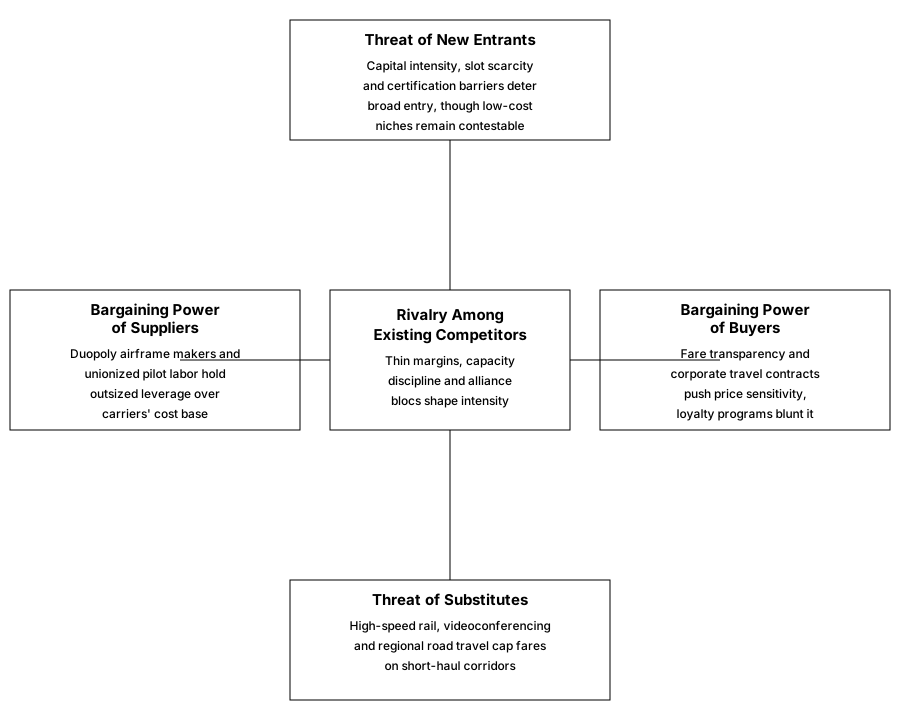
Bargaining power of buyers
Passengers and corporate travel buyers hold meaningful leverage in this industry, driven primarily by price transparency. Metasearch engines and online travel agencies let consumers compare fares across dozens of carriers within seconds and because a seat on one airline's flight is often functionally interchangeable with a seat on a competitor's flight covering the same route and time window, price becomes the dominant selection criterion for a large share of leisure travelers. Corporate travel departments amplify this dynamic further, negotiating volume discounts directly with airlines and routing bookings through managed travel programs that pit carriers against each other on price and schedule convenience.
Airlines counter this pressure primarily through loyalty programs, which create switching costs by rewarding repeat purchases with status tiers, upgrades and mileage redemptions that lose value if a traveler splits volume across multiple carriers. Premium cabin passengers and business travelers, who are less price-sensitive than leisure travelers, generate a disproportionate share of profit relative to their share of seats, giving airlines an incentive to protect and expand this segment even as economy fares stay under constant pressure. Cargo customers, typically freight forwarders and large shippers, negotiate rates based on committed volume and exert buyer power similar to corporate travel accounts, though with less brand loyalty since cargo space is even more commoditized than passenger seats.
| Buyer segment | Source of leverage | Airline countermeasure |
|---|---|---|
| Leisure travelers | Price comparison tools, low switching costs | Ancillary bundling, dynamic pricing |
| Corporate travel buyers | Volume negotiation, managed programs | Corporate loyalty tiers, capacity guarantees |
| Premium and business travelers | Multiple carrier options on major routes | Lounge access, elite status, cabin differentiation |
| Freight forwarders and shippers | Multi-carrier freight options | Committed capacity contracts, charter agreements |
Bargaining power of suppliers
Suppliers hold structurally strong leverage over airlines, a rare condition in a market this large. Aircraft manufacturing operates as a global duopoly for narrow-body and wide-body jets, meaning airlines negotiating fleet orders face just two credible suppliers for most aircraft categories and order backlogs stretching years into the future strip carriers of any real timing leverage. Engine manufacturers operate in a similarly concentrated market and because engines require long-term maintenance contracts tied to the original purchase, airlines often lock into a single supplier relationship for the operational life of an aircraft.
Labor represents the second major source of supplier power. Pilots, in particular, are represented by unions with substantial bargaining leverage because training a replacement pilot takes years and because a strike or slowdown can ground an entire operation almost immediately. Airports and air navigation service providers add a third layer of supplier concentration, since a carrier cannot simply choose a cheaper airport if its route network requires access to a specific city and landing slots at congested hubs like London Heathrow or New York's LaGuardia are effectively fixed in supply. Fuel suppliers complete the picture and while fuel itself trades as a global commodity, airlines have little influence over the refining capacity or crude price dynamics that determine what they pay.
| Supplier category | Concentration | Impact on airline cost base |
|---|---|---|
| Airframe manufacturers | Global duopoly | Multi-year order backlogs, limited price negotiation |
| Engine manufacturers | Concentrated oligopoly | Long-term maintenance lock-in |
| Pilot and crew unions | High, carrier-specific | Wage inflation, scheduling rigidity |
| Slot-constrained airports | Fixed capacity | Premium landing and gate fees |
| Fuel refiners and traders | Commodity market | Volatile input cost exposure |
Rivalry among existing competitors
Competitive intensity in commercial aviation stays elevated primarily because exit barriers, not entry barriers, keep capacity in the market well past the point where it makes economic sense. An aircraft can be repositioned to another route, leased to another carrier or parked temporarily, but it rarely disappears from the global fleet entirely, which means overcapacity in one market segment tends to persist rather than self-correct through bankruptcy and asset scrapping the way it might in industries with more perishable capital.
Alliance structures shape rivalry in a distinctive way. Star Alliance, Oneworld and SkyTeam group the world's major carriers into three blocs that coordinate schedules, share codes and jointly market long-haul itineraries, effectively converting what would otherwise be head-to-head competition on international routes into cooperation within each bloc and competition between blocs. Star Alliance currently leads with roughly 17.4% of global passenger share, ahead of SkyTeam at 13.7% and Oneworld at 11.9% and alliance membership has kept shifting as carriers change allegiance following mergers and equity stakes.3 Low-cost carriers add a separate axis of rivalry entirely outside the alliance system, competing on cost structure rather than network reach and steadily gaining share on short and medium-haul routes where connecting itineraries matter less. Domestic markets in large economies like the United States and China have consolidated into a small number of major carriers, reducing the number of direct competitors on many routes even as international long-haul rivalry stays fragmented and intense.
| Competitive dimension | Dynamic | Strategic implication |
|---|---|---|
| Alliance bloc competition | Three dominant global groupings | Network reach without full merger |
| Low-cost versus legacy rivalry | Structural cost gap on short-haul | Margin pressure on economy fares |
| Domestic market concentration | Few major carriers per large market | Reduced rivalry on protected routes |
| International long-haul competition | Fragmented, capacity-driven | Persistent fare pressure |
Threat of new entrants
Genuine barriers protect the industry's core network structure even as focused entry keeps happening at the margins. Aircraft acquisition alone requires either enormous upfront capital or a leasing relationship that still demands strong credit and operating history and new manufacturing orders now carry lead times of several years given the current backlog at both major airframe makers. Regulatory certification, covering everything from operating licenses to safety audits, takes years to complete and effectively rules out overnight entry by outside capital.
Slot scarcity at the world's busiest airports adds a second, often decisive barrier, because a new entrant cannot serve a congested hub without acquiring takeoff and landing rights that incumbents typically hold and rarely relinquish voluntarily. Despite these barriers, entry keeps happening successfully in narrower forms: low-cost and ultra-low-cost startups target underserved secondary airports where slots are available and costs are lower, regional carriers enter through capacity purchase agreements with larger partners rather than building brand recognition from scratch and cargo-only operators enter routes that scheduled passenger carriers have deprioritized. The pattern suggests the industry is closed to broad, full-network entry but remains genuinely open to focused entry that avoids competing head-on with incumbents' core hub assets.
| Entry barrier | Severity | Where entry still succeeds |
|---|---|---|
| Aircraft capital requirements | High | Leasing arrangements, smaller fleet types |
| Regulatory certification | High, multi-year process | Partnership with established operating certificate holders |
| Slot access at major hubs | Severe at congested airports | Secondary and underserved airports |
| Brand and loyalty recognition | Moderate | Price-led ultra-low-cost positioning |
Threat of substitutes
Substitution pressure varies enormously by route length and purpose of travel. High-speed rail poses a credible substitute on short and medium-haul corridors where a train can match or beat door-to-door travel time once airport transit and security are factored in, a dynamic already visible on routes across Western Europe, Japan and increasingly China, where rail investment has captured meaningful share from short-haul flying. Videoconferencing technology, accelerated in adoption during the pandemic era, permanently displaced a portion of business travel that once required a flight, particularly for routine internal meetings that companies now handle remotely without a noticeable loss of effectiveness.
Road travel, whether by car or intercity bus, substitutes for aviation on very short routes and among price-sensitive travelers, though it rarely threatens medium and long-haul demand given the time penalty involved. Long-haul international travel faces almost no credible substitute today, since no alternative mode can move passengers across oceans and continents within a comparable timeframe, which is precisely why long-haul premium cabins remain among the industry's most defensible profit pools. The overall substitution threat therefore concentrates heavily on short-haul, price-sensitive segments while leaving long-haul and premium travel comparatively insulated.
| Substitute | Route segment affected | Competitive pressure |
|---|---|---|
| High-speed rail | Short and medium-haul, dense corridors | High where rail infrastructure exists |
| Videoconferencing | Business travel, routine meetings | Structural, permanent demand reduction |
| Road and bus travel | Very short-haul, price-sensitive segments | Moderate, mainly at the margin |
| Long-haul alternatives | International, cross-continental routes | Minimal, no comparable substitute exists |
Value chain and profit pools
The airline value chain runs from aircraft and engine manufacturing through leasing and financing, into the actual operation of scheduled flights and finally into ground handling, distribution and the loyalty and ancillary systems that monetize the passenger relationship beyond the base fare. Upstream, manufacturers and their supply chains of engine and component makers set the pace of fleet renewal and effectively dictate the fuel efficiency and reliability characteristics every airline must work within. Aircraft leasing companies sit adjacent to this stage, financing a substantial share of the global fleet and allowing airlines to operate modern aircraft without tying up capital in outright ownership, though at the cost of ongoing lease payments that behave much like fixed costs.
The production stage, in this industry, is the flight operation itself: crew scheduling, maintenance planning, fuel procurement and the physical execution of the flight schedule. This is where airlines exercise the most direct operational control and where cost discipline separates profitable carriers from struggling ones, since two airlines flying similar routes with similar aircraft can post very different unit costs based on crew productivity, aircraft utilization rates and maintenance efficiency. Distribution and customer interface, historically dominated by global distribution systems and travel agencies, has shifted meaningfully toward direct airline websites and apps, giving carriers more control over pricing and a direct data relationship with passengers that supports personalized offers and loyalty program engagement. Ground handling and airport services form a distinct stage, often outsourced to specialist providers who manage baggage, aircraft turnaround and gate operations, particularly at airports where an airline lacks the scale to justify running its own ground crew.
Enabling infrastructure, spanning air traffic control, airport ownership and aviation regulation, sits outside any single airline's control yet shapes cost and capacity at every other stage of the chain. Loyalty program management has effectively become its own value chain stage in recent years, operating almost as a separate financial business that sells miles to co-branded credit card partners and generates cash flow largely independent of flight operations, a structural shift examined further in the profit pool discussion below.
Profit pool
Profit concentrates unevenly across this chain and the pattern has shifted meaningfully over the past two decades. Aircraft manufacturing and leasing historically captured stronger, steadier margins than flying the aircraft, since a duopoly market structure with long order backlogs gives manufacturers pricing power that fragmented, capacity-driven airline markets simply do not have. Maintenance, repair and overhaul services follow a similar pattern, with specialized providers and manufacturer-affiliated service networks earning healthier margins on parts and labor than the airlines whose aircraft they service.
Within the airline segment itself, the clearest recent shift has been the rise of loyalty programs as a distinct and often more profitable business than flying. Major network carriers now generate substantial cash flow from selling miles to banks that use them to reward credit card spending, a business with far lower capital intensity and volatility than scheduled flying and several carriers have restructured their loyalty programs into separate financial entities partly to make this value visible to investors. Cargo has also become a more significant swing factor in profitability, particularly for carriers with substantial wide-body freighter capacity, since cargo demand cycles do not always move in lockstep with passenger demand and can offset softness in one segment with strength in the other. Premium cabins on long-haul international routes remain a durable profit pool because business and first-class fares carry margins far exceeding economy and the routes where genuine competition for premium traffic is limited, often slot-constrained hub pairs, produce the airline industry's closest approximation of pricing power.
Industry economics and business models
Three business model patterns dominate commercial aviation and each implies a distinct cost structure and growth strategy. The full-service network model relies on hub-and-spoke connectivity to aggregate demand across thousands of city pairs that could not support direct service on their own, cross-subsidizing thinner routes with stronger ones and monetizing a mixed cabin structure where premium passengers fund a large share of total profit. This model is asset-heavy, carries high fixed costs tied to hub infrastructure and long-haul fleets and depends heavily on alliance partnerships to extend reach beyond what a single carrier's fleet could cover alone.
The low-cost, point-to-point model strips out connectivity complexity in favor of a single aircraft type, rapid gate turnarounds and unbundled pricing that separates the base fare from every ancillary service. This model trades network breadth for cost efficiency, achieving a materially lower cost per available seat mile that lets it undercut legacy carriers on price while still reaching profitability through high aircraft utilization and ancillary revenue capture. A third pattern, increasingly significant, treats the airline as a two-sided platform connecting travelers with a broader ecosystem of financial services, retail partners and travel-adjacent products through the loyalty program, generating revenue streams that are transaction-based rather than tied directly to flight operations and that carry structurally higher margins than the flying business itself. Cargo-focused operators represent a fourth, narrower pattern built around fee-for-service logistics economics rather than passenger demand cycles, with revenue tied to global trade volumes and e-commerce growth rather than tourism or business travel patterns.
Cost drivers and scalability
Airline cost structures split into a large fixed and semi-fixed component and a smaller but volatile variable component. Aircraft ownership or lease payments, crew base salaries, airport gate and slot fees and insurance all behave as largely fixed costs that an airline incurs regardless of how many passengers board a given flight, which is precisely why load factor matters so intensely to profitability: every additional passenger on an already-scheduled flight contributes revenue at close to pure margin once the fixed costs of operating that flight are covered. Fuel represents the largest genuinely variable cost, typically accounting for a fifth to a quarter of total operating expense and swinging significantly with global oil prices, which is why disciplined hedging programs and fuel-efficient fleets translate directly into competitive advantage during periods of price volatility.
Economies of scale operate powerfully in this industry through network density and fleet standardization. A carrier with more routes radiating from a hub can offer more connection options, attracting more transfer traffic and filling more seats on every leg of the network, a self-reinforcing dynamic that rewards scale disproportionately once a hub reaches a critical mass of connections. Fleet standardization around a smaller number of aircraft types, the approach low-cost carriers have pushed furthest, reduces training, spare parts and maintenance costs by letting crews and technicians work across the entire fleet rather than specializing by aircraft type. Unit economics in this industry center on cost per available seat mile and revenue per available seat mile and the gap between the two, sometimes just a few cents, determines whether a carrier is profitable or not; airlines that manage to widen this gap even marginally, through better fuel efficiency, higher load factors or stronger ancillary monetization, compound that advantage across billions of seat miles flown annually.
Moats, advantages and strategic levers
Durable competitive advantage in this industry is scarcer than the size of the market might suggest and it tends to concentrate around a small number of structural sources rather than broad-based excellence in operations. Slot access at capacity-constrained airports functions as close to a genuine regulatory moat as exists in commercial aviation, because slots are finite, historically allocated to incumbents and extremely difficult for a new entrant to acquire in meaningful volume, giving carriers that hold strong slot portfolios at major hubs like London Heathrow, Tokyo Haneda or New York's LaGuardia a durable advantage on those specific routes regardless of how efficient a competitor's cost structure might be elsewhere.
Loyalty program switching costs represent the second major moat, since frequent travelers accumulate status and mileage balances that lose value the moment they split spending across carriers, locking in a behavioral pattern that price alone often cannot break, particularly among business travelers whose employers are indifferent to which carrier earns the loyalty points. Network density creates a scale advantage that compounds over time, as a hub carrier's ability to offer more connections attracts more transfer traffic, which in turn supports more direct routes, in a cycle that smaller competitors struggle to replicate without matching the underlying hub investment. Cost leadership, the primary advantage low-cost carriers pursue, functions as a genuine moat only when sustained through operational discipline across fleet standardization, crew productivity and aircraft utilization simultaneously, since any one of these slipping erodes the cost gap that justifies the entire business model. Data advantages are emerging as a newer source of differentiation, with carriers that have built sophisticated revenue management and personalization systems extracting meaningfully more revenue per passenger than competitors relying on simpler, less dynamic pricing approaches.
Strategic levers
Executives evaluating a position in this industry have a limited but consequential set of levers available. Customer segment focus is the most immediate:
a carrier can choose to concentrate on price-sensitive leisure travel, business and premium travel, or cargo and each choice implies a different fleet, network and cost structure, making a hybrid strategy across all three genuinely difficult to execute well without diluting the cost or service advantages that make any single focus work
Vertical integration versus partnering represents a second major lever, particularly around loyalty program monetization, ground handling and maintenance capability, where carriers must decide whether to build these functions internally for control or outsource them to specialists for cost efficiency and capital discipline. Geographic expansion through alliance membership or joint ventures offers a way to extend network reach without the capital burden of building routes independently and immunized joint ventures on transatlantic and transpacific corridors have effectively let major carriers behave as merged entities on their most profitable long-haul routes without the regulatory complexity of an outright merger. Ecosystem orchestration through loyalty programs has become an increasingly important lever, as carriers that build strong co-branded credit card and retail partnerships around their loyalty currency generate a revenue stream that diversifies away from the volatility of flight operations entirely. Capacity discipline, holding growth below what a carrier's balance sheet might technically support, remains perhaps the least glamorous but most financially consequential lever, since the industry's history is littered with carriers that grew capacity into demand cycles that later reversed, leaving them overleveraged precisely when revenue softened.
Structural risks, regulation and trends
Several structural risks shape long-term industry economics beyond the ordinary cyclicality of travel demand. Regulatory risk is rising through sustainable aviation fuel mandates now being phased in across major markets, which will raise fuel costs meaningfully before alternative fuel supply scales to a level that brings prices down, creating a multi-year period where compliance costs outpace the industry's ability to pass them through fully in fares. Aerospace supply chain constraints have delayed aircraft deliveries from both major manufacturers for several years running, forcing carriers to keep older, less fuel-efficient aircraft in service longer than planned and constraining the capacity growth many carriers had built into their fleet plans.4 Geopolitical risk remains ever-present given the industry's dependence on overflight rights, airspace access and fuel markets that can be disrupted overnight by conflict and carriers with route networks concentrated in politically volatile regions carry a risk premium that more diversified competitors avoid.
Commodity price exposure through fuel remains the single largest source of earnings volatility industry-wide and IATA's own forecasts show how sensitive profitability is to fuel price assumptions even when demand growth stays robust. Demand-side trends remain broadly favorable, with passenger volumes forecast to keep growing as emerging market middle classes expand air travel access, though this growth increasingly concentrates in Asia-Pacific markets rather than the mature North American and European markets that dominated the industry for decades.5 Supply-side trends point toward continued consolidation in mature markets, where a small number of major carriers already control the bulk of domestic capacity, alongside fragmentation in emerging markets where new low-cost entrants keep launching to serve growing demand that established carriers have not yet captured.
For entrants considering this industry, the playbook favors narrow over broad positioning almost without exception: a focused low-cost or ultra-low-cost model targeting underserved secondary markets, or a cargo-only operation serving trade lanes that passenger carriers have deprioritized, offers a realistic path to profitability that a full-network, hub-and-spoke entry simply does not. Partnering through capacity purchase agreements or alliance affiliation, rather than building brand recognition and network reach independently, compresses the time to viable scale considerably. Regulatory strategy matters disproportionately in this industry and carriers that engage early with sustainable aviation fuel policy and slot allocation processes tend to secure more favorable positioning than those that treat regulation as a cost to absorb passively after the fact.
Incumbents face a different set of choices centered on defending existing advantages while selectively expanding. Defending slot portfolios and loyalty program value against low-cost competitive pressure requires continued investment in premium product differentiation, since price alone cannot be the basis of defense against carriers whose entire cost structure is built to compete there. Expanding through alliance deepening and joint venture immunization, rather than organic network growth alone, lets incumbents capture more long-haul profit pool without matching the capital intensity of unilateral expansion. Deepening moats increasingly means investing in the loyalty and cargo businesses as distinct profit centers with their own strategic plans, rather than treating them as byproducts of the core flying operation, a shift that several major carriers have already begun executing through more explicit financial reporting and even partial monetization of loyalty program equity.
The industry's economics reward capacity discipline and network density far more consistently than they reward growth for its own sake
Southwest Airlines and the discipline of a single model
Southwest Airlines offers the clearest public illustration of how a disciplined business model can sustain a durable cost advantage over decades in an industry where most competitive advantages erode quickly. Founded in 1967 by Herb Kelleher and Rollin King, the airline began flying in 1971 as an intrastate carrier connecting Dallas, Houston and San Antonio, a modest starting point that nonetheless established the point-to-point route philosophy the airline has never abandoned.6 Unlike nearly every other major carrier in the United States, which eventually adopted hub-and-spoke networks to aggregate connecting traffic, Southwest built its entire operation around flying passengers directly between city pairs, avoiding the complexity and cost of large connecting hubs.
Industry at a glance applied
Southwest's operating model demonstrates several of the structural forces examined throughout this analysis in concentrated form. Fleet standardization around the Boeing 737 family, maintained consistently since the airline's founding, keeps training, maintenance and spare parts costs meaningfully lower than carriers operating mixed fleets across multiple aircraft types. This single decision touches nearly every cost driver discussed earlier:
crews can be scheduled across the entire fleet without type-specific certification constraints, maintenance technicians specialize deeply in one airframe rather than spreading expertise thin and spare parts inventory stays concentrated rather than fragmented across incompatible aircraft families
Market structure applied
Southwest's position within the five forces framework explains much of its historical resilience. The point-to-point network sidesteps the intense hub competition that defines rivalry among the major legacy network carriers, since Southwest rarely competes head-on for connecting traffic the way American, Delta and United do at their respective hubs. Its cost structure gives it meaningful insulation against buyer price pressure, since Southwest can profitably match fares that would be uneconomical for a higher-cost legacy competitor to sustain. The airline's customer-friendly policies, including no change fees and two free checked bags for years after competitors began charging for both, functioned as a differentiation lever against low-cost rivals even as Southwest maintained a cost base competitive with the leanest carriers in the market.
Strategic levers applied
Southwest's growth strategy has consistently favored organic network expansion into underserved or overpriced markets rather than acquisition-led consolidation, a choice that preserved the operational simplicity underpinning its cost advantage. The airline has increasingly had to adapt this model as the broader low-cost segment has matured and ultra-low-cost carriers with even leaner cost structures have entered markets Southwest once had largely to itself, pushing the airline toward incremental changes in seating, boarding and fare bundling that represent a meaningful departure from its historical simplicity. This tension illustrates a broader industry lesson:
even the most durable operating model requires continuous adaptation as competitive dynamics shift and no cost advantage, however deeply embedded in operational history, remains permanently immune to erosion from newer, leaner competitors entering the same segment
Structural risks and trends applied
Southwest's experience also illustrates fuel and labor cost exposure common across the industry, since its single-fleet strategy, while efficient, concentrates risk around one aircraft family's reliability and regulatory standing rather than diversifying that exposure across multiple aircraft types. The broader lesson for strategists is that a genuinely differentiated operating model, sustained with discipline over decades, can produce structural cost advantages that persist even in an industry defined by thin margins and intense rivalry, but sustaining that advantage requires continuous investment and adaptation rather than treating the original model as a permanent solution.
Airlines move people and goods at a scale no other transport mode matches, underwriting global trade, tourism and business connectivity. The industry's economics remain punishing by design: heavy fixed costs, cyclical demand and suppliers who capture more value than the operators flying their equipment. Winners separate the flying business from the loyalty and cargo businesses, hedge fuel and currency exposure deliberately and defend slot-constrained hubs as the closest thing to a durable moat this industry offers. Consolidation, alliance economics and premium-cabin demand will keep reshaping who profits, but the structural lesson holds: capacity discipline and ancillary monetization matter more than growth for its own sake.
Citation
Cite this article
Sridharan, M. A. (2023, May 22). Industry Analysis: Airlines and Aviation. Think Insights. https://thinkinsights.net/strategy/industry-analysis-airlines-and-aviation (Accessed [[ACCESS_DATE]])
Sridharan, Mithun A. "Industry Analysis: Airlines and Aviation." Think Insights, 22 May 2023, https://thinkinsights.net/strategy/industry-analysis-airlines-and-aviation. Accessed [[ACCESS_DATE]].
Mithun A. Sridharan, "Industry Analysis: Airlines and Aviation," Think Insights, May 22, 2023, https://thinkinsights.net/strategy/industry-analysis-airlines-and-aviation. Accessed [[ACCESS_DATE]].
Sridharan, M.A. (2023) 'Industry Analysis: Airlines and Aviation', Think Insights. Available at: https://thinkinsights.net/strategy/industry-analysis-airlines-and-aviation (Accessed: [[ACCESS_DATE]]).
M. A. Sridharan, "Industry Analysis: Airlines and Aviation," Think Insights, 2023. [Online]. Available: https://thinkinsights.net/strategy/industry-analysis-airlines-and-aviation. [Accessed: [[ACCESS_DATE]]].
Sridharan MA. Industry Analysis: Airlines and Aviation. Think Insights. Published May 22, 2023. Accessed [[ACCESS_DATE]]. https://thinkinsights.net/strategy/industry-analysis-airlines-and-aviation
Test Your Knowledge
Industry Analysis: Airlines and Aviation
Challenge yourself on the concepts from this article and see how well you understood them.
Subscribers get weekly quizzes and insights — subscribe free
Sponsor this article
Partner with Think Insights
Reach 50,000+ business leaders, consultants, and strategists. Feature your brand alongside expert articles on strategy, leadership, and digital transformation.
Become a Sponsor