Industry Analysis: Agriculture


Treat agriculture as an integrated operating system, not simply farm production. Value accrues unevenly across the chain: input suppliers, branded processors, logistics owners, and retailers often capture more dependable margins than growers exposed to weather and commodity prices. Investors and operators should therefore assess control of data, water, genetics, processing capacity, and route to market before assessing acreage alone. Agriculture supplies food, feed, fiber, and renewable inputs, making it strategically central to household welfare, industrial supply, trade, and public stability. Bargaining power is moving toward concentrated buyers, technology platforms, and providers of scarce inputs, while climate volatility increases the value of resilient production systems. Winning firms combine biological expertise with disciplined capital allocation, market access, and risk management
Is agriculture attractive for new entrants?
It is attractive when an entrant targets a specific production constraint, crop system, or channel rather than competing across a broad commodity market.
Which parts of the value chain are most profitable?
Differentiated inputs, processing, branded products, specialized logistics, and market infrastructure often earn steadier returns than undifferentiated primary production.
How is technology changing agriculture?
Sensing, automation, software, genetics, and analytics reduce information gaps and improve decisions, but they create value only when integrated into farm and supply-chain workflows.
What capabilities are table stakes versus differentiators?
Agronomic competence, compliance, reliable operations, and market access are table stakes. Superior genetics, proprietary data, processing capability, and customer relationships differentiate.
How should investors and consultants evaluate opportunities here?
Examine biological risk, water exposure, unit economics, working-capital needs, customer concentration, processing bottlenecks, and the ability to pass costs through the chain.
Why do growers often earn volatile returns?
They sell into markets shaped by weather, global supply, input costs, and buyer concentration while production decisions are made months before final prices are known.
Can digital agriculture create a durable moat?
Yes, when software becomes embedded in operating decisions and combines proprietary farm data with services, distribution, or financing.
What does climate change mean for agriculture strategy?
It changes crop suitability, water availability, pest pressure, insurance economics, and the value of geographic diversification.
Why does processing matter so much?
Processing can reduce perishability, standardize quality, create product differentiation, and move a business nearer to the customer.
What should incumbents defend first?
They should defend trusted grower relationships, physical throughput, supply reliability, and the data flows that link production to customer demand.
Agriculture is often described as a primary sector, which understates its commercial complexity. The sector is a distributed production network exposed to biological cycles and weather, then connected to capital-intensive processing, logistics, retail, food service, and export systems. Strategy starts with a precise question: which actor owns the scarce constraint, absorbs the risk, and captures the economic rent when the crop moves from field to final user?
Industry at a glance
Agriculture covers cultivation of crops, livestock production, aquaculture, and closely linked on-farm activities that generate food, feed, fiber, fuel inputs, and industrial materials. This analysis includes the commercial system immediately surrounding production: seeds and genetics, fertilizer and crop-protection products, farm machinery, irrigation, storage, primary processing, trading, and agricultural services. It does not treat grocery retail, restaurants, or unrelated consumer packaged goods as agriculture, although their buying behavior directly affects the sector.
The sector serves business-to-business, business-to-consumer, and government customers. Grain growers supply feed mills, exporters, processors, and biofuel producers. Fresh-produce operations sell through packers, distributors, retailers, and food service operators. Livestock businesses combine feed, breeding, animal health, processing, and cold-chain systems. Governments participate as regulators, buyers, lenders, insurers, and, in some markets, market-makers.
Agricultural revenue models reflect the physical nature of production. Growers typically sell commodities or differentiated crops at harvest, under spot, forward, or contract pricing. Input suppliers use product sales, licenses, dealer networks, and service contracts. Processors earn conversion margins, while technology providers use subscriptions, transaction fees, equipment sales, or data-enabled services. The farm-to-fork system joins production, processing, distribution, and consumption, together with the inputs that support each stage 1.
Capital intensity varies sharply. Broad-acre farming requires land, machinery, storage, and working capital, but may operate with comparatively small permanent workforces. Greenhouses, dairy, aquaculture, and processing plants carry higher fixed assets and tighter operating controls. Regulation touches food safety, animal welfare, labor, water, land use, chemicals, trade, and environmental performance. Those constraints create compliance cost, but they can also create barriers for undisciplined entrants.
Industry segmentation
Five segments explain most of the industry's strategic variation. Agricultural inputs cover seeds, animal genetics, fertilizer, crop protection, feed, equipment, irrigation, and farm services. Primary production includes broad-acre crops, horticulture, livestock, dairy, and aquaculture. Post-harvest handling comprises aggregation, grading, storage, packing, and cold chain. Processing transforms raw commodities into ingredients, feed, food products, textiles, fuels, and biomaterial. Agricultural services and technology include finance, insurance, trading, farm management software, data platforms, precision equipment, and advisory.
These segments should not be assessed with one profit formula. Seeds and animal genetics can create intellectual property and repeat purchasing. Fertilizer and crop protection depend more heavily on feedstock, manufacturing, distribution, and regulation. Farms compete through agronomy, land quality, water access, scale, and commercial discipline. Processing economics rest on plant utilization, procurement, product mix, energy, quality systems, and customer concentration.
A second segmentation lens is customer and production intensity. Staple commodities are globally traded and often price-led. Perishable fresh products depend on local or regional logistics, quality management, and timing. Premium, certified, and identity-preserved products gain value from traceability and attributes that buyers recognize. Controlled-environment agriculture occupies a different position again: it trades high capital and energy use for tighter biological control, year-round output, and proximity to urban demand.
Market structure
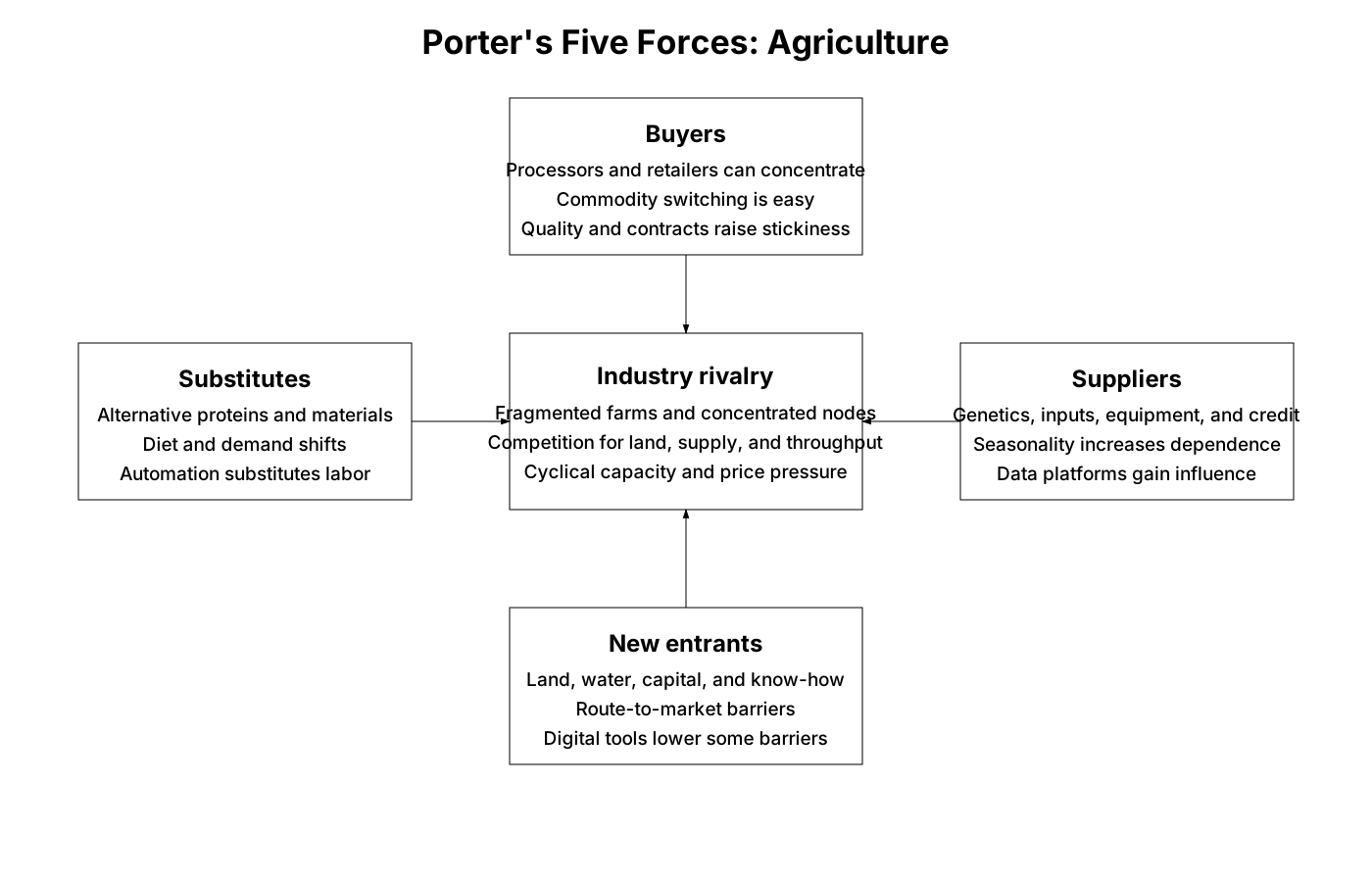
Agriculture has fragmented production but concentrated nodes of influence. Many farms sell into a smaller number of input distributors, processors, exporters, commodity merchants, and retail chains. The resulting structure gives the sector a familiar asymmetry: individual producers carry biological risk, while downstream coordinators can use scale, market information, and asset control to shape commercial terms.
| Dimension | Assessment |
|---|---|
| Customer concentration | Processors, exporters, retailers, and food service groups can be concentrated in local procurement zones |
| Switching costs | Commodity buyers can switch suppliers, while identity-preserved or perishable programs require reliable partners |
| Price discovery | Benchmark markets help transparency but do not remove local basis, quality, and logistics effects |
| Contract design | Specifications, volume commitments, and payment terms can shift risk back toward growers |
Buyer power is strongest where products are undifferentiated, storage is limited, and there are few local outlets. It weakens when growers can offer reliable volume, unique quality, certification, or proximity to demand. Producers can improve their position through cooperatives, contractual programs, storage, processing participation, and a better understanding of delivered cost rather than farm-gate price alone.
| Dimension | Assessment |
|---|---|
| Biological inputs | Patented genetics, breeding stock, and specialized crop-protection products can carry pricing power |
| Farm equipment | Machinery, irrigation, and automation suppliers influence productivity and replacement cycles |
| Finance and insurance | Credit availability and risk-transfer capacity determine what producers can plant and hold |
| Digital infrastructure | Data platforms and connectivity increasingly shape operational decisions and service access |
Supplier power becomes acute when an input is both essential and time-sensitive. A missed planting window cannot be recovered with a later purchase, and a disease event can turn a product shortage into a production crisis. Farmers reduce this exposure through procurement discipline, product substitution where agronomically sound, cooperative buying, and data that improves application accuracy.
| Dimension | Assessment |
|---|---|
| Production base | Farms are fragmented in many regions, while corporate operations and cooperatives bring scale in selected systems |
| Cost position | Land quality, water, yield, labor, and logistics create persistent differences in delivered cost |
| Product overlap | Commodity producers face direct rivalry, while specialized producers compete on service, quality, and timing |
| Cyclicality | Price cycles can produce aggressive capacity expansion before later correction |
Rivalry is often indirect because producers sell into shared markets rather than fight account by account. Still, local competition for land, labor, water, processing slots, and transport can be intense. In processing, rivalry becomes more conventional: plants compete for raw-material supply and customer contracts, and poor utilization can rapidly erode margins.
| Dimension | Assessment |
|---|---|
| Land and water | Access can be expensive, regulated, and locally constrained |
| Capability | Biological knowledge, operating discipline, and seasonal learning curves create hidden barriers |
| Capital | Machinery, facilities, livestock, orchards, and working capital can require substantial commitment |
| Route to market | New producers need buyers, specifications, storage, and dependable logistics before harvest |
Entry barriers vary by segment. A small specialty grower can begin with modest acreage and direct sales, while a grain elevator, slaughter facility, or export terminal requires assets, permits, and throughput. Technology entrants face fewer physical barriers, but adoption is difficult without trust, clear return on investment, and integration into existing farm workflows.
| Dimension | Assessment |
|---|---|
| Alternative proteins | Plant-based, fermentation-derived, and cultivated products can substitute for selected animal products |
| Material substitution | Synthetic fibers, recycled materials, and bio-based alternatives compete with agricultural feedstocks |
| Diet shifts | Consumer preferences can redirect demand across crops and protein categories |
| Automation | Software and robotics substitute for some manual farm and post-harvest tasks |
Substitution affects products unevenly. Basic calories and feed remain anchored in biological supply, but specific ingredients, fibers, and proteins can face meaningful alternatives. The more strategic question is whether a substitute changes the buyer's economics, quality, reliability, or regulatory burden. Alternative production systems matter when they solve a constraint that conventional supply cannot address.
Value chain and profit pools
The value chain begins with upstream inputs: genetic material, nutrients, crop-protection products, feed, machinery, energy, water, finance, and agronomic knowledge. It then moves through production, where biological systems convert these inputs into crops or animals. Post-harvest handling preserves, grades, aggregates, and stores output. Processing changes form, extends shelf life, and creates ingredients or branded products. Distribution connects products to retailers, food service, industrial users, and export markets. Standards, inspection, digital platforms, market data, and trade rules enable every stage.
Each handoff creates loss, cost, and information gaps. Poor storage can convert a good harvest into a low-value sale. Weak cold chain can eliminate the margin of a fresh product. A processor that cannot secure raw material at planned utilization cannot recover fixed cost. This is why an agricultural strategy that starts and ends at the farm gate misses much of the economic system.
Profit pools tend to concentrate where differentiation, asset utilization, or switching costs are present. Proprietary seeds and genetics can earn returns through intellectual property. Processors can earn attractive margins when they operate scarce assets at high utilization and sell differentiated products. Brands, specialty ingredients, and distribution systems may earn more stable returns because they sit closer to demand. Commodity production can still be profitable, but it requires a cost advantage, risk discipline, or a structural advantage in land, water, yield, or logistics.
The profit pool is shifting as data becomes operational infrastructure. Farm-management systems, remote sensing, automated equipment, and traceability tools can reduce input waste and improve timing. Their value does not arise from collecting data alone. It arises when data changes a crop decision, links production to a buyer specification, or improves the reliability of finance and insurance. Digital agricultural technologies can improve information, financial access, market links, and resource allocation across the value chain 2.
Industry economics and business models
Primary production is usually asset-heavy and biologically constrained. Land, water rights, livestock, trees, machinery, and working capital are committed before revenue arrives. A farm's income therefore depends on yield, price, quality, timing, and cost, with limited ability to change course mid-season. This makes cash-flow planning, hedging, insurance, and liquidity as important as agronomy.
Input companies use a different model. Their economics depend on research and development, manufacturing or sourcing, product registration, dealer coverage, and recurring seasonal demand. Companies with differentiated intellectual property can defend price better than firms selling readily comparable products. Distribution businesses earn from volume, inventory management, local relationships, and service density, although their working-capital exposure can be substantial.
Processors sit between volatile supply and demanding customers. They buy raw material, transform it, and sell a product with a different price structure. Their central measure is often the conversion margin after raw-material cost, energy, labor, yield loss, and plant utilization. When a processor also owns a brand, customer relationship, or specialty formulation, it can reduce exposure to pure commodity spreads.
Agricultural technology is largely asset-light until it moves into hardware, finance, or managed services. Software subscriptions, transaction charges, data services, and equipment-enabled recurring revenue can scale, but customer acquisition remains expensive because farmers require proof under local operating conditions. The most durable model often combines software with a trusted channel such as a dealer, cooperative, processor, insurer, or lender.
Cost drivers and scalability
The sector's fixed and variable costs vary by production system. Land rent, debt service, buildings, irrigation infrastructure, orchards, and core equipment create fixed commitments. Seed, fertilizer, feed, fuel, chemicals, seasonal labor, repairs, packaging, energy, and freight vary with production volume, though not always proportionately. In livestock and controlled-environment systems, feed and energy can dominate the cost base. In broad-acre crops, land, fertilizer, machinery, and weather-adjusted yield often determine the cost curve.
Scale matters where it improves purchasing, asset utilization, technical specialization, and access to buyers. It does not guarantee superior returns. A large farm with weak field-level discipline can lose the benefit of bulk purchasing through waste and complexity. A small producer can outperform through high-value crops, direct relationships, and rapid decisions. The relevant measure is not acreage or headcount alone, but profitable output per unit of constrained capital, land, water, labor, and time.
A practical agricultural flywheel begins with better operating data. Better data improves field or herd decisions. Improved decisions reduce avoidable input use and raise output consistency. Consistency improves access to preferred buyers and finance. Those relationships then create more data and more predictable revenue, supporting additional investment. The loop fails when technology creates reports without changing decisions or when a provider cannot connect data to the economic outcome that the grower values.
Unit economics must account for loss and risk. For a crop, the central equation combines yield per hectare, realized price, direct cost, overhead allocation, and post-harvest loss. For a processor, it includes raw-material yield, throughput, recovery rate, energy, labor, packaging, and freight. For a digital service, it includes acquisition cost, onboarding effort, retention, support burden, and the contribution margin generated after integration. Investors should demand these operating measures before relying on acreage, addressable-market estimates, or technology claims.
Moats, advantages, and strategic levers
Cost leadership in agriculture comes from a lower delivered cost, not merely a lower production cost. A producer near a processor, port, or large consumer market may hold an advantage despite higher field costs. Better soil, water security, genetics, mechanization, and scale can reinforce that advantage. Companies should distinguish a favorable year from a repeatable structural position.
Differentiation comes from products or systems that buyers value and can verify. Examples include high-oleic oils, certified organic supply, disease-free plant material, welfare standards, consistent protein specification, or traceable origin. A label alone is rarely sufficient. The firm needs operational capability to deliver the promise, documentation to prove it, and a customer willing to pay for it.
Network effects appear in agricultural ecosystems rather than consumer-style social networks. A platform with more growers may produce better regional benchmarks. More data can improve recommendations, insurance pricing, or procurement forecasting. More participating buyers can improve market liquidity. These effects become defensible only when the data is difficult to replicate and the platform is embedded in a transaction or operating workflow.
Switching costs emerge through integration. A grower is reluctant to change a provider that holds historical field records, supplies agronomic advice, links to machinery, finances inputs, or connects output to a contracted buyer. Regulatory moats arise from seed registration, chemical approvals, food-safety systems, water permissions, and inspection capability. Learning moats arise when a business converts repeated biological outcomes into better genetics, practices, or risk models.
Strategic levers
The first strategic lever is customer and crop focus. An entrant should choose a crop, production system, or buyer problem where performance can be measured and the economic pain is immediate. Generic propositions such as improving farm productivity rarely survive procurement scrutiny. A sharper proposition might reduce packhouse rejection for a specific export crop, improve feed conversion in a defined livestock segment, or provide verifiable traceability for a processor's sourcing program.
The second lever is product scope. A narrow tool can win initial adoption, but a broader solution may later capture more value if it connects decisions across the season. The key is sequence. A business should first solve a workflow that customers already recognize, then add adjacent services once data and trust are established. Full-stack models work only when the operator can manage the complexity of finance, agronomy, logistics, and customer service.
The third lever is the choice between owning assets and orchestrating partners. Owning land, processing, storage, or distribution can secure supply and protect quality, but it raises capital intensity and cycle risk. Partnerships can produce faster coverage, especially with cooperatives, dealers, processors, and lenders. The decision should follow the bottleneck: own the asset when it is scarce, strategic, and better managed internally; partner when scale and local access matter more than ownership.
Geographic expansion should follow agronomy and demand rather than map coverage. A crop that performs in one climate zone may fail commercially in another because of water, labor, disease, regulation, or logistics. Ecosystem orchestration can be more valuable than expansion alone. Firms that coordinate growers, inputs, finance, insurance, processors, and buyers can reduce friction across the chain and create a stronger commercial position.
Structural risks, regulation, and trends
Climate risk is now a core strategic variable rather than an external disruption. Heat, drought, flood, shifting seasons, pest pressure, and water scarcity affect yields, crop suitability, labor conditions, and asset values. They also affect credit and insurance availability. Climate-smart approaches seek to improve productivity, resilience, and emissions performance together, but each investment still requires local agronomic and economic validation 3.
Commodity-price risk can be as damaging as yield risk. Producers make planting, breeding, and capital decisions under uncertain prices. Currency moves, trade policy, energy costs, and global inventories can change profitability after those decisions are locked in. Effective risk management combines diversified revenue, forward contracts, options where appropriate, inventory discipline, liquidity planning, and an explicit understanding of basis and transport exposure.
Regulation will continue to reshape cost and market access. Food safety, pesticide approvals, nutrient management, methane and fertilizer emissions, biodiversity, labor, land rights, trade rules, and deforestation-related sourcing requirements are altering production and procurement. The strategic response should be operational: measure relevant practices, secure evidence, redesign sourcing where needed, and avoid treating compliance as a reporting exercise.
Technology will concentrate around labor substitution, biological precision, and supply-chain transparency. Robotics and automation can relieve labor constraints in harvesting, milking, sorting, and packing. Sensing and analytics can direct irrigation, fertilizer, and crop-protection decisions. Genetics can increase resistance and performance. The durable opportunity lies in systems that integrate these tools into a business model, not in stand-alone demonstrations. The Food and Agriculture Organization identifies climate technologies as a route to adaptation, lower emissions, carbon storage, and more resilient agrifood systems 4.
A new entrant should enter through a narrow wedge, partner for distribution, and prove economics in one production cycle before expanding. It should avoid assuming that farm-level interest converts into willingness to pay. Incumbents should protect market access, grower trust, and physical throughput while simplifying fragmented technology stacks. They should use scenario planning for water, trade, energy, labor, and climate, then invest in options that retain value across several plausible futures.
Caselet
Cargill provides a useful case because it operates across several layers of the agricultural value chain rather than at a single point. The company began in 1865 as a grain-storage business in Iowa, an origin that placed it at a critical interface between seasonal farm output and broader markets. Its growth followed the economics of aggregation: grain storage, trading, transport, processing, and risk management can turn dispersed production into reliable supply for industrial and food customers.
The company's operating footprint demonstrates why the middle of the chain can exert influence. Cargill participates in commodity trading, animal nutrition, food ingredients, protein, agricultural supply chains, and risk management. These activities require different capabilities, but they share a common advantage: access to flows of commodities, market intelligence, logistics assets, and customer demand. A firm operating across those flows can match supply and demand, manage inventory, and add value through processing or formulation.
Its history also shows the tension inherent in scale. Large agricultural intermediaries can create efficiency through storage, global trading, quality systems, and reliable delivery. They also face scrutiny over supply-chain transparency, environmental standards, market concentration, and relationships with producers and communities. Scale therefore requires governance as well as assets. A company that loses credibility with farmers, regulators, or customers can weaken the information and access that underpin its commercial position.
The value-chain logic is clear. Upstream, the company depends on growers, input markets, and local procurement relationships. In the production and aggregation stage, its storage, logistics, and purchasing systems affect throughput and quality. Downstream, processing and ingredient formulation can shift revenue away from raw commodity exposure toward customer-specific products. Enabling infrastructure includes trading systems, risk controls, food-safety standards, trade compliance, and traceability programs.
The profit-pool lesson is not that every agriculture company should become a global merchant. It is that asset ownership and information control can create an advantage when they solve a genuine coordination problem. A regional processor may apply the same lesson at smaller scale by securing grower supply, raising plant utilization, improving specifications, and building a customer program around dependable delivery. Cargill's long operating history illustrates how agriculture rewards firms that connect biological production to industrial demand through infrastructure and commercial capability 5.
Agriculture converts land, biology, labor, capital, and knowledge into food, feed, fiber, and industrial inputs. Its economics remain shaped by volatility at the farm gate and concentration in many downstream channels. Margins cluster where a company controls differentiated inputs, processing assets, trusted brands, scarce logistics, or a recurring data relationship with growers. The strongest strategic levers are selective crop and geography choices, resilient production systems, value-added processing, commercial partnerships, and rigorous risk management. Entrants should begin with a narrow, measurable problem rather than a broad farm proposition. Incumbents should protect access to growers and end markets while using data and automation to improve asset utilization, forecast demand, and reduce avoidable loss
Citation
Cite this article
Sridharan, M. A. (2026, June 10). Industry Analysis: Agriculture. Think Insights. https://thinkinsights.net/strategy/industry-analysis-agriculture (Accessed [[ACCESS_DATE]])
Sridharan, Mithun A. "Industry Analysis: Agriculture." Think Insights, 10 June 2026, https://thinkinsights.net/strategy/industry-analysis-agriculture. Accessed [[ACCESS_DATE]].
Mithun A. Sridharan, "Industry Analysis: Agriculture," Think Insights, June 10, 2026, https://thinkinsights.net/strategy/industry-analysis-agriculture. Accessed [[ACCESS_DATE]].
Sridharan, M.A. (2026) 'Industry Analysis: Agriculture', Think Insights. Available at: https://thinkinsights.net/strategy/industry-analysis-agriculture (Accessed: [[ACCESS_DATE]]).
M. A. Sridharan, "Industry Analysis: Agriculture," Think Insights, 2026. [Online]. Available: https://thinkinsights.net/strategy/industry-analysis-agriculture. [Accessed: [[ACCESS_DATE]]].
Sridharan MA. Industry Analysis: Agriculture. Think Insights. Published June 10, 2026. Accessed [[ACCESS_DATE]]. https://thinkinsights.net/strategy/industry-analysis-agriculture
Test Your Knowledge
Industry Analysis: Agriculture
Challenge yourself on the concepts from this article and see how well you understood them.
Subscribers get weekly quizzes and insights — subscribe free
Sponsor this article
Partner with Think Insights
Reach 50,000+ business leaders, consultants, and strategists. Feature your brand alongside expert articles on strategy, leadership, and digital transformation.
Become a Sponsor