Industry Analysis: Aerospace Manufacturing


Two commercial aircraft manufacturers and five defense primes control an industry that will invoice more than 1 trillion dollars this year and the money keeps flowing to whoever owns the parts that wear out. Engine makers, not airframe assemblers, capture the richest margins because they sell hardware near cost and recover profit over 20 years of maintenance contracts. Suppliers of forged titanium and single-source castings increasingly dictate delivery schedules to Boeing and Airbus, not the reverse. Boards evaluating this sector should stop chasing airframe assembly, where certification cost and duopoly pricing cap upside and instead target aftermarket services, specialty materials and software-defined avionics, where switching costs and regulatory approval create durable, compounding advantage.
Is aerospace manufacturing attractive for new entrants?
It is attractive in narrow slices and forbidding everywhere else. Building a clean-sheet commercial airframe or turbofan engine requires billions of dollars, a decade of certification work and an existing relationship with regulators that new entrants simply do not have. The more realistic entry points are specialty materials, software-defined avionics, additive manufacturing of qualified parts and space-adjacent hardware, where certification cycles are shorter and incumbents have not yet locked up every supply position.
Which parts of the value chain are most profitable?
Engine manufacturing and its attached aftermarket services generate the highest and most durable margins in the industry, commonly cited near 19 to 20 percent, because engine makers recover thin original equipment margins through decades of maintenance, repair and overhaul work. Avionics and mission systems suppliers with proprietary software also earn double-digit margins, while airframe assembly and structural component production sit at the lower end because of price competition and heavy fixed investment.
How is technology changing this industry?
Digital engineering, model-based systems engineering and additive manufacturing are compressing design and qualification cycles that used to take a decade into a handful of years. Predictive maintenance software built on engine sensor data is shifting revenue from reactive part replacement toward subscription-like health monitoring contracts and autonomy software is becoming as strategically important as the airframe it flies.
What capabilities are table stakes vs differentiators?
Meeting airworthiness certification, quality system accreditation and export control compliance is table stakes; without them, a supplier cannot participate at all. Differentiation comes from proprietary materials science, sole-source qualification on high-value components, software-enabled aftermarket platforms and the ability to absorb multi-year fixed-price development risk without impairing the balance sheet.
How should investors or consultants evaluate opportunities here?
Evaluate exposure by asking where a target sits relative to installed base, not by revenue growth alone. A company selling into a large and aging fleet with sole-source parts approval has more durable economics than one only winning new-aircraft content, because the former earns for 25 years after the sale while the latter depends on the next order cycle. Backlog quality, program diversification across defense and commercial and exposure to fixed-price versus cost-plus contracts are the underwriting variables that matter most.
Why do Boeing and Airbus effectively control commercial aviation manufacturing?
Seven-figure certification costs, decade-long development timelines and the network effects of an installed global maintenance and pilot-training ecosystem make it commercially irrational for a third competitor to attempt a full-line challenge, which is why Comac and Embraer compete at the margins rather than head-on.
Why do engine makers sell engines near cost?
Selling the engine near cost buys the manufacturer a captive, contractually locked customer for the next two decades of servicing and because engines require certified parts and certified shops, the manufacturer largely controls who gets to do that servicing and at what price.
What is the biggest structural risk facing aerospace manufacturers today?
Supply chain fragility below the tier-one level, particularly in forged titanium, specialty castings and semiconductors, has become the binding constraint on production rates even as order backlogs stretch past a decade, meaning the industry's growth ceiling is now set by metallurgical capacity rather than demand.
How does defense procurement differ from commercial aircraft sales economics?
Defense contracts are negotiated with a single government buyer under statutory acquisition rules, often on a cost-plus basis that reimburses expenses plus a fee, whereas commercial aircraft are sold competitively to airlines and lessors at negotiated discounts off list price, exposing manufacturers to real pricing risk that defense primes rarely face.
Is space and satellite manufacturing part of this industry or a separate one?
It sits inside aerospace manufacturing's outer segment and shares its supplier base, engineering talent and regulatory apparatus, but it operates on a different economic model built around constellation-scale production runs and reusable launch systems rather than one-off, decades-long airframe programs.
Aerospace manufacturing occupies a strange position in the industrial economy. It is simultaneously one of the most technologically advanced sectors in existence and one of the slowest to change hands, dominated by a handful of companies whose market positions have barely shifted in two generations. The industry builds machines that carry passengers, cargo, weapons and now increasingly data across the planet and beyond it and it does so under a regulatory and certification regime that makes disruption almost structurally impossible. Understanding where value is created and more importantly where it is captured, requires separating the airframe business from the engine business and separating both from the defense primes that answer to a single customer with a checkbook the size of a national budget.
Industry at a glance
Aerospace manufacturing, for the purposes of this analysis, covers the design, engineering and production of commercial and military aircraft, aircraft engines, avionics and mission systems and space and satellite hardware, along with the tiered network of structural, materials and component suppliers that feed those final assemblers. It excludes the operation of airlines and cargo carriers, which is a separate industry built on load factors, fuel hedging and route economics rather than product development and manufacturing throughput. The commercial aircraft manufacturing segment alone is valued in the range of 430 to 500 billion dollars in 2026, while the broader aerospace parts and components manufacturing base, spanning commercial, defense and space applications, is estimated well above 1 trillion dollars globally.1
The customer base is almost entirely business-to-business and business-to-government. Airframe manufacturers sell to airlines, leasing companies and cargo operators; engine makers sell to airframers directly and then to operators through long-term service agreements; and defense primes sell almost exclusively to national governments through structured procurement programs. There is essentially no direct business-to-consumer component, which insulates the industry from retail demand swings but exposes it fully to macroeconomic cycles in air travel demand, sovereign defense budgets and interest rates that determine aircraft financing costs. The industry sits downstream of steel, titanium, aluminum, composite materials and semiconductor supply chains and it sits upstream of the airline and defense-operations industries that depend entirely on its output to function.
Capital intensity is extreme by any industrial standard. A new commercial aircraft program routinely costs 10 to 15 billion dollars to develop and certify before the first unit generates revenue and a new engine program carries similar multi-billion-dollar price tags with certification timelines stretching past seven years. Labor intensity is also high, particularly in final assembly and precision machining, though automation and additive manufacturing are steadily eroding the labor share of production cost in structural components. Regulatory intensity may be the defining feature of the industry:
every part on a certified aircraft must trace to an approved design, an approved manufacturing process and an approved quality system, enforced by aviation authorities whose approval is a prerequisite for revenue, not a compliance afterthought layered on top of it
Revenue models bifurcate sharply between original equipment sales and aftermarket services. Original equipment sales are lumpy, competitively priced and often loss-leading, particularly for engines, while aftermarket services, spare parts and long-term maintenance agreements generate steady, high-margin, multi-decade revenue streams tied to an installed base rather than to new production volume. Defense manufacturers add a third model on top of these two:
cost-plus and fixed-price-incentive government contracts that shift some, though rarely all, of the financial risk of development onto the taxpayer
Industry segmentation
The industry breaks into five segments defined primarily by product category and secondarily by customer type. Commercial airframe manufacturing covers the design and final assembly of passenger and freighter aircraft, dominated globally by two companies that together account for the overwhelming majority of large commercial jet deliveries. Military and defense platform manufacturing covers fighter aircraft, transport aircraft, helicopters, missiles and unmanned systems, sold almost exclusively to national governments and their allies under export-controlled licensing regimes.
Engine and propulsion manufacturing forms its own segment because the economics, the customer relationships and the competitive dynamics differ fundamentally from airframe production, with a small number of manufacturers and joint ventures supplying nearly every large commercial and military platform in production. Avionics, mission systems and components manufacturing covers the electronics, flight control systems, landing gear, structural components and interior systems that feed into final assembly, produced by a much larger and more fragmented set of tier-one, tier-two and tier-three suppliers organized in a classic pyramid supply structure. Space and satellite manufacturing rounds out the segmentation, covering launch vehicles, satellites and space station hardware, a segment that has grown rapidly on the back of low-earth-orbit constellation programs and reusable launch economics that did not exist commercially a decade ago.
These segments are dimensioned primarily by value chain position, since a titanium forging supplier, an airframe integrator and a satellite constellation operator all sell fundamentally different products to different buyers despite sharing overlapping engineering disciplines and, in many cases, the same tier-one suppliers.
Market structure
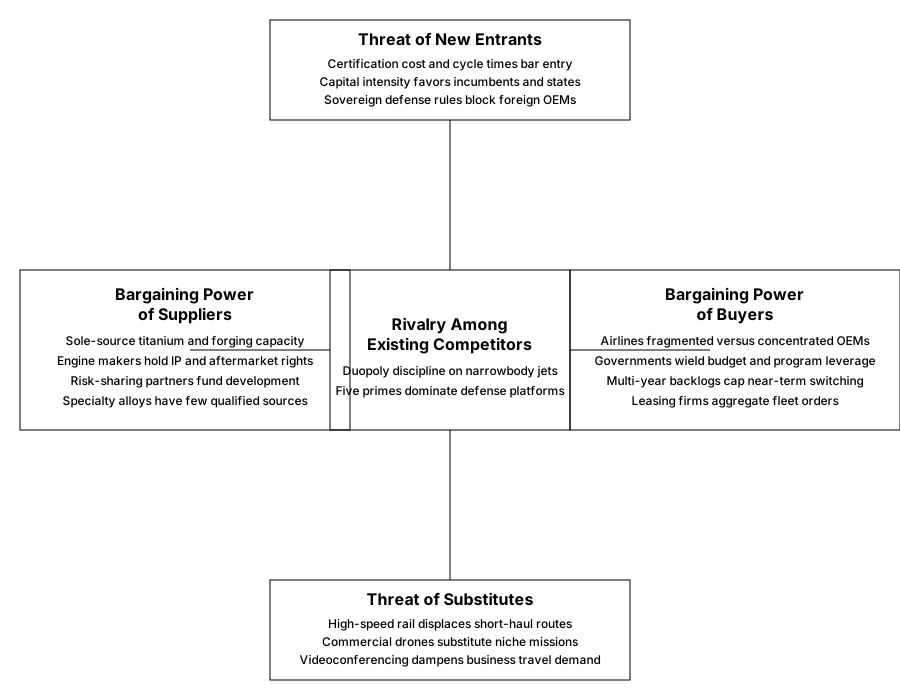
Aerospace manufacturing exhibits a market structure shaped more by capital barriers and government policy than by classic competitive dynamics. Rivalry is muted at the top of the value chain because certification cost and program timelines make head-on competition irrational for all but two commercial airframers and five American defense primes, while pricing power flows disproportionately to suppliers who hold sole-source qualification on critical materials and components. Buyers, whether airlines or governments, retain leverage mainly through the size and timing of orders rather than through the ability to switch suppliers, since switching a certified aircraft type or a fielded weapons platform is a decade-long undertaking in itself.
Bargaining power of buyers
Airlines and lessors, taken individually, hold comparatively little leverage over Boeing and Airbus because the two manufacturers control nearly the entire supply of large commercial jets and both currently carry order backlogs stretching close to a decade of production. An airline unhappy with delivery delays has almost nowhere else to go and switching to the other manufacturer mid-fleet means absorbing new pilot training, maintenance infrastructure and spare parts inventories that can cost hundreds of millions of dollars. That said, the largest airlines and leasing companies aggregate enough order volume, sometimes hundreds of aircraft in a single contract, to extract meaningful discounts off list price and favorable delivery slots, giving them proportionally more power than a smaller regional carrier placing a handful of orders.
Government buyers occupy a different position entirely. A defense ministry negotiating a fighter jet or transport aircraft program is often the only customer for that platform, which theoretically hands it enormous leverage, but that leverage is constrained by the fact that only a handful of primes can deliver the required technology and switching mid-program risks years of delay and cost overrun that governments are reluctant to absorb once a platform is fielded. Multi-year backlogs at Lockheed Martin, RTX and Northrop Grumman, some running past 150 billion dollars, illustrate how deeply governments commit once a platform is chosen.2
| Buyer type | Source of leverage | Constraint on that leverage |
|---|---|---|
| Major airline groups | Large aggregated fleet orders | Multi-year backlogs limit near-term alternatives |
| Aircraft leasing companies | Bulk purchasing across multiple airline customers | Residual value tied to manufacturer support |
| Defense ministries | Sole customer for national platforms | Limited qualified suppliers for complex systems |
| Regional and low-cost carriers | Price sensitivity on narrowbody orders | Small order size reduces negotiating weight |
Bargaining power of suppliers
Suppliers have quietly become one of the most powerful forces in this industry, a reversal of the traditional assumption that a handful of giant assemblers should be able to dictate terms downstream. Titanium forging and casting capacity in the Western supply base was deliberately reduced during the pandemic-era downturn and has not been fully restored, leaving Boeing, Airbus and their tier-one integrators dependent on a small number of qualified forges for parts that cannot legally be substituted without a fresh, multi-year certification process.3 Airbus has responded by pulling forward titanium procurement to guard against an anticipated 2027 supply shock, a defensive move that itself signals how much power has shifted downstream toward the material suppliers.
Engine manufacturers hold perhaps the single strongest supplier position in the entire value chain, because an airframer choosing an engine is locked into that choice and often that supplier, for the life of the aircraft program, typically 25 to 30 years. Risk-sharing partners who help fund engine or airframe development in exchange for guaranteed production work further shift bargaining power away from the final assembler, since the assembler now owes its financing partners a share of every unit produced regardless of market conditions. Specialty electronics and semiconductor suppliers, similarly concentrated, hold comparable leverage on the avionics side of the business.
| Supplier type | Source of leverage | Effect on manufacturers |
|---|---|---|
| Titanium forging and casting houses | Limited qualified capacity per alloy | Extended lead times and cost inflation |
| Engine original equipment manufacturers | Sole-source position for life of program | Airframer locked in for decades |
| Risk-sharing development partners | Co-funded program equity | Guaranteed production share regardless of demand |
| Specialty avionics and semiconductor firms | Narrow qualified vendor pools | Component shortages delay final assembly |
Rivalry among existing competitors
At the commercial airframe level, rivalry looks more like managed duopoly than open competition. Boeing and Airbus compete intensely on individual campaigns for airline orders, offering steep discounts off list price and favorable financing terms, but neither has any incentive to trigger a price war that would erode the economics of an industry both depend on for survival and neither faces a credible third entrant capable of taking meaningful share in the near term. The backlog data illustrates the discipline: narrowbody order books at both manufacturers now stretch toward a decade of production even before accounting for further order intake, a level of demand visibility that removes much of the incentive to compete aggressively on price.4
Defense manufacturing rivalry is similarly constrained by structure rather than dampened by choice. The number of companies capable of serving as a prime contractor to the US Department of Defense has fallen from 51 in the 1990s to five today, consolidation driven by a wave of mergers that regulators allowed under the logic that fewer, larger contractors could better absorb the fixed costs of developing next-generation platforms. That consolidation means competitive intensity now plays out mostly at the program-award stage, a handful of times per decade, rather than through continuous price and feature competition.
| Rivalry dimension | Commercial airframe segment | Defense platform segment |
|---|---|---|
| Number of credible full-line competitors | Two | Five |
| Primary competitive lever | Delivery slots and financing terms | Technology edge and program cost control |
| Order visibility | Multi-year backlog | Multi-decade program lifecycle |
| Price competition intensity | Moderate, campaign-specific | Low, contract-award-specific |
Threat of new entrants
New entrants face a wall of capital requirements, certification timelines and installed-base network effects that makes a frontal assault on the established players almost unthinkable. Developing and certifying a new commercial airframe typically consumes 10 to 15 billion dollars and seven to ten years before the first revenue-generating delivery and that is before accounting for the years of flight testing and regulatory scrutiny required to win airworthiness approval from multiple national aviation authorities simultaneously. China's Comac and Brazil's Embraer illustrate both the difficulty and the narrow path available:
Comac has spent close to two decades bringing a single narrowbody competitor to market, largely for its domestic government-supported customer base, while Embraer has succeeded by focusing on the regional jet niche that the two majors have largely ceded rather than attempting to challenge them head-on
Defense manufacturing raises the entry bar even further through sovereign procurement rules that in most countries legally require or heavily favor domestic or allied suppliers for sensitive platforms, making cross-border entry a matter of government relations as much as engineering capability. The more realistic points of entry sit lower in the value chain, in specialty materials, additive manufacturing of qualified components, software-defined avionics and space hardware, where certification cycles are shorter and incumbents have not yet fully locked up every supply position.
| Entry barrier | Description | Effect on new entrants |
|---|---|---|
| Capital requirement for a clean-sheet program | Multi-billion-dollar development spend before revenue | Excludes all but state-backed challengers |
| Certification timeline | Seven to ten years for airworthiness approval | Delays payback and deters private capital |
| Installed base and training ecosystem | Decades of pilot, mechanic and parts infrastructure | Locks in incumbent even after a rival product exists |
| Sovereign procurement rules | Legal preference for domestic or allied suppliers | Blocks foreign entrants from defense programs |
Threat of substitutes
Substitution pressure on aerospace manufacturing operates indirectly, through the demand for the end product rather than through a rival technology that displaces the aircraft itself. High-speed rail has proven a credible substitute for short-haul commercial flying in markets with dense rail infrastructure, most visibly across parts of Europe and East Asia, where journeys under three hours increasingly shift to rail once high-speed lines are built, reducing regional jet and narrowbody demand on those specific routes. Videoconferencing technology, accelerated permanently by pandemic-era behavior change, has structurally dampened business travel demand in a way that airlines and, by extension, aircraft manufacturers have had to absorb into long-range demand forecasts.
On the defense side, substitution shows up as a shift in mission profile rather than a threat to the manufacturers themselves, since the same primes building crewed fighter aircraft are also the companies building the unmanned systems increasingly substituting for certain manned missions, which blunts the disruptive threat by keeping the revenue inside the existing industry structure. Space-based and drone-based substitutes for some traditional aircraft missions, such as surveillance and certain cargo functions, represent a longer-term threat vector that established manufacturers are managing by acquiring or building capability internally rather than ceding the space to outsiders.
| Substitute | Affected segment | Degree of threat |
|---|---|---|
| High-speed rail | Short-haul narrowbody demand | Moderate, geographically concentrated |
| Videoconferencing | Business and premium travel demand | Moderate, structural post-pandemic shift |
| Unmanned and autonomous systems | Selected crewed military missions | Low direct threat, mostly captured by incumbents |
| Space-based surveillance platforms | Long-range reconnaissance aircraft | Low today, rising over the next decade |
Value chain and profit pools
The aerospace manufacturing value chain runs through six distinct stages, each with a different risk and margin profile. Raw material and specialty input supply sits upstream, covering titanium, aluminum, composite fiber, specialty alloys and semiconductors, a stage characterized by cyclical commodity pricing layered on top of aerospace-specific qualification requirements that limit how many mills and forges can actually sell into the industry. Component and subsystem manufacturing comes next, covering landing gear, avionics, structural sections and cabin interiors produced by a tiered network of specialized suppliers who design to the airframer's or engine maker's specification.
Engine and propulsion system manufacturing forms a stage of its own given its distinct economics and its outsized influence over the rest of the chain, followed by final airframe assembly and integration, where the completed aircraft or defense platform comes together, typically at a small number of dedicated final assembly lines per program. Distribution in this industry does not resemble consumer logistics; it consists of the delivery, financing and entry-into-service process that hands a finished aircraft or platform to an airline, lessor or government customer, often bundled with training and initial spares provisioning. The customer interface and aftermarket stage covers spare parts, maintenance, repair and overhaul services and long-term service agreements that run for decades after original delivery, generating the steadiest revenue in the entire chain. Enabling infrastructure, spanning flight testing facilities, certification laboratories and simulation and training systems, underpins every other stage and functions as a quiet but essential cost center for every serious participant.
Profit pool
Profit concentration in this industry has moved decisively toward the middle and back end of the value chain, away from final assembly. Engine manufacturers and their aftermarket service networks captured roughly 47 percent of total commercial aerospace profit pool value in the most recent year measured, with operating margins near 19.5 percent, a figure well above pre-pandemic historical norms and far ahead of every other stage in the chain.5 Equipment and systems original equipment manufacturers, the tier-one suppliers of avionics, landing gear and cabin systems, hold the next tier of profitability at roughly 17 percent margins, while independent maintenance, repair and overhaul providers not affiliated with an engine or airframe maker operate closer to a 7 percent margin, squeezed between the manufacturers who control parts pricing and the airline customers who control demand timing.
Cabin interior suppliers and lower-tier structural component makers sit at the bottom of the profit pool, often earning low single-digit margins because their products are more commoditized and their customers, the airframers, hold significant negotiating leverage over them despite the broader supplier power shift described above. Final airframe assembly itself, counterintuitively, is not where the money is made; Boeing and Airbus generate the bulk of their profitability from spare parts, upgrades and services attached to their enormous installed fleets rather than from the margin on a newly delivered jet, which is frequently sold near breakeven to win the multi-decade aftermarket annuity that follows.
The dominant engine original equipment manufacturers secured nearly half of commercial aerospace profit pool value last year, at margins well above historical levels, while cabin interior suppliers remained stuck in low single digits
This bifurcation explains much of the strategic behavior visible across the industry:
airframers push harder into services and digital fleet management, engine makers defend their aftermarket monopoly fiercely and private equity has poured into independent maintenance, repair and overhaul platforms betting that consolidation can lift that segment's margin profile closer to the equipment tier
Industry economics and business models
Three business models dominate aerospace manufacturing, each tied to a different point in the value chain. The first is the asset-heavy, program-based development model used by airframers and engine makers, in which a company commits billions of dollars of upfront capital against a single product line and recovers that investment over a production run lasting 20 to 40 years, a structure that resembles a very long-duration bond more than it resembles a typical manufacturing business. The second is the razor-and-blade aftermarket model most fully realized by engine manufacturers, who deliberately price original equipment near cost to secure the multi-decade maintenance annuity that follows, effectively subsidizing the sale to lock in the service contract.
The third model, dominant on the defense side, is the government-contracted development model, split between cost-plus contracts that reimburse a contractor's costs plus an agreed fee, shielding the contractor from cost-overrun risk and fixed-price contracts that shift that risk onto the contractor in exchange for higher potential margin. The mix between these two contract types has shifted meaningfully over the past decade as the Pentagon and allied defense ministries have pushed for more fixed-price agreements on mature programs while retaining cost-plus structures for genuinely novel research and development work, a distinction that materially changes a defense contractor's earnings volatility and is closely watched by investors underwriting the sector.
Cost drivers and scalability
Fixed costs dominate the cost structure of aerospace manufacturing at every stage above the raw material tier, driven by the enormous sunk investment required in engineering, tooling, certification and dedicated production facilities before a single unit generates revenue. Because so much of the cost base is fixed, production rate becomes the single most important scalability lever in the industry: an airframer or engine maker that can lift its monthly output from, say, 30 to 60 units spreads its fixed development and facility costs across twice as many units, which is precisely why Airbus's repeated delays in reaching its target narrowbody production rate matter so much to its margin trajectory, not merely to its delivery count.6
Economies of scale operate powerfully at the platform level but far less powerfully across platforms, because tooling, supply chains and certified workforces are largely program-specific and do not transfer cleanly from one aircraft type to another. Economies of scope exist mainly in the supplier base, where a tier-one avionics or structural component maker can spread its engineering and manufacturing capability across multiple customer programs simultaneously, which is one reason the supplier tier has proven more resilient to demand shocks than assumed. Unit economics on the services side look entirely different from the manufacturing side:
an engine shop visit or a defense platform sustainment contract behaves much like a capacity-utilization business, where marginal revenue on each additional maintenance slot carries high margin because the fixed cost of the certified facility and workforce is already sunk, similar in spirit to how a hospital or a data center monetizes fixed capacity
Moats, advantages and strategic levers
Defensibility in this industry is built on regulatory approval more than on any other single factor. Once a part, a supplier facility or an aircraft design wins certification from an aviation authority, replicating that approval elsewhere requires years of testing and paperwork that a competitor cannot shortcut regardless of capital available, which converts what looks like a bureaucratic hurdle into one of the strongest moats found in any global industry. Layered on top of regulatory moats are switching costs tied to the installed base:
an airline that has trained its pilots and mechanics on one aircraft type, stocked its hangars with one manufacturer's spare parts and built its maintenance schedules around one engine's service intervals faces enormous friction switching to a competing product, even one that might be marginally cheaper or more efficient
Learning-curve and scale advantages reinforce those structural moats. A manufacturer running a production line for two decades has accumulated manufacturing know-how, supplier relationships and defect-rate improvements that a new entrant cannot replicate through capital investment alone, it can only be earned through years of accumulated unit production. Data advantages are becoming more important as engines and airframes generate continuous sensor data feeding predictive maintenance algorithms and the manufacturer that owns both the hardware and the largest fleet of connected sensors has a growing informational edge over independent maintenance providers who see only a fraction of the operating data.
Strategic levers
Executives operating in or evaluating this industry have a limited but powerful set of levers available. Choosing a customer segment focus, rather than attempting to serve every buyer, allows a company to specialize either in the commercial fleet, where scale and cost discipline dominate, or in the defense and government fleet, where technology differentiation and program relationships dominate, since the sales motion and risk profile of the two differ enough that few companies excel at both simultaneously.
Deciding on the degree of vertical integration versus partnership is equally consequential; airframers increasingly outsource structural and systems work to risk-sharing partners to reduce upfront capital exposure, while at the same time reclaiming certain high-value, high-margin activities like software and aftermarket services in-house because that is where the durable profit sits. Geographic expansion, particularly localizing final assembly or component production inside a target government's borders, has become a near-mandatory lever for winning defense and, increasingly, commercial orders in countries that condition purchases on domestic industrial participation. Finally, ecosystem orchestration, building the software platform, the data infrastructure and the training systems that surround the physical product, is emerging as the clearest path for an incumbent to extend its moat beyond the hardware itself and into the decades of service revenue that follow.
Structural risks, regulation and trends
The most immediate structural risk facing the industry is not demand but supply. Backlogs at both commercial airframers and the leading defense primes now stretch close to a decade, yet production rates remain capped by forging capacity, engine component shortages and a shrunken tier-two and tier-three supplier base that has not fully recovered from pandemic-era cutbacks.7 That dynamic converts what looks like a demand problem into a capacity-management problem and it means near-term revenue growth for the industry is now bounded more by metallurgical and machining capacity than by airline or government appetite for new aircraft.
Regulatory risk remains ever-present given the industry's total dependence on certification bodies and any high-profile safety or quality failure carries the power to ground fleets, halt deliveries and trigger years of remediation cost, a risk made vivid by Boeing's own quality control setbacks earlier in the decade. Geopolitical risk cuts two ways: rising global defense budgets, with the United States alone authorizing over 1 trillion dollars in total defense funding for the current fiscal year, are a tailwind for the defense manufacturing segment, while export control tightening and supply chain reshoring pressures raise costs and complicate the historically globalized commercial supply base.8
Secular demand trends remain broadly favorable. Global air travel continues its long-run growth trajectory, defense budgets across nearly every major economy are rising rather than falling and the space and satellite segment has opened an entirely new demand pool tied to low-earth-orbit constellations that barely existed as a commercial category a decade ago. Disruptive models worth monitoring include additive manufacturing's steady expansion into certified flight-critical parts, which could eventually loosen the grip that traditional forging and casting suppliers hold over the value chain and the gradual move toward software-defined, autonomy-capable platforms that shift competitive advantage away from pure airframe design and toward the mission software layered on top of it.
For a company deciding how to enter this industry, the playbook depends heavily on ambition and capital availability. A niche entry strategy, targeting a specific certified component, a specialty material or a software layer that plugs into an existing platform, offers the fastest and least capital-intensive path to revenue and it is the route nearly every successful new entrant of the past two decades has actually taken. A broad entry strategy, attempting to challenge an incumbent airframer or engine maker directly, is realistically available only to state-backed champions willing to absorb losses for a decade or more in service of strategic industrial policy goals, as China's approach to Comac demonstrates. Partnering with an established prime, through risk-sharing or subsystem supply agreements, remains the most common route into defense programs, since it lets a smaller company access a certified platform's revenue without bearing the full cost of certifying its own.
Incumbents, for their part, are best served by deepening the moats already available to them rather than chasing volume growth for its own sake. Expanding aftermarket and digital services attached to the existing installed base captures profit more reliably than winning marginal new-aircraft orders at thin margins and securing supply chain resilience, through dual-sourcing critical materials or taking equity stakes in constrained tier-two suppliers, has become as strategically important as any product development decision an incumbent will make this decade.
Caselet: GE Aerospace and the aftermarket flywheel
GE Aerospace, spun off as an independent company from General Electric's broader industrial conglomerate structure in 2024, offers one of the clearest illustrations of how the engine aftermarket business model compounds value over time. The company, through its historic joint venture CFM International with France's Safran, produces the CFM56 and LEAP engine families that power the overwhelming majority of Boeing 737 and Airbus A320 family narrowbody aircraft in service globally, a footprint built over four decades of continuous production and fleet expansion.
The company's operating history demonstrates the razor-and-blade logic in its purest form. GE Aerospace and its CFM joint venture have historically priced original engine sales competitively, often near or below the manufacturer's own cost of production, a strategy that would look irrational examined in isolation but makes complete sense once the aftermarket annuity attached to each engine sale is factored in. Every engine delivered commits its airline operator to a service relationship stretching 20 years or more, covering scheduled shop visits, spare parts, repairs and increasingly software-enabled health monitoring, all of which flow disproportionately back to the original manufacturer rather than to independent maintenance shops, because engine repair at the most complex level requires proprietary technical data, certified tooling and, in many cases, parts that only the original manufacturer is licensed to produce.
The scale of the resulting installed base is what makes the model so durable. With tens of thousands of CFM56 and LEAP engines in active service worldwide, GE Aerospace's aftermarket revenue stream is large enough and predictable enough, that it now represents the majority of the company's commercial aerospace segment profit, even though original engine sales still generate the headline order announcements that dominate press coverage at industry air shows. That mismatch between headline attention and actual profit source is itself instructive:
casual observers of the industry track new orders, while sophisticated investors and competitors track installed base and shop visit volume, because that is where the money genuinely sits
GE Aerospace's more recent strategic moves reinforce the pattern rather than departing from it. The company has invested heavily in predictive maintenance software that uses sensor data streamed from engines in operation to forecast component wear before failure occurs, a capability that both improves airline safety and operating economics and deepens GE's informational advantage over any independent maintenance provider who lacks access to that same fleet-wide sensor data. It has also continued expanding its LEAP engine production specifically to meet Boeing and Airbus's narrowbody delivery targets, a reminder that even the most aftermarket-focused business in the industry still depends on winning the original equipment mandate first, because the annuity only begins once the engine is actually flying.
The broader lesson for strategists studying this industry is that GE Aerospace's dominant position was not built through a single technological breakthrough but through the patient, compounding accumulation of an installed base over decades, defended by certification requirements and proprietary service relationships that a new entrant, however well-capitalized, cannot buy its way into on any realistic timeline. That is the essence of how durable advantage is actually built in aerospace manufacturing:
not by winning the next order, but by owning the maintenance relationship on every order won for the preceding forty years
- 1Aerospace Parts Manufacturing Market Report
- 2Defense Contractor Backlogs And Market Position
- 3Aerospace Titanium Supply Chain Constraints
- 4Airbus And Boeing Commercial Aircraft Backlog
- 5Engine Makers Capture Outsized Profit Share
- 6Airbus And Boeing Production Rate Challenges
- 7Aerospace Supply Chain Constraints Into 2027
- 8Record Defense Budget Authorization
Aerospace manufacturing turns physics, regulation and geopolitics into an unusually durable form of pricing power and it does so by making almost everything about the business hard to replicate quickly. Airframe assembly commands attention but engine aftermarket, defense platform sustainment and specialty materials command the returns. The lever available to every participant is the same: choose the segment where certification, installed base and government relationships compound rather than depreciate, then defend it with capacity discipline instead of chasing volume for its own sake. Capital allocators who understand that difference will outperform those still measuring this industry by aircraft delivered rather than dollars of margin banked per unit shipped over its operating life.
Citation
Cite this article
Sridharan, M. A. (2024, June 13). Industry Analysis: Aerospace Manufacturing. Think Insights. https://thinkinsights.net/strategy/industry-analysis-aerospace-manufacturing (Accessed [[ACCESS_DATE]])
Sridharan, Mithun A. "Industry Analysis: Aerospace Manufacturing." Think Insights, 13 June 2024, https://thinkinsights.net/strategy/industry-analysis-aerospace-manufacturing. Accessed [[ACCESS_DATE]].
Mithun A. Sridharan, "Industry Analysis: Aerospace Manufacturing," Think Insights, June 13, 2024, https://thinkinsights.net/strategy/industry-analysis-aerospace-manufacturing. Accessed [[ACCESS_DATE]].
Sridharan, M.A. (2024) 'Industry Analysis: Aerospace Manufacturing', Think Insights. Available at: https://thinkinsights.net/strategy/industry-analysis-aerospace-manufacturing (Accessed: [[ACCESS_DATE]]).
M. A. Sridharan, "Industry Analysis: Aerospace Manufacturing," Think Insights, 2024. [Online]. Available: https://thinkinsights.net/strategy/industry-analysis-aerospace-manufacturing. [Accessed: [[ACCESS_DATE]]].
Sridharan MA. Industry Analysis: Aerospace Manufacturing. Think Insights. Published June 13, 2024. Accessed [[ACCESS_DATE]]. https://thinkinsights.net/strategy/industry-analysis-aerospace-manufacturing
Test Your Knowledge
Industry Analysis: Aerospace Manufacturing
Challenge yourself on the concepts from this article and see how well you understood them.
Subscribers get weekly quizzes and insights — subscribe free
Sponsor this article
Partner with Think Insights
Reach 50,000+ business leaders, consultants, and strategists. Feature your brand alongside expert articles on strategy, leadership, and digital transformation.
Become a Sponsor