How BT Group Powers Britain


BT Group runs the United Kingdom's telecommunications backbone and sells access to it twice, once through its own retail brands, BT, EE and Plusnet and again through Openreach, the wholesale division connecting more than 600 rival service providers to the same fiber and copper network. This dual approach means BT earns money whether a household picks BT or switches to Sky or TalkTalk, since most fixed-line traffic in Britain still runs over Openreach infrastructure. The company traces its roots to the state-owned General Post Office, was privatized in 1984 and transformed again with its 2016 purchase of mobile operator EE. Today, BT Group balances infrastructure investment, regulatory obligations and retail competition across consumer, business and wholesale markets at the same time.
What is Openreach and why does it matter?
Openreach is the BT Group division that owns and maintains the local access network connecting homes and businesses across the UK. It supplies wholesale access to more than 600 communications providers, including rivals such as Sky and TalkTalk, on equal terms. This arrangement means most UK broadband, regardless of the brand on the bill, travels over infrastructure BT built and maintains.
Why does BT operate BT, EE and Plusnet as separate brands?
Each brand targets a different buyer: BT serves households wanting bundled fiber, mobile and TV, EE anchors mobile and 5G home broadband and Plusnet competes purely on price. Running three brands lets BT Group capture multiple price points without one brand undercutting another's margin directly. All three still depend on the same underlying Openreach network for fixed-line service.
How does BT Group profit even when customers choose a competitor?
Because Openreach owns most of the physical network, competing providers such as Sky, TalkTalk and Vodafone pay wholesale fees to reach customers over BT's infrastructure. A household that switches away from BT rarely switches away from the network underneath it. This structure gives BT Group revenue from both its own retail customers and those of its rivals.
A Legacy Built on Britain's Networks
BT traces its lineage to the General Post Office, which ran Britain's telephone network for most of the 20th century. The business became British Telecommunications in 1980 and was privatized in 1984, one of the largest share sales in UK history at the time.1 Over the following three decades, BT expanded from fixed-line telephony into broadband, enterprise data services and eventually mobile. The 2016 acquisition of EE, then the country's largest mobile operator, gave BT a direct stake in mobile spectrum and turned it into a converged fixed-mobile operator almost overnight.2 That deal set up the multi-brand structure that defines BT Group today.
Separating the Pipes From the Brands
In 2006, BT created Openreach as an internal division tasked with running the local access network independently of BT's retail arm. Ofcom pushed further in 2017, requiring Openreach to become a legally separate company with its own board, budget and staff, a change BT agreed to rather than face imposed regulation.3 The goal was to stop BT's retail business from getting preferential access to ducts, cabinets and fiber that rivals also needed to reach their own customers. That separation now underpins BT Group's entire model, one regulated network company supporting several competing retail brands.
Three Brands, One Network
BT Group sells connectivity through three consumer-facing brands, each aimed at a different buyer. BT itself is the full-service brand, bundling fiber broadband, mobile and TV for households willing to pay for convenience. EE anchors mobile, having built the UK's first 4G network and now doubles as a 5G home broadband option. Plusnet, by contrast, strips out extras and competes purely on price for budget-conscious customers.
"BT Group's structure is unique because Openreach operates the infrastructure while multiple retail brands compete on top of it. This means consumers often see different providers, but they're actually using the same underlying network. Availability ultimately depends on the infrastructure serving a specific address, not just the brand", said Tomas Novosad, founder of Fibre In My Area, a UK fiber broadband availability checker
Because all three brands lease capacity from the same Openreach network, BT Group can capture customers across price tiers without one brand eating entirely into another's margin.
Openreach's Wholesale Reach
Openreach's business runs almost entirely on wholesale contracts rather than direct consumer relationships. It supplies fiber, copper and duct access to more than 600 communications providers across the country, including direct BT rivals such as Sky, TalkTalk and Vodafone.4 Ofcom requires Openreach to offer these providers the same prices and technical terms it offers BT's own retail brands, a principle known as equivalence of input. That obligation is what makes it possible for a Sky or TalkTalk customer to get service that runs, physically, over BT-built infrastructure.
How the Money Flows
BT Group organizes its accounts around a handful of segments: Consumer, Business, Openreach and, since mid-2025, a separate International unit. Group revenue reached £20.4 billion in the fiscal year ending March 2025, with Openreach's wholesale fees offsetting declines elsewhere in the business.5 Consumer broadband, TV and EE mobile contracts still supply the bulk of retail cash flow, while enterprise connectivity and cloud services serve larger business customers. Because Openreach charges other providers regardless of which brand wins a given household, BT Group's total revenue is less exposed to retail market-share swings than a single-brand competitor's would be.
The Full Fiber Race
BT Group's largest capital commitment right now is replacing its aging copper network with full fiber. Openreach is targeting 25 million premises passed with fiber-to-the-premises technology by December 2026, backed by roughly £15 billion in planned investment.6 Faster fiber lowers Openreach's long-term maintenance costs and supports the higher-bandwidth services BT and its wholesale customers can sell on top of it. Alongside fiber, EE's 5G rollout gives BT Group a second growth lever, letting it bundle mobile and fixed connections as copper lines are retired.
Competing While Cooperating
BT Group competes against operators that mirror parts of its own structure. Virgin Media O2 runs its own cable and mobile network end to end, avoiding Openreach fees entirely. Sky and TalkTalk instead lease Openreach's network to sell broadband, making them customers and competitors of BT Group at the same time, while CityFibre and other alternative-network builders lay rival fiber in areas Openreach has yet to reach. Parliament's own researchers have tracked how this mix of competition and regulation has shaped investment incentives across the sector since the 2017 separation.7 BT Group's position depends on staying ahead in fiber coverage while Ofcom keeps wholesale pricing within limits the company can still profit from.
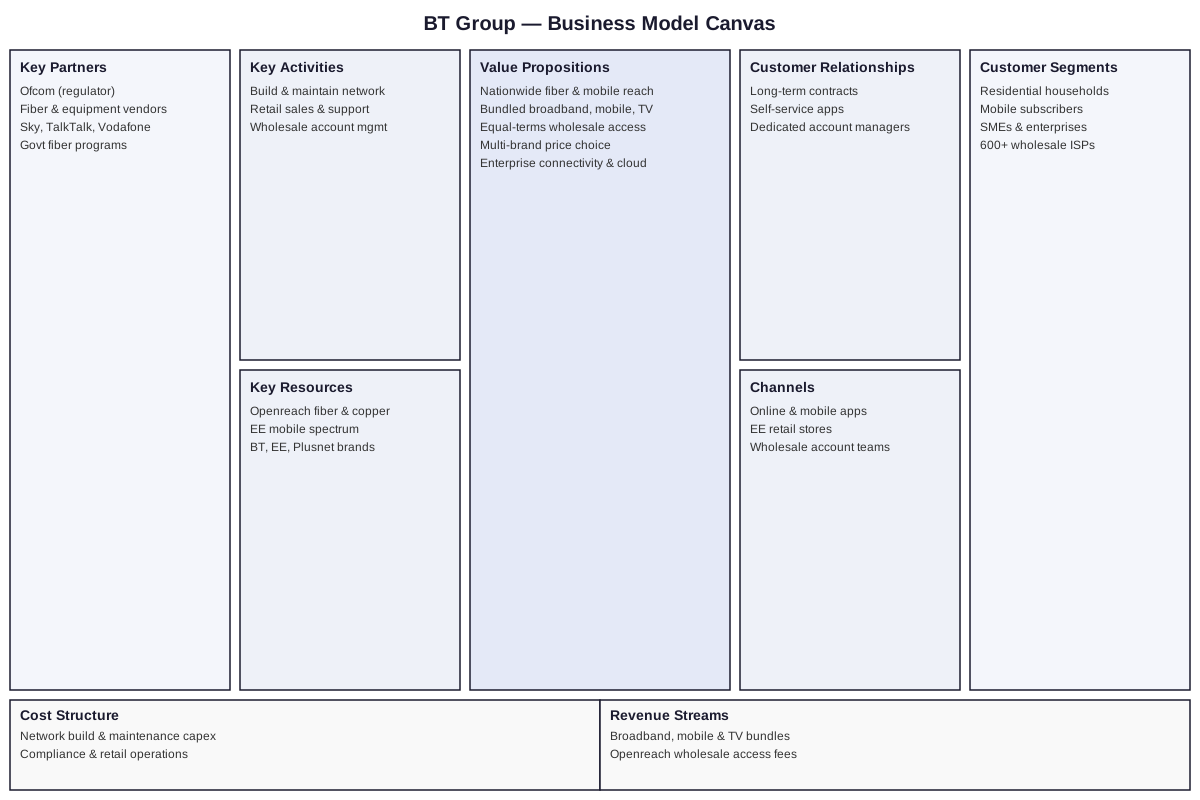
Key Partners
BT Group depends on a small set of critical partners to keep its network running and growing. Ofcom sets the regulatory terms Openreach must follow, including wholesale pricing and equal-access rules. Equipment vendors supply the fiber, routers and mobile hardware BT deploys nationwide. Government co-funding programs, such as Project Gigabit, help extend fiber into rural areas Openreach would not reach on commercial terms alone.
Key Activities
BT Group's core activity is building and maintaining physical network infrastructure, from fiber cabinets to mobile masts. Openreach engineers install and repair lines used by BT and competing brands alike. Retail teams across BT, EE and Plusnet manage customer acquisition, billing and support. A separate wholesale operations function manages contracts and service levels for the hundreds of providers buying Openreach access.
Key Resources
The most valuable asset BT Group holds is Openreach's physical network of ducts, poles, cabinets and fiber lines reaching most UK premises. EE's mobile spectrum licenses and radio network add a second infrastructure layer. The BT, EE and Plusnet brand portfolio is itself a resource, letting the company address multiple price points without building separate networks. A workforce of engineers and technicians, many inherited from Openreach's 2017 separation, keeps that infrastructure running day to day.
Value Propositions
For most UK households, BT Group offers nationwide fiber and mobile coverage that few rivals can match without leasing its network. Customers can bundle broadband, mobile and TV under one brand, or choose a stripped-down option through Plusnet. For wholesale buyers such as Sky and TalkTalk, the pitch is regulated, equal-terms access to a fiber network they would find prohibitively expensive to duplicate. Enterprises get dedicated connectivity and cloud services layered on top of the same infrastructure.
Customer Relationships
BT Group manages most household customers through long-term contracts renewed annually or every two years. Self-service apps and online account tools handle routine billing and fault reporting across BT, EE and Plusnet. Larger business and enterprise customers get dedicated account managers who negotiate service levels directly. Wholesale relationships with other providers run on formal contracts governed by Ofcom's equivalence rules rather than sales relationships.
Channels
BT Group sells directly to consumers through its own websites and mobile apps, alongside EE's physical retail stores across the country. Comparison sites and third-party retailers extend its reach to price-sensitive shoppers researching broadband and mobile deals. Enterprise and public-sector customers are served through dedicated sales teams that negotiate custom contracts. Openreach reaches its own customers, the wholesale providers, through account teams and technical onboarding rather than public marketing.
Customer Segments
Residential broadband and mobile customers make up BT Group's largest segment, split across its three retail brands by price sensitivity. Small and medium-sized businesses buy connectivity and basic cloud services through the Business division. Large enterprises and public-sector bodies contract for dedicated networks, security and managed services. The final segment and arguably the most distinctive, is the more than 600 rival providers that buy wholesale access from Openreach instead of building their own network.
Cost Structure
Network construction and maintenance dominate BT Group's cost base, particularly the ongoing fiber rollout Openreach funds with billions of pounds each year. Regulatory compliance, including the reporting and equal-access obligations tied to Openreach's legal separation, adds recurring administrative cost. Retail operations across three brands, plus EE's mobile network and retail stores, add a further layer of customer-facing expense on top of network costs.
Revenue Streams
Consumer broadband, TV and mobile subscriptions across BT, EE and Plusnet form the largest slice of BT Group's revenue. Openreach's wholesale fees, charged to more than 600 competing providers for network access, supply a second major stream that does not depend on retail market share. Enterprise connectivity, cloud and managed services contracts add revenue from business customers. International and legacy voice services contribute a smaller, declining share as the group shifts toward fiber and mobile.
BT Group's business model rests on a simple bet: owning the network pays off even when customers pick a competitor's brand. Openreach's wholesale fees from Sky, TalkTalk, Vodafone and hundreds of smaller providers cushion the group against retail losses, while BT, EE and Plusnet compete for the households that remain loyal. The 2017 legal separation of Openreach reduced the conflict between network ownership and retail competition, satisfying regulators without breaking up the company outright. As fiber rollout nears its 25-million-premise target and 5G expands EE's mobile base, BT Group's next phase depends less on winning retail market share and more on keeping Openreach's regulated returns steady while paying down the debt that fiber construction requires.
Citation
Cite this article
Sridharan, M. A. (2020, December 20). How BT Group Powers Britain. Think Insights. https://thinkinsights.net/strategy/how-bt-group-powers-britain (Accessed [[ACCESS_DATE]])
Sridharan, Mithun A. "How BT Group Powers Britain." Think Insights, 20 Dec. 2020, https://thinkinsights.net/strategy/how-bt-group-powers-britain. Accessed [[ACCESS_DATE]].
Mithun A. Sridharan, "How BT Group Powers Britain," Think Insights, December 20, 2020, https://thinkinsights.net/strategy/how-bt-group-powers-britain. Accessed [[ACCESS_DATE]].
Sridharan, M.A. (2020) 'How BT Group Powers Britain', Think Insights. Available at: https://thinkinsights.net/strategy/how-bt-group-powers-britain (Accessed: [[ACCESS_DATE]]).
M. A. Sridharan, "How BT Group Powers Britain," Think Insights, 2020. [Online]. Available: https://thinkinsights.net/strategy/how-bt-group-powers-britain. [Accessed: [[ACCESS_DATE]]].
Sridharan MA. How BT Group Powers Britain. Think Insights. Published December 20, 2020. Accessed [[ACCESS_DATE]]. https://thinkinsights.net/strategy/how-bt-group-powers-britain
Test Your Knowledge
How BT Group Powers Britain
Challenge yourself on the concepts from this article and see how well you understood them.
Subscribers get weekly quizzes and insights — subscribe free
Sponsor this article
Partner with Think Insights
Reach 50,000+ business leaders, consultants, and strategists. Feature your brand alongside expert articles on strategy, leadership, and digital transformation.
Become a Sponsor