Hilton's Asset-Light Business Model


Hilton runs one of the largest hotel networks on earth while owning almost none of the real estate behind it. The company earns money chiefly through franchise and management fees paid by independent owners, a structure that keeps capital spending low and cash flow strong even when travel demand swings. Roughly 97% of Hilton's more than 8,400 properties belong to franchisees and third-party owners, not to Hilton itself. Hilton Honors, the loyalty program with more than 250 million members, reinforces the arrangement by feeding direct bookings and higher room rates back into the fee base. For executives studying platform economics, Hilton offers a clear case of a brand converting scale and guest data into recurring revenue without carrying the balance-sheet risk of ownership.
Does Hilton own the hotels that carry its brand name?
No. Hilton owns or leases a small share of its portfolio, well under 5%. Most properties belong to independent owners who pay Hilton franchise fees for the brand name, reservation system and loyalty program access, or who hire Hilton to run day-to-day operations under a separate management contract.
How does Hilton Honors make money for the company?
Hilton Honors does not sell memberships directly, but it drives revenue in two ways. Loyalty members book more often through Hilton's own channels rather than third-party travel sites, which lowers distribution costs, and co-branded credit cards issued with American Express generate fee income tied to card spending that the two companies share.
What is the difference between Hilton's franchise fees and management fees?
Franchise fees are paid by independent owners for the right to use a Hilton brand name, its reservation system and marketing support, typically calculated as a percentage of room revenue. Management fees apply when Hilton actually operates the hotel on an owner's behalf, usually a share of revenue plus a bonus tied to profit.
A hotel bought during an oil boom
Conrad Hilton did not plan to build a hotel empire. He traveled to Cisco, Texas, in 1919 to buy a bank. That deal fell through, so he bought the Mobley Hotel instead, a 40-room property that rented rooms in eight-hour shifts to oil workers.1 That single purchase became the seed of a company that now operates in more than 140 countries and territories.
Growth sped up after World War II. Returning servicemen and a surge in domestic travel gave Hilton room to expand across the United States. In 1949, Hilton opened its first hotel outside the country, in Puerto Rico. The brand was a fixture of American business travel within two decades. Hilton kept adding brands to reach new price points, including Hampton and DoubleTree. Its 1998 merger with Promus Hotel Corporation brought Embassy Suites and Homewood Suites into the portfolio.
The biggest turn came in 2007, when The Blackstone Group acquired Hilton in a leveraged buyout. Blackstone pushed the company to sell owned real estate and lean harder into franchising and management contracts. That decision reshaped Hilton into the fee-driven business it is today, and it set up the company's return to public markets in 2013.
Hilton still frames its purpose in language close to Conrad Hilton's original instinct for hospitality:
to fill the earth with the light and warmth of hospitality
That statement predates the franchise and management system built around it. But the system exists to deliver on the same promise, just at a scale one founder and one hotel could never reach alone.
Ownership and public listing
Hilton trades on the New York Stock Exchange [NYSE] under the ticker HLT. Institutional investors hold most of its shares. Blackstone financed its 2007 purchase of Hilton Hotels Corporation with about $20.5 billion in debt and $5.6 billion in equity. The leveraged buyout [LBO] ranked among the largest private equity deals of its era.2
Blackstone spent six years reworking the company's debt and operations. Then it took Hilton public again in December 2013. The $2.35 billion initial public offering [IPO] ranked as the largest hotel IPO on record. Blackstone later sold its remaining stake at a profit topping $10 billion, a return hospitality investors still study as a model for operational turnarounds.
Hilton's board and executive team have kept the asset-light direction Blackstone set in motion. Fee income and unit growth still come before property ownership. That continuity matters because it tells franchisees and shareholders the strategy is structural, not a temporary response to one ownership group.
The asset-light architecture behind the brand
Hilton reports its results through two segments: management and franchise, and ownership. The management and franchise segment collects fees from third-party hotel owners and licensing partners. The ownership segment covers the small number of hotels Hilton still owns or leases outright. At the end of 2024, Hilton counted 8,447 properties and roughly 1.27 million rooms across its brand portfolio, and it generated total revenue of $11.17 billion for the year.3
More than 97% of those properties belong to independent owners, not Hilton. That structure means Hilton avoids most of the capital spending, staffing costs and local regulatory exposure that come with running individual buildings. Instead, the company puts its money into brand standards, technology platforms and the loyalty program that ties the network together.
This division of labor produces high margins on new revenue. Every franchised hotel that opens adds fee income without Hilton having to fund construction. The company's balance sheet also carries far less real estate risk than a traditional hotel owner would face in a downturn.
Franchise fees and management contracts
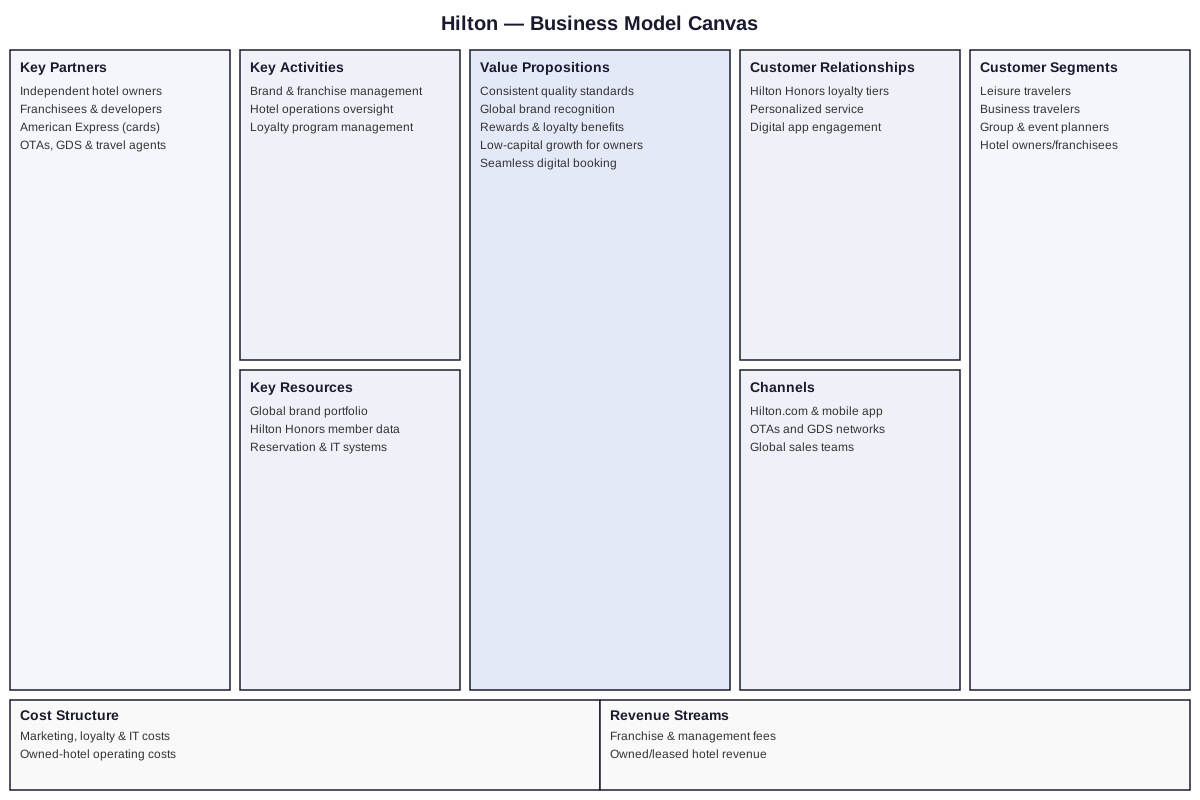
Owners who want to run a hotel under a Hilton brand sign a franchise agreement. They pay an initial fee to join the system, then ongoing fees calculated as a share of room revenue. In exchange, franchisees get access to Hilton's reservation systems, marketing programs, quality standards and its loyalty member base, resources a standalone hotel would find expensive to build on its own.
Some owners prefer to hand off daily operations entirely. Under a management contract, Hilton's own staff and systems run the property while the owner keeps title to the real estate. Hilton earns a management fee tied to revenue or profit. This setup lets Hilton apply its operating expertise to hotels it does not own, growing its footprint without matching capital spending.
Both structures push the biggest risks, construction costs, local labor markets and property debt, onto the owner, while Hilton collects a steady fee stream. The tradeoff is less direct control. Hilton cannot run day-to-day service at every hotel the way it could if it owned the property outright, so training and audit systems carry the weight of keeping brand standards consistent.
Hilton Honors as a demand engine
Hilton Honors, the company's loyalty program, launched in 1987. It now counts more than 250 million members worldwide. Members earn points for stays and redeem them for free nights, room upgrades and curated experiences. Higher tiers unlock extra perks, such as lounge access and guaranteed late checkout. The program has grown fast enough that Hilton Honors is closing the gap with Marriott Bonvoy, the largest hotel loyalty program by membership.4
The economics behind the program are simple. Members who book directly through Hilton's website or app cost the company less in distribution fees than guests who arrive through online travel agencies. Loyal guests also stay more often and pay less attention to price when choosing where to sleep. Hilton issues co-branded credit cards with American Express, too, and cardholders earn points on everyday spending. That extends the loyalty relationship well beyond actual hotel stays.
Franchisees benefit from this member base without funding the program themselves, so Hilton Honors doubles as a selling point when recruiting new franchise owners. A hotel that joins the Hilton system inherits a pipeline of repeat guests it would otherwise take years to build.
Customer segments, channels and value proposition
Hilton serves several distinct groups of paying customers, not just one type of traveler. Leisure travelers book vacations and weekend stays, drawn in by loyalty promotions and family-friendly amenities. Business travelers value convenient locations, reliable Wi-Fi and meeting space, and they fill rooms on weekdays between leisure peaks. Group and event planners bring block bookings for conferences, weddings and corporate meetings, filling space that would otherwise sit empty.
Independent hotel owners and franchisees form a customer segment of their own. They pay Hilton for brand access and operating support, not for a place to sleep. Travel agents and corporate travel managers round out the list, booking on behalf of clients in exchange for commissions and reliable service.
Guests reach Hilton through several channels. These include the company's own website and mobile app, online travel agencies [OTAs] such as Expedia and Booking.com, global distribution systems [GDS] used by travel agents, and direct relationships built by Hilton's corporate sales teams. Hilton keeps steering marketing toward its own channels because they carry lower distribution costs and yield better data on guest preferences.
Competitive pressure and the limits of the model
Hilton competes against hotel groups running similar fee-based strategies. Marriott International operates the largest loyalty program by membership, Marriott Bonvoy, and its brands span luxury to budget categories. Hyatt Hotels Corporation leans into lifestyle and upscale positioning through World of Hyatt. InterContinental Hotels Group and Wyndham Hotels & Resorts compete harder in the mid-scale and economy segments. Airbnb and other short-term rental platforms add a different kind of pressure, pulling leisure travelers toward accommodations that sit outside the traditional hotel category.
The asset-light structure that makes Hilton resilient in downturns also limits its control over any single property. Franchise agreements set standards, but enforcement relies on inspections and incentives rather than direct management. That leaves room for inconsistency across thousands of independently owned hotels. Hilton's fee-based income has still proven more durable through demand swings than ownership-heavy models, since franchise and management fees keep flowing even when individual owners absorb the brunt of a slow travel season.5
Hilton has described its growth pipeline as exceeding 460,000 rooms under development. That suggests franchisees and developers still see enough value in the brand to keep signing new agreements. Sustaining that appetite means Hilton must keep proving its loyalty program, technology and marketing support are worth the fees owners pay for them.
Hilton's shift from hotel owner to fee-collecting brand manager did not happen by accident. Blackstone's 2007 buyout pushed the company to sell real estate and lean into management and franchise contracts, a move that set up its 2013 return to public markets and the growth that followed. The model now rests on three things working together: a franchise network that expands the brand without tying up capital, a loyalty program that channels demand back to Hilton-branded properties, and enough operating discipline to keep independent owners satisfied. Marriott and Hyatt run comparable playbooks, and Airbnb keeps pressure on pricing in leisure markets. Whether Hilton keeps its edge will depend less on how many rooms it adds and more on how well it defends brand standards across thousands of properties it does not control.
Citation
Cite this article
Sridharan, M. A. (2024, July 27). Hilton's Asset-Light Business Model. Think Insights. https://thinkinsights.net/strategy/hiltons-asset-light-business-model (Accessed [[ACCESS_DATE]])
Sridharan, Mithun A. "Hilton's Asset-Light Business Model." Think Insights, 27 July 2024, https://thinkinsights.net/strategy/hiltons-asset-light-business-model. Accessed [[ACCESS_DATE]].
Mithun A. Sridharan, "Hilton's Asset-Light Business Model," Think Insights, July 27, 2024, https://thinkinsights.net/strategy/hiltons-asset-light-business-model. Accessed [[ACCESS_DATE]].
Sridharan, M.A. (2024) 'Hilton's Asset-Light Business Model', Think Insights. Available at: https://thinkinsights.net/strategy/hiltons-asset-light-business-model (Accessed: [[ACCESS_DATE]]).
M. A. Sridharan, "Hilton's Asset-Light Business Model," Think Insights, 2024. [Online]. Available: https://thinkinsights.net/strategy/hiltons-asset-light-business-model. [Accessed: [[ACCESS_DATE]]].
Sridharan MA. Hilton's Asset-Light Business Model. Think Insights. Published July 27, 2024. Accessed [[ACCESS_DATE]]. https://thinkinsights.net/strategy/hiltons-asset-light-business-model
Test Your Knowledge
Hilton's Asset-Light Business Model
Challenge yourself on the concepts from this article and see how well you understood them.
Subscribers get weekly quizzes and insights — subscribe free
Sponsor this article
Partner with Think Insights
Reach 50,000+ business leaders, consultants, and strategists. Feature your brand alongside expert articles on strategy, leadership, and digital transformation.
Become a Sponsor