The Hidden Timeline Advantage


Business models rest on assumptions about demand, cost and timing that rarely get tested against history. Most companies treat weather as a short-term operational detail, something to check before a shipment goes out or a store opens for the weekend. Few connect it to strategy. Yet weather follows patterns that repeat across weeks, seasons and years, patterns that shape revenue, staffing and supply chains long before they show up in a quarterly report. Tomorrow.io, a weather intelligence company built around a satellite constellation and a unified data platform, shows what happens when a company treats environmental history as a strategic asset rather than a forecasting footnote. Its business model shows how connecting past, present and future data into one timeline turns a routine operational input into a source of durable competitive insight.
What is a hidden timeline in a business model
It is the pattern connecting past, present and future external conditions, such as weather, that consistently shapes demand, cost and operations, even though most planning tools only show a narrow window around today.
Why does weather work as an example of this pattern
Weather affects nearly every industry through purchasing behavior, logistics and staffing and its cycles repeat closely enough across seasons and years that historical data can reveal them, unlike more erratic external variables.
How does Tomorrow.io put time-aware weather data to use
It combines a proprietary satellite constellation with historical archives and live forecasts into a single API, letting customers in aviation, logistics, insurance and government treat weather as one continuous timeline rather than three separate feeds.
Why Timelines Hide in Plain Sight
Business models are built on assumptions about demand, cost and timing. Most companies test those assumptions against internal data such as sales history, customer feedback and cost trends, refining them as new information arrives. One input this process often understates is time itself, specifically how external conditions such as weather move through predictable cycles that shape performance well before they show up in quarterly results.
Companies plan for the obvious seasonal swings. Retailers stock up before winter holidays, airlines add capacity for summer travel and utilities adjust output for extreme heat or cold, generally following broad rules of thumb rather than a rigorous look at historical behavior. Weather touches nearly every industry, yet many companies still treat it as a daily check rather than a long-range planning input.
Tomorrow.io, a Boston-based weather intelligence company founded in 2016, was built around exactly this gap.1 Its founders started by pulling weather signals from cellular networks and connected devices instead of relying only on traditional radar, then expanded into a proprietary satellite constellation and a unified data platform serving airlines, logistics firms, insurers and governments. The company's growth shows what changes when a business treats environmental history not as a side note, but as a structural part of its own business model.
Every business operates inside a timeline shaped by outside forces; the question is whether it looks at that timeline directly or waits for the outcome to arrive as a surprise.
The Cost of Snapshot Thinking
Most operational tools are built for the short term. Dashboards highlight today's numbers, forecasting tools focus on the next few days and planning meetings revolve around current conditions. That structure feels efficient, but it introduces a real limitation. It treats a repeating pattern as a series of unconnected events.
A retailer reordering stock from this week's forecast, or a carrier rerouting trucks from today's radar, makes a reasonable short-term call. What it misses is the broader rhythm behind it, whether a similar spike occurred at the same point in past years and how large it tends to run. Without that context, teams react to outcomes rather than anticipating them.
Data fragmentation makes the problem worse. Historical archives, live conditions and forecasts often live in separate systems built by different vendors, each with its own format and update schedule. Reconciling those sources consumes time that could go toward analysis instead, leaving strategy built on fragments rather than a connected sequence.
What History Reveals That Forecasts Alone Cannot
A short-range forecast answers one question: what is likely to happen next. It does not say whether that outcome is typical or unusual, because it lacks a reference point. Only historical data supplies that reference, showing whether a temperature swing, a rain event or a wind pattern is a recurring cycle or a rare deviation.
Space agencies rely on this same principle when they validate commercial weather data against long-running scientific records. The National Aeronautics and Space Administration [NASA] lists Tomorrow.io as an approved vendor for supplemental Earth-observation data, a status that depends partly on the company's ability to reconcile new satellite readings with decades of historical atmospheric measurements.2 That reconciliation process, done at agency scale, is a scientific version of what any company must do on a smaller scale: line up today's conditions against yesterday's pattern before drawing conclusions.
For most businesses, the obstacle is not scientific rigor but access. Historical archives, current feeds and forecasts typically sit with different providers, each using its own file structure, unit system and update interval. Assembling a usable dataset from these pieces takes real effort, discouraging the deeper, longer-range analysis that would otherwise pay off.
From Scattered Data to a Single Timeline
The most direct fix for data fragmentation is structural: put historical records, live readings and forecasts on one timeline instead of three. Tomorrow.io pursued this by building its own hardware layer rather than depending only on third-party feeds, launching radar-equipped satellites starting in 2023 and expanding to a constellation that revisits most points on the globe roughly once an hour, far tighter than the multi-day gaps typical of older weather-radar missions.3
That physical infrastructure feeds a single software layer, delivering historical archives, live feeds and forecasts as one continuous stream through an application programming interface [API] instead of three separate vendor feeds. A logistics company can pull five years of precipitation data for a delivery corridor and the next 72 hours of forecast for that corridor from the same query, in the same units and structure.
That continuity changes what analysis is possible. Teams can measure how far current conditions deviate from a seasonal norm instead of guessing whether this week looks unusual and build models that treat weather as an ongoing input rather than a one-time check. That is the difference between reacting to a storm and planning for the predictable rate at which storms of a given size occur.
Where Hidden Timelines Show Up in Performance
Weather's effect on performance rarely announces itself as a single event. It shows up as a pattern across revenue, cost and staffing that only becomes visible across more than one data point. Demand for certain products rises and falls with temperature and precipitation in ways that repeat year after year, yet many finance teams still record the shifts as unexplained variance rather than a predictable cycle.
Cost structures move in step. Delivery networks slow down during storms, raising fuel and labor costs per shipment, while energy bills climb with heating and cooling demand. Staffing plans built around expected foot traffic or call volume have to flex when conditions push customers to behave differently than a flat seasonal average suggests. Fast Company recognized Tomorrow.io as the most innovative logistics company in its 2024 rankings, largely because its data let carriers see these cost swings coming rather than absorbing them after the fact.4
Customer segments do not respond the same way, either. Frequent travelers adjust plans quickly around a forecast; occasional buyers may not react until conditions already disrupt them. That difference helps a company decide where to invest in proactive outreach and where a standard notification is enough.
Turning Patterns Into Decisions
Identifying a pattern only pays off once it changes a decision. Demand planning is the most direct application: a company that knows how a specific temperature range or storm track affected past sales can adjust inventory and staffing ahead of time, moving planning from reactive to anticipatory.
Pricing benefits in a similar way. Airlines, event organizers and delivery platforms can adjust prices when conditions historically push demand up or down, rather than relying on guesswork tied to the current forecast alone. Tomorrow.io's collaboration with NVIDIA applies this logic at a larger scale, feeding near-real-time satellite data into an Artificial Intelligence [AI]-driven digital twin of Earth's atmosphere that sharpens the models customers use to make exactly these calls.5
Risk management rounds out the list. A company that reviews how past storms, heat waves or cold snaps disrupted operations can build contingency plans around a known range of outcomes instead of an untested guess. None of this requires new data, only treating existing data as a continuous timeline rather than a stack of disconnected reports.
Rebuilding the Business Model Around Time
Traditional business model planning leans on averages: typical demand, typical cost, typical staffing level. Averages are useful as a baseline, but they flatten the cycles that time-aware data is meant to reveal. A company that only plans around an average summer will be surprised by an unusually hot one, even though the odds of it are themselves predictable.
Rebuilding a model around time does not require replacing every assumption at once. It starts with treating weather, or whatever external signal matters most to a given industry, as a variable with a history worth studying rather than a condition to check each morning. Tomorrow.io's place on TIME's list of the most influential companies reflected exactly this shift, turning an operational input into a strategic one.6
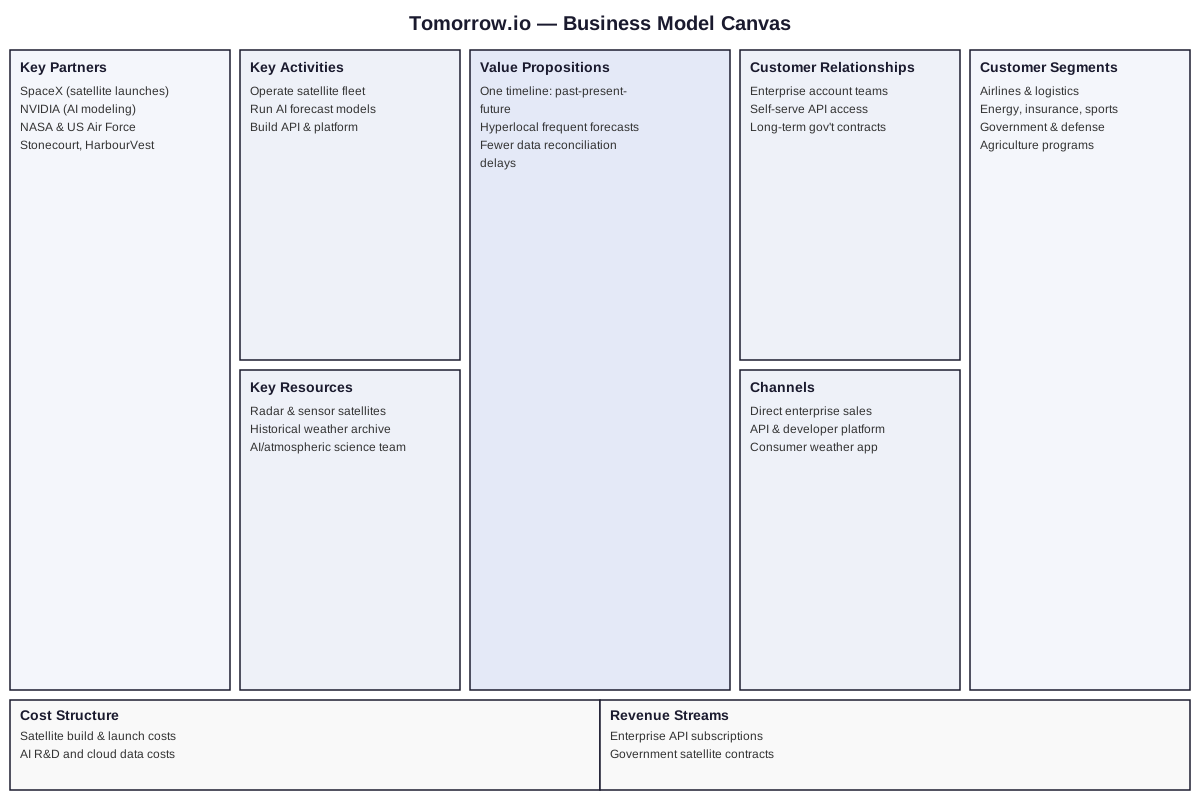
The sections below apply this thinking directly to Tomorrow.io's own business model, mapped against the nine building blocks of the Business Model Canvas. Each block shows where time-aware weather data changes what the company offers, whom it serves and how it earns revenue.
Key Partners
Tomorrow.io's model depends on partners that extend its reach into space, government and applied science. SpaceX has launched its radar and passive-sensing satellites since 2023, forming the backbone of its own constellation, while NVIDIA works with the company on AI-driven atmospheric modeling through its Earth-2 platform. Government bodies including NASA and the US Air Force fund and validate parts of the satellite program and investors such as Stonecourt Capital and HarbourVest Partners fund its space buildout.
Key Activities
The company's core activity is operating a private satellite constellation and turning its output into usable forecasts. Engineers manage radar and microwave-sensor satellites, process the data through AI models and merge it with historical archives into one timeline, then maintain the API and dashboard that deliver this data to enterprise customers. A further activity is building government-specific programs, from Air Force weather sensors to agricultural forecasting for partner nations.
Key Resources
Tomorrow.io's most distinct resource is its own constellation of radar and passive-sensing satellites, among the first of their kind built by a private company. Alongside that hardware sits a growing archive of historical and real-time atmospheric data, structured to work as one continuous timeline. Its AI and atmospheric science teams turn that data into forecasting models and its cloud platform and API infrastructure make the results usable at enterprise scale.
Value Propositions
The company's central offer is a single timeline spanning historical records, current conditions and forecasts, replacing the fragmented sources most businesses juggle. That structure supports hyperlocal, frequently updated forecasts drawn from its own satellites rather than only public models, cutting the delays that come from reconciling separate datasets. Sectors from aviation to logistics use this to cut weather-related disruption and plan operations around expected conditions rather than react after the fact.
Customer Relationships
Enterprise customers work with dedicated account teams that help integrate weather data into existing planning and operational systems, while smaller or technical customers build directly on the self-serve API without a sales relationship. Government clients tend toward long, multi-year contracts tied to specific satellite or sensor programs. A research collaboration with the National Oceanic and Atmospheric Administration [NOAA] reflects a further relationship type, where Tomorrow.io works alongside public agencies rather than only selling to them.
Channels
Tomorrow.io reaches enterprise customers through direct sales and its developer-facing API and dashboard platform. Government business flows through formal procurement channels, including Air Force and Department of Defense contracting processes and a consumer channel exists through its Weather by Tomorrow mobile app. Partnerships with companies such as Uber and JetBlue also embed its forecasts inside other companies' own customer-facing products.
Customer Segments
The company's customer base spans sectors that depend on weather timing: airlines, logistics and on-demand delivery platforms, energy and insurance providers and sports and media organizations planning around outdoor conditions. Government and defense agencies form another segment, including the US Department of Defense and Air Force, alongside national agriculture programs in Nigeria and the Philippines that use the data to guide farmers' planting decisions.
Cost Structure
The largest costs sit in the satellite program: manufacturing, launch and ongoing operation of a growing constellation. Research and development for AI forecasting models is a second major cost, particularly as the company expands into next-generation programs such as DeepSky and cloud infrastructure and data processing costs scale with the volume of historical and real-time data the platform handles. Sales, government contract compliance and account management round out the remaining cost base.
Revenue Streams
Most revenue comes from enterprise subscriptions to the weather API and platform, priced around usage and the level of customization a customer needs. Government contracts, including Air Force and Department of Defense agreements tied to satellite development, form a second stream and licensing proprietary data to partners and integrators adds a third. The consumer app rounds out the model as a smaller channel, extending the brand to a broader audience beyond its enterprise base.
Every company already operates inside a timeline; most just refuse to look at it directly. Weather is one of the clearest signals available because it is measurable, consistent and largely treated as an operational nuisance rather than a strategic input. Tomorrow.io built a business around closing that gap, turning satellite data, historical archives and forecasts into a single structure that customers can query as one source of truth. The lesson extends past weather. Any business model built only on current conditions and short-term forecasts is missing the middle piece, the pattern connecting past and future. Companies that learn to read that pattern, whatever the underlying signal, gain a planning advantage that snapshot-driven competitors cannot easily copy.
Citation
Cite this article
Sridharan, M. A. (2021, March 9). The Hidden Timeline Advantage. Think Insights. https://thinkinsights.net/strategy/hidden-timeline-advantage (Accessed [[ACCESS_DATE]])
Sridharan, Mithun A. "The Hidden Timeline Advantage." Think Insights, 9 Mar. 2021, https://thinkinsights.net/strategy/hidden-timeline-advantage. Accessed [[ACCESS_DATE]].
Mithun A. Sridharan, "The Hidden Timeline Advantage," Think Insights, March 9, 2021, https://thinkinsights.net/strategy/hidden-timeline-advantage. Accessed [[ACCESS_DATE]].
Sridharan, M.A. (2021) 'The Hidden Timeline Advantage', Think Insights. Available at: https://thinkinsights.net/strategy/hidden-timeline-advantage (Accessed: [[ACCESS_DATE]]).
M. A. Sridharan, "The Hidden Timeline Advantage," Think Insights, 2021. [Online]. Available: https://thinkinsights.net/strategy/hidden-timeline-advantage. [Accessed: [[ACCESS_DATE]]].
Sridharan MA. The Hidden Timeline Advantage. Think Insights. Published March 9, 2021. Accessed [[ACCESS_DATE]]. https://thinkinsights.net/strategy/hidden-timeline-advantage
Test Your Knowledge
The Hidden Timeline Advantage
Challenge yourself on the concepts from this article and see how well you understood them.
Subscribers get weekly quizzes and insights — subscribe free
Sponsor this article
Partner with Think Insights
Reach 50,000+ business leaders, consultants, and strategists. Feature your brand alongside expert articles on strategy, leadership, and digital transformation.
Become a Sponsor