Heinrichs Law


- Heinrich's most famous theories include unsafe acts of persons are responsible for most accidents and the 300-29-1 ratio of workplace accidents.
- Critics claim that adhering to the Heinrich model can lead to an over-emphasis on worker behavior and not enough attention on systems.
- Heinrich is credited with bringing attention to workplace safety and focusing on the human element of safety.
What is the core ratio in Heinrich's Law?
For every major injury, there are 29 minor injuries and 300 no-injury incidents, forming a 1:29:300 ratio known as the Safety Triangle.
Who developed Heinrich's Law and when?
Herbert William Heinrich, an employee at Traveler's Insurance Company, developed the theory in the 1930s after reviewing thousands of workplace accident reports.
What percentage of workplace accidents did Heinrich attribute to human behavior?
Heinrich concluded that approximately 88% of workplace accidents are caused by unsafe acts rather than unsafe conditions, though his work also encouraged addressing physical hazards.
Has Heinrich's Law been challenged?
Yes. Fred Manuele published research finding that while managing small incidents reduces minor incident rates, major accident rates may remain the same or slightly increase.
How does Heinrich's Law relate to the Swiss Cheese Model?
Both frameworks address systemic safety failures. Heinrich's Law provides statistical ratios for incident frequency, while the Swiss Cheese Model explains how multiple defensive layer failures align to cause accidents.
Heinrich's Law, also known as the Safety Triangle or Safety Pyramid, is a fundamental concept in industrial safety and accident prevention. Developed by Herbert William Heinrich in the 1930s, this theory has significantly influenced workplace safety practices for nearly a century.
The concept
In the 1930's, William Herbert Heinrich, an employee working for Traveler's Insurance Company, published 1 groundbreaking theories about safety and health in the workplace. One such theory became known as Heinrich's Law:
that in a workplace, for every accident that causes a major injury, there are 29 accidents that cause minor injuries and 300 accidents that cause no injuries.
Because many accidents share common root causes, addressing more commonplace accidents that cause no injuries can prevent accidents that cause injuries.
At its core, Heinrich's Law posits that for every workplace accident resulting in a major injury, there are 29 accidents causing minor injuries and 300 incidents that cause no injuries. This 1:29:300 ratio forms the basis of the Safety Triangle, illustrating the relationship between serious accidents, minor incidents, and near-misses in the workplace.
The principle behind Heinrich's Law is that many accidents share common root causes. By addressing and eliminating the more frequent minor incidents and near-misses, organizations can effectively reduce the likelihood of major accidents occurring. This approach emphasizes the importance of proactive safety measures and encourages businesses to pay attention to seemingly insignificant safety issues before they escalate into more serious problems.
Role of human behavior
Heinrich's work also highlighted the role of human behavior in workplace accidents. He suggested that as many as 88% of all workplace accidents and injuries are caused by unsafe acts rather than unsafe conditions. This conclusion led to the development of behavior-based safety programs, which focus on identifying and modifying risky behaviors to prevent accidents.
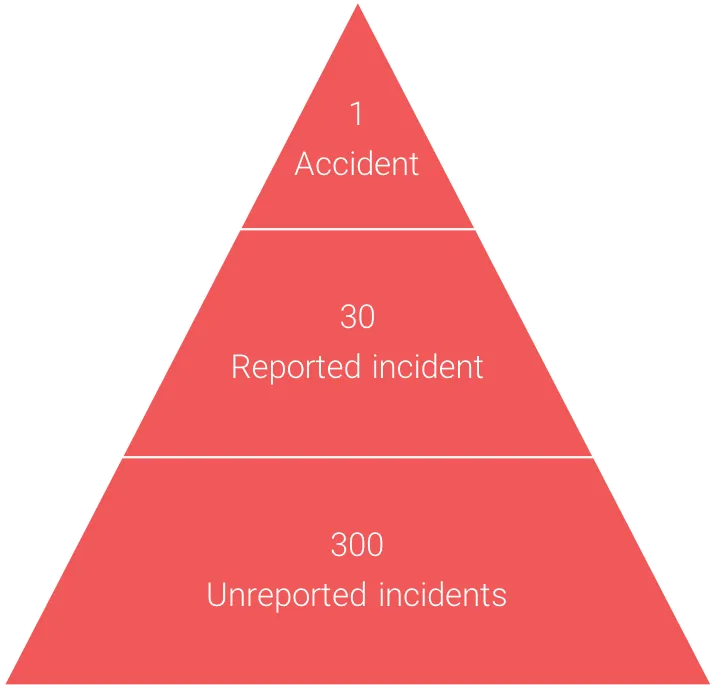
Heinrich's Pyramid[/caption] Heinrich's work is claimed as the basis for the theory of behavior-based safety by some experts of this field, which holds that as many as 95% of all workplace accidents are caused by unsafe acts. Heinrich came to this conclusion after reviewing thousands of accident reports completed by supervisors, who generally blamed workers for causing accidents without conducting detailed investigations into the root causes. While Heinrich's figure that 88% of all workplace accidents and injuries/illnesses are caused by man-failure is perhaps his most oft-cited conclusion, his book actually encouraged employers to control hazards, not merely focus on worker behaviors.
No matter how strongly the statistical records emphasize personal faults or how imperatively the need for educational activity is shown, no safety procedure is complete or satisfactory that does not provide for the . . . correction or elimination of . . . physical hazards,
Heinrich wrote in his book. Heinrich's theories were considered sacrosanct, until Fred Manuele, President of Hazards Limited, a consulting firm, recently published 2an article in the ASSE periodical - Professional Safety challenging the validity of Heinrich's Law. The challenge specifically targets this premise:
focusing on incident frequency reduction will equivalently achieve severity reduction.
What Mr. Manuele found is that if you manage the small incidents effectively, the small incident rate improves, but the major accident rate stays the same, or even slightly increases.
Industrial impact
Heinrich's Law has had a significant impact across various industries, particularly those with higher occupational hazards. While the exact impact varies, several sectors have notably benefited from applying Heinrich's principles:
- Manufacturing and Industrial Sectors: These industries were among the first to adopt Heinrich's theories, given their higher risk of workplace accidents. The application of the Safety Triangle has helped reduce both minor and major incidents in factories and production facilities
- Construction: The construction industry, known for its high accident rates, has widely implemented Heinrich's principles to improve safety practices and reduce workplace injuries
- Oil and Gas: This sector has seen significant impact, with studies specifically conducted to test Heinrich's theories in the industry. The focus on reducing minor incidents has contributed to overall safety improvements
- Logistics and Warehousing: In these industries, Heinrich's Law has been applied to address near-misses and minor incidents, particularly in areas like package handling and equipment operation
- Healthcare: Medical facilities have used Heinrich's principles to improve patient safety and reduce workplace accidents among healthcare workers
- Mining: Given the high-risk nature of mining operations, the industry has benefited from applying Heinrich's theories to prevent both minor and major accidents
- Transportation: The principles have been applied in traffic safety and accident prevention in various modes of transportation
Heinrich's Law and Domino Theory
Heinrich's Law complements the Domino Theory in accident prevention by providing a quantitative framework that supports and enhances the sequential model of accident causation. While the Domino Theory illustrates the chain of events leading to an accident, Heinrich's Law adds a statistical perspective on the relationship between minor incidents and major accidents.
The Domino Theory, developed by Heinrich himself, posits that accidents result from a series of sequential events, much like a row of falling dominoes. It emphasizes that removing any factor in this sequence can prevent the accident. Heinrich's Law complements this by highlighting that for every major injury, there are typically 29 minor injuries and 300 near-misses or underlying risk factors.
This complementary relationship works in several ways:
- Emphasis on root causes: Both theories stress the importance of addressing underlying factors. The Domino Theory shows how these factors are interconnected, while Heinrich's Law quantifies their prevalence
- Focus on prevention: Heinrich's Law reinforces the Domino Theory's preventive approach by suggesting that addressing minor incidents can significantly reduce the likelihood of major accidents
- Proactive safety management: The combination of these theories encourages organizations to pay attention to and report minor incidents and near-misses, as they are indicators of potential major accidents
- Behavioral focus: Both theories highlight the role of human behavior in accident causation, with Heinrich's Law providing a statistical basis for the importance of addressing unsafe acts
- Systemic approach: While the Domino Theory illustrates the accident sequence, Heinrich's Law adds a broader perspective on the overall safety landscape within an organization
Heinrich's Law and Dr. Reason's Swiss Cheese Model
Dr. Reason's Swiss Cheese Model, developed in the 1990s, takes a more systemic approach to accident causation. Dr. James Reason's Swiss Cheese Model is a widely recognized framework for understanding how accidents occur in complex systems.
Developed in the 1990s, this model visualizes an organization's defenses against failures as a series of barriers, represented by slices of Swiss cheese. Each slice represents a defensive layer in the system - such as policies, procedures, technology, or human factors. The holes in the cheese symbolize weaknesses or gaps in these defenses, which can vary in size and position. Accidents occur when the holes in all layers momentarily align, allowing a hazard to pass through all the defensive layers.

This model emphasizes that most accidents result from multiple, small failures that line up in an unfortunate way, rather than from a single catastrophic error. It highlights the importance of addressing both active failures (immediate unsafe acts) and latent conditions (underlying systemic weaknesses) in preventing accidents. The Swiss Cheese Model has been influential in various high-risk industries, including aviation, healthcare, and nuclear power, guiding the development of more comprehensive and systemic approaches to safety management.
- Multiple barriers: It represents an organization's defenses as layers of Swiss cheese, with holes representing weaknesses in each layer
- Alignment of failures: Accidents occur when holes in all layers momentarily align, allowing a hazard to pass through
- Active and latent failures: The model distinguishes between immediate unsafe acts and underlying systemic weaknesses
- Organizational factors: It emphasizes the role of organizational influences, unsafe supervision, and preconditions for unsafe acts
While Heinrich's Law may not be a perfect predictor of accident ratios, its core principle of addressing minor incidents to prevent major ones remains relevant in today's workplace safety practices. As industries evolve and new safety challenges emerge, the fundamental idea of proactive risk management inspired by Heinrich's work continues to shape safety strategies across the globe.
Citation
Cite this article
Sridharan, M. A. (2018, April 13). Heinrichs Law. Think Insights. https://thinkinsights.net/strategy/heinrichs-law (Accessed [[ACCESS_DATE]])
Sridharan, Mithun A. "Heinrichs Law." Think Insights, 13 Apr. 2018, https://thinkinsights.net/strategy/heinrichs-law. Accessed [[ACCESS_DATE]].
Mithun A. Sridharan, "Heinrichs Law," Think Insights, April 13, 2018, https://thinkinsights.net/strategy/heinrichs-law. Accessed [[ACCESS_DATE]].
Sridharan, M.A. (2018) 'Heinrichs Law', Think Insights. Available at: https://thinkinsights.net/strategy/heinrichs-law (Accessed: [[ACCESS_DATE]]).
M. A. Sridharan, "Heinrichs Law," Think Insights, 2018. [Online]. Available: https://thinkinsights.net/strategy/heinrichs-law. [Accessed: [[ACCESS_DATE]]].
Sridharan MA. Heinrichs Law. Think Insights. Published April 13, 2018. Accessed [[ACCESS_DATE]]. https://thinkinsights.net/strategy/heinrichs-law
Test Your Knowledge
Heinrichs Law
Challenge yourself on the concepts from this article and see how well you understood them.
Subscribers get weekly quizzes and insights — subscribe free
Sponsor this article
Partner with Think Insights
Reach 50,000+ business leaders, consultants, and strategists. Feature your brand alongside expert articles on strategy, leadership, and digital transformation.
Become a Sponsor