Google's Multi-Sided Business Model


Google turns free search into one of the most profitable business models in technology. Alphabet, its parent company, generated more than $400 billion in 2025 revenue, and search advertising still supplied over half of that total. Users never pay a fee; advertisers do, bidding for placement next to search results and YouTube videos through automated auctions. That advertising engine funds a widening set of businesses, including Google Cloud, subscription products such as YouTube Premium and Google One, and a fast-growing Gemini Artificial Intelligence [AI] platform embedded across Search, Workspace and enterprise tools. The model works because Google controls both the audience, through Search, Android, Chrome and YouTube, and the marketplace where advertisers compete for that audience's attention. This breakdown covers Google's partners, costs and all nine blocks of its business model canvas.
How does Google make money from a free search engine?
Google does not charge users. It charges advertisers, who bid for placement next to search results and pay mostly on a cost-per-click basis when someone clicks their ad. This performance-based auction, combined with brand advertising priced per impression, produced most of Alphabet's $402.8 billion in 2025 revenue.
What share of Alphabet's revenue comes from advertising versus Cloud and AI?
In 2025, Google Search and Other brought in $224.5 billion and Google Network another $29.8 billion, together well over half of Alphabet's total. Google Cloud, which now embeds Gemini AI tools, contributed $58.7 billion and was the fastest-growing large segment, with quarterly growth reaching 82% by mid-2026.
Why is Google's business model considered multisided?
Google connects three distinct groups on one platform: users who search for free, publishers who supply content and share ad space, and advertisers who pay to reach both. Each side needs the others, which is what makes it a multisided platform rather than a simple retailer or subscription business.
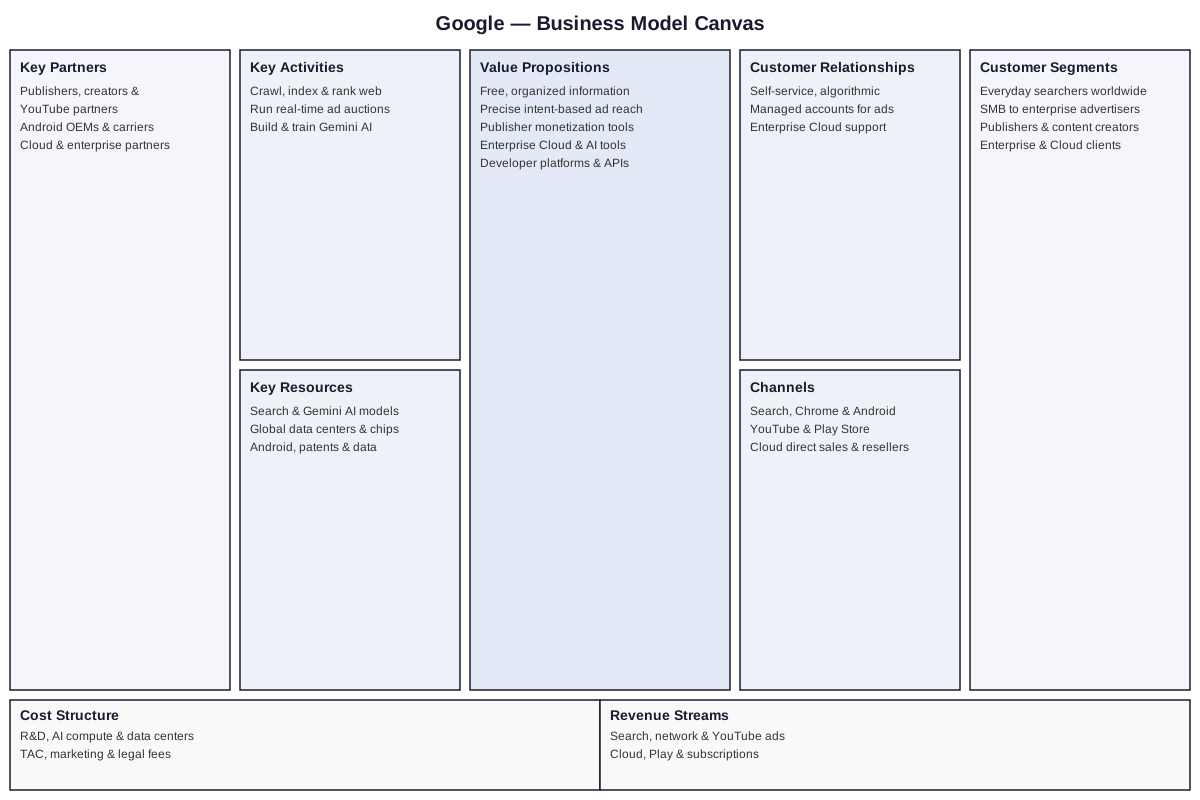
A Search Engine Becomes a Platform
Google started in 1996 as a Stanford research project by Larry Page and Sergey Brin, who wanted to rank web pages by counting the links pointing to them rather than just matching keywords. They called the prototype BackRub before renaming it Google, a play on googol, the number one followed by 100 zeros. The company incorporated in 1998, moved into the Googleplex in Mountain View, California, and went public in 2004 in an offering that raised $1.66 billion. Two decades later, Google sits inside Alphabet Inc, the holding company Page and Brin created in 2015 to separate the core search and advertising business from riskier ventures. Sundar Pichai now runs both Alphabet and Google as chief executive officer [CEO], a role he has held since Page stepped back in December 2019.
Monetizing Free Search
Google's core insight was to let users search for nothing while charging the businesses that want their attention. Advertisers bid in real time for placement above organic results, and most pay only when someone clicks, a pricing model known as cost per click [CPC]. A parallel format, cost per impression [CPM], lets brands pay for visibility rather than clicks when the goal is awareness rather than an immediate sale. Search and its network of partner sites still anchor this business: Google Search and Other generated $224.5 billion of Alphabet's $402.8 billion in 2025 revenue, more than half the company total. 1 Traffic acquisition costs [TAC], the payments Google makes to Apple, Mozilla and Android partners to stay the default search engine, ran at roughly 21% of advertising revenue in 2025, a cost line that draws regulatory scrutiny precisely because it cements Google's distribution advantage.
Diversifying Beyond Ads
Advertising still dominates, but Google has spent two decades building revenue lines that do not depend on an ad auction. YouTube collects a second advertising stream from video, plus subscription income through YouTube Premium and YouTube TV. Google Cloud sells infrastructure and software to enterprises on a consumption basis, and it has become the company's fastest-growing large segment, with revenue up 35.8% to $58.7 billion in 2025 and quarterly growth accelerating to 82% in the second quarter of 2026 as customers bought AI infrastructure and services. 2 Hardware, including Pixel phones and Nest smart-home devices, and subscriptions such as Google One round out a segment Alphabet now reports separately as Subscriptions, Platforms and Devices. None of these lines rivals search yet, but together they reduce Alphabet's dependence on a single revenue source that regulators and competitors are both circling.
The AI Reinvention
Generative AI has moved from a side project to the center of Google's strategy. Gemini now powers AI Overviews inside Search, a dedicated Gemini app, and Gemini Enterprise tools sold through Google Cloud and Workspace. Adoption has scaled quickly: the Gemini app reported 950 million monthly active users, nearly 90% of Fortune 100 companies use Gemini Enterprise, and Google's models process 22 billion API tokens per minute. 3 That scale comes at a cost. Alphabet has raised capital expenditure guidance repeatedly to fund the data centers and custom chips AI workloads require, betting that owning the infrastructure will protect margins as rivals such as OpenAI and Microsoft race for the same enterprise customers.
Competitive and Regulatory Pressure
Scale has not made Google immune to competition or oversight. Search still commands about 90% of global query volume, but that share has slipped as Microsoft's Bing gains from Copilot integration and AI search assistants pull queries away from a traditional results page. 4 In advertising, Meta and Amazon both compete for the same brand budgets, with Amazon's product-search ads a particular threat because shoppers increasingly start there instead of Google. Regulators have acted on the concentration this dominance created: a US federal court ruled in August 2024 that Google illegally maintained its search monopoly through default placement deals with Apple and browser makers, and a September 2025 remedies ruling ordered Google to share search data and loosen exclusivity terms, though it stopped short of forcing a breakup. 5 Both Google and the states challenging the ruling have appealed, so the final shape of any remedy remains unsettled.
Holding Company Discipline
Alphabet's corporate structure exists to keep this sprawl manageable. Google Search, Ads, Cloud, Android and YouTube sit inside Google itself, while Other Bets such as Waymo, the self-driving unit, are held and reported separately so their losses do not obscure the core business's profitability. That separation lets Alphabet fund long-horizon projects without asking search advertising to justify every dollar spent on them. It also gives investors a clearer read on margins: Other Bets produced only $1.5 billion of Alphabet's 2025 revenue, a rounding error next to search, yet the segment carries option value if any of its bets, from autonomous driving to life sciences, reaches commercial scale. Whether that patience pays off depends on how long advertising and Cloud can keep funding it.
Key Partners
Google's partner network spans everyone who supplies audience or infrastructure. Content publishers and video creators supply the material that appears in search results and on YouTube, then share ad revenue back with Google. Advertisers, agencies and brands of every size fund the model by bidding for placement. Android device makers and telecom carriers extend Google's reach into hardware, while Cloud and enterprise software partners help sell Google Cloud and Workspace into large organizations.
Key Activities
Google's daily work centers on organizing the web and matching it to intent. Crawling, indexing and ranking billions of pages remains the foundation search and ads depend on. Running real-time ad auctions across Search, the Display Network and YouTube converts that traffic into revenue. Building and training Gemini and other AI models has become a core activity in its own right, feeding both consumer products and Cloud customers.
Key Resources
The company's most valuable resources are not physical. Search algorithms, ranking signals and the Gemini family of AI models represent decades of engineering investment that competitors struggle to replicate. A global network of data centers and custom AI chips gives Google the computing capacity to run Search, Cloud and Gemini at scale. Patents, the Android operating system and the behavioral data collected across its products round out a resource base that reinforces itself with every additional user.
Value Propositions
Each customer segment gets a different value proposition. Users get fast, organized access to the world's information at no charge, delivered through a single search box or app. Advertisers get precise targeting based on what someone is actively searching for, which improves conversion compared with untargeted media. Publishers get tools to monetize their own traffic through ad placements and revenue sharing, and enterprises get Cloud infrastructure and Gemini-powered tools that let them build and deploy AI without owning the underlying hardware.
Customer Relationships
Most of Google's relationship with ordinary users is self-service and automated, mediated entirely through algorithms rather than support staff. Search results, ad placements and Gemini responses all rely on machine ranking rather than a human account manager. Larger advertisers and enterprise Cloud customers get a different treatment: dedicated account teams, technical support and negotiated contracts. Developer communities around Android and Gemini provide a third layer, sustained through documentation, forums and API access rather than direct sales.
Channels
Google reaches users directly through its own properties, starting with Search, Chrome and the Android operating system that ships on most of the world's smartphones. YouTube and the Play Store add distribution for video and apps, feeding traffic and purchase behavior back into the advertising business. Gmail, Maps and Google News function as secondary channels that surface ads and Gemini features to people already inside the ecosystem. Google Cloud instead uses a direct enterprise sales force and partner resellers rather than self-service signup alone.
Customer Segments
Google's customer base breaks into four groups with different needs. Everyday searchers, billions of them worldwide, use its free products and generate the traffic advertisers pay for. Advertisers range from small local businesses bidding on a handful of keywords to global brands running campaigns across search, YouTube and the ad network. Content publishers and creators supply material in exchange for a share of ad revenue, while enterprises and public-sector organizations buy Google Cloud and Gemini Enterprise for infrastructure, productivity and AI capability.
Cost Structure
Google's cost base has shifted toward capital intensity as AI has scaled. Research and development, plus the capital expenditure on data centers and custom chips needed to train and run AI models, now represents the largest and fastest-growing cost line. Traffic acquisition costs, the payments to Apple, Mozilla and Android partners for default placement, remain a major and closely watched expense. Sales, marketing, and general, administrative and legal costs, including a growing antitrust litigation bill, round out the structure.
Revenue Streams
Search and network advertising, priced mostly on a cost-per-click basis, still generates more than half of Alphabet's revenue. YouTube contributes a second advertising stream plus subscription revenue from YouTube Premium and YouTube TV. Google Cloud charges enterprise customers on a consumption basis for infrastructure, software and Gemini Enterprise access. Smaller streams include a revenue share on Play Store app and subscription sales, plus direct sales of Pixel and Nest hardware.
Google's business model endures because it monetizes attention without charging the people who generate it. Search, Android, Chrome and YouTube keep billions of users inside an ecosystem advertisers pay to reach, while Google Cloud and Gemini give Alphabet a second growth engine less dependent on advertising cycles. That diversification matters more now than a decade ago. Regulators in the United States have challenged the default-placement deals that helped Google reach its current scale, and appeals working through the courts could still reshape distribution economics. AI-driven search alternatives and retail-media rivals such as Amazon add further pressure on advertising. Even so, Alphabet's combination of data, infrastructure and audience reach gives it more room to adapt than most challengers face, so the model keeps generating cash even as its shape changes.
Citation
Cite this article
Sridharan, M. A. (2019, February 20). Google's Multi-Sided Business Model. Think Insights. https://thinkinsights.net/strategy/googles-multi-sided-business-model (Accessed [[ACCESS_DATE]])
Sridharan, Mithun A. "Google's Multi-Sided Business Model." Think Insights, 20 Feb. 2019, https://thinkinsights.net/strategy/googles-multi-sided-business-model. Accessed [[ACCESS_DATE]].
Mithun A. Sridharan, "Google's Multi-Sided Business Model," Think Insights, February 20, 2019, https://thinkinsights.net/strategy/googles-multi-sided-business-model. Accessed [[ACCESS_DATE]].
Sridharan, M.A. (2019) 'Google's Multi-Sided Business Model', Think Insights. Available at: https://thinkinsights.net/strategy/googles-multi-sided-business-model (Accessed: [[ACCESS_DATE]]).
M. A. Sridharan, "Google's Multi-Sided Business Model," Think Insights, 2019. [Online]. Available: https://thinkinsights.net/strategy/googles-multi-sided-business-model. [Accessed: [[ACCESS_DATE]]].
Sridharan MA. Google's Multi-Sided Business Model. Think Insights. Published February 20, 2019. Accessed [[ACCESS_DATE]]. https://thinkinsights.net/strategy/googles-multi-sided-business-model
Test Your Knowledge
Google's Multi-Sided Business Model
Challenge yourself on the concepts from this article and see how well you understood them.
Subscribers get weekly quizzes and insights — subscribe free
Sponsor this article
Partner with Think Insights
Reach 50,000+ business leaders, consultants, and strategists. Feature your brand alongside expert articles on strategy, leadership, and digital transformation.
Become a Sponsor