Freemium Business Model


Freemium is a pricing strategy that gives away a basic product free while charging for a premium version with more features, capacity or functionality. Companies from Spotify to Dropbox to Slack built their subscriber base this way, using free access to attract users at near-zero cost, then converting a slice of that base into paying customers. The model works because it turns marketing into a byproduct of the product itself, since every free user who tells a colleague or shares a file becomes an unpaid distribution channel. Conversion rates typically run between 2% and 5%, so the model demands scale, low serving costs and a genuinely desirable paid tier, not just clever marketing. Executives weighing freemium need to understand both its economics and its limits before betting a product line on it.
What is the difference between freemium and a free trial?
A free trial gives full access to a product for a limited time before the user must pay or lose access entirely. Freemium works differently, since the free tier never expires, though it usually caps storage, features or usage volume rather than time. Dropbox followed a freemium model in its early years, then moved its consumer product toward a trial structure once its acquisition strategy shifted, showing how a company can move between the two approaches.
How much revenue can a freemium company expect from paying users?
Most freemium companies convert between 2% and 5% of free users into paying customers, according to research on the model. A small number of consumer products, including Spotify, convert closer to 30% or more, though that level of performance depends on years of investment and a large addressable market. Revenue per paying user still has to cover the cost of serving every free account, so the conversion rate alone does not determine profitability.
When should a company avoid the freemium model?
Freemium works best when a product serves a very large potential audience, since only a small share of users end up paying for it. A company targeting a narrow, specialized market rarely reaches the scale needed to make the model profitable, and a straightforward paid offering usually performs better in that situation. Freemium also fails when the cost of serving free users, such as storage, bandwidth or support, stays too high relative to the revenue premium subscribers generate.
How the freemium model works
Freemium combines two words, free and premium, into a single pricing structure that offers a basic version of a product at no cost while charging for a fuller version with more capacity, more features or fewer restrictions. A company running a freemium model keeps the free tier live indefinitely, so it looks nothing like a free trial that expires after a set number of days. Cloud storage services illustrate the pattern well: a provider might grant a few gigabytes of free space and price additional space monthly, so the customer sees exactly what more money buys. Ad-supported apps use a similar approach, removing advertisements only for people who pay a subscription fee. The design choice at the center of freemium is the size of the gap between the two tiers, since a gap too small gives users no reason to upgrade and a gap too large makes the free tier useless as a marketing tool.1 Slack applies the same logic to workplace messaging, limiting free workspaces to a fixed number of searchable messages while unlocking full history and administrative controls only for paid teams. Duolingo applies it to language learning, capping the free experience with ads and limited hearts while a paid subscription removes both restrictions entirely.
A pricing idea with clear origins
The term freemium traces back to 2006, when venture capitalist Fred Wilson described a business model built on giving a service away, building a large user base through word of mouth and referral, then charging that base for an enhanced version of the same product. Wilson credited the actual word to Jarid Lukin, an executive at one of his portfolio companies, after readers of his blog suggested names for the pattern he had outlined.
Give your service away for free, possibly ad supported but maybe not, acquire a lot of customers very efficiently through word of mouth, referral networks and organic search marketing, then offer premium priced, value added services to your customer base
Wired editor Chris Anderson expanded the idea into a full book three years later, arguing that falling technology costs made giving products away a viable long-term strategy rather than a loss leader.2
Why giving away access builds network effects
A product becomes more useful as more people use it, and free tiers are the fastest route to that scale. Messaging apps, professional networks and collaboration tools all depend on this dynamic, since a network with ten members offers little value compared with one that has ten million. Charging a fee at the entry point would slow that growth sharply, so the free tier absorbs the cost of building an audience and lets the paid tier fund the business once that audience exists. Free users also generate a return that never shows up as revenue directly, in the form of referrals. One estimate values a freemium customer's referral activity at roughly a quarter of what a paying customer contributes to the business, since free users recommend the product to colleagues and friends who eventually convert themselves.3 That value is easy to overlook when a finance team focuses only on paying accounts, yet it explains why companies tolerate a large, unprofitable free base for years before the model turns cash-positive.
The conversion math behind freemium
Freemium businesses live on a small percentage of their user base, and that percentage rarely rises above single digits. A study from Harvard Business School puts the typical free-to-paid conversion rate between 2% and 5%, with rates in the double digits considered strong and rates above 30% reserved for a handful of exceptional consumer products.4 That math forces a company to plan around tens of millions of free users, not thousands, before the paid segment can support a real business. A niche product with a narrow addressable market rarely clears that bar, which is why advisers steer companies serving specialized business-to-business (B2B) buyers toward a straightforward paid model instead. Revenue per paying customer also has to outweigh the cost of serving every free user, including hosting, support and infrastructure, or growth in the free tier will erode margins faster than premium subscriptions rebuild them.
Spotify's free-to-paid funnel
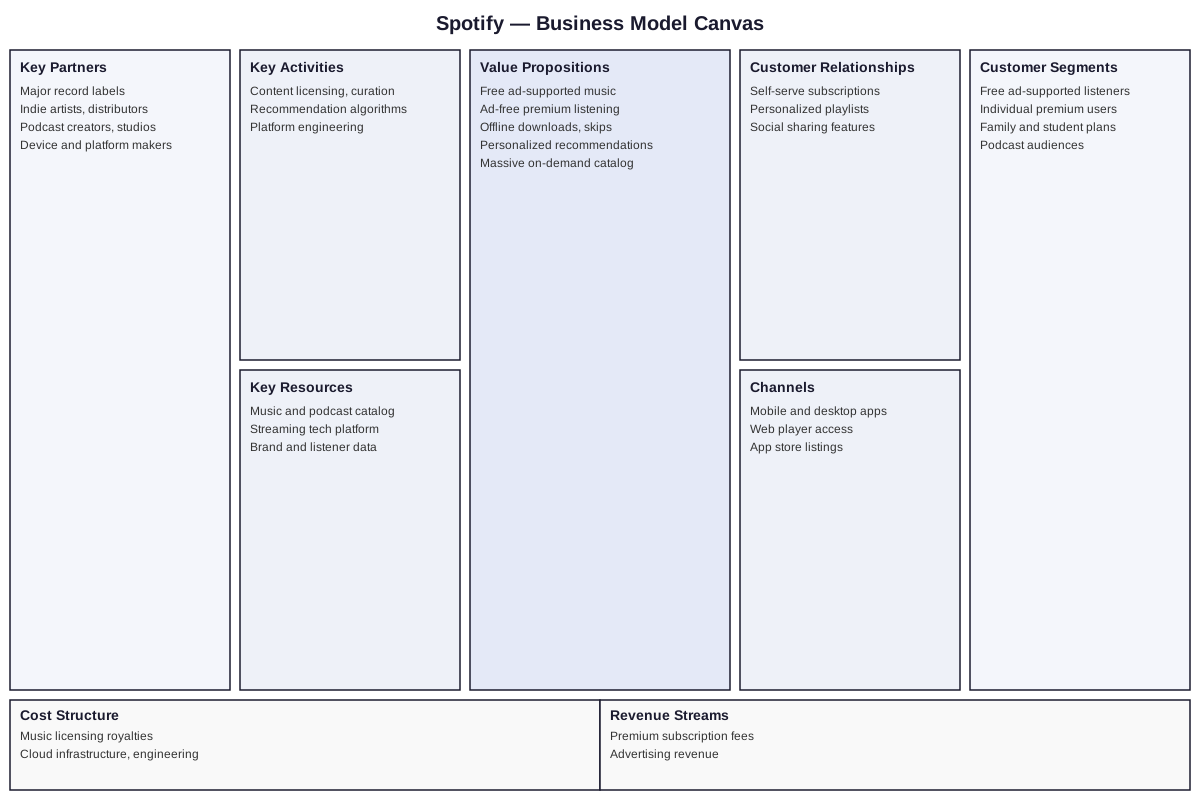
Spotify built a well-documented example of freemium economics in the music industry, offering ad-supported streaming free while reserving offline downloads, unlimited skips and ad-free listening for paying subscribers. By the end of 2025, Spotify reported 761 million monthly active users [MAU] and 293 million premium subscribers, a conversion rate near 38%, far above the industry average for consumer software.5 That performance took more than a decade of investment in catalog licensing, recommendation algorithms and international expansion before the premium tier turned profitable. Spotify's free tier still serves a purpose beyond acquisition, since it keeps casual listeners inside the platform long enough for the product to demonstrate its value, which is what eventually moves a share of them toward a subscription. Few companies replicate a conversion rate this high, and Spotify's scale, content licensing relationships and years of tuning make it closer to an outlier than a template other companies can copy directly.
The hidden costs of scale
Every free user still costs something, whether in bandwidth, customer support, fraud monitoring or the engineering time spent maintaining features nobody pays for. A freemium business that ignores this cost structure can end up subsidizing millions of unprofitable accounts while waiting for a small paid segment to break even. Keeping that free-tier cost low is a design decision as much as an engineering one, since limiting storage, bandwidth or support hours directly shapes how expensive the free base becomes to maintain. Companies that succeed with freemium track cost per free user and revenue per paying user as separate lines, adjusting the balance between the tiers whenever the gap narrows. Storage-heavy products face this pressure earliest, since every free account consumes disk space and bandwidth from day one, while messaging or productivity tools can often delay the cost until usage climbs toward the limits of the free plan.
Why some companies retreat from freemium
Not every company that starts with freemium keeps it. Dropbox spent years running a free tier alongside paid storage upgrades before shifting its consumer offer toward a time-limited free trial rather than a permanent free plan, choosing to lead with premium once its brand and acquisition channels no longer depended on giving the product away.6 That kind of reversal usually follows a shift in customer acquisition cost [CAC], when a company decides that converting new users to paid plans directly costs less than running a permanent free tier at scale. Mailchimp took the opposite path, starting as a premium-only email service in 2001 and adding a free tier in 2009, after which paying customers grew 150% within a year and profit rose 650%. These divergent choices show that freemium is not a fixed formula but a hypothesis a company can test, keep or abandon as market conditions change.
Building a freemium model that lasts
A durable freemium model starts with two value propositions designed together rather than one built as an afterthought to the other. The free tier has to be strong enough to earn word of mouth and satisfy real use cases, while the premium tier needs features that free users actually miss once they hit its limits. Executives evaluating the model should map conversion rate, cost per free user and lifetime value of paying customers before committing capital, since freemium takes years, not quarters, to reach profitability. Testing matters too, since companies can run the free and paid tiers side by side, adjust the boundary between them and measure how small changes in the free offer move upgrade rates. Getting that boundary right, more than any marketing tactic, determines whether a freemium bet turns into a durable business or an expensive customer acquisition program with no exit. Boards and investors reviewing a freemium plan should ask for the conversion rate, the cost per free user and the timeline to profitability as three separate numbers, rather than accept a single growth chart as proof the strategy works.
Freemium succeeds when the free tier is generous enough to attract users and the paid tier is compelling enough to convert them, all while operating costs per free user stay low. Spotify, Dropbox and Mailchimp show how differently that balance can play out: one keeps millions on ads indefinitely, another walked away from a permanent free plan once its funnel matured, and a third added freemium years after launch and grew faster because of it. Executives evaluating freemium should treat it as a long-term capital commitment rather than a marketing tactic, since profitability arrives only after the free base reaches real scale. The right question is not whether people will use a free product, since most will, but whether enough of them will eventually pay for something better. Getting that ratio wrong is why more freemium bets fail quietly than succeed publicly.
Citation
Cite this article
Sridharan, M. A. (2023, August 29). Freemium Business Model. Think Insights. https://thinkinsights.net/strategy/freemium-business-model (Accessed [[ACCESS_DATE]])
Sridharan, Mithun A. "Freemium Business Model." Think Insights, 29 Aug. 2023, https://thinkinsights.net/strategy/freemium-business-model. Accessed [[ACCESS_DATE]].
Mithun A. Sridharan, "Freemium Business Model," Think Insights, August 29, 2023, https://thinkinsights.net/strategy/freemium-business-model. Accessed [[ACCESS_DATE]].
Sridharan, M.A. (2023) 'Freemium Business Model', Think Insights. Available at: https://thinkinsights.net/strategy/freemium-business-model (Accessed: [[ACCESS_DATE]]).
M. A. Sridharan, "Freemium Business Model," Think Insights, 2023. [Online]. Available: https://thinkinsights.net/strategy/freemium-business-model. [Accessed: [[ACCESS_DATE]]].
Sridharan MA. Freemium Business Model. Think Insights. Published August 29, 2023. Accessed [[ACCESS_DATE]]. https://thinkinsights.net/strategy/freemium-business-model
Test Your Knowledge
Freemium Business Model
Challenge yourself on the concepts from this article and see how well you understood them.
Subscribers get weekly quizzes and insights — subscribe free
Sponsor this article
Partner with Think Insights
Reach 50,000+ business leaders, consultants, and strategists. Feature your brand alongside expert articles on strategy, leadership, and digital transformation.
Become a Sponsor