FedEx Versus UPS Strategy


FedEx and UPS spent fiscal 2025 pulling in opposite directions after decades of near-identical playbooks. FedEx is separating its freight division into a standalone public company and merging its express and ground networks into one operation, betting that a leaner, more focused structure lifts margins faster than added scale. UPS is doing the reverse on volume: it is deliberately halving the packages it carries for Amazon, its largest customer, because that business earned too little to justify the capacity it consumed. Both moves say the same thing about the delivery industry in 2026: raw parcel volume no longer guarantees profit, and carriers that chase every shipment risk diluting the returns on their networks. For executives evaluating logistics partners or benchmarking their own restructuring decisions, the FedEx-UPS split offers a live test of whether shrinking strategically beats growing indiscriminately.
How do FedEx and UPS differ in their core business models?
FedEx built its network around time-defined air delivery, while UPS grew from ground delivery and added air express decades later. FedEx has since narrowed its structure by spinning off freight, while UPS is narrowing its customer base by cutting Amazon volume. The difference today is less air versus ground and more which lever, structure or customer mix, each company pulls to raise margin.
Why is UPS reducing the volume of packages it carries for Amazon?
Amazon packages carried lower per-package revenue than UPS earns elsewhere, compressing overall margin despite the volume they added. UPS decided that capacity could earn more if redirected toward small and medium-sized businesses and healthcare shippers, who pay higher rates. The company targeted cutting Amazon volume by more than half by the second half of 2026.
What does the FedEx Freight spin-off change for FedEx as a company?
FedEx separated FedEx Freight, its less-than-truckload trucking division, into an independent public company trading on the New York Stock Exchange since June 1, 2026. The remaining FedEx Corporation now focuses on express and ground parcel delivery, its largest revenue segment. Executives argued that freight and parcel businesses have different customers and capital needs, so separating them lets each direct investment toward its own market.
Two Founders, One Rivalry
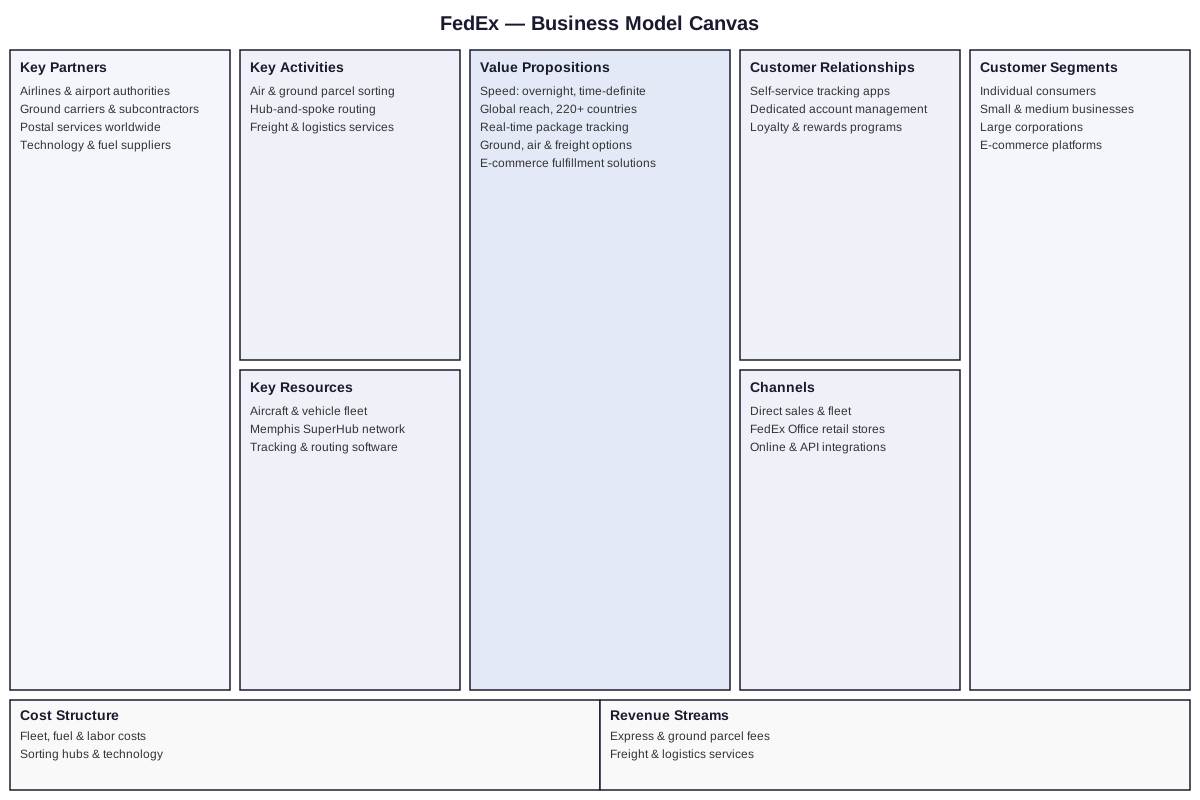
Frederick W. Smith founded FedEx in 1971 in Memphis, Tennessee. The idea started as a term paper at Yale, arguing for a centralized air-cargo network built around overnight delivery. Smith raised roughly four million dollars from his inheritance and another eighty million dollars in loans. He launched with a small fleet of aircraft serving twenty-five U.S. cities. The hub-and-spoke model he built routed every package through a central sorting point in Memphis. That design became the structural template much of the express industry later copied.
United Parcel Service [UPS] predates FedEx by more than six decades. James E. Casey started the company in 1907 in Seattle as a bicycle messenger service. He spent the following decades building it into a national ground delivery network. UPS added uniformed drivers and standardized routing early on, then launched its own air cargo operation in the early 1980s to compete directly with FedEx in express shipping.1 The two companies have mirrored each other's expansions ever since. Each has pushed into the other's core territory as e-commerce made speed and ground coverage equally essential for any national carrier.
That mirrored expansion produced two carriers of similar scale but different institutional habits. FedEx grew up solving a speed problem, and that engineering mindset still shows in how quickly it adopts new routing and automated sorting technology. UPS grew up solving a density and reliability problem across millions of daily ground stops, and that discipline still shows in its route standardization and driver culture. Neither habit disappeared as both companies diversified into freight, supply chain consulting and e-commerce fulfillment. Both habits now shape how each company is responding to pressure on parcel margins in 2026.
How Each Company Earns Its Revenue
FedEx organizes its business around a handful of operating segments. The core Federal Express unit, its express and ground parcel delivery arm, generated $75.3 billion of the company's $87.9 billion in fiscal 2025 revenue. Most of the remainder came from FedEx Freight, its less-than-truckload [LTL] trucking division, which contributed $8.9 billion before FedEx moved to spin the unit off as a separate public company.2 UPS splits its business differently. It runs a U.S. domestic segment for ground and air parcel delivery, an international segment serving customers in more than 220 countries and territories, and a supply chain solutions segment that handles freight forwarding, customs brokerage and warehousing for corporate clients. Both companies now describe themselves as integrated logistics providers rather than pure couriers. That shift reflects how much of their growth now comes from e-commerce fulfillment, freight brokerage and consulting layered on top of the original parcel business.
A Financial Picture That Has Diverged
The two companies' recent results tell different stories. FedEx closed fiscal 2025, the twelve months ended May 31, 2025, with revenue of $87.9 billion and operating income of $5.2 billion, an operating margin of 5.9%. Higher transportation and wage costs weighed on that margin, along with the loss of a longstanding U.S. Postal Service air contract. UPS, on a calendar-year basis, reported $88.7 billion in revenue and $8.7 billion in operating profit for 2025, an operating margin near 9.8%, even while absorbing the cost of cutting its own workforce and closing facilities.3 The gap in operating margin, roughly four percentage points in UPS's favor despite near-identical revenue, is early evidence of a simple point. How a carrier fills its network matters as much as how much volume moves through it.
Technology And Operating Networks
Both carriers depend on physical scale to make their networks function. Both have layered software on top of that scale to extract more efficiency from it. FedEx operates several hundred aircraft and well over 100,000 motor vehicles. Its Network 2.0 initiative is merging what were historically separate Express and Ground operating structures into one shared pickup, sorting and delivery network, cutting duplicate facilities and routes.4 UPS built its efficiency case around ORION, a routing algorithm in service since 2012. ORION recalculates each driver's stops using live traffic, weather and delivery-window data rather than a fixed route. On the customer-facing side, FedEx Delivery Manager and UPS My Choice perform similar jobs. Both let recipients reschedule, redirect or authorize deliveries from an app, evidence that customer control over the last mile has become a standard feature rather than a point of differentiation between the two carriers.
Branding And Customer Positioning
FedEx has marketed itself under the line "The World on Time" for decades, a promise built around punctuality and global reach. Its purple and orange logo signals express shipping rather than everyday ground delivery. FedEx advertising leans on high-visibility placements, including recurring Super Bowl commercials, aimed at building broad brand recognition among businesses that need urgent shipping decisions made quickly. UPS markets itself around the phrase "We Love Logistics," a line built around complexity and partnership rather than speed. Its brown trucks and uniforms make the company recognizable without relying on a logo alone. UPS leans more on sponsorships, such as NASCAR, and on content marketing aimed at small business owners who need practical shipping guidance rather than brand reassurance. The contrast reflects the underlying business split: FedEx sells urgency to individual shippers and enterprises, while UPS sells operational partnership to businesses managing recurring, complex shipping needs.
FedEx Splits Off Its Freight Business
FedEx's board approved the full separation of FedEx Freight into an independent, publicly traded company. The process started with a Form 10 registration filing and culminated when FedEx Freight shares began trading on the New York Stock Exchange on June 1, 2026. The rationale is straightforward. Parcel delivery and long-haul LTL trucking serve different customers, carry different cost structures and grow at different rates, so combining them under one balance sheet blurred the return profile of both businesses. FedEx Freight's own leadership argued that operating independently lets the LTL business direct equipment, terminal and pricing decisions specifically toward freight customers, instead of competing internally for capital against the much larger parcel business.5 The spin-off leaves the remaining FedEx Corporation more concentrated in express and ground parcel delivery, the same core business UPS has occupied for most of its history. It narrows rather than widens the strategic distance between the two companies.
UPS Trades Amazon Volume For Margin
UPS made the opposite kind of bet. Instead of restructuring itself, it chose to shrink its relationship with its largest customer. Amazon accounted for roughly 11% of UPS's revenue in 2024, but a much larger share of U.S. network volume. UPS management concluded the packages carried prices too low to justify the capacity they occupied. UPS committed to cutting Amazon volume by more than half by the second half of 2026. The company eliminated roughly 48,000 positions and closed dozens of facilities in 2025 alone. It then redirected the freed capacity toward small and medium-sized businesses [SMBs] and healthcare shippers, segments that carry higher revenue per package. Amazon, in turn, signed a new multiyear delivery agreement with FedEx covering large packages, the first such arrangement between the two companies in six years. Amazon also expanded its own Amazon Shipping unit to compete directly with both carriers on price.6 The realignment shows how one large customer relationship can reshape two competitors' networks at once. UPS ceded volume, FedEx absorbed part of it, and Amazon itself emerged as a third logistics competitor rather than just a shared customer.
What This Divergence Means For Decision-Makers
For a board or executive team evaluating either company as a logistics partner, the practical question has shifted. It is no longer which carrier is bigger, but which carrier's current strategy matches a given shipment profile. FedEx's spin-off and network merger point toward a company optimizing for parcel speed and operational focus. That suits shippers whose volume is time-sensitive and does not depend on LTL freight bundled into the same contract. UPS's Amazon glide-down points toward a company optimizing for margin over volume. That favors mid-sized shippers able to offer UPS steadier, higher-margin business than a single dominant account ever could. Consultants advising clients on carrier selection, or on their own restructuring decisions, should treat these two examples as a live comparison of strategic focus versus customer-mix discipline. The coming fiscal year will show which bet, a leaner corporate structure or a deliberately smaller customer base, produces the stronger return.
The broader lesson extends past logistics. Both companies had access to the same growth option: add more volume from the largest possible customers and the widest possible service portfolio. Both concluded that option no longer paid at the margins shareholders expect. FedEx chose to separate a large, capital-intensive business rather than keep subsidizing it inside a shared structure. UPS chose to walk away from guaranteed volume from its biggest account rather than keep serving it at a loss-making rate. Any board weighing a similar trade-off between scale and margin now has two large, well-documented examples to study before making its own call.
FedEx and UPS have reached the same conclusion from opposite directions: undifferentiated volume no longer pays. FedEx separated its freight division and merged its express and ground operations into a single network, narrowing its focus to parcel delivery at scale. UPS chose to shrink its relationship with Amazon, its largest customer, and redirect that capacity toward small and medium-sized businesses and healthcare shippers who pay more per package. FedEx's operating margin sits below UPS's even after its own cost cuts, which suggests structure alone does not close the gap; customer mix matters just as much. Amazon's own expansion into shipping, plus its new delivery agreement with FedEx, adds a third variable neither carrier fully controls. Executives weighing logistics partnerships, or planning their own portfolio pruning, now have two live, opposite-direction case studies to test against their own assumptions about scale, focus and margin.
Citation
Cite this article
Sridharan, M. A. (2025, September 19). FedEx Versus UPS Strategy. Think Insights. https://thinkinsights.net/strategy/fedex-versus-ups-strategy (Accessed [[ACCESS_DATE]])
Sridharan, Mithun A. "FedEx Versus UPS Strategy." Think Insights, 19 Sep. 2025, https://thinkinsights.net/strategy/fedex-versus-ups-strategy. Accessed [[ACCESS_DATE]].
Mithun A. Sridharan, "FedEx Versus UPS Strategy," Think Insights, September 19, 2025, https://thinkinsights.net/strategy/fedex-versus-ups-strategy. Accessed [[ACCESS_DATE]].
Sridharan, M.A. (2025) 'FedEx Versus UPS Strategy', Think Insights. Available at: https://thinkinsights.net/strategy/fedex-versus-ups-strategy (Accessed: [[ACCESS_DATE]]).
M. A. Sridharan, "FedEx Versus UPS Strategy," Think Insights, 2025. [Online]. Available: https://thinkinsights.net/strategy/fedex-versus-ups-strategy. [Accessed: [[ACCESS_DATE]]].
Sridharan MA. FedEx Versus UPS Strategy. Think Insights. Published September 19, 2025. Accessed [[ACCESS_DATE]]. https://thinkinsights.net/strategy/fedex-versus-ups-strategy
Test Your Knowledge
FedEx Versus UPS Strategy
Challenge yourself on the concepts from this article and see how well you understood them.
Subscribers get weekly quizzes and insights — subscribe free
Sponsor this article
Partner with Think Insights
Reach 50,000+ business leaders, consultants, and strategists. Feature your brand alongside expert articles on strategy, leadership, and digital transformation.
Become a Sponsor