Disney Business Model


The Walt Disney Company generates roughly $94 billion a year from three connected businesses: entertainment content, live sports and physical experiences. What began in 1923 as a cartoon distribution deal has become a media and hospitality conglomerate spanning film studios, television networks, streaming platforms, theme parks, cruise ships and consumer products. Streaming, once a drag on profits, produced a combined profit of $1.33 billion in fiscal 2025 for Disney+ and Hulu, up from just $143 million a year earlier. Parks and experiences delivered record operating income that same year. This article breaks down how Disney's segments work together, who leads and owns the company, where its revenue actually comes from, and what risks could disrupt a business model built on intellectual property, scale and repeat visitation
How does Disney make most of its money?
Disney reports revenue across three segments: Entertainment, Sports and Experiences. In fiscal 2025, Entertainment produced the largest share at $42.47 billion, helped by streaming and studio content. Experiences, covering parks, resorts and cruises, generated $36.16 billion in revenue and a record $10 billion in operating income, while Sports, built around ESPN, added roughly $17.7 billion.
What kind of business model does Disney run?
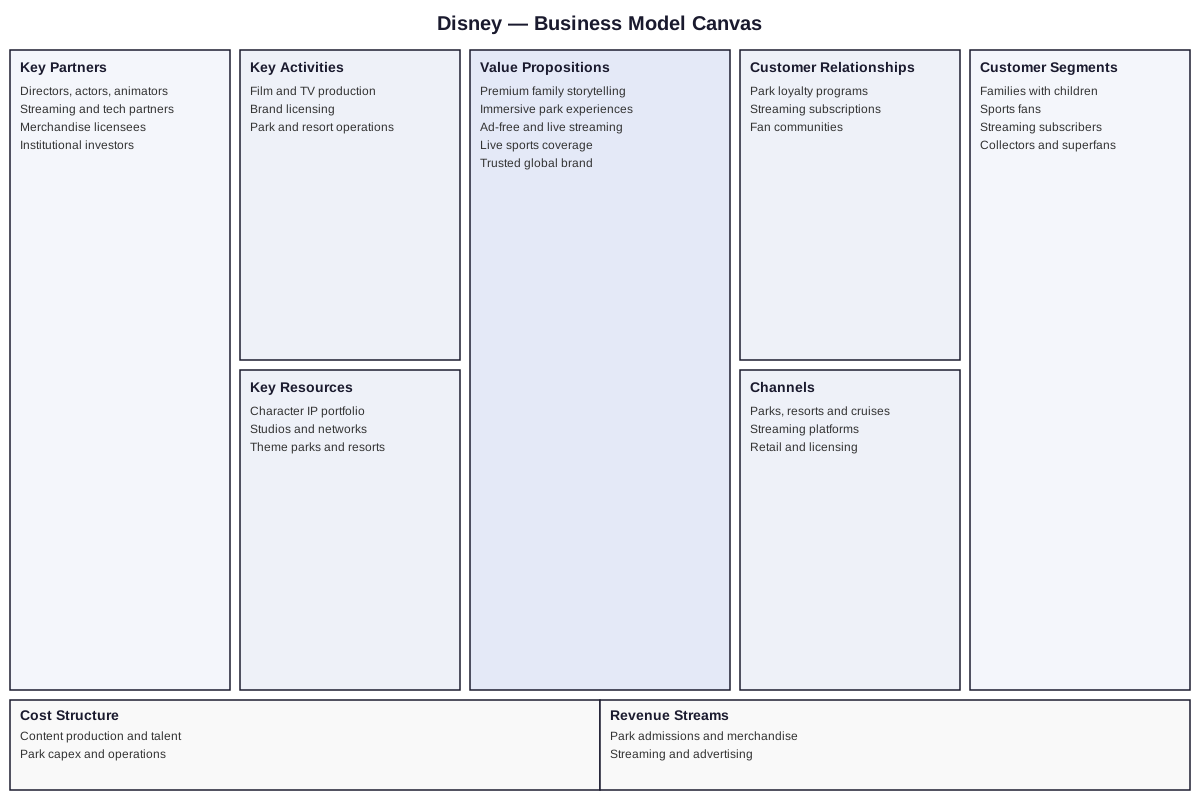
Disney pairs content creation with direct distribution and physical experiences rather than relying on one revenue stream. It licenses and repackages the same characters and stories across film, television, streaming, theme parks and merchandise, a pattern often described as franchise reuse or a content flywheel, so a single creative investment pays out across many channels.
Who owns and runs the Walt Disney Company today?
Disney is publicly traded and held by a broad mix of institutional and individual shareholders, with Vanguard Group as the largest reported holder. Josh D'Amaro became chief executive in March 2026, succeeding Bob Iger, after leading Disney Experiences, while Dana Walden took on a new role overseeing creative strategy across the company.
From Kansas City sketches to global conglomerate
Walt Disney did not start with theme parks or streaming platforms. He started with a short cartoon made in Kansas City about a girl who wanders into an animated world, called Alice's Wonderland. He moved to California in the summer of 1923 and signed a distribution deal for the "Alice Comedies," and that agreement, dated October 16, 1923, marks the official start of the company. Walt handled creative work while his brother Roy ran the business side, and the two held equal ownership in what they first called Disney Brothers Cartoon Studio, later renamed Walt Disney Studio at Roy's suggestion.
The early years brought both success and setbacks. Oswald the Lucky Rabbit, introduced in 1927, generated 26 cartoons within a year but triggered an ownership dispute, since Disney's distributor held the rights to the character rather than Disney himself. That loss pushed Walt to create a character the studio could fully own. In 1928, on a train back to California, he sketched a mouse. Steamboat Willie introduced Mickey Mouse to audiences later that year and became the foundation for a company that has produced entertainment for more than a century since.
A mission built on storytelling
Disney's public mission statement frames the company around narrative rather than any single product line. That framing carries strategic weight, since it lets a game studio, a cruise line and a television network all sit under one purpose without feeling disconnected from each other.
To entertain, inform and inspire people around the globe through the power of unparalleled storytelling, reflecting the iconic brands, creative minds and innovative technologies that make ours the world's premier entertainment company
The statement also doubles as a filter for acquisitions. Every major purchase over the past two decades, Pixar in 2006, Marvel in 2009, Lucasfilm in 2012 and the 21st Century Fox entertainment assets in 2019, added a library of characters and stories rather than a factory or a supply chain. Disney competes on the strength of intellectual property [IP] it can license across formats, and each acquisition expanded the catalog it draws on for films, series, park attractions and merchandise.
Leadership and ownership
Bob Iger returned as chief executive in 2022 to steady a company shaken by streaming losses and an activist investor challenge, then retired at the end of his extended contract. Josh D'Amaro, previously chairman of Disney Experiences, became chief executive on March 18, 2026.[^1] Dana Walden, co-chairman of Disney Entertainment, moved into a newly created role as president and chief creative officer, reporting to D'Amaro and overseeing storytelling strategy across the company's platforms. Handing the top job to a parks-and-experiences executive, rather than another content leader, signaled that the board wanted operational discipline as much as creative direction.
Ownership tells a separate story from leadership. Walt and Roy Disney split the company evenly in 1923, and today Disney is held by a broad mix of institutional and retail shareholders. Vanguard Group remains the largest reported holder, with a stake of 7.49% disclosed in a filing to the U.S. Securities and Exchange Commission [SEC] in early 2026.[^2] BlackRock and State Street hold the next-largest stakes, and the founding family's ownership has fallen to a small fraction of the company it created.
Three segments, one flywheel
In February 2023, Disney collapsed a more fragmented structure into three reporting segments: Disney Entertainment, ESPN and Disney Experiences. The change followed a period when the streaming business absorbed heavy losses and creative leaders complained that decision rights sat too far from the content itself. Splitting the company around entertainment, sports and physical experiences gave each unit clearer accountability for both content and the streaming or in-park delivery of that content.
The restructuring shows up in the numbers. Disney closed fiscal 2025, the year ended in late September, with $94.4 billion in total revenue.[^3] Entertainment, which houses the film studios, television networks and streaming services, produced the largest share at $42.47 billion, up 3% from the prior year. Experiences, covering theme parks, resorts, cruise ships and consumer products, generated $36.16 billion in revenue and a record $10 billion in operating income. Sports, built around ESPN, contributed roughly $17.7 billion. No single segment dominates the business outright, and a weak year in one division can be offset by strength in another.
Disney Entertainment: studios, networks and streaming
The Walt Disney Studios sit at the center of the Entertainment segment and include Walt Disney Animation Studios, Pixar, Marvel Studios, Lucasfilm, 20th Century Studios and Searchlight Pictures. Films from these studios generate revenue through theatrical release, home distribution, television licensing and merchandising, but their larger function now is feeding characters and stories into Disney+ and the parks.
Streaming has moved from a drag on earnings to a genuine contributor. Disney+ closed fiscal 2025 with 112.6 million subscribers, and combined with Hulu the direct-to-consumer base reached roughly 196 million accounts.[^4] Combined profit for Disney+ and Hulu reached $1.33 billion for the year, a sharp jump from $143 million in fiscal 2024. That improvement came from price increases, an ad-supported tier and tighter content spending rather than subscriber growth alone. Margins still trail Netflix, whose streaming operating margin sits closer to 30% against Disney's roughly 5% over the same period, leaving room for Disney to close the gap.
ESPN and the direct-to-consumer sports bet
ESPN has carried much of Disney's television advertising and affiliate-fee revenue for decades, but cord-cutting eroded the pay-television bundle that once delivered ESPN into most American households automatically. Disney answered with the direct-to-consumer [DTC] model, launching a flagship ESPN streaming app on August 21, 2025, priced at $29.99 a month on its own or $35.99 a month when bundled with Disney+ and Hulu.[^5] The app carries live games, studio programming, betting and fantasy integrations, and personalized statistics, effectively moving ESPN's full linear lineup onto a direct subscription product for the first time.
Bob Iger, who was still serving as Disney's chief executive at the time, described the turnaround on the company's fiscal 2025 earnings call in November 2025.
Not bad, considering DTC was running with a $4 billion annual operating loss just three years ago
The timing of the ESPN launch, just ahead of National Football League [NFL] and college football season, aimed to capture sports viewers who had already dropped cable television.
Disney Experiences: parks, cruises and consumer products
Experiences is Disney's hospitality and licensing engine. It runs theme parks and resort hotels in Florida, California, Paris, Tokyo, Hong Kong and Shanghai, the Disney Cruise Line and Disney Vacation Club, alongside a retail and licensing business that puts Disney characters on toys, apparel, books and video games sold through Disney stores, e-commerce and third-party retailers worldwide. Admission fees, room nights, food and merchandise sales and cruise fares make this the most capital-intensive of Disney's three segments, since parks require years of reinvestment in rides, hotels and ships before they generate meaningful revenue.
The segment posted record operating income in fiscal 2025, helped by higher per-guest spending and continued demand for cruise capacity, even as management flagged softer early bookings heading into 2026. That pattern, strong trailing results paired with cautious guidance, is typical of a business tied closely to discretionary household spending and international travel.
Brand strength and competitive pressure
Disney's competitive position still rests heavily on brand recognition built over a century, but that advantage has weakened in recent years. Disney's standing on RepTrak's global reputation rankings fell from the top ten in the early 2020s to outside the top seventy by 2025, and off the list entirely in 2026, a decline researchers linked to perceptions that parks and streaming products had become too expensive and to employee relations concerns.[^6] That slide matters strategically, since Disney has historically priced and marketed itself on trust and nostalgia rather than on being the cheapest option in any category.
Competition comes from several directions at once. Netflix and Amazon Prime Video compete for streaming attention and content budgets. Comcast's NBCUniversal and Warner Bros. Discovery compete across film, television and theme parks. Sony Pictures produces and distributes film and television content without owning a legacy broadcast network. Each rival forces Disney to spend more on content, marketing or park investment just to hold its position, and content piracy continues to erode potential revenue in markets where enforcement is weak.
What comes next
D'Amaro moved quickly after taking over, authorizing rounds of layoffs through 2026 that were expected to affect as many as 1,000 employees, with cuts landing at Pixar, ESPN and National Geographic as he pushed to streamline a company built through decades of acquisitions.[^7] The cuts reflect a broader push to run Disney's businesses with tighter cost discipline after years of expansion, rather than a retreat from any single segment.
The near-term priorities are visible in where Disney keeps spending and cutting at the same time. The ESPN flagship app needs to convert cord-cutters into direct subscribers at a price point above the standard Disney+ tier. Parks investment continues across existing resorts and cruise ship additions, betting that guests will keep paying premium prices for in-person experiences even as streaming absorbs more entertainment budgets. Streaming itself needs to keep closing its margin gap with Netflix rather than simply staying profitable in absolute terms. None of this removes the structural risk that more than two-thirds of Disney's revenue still ties back to North American consumers, leaving the company exposed to a regional economic slowdown even as it works to repair the brand trust that once set it apart.1
- 1Bob Iger's Last Day Leading Disney, And What Comes NextWalt Disney Co Proxy Statement, SEC EDGAR FilingThe Walt Disney Company Reports Fourth Quarter And Full Year Earnings For Fiscal 2025Disney Streaming Subscribers Grow As Executives Hint At AI PlansDisney's New ESPN Flagship Streaming App LaunchesDisney's New CEO Starts With Job Cuts And A Corporate Reputation To RebuildDisney Expected To Lay Off As Many As 1,000 Employees
Disney's business model works because its segments reinforce each other. A Marvel film fills theaters, feeds Disney+, sells merchandise in parks and licenses characters to toy makers, all from a single creative investment. That flywheel took a hit when streaming ran up billions in losses, but the correction since 2023 shows a company willing to restructure around accountability rather than protect legacy divisions. The launch of the ESPN flagship app and continued investment in parks and cruise capacity signal where growth is expected next. Execution risk remains real: content costs stay high, competition from Netflix, Amazon and Warner Bros. Discovery is intense, and dependence on North American consumer spending leaves the company exposed to economic cycles. For strategists, Disney demonstrates both the strength and the fragility of a business built on owning stories and finding new ways to sell them
Citation
Cite this article
Sridharan, M. A. (2026, January 11). Disney Business Model. Think Insights. https://thinkinsights.net/strategy/disney-business-model (Accessed [[ACCESS_DATE]])
Sridharan, Mithun A. "Disney Business Model." Think Insights, 11 Jan. 2026, https://thinkinsights.net/strategy/disney-business-model. Accessed [[ACCESS_DATE]].
Mithun A. Sridharan, "Disney Business Model," Think Insights, January 11, 2026, https://thinkinsights.net/strategy/disney-business-model. Accessed [[ACCESS_DATE]].
Sridharan, M.A. (2026) 'Disney Business Model', Think Insights. Available at: https://thinkinsights.net/strategy/disney-business-model (Accessed: [[ACCESS_DATE]]).
M. A. Sridharan, "Disney Business Model," Think Insights, 2026. [Online]. Available: https://thinkinsights.net/strategy/disney-business-model. [Accessed: [[ACCESS_DATE]]].
Sridharan MA. Disney Business Model. Think Insights. Published January 11, 2026. Accessed [[ACCESS_DATE]]. https://thinkinsights.net/strategy/disney-business-model
Test Your Knowledge
Disney Business Model
Challenge yourself on the concepts from this article and see how well you understood them.
Subscribers get weekly quizzes and insights — subscribe free
Sponsor this article
Partner with Think Insights
Reach 50,000+ business leaders, consultants, and strategists. Feature your brand alongside expert articles on strategy, leadership, and digital transformation.
Become a Sponsor