The Cooperative Ownership Model


Roughly 3 million cooperatives operate worldwide and the 300 largest cooperatives and mutuals generate $2.79 trillion in annual turnover combined. That scale contradicts the idea that cooperative ownership is a niche or purely social choice. A cooperative is a business owned and governed by the people who use it, work in it, supply it or depend on it, with control allocated through one member, one vote rather than through capital contributed. REI, the outdoor retail cooperative with more than 25 million active members and customers, shows how this structure competes at national scale while returning surplus to the people who generate it. This article maps the cooperative model onto the Business Model Canvas and uses REI's structure to show how member ownership reshapes governance, financing and value distribution without giving up commercial discipline.
What makes a cooperative different from a regular company?
A cooperative is owned and governed by the people who use it, work in it or supply it, rather than by outside shareholders. Control follows membership under one member, one vote, not capital contributed. Surplus is typically returned to members through patronage dividends or retained as shared capital instead of flowing to external investors.
Can a cooperative raise growth capital like a startup?
Not in the same way. Venture capital expects scalable ownership rights and governance tied to capital deployed, which conflicts with democratic control. Cooperatives instead rely on member equity, retained surplus, mission-aligned lenders and, in some cases, grants, so growth capital has to fit the governance model rather than override it.
Which businesses fit the cooperative model best?
Cooperatives work well where buyers, producers, workers or independent operators face a shared coordination problem, such as fragmented purchasing power or inconsistent market access. Consumer cooperatives such as REI fit when customers want a stronger voice in pricing and service, while producer and purchasing cooperatives fit sectors where members need collective scale.
What Is the Cooperative Business Model
A cooperative is a business owned by the people who use it, work in it, supply it or depend on it, rather than by outside shareholders. Control sits with members, not with capital and that single design choice changes almost everything else about how the enterprise runs. The model is larger than its small-town image suggests. Roughly 3 million cooperatives operate worldwide, providing jobs or work opportunities to one in 10 employed people and the 300 largest cooperatives and mutuals generated $2.79 trillion in turnover in the latest tally.1 That scale means a cooperative is not a workaround for founders who cannot raise venture capital. It is a deliberate ownership structure suited to specific market conditions and evaluating it requires the same rigor executives apply to any other business model.
How Cooperative Governance Creates Value
The core mechanic of a cooperative is governance and it starts with one member, one vote. Voting power follows membership rather than capital contributed and profits are redistributed to members in proportion to their participation rather than paid out to outside shareholders.2 Members elect a board, the board sets direction and management runs daily operations, so the structure still separates governance from execution the way a well-run corporation does.
Governance decides who benefits from success long before the numbers show it
What changes is who authorizes strategy and who captures the value it produces. Surplus is typically returned to members through patronage dividends or retained as shared capital, which keeps incentives pointed at member benefit instead of external return.
The Four Types of Cooperatives
Cooperatives split into a few recognizable types and the type usually follows the coordination problem the members are solving. Consumer cooperatives, such as REI, organize around buyers who want dependable pricing, quality or a voice in how the business runs. Producer cooperatives organize farmers or independent makers who need shared processing, branding or bargaining power they could not build alone. Worker cooperatives tie ownership to labor, which suits firms where retention and craft quality matter more than fast external capital. Purchasing cooperatives let independent operators pool buying power and back-office functions without merging their businesses, a structure recognized across the cooperative movement's founding principles.3 Choosing the right type starts with identifying the fragmented stakeholder group, not with ideology.
Mapping Ownership onto the Business Model Canvas
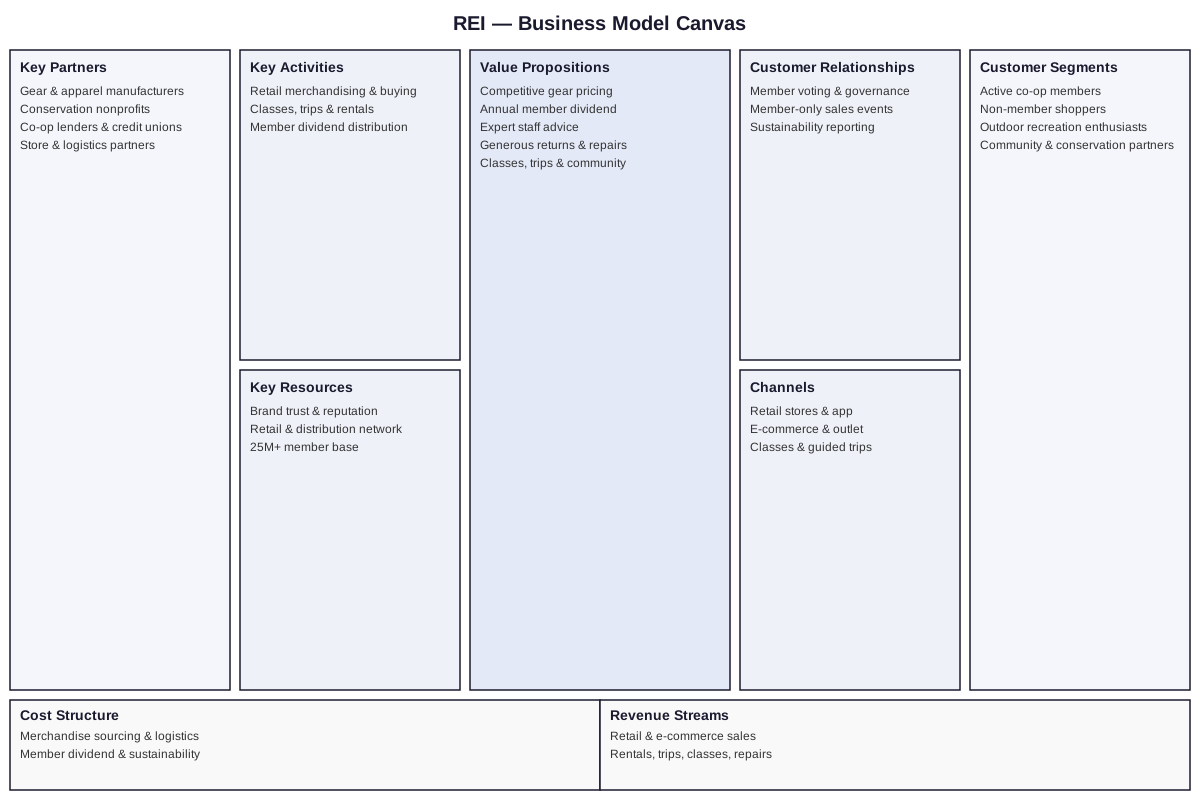
A cooperative can look unusual in legal form and still map cleanly onto the Business Model Canvas, which is why the framework is useful here. The canvas does not need new blocks for a cooperative. It needs the same nine blocks filled in with a different logic, because the user and the owner frequently overlap. Customer Segments often include the members themselves, Value Propositions combine functional benefits with the structural benefit of ownership and Cost Structure includes the cost of governance and participation alongside standard operating costs. The sections that follow open each block of that canvas using REI, the outdoor retail cooperative, as the working example.
Financing Growth Without Losing Control
The hardest strategic question in a cooperative is not purpose. It is capital. Traditional venture capital expects scalable ownership rights and governance tied to money invested and those terms collide directly with democratic control. Cooperatives instead assemble financing from member equity contributions, retained surplus, mission-aligned lenders and, in some sectors, grants that support formation without diluting membership. The scale this can reach is not small: a national study identified more than 29,000 cooperatives operating across the United States, accounting for roughly $654 billion in revenue and more than 2 million jobs once indirect effects are included.4 The design lesson is to set capital and governance rules before the money arrives, not after.
The Story Behind REI's Cooperative Structure
REI began in Seattle in 1938, when climbers Lloyd and Mary Anderson organized 23 fellow mountaineers who could not find affordable ice axes and climbing gear locally. Each of the founding members paid roughly a dollar to pool buying power and the group secured better prices by ordering equipment directly from Europe.5 By the end of that first year, membership had grown well beyond the original group and the cooperative structure carried the business from a shelf inside a Seattle grocery store toward national retail. The founding logic never changed: members join, contribute a small fee and gain both a voice in governance and a share in the surplus their purchases help create.
How REI Competes at National Scale Today
That founding logic still runs the business today, at a scale the original 23 members could not have imagined. REI now serves more than 25 million active members and customers through stores, e-commerce and rental and repair services and it closed 2024 with $3.53 billion in net sales while investing more than $282 million back into the co-op community.6 Members typically receive an annual dividend equal to about 10% of their prior year's eligible full-price purchases, a mechanism that distributes real surplus rather than promotional points. No single investor, founding family or private equity firm controls the company and the board answers to members rather than to outside capital.
Lessons for Executives Weighing the Model
REI's example generalizes further than outdoor retail. A cooperative tends to outperform a conventional firm when a market suffers from concentration on one side, fragmentation on the other, or distrust in the middle, because member ownership resolves exactly that kind of coordination failure.
A cooperative wins when its governance model reinforces its operating model, not when membership is just a legal label
Executives weighing the structure should start with a plain question: which stakeholder group creates the most long-term value for this business and would giving that group ownership improve alignment more than it slows decision-making. If the answer favors members, the cooperative model deserves the same disciplined design work as any other ownership structure, covering governance, capital rules and participation from the outset.
Key Partners
REI depends on outdoor gear manufacturers and its own REI Co-op private-label production partners for merchandise. Conservation and trail nonprofits extend the co-op's mission beyond retail sales. Credit unions and cooperative-focused lenders provide financing aligned with member governance rather than outside equity. Store landlords and logistics providers support the physical footprint behind more than 190 locations across the United States.
Key Activities
Retail merchandising, purchasing and inventory management form the operational core of REI's business. The co-op also runs classes, guided trips and gear rental programs that build skills and community among members. Calculating and distributing the annual member dividend is itself a recurring operational activity, not a marketing afterthought. Sustainability work, including the recent push to zero waste operations, now sits alongside retail execution as a core activity.
Key Resources
REI's brand and decades of trust among outdoor enthusiasts function as a core resource that outside capital cannot easily replicate. Its retail and distribution network, plus its owned REI Co-op product line, support both revenue and member value. The active membership base itself, now more than 25 million people, is a resource because it supplies capital, feedback and repeat demand.
Value Propositions
REI offers competitive pricing on outdoor gear alongside advice from staff who are often outdoor practitioners themselves. Membership carries a structural benefit beyond product: co-owners receive an annual dividend on eligible purchases and a vote in governance. The co-op backs gear with a generous return policy and repair services that extend product life. Access to classes, guided trips and community events rounds out the value proposition beyond the transaction itself.
Customer Relationships
Members are not passive shoppers; they vote at an annual meeting and can stand for the board. REI communicates through member-only sales events, dividend notices and sustainability reporting that treats members as co-owners rather than an audience. Loyalty here is structural rather than promotional, since members hold an actual financial and governance stake in outcomes.
Channels
REI sells through its retail stores, e-commerce site and mobile app, alongside rental and outlet channels for used or clearance gear. Its member communications, including the annual dividend notice and governance ballots, function as a channel distinct from marketing. Community events, classes and guided trips serve as an experiential channel that reinforces the retail relationship.
Customer Segments
Active co-op members who receive dividends and voting rights form the primary segment. Non-member shoppers who buy without joining represent a secondary segment the co-op continues to convert into members. Outdoor recreation participants across hiking, climbing, cycling and camping make up the underlying demand base. Community and conservation partners engaging REI's sustainability programs form a smaller but strategically relevant segment.
Cost Structure
Merchandise sourcing, retail operations and distribution logistics make up the largest cost categories. The annual member dividend, funded from operating surplus, is a structural cost unique to the cooperative model rather than a discretionary rebate. Investments in sustainability, including the path to zero waste, add cost lines that a conventional retailer might treat as optional.
Revenue Streams
Retail and e-commerce sales of gear and apparel generate the bulk of REI's revenue. Rental, guided trips, classes and repair services provide secondary revenue tied directly to the co-op's outdoor mission. Membership fees contribute modestly to revenue but function more as an ownership mechanism than a profit center.
Cooperative ownership does not trade away business discipline. It replaces one set of incentives, tied to outside investors, with another, tied to the members who create the enterprise's demand, labor or supply. REI shows that a member-owned retailer can compete at national scale, invest in stores and inventory and still return surplus to members every year. The trade-off is real. Growth capital moves slower when governance stays democratic and member participation has to be designed into the business rather than assumed. Executives evaluating this structure should treat governance and capital rules as core design decisions from day one, not details to work out later. When the people creating value also hold the vote, alignment becomes the operating model rather than a talking point.
Citation
Cite this article
Sridharan, M. A. (2020, December 5). The Cooperative Ownership Model. Think Insights. https://thinkinsights.net/strategy/cooperative-ownership-model (Accessed [[ACCESS_DATE]])
Sridharan, Mithun A. "The Cooperative Ownership Model." Think Insights, 5 Dec. 2020, https://thinkinsights.net/strategy/cooperative-ownership-model. Accessed [[ACCESS_DATE]].
Mithun A. Sridharan, "The Cooperative Ownership Model," Think Insights, December 5, 2020, https://thinkinsights.net/strategy/cooperative-ownership-model. Accessed [[ACCESS_DATE]].
Sridharan, M.A. (2020) 'The Cooperative Ownership Model', Think Insights. Available at: https://thinkinsights.net/strategy/cooperative-ownership-model (Accessed: [[ACCESS_DATE]]).
M. A. Sridharan, "The Cooperative Ownership Model," Think Insights, 2020. [Online]. Available: https://thinkinsights.net/strategy/cooperative-ownership-model. [Accessed: [[ACCESS_DATE]]].
Sridharan MA. The Cooperative Ownership Model. Think Insights. Published December 5, 2020. Accessed [[ACCESS_DATE]]. https://thinkinsights.net/strategy/cooperative-ownership-model
Test Your Knowledge
The Cooperative Ownership Model
Challenge yourself on the concepts from this article and see how well you understood them.
Subscribers get weekly quizzes and insights — subscribe free
Sponsor this article
Partner with Think Insights
Reach 50,000+ business leaders, consultants, and strategists. Feature your brand alongside expert articles on strategy, leadership, and digital transformation.
Become a Sponsor