The Contingency-Fee Flywheel


Contingency fee law firms operate less like traditional legal practices and more like risk-taking investors. Instead of billing hourly, they front the cost of building a case and collect a share of the recovery only if it succeeds. That arrangement removes upfront cost for clients and creates a direct incentive for firms to select strong cases, build them well and resolve them efficiently. Morgan and Morgan, the largest personal injury firm in the United States, shows how this model scales into a national operation spanning more than 140 offices. Its growth depends on the same mechanics that drive any contingency practice: disciplined intake, evidence-backed negotiation and a reputation that compounds with each favorable outcome. Firms that manage this cycle well build a durable advantage. Those that chase volume without screening discipline can see the same structure work against them.
What makes a contingency fee different from hourly billing?
A contingency fee ties payment to the outcome of a case rather than hours worked. The firm covers the cost of investigation, filings and preparation upfront and collects a percentage of the recovery, typically 33 percent to 40 percent, only if the case succeeds. That structure removes upfront cost for the client and gives the firm a direct financial stake in the strength and speed of the result.
Why does case screening matter so much in this model?
Since a firm only gets paid when a case resolves favorably, taking on weak claims wastes staff time and capital without producing revenue. Disciplined screening lets a firm focus resources on matters with a realistic path to recovery, which protects margins and keeps stronger cases moving faster. Firms that loosen screening standards to chase volume often see profitability decline even as intake grows.
What can cause a contingency-fee firm's growth to stall?
Growth typically stalls when volume outpaces the systems needed to manage it well. Inconsistent documentation, slow case preparation and weakened screening standards can all reduce leverage in negotiations and drag out timelines. A firm that scales marketing faster than its intake and case-management capacity often ends up with lower-quality cases and thinner margins.
Why Contingency Fees Function as a Business Model
A contingency fee changes a law firm's economics from the first conversation with a client. Revenue no longer comes from hours logged along the way. It depends on whether the firm can identify a viable claim, carry the cost of pursuing it and convert legal work into a financial recovery. That shift pushes a firm to behave less like a conventional professional service provider and more like an operator allocating capital under uncertainty.
The American Bar Association's Model Rules require contingency arrangements to be documented in writing, spelling out the percentage owed and how case expenses are handled.1 That formal structure touches nearly every function inside the firm. Marketing has to attract people with real claims rather than broad traffic, case selection becomes a financial decision as much as a legal one and staffing has to support work that produces no revenue until a case resolves.
Aligned Incentives and Lower Upfront Friction
The appeal of a contingency fee starts with access. Injured workers often face lost income and mounting medical bills at the exact moment paying hourly legal fees feels least realistic. A no-upfront-cost structure removes that friction and makes representation easier to consider, with the firm typically collecting between 33 percent and 40 percent of the eventual recovery.2
The arrangement also changes the relationship between client and firm. Because payment depends on the result, the firm has a direct stake in the strength of the claim and the value of the outcome. That creates tighter incentive alignment than hourly billing typically offers, though it raises the importance of screening inquiries quickly and consistently rather than accepting every case that walks in the door.
Screening and Specialization Drive the First Turn
Every contingency practice depends on judgment at the front end. A firm can attract a large volume of inquiries, but growth becomes sustainable only when intake and screening identify cases with a realistic path to recovery. Morgan and Morgan illustrates how far this can scale. The firm now operates more than 140 offices and employs over 1,000 attorneys among roughly 6,000 total staff, spanning all 50 states.3
That scale only works because screening keeps pace with intake volume. Specialization sharpens the process further, since attorneys handling similar claim types repeatedly develop sharper instincts about documentation needs, likely obstacles and expected timelines. Better positioning attracts better-fit leads, better-fit leads improve screening efficiency and stronger case selection gives the firm a better chance of producing outcomes that reinforce its reputation.
Evidence as an Operating Asset
In a contingency practice, evidence supports the economics of a case as much as the legal argument. The stronger the documentation, the easier it becomes to estimate risk and decide whether the expected return justifies the time and resources required. Morgan and Morgan describes its own process as building the factual record early, gathering medical records, incident reports and proof of damages before deciding how aggressively to pursue a claim.4
That upfront investment in documentation is not separate from the business model; it is part of the product itself. Firms that handle similar matters repeatedly tend to spot missing documentation faster and build a more consistent case narrative, which strengthens their position once negotiations begin.
Negotiation Leverage and Settlement Velocity
Once a firm has screened a case well and built a strong factual record, the next source of advantage is leverage. Contingency firms do not earn more by spending more time; they earn more when effort translates into outcome. Many firms structure fees on a sliding scale tied to how a case resolves, often around 33 percent for a pre-litigation settlement and closer to 40 percent if the matter proceeds through trial.5
That fee structure rewards firms for resolving strong cases efficiently without needing a trial to secure a fair outcome. Settlement velocity, in that context, does not mean rushed resolution. It means reducing friction between intake and outcome through strong preparation, responsive communication and a repeatable process that keeps pressure on the other side.
Reputation, Referrals and the Limits of Growth
A contingency practice grows through outcomes, but outcomes alone do not create momentum; the firm has to turn strong results into visibility and repeatable demand. Morgan and Morgan has leaned heavily on paid marketing to build that visibility and national legal advertising spending has climbed sharply over the past decade as personal injury firms compete for the same pool of claims.6
Referrals reinforce that pattern at lower cost, since past clients and professional contacts send higher-intent leads into the pipeline. But the same structure that creates upside also creates pressure. Case selection is the clearest weak point: if a firm lowers its standards to chase volume, weak claims consume staff time, slow down stronger matters and erode the margins that fund reinvestment.
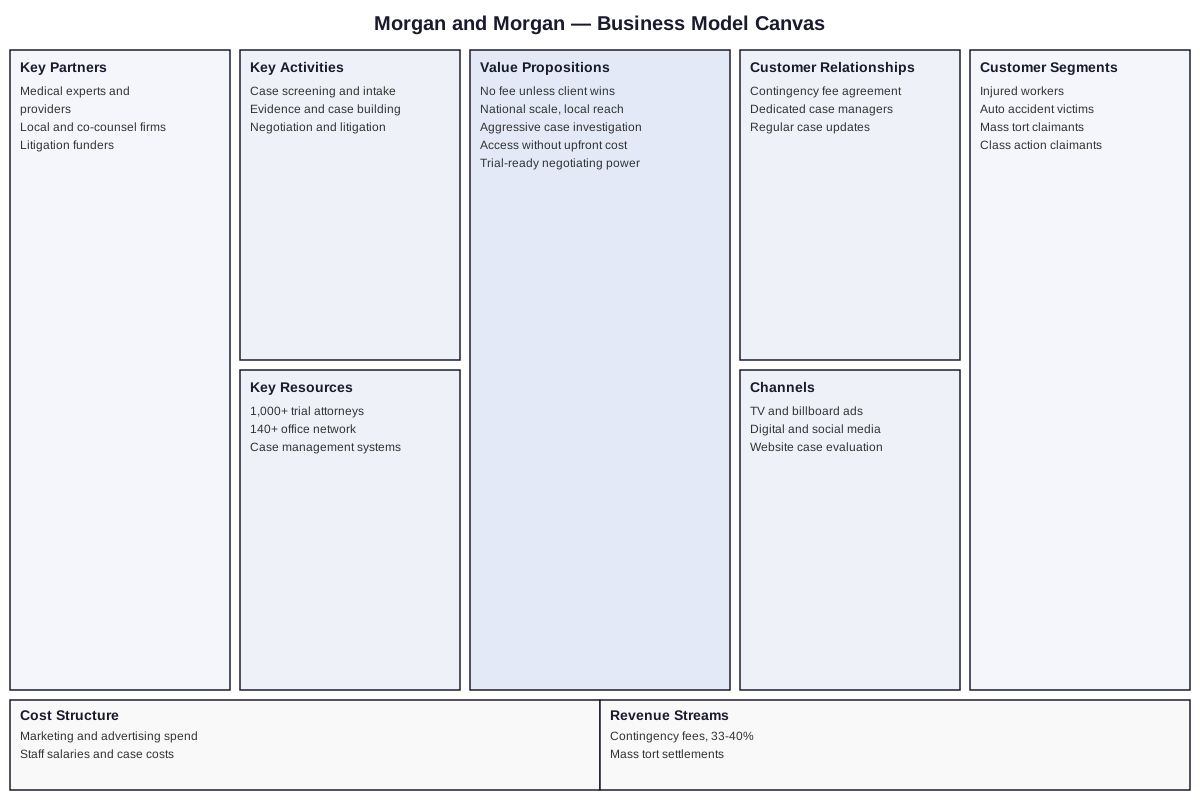
Key Partners
Morgan and Morgan relies on medical providers and expert witnesses to document injuries and damages credibly. Local and co-counsel firms extend its reach into markets and practice areas outside its core teams. Litigation funders help bridge the gap between case costs and eventual recovery on longer-running matters. Advertising agencies and media outlets execute the national marketing campaigns that keep the firm's brand visible.
Key Activities
Intake and case screening sit at the center of Morgan and Morgan's daily operations, filtering inquiries down to claims with a realistic recovery path. Case managers and attorneys then build the factual record, gathering medical documentation, incident reports and damages evidence. Negotiation and litigation follow once a case is prepared, with attorneys pushing for settlement or preparing for trial depending on how the insurer responds.
Key Resources
The firm's roster of more than 1,000 attorneys, supported by thousands of case managers and support staff, is its core resource. A network exceeding 140 offices across all 50 states gives it local presence most competitors cannot match. Proprietary case-management and document-review systems help staff track thousands of active matters and flag missing evidence quickly.
Value Propositions
Clients pay nothing unless Morgan and Morgan wins their case, removing the upfront cost barrier that keeps many injured workers from seeking representation. The firm pairs national scale with local offices, giving clients a recognizable brand and a nearby point of contact. Its capacity for aggressive case investigation and trial-ready preparation gives clients negotiating leverage they could not generate on their own.
Customer Relationships
Every client relationship begins with a signed contingency fee agreement that sets expectations on cost and payment upfront. Dedicated case managers serve as the primary point of contact throughout a case, handling questions and status updates. Regular progress communication, particularly during long-running claims, helps maintain trust while a case moves toward resolution.
Channels
Television commercials and billboards, built around the firm's founder and its "For the People" branding, remain Morgan and Morgan's most visible acquisition channel. Digital advertising and social media extend that reach to younger and more targeted audiences. The firm's own website handles initial case evaluation and intake before a prospective client ever speaks with staff.
Customer Segments
Injured workers seeking compensation for workplace accidents form one of the firm's largest segments. Auto accident victims and other personal injury claimants make up a broader base of individual clients. Mass tort and class action claimants, including those affected by defective products or data breaches, represent a growing segment tied to large-scale corporate liability.
Cost Structure
Marketing and advertising spending represents one of the largest line items in Morgan and Morgan's cost structure, given its national television and billboard presence. Attorney and staff salaries across more than 140 offices add substantial fixed cost regardless of case outcomes. Case-related expenses, including expert witnesses and record retrieval, are advanced by the firm and recovered only when a case resolves successfully.
Revenue Streams
Contingency fees, typically ranging from 33 percent to 40 percent of a settlement or verdict, form the firm's primary revenue stream. Fee percentages generally rise when a case proceeds through litigation rather than resolving through early settlement. Mass tort and class action recoveries, often resolved in batches, add a second revenue stream with different timelines than individual injury claims.
The contingency fee model succeeds when risk-sharing, selective intake and disciplined execution reinforce each other. Morgan and Morgan built its scale by combining aggressive marketing with systems that screen for viable claims, gather evidence quickly and negotiate from a position of preparation rather than pressure. That combination turns each successful case into fuel for the next one, funding further advertising, staffing and technology investment. The same logic applies well beyond personal injury law. Any business that shares risk with its customers, focuses on a defined niche and treats execution as repeatable rather than improvised can build a similar compounding advantage. The lesson for executives outside legal services is straightforward: aligning incentives with customers lowers friction, but only disciplined selection and delivery turn that alignment into a durable growth engine rather than a fragile one.
Citation
Cite this article
Sridharan, M. A. (2021, June 1). The Contingency-Fee Flywheel. Think Insights. https://thinkinsights.net/strategy/contingency-fee-flywheel (Accessed [[ACCESS_DATE]])
Sridharan, Mithun A. "The Contingency-Fee Flywheel." Think Insights, 1 June 2021, https://thinkinsights.net/strategy/contingency-fee-flywheel. Accessed [[ACCESS_DATE]].
Mithun A. Sridharan, "The Contingency-Fee Flywheel," Think Insights, June 1, 2021, https://thinkinsights.net/strategy/contingency-fee-flywheel. Accessed [[ACCESS_DATE]].
Sridharan, M.A. (2021) 'The Contingency-Fee Flywheel', Think Insights. Available at: https://thinkinsights.net/strategy/contingency-fee-flywheel (Accessed: [[ACCESS_DATE]]).
M. A. Sridharan, "The Contingency-Fee Flywheel," Think Insights, 2021. [Online]. Available: https://thinkinsights.net/strategy/contingency-fee-flywheel. [Accessed: [[ACCESS_DATE]]].
Sridharan MA. The Contingency-Fee Flywheel. Think Insights. Published June 1, 2021. Accessed [[ACCESS_DATE]]. https://thinkinsights.net/strategy/contingency-fee-flywheel
Test Your Knowledge
The Contingency-Fee Flywheel
Challenge yourself on the concepts from this article and see how well you understood them.
Subscribers get weekly quizzes and insights — subscribe free
Sponsor this article
Partner with Think Insights
Reach 50,000+ business leaders, consultants, and strategists. Feature your brand alongside expert articles on strategy, leadership, and digital transformation.
Become a Sponsor