Coinbase Business Model


Coinbase operates the largest publicly traded cryptocurrency exchange in the United States, built in 2012 by Brian Armstrong and Fred Ehrsam and taken public through a Nasdaq direct listing in April 2021. Trading commissions once supplied nearly all of its income, but that concentration created a business tied directly to crypto market cycles. Coinbase has spent the past several years diversifying, and subscription and services revenue, anchored by interest income on its USDC stablecoin, now accounts for more than 40% of net revenue. The company's 2025 acquisition of derivatives exchange Deribit for roughly $2.9 billion pushed it deeper into institutional trading, while its Base blockchain generates fees from onchain activity outside the core exchange. Regulatory tailwinds from the 2025 GENIUS Act have reinforced USDC's position as a core revenue engine, giving Coinbase a more balanced model heading into 2026.
How does Coinbase make most of its money today
Coinbase no longer depends on trading commissions the way it did in its early years. Subscription and services revenue, anchored by interest income on USDC and supplemented by Coinbase One subscriptions, staking and custody fees, made up more than 40% of net revenue through 2025 and grew to roughly 44% of the total by the first quarter of 2026. Transaction revenue still matters, split between consumer trading fees and a fast-growing institutional business built around derivatives, but the company now draws a meaningful share of income from sources that do not depend directly on trading volume.
What is Coinbase's relationship with USDC and Circle
Coinbase co-created USDC with Circle Internet Financial and earns a share of the interest generated by the reserves backing the stablecoin. Under the arrangement, Coinbase keeps 100% of the interest income on USDC held on its own platform, roughly a fifth of total supply, and splits the remainder evenly with Circle on USDC circulating elsewhere. That income scaled quickly as USDC's market capitalization grew, and the 2025 GENIUS Act gave the arrangement a clearer federal legal foundation by formalizing rules for how stablecoin issuers manage reserves and yield.
Who competes most directly with Coinbase
Binance remains the largest cryptocurrency exchange globally by trading volume and competes with Coinbase across nearly every product line, from spot trading to derivatives. Kraken and Gemini compete more directly in the U.S. retail and institutional markets Coinbase has historically dominated, and Robinhood has pushed aggressively into crypto trading, options and even prediction markets, narrowing the gap with Coinbase among younger retail investors. Coinbase's public listing and its U.S. regulatory relationships give it an advantage in institutional trust that private or offshore exchanges struggle to match.
From a Y Combinator startup to a Nasdaq listing
Brian Armstrong, a former Airbnb engineer, and Fred Ehrsam, a former Goldman Sachs trader, founded Coinbase in June 2012, building a platform meant to make buying, storing and using bitcoin simple for people outside the existing cryptocurrency community. The company's first product rested on a straightforward proposition: hold customer funds securely and make conversion between dollars and crypto easy enough for a mainstream audience, not just early adopters comfortable running their own wallets. Coinbase spent its first decade acquiring money transmitter licenses across dozens of U.S. states and international jurisdictions, a slow and expensive process that later became a competitive advantage over exchanges that skipped licensing to grow faster. The company went public through a direct listing on the Nasdaq under the ticker COIN on April 14, 2021, an unusual route that let existing shareholders sell directly into the market without a traditional underwritten offering, and shares opened trading with the company valued near $100 billion. 1 Armstrong remains chief executive officer [CEO] and the company's largest individual shareholder, holding a stake widely estimated near a fifth of Coinbase, which keeps him firmly in control of strategy even though the company now answers to public markets and quarterly disclosure.
A mission statement built around access
Coinbase describes its purpose in a single line that has appeared on the company's about page since its early years.
"To increase economic freedom in the world"
That mission shows up less as a marketing slogan and more as a design choice running through the product. Coinbase built separate interfaces for first-time retail buyers and for institutions moving nine-figure positions, rather than forcing both audiences through the same trading screen, and it prioritized regulatory licensing over the faster, looser growth some competitors pursued. The approach cost Coinbase speed in its early years, since obtaining licenses state by state is far slower than operating from a single offshore jurisdiction, but it also gave the company a level of institutional and regulatory trust that has become central to its current business.
A revenue mix that has moved beyond trading fees
For most of its history, Coinbase's income came almost entirely from transaction fees, the spread and commission charged every time a customer bought, sold or converted crypto on the platform; by 2020, those fees supplied roughly 90% of revenue. That concentration made quarterly results swing directly with trading volume, since a quiet market for bitcoin or ether meant a quiet quarter for Coinbase's income statement. The company has spent the years since building a second revenue engine in subscription and services income, which covers interest earned on USDC reserves, Coinbase One subscription fees, staking commissions and custody fees charged to institutional clients. By 2025, that subscription and services line had grown to supply more than 40% of net revenue, and Coinbase's own securities filings now flag a different concentration risk: that a meaningful share of both transaction and subscription revenue rests on a narrow set of products, chiefly bitcoin and ether trading and USDC-linked stablecoin income. 2 Consumer and institutional transaction revenue are now reported as separate lines, and institutional trading, which barely registered a decade ago, has grown into a business worth hundreds of millions of dollars a quarter on its own.
USDC and the stablecoin yield engine
USDC, the dollar-backed stablecoin Coinbase co-created with Circle Internet Financial in 2018, has become the single largest contributor to Coinbase's subscription and services revenue. Under the companies' arrangement, Coinbase keeps all of the interest income earned on USDC held directly on its own platform, roughly a fifth of total supply, and splits the interest on USDC held elsewhere evenly with Circle. As USDC's market capitalization climbed toward $74 billion, that arrangement turned into one of Coinbase's most reliable revenue lines, contributing more each quarter than the entire subscription business generated only a few years earlier. The 2025 GENIUS Act, the first federal law setting clear rules for how U.S. stablecoin issuers back and manage their tokens, reinforced that business rather than threatening it, and Coinbase has since pushed regulators to interpret the law's yield restrictions narrowly, arguing that limits on issuer-paid yield should not extend to its own interest-sharing arrangement with Circle. 3
Institutional scale through Deribit and Prime
Coinbase's institutional business rests on two pillars: Coinbase Prime, its custody and trading platform for hedge funds, asset managers and corporate treasuries, and, since 2025, Deribit, the derivatives exchange Coinbase bought for roughly $2.9 billion in cash and stock. 4 The deal, the largest merger and acquisition transaction in crypto industry history, brought Coinbase roughly $59 billion in open interest and more than $1 trillion in annual trading volume, most of it in bitcoin and ether options that institutional traders use to hedge exposure. Combined with its existing futures and spot products, the acquisition filled a gap Coinbase had carried for years: a full derivatives stack that lets institutional clients trade spot, futures, perpetual contracts and options without leaving the Coinbase ecosystem. Institutional transaction revenue, a minor line next to consumer trading fees for most of Coinbase's history, jumped sharply in the quarters following the acquisition, growing faster than any other part of the business as Deribit's volume flowed through Coinbase's books.
Base and the onchain extension
Coinbase's ambitions extend past its own exchange through Base, a Layer 2 (L2) blockchain the company built on top of Ethereum and opened to outside developers in 2023. Base processes transactions for decentralized applications, from lending protocols to consumer apps, and earns sequencer fees on that activity much like a payment network earns fees on card swipes, without Coinbase needing to run the underlying application itself. That structure lets Coinbase capture revenue from crypto activity that never touches its own trading interface, extending the company's reach into the broader onchain economy rather than competing solely for trading volume. Base's growth also reinforces Coinbase's wallet and developer tools, since projects building on the network often integrate directly with Coinbase's software development kits [SDKs] and its self-custody wallet product, creating a loop where more onchain activity drives more use of Coinbase's own infrastructure.
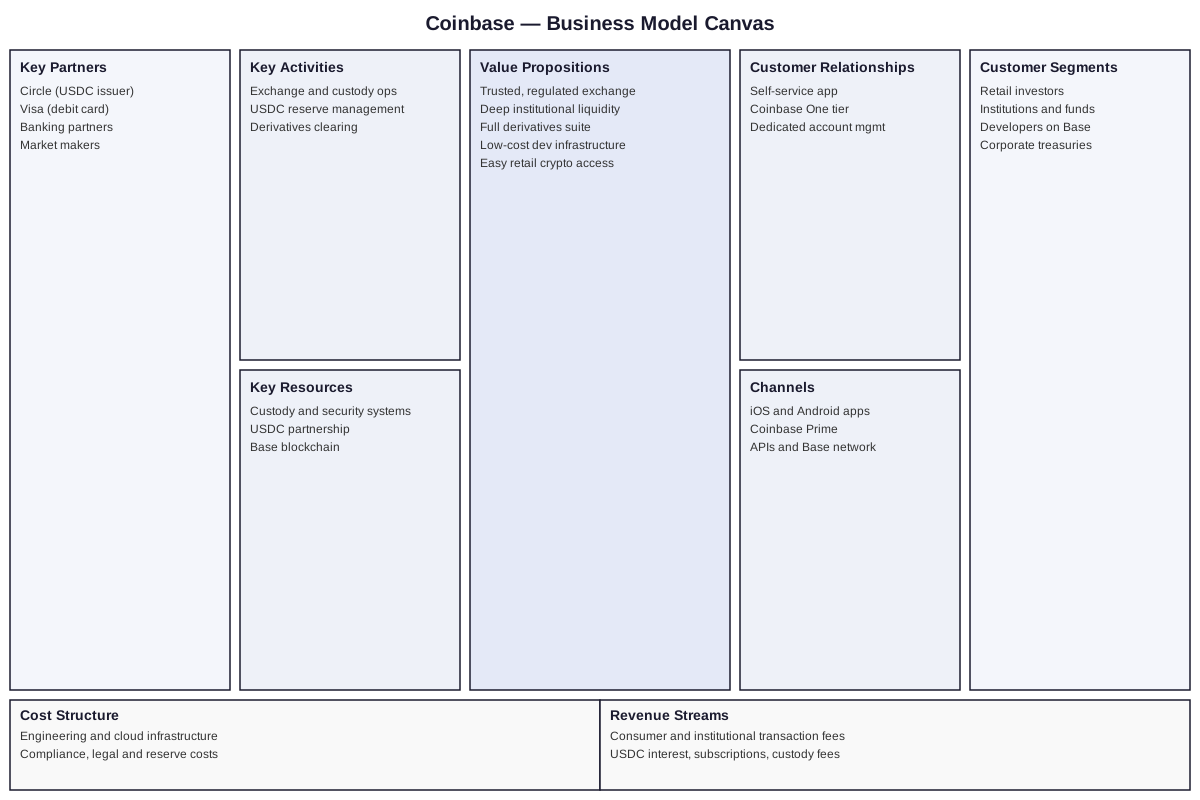
Mapping the business model canvas
Coinbase's customer base splits into three groups: retail investors who want a trusted place to buy and hold crypto, institutions from hedge funds to corporate treasuries that need custody and derivatives access, and developers who build applications on Base or plug into Coinbase's application programming interfaces [APIs]. For retail users, the value proposition centers on security, regulatory standing and ease of use; for institutions, it is custody, deep liquidity and now a full derivatives suite through Deribit; for developers, it is low-cost infrastructure and distribution through Coinbase's existing user base. 5 Customers reach Coinbase through its website and iOS and Android apps for retail trading, through Coinbase Prime for institutional accounts, and through open APIs and the Base network for developers, while relationships run through a mix of self-service tools, a Coinbase One subscription tier with added support and rewards, and dedicated account management for large institutional clients.
The company's key resources are its custody infrastructure and security systems, its USDC partnership with Circle, the Base blockchain, and the regulatory licenses it holds across dozens of jurisdictions, an asset competitors built outside the U.S. never had to acquire. Running the exchange and custody platform, managing USDC reserves, clearing derivatives through Deribit and operating the Base sequencer make up its core activities, supported by partnerships with Circle for stablecoin issuance, Visa for its debit card, banks that hold customer fiat deposits and the market makers that supply liquidity across its order books. Costs run in the familiar pattern for a regulated financial technology platform: engineering and cloud infrastructure, a compliance and legal function that has grown substantially since the IPO, customer support and marketing, and the reserve-management costs tied to holding billions of dollars in USDC and customer funds.
Competing against Binance, Kraken and a faster Robinhood
Binance remains the largest cryptocurrency exchange in the world by trading volume, competing with Coinbase on price and breadth of listed assets, though Coinbase's status as a U.S. public company gives it a disclosure standard and regulatory relationship offshore exchanges cannot match. Kraken and Gemini compete most directly for the security-conscious retail and institutional customers Coinbase built its early reputation on, while Robinhood has emerged as the sharpest domestic threat, expanding from stock trading into crypto, options and prediction markets and pulling in younger investors who might otherwise have opened a Coinbase account first. Coinbase completed its purchase of Deribit in 2025, a deal that consolidated the derivatives side of the industry around a single dominant platform rather than leaving it split across smaller specialist exchanges. 6 The fight ahead centers less on whether crypto trading survives as a business and more on which platform captures the growing share of activity moving into derivatives, stablecoins and onchain applications, a contest where Coinbase's balance sheet and regulatory position give it real advantages over smaller rivals.
- 1Coinbase Stock Debuts On Nasdaq In Direct Listing
- 2Coinbase Flags Revenue Concentration In Its 2025 Annual Report
- 3The GENIUS Act Stablecoin Yield Ban Has A Coinbase-Shaped Hole
- 4Coinbase Agrees To Buy Deribit For $2.9 Billion
- 5Coinbase Says Deal Creates The Most Comprehensive Derivatives Platform
- 6Coinbase Completes Its Acquisition Of Deribit
Coinbase's shift from a fee-driven trading venue to a diversified financial platform shows how quickly a crypto-native business can rebuild its revenue base under regulatory and market pressure. The company still depends on trading activity for a meaningful share of income, but USDC interest, institutional custody and derivatives clearing now cushion it against the volume swings that once dictated its quarterly results almost entirely. The Deribit acquisition and the Base blockchain both point toward the same strategy: capture value at more points in the crypto lifecycle rather than relying on retail trading alone. The GENIUS Act gave that strategy a legal foundation, formalizing the stablecoin framework Coinbase had already built its subscription business around. For consultants and executives, Coinbase offers a working example of how a platform business can renegotiate its own risk profile without abandoning the market that built it.
Citation
Cite this article
Sridharan, M. A. (2025, April 10). Coinbase Business Model. Think Insights. https://thinkinsights.net/strategy/coinbase-business-model (Accessed [[ACCESS_DATE]])
Sridharan, Mithun A. "Coinbase Business Model." Think Insights, 10 Apr. 2025, https://thinkinsights.net/strategy/coinbase-business-model. Accessed [[ACCESS_DATE]].
Mithun A. Sridharan, "Coinbase Business Model," Think Insights, April 10, 2025, https://thinkinsights.net/strategy/coinbase-business-model. Accessed [[ACCESS_DATE]].
Sridharan, M.A. (2025) 'Coinbase Business Model', Think Insights. Available at: https://thinkinsights.net/strategy/coinbase-business-model (Accessed: [[ACCESS_DATE]]).
M. A. Sridharan, "Coinbase Business Model," Think Insights, 2025. [Online]. Available: https://thinkinsights.net/strategy/coinbase-business-model. [Accessed: [[ACCESS_DATE]]].
Sridharan MA. Coinbase Business Model. Think Insights. Published April 10, 2025. Accessed [[ACCESS_DATE]]. https://thinkinsights.net/strategy/coinbase-business-model
Test Your Knowledge
Coinbase Business Model
Challenge yourself on the concepts from this article and see how well you understood them.
Subscribers get weekly quizzes and insights — subscribe free
Sponsor this article
Partner with Think Insights
Reach 50,000+ business leaders, consultants, and strategists. Feature your brand alongside expert articles on strategy, leadership, and digital transformation.
Become a Sponsor