Binance Business Model


Binance runs the largest cryptocurrency exchange by trading volume, moving tens of billions of dollars daily across spot and derivatives markets. Changpeng Zhao and Yi He founded the company in 2017, building a model that charges a small fee on every trade and layers on lending, cloud infrastructure and interchange income from its own BNB token. That model produced roughly $16.8 billion in revenue in 2024, with trading fees supplying close to 90% of it. The growth carried a cost. In November 2023, Binance pleaded guilty to violating U.S. anti-money laundering and sanctions law and paid over $4.3 billion in penalties, a settlement that forced Zhao out as chief executive officer [CEO]. Under current CEO Richard Teng, Binance rebuilt its compliance function while holding its market lead, controlling close to 39% of global spot trading volume through 2025.
How does Binance make most of its money
Binance draws close to 90% of its revenue from trading fees, charging around 0.1% on standard spot trades and lower tiered rates on futures and margin products. Users who pay fees in BNB, Binance's own token, receive a discount, which pushes volume toward the token and deepens its utility. The remainder comes from smaller lines including its Visa-linked card, cloud services for partner exchanges, crypto-backed lending and its Bitcoin and Ethereum mining pools.
Why did Binance pay $4.3 billion to U.S. regulators
In November 2023, Binance pleaded guilty to violating the Bank Secrecy Act, operating as an unregistered money transmitter and breaching U.S. sanctions law by letting American users trade with counterparties in Iran and other sanctioned jurisdictions. The Justice Department, Treasury and Commodity Futures Trading Commission reached coordinated settlements totaling more than $4.3 billion, and founder Changpeng Zhao pleaded guilty personally and stepped down as CEO. The case remains one of the largest corporate penalties in U.S. history.
What role does BNB play in Binance's business model
BNB started as a 2017 fundraising token and evolved into the core loyalty mechanism of the Binance ecosystem, cutting trading fees for holders and powering transactions on the separate BNB Chain blockchain. Binance uses part of its profit to buy back and permanently remove BNB from circulation each quarter, a mechanism designed to support the token's value as platform volume grows. Because BNB adoption drives fee discounts back into Binance's own revenue base, the token functions as both a cost lever for users and a demand engine for the company.
From a Shanghai apartment to a global exchange
Changpeng Zhao and Yi He started Binance in China in 2017, drawing on experience both had gained in senior roles at OKCoin, an earlier cryptocurrency exchange. Rather than raise venture capital, they funded the company through an initial coin offering [ICO], selling newly created BNB tokens to early backers and reportedly raising around $15 million, though a later Forbes investigation questioned whether the true figure was closer to $5 million. 1 Zhao and He put roughly a third of that capital into building the trading platform, half into marketing and branding, and kept the rest as a reserve. Chinese regulators tightened rules on cryptocurrency exchanges soon after launch, and Binance relocated its operations outside the country, eventually settling its headquarters in George Town, Cayman Islands, while running offices across dozens of countries. The exchange grew fast: by 2021 it was already handling more than $9.5 trillion in annual trading volume, a scale that put it well ahead of every other centralized exchange at the time.
Ownership and a leadership reset
Binance remains privately held, with Zhao as its largest shareholder alongside a small group of early investors and Yi He, who co-founded the company and continues to run large parts of its operations. That ownership structure changed in practice, if not on paper, in November 2023, when Zhao resigned as CEO as part of the company's settlement with U.S. authorities. Richard Teng, a former regulator at the Abu Dhabi Global Market and the Singapore Exchange, took over as CEO and set about building a formal board of directors and a permanent headquarters, moves the founder-led Binance had avoided for years. 2
"It's really about building a sustainable enterprise that will not only succeed over the next few years, but continue to prosper for the next 50 to 100 years"
Teng has said the exchange has no near-term plans to pursue an initial public offering, arguing that Binance has been profitable since its fifth month of operation and does not need outside capital. In May 2025, the U.S. Securities and Exchange Commission [SEC] dropped its own civil lawsuit against Binance and Zhao, dismissing the case with prejudice, a sign that the exchange's compliance rebuild had started to change its standing with American regulators. 3
A mission built around infrastructure, not speculation
Binance describes its mission as becoming the infrastructure services provider for the blockchain ecosystem, a framing that positions the company as more than a trading venue. That ambition shows up in the breadth of products Binance has built around its core exchange, from a research arm and an educational platform called Binance Academy to a venture and incubation unit, Binance Labs, that funds early-stage blockchain projects. The company also operates Binance Chain and the associated BNB Chain, giving it its own settlement layer rather than relying entirely on Ethereum or other third-party blockchains. This full-stack approach lets Binance capture value at multiple points in the crypto lifecycle, from token issuance through Launchpad to ongoing trading and custody, rather than depending on a single product line.
The fee engine that drives revenue
Trading fees remain Binance's dominant revenue source, with the exchange charging roughly 0.1% on standard spot trades and a tiered structure on futures that runs lower for high-volume market makers. Spread income supplements this: Binance does not always charge an explicit fee on certain token swaps, instead earning the difference between the buy and sell price it quotes. The company also collects interchange fees through its Binance Card, issued in partnership with Visa, every time a user spends converted crypto at a merchant, along with fees on ATM withdrawals made with the card. Binance Cloud, a software-as-a-service [SaaS] product, lets other companies license Binance's exchange technology to launch their own trading platforms for an annual fee, and Binance's Bitcoin and Ethereum mining pools charge participants a share of mined rewards. A separate lending business lets users borrow against their crypto holdings for periods of seven to 180 days, with interest rates set by loan size, collateral type and repayment term, and the company earns further income from its own portfolio of investments in other crypto and blockchain projects.
BNB: the token that pays for itself
BNB began as the token sold in Binance's 2017 ICO and has since become the load-bearing asset of the entire ecosystem. Holding and paying fees in BNB earns users a discount on trading costs, which pushes volume toward the token and gives Binance a built-in reason to keep expanding what BNB can be used for, including payments, travel bookings and fees on the BNB Chain itself. Binance also runs a recurring buyback-and-burn program, using a portion of its profit to purchase BNB on the open market and permanently retire it, a mechanism intended to tighten supply as platform activity grows. 4 The arrangement ties BNB's value to Binance's trading volume directly, giving the exchange a currency that reinforces its own revenue base rather than simply sitting alongside it.
Mapping the business model canvas
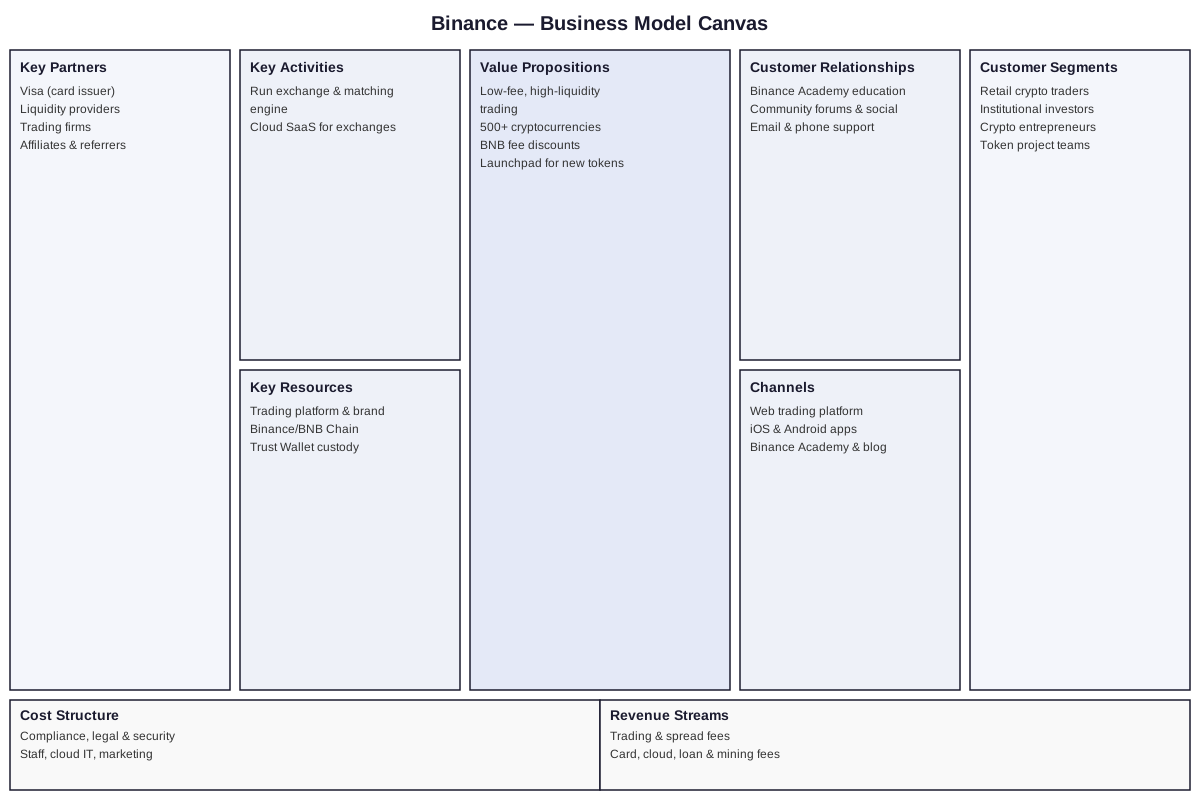
Binance's customer base splits broadly into individual traders who want access to a liquid, secure venue and crypto entrepreneurs who need a platform to launch new tokens and projects. For traders, the value proposition centers on low transaction costs, deep liquidity across more than 500 cryptocurrencies and continuous market access through web and mobile apps on Android and iOS. For entrepreneurs, Binance offers Launchpad, which hosts token sales for vetted early-stage projects, and Binance Labs, which provides direct funding and mentorship to founders building on blockchain infrastructure. Customer relationships run through a mix of self-service tools, community channels and formal support: social media, email and phone support sit alongside the Binance community forums and Binance Academy's free educational content, which doubles as a funnel for new users learning the basics of crypto trading.
Resources, activities and partners behind the platform
The exchange's core resources are its matching engine and trading platform, its own Binance Chain and BNB Chain blockchains, the Trust Wallet software it acquired for self-custody, and the accumulated brand trust that comes with being the largest venue by volume. Its key activities center on running that trading infrastructure at scale, offering the cloud-based SaaS product to partner exchanges, and supporting liquidity through market-making and swap arrangements with large trading firms. Binance's partner base includes payment networks such as Visa for its card product, liquidity providers and institutional trading firms, and the broader base of platform users and affiliates who refer new customers in exchange for a share of trading fees. Its cost structure follows a familiar pattern for a technology platform at this scale: salaries for a global workforce, cloud and IT operations to keep the exchange running around the clock, ongoing platform security and maintenance, marketing spend to acquire new users, and a growing legal and compliance budget that expanded sharply after 2023.
Competing in a crowded exchange market
Coinbase remains Binance's most visible competitor in markets where regulatory clarity matters most, built around a simpler interface and a public listing that gives it a level of disclosure Binance has never matched as a private company. Kraken appeals to more sophisticated traders through advanced order types and a reputation for strong account security, while KuCoin competes on its catalog of smaller altcoins and low-fee automated trading tools. Crypto.com has built a loyalty program around its own token, Cronos, offering fee discounts and card rewards similar in structure to Binance's BNB model, and Bitstamp, one of the oldest exchanges still operating, competes on charting tools and its long operating history. Binance's advantage over all of them remains raw scale, with a spot market share around 39% as of 2025, giving it liquidity depth that smaller exchanges cannot easily replicate even when they undercut Binance on individual fees.
Regulatory reckoning and the path back to legitimacy
Binance's growth attracted scrutiny in direct proportion to its size, and that scrutiny came to a head in November 2023, when the company pleaded guilty to Bank Secrecy Act violations, operating an unregistered money transmitting business and breaching U.S. sanctions law by allowing transactions between American users and counterparties in Iran and other sanctioned jurisdictions. 5
"Binance became the world's largest cryptocurrency exchange in part because of the crimes it committed, now it is paying one of the largest corporate penalties in U.S. history"
Then-Attorney General Merrick Garland made that statement when the Justice Department announced the settlement, which required Binance to pay over $4.3 billion and accept an independent compliance monitor for three years. Zhao personally pleaded guilty, paid a $50 million fine and served roughly four months in federal prison after sentencing in 2024. The story took another turn in October 2025, when President Trump pardoned Zhao, with the White House arguing his prosecution had been politically motivated under the prior administration, a decision that drew scrutiny given the Trump family's own ties to the crypto industry through World Liberty Financial. 6 For an exchange that built its business on moving fast and asking permission later, the settlement, sentence and pardon together illustrate how much the regulatory environment around crypto platforms has shifted in less than a decade, and how much that shift now shapes Binance's own strategic choices around where and how it operates.
Binance's trajectory shows how a fee-based, high-volume platform can outrun the regulation meant to contain it. The exchange turned a $15 million token sale into control of nearly 40% of global crypto trading volume within eight years, while adding lending, cloud services and card payments that reduce its dependence on any single revenue line. Its 2023 settlement with U.S. authorities, followed by Zhao's 2025 pardon, shows how fast the legal and political ground can move under a fast-growing platform business. For consultants and executives studying digital asset markets, Binance is a working case study in scaling ahead of compliance, then paying to catch up, and in how a native token can align user incentives with platform growth in ways a traditional exchange cannot match. The next test is whether Binance can sustain its volume lead as competitors close the compliance gap and regulators in major markets set clearer rules for the asset class.
Citation
Cite this article
Sridharan, M. A. (2023, December 6). Binance Business Model. Think Insights. https://thinkinsights.net/strategy/binance-business-model (Accessed [[ACCESS_DATE]])
Sridharan, Mithun A. "Binance Business Model." Think Insights, 6 Dec. 2023, https://thinkinsights.net/strategy/binance-business-model. Accessed [[ACCESS_DATE]].
Mithun A. Sridharan, "Binance Business Model," Think Insights, December 6, 2023, https://thinkinsights.net/strategy/binance-business-model. Accessed [[ACCESS_DATE]].
Sridharan, M.A. (2023) 'Binance Business Model', Think Insights. Available at: https://thinkinsights.net/strategy/binance-business-model (Accessed: [[ACCESS_DATE]]).
M. A. Sridharan, "Binance Business Model," Think Insights, 2023. [Online]. Available: https://thinkinsights.net/strategy/binance-business-model. [Accessed: [[ACCESS_DATE]]].
Sridharan MA. Binance Business Model. Think Insights. Published December 6, 2023. Accessed [[ACCESS_DATE]]. https://thinkinsights.net/strategy/binance-business-model
Test Your Knowledge
Binance Business Model
Challenge yourself on the concepts from this article and see how well you understood them.
Subscribers get weekly quizzes and insights — subscribe free
Sponsor this article
Partner with Think Insights
Reach 50,000+ business leaders, consultants, and strategists. Feature your brand alongside expert articles on strategy, leadership, and digital transformation.
Become a Sponsor