Best Business Model Canvas Makers


Choosing a business model canvas maker depends less on feature count than on the job the canvas needs to do next. Live workshops reward speed, sticky notes and group editing. Client and classroom work rewards polish, branding and export quality. Startup validation rewards a tight loop between assumptions and evidence. This guide sorts the leading tools by that use case rather than treating every product as a generic canvas app, then walks through Miro's own business model, block by block, as a concrete example of how a visual collaboration company answers the nine canvas questions about itself. Executives and consultants shortlisting software should match the tool to how their team already works, because the strongest fit usually beats the tool with the longest feature list
What is a business model canvas maker
A business model canvas maker is software that turns the nine-block business model canvas into an editable, shareable digital workspace, letting teams draft, discuss and revise a company's value proposition, activities and revenue logic together instead of filling in a static template alone.
Which canvas tool fits a live workshop best
Whiteboard-first platforms such as Miro fit live workshops best because they support simultaneous editing, voting, timers and sticky notes, which keep a room moving through the nine blocks without breaking the discussion to fix formatting.
Do consultants need a different tool than founders
Consultants often need a different tool than founders because client work rewards presentation quality, branding and secure sharing, while founders typically prioritize speed and cheap iteration as assumptions change with each round of customer feedback.
Why the Canvas Still Matters
The business model canvas condenses a company's logic into nine connected blocks: key partners, key activities, key resources, value propositions, customer relationships, channels, customer segments, cost structure and revenue streams. Alexander Osterwalder and Yves Pigneur built the format so a team could see how those pieces connect on one page rather than buried across a lengthy business plan.1 That single-page view is why the framework spread from startup circles into corporate innovation labs and business school classrooms. A canvas maker inherits that job. It has to make nine interdependent questions easy to edit, discuss and revisit as a team's understanding of the business changes.
Workshops Versus Deliverables
Not every canvas tool solves the same problem. Some platforms are built for a live session where a facilitator needs the group filling in sticky notes, voting on priorities and time-boxing debate. Gartner groups these under visual collaboration applications, tools built around a shared digital canvas that supports both real-time and asynchronous work across distributed teams.2 Other platforms optimize for the opposite moment, turning a rough canvas into something a client, board or classroom can read without explanation. Buyers who conflate these two jobs usually end up with a tool that does one well and the other poorly.
A tool built for a workshop and a tool built for a deliverable rarely excel at both
Scale Changes What a Tool Needs to Do
A canvas maker built for a five-person startup faces different demands than one supporting thousands of concurrent enterprise users. Miro's growth illustrates how far that demand can stretch. The company raised 400 million dollars in a funding round that valued it at 17.5 billion dollars, on the back of user growth that took it from 5 million to 30 million users in roughly two years.3 That scale forced Miro to build features far beyond a blank canvas, including permissioning, integrations, template governance and enterprise administration. A tool optimized only for a single workshop rarely survives that transition without a redesign.
Presentation Quality as a Buying Criterion
For consultants, educators and solo founders, how a canvas looks after the workshop often matters as much as how it worked during the workshop. The business model canvas remains one of the most widely used strategic planning tools partly because it can double as a client deliverable, not just an internal exercise.4 A messy canvas can still guide a team's thinking, but it rarely survives client review or a classroom handout. Tools that treat branding, export quality and layout as first-class features solve a different problem than tools built purely for group facilitation speed.
A good-looking canvas doesn't make the business model better, it makes the strategy easier to communicate
Validation Changes the Job Again
Some teams don't need a general canvas at all. They need a structured path from assumption to evidence. Lean methodology treats a business model as a set of falsifiable hypotheses that a team tests, then revises, rather than a plan to defend.5 Platforms built around that discipline connect the canvas to diagnostics and guided experiments instead of leaving validation to the user's judgment. That difference matters most for accelerators, startup educators and early-stage founders who need the software to enforce rigor the team hasn't built on its own yet.
Reputation and Adoption as Signals
Buyers weighing dozens of canvas tools often lean on peer review platforms to narrow the field before a trial. Miro's standing as a leading visual collaboration product on G2, based on aggregated user reviews and satisfaction scores, shows how adoption data can substitute for a lengthy internal evaluation.6 Peer review signals do not replace a fit assessment against a team's own workflow, but they narrow a crowded market to a shortlist worth testing directly. Momentum in the market also points to ongoing investment in the product, which matters for a tool a team expects to use for years.
Matching the Tool to the Role
The strongest match is rarely the tool with the most features. A founder needs iteration to be cheap because the model will change repeatedly as customer feedback arrives. A consultant needs a platform that supports group discussion, then turns that work into something presentable without a rebuild. An educator needs predictable setup and enough structure that students spend class time on business logic, not software mechanics.
The right canvas maker fits how the team already works, not the other way around
Role, not feature count, should drive the shortlist. The right canvas maker is the one that fits how a team already works rather than the one asking the team to change its habits.
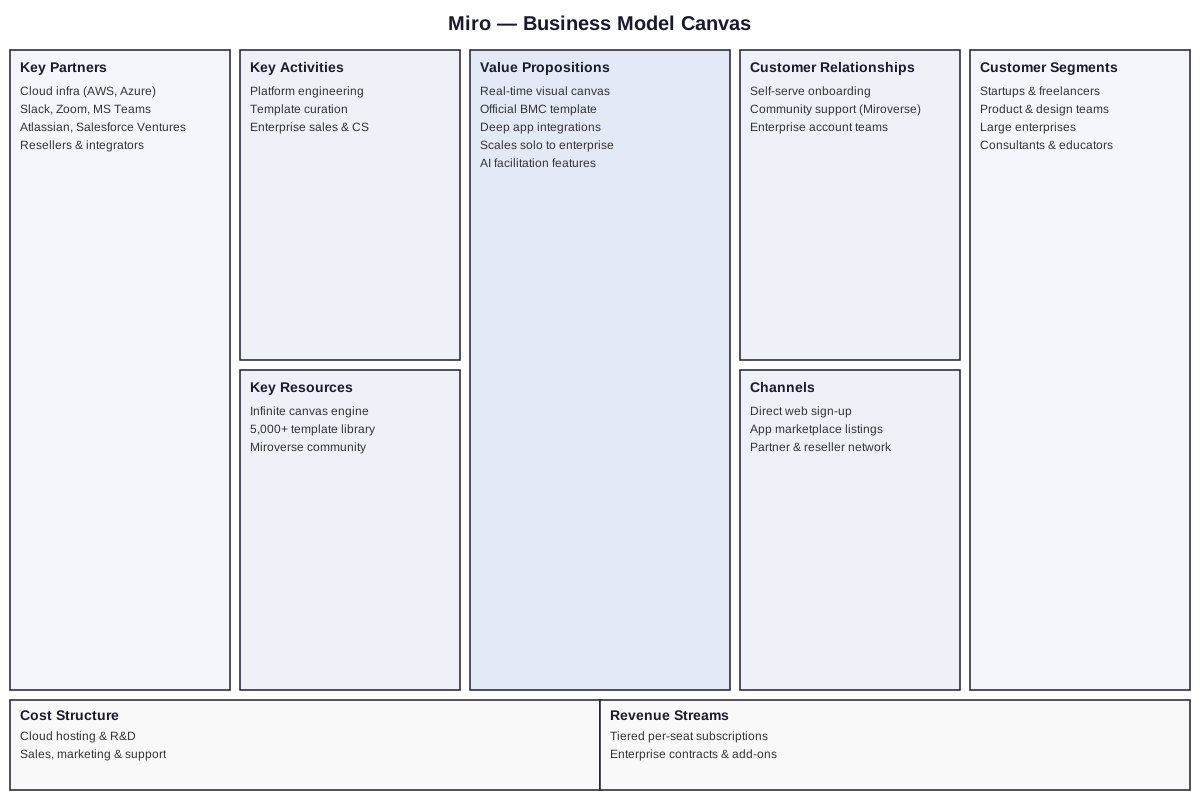
Key Partners
Miro depends on cloud infrastructure providers such as Amazon Web Services [AWS] to run its platform at scale, plus integration partners including Atlassian, Slack, Microsoft Teams and Zoom that keep the canvas inside a team's existing workflow. Strategic investors such as Salesforce Ventures extend distribution into enterprise accounts. A network of resellers and systems integrators supports larger deployments and independent developers building marketplace add-ons round out the partner ecosystem.
Key Activities
Product engineering is the core activity, maintaining an infinite canvas that performs smoothly with hundreds of simultaneous editors. Miro also curates and expands its template library, including the official business model canvas template and runs Miroverse, a community where users share templates and use cases. Enterprise sales, customer success and security compliance work round out the operating rhythm as accounts grow from a handful of seats to company-wide deployments.
Key Resources
The infinite canvas engine and its real-time sync technology are Miro's central resource, since collaboration quality depends on that infrastructure holding up under load. A library of more than 5,000 templates, including the business model canvas, lowers the barrier to a first board. The Miroverse community and the Miro brand itself function as resources too, driving organic adoption without matching sales spend.
Value Propositions
Miro's core promise is a shared visual canvas where distributed teams build, discuss and revise structured work such as a business model canvas in real time. Its template ecosystem and deep integrations mean the canvas rarely sits in isolation. It can connect to roadmaps, journey maps and sprint boards and the platform scales from a single founder's free account to a Fortune 100 enterprise deployment with added governance features like single sign-on and admin controls.
Customer Relationships
Most Miro relationships begin through self-serve sign-up, supported by in-product prompts and templates that shorten the path from a blank board to a finished canvas. The Miroverse community adds peer-driven support and inspiration outside formal channels. Larger accounts get dedicated customer success and account management once usage crosses into enterprise territory, reflecting the shift from product-led growth to sales-assisted expansion.
Channels
Direct web sign-up remains Miro's primary channel, reflecting its product-led growth strategy and freemium model. App marketplace listings inside Slack, Zoom and Microsoft Teams extend reach into teams already using those tools. An enterprise sales force and a network of resellers and consulting partners handle larger, more complex deployments, while content marketing and template search visibility continue to feed the top of the funnel.
Customer Segments
Miro's base spans individual freelancers and small teams on free plans, startups and scaleups running quick model exploration and mid-market product and design teams using the canvas alongside other planning work. Large enterprises, including a large share of the Fortune 100, represent the highest-value segment. Consultants and educators form a smaller but steady segment, often using Miro's business model canvas template for client workshops or classroom sessions.
Cost Structure
Cloud hosting and infrastructure make up a significant recurring cost, given the compute and bandwidth needed for real-time collaboration at scale. Engineering and product development payroll represent the largest fixed cost, followed by sales and marketing spend tied to enterprise expansion. Customer support, security certification and compliance maintenance add further ongoing cost as the platform serves larger, more regulated customers.
Revenue Streams
Miro's revenue model centers on tiered, per-seat subscriptions that move users from a free plan into paid team, business and enterprise tiers. Enterprise contracts, which add single sign-on, admin controls and dedicated support, contribute a disproportionate share of revenue relative to seat count. Expansion revenue from accounts that grow from a handful of users to company-wide adoption is a meaningful part of overall growth, consistent with Miro's product-led go-to-market approach.
A business model canvas maker is a strategy tool, not just a drawing surface and the software shapes how a team frames a business as much as any workshop facilitator does. Teams running live sessions need speed and low-friction collaboration. Teams producing client documents or classroom materials need cleaner output and simpler sharing. Founders need cheap iteration, consultants need a path from discussion to deliverable and educators need predictable setup that keeps attention on business logic rather than software mechanics. Miro's own business model, mapped across the nine blocks, shows how a platform built for live collaboration also has to solve subscription economics, partner integrations and enterprise governance once its user base scales into the millions. Pick the category first, then the product within it
Citation
Cite this article
Sridharan, M. A. (2021, January 19). Best Business Model Canvas Makers. Think Insights. https://thinkinsights.net/strategy/best-business-model-canvas-makers (Accessed [[ACCESS_DATE]])
Sridharan, Mithun A. "Best Business Model Canvas Makers." Think Insights, 19 Jan. 2021, https://thinkinsights.net/strategy/best-business-model-canvas-makers. Accessed [[ACCESS_DATE]].
Mithun A. Sridharan, "Best Business Model Canvas Makers," Think Insights, January 19, 2021, https://thinkinsights.net/strategy/best-business-model-canvas-makers. Accessed [[ACCESS_DATE]].
Sridharan, M.A. (2021) 'Best Business Model Canvas Makers', Think Insights. Available at: https://thinkinsights.net/strategy/best-business-model-canvas-makers (Accessed: [[ACCESS_DATE]]).
M. A. Sridharan, "Best Business Model Canvas Makers," Think Insights, 2021. [Online]. Available: https://thinkinsights.net/strategy/best-business-model-canvas-makers. [Accessed: [[ACCESS_DATE]]].
Sridharan MA. Best Business Model Canvas Makers. Think Insights. Published January 19, 2021. Accessed [[ACCESS_DATE]]. https://thinkinsights.net/strategy/best-business-model-canvas-makers
Test Your Knowledge
Best Business Model Canvas Makers
Challenge yourself on the concepts from this article and see how well you understood them.
Subscribers get weekly quizzes and insights — subscribe free
Sponsor this article
Partner with Think Insights
Reach 50,000+ business leaders, consultants, and strategists. Feature your brand alongside expert articles on strategy, leadership, and digital transformation.
Become a Sponsor