The AI Learning Startup Canvas


AI learning startups often win attention with fast, polished demos, but a working business rests on clearer choices than any demo shows. This article uses the business model canvas to break that decision down into nine parts: who the buyer is, what problem gets solved, how the product reaches people and how money comes in. Duolingo illustrates the canvas in practice, from its free gamified app to its paid subscription tier and its English proficiency test used by thousands of institutions. The goal is not to describe one company's history. It is to give founders and executives a structured way to test whether an AI-driven education product has a business model that holds up, not just a feature set that impresses in a pitch.
Why use a business model canvas for AI learning startups
The canvas forces founders to separate a compelling product demo from a working business. It maps who buys, what problem the product solves, how it reaches users and how revenue holds up over time, which matters in a fragmented market like education and training.
What makes Duolingo a useful canvas example
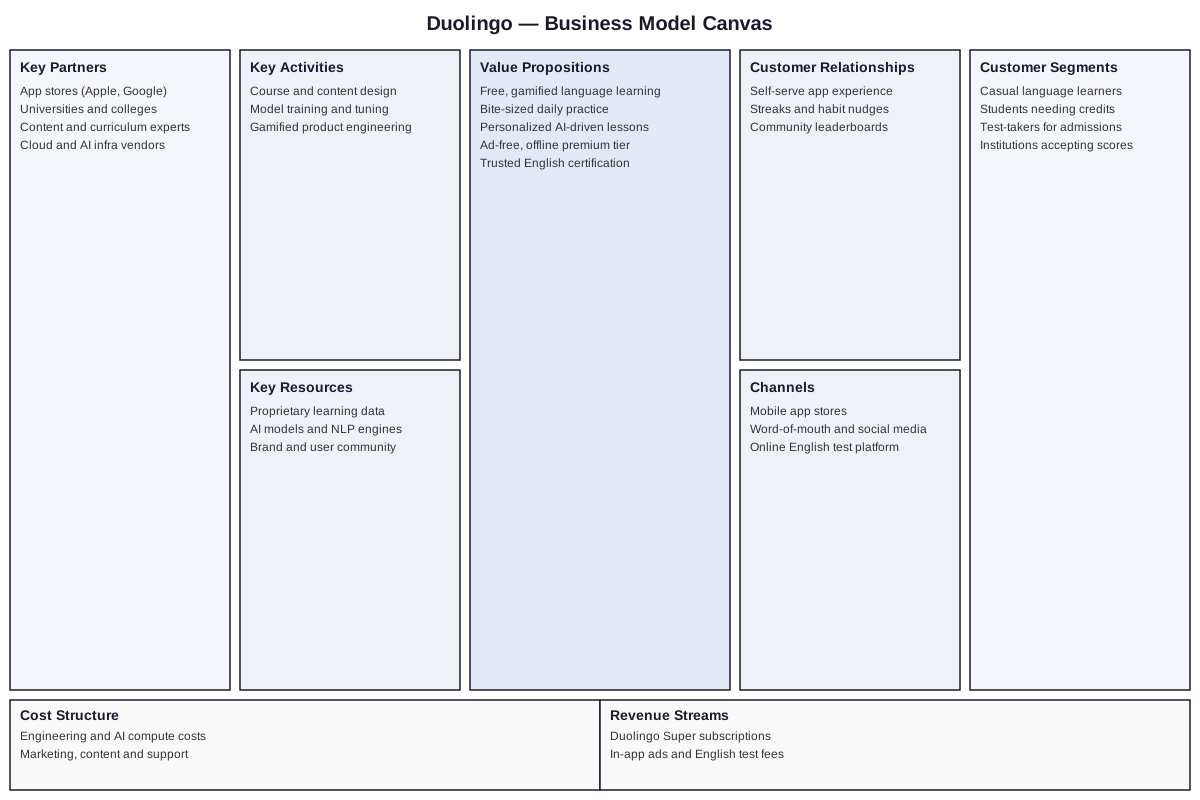
Duolingo serves several distinct segments, casual learners, subscribers and institutions, through one shared AI and content engine. Its mix of a free app, a paid tier and a paid certification test shows how one company can align activities, resources and revenue across different buyer types.
What is the biggest business model mistake AI learning startups make
Many try to serve too many user types with one undifferentiated offer. Without a clear first segment, the value proposition, pricing and channels tend to stay vague, which weakens every other block of the canvas.
Why the canvas forces real answers
Many Artificial Intelligence [AI] learning products look convincing in a demo because they can summarize a chapter, generate quiz questions or draft a lesson plan in seconds. That capability says nothing about whether the product fits into a workflow someone will pay to keep using. The business model canvas, a single-page framework Alexander Osterwalder introduced in 2005, breaks a company down into nine linked parts: partners, activities, resources, value, relationships, channels, segments, costs and revenue.1
Filling in those nine boxes for an AI learning startup usually exposes a harder question than any product demo answers: who is the paying customer and what has to be true for them to renew.
A canvas that does not fit together usually means the product does not either
Choosing a segment before a feature set
Early AI learning teams tend to chase every user at once, students who want to study faster, teachers building lessons and companies cutting training time. That breadth feels ambitious, but it usually produces a generic offer nobody chooses first. Duolingo did not start by trying to serve every language learner and every institution the same way. Its core segment is the casual, mobile-first learner practicing a few minutes a day, a distinct group from the roughly 4,000 institutions that now accept its English proficiency test for admissions decisions.2
Separating those segments early lets a startup decide which one to design the entire canvas around first.
Tying the value proposition to outcomes
Generating content quickly is not a value proposition, it is a feature. A stronger claim explains what actually improves for the user, faster recall, less prep time or a completed course instead of an abandoned one. Duolingo's premium tier does not sell more content, it sells fewer interruptions and better tracking, ad-free lessons, offline access and progress data that make the daily habit easier to keep. For an AI learning startup, the equivalent test is whether the paid version changes an outcome or just removes friction around one that already exists.
Key activities that decide whether it scales
In most software startups, key activities mean building the product, marketing it and supporting customers. An AI learning startup carries a longer list: content quality control, prompt and workflow design, model evaluation and instructional logic that decides how a lesson actually teaches something. Duolingo's activity list includes maintaining course content across dozens of languages, running the machine learning systems that adapt exercise difficulty and operating the test infrastructure behind its English exam. Founders who write "build the AI product" as their only key activity are usually underestimating how much of the business lives in that operational layer.
Resources and partners that carry the trust
The model is rarely the scarcest resource, the surrounding system usually is. Key resources for an AI learning startup include subject-matter content, instructional design logic, proprietary usage data and, increasingly, the trust that comes from a track record of accurate output. Duolingo built that trust for its English test through academic partners, starting with Carnegie Mellon University as its first academic partner, followed by a pilot with Yale and MIT.3
Reliability matters even more once an AI system's output feeds into a certification, admissions or onboarding decision, which is why frameworks such as the National Institute of Standards and Technology [NIST] AI Risk Management Framework exist as a reference point for managing that kind of risk.4
Matching revenue to how people actually pay
A sound product can still fail commercially if the pricing model does not match how the buyer behaves. Some AI learning products suit self-serve subscriptions, others fit seat-based licensing or per-institution contracts. Duolingo runs three revenue streams side by side, a subscription tier called Duolingo Super, in-app advertising for free users and paid fees for its English proficiency test, with subscriptions making up most of its revenue.5
Startups copying a single generic subscription price often miss that some users need a product weekly, while others only need it once, before an exam or a compliance deadline.
Channels and relationships built to reduce friction
Distribution is not only a marketing question, it also shapes how a product gets adopted and kept. Duolingo's main channel is direct app store distribution, reinforced by word-of-mouth and social sharing, but its English test relies on a different channel entirely, a remote, webcam-proctored exam that learners can take at home instead of visiting a physical test center.6
That second channel removed a major point of friction for international applicants, since a scheduled seat at a physical site is no longer required to get a certified score. An AI learning startup building a self-serve product needs a fast first-use moment, while one selling to institutions needs a channel built around procurement and predictable setup.
Key Partners
Duolingo depends on Apple and Google app stores for distribution to its global user base. Universities and colleges act as partners on the demand side, since they define the admissions requirements the English test has to meet. Content and curriculum experts contribute pedagogical structure across dozens of language courses. Cloud and AI infrastructure vendors supply the compute and model tooling behind personalized lessons and test scoring.
Key Activities
The company's core activities include designing and maintaining course content across many languages and skill levels. It also trains and tunes the machine learning models that adapt lesson difficulty to each learner's pace. A third activity is gamified product engineering, building streaks, leaderboards and reminders that keep a free habit-forming app sticky enough to convert into a paying subscriber base.
Key Resources
Proprietary learning data, drawn from hundreds of millions of practice sessions, lets Duolingo tune difficulty and predict where learners drop off. Its AI models and natural language processing engines power everything from exercise generation to English test scoring. A third resource is less technical, a recognizable brand and an active learner community that keeps engagement high without heavy paid acquisition.
Value Propositions
For casual learners, Duolingo's value proposition is free, gamified language practice that fits into a few minutes a day. Bite-sized daily lessons lower the barrier to starting and returning. Paying subscribers get a step up, personalized AI-driven lesson sequencing and an ad-free, offline experience through Duolingo Super. Institutions and applicants get a third proposition entirely, a fast, trusted English certification accepted in place of older, slower exams.
Customer Relationships
Most learners never speak to a Duolingo employee, the relationship runs entirely through the self-serve app experience. Streaks, reminders and other habit nudges substitute for human account management, prompting daily return visits without a support team behind them. Community leaderboards add a light social layer, letting learners compare progress with friends or strangers at a similar level.
Channels
Mobile app stores remain the primary channel for new learner acquisition, supported heavily by word-of-mouth and social media moments. A separate channel serves the English test business, an online, remotely proctored testing platform that applicants can access from a personal computer instead of a physical test center. Keeping these channels distinct lets Duolingo tailor onboarding to two very different buying occasions.
Customer Segments
Casual language learners make up Duolingo's largest and most visible segment, using the free app without ever paying. A second segment includes students who need language credit or structured practice tied to a course. A third, higher-intent segment covers test-takers preparing for admissions who need a certified score. The fourth segment sits on the buyer side rather than the user side, institutions that accept those scores and set the requirements test-takers must meet.
Cost Structure
Engineering and AI compute costs make up a substantial share of Duolingo's cost base, covering model training, inference and the infrastructure behind millions of daily sessions. The remainder goes to marketing, content production and the support operations behind both the consumer app and the English test business. Because the product is free for most users, the company has to manage these costs against a comparatively small paying subscriber base.
Revenue Streams
Duolingo Super, the paid subscription tier, generates the largest share of company revenue. In-app advertising shown to free users adds a second stream that scales with the size of the non-paying user base. Fees from the Duolingo English Test add a third, distinct revenue line tied to admissions cycles rather than daily app usage.
A business model canvas does not make an AI learning product better on its own. It forces founders to state, in plain terms, who pays, why they pay and what keeps them coming back. Duolingo's version of that canvas shows how one company can serve casual learners with a free app, subscribers with a premium tier and institutions with a certified English test, all built on the same underlying models and content engine. Executives evaluating AI education startups should ask the same nine questions of any team they assess. When the answers align, across partners, activities, resources, value, relationships, channels, segments, costs and revenue, the product usually has a durable business behind it, not just a capable model.
Citation
Cite this article
Sridharan, M. A. (2021, February 24). The AI Learning Startup Canvas. Think Insights. https://thinkinsights.net/strategy/ai-learning-startup-canvas (Accessed [[ACCESS_DATE]])
Sridharan, Mithun A. "The AI Learning Startup Canvas." Think Insights, 24 Feb. 2021, https://thinkinsights.net/strategy/ai-learning-startup-canvas. Accessed [[ACCESS_DATE]].
Mithun A. Sridharan, "The AI Learning Startup Canvas," Think Insights, February 24, 2021, https://thinkinsights.net/strategy/ai-learning-startup-canvas. Accessed [[ACCESS_DATE]].
Sridharan, M.A. (2021) 'The AI Learning Startup Canvas', Think Insights. Available at: https://thinkinsights.net/strategy/ai-learning-startup-canvas (Accessed: [[ACCESS_DATE]]).
M. A. Sridharan, "The AI Learning Startup Canvas," Think Insights, 2021. [Online]. Available: https://thinkinsights.net/strategy/ai-learning-startup-canvas. [Accessed: [[ACCESS_DATE]]].
Sridharan MA. The AI Learning Startup Canvas. Think Insights. Published February 24, 2021. Accessed [[ACCESS_DATE]]. https://thinkinsights.net/strategy/ai-learning-startup-canvas
Test Your Knowledge
The AI Learning Startup Canvas
Challenge yourself on the concepts from this article and see how well you understood them.
Subscribers get weekly quizzes and insights — subscribe free
Sponsor this article
Partner with Think Insights
Reach 50,000+ business leaders, consultants, and strategists. Feature your brand alongside expert articles on strategy, leadership, and digital transformation.
Become a Sponsor