Leadership Attributes


Effective leadership hinges on three core elements—coaching, communication, and drive. Coaching helps leaders tailor support to varying levels of accountability and skill, ensuring each team member grows and contributes meaningfully. Strong communication balances listening, questioning, and expression to build trust and clarity. Leadership drive, combined with self-awareness, propels teams toward improvement and collaboration. By mastering these traits, leaders create motivated, capable teams that thrive on shared purpose and continuous development.
What are the four coaching scenarios leaders should recognize?
Leaders should identify whether team members are accountable and able, accountable but not able, able but not accountable, or neither accountable nor able. Each scenario requires a different coaching approach.
How does communication style affect team performance?
Leaders who balance talking, listening, and questioning build trust and clarity. Dominating conversations or disengaging entirely can cause frustration, confusion, and reduced team effectiveness.
Why does self-awareness matter for leadership drive?
High-drive leaders with low self-awareness can derail teams despite good intentions. Recognizing personal limitations allows leaders to leverage team strengths and avoid conflicting or poorly executed strategies.
What should leaders do with team members who are able but not accountable?
Leaders should set clear expectations, conduct regular follow-ups, and provide constructive feedback to address behavior and encourage ownership of responsibilities.
How can low-drive leaders still achieve positive outcomes?
By delegating effectively and sharing authority, low-drive leaders can make gradual progress. Acknowledging the need for external support and empowering capable team members helps compensate for limited personal motivation.
Leadership is more than just delegating tasks; it's about guiding and inspiring your team to achieve their best. Effective leaders understand their people, identify their motivations, and provide the right support to help them succeed. When developing leadership skills or fostering leadership in others, it's important to focus on key attributes. This guide explores three critical areas: coaching, communication, and leadership drive, along with their impact on team performance.
Role of Coaching in Leadership
Coaching is essential for helping team members grow and succeed. Leaders must adapt their coaching style based on individuals' abilities and accountability levels.
Here's a breakdown of coaching scenarios:

Accountable and Able
These individuals are a dream for any leader. They take ownership of their roles and deliver results with minimal guidance. Leaders only need to define the objectives, and these team members take it from there. Providing occasional feedback and support ensures they stay on track and feel valued.
Accountable but Not Able
Some team members show accountability but lack the necessary skills. These individuals are eager to learn and improve. Leaders should invest in their development through training and mentorship, creating a supportive environment where questions are encouraged, and growth is celebrated.
Not Accountable but Able
This group poses a significant challenge. They possess the skills but lack the willingness to take ownership. Leaders need to address behavior and instill accountability through clear expectations, regular follow-ups, and constructive feedback.
Not Accountable and Unable
When individuals lack both accountability and ability, leaders must make tough decisions. These team members may need to be reassigned to roles better suited to their capabilities or supported in finding opportunities outside the organization.
The Art of Communication
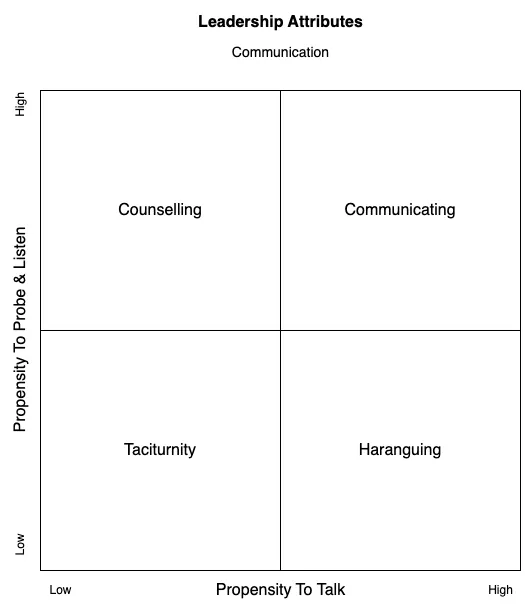
Communication is the lifeblood of leadership. Effective communication involves balancing talking, listening, and asking questions. Unfortunately, many leaders struggle to master all three. Here are four common communication styles and their impact:
High Talk, High Listening and Questioning
Leaders who excel in both talking and listening are perceived as empathetic and effective communicators. They foster trust and clarity by engaging in meaningful dialogue and addressing concerns promptly.
High Talk, Low Listening and Questioning
These leaders dominate conversations, often overshadowing others' input. Their communication style can lead to frustration, disengagement, and a lack of understanding among team members. Such leaders need to consciously practice active listening and prioritize others' perspectives.
Low Talk, High Listening and Questioning
Passive communicators focus on others' views but struggle to express their own. While they may excel in understanding others, their reluctance to share their thoughts can cause confusion. Leaders in this category must learn to articulate their expectations assertively and clearly.
Low Talk, Low Listening and Questioning
Leaders with minimal engagement in conversations create an atmosphere of ambiguity and detachment. These individuals may appear unapproachable and ineffective. Building communication skills and fostering openness are essential for such leaders to connect with their teams.
Leadership Drive and Team Performance
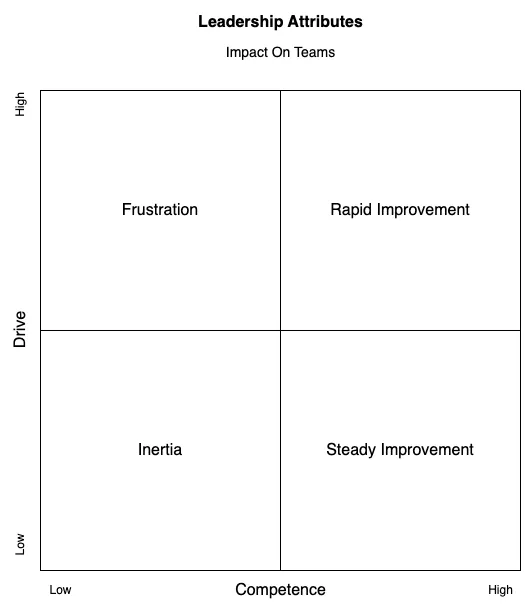
A leader's drive and self-awareness significantly influence team dynamics, particularly in underperforming teams. These factors determine whether a leader can inspire progress or hinder it.
High Drive, Low Unconscious Incompetence
Leaders who recognize their limitations and rely on skilled team members for guidance tend to drive rapid improvements. Their humility and determination create an environment of collaboration and achievement.
High Drive, High Unconscious Incompetence
Leaders with strong drive but little self-awareness often derail progress. They may initially motivate the team, but their inability to listen, poor execution, and conflicting strategies ultimately lead to frustration and stagnation.
Low Drive, Low Unconscious Incompetence
Leaders who lack both drive and self-awareness may make gradual progress by delegating effectively. However, their limited motivation can slow down the team's growth. Recognizing their need for support and sharing authority can help them improve outcomes.
Low Drive, High Unconscious Incompetence
Leaders in this category struggle the most. Their lack of drive and awareness creates a vacuum where more driven individuals may compete for influence, leading to disarray. Clear direction and strong external support are critical to overcoming these challenges.
Leadership attributes shape how teams perform and evolve. Coaching ensures team members grow and thrive, communication builds trust and clarity, and leadership drive inspires momentum. By focusing on these areas, leaders can create an environment where both individuals and teams excel.
Effective leadership isn't about perfection—it's about continuous improvement. Understanding your strengths and addressing your weaknesses can transform your leadership style, fostering a team that is motivated, capable, and aligned with organizational goals.
Leadership extends beyond management—it's about nurturing people and driving performance through thoughtful coaching, clear communication, and purposeful energy. Great leaders adapt their coaching to individual needs, strengthen engagement through active listening and balanced dialogue, and channel their drive with self-awareness to inspire consistent progress. When these qualities align, teams perform with confidence and coherence. Leadership, at its core, is an evolving practice of guiding others toward growth, accountability, and collective excellence.
Citation
Cite this article
Sridharan, M. A. (2022, December 11). Leadership Attributes. Think Insights. https://thinkinsights.net/leadership/leadership-attributes (Accessed [[ACCESS_DATE]])
Sridharan, Mithun A. "Leadership Attributes." Think Insights, 11 Dec. 2022, https://thinkinsights.net/leadership/leadership-attributes. Accessed [[ACCESS_DATE]].
Mithun A. Sridharan, "Leadership Attributes," Think Insights, December 11, 2022, https://thinkinsights.net/leadership/leadership-attributes. Accessed [[ACCESS_DATE]].
Sridharan, M.A. (2022) 'Leadership Attributes', Think Insights. Available at: https://thinkinsights.net/leadership/leadership-attributes (Accessed: [[ACCESS_DATE]]).
M. A. Sridharan, "Leadership Attributes," Think Insights, 2022. [Online]. Available: https://thinkinsights.net/leadership/leadership-attributes. [Accessed: [[ACCESS_DATE]]].
Sridharan MA. Leadership Attributes. Think Insights. Published December 11, 2022. Accessed [[ACCESS_DATE]]. https://thinkinsights.net/leadership/leadership-attributes
Test Your Knowledge
Leadership Attributes
Challenge yourself on the concepts from this article and see how well you understood them.
Subscribers get weekly quizzes and insights — subscribe free
Sponsor this article
Partner with Think Insights
Reach 50,000+ business leaders, consultants, and strategists. Feature your brand alongside expert articles on strategy, leadership, and digital transformation.
Become a Sponsor