Industry Analysis: Legal Services


Legal Services converts institutional, financial, physical, or human inputs into legal assistance and advice. Decision-makers should prioritize the segment where specialized advice, representation, recurring institutional clients and scalable standardized services because that is where defensibility is most likely to accumulate. The industry matters through its effect on individuals, SMEs, enterprises, governments and through the infrastructure and expertise required to deliver reliable outcomes. Bargaining power is shifting toward parties that control scarce capacity, trusted customer access, proprietary data, or regulated permissions. Executives should therefore avoid broad expansion before proving unit economics, secure critical suppliers or capabilities early and use technology to remove repeatable friction rather than simply digitize existing work.
Is Legal Services attractive for new entrants?
Entry can be attractive in focused niches where customers face a clear service gap and incumbents carry avoidable cost. The strongest openings usually combine a narrow customer segment with a capability that is difficult to compare on price alone. Broad entry is harder when professional credentials, reputation, trust, specialized knowledge, client relationships and regulatory permissions creates strong incumbent advantages.
Which parts of the value chain are most profitable?
Profit tends to concentrate around specialized advice, representation, recurring institutional clients and scalable standardized services. Activities that are standardized and easily compared tend to face stronger price competition, while activities tied to scarce capability, customer trust, or differentiated access can sustain better economics.
How is technology changing this industry?
Technology is changing workflow, distribution, data quality and the economics of scale. The largest effect comes when software alters a bottleneck such as matching, forecasting, processing, compliance, service delivery, or customer acquisition rather than simply digitizing an existing document.
What capabilities are table stakes versus differentiators?
Table stakes include reliable delivery, compliance, core technology, qualified people and basic customer service. Differentiation comes from a defensible combination of specialization, distribution, data, speed, trust, network density, or operating efficiency.
How should investors and consultants evaluate opportunities here?
Start with the segment, not the industry label. Map the buyer, supplier, substitute, regulatory regime, capital cycle, unit economics and source of switching costs, then test whether growth improves utilization and customer economics or merely increases complexity.
Where is bargaining power shifting?
Power shifts toward the party controlling scarce capacity or a hard-to-replace customer relationship. Digital transparency can strengthen buyers, while specialized talent, infrastructure, data, or regulatory access can strengthen suppliers.
What makes scale valuable?
Scale matters when it spreads fixed costs, improves network density, increases purchasing power, strengthens data, or raises service reliability. Scale is less useful when every additional unit requires proportional expert labor or bespoke complexity.
Which risks deserve board attention?
Boards should focus on regulatory change, technology substitution, concentration in critical suppliers or customers and the resilience of the operating model under demand or input shocks. Scenario tests should connect each risk to cash flow, capacity and strategic flexibility.
Should an incumbent integrate vertically?
Integration is justified when the controlled activity affects quality, supply security, customer experience, or a material source of margin. Partnership is preferable when the input is standardized and external providers can achieve better scale or innovation.
What is the clearest strategic priority?
Build control around the constraint that determines customer value. For Legal Services, that means protecting the scarce capability, relationship, or infrastructure that supports specialized advice, representation, recurring institutional clients and scalable standardized services, while automating or partnering for activities that do not create defensible differentiation.
Legal Services is best understood as a system for converting scarce inputs into a defined economic, public, or customer outcome. The system includes the organizations that perform the core activity, the infrastructure that makes it possible, the channels that connect providers with users and the governance mechanisms that determine acceptable conduct. The analysis below treats those components as one operating system, then separates the profit pools, cost drivers, moats and strategic choices that determine where value accumulates.
Industry at a glance
Legal Services operates at the intersection of mandate, demand and institutional capacity. Its core economic or public function is to legal services help clients understand rights and obligations, manage disputes, execute transactions and navigate legal systems. That function looks simple at the point of delivery, but the underlying system includes funding, specialist labor, infrastructure, governance, data and distribution. The strategic question for an executive is therefore not whether demand exists. It is whether the organization can convert demand into repeatable outcomes while keeping the scarce inputs that determine quality under control.
Technology changes the economics of Legal Services when it changes a constraint rather than simply adding a tool. Automation can reduce repetitive processing, data can improve matching or forecasting and digital channels can widen reach. None of these benefits is automatic. The value appears when the technology is integrated into a workflow, governed by clear decision rights and connected to a measurable customer or institutional outcome.
Market power in Legal Services often moves through the value chain rather than disappearing. A customer may gain transparency while a specialized supplier gains scarcity. A platform may lower distribution friction while increasing dependency on its interface. A regulator may reduce entry barriers in one activity while raising them in another. Executives should therefore map power at the level of each transaction, because industry-wide averages can hide very different economics between adjacent segments.
The scope includes the core providers, their direct enabling infrastructure and the commercial or institutional interfaces required to deliver the outcome. It excludes adjacent activities whose economics depend on a different primary customer problem. This boundary matters because broad industry labels often mix businesses with different capital cycles, regulatory exposure and bargaining power.1
For decision-makers, four baseline metrics matter. Revenue may arrive through fees, subscriptions, transactions, commissions, contracts, public funding, asset returns, or a combination of these. Capital intensity determines how much growth requires physical or financial investment. Labor intensity determines whether growth can scale through software and process design or requires additional skilled capacity. Regulation intensity determines the cost of entry, the pace of product change and the amount of evidence an operator must maintain.
Industry segmentation
Legal Services can be divided into segments according to where value is created and how customers buy. The most useful segmentation follows the operating model rather than a marketing taxonomy. The relevant boundaries are usually upstream inputs, core delivery, distribution, customer interface and enabling infrastructure.
-
Legal aid. This segment addresses a distinct point in the value chain and tends to attract a different mix of customers, suppliers and competitors. Its economics depend on the scarcity of the inputs it controls and on how directly customers can compare alternatives. Operators should assess utilization, pricing authority, switching costs and regulatory exposure separately rather than assuming that the whole industry shares one margin structure.
-
Document services. This segment addresses a distinct point in the value chain and tends to attract a different mix of customers, suppliers and competitors. Its economics depend on the scarcity of the inputs it controls and on how directly customers can compare alternatives. Operators should assess utilization, pricing authority, switching costs and regulatory exposure separately rather than assuming that the whole industry shares one margin structure.
-
Advisory. This segment addresses a distinct point in the value chain and tends to attract a different mix of customers, suppliers and competitors. Its economics depend on the scarcity of the inputs it controls and on how directly customers can compare alternatives. Operators should assess utilization, pricing authority, switching costs and regulatory exposure separately rather than assuming that the whole industry shares one margin structure.
-
Representation. This segment addresses a distinct point in the value chain and tends to attract a different mix of customers, suppliers and competitors. Its economics depend on the scarcity of the inputs it controls and on how directly customers can compare alternatives. Operators should assess utilization, pricing authority, switching costs and regulatory exposure separately rather than assuming that the whole industry shares one margin structure.
-
Compliance. This segment addresses a distinct point in the value chain and tends to attract a different mix of customers, suppliers and competitors. Its economics depend on the scarcity of the inputs it controls and on how directly customers can compare alternatives. Operators should assess utilization, pricing authority, switching costs and regulatory exposure separately rather than assuming that the whole industry shares one margin structure.
Customer dimension also matters. individuals, SMEs, enterprises, governments form the principal demand base, but they do not have identical buying criteria. Enterprise and institutional buyers tend to emphasize assurance, integration, governance and contractual performance, while consumers tend to emphasize convenience, price, trust, brand and experience. Segmenting the market by buying behavior exposes more useful entry points than segmenting only by product.2
Market structure
Porter's Five Forces points to a market in which value is determined by dependency, differentiation and control of scarce capacity. In Legal Services, the strongest strategic positions generally sit where an organization controls a hard-to-replace input or owns a customer relationship that is expensive to dislodge. The force pattern also varies by segment, so an attractive niche can coexist with a structurally difficult mass market3.
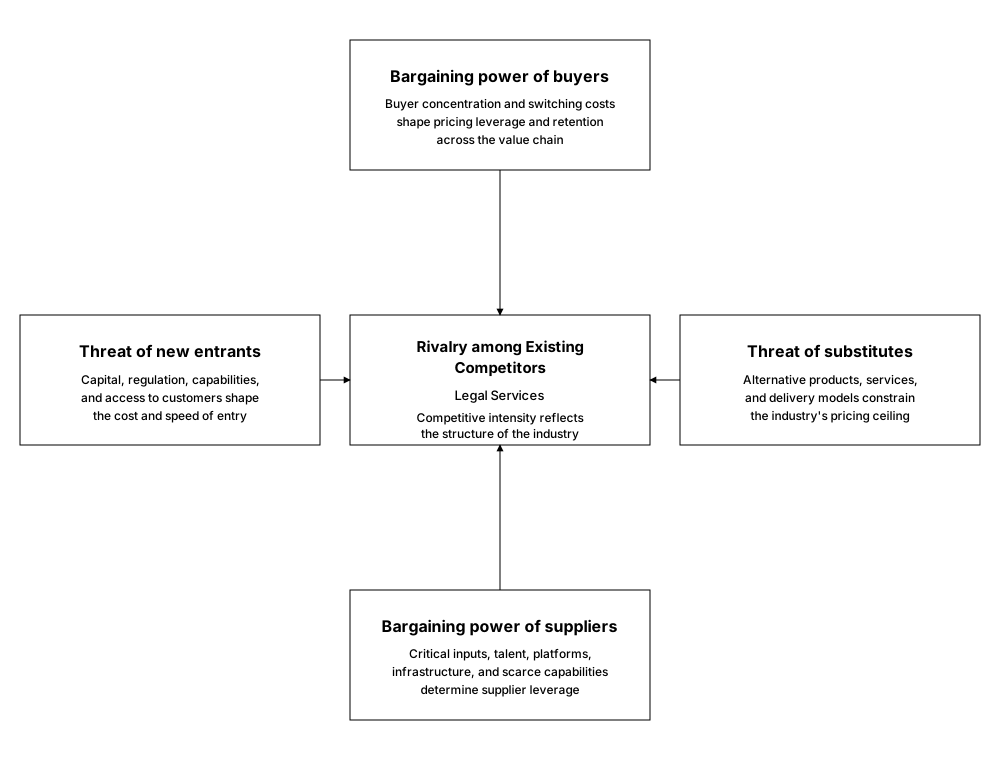
Legal Services has a force structure shaped by individuals, SMEs, enterprises, governments and institutions, qualified legal professionals, technology, research databases, courts and expert witnesses and the institutional conditions that govern participation. The central issue is where dependency accumulates. Buyers gain leverage when offerings become comparable, suppliers gain leverage when expertise or capacity is scarce and rivalry intensifies when several providers chase the same high-quality demand. Entry can remain difficult even when technology lowers operating costs, because trust, permissions, distribution and installed relationships may still matter. Substitution is often less visible:
it can arrive through internalization, a new channel, automation, or a different way of solving the customer's underlying problem
Bargaining power of buyers
The structure of Legal Services changes materially when viewed through Buyers. Buyers do not purchase an abstract industry output; they purchase a defined outcome, such as access, capital, certainty, mobility, resolution, or a trusted experience. Suppliers, meanwhile, compete for scarce inputs that may be difficult to standardize. This asymmetry creates a recurring pattern:
the organizations closest to scarce demand or scarce capability capture more value than participants performing activities that buyers can compare easily
A useful management discipline in Legal Services is to separate volume from economic quality. Growth can increase workload without improving returns when capacity, compliance, inventory, or service complexity rises at the same time. A stronger operating model identifies which activities scale with demand, which require additional expert capacity and which can be digitized or standardized. The result is a clearer view of where expansion creates operating leverage and where it merely creates more work.
| Dimension | Executive implication |
|---|---|
| Concentration | Large or institutional buyers can aggregate demand and negotiate on price, service levels and contractual terms |
| Switching | Switching costs depend on integration depth, trust, regulatory permissions, data portability and continuity requirements |
| Transparency | Digital comparison and standardized specifications increase price visibility and weaken opaque pricing |
| Criticality | Where failure is costly, buyers value reliability and may accept premium pricing for assured outcomes |
Bargaining power of suppliers
The structure of Legal Services changes materially when viewed through Suppliers. Buyers do not purchase an abstract industry output; they purchase a defined outcome, such as access, capital, certainty, mobility, resolution, or a trusted experience. Suppliers, meanwhile, compete for scarce inputs that may be difficult to standardize. This asymmetry creates a recurring pattern:
the organizations closest to scarce demand or scarce capability capture more value than participants performing activities that buyers can compare easily
A useful management discipline in Legal Services is to separate volume from economic quality. Growth can increase workload without improving returns when capacity, compliance, inventory, or service complexity rises at the same time. A stronger operating model identifies which activities scale with demand, which require additional expert capacity and which can be digitized or standardized. The result is a clearer view of where expansion creates operating leverage and where it merely creates more work.
| Dimension | Executive implication |
|---|---|
| Scarcity | Specialist talent, constrained infrastructure, regulated inputs, or proprietary technology can give suppliers leverage |
| Concentration | A small number of credible suppliers can increase dependency and reduce negotiation flexibility |
| Input substitutability | Commodity inputs create less leverage than specialized inputs tied to workflow or quality |
| Integration | Long-term integration can reduce transaction friction while increasing dependency on the incumbent supplier |
Rivalry among existing competitors
The structure of Legal Services changes materially when viewed through Rivalry. Buyers do not purchase an abstract industry output; they purchase a defined outcome, such as access, capital, certainty, mobility, resolution, or a trusted experience. Suppliers, meanwhile, compete for scarce inputs that may be difficult to standardize. This asymmetry creates a recurring pattern:
the organizations closest to scarce demand or scarce capability capture more value than participants performing activities that buyers can compare easily
A useful management discipline in Legal Services is to separate volume from economic quality. Growth can increase workload without improving returns when capacity, compliance, inventory, or service complexity rises at the same time. A stronger operating model identifies which activities scale with demand, which require additional expert capacity and which can be digitized or standardized. The result is a clearer view of where expansion creates operating leverage and where it merely creates more work.
| Dimension | Executive implication |
|---|---|
| Market shape | The segment may combine global incumbents, regional specialists and focused entrants with different cost structures |
| Basis of competition | Price competes with service reliability, reputation, specialization, speed, access and customer integration |
| Capacity | Excess capacity increases discounting, while constrained capacity shifts power toward scarce providers |
| Consolidation | Mergers can improve network density or capability breadth but may intensify regulatory scrutiny |
Threat of new entrants
The structure of Legal Services changes materially when viewed through Entrants. Buyers do not purchase an abstract industry output; they purchase a defined outcome, such as access, capital, certainty, mobility, resolution, or a trusted experience. Suppliers, meanwhile, compete for scarce inputs that may be difficult to standardize. This asymmetry creates a recurring pattern:
the organizations closest to scarce demand or scarce capability capture more value than participants performing activities that buyers can compare easily
A useful management discipline in Legal Services is to separate volume from economic quality. Growth can increase workload without improving returns when capacity, compliance, inventory, or service complexity rises at the same time. A stronger operating model identifies which activities scale with demand, which require additional expert capacity and which can be digitized or standardized. The result is a clearer view of where expansion creates operating leverage and where it merely creates more work.
| Dimension | Executive implication |
|---|---|
| Capital | Physical infrastructure, inventory, regulatory capital, or acquisition funding can raise the minimum viable scale |
| Regulation | Licensing, professional credentials, security requirements, or public mandates can restrict entry |
| Trust | Customers may prefer established providers when mistakes have financial, legal, safety, or reputational consequences |
| Distribution | Access to customers, channels, data, or networks can matter as much as the underlying product |
Threat of substitutes
The structure of Legal Services changes materially when viewed through Substitutes. Buyers do not purchase an abstract industry output; they purchase a defined outcome, such as access, capital, certainty, mobility, resolution, or a trusted experience. Suppliers, meanwhile, compete for scarce inputs that may be difficult to standardize. This asymmetry creates a recurring pattern:
the organizations closest to scarce demand or scarce capability capture more value than participants performing activities that buyers can compare easily
A useful management discipline in Legal Services is to separate volume from economic quality. Growth can increase workload without improving returns when capacity, compliance, inventory, or service complexity rises at the same time. A stronger operating model identifies which activities scale with demand, which require additional expert capacity and which can be digitized or standardized. The result is a clearer view of where expansion creates operating leverage and where it merely creates more work.
| Dimension | Executive implication |
|---|---|
| Direct substitute | Customers may internalize the activity, use a different channel, or redesign the underlying process |
| Technology | Automation or software can remove a human or physical step from the value chain |
| Adjacent provider | A neighboring industry can bundle the same outcome into a broader offering |
| Behavior change | New customer habits can reduce demand for legacy formats even without a direct competitor |
Value chain and profit pools
Legal Services operates at the intersection of mandate, demand and institutional capacity. Its core economic or public function is to legal services help clients understand rights and obligations, manage disputes, execute transactions and navigate legal systems. That function looks simple at the point of delivery, but the underlying system includes funding, specialist labor, infrastructure, governance, data and distribution. The strategic question for an executive is therefore not whether demand exists. It is whether the organization can convert demand into repeatable outcomes while keeping the scarce inputs that determine quality under control.
Upstream inputs
Key inputs include qualified legal professionals, technology, research databases, courts and expert witnesses. The operational question is whether the input is standardized, scarce, regulated, or embedded in the provider's workflow. Scarce inputs tend to capture more value when customers cannot easily substitute them.
The structure of Legal Services changes materially when viewed through Upstream inputs. Buyers do not purchase an abstract industry output; they purchase a defined outcome, such as access, capital, certainty, mobility, resolution, or a trusted experience. Suppliers, meanwhile, compete for scarce inputs that may be difficult to standardize. This asymmetry creates a recurring pattern:
the organizations closest to scarce demand or scarce capability capture more value than participants performing activities that buyers can compare easily
The strongest operators in Legal Services tend to make a few choices repeatedly. They define a customer segment precisely, build capabilities around the segment's hardest problem and avoid owning assets that do not improve control of the value proposition. They also use scale selectively. Scale matters when it lowers unit cost, improves data, increases network density, strengthens purchasing, or supports a broader service footprint. It matters less when additional volume creates complexity without a corresponding learning effect.
Production/processing
The core delivery layer converts those inputs into the industry's output. In Legal Services, this is where process discipline, specialist knowledge, capacity utilization and quality controls determine whether revenue scales faster than cost. Automation is most valuable where it removes repeatable friction without weakening the attributes customers actually pay for.
The structure of Legal Services changes materially when viewed through Production/processing. Buyers do not purchase an abstract industry output; they purchase a defined outcome, such as access, capital, certainty, mobility, resolution, or a trusted experience. Suppliers, meanwhile, compete for scarce inputs that may be difficult to standardize. This asymmetry creates a recurring pattern:
the organizations closest to scarce demand or scarce capability capture more value than participants performing activities that buyers can compare easily
The strongest operators in Legal Services tend to make a few choices repeatedly. They define a customer segment precisely, build capabilities around the segment's hardest problem and avoid owning assets that do not improve control of the value proposition. They also use scale selectively. Scale matters when it lowers unit cost, improves data, increases network density, strengthens purchasing, or supports a broader service footprint. It matters less when additional volume creates complexity without a corresponding learning effect.
Distribution/logistics
Distribution connects the core output to the customer. It may involve physical movement, digital channels, intermediaries, institutional networks, or direct sales. The strongest channels reduce acquisition cost and improve utilization at the same time, while weak channels add fees without creating durable customer access.
The structure of Legal Services changes materially when viewed through Distribution/logistics. Buyers do not purchase an abstract industry output; they purchase a defined outcome, such as access, capital, certainty, mobility, resolution, or a trusted experience. Suppliers, meanwhile, compete for scarce inputs that may be difficult to standardize. This asymmetry creates a recurring pattern:
the organizations closest to scarce demand or scarce capability capture more value than participants performing activities that buyers can compare easily
The strongest operators in Legal Services tend to make a few choices repeatedly. They define a customer segment precisely, build capabilities around the segment's hardest problem and avoid owning assets that do not improve control of the value proposition. They also use scale selectively. Scale matters when it lowers unit cost, improves data, increases network density, strengthens purchasing, or supports a broader service footprint. It matters less when additional volume creates complexity without a corresponding learning effect.
Customer interface
The customer interface includes discovery, sales, contracting, onboarding, service and retention. This layer can become a major profit pool when the provider owns the relationship, controls pricing and captures first-party demand data. It becomes weaker when customers compare providers through a transparent intermediary.
The structure of Legal Services changes materially when viewed through Customer interface. Buyers do not purchase an abstract industry output; they purchase a defined outcome, such as access, capital, certainty, mobility, resolution, or a trusted experience. Suppliers, meanwhile, compete for scarce inputs that may be difficult to standardize. This asymmetry creates a recurring pattern:
the organizations closest to scarce demand or scarce capability capture more value than participants performing activities that buyers can compare easily
The strongest operators in Legal Services tend to make a few choices repeatedly. They define a customer segment precisely, build capabilities around the segment's hardest problem and avoid owning assets that do not improve control of the value proposition. They also use scale selectively. Scale matters when it lowers unit cost, improves data, increases network density, strengthens purchasing, or supports a broader service footprint. It matters less when additional volume creates complexity without a corresponding learning effect.
Enabling infrastructure
Enabling infrastructure includes regulation, standards, financing, technology platforms, data, professional credentials and shared physical systems. These assets may not be visible in the final transaction, but they determine who can participate and at what cost. Organizations that shape the infrastructure can influence the economics of every downstream participant.
The structure of Legal Services changes materially when viewed through Enabling infrastructure. Buyers do not purchase an abstract industry output; they purchase a defined outcome, such as access, capital, certainty, mobility, resolution, or a trusted experience. Suppliers, meanwhile, compete for scarce inputs that may be difficult to standardize. This asymmetry creates a recurring pattern:
the organizations closest to scarce demand or scarce capability capture more value than participants performing activities that buyers can compare easily
The strongest operators in Legal Services tend to make a few choices repeatedly. They define a customer segment precisely, build capabilities around the segment's hardest problem and avoid owning assets that do not improve control of the value proposition. They also use scale selectively. Scale matters when it lowers unit cost, improves data, increases network density, strengthens purchasing, or supports a broader service footprint. It matters less when additional volume creates complexity without a corresponding learning effect.
Profit pool
Profit in Legal Services tends to concentrate where an organization controls scarce capacity, owns a trusted customer relationship, or can spread fixed costs across a large installed base. For this industry, the most defensible pool is associated with specialized advice, representation, recurring institutional clients and scalable standardized services. Participants performing highly comparable activities compete more directly on price and therefore need either scale or specialization to protect returns4.
The profit pool can shift when technology changes the cost of distribution or when customers gain better information. A new platform may capture the interface while suppliers retain the physical or professional work. Conversely, a supplier with unique capability can use integration to move closer to the customer. Management teams should track gross margin, contribution margin, customer acquisition cost, utilization, working capital and retention at the segment level so that cross-subsidies do not conceal weak economics.
Industry economics and business models
Legal Services operates at the intersection of mandate, demand and institutional capacity. Its core economic or public function is to legal services help clients understand rights and obligations, manage disputes, execute transactions and navigate legal systems. That function looks simple at the point of delivery, but the underlying system includes funding, specialist labor, infrastructure, governance, data and distribution. The strategic question for an executive is therefore not whether demand exists. It is whether the organization can convert demand into repeatable outcomes while keeping the scarce inputs that determine quality under control.
-
Recurring contracts or subscriptions create predictable revenue but require retention, service reliability and ongoing delivery
-
Transaction, commission, or fee models align revenue with activity volume and can scale quickly when distribution is efficient
-
Asset-heavy ownership models can create strong operating leverage once utilization rises, but they expose the operator to financing and maintenance risk
-
Platform or managed-service models capture value from coordinating multiple parties and can create network or workflow effects
Regulation is part of the operating model in Legal Services, not a separate compliance layer. Rules influence who can participate, what evidence must be retained, how services can be marketed and which risks must be capitalized or controlled. Organizations that treat regulatory requirements as process constraints often incur avoidable cost. Organizations that translate them into product design, governance and data architecture can turn compliance into a source of reliability and market access.
Business model choice should follow the customer's buying process. Where demand is recurrent and measurable, contracts can reduce friction and improve planning. Where customers value flexibility or outcomes that vary by case, transaction or usage pricing may work better. In institutional settings, procurement cycles and budget rules can be more important than consumer-style willingness to pay.
Cost drivers & scalability
Cost structure in Legal Services reflects low physical capex with high professional labor and compliance costs. Fixed costs include facilities, core technology, licenses, management systems and long-lived assets where applicable. Variable costs include labor hours, materials, transaction fees, energy, commissions, logistics and external expertise. The operating leverage comes from increasing utilization of fixed assets or reusable intellectual capital without allowing service complexity to grow at the same rate.
A useful management discipline in Legal Services is to separate volume from economic quality. Growth can increase workload without improving returns when capacity, compliance, inventory, or service complexity rises at the same time. A stronger operating model identifies which activities scale with demand, which require additional expert capacity and which can be digitized or standardized. The result is a clearer view of where expansion creates operating leverage and where it merely creates more work.
Market power in Legal Services often moves through the value chain rather than disappearing. A customer may gain transparency while a specialized supplier gains scarcity. A platform may lower distribution friction while increasing dependency on its interface. A regulator may reduce entry barriers in one activity while raising them in another. Executives should therefore map power at the level of each transaction, because industry-wide averages can hide very different economics between adjacent segments.
Regulation is part of the operating model in Legal Services, not a separate compliance layer. Rules influence who can participate, what evidence must be retained, how services can be marketed and which risks must be capitalized or controlled. Organizations that treat regulatory requirements as process constraints often incur avoidable cost. Organizations that translate them into product design, governance and data architecture can turn compliance into a source of reliability and market access.
A useful flywheel begins with better demand capture, then improves utilization, data quality and service reliability. Better utilization lowers unit cost or increases throughput. Better data improves forecasting, matching, pricing, or risk selection. Those improvements can strengthen retention and create more volume, but only if the organization protects service quality while it grows.
Moats, advantages and strategic levers
Defensibility in Legal Services comes from assets or relationships that competitors cannot reproduce quickly. The most credible moat for this industry is professional credentials, reputation, trust, specialized knowledge, client relationships and regulatory permissions. A moat is useful only when it changes customer behavior or competitor economics, so management should connect every proposed advantage to a measurable effect on price, retention, acquisition cost, utilization, or risk.
-
Cost advantage: standardize repeatable work, concentrate volume and automate low-value processing
-
Differentiation: make the customer experience, technical quality, specialization, or outcome visibly distinct
-
Network effects: increase the value of participation as more customers, suppliers, partners, or data points join
-
Switching costs: embed workflows, records, integrations, contracts, training, or institutional knowledge
-
Regulatory moats: build the licenses, certifications, controls, or governance capabilities that customers cannot easily replicate
-
Data and learning: use proprietary operating data to improve selection, forecasting, pricing, service, or risk decisions
Capital allocation also behaves differently across the segments of Legal Services. An asset-heavy model needs utilization, maintenance discipline and financing resilience. An asset-light model needs customer acquisition efficiency, talent retention and workflow productivity. Hybrid models require both. The right investment case therefore starts with the operating bottleneck rather than with a generic assumption that the industry will grow.
Strategic levers
Executives have five practical levers in Legal Services. First, choose the customer segment where the organization's scarce capability has the highest economic value. Second, decide whether to own the full stack or remain a focused specialist. Third, integrate vertically only where ownership improves control, economics, or reliability. Fourth, expand geographically when the operating model travels without excessive localization cost. Fifth, orchestrate an ecosystem when partners can increase reach or capability faster than internal investment.
Legal Services operates at the intersection of mandate, demand and institutional capacity. Its core economic or public function is to legal services help clients understand rights and obligations, manage disputes, execute transactions and navigate legal systems. That function looks simple at the point of delivery, but the underlying system includes funding, specialist labor, infrastructure, governance, data and distribution. The strategic question for an executive is therefore not whether demand exists. It is whether the organization can convert demand into repeatable outcomes while keeping the scarce inputs that determine quality under control.
Technology changes the economics of Legal Services when it changes a constraint rather than simply adding a tool. Automation can reduce repetitive processing, data can improve matching or forecasting and digital channels can widen reach. None of these benefits is automatic. The value appears when the technology is integrated into a workflow, governed by clear decision rights and connected to a measurable customer or institutional outcome.
The strongest operators in Legal Services tend to make a few choices repeatedly. They define a customer segment precisely, build capabilities around the segment's hardest problem and avoid owning assets that do not improve control of the value proposition. They also use scale selectively. Scale matters when it lowers unit cost, improves data, increases network density, strengthens purchasing, or supports a broader service footprint. It matters less when additional volume creates complexity without a corresponding learning effect.
Capital allocation also behaves differently across the segments of Legal Services. An asset-heavy model needs utilization, maintenance discipline and financing resilience. An asset-light model needs customer acquisition efficiency, talent retention and workflow productivity. Hybrid models require both. The right investment case therefore starts with the operating bottleneck rather than with a generic assumption that the industry will grow.
Structural risks, regulation and trends
-
Regulatory risk can change market access, allowable conduct, reporting requirements, or economics with limited notice5
-
Technology risk can make an established process less valuable or change the cost curve of a core activity
-
Input or price risk can compress margins when scarce materials, capacity, financing, or labor become more expensive
-
Geopolitical and supply-chain risk can disrupt cross-border activity, supplier concentration, or access to critical infrastructure
The structure of Legal Services changes materially when viewed through regulatory risk. Buyers do not purchase an abstract industry output; they purchase a defined outcome, such as access, capital, certainty, mobility, resolution, or a trusted experience. Suppliers, meanwhile, compete for scarce inputs that may be difficult to standardize. This asymmetry creates a recurring pattern:
the organizations closest to scarce demand or scarce capability capture more value than participants performing activities that buyers can compare easily
A useful management discipline in Legal Services is to separate volume from economic quality. Growth can increase workload without improving returns when capacity, compliance, inventory, or service complexity rises at the same time. A stronger operating model identifies which activities scale with demand, which require additional expert capacity and which can be digitized or standardized. The result is a clearer view of where expansion creates operating leverage and where it merely creates more work.
Market power in Legal Services often moves through the value chain rather than disappearing. A customer may gain transparency while a specialized supplier gains scarcity. A platform may lower distribution friction while increasing dependency on its interface. A regulator may reduce entry barriers in one activity while raising them in another. Executives should therefore map power at the level of each transaction, because industry-wide averages can hide very different economics between adjacent segments.
Regulation is part of the operating model in Legal Services, not a separate compliance layer. Rules influence who can participate, what evidence must be retained, how services can be marketed and which risks must be capitalized or controlled. Organizations that treat regulatory requirements as process constraints often incur avoidable cost. Organizations that translate them into product design, governance and data architecture can turn compliance into a source of reliability and market access.
Legal Services operates at the intersection of mandate, demand and institutional capacity. Its core economic or public function is to legal services help clients understand rights and obligations, manage disputes, execute transactions and navigate legal systems. That function looks simple at the point of delivery, but the underlying system includes funding, specialist labor, infrastructure, governance, data and distribution. The strategic question for an executive is therefore not whether demand exists. It is whether the organization can convert demand into repeatable outcomes while keeping the scarce inputs that determine quality under control.
Scenario planning should focus on the variable that can break the current business model. A demand shock tests utilization and fixed-cost absorption. A supply shock tests substitution and contractual flexibility. A technology shock tests whether the organization owns the customer relationship or only performs a process that can be automated. A regulatory shock tests the speed at which governance can be redesigned.
Strategic playbook
For a new entrant, the preferred path is usually a narrow wedge around a customer problem where incumbents carry avoidable cost or complexity. The entrant should partner for regulated, capital-intensive, or network-dependent capabilities unless owning them creates a defensible advantage. It should build the proprietary layer around data, workflow, customer relationships, or specialist know-how, then widen the offer only after unit economics are proven6.
For an incumbent, defense should focus on the relationships and capabilities that competitors actually threaten. Expansion works when adjacent products increase customer lifetime value or reduce churn without adding disproportionate complexity. The most durable moat is created when operating data, trusted service, specialist expertise and distribution reinforce one another. In Legal Services, that means turning scale into a learning advantage rather than simply a larger cost base.
Caselet
Legal Services Corporation
The Legal Services Corporation was created by the U.S. Congress in 1974 as an independent nonprofit corporation that funds civil legal aid organizations. Its model illustrates a legal-services market where the central constraint is not willingness to pay but access to qualified assistance. Delivery depends on funding, professional capacity, eligibility systems, local organizations and case-management infrastructure. The case shows why standardized processes and technology can expand reach without replacing the need for legal judgment.
Technology changes the economics of Legal Services when it changes a constraint rather than simply adding a tool. Automation can reduce repetitive processing, data can improve matching or forecasting and digital channels can widen reach. None of these benefits is automatic. The value appears when the technology is integrated into a workflow, governed by clear decision rights and connected to a measurable customer or institutional outcome.
The strongest operators in Legal Services tend to make a few choices repeatedly. They define a customer segment precisely, build capabilities around the segment's hardest problem and avoid owning assets that do not improve control of the value proposition. They also use scale selectively. Scale matters when it lowers unit cost, improves data, increases network density, strengthens purchasing, or supports a broader service footprint. It matters less when additional volume creates complexity without a corresponding learning effect.
Legal Services is an operating system for legal assistance and advice. Its economics depend on the balance between scarce inputs, customer access, fixed infrastructure, skilled labor and the rules that determine participation. Profit or institutional value tends to concentrate around specialized advice, representation, recurring institutional clients and scalable standardized services. The strategic agenda is to choose a defensible customer segment, control the constraint that most affects customer outcomes and use scale where it lowers unit cost or improves learning. Incumbents should deepen relationships and convert operational data into better service, while entrants should target narrow gaps and partner for capital-intensive or regulated capabilities. The winners will be those that turn operating discipline into a structural advantage rather than relying on market growth alone.
Citation
Cite this article
Sridharan, M. A. (2021, January 25). Industry Analysis: Legal Services. Think Insights. https://thinkinsights.net/insights/industry-analysis-legal-services (Accessed [[ACCESS_DATE]])
Sridharan, Mithun A. "Industry Analysis: Legal Services." Think Insights, 25 Jan. 2021, https://thinkinsights.net/insights/industry-analysis-legal-services. Accessed [[ACCESS_DATE]].
Mithun A. Sridharan, "Industry Analysis: Legal Services," Think Insights, January 25, 2021, https://thinkinsights.net/insights/industry-analysis-legal-services. Accessed [[ACCESS_DATE]].
Sridharan, M.A. (2021) 'Industry Analysis: Legal Services', Think Insights. Available at: https://thinkinsights.net/insights/industry-analysis-legal-services (Accessed: [[ACCESS_DATE]]).
M. A. Sridharan, "Industry Analysis: Legal Services," Think Insights, 2021. [Online]. Available: https://thinkinsights.net/insights/industry-analysis-legal-services. [Accessed: [[ACCESS_DATE]]].
Sridharan MA. Industry Analysis: Legal Services. Think Insights. Published January 25, 2021. Accessed [[ACCESS_DATE]]. https://thinkinsights.net/insights/industry-analysis-legal-services
Test Your Knowledge
Industry Analysis: Legal Services
Challenge yourself on the concepts from this article and see how well you understood them.
Subscribers get weekly quizzes and insights — subscribe free
Sponsor this article
Partner with Think Insights
Reach 50,000+ business leaders, consultants, and strategists. Feature your brand alongside expert articles on strategy, leadership, and digital transformation.
Become a Sponsor