Industry Analysis: Hunting and Trapping


Hunting and Trapping converts regulated hunting, trapping, wildlife management, equipment, licenses, guided services into outcomes for hunters, trappers, outfitters, equipment brands, public agencies and conservation programs. Management should focus first on the parts of the value chain where customer willingness to pay exceeds the full cost of delivery and where a scarce capability, trusted relationship, or embedded workflow can defend the spread. Profit usually concentrates near differentiated customer interfaces, specialized inputs, controlled infrastructure, or repeatable platforms rather than in undifferentiated execution. Bargaining power shifts toward buyers when procurement becomes comparable and toward suppliers when scarce talent, technology, regulation, materials, or distribution become harder to replace. The immediate strategic priority is to choose a narrow economic position, prove repeatable unit economics and build a moat around the capability that customers cannot easily substitute.
Is hunting and trapping attractive for new entrants?
Entry can be attractive when a focused customer problem is underserved and the entrant can avoid the heaviest fixed costs. The case weakens where regulation, installed relationships, capital intensity, or scale economics dominate procurement.
Which parts of the value chain are most profitable?
Profit tends to concentrate where differentiation, scarcity, recurring demand, or control of distribution limits price comparison. Commodity inputs and easily benchmarked execution usually face more pressure.
How is technology changing this industry?
Technology changes delivery cost, information flow, customer acquisition, measurement and workflow design. The strategic effect depends on whether automation reinforces differentiation or turns the core output into a commodity.
What capabilities are table stakes versus differentiators?
Table stakes include reliable delivery, controls, domain competence and predictable service. Differentiators include workflow integration, proprietary data, specialized expertise, trusted distribution and measurable customer outcomes.
How should investors and consultants evaluate opportunities here?
Test customer concentration, pricing power, utilization, recurring revenue, capital intensity, working capital, regulatory exposure and the share of economics tied to scarce capabilities. Then examine whether growth produces operating leverage.
Where is bargaining power shifting?
Power moves toward the party controlling a scarce input, a critical workflow, a trusted channel, or a meaningful switching cost. Technology can move that position quickly.
What is the biggest economic trap?
Revenue growth can conceal structurally flat margins when each new unit of revenue requires nearly proportional labor, inventory, support, or capital. Management should separate volume growth from true operating leverage.
What creates the strongest moat?
The strongest moat usually combines customer trust with embedded workflow, specialized knowledge, data, or infrastructure. The combination is harder to replicate than any single feature.
How should incumbents respond to automation?
Automate repeatable work while protecting the judgment, relationships and assets customers pay to trust. Revisit pricing when automation changes the link between input cost and customer value.
What is the best entry strategy?
Choose one segment where the entrant can build references and repeatable delivery quickly. Partner where regulation, infrastructure, or distribution would otherwise slow market access.
Hunting and Trapping is best understood as a system of economic activities rather than a single product category. It connects regulated hunting, trapping, wildlife management, equipment, licenses, guided services to customer outcomes and depends on decisions about specialization, capacity, distribution, technology and risk. The commercial question is where scarce inputs, differentiated capabilities, regulation, data, or customer trust create an advantage that survives normal competitive pressure. This analysis treats the industry as a value chain and tests how customers, suppliers, rivals, entrants and substitutes influence the distribution of economic returns.
Industry at a glance
Hunting and Trapping converts regulated hunting, trapping, wildlife management, equipment, licenses, guided services into outcomes customers can recognize and pay for. Its economics depend on how much of the work is standardized, how scarce the required capabilities are and who controls the customer relationship. Buyers typically compare a bundle of price, reliability, speed, compliance and service quality rather than a single product feature. That makes the industry structurally heterogeneous:
a specialist with strong retention can earn better returns than a larger generalist, while a scaled operator can still struggle if procurement turns the output into a commodity
The customer base for Hunting and Trapping includes hunters, trappers, outfitters, equipment brands, public agencies and conservation programs, but those buyers do not value the same attributes. Enterprise customers may prioritize integration, continuity, governance and predictable cost, while smaller customers may prioritize responsiveness and transparent pricing. Public-sector or regulated buyers add documentation and procurement requirements. Management should therefore measure economics by segment, contract type and cost to serve rather than using one blended margin. A segment with modest revenue can be strategically attractive if it has lower acquisition cost, better retention and a clearer path to pricing power.
Technology changes the production function when it removes a recurring bottleneck. In Hunting and Trapping, the relevant bottleneck may be planning, matching, documentation, scheduling, quality control, analysis, customer support, or asset utilization. When the same technology is available to every competitor, the benefit often flows to customers through lower prices. When technology is combined with proprietary data, workflow integration, specialized knowledge, or trusted distribution, the provider can retain more of the productivity gain. That distinction should shape investment priorities.
Regulation influences Hunting and Trapping through licensing, safety, privacy, labor rules, environmental requirements, procurement standards, or reporting obligations, depending on the segment. Compliance creates cost, but it can also create a moat when customers need credible evidence that a provider can operate within a defined regime. The effect is asymmetric because fixed compliance costs can favor scale while specialized compliance knowledge can open attractive niches. Operators should treat regulatory capability as part of commercial delivery, not as an isolated administrative function.1
Industry segmentation
Hunting and Trapping converts regulated hunting, trapping, wildlife management, equipment, licenses, guided services into outcomes customers can recognize and pay for. Its economics depend on how much of the work is standardized, how scarce the required capabilities are and who controls the customer relationship. Buyers typically compare a bundle of price, reliability, speed, compliance and service quality rather than a single product feature. That makes the industry structurally heterogeneous:
a specialist with strong retention can earn better returns than a larger generalist, while a scaled operator can still struggle if procurement turns the output into a commodity
The customer base for Hunting and Trapping includes hunters, trappers, outfitters, equipment brands, public agencies and conservation programs, but those buyers do not value the same attributes. Enterprise customers may prioritize integration, continuity, governance and predictable cost, while smaller customers may prioritize responsiveness and transparent pricing. Public-sector or regulated buyers add documentation and procurement requirements. Management should therefore measure economics by segment, contract type and cost to serve rather than using one blended margin. A segment with modest revenue can be strategically attractive if it has lower acquisition cost, better retention and a clearer path to pricing power.
Technology changes the production function when it removes a recurring bottleneck. In Hunting and Trapping, the relevant bottleneck may be planning, matching, documentation, scheduling, quality control, analysis, customer support, or asset utilization. When the same technology is available to every competitor, the benefit often flows to customers through lower prices. When technology is combined with proprietary data, workflow integration, specialized knowledge, or trusted distribution, the provider can retain more of the productivity gain. That distinction should shape investment priorities.
Regulation influences Hunting and Trapping through licensing, safety, privacy, labor rules, environmental requirements, procurement standards, or reporting obligations, depending on the segment. Compliance creates cost, but it can also create a moat when customers need credible evidence that a provider can operate within a defined regime. The effect is asymmetric because fixed compliance costs can favor scale while specialized compliance knowledge can open attractive niches. Operators should treat regulatory capability as part of commercial delivery, not as an isolated administrative function.
Market structure
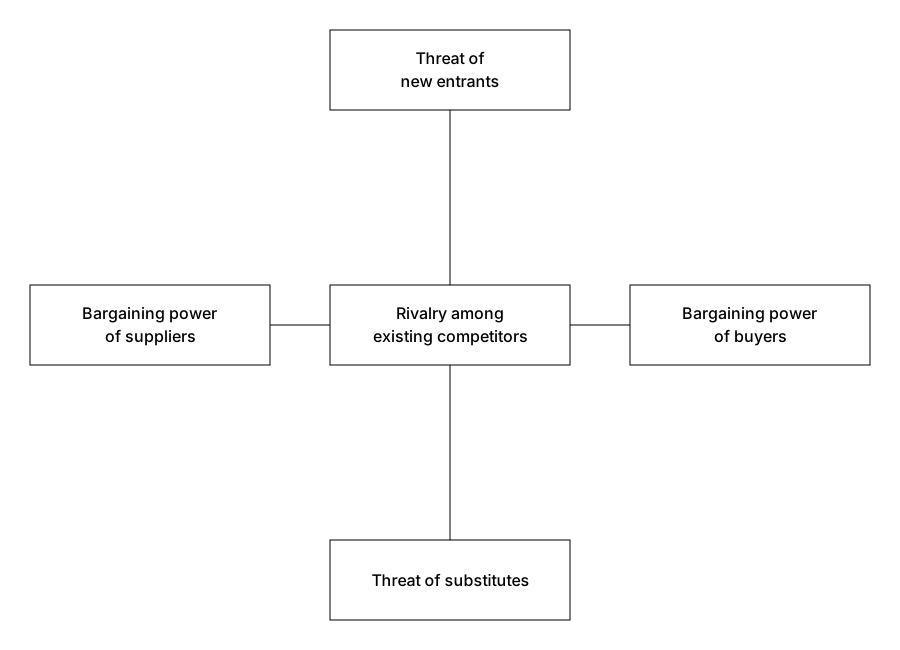
Porter's Five Forces maps how economic value is divided across Hunting and Trapping. The framework is useful because market growth alone does not determine attractiveness. A growing market can still produce weak returns if customers are concentrated, suppliers are scarce, rivals add capacity aggressively, entry is easy, or substitutes solve the same customer problem at lower total cost. The force that matters most can also change over time as regulation, technology and distribution shift.
Bargaining power of buyers
Buyer power is shaped by concentration, switching friction, procurement transparency and the consequences of failure. In this industry, large customers can often standardize requirements and compare providers, while smaller customers may depend more heavily on reputation or local availability. The strongest defense is a measurable customer outcome combined with integration, specialization, or service continuity that makes replacement costly. Management should monitor renewal behavior, rebid frequency, customer concentration and the share of revenue exposed to price-led procurement. The customer base for Hunting and Trapping includes hunters, trappers, outfitters, equipment brands, public agencies and conservation programs, but those buyers do not value the same attributes. Enterprise customers may prioritize integration, continuity, governance and predictable cost, while smaller customers may prioritize responsiveness and transparent pricing. Public-sector or regulated buyers add documentation and procurement requirements. Management should therefore measure economics by segment, contract type and cost to serve rather than using one blended margin. A segment with modest revenue can be strategically attractive if it has lower acquisition cost, better retention and a clearer path to pricing power.
Competitive advantage in Hunting and Trapping usually comes from a combination of mechanisms. Cost advantage matters where customers can compare standardized outputs, while differentiation matters when quality or failure risk is difficult to judge before purchase. Embedded workflows can increase switching costs, proprietary data can improve performance and controlled distribution can reduce customer acquisition cost. The strongest positions connect several of these mechanisms so that a rival cannot reproduce the full proposition by copying one feature or matching one price.
| Dimension | Executive implication | What to test |
|---|---|---|
| Customer concentration | Concentrated accounts can compress price | Revenue share, renewal terms, rebid rate |
| Switching friction | Embedded work reduces buyer mobility | Migration effort, retraining, integration |
| Price transparency | Comparable offers strengthen procurement | Benchmark availability, bid dispersion |
| Criticality | High failure cost supports provider leverage | Downtime, compliance, operational impact |
Bargaining power of suppliers
Supplier power increases when a critical input is scarce, differentiated, regulated, or difficult to qualify. Inputs can include talent, technology platforms, physical materials, infrastructure, licenses, intellectual property, or distribution access. The risk is greatest when a supplier can raise price or restrict capacity without creating an immediate alternative. Providers can reduce exposure through multi-sourcing, standardization, internal capability, or better demand planning. The right measure is not procurement spend alone, but the share of customer delivery that depends on an input with weak substitutes. The customer base for Hunting and Trapping includes hunters, trappers, outfitters, equipment brands, public agencies and conservation programs, but those buyers do not value the same attributes. Enterprise customers may prioritize integration, continuity, governance and predictable cost, while smaller customers may prioritize responsiveness and transparent pricing. Public-sector or regulated buyers add documentation and procurement requirements. Management should therefore measure economics by segment, contract type and cost to serve rather than using one blended margin. A segment with modest revenue can be strategically attractive if it has lower acquisition cost, better retention and a clearer path to pricing power.
Competitive advantage in Hunting and Trapping usually comes from a combination of mechanisms. Cost advantage matters where customers can compare standardized outputs, while differentiation matters when quality or failure risk is difficult to judge before purchase. Embedded workflows can increase switching costs, proprietary data can improve performance and controlled distribution can reduce customer acquisition cost. The strongest positions connect several of these mechanisms so that a rival cannot reproduce the full proposition by copying one feature or matching one price.
| Dimension | Executive implication | What to test |
|---|---|---|
| Input scarcity | Scarce inputs can constrain growth | Lead time, vacancy, qualified alternatives |
| Platform dependence | Critical platforms can capture economics | Fees, access rules, concentration |
| Specialist capability | Credentialed or rare skills can limit capacity | Hiring time, retention, utilization |
| Supply resilience | Alternative sources reduce disruption | Dual sourcing, inventory, substitution |
Rivalry among existing competitors
Rivalry determines how much of the available demand becomes economic profit. It intensifies when offerings are comparable, customers can switch easily, capacity is plentiful and fixed costs encourage providers to chase utilization. It weakens when firms own scarce capabilities, differentiated brands, proprietary data, strong distribution, or embedded workflows. Management should distinguish market growth from share growth and share growth from profitable share growth. A growing market can still be unattractive when every participant adds capacity faster than customer willingness to pay. The customer base for Hunting and Trapping includes hunters, trappers, outfitters, equipment brands, public agencies and conservation programs, but those buyers do not value the same attributes. Enterprise customers may prioritize integration, continuity, governance and predictable cost, while smaller customers may prioritize responsiveness and transparent pricing. Public-sector or regulated buyers add documentation and procurement requirements. Management should therefore measure economics by segment, contract type and cost to serve rather than using one blended margin. A segment with modest revenue can be strategically attractive if it has lower acquisition cost, better retention and a clearer path to pricing power.
Competitive advantage in Hunting and Trapping usually comes from a combination of mechanisms. Cost advantage matters where customers can compare standardized outputs, while differentiation matters when quality or failure risk is difficult to judge before purchase. Embedded workflows can increase switching costs, proprietary data can improve performance and controlled distribution can reduce customer acquisition cost. The strongest positions connect several of these mechanisms so that a rival cannot reproduce the full proposition by copying one feature or matching one price.
| Dimension | Executive implication | What to test |
|---|---|---|
| Fragmentation | More comparable providers can intensify price pressure | Market shares, competitor density |
| Capacity | Excess capacity can trigger discounting | Utilization, backlog, new capacity |
| Differentiation | Distinct outcomes reduce direct price comparison | Retention, premium pricing, win rate |
| Consolidation | Scale can improve cost and distribution | M&A activity, procurement leverage |
Threat of new entrants
Entry barriers arise from capital requirements, regulation, customer trust, network effects, installed workflows, proprietary knowledge and access to distribution. Digital tools can reduce some barriers by lowering initial fixed cost, while compliance and credibility can preserve others. A new entrant should identify the smallest customer problem that proves demand without requiring the entire incumbent operating model. Incumbents should watch for entrants that remove a bottleneck rather than replicate the established category. Those entrants can change the basis of competition before they become obvious scale competitors. The customer base for Hunting and Trapping includes hunters, trappers, outfitters, equipment brands, public agencies and conservation programs, but those buyers do not value the same attributes. Enterprise customers may prioritize integration, continuity, governance and predictable cost, while smaller customers may prioritize responsiveness and transparent pricing. Public-sector or regulated buyers add documentation and procurement requirements. Management should therefore measure economics by segment, contract type and cost to serve rather than using one blended margin. A segment with modest revenue can be strategically attractive if it has lower acquisition cost, better retention and a clearer path to pricing power.
Competitive advantage in Hunting and Trapping usually comes from a combination of mechanisms. Cost advantage matters where customers can compare standardized outputs, while differentiation matters when quality or failure risk is difficult to judge before purchase. Embedded workflows can increase switching costs, proprietary data can improve performance and controlled distribution can reduce customer acquisition cost. The strongest positions connect several of these mechanisms so that a rival cannot reproduce the full proposition by copying one feature or matching one price.
| Dimension | Executive implication | What to test |
|---|---|---|
| Capital barriers | High fixed investment slows entry | Capex, financing, payback period |
| Regulation | Licensing and compliance raise entry cost | Permits, certifications, audits |
| Trust and references | Customers may prefer proven providers | Reference requirements, switching risk |
| Technology | Cloud and automation can lower entry cost | Tool availability, deployment time |
Threat of substitutes
Substitutes solve the same customer problem through a different product, process, technology, supplier, or internal capability. The most dangerous substitute is often not a direct competitor but a cheaper or simpler way to achieve the desired outcome. Management should therefore track changes in customer workflows, not just competitor launches. Substitution pressure is manageable when the provider improves the total economics of the customer process, including reliability, switching cost, speed, compliance and risk. A narrow focus on feature parity can miss a change in the customer's underlying job to be done. The customer base for Hunting and Trapping includes hunters, trappers, outfitters, equipment brands, public agencies and conservation programs, but those buyers do not value the same attributes. Enterprise customers may prioritize integration, continuity, governance and predictable cost, while smaller customers may prioritize responsiveness and transparent pricing. Public-sector or regulated buyers add documentation and procurement requirements. Management should therefore measure economics by segment, contract type and cost to serve rather than using one blended margin. A segment with modest revenue can be strategically attractive if it has lower acquisition cost, better retention and a clearer path to pricing power.
Competitive advantage in Hunting and Trapping usually comes from a combination of mechanisms. Cost advantage matters where customers can compare standardized outputs, while differentiation matters when quality or failure risk is difficult to judge before purchase. Embedded workflows can increase switching costs, proprietary data can improve performance and controlled distribution can reduce customer acquisition cost. The strongest positions connect several of these mechanisms so that a rival cannot reproduce the full proposition by copying one feature or matching one price.
| Dimension | Executive implication | What to test |
|---|---|---|
| Internal capability | Customers can bring work in-house | Build cost, talent availability |
| Adjacent solution | Different products can solve the same job | Alternative workflows, adoption |
| Automation | Software can replace manual delivery | Automation rate, productivity |
| Channel shift | New channels can bypass incumbents | Direct share, platform dependency |
Value chain and profit pools
Upstream inputs in Hunting and Trapping include regulated hunting, trapping, wildlife management, equipment, licenses, guided services. Control matters when scarcity, qualification, reliability, or switching cost affects delivery. Providers should map which inputs can be standardized and which ones create exposure to supplier power.
Production or processing converts those inputs into the service or product customers buy. The central operating question is how much of the output can be standardized without reducing the value customers perceive. Repeatability can improve margin, but excessive standardization can erase the differentiation that supports price.
Distribution, customer interface and enabling infrastructure determine who owns demand. Direct channels provide customer data and control but carry acquisition costs; intermediated channels reduce reach costs but can capture part of the economics. Regulation, standards, finance and platforms can also become critical infrastructure.
The final link is measurement and renewal. Providers that prove outcomes can defend retention more effectively than providers that sell undifferentiated activity. Management should therefore connect delivery metrics to customer outcomes and use that evidence to refine pricing, segmentation and service design.2
Profit pool
Profit in Hunting and Trapping tends to concentrate where customers pay for scarce capability rather than raw activity. Management should separate revenue by type of work and identify which layer controls the customer decision.
Recurring relationships often produce better economics than one-off volume because acquisition costs are spread across the relationship and operating data improves delivery. The advantage disappears when renewal requires repeated discounting or heavy manual service.
Technology can move the profit pool when it makes a former bottleneck cheap. The firms that retain the benefit usually combine the new capability with differentiation, proprietary workflow, data, or distribution rather than selling the productivity gain as a commodity.
Consolidation can shift value toward scaled providers when purchasing, utilization, compliance, or distribution costs fall faster than pricing. Fragmentation can remain attractive where local knowledge, trust, specialist expertise, or geographic density create real switching friction.3
Industry economics and business models
Hunting and Trapping converts regulated hunting, trapping, wildlife management, equipment, licenses, guided services into outcomes customers can recognize and pay for. Its economics depend on how much of the work is standardized, how scarce the required capabilities are and who controls the customer relationship. Buyers typically compare a bundle of price, reliability, speed, compliance and service quality rather than a single product feature. That makes the industry structurally heterogeneous:
a specialist with strong retention can earn better returns than a larger generalist, while a scaled operator can still struggle if procurement turns the output into a commodity
The customer base for Hunting and Trapping includes hunters, trappers, outfitters, equipment brands, public agencies and conservation programs, but those buyers do not value the same attributes. Enterprise customers may prioritize integration, continuity, governance and predictable cost, while smaller customers may prioritize responsiveness and transparent pricing. Public-sector or regulated buyers add documentation and procurement requirements. Management should therefore measure economics by segment, contract type and cost to serve rather than using one blended margin. A segment with modest revenue can be strategically attractive if it has lower acquisition cost, better retention and a clearer path to pricing power.
Technology changes the production function when it removes a recurring bottleneck. In Hunting and Trapping, the relevant bottleneck may be planning, matching, documentation, scheduling, quality control, analysis, customer support, or asset utilization. When the same technology is available to every competitor, the benefit often flows to customers through lower prices. When technology is combined with proprietary data, workflow integration, specialized knowledge, or trusted distribution, the provider can retain more of the productivity gain. That distinction should shape investment priorities.
Regulation influences Hunting and Trapping through licensing, safety, privacy, labor rules, environmental requirements, procurement standards, or reporting obligations, depending on the segment. Compliance creates cost, but it can also create a moat when customers need credible evidence that a provider can operate within a defined regime. The effect is asymmetric because fixed compliance costs can favor scale while specialized compliance knowledge can open attractive niches. Operators should treat regulatory capability as part of commercial delivery, not as an isolated administrative function.4
Cost drivers & scalability
Hunting and Trapping converts regulated hunting, trapping, wildlife management, equipment, licenses, guided services into outcomes customers can recognize and pay for. Its economics depend on how much of the work is standardized, how scarce the required capabilities are and who controls the customer relationship. Buyers typically compare a bundle of price, reliability, speed, compliance and service quality rather than a single product feature. That makes the industry structurally heterogeneous:
a specialist with strong retention can earn better returns than a larger generalist, while a scaled operator can still struggle if procurement turns the output into a commodity
The customer base for Hunting and Trapping includes hunters, trappers, outfitters, equipment brands, public agencies and conservation programs, but those buyers do not value the same attributes. Enterprise customers may prioritize integration, continuity, governance and predictable cost, while smaller customers may prioritize responsiveness and transparent pricing. Public-sector or regulated buyers add documentation and procurement requirements. Management should therefore measure economics by segment, contract type and cost to serve rather than using one blended margin. A segment with modest revenue can be strategically attractive if it has lower acquisition cost, better retention and a clearer path to pricing power.
Technology changes the production function when it removes a recurring bottleneck. In Hunting and Trapping, the relevant bottleneck may be planning, matching, documentation, scheduling, quality control, analysis, customer support, or asset utilization. When the same technology is available to every competitor, the benefit often flows to customers through lower prices. When technology is combined with proprietary data, workflow integration, specialized knowledge, or trusted distribution, the provider can retain more of the productivity gain. That distinction should shape investment priorities.
Regulation influences Hunting and Trapping through licensing, safety, privacy, labor rules, environmental requirements, procurement standards, or reporting obligations, depending on the segment. Compliance creates cost, but it can also create a moat when customers need credible evidence that a provider can operate within a defined regime. The effect is asymmetric because fixed compliance costs can favor scale while specialized compliance knowledge can open attractive niches. Operators should treat regulatory capability as part of commercial delivery, not as an isolated administrative function.5
Moats, advantages and strategic levers
Hunting and Trapping converts regulated hunting, trapping, wildlife management, equipment, licenses, guided services into outcomes customers can recognize and pay for. Its economics depend on how much of the work is standardized, how scarce the required capabilities are and who controls the customer relationship. Buyers typically compare a bundle of price, reliability, speed, compliance and service quality rather than a single product feature. That makes the industry structurally heterogeneous:
a specialist with strong retention can earn better returns than a larger generalist, while a scaled operator can still struggle if procurement turns the output into a commodity
The customer base for Hunting and Trapping includes hunters, trappers, outfitters, equipment brands, public agencies and conservation programs, but those buyers do not value the same attributes. Enterprise customers may prioritize integration, continuity, governance and predictable cost, while smaller customers may prioritize responsiveness and transparent pricing. Public-sector or regulated buyers add documentation and procurement requirements. Management should therefore measure economics by segment, contract type and cost to serve rather than using one blended margin. A segment with modest revenue can be strategically attractive if it has lower acquisition cost, better retention and a clearer path to pricing power.
Technology changes the production function when it removes a recurring bottleneck. In Hunting and Trapping, the relevant bottleneck may be planning, matching, documentation, scheduling, quality control, analysis, customer support, or asset utilization. When the same technology is available to every competitor, the benefit often flows to customers through lower prices. When technology is combined with proprietary data, workflow integration, specialized knowledge, or trusted distribution, the provider can retain more of the productivity gain. That distinction should shape investment priorities.
Regulation influences Hunting and Trapping through licensing, safety, privacy, labor rules, environmental requirements, procurement standards, or reporting obligations, depending on the segment. Compliance creates cost, but it can also create a moat when customers need credible evidence that a provider can operate within a defined regime. The effect is asymmetric because fixed compliance costs can favor scale while specialized compliance knowledge can open attractive niches. Operators should treat regulatory capability as part of commercial delivery, not as an isolated administrative function.6
Strategic levers
Hunting and Trapping converts regulated hunting, trapping, wildlife management, equipment, licenses, guided services into outcomes customers can recognize and pay for. Its economics depend on how much of the work is standardized, how scarce the required capabilities are and who controls the customer relationship. Buyers typically compare a bundle of price, reliability, speed, compliance and service quality rather than a single product feature. That makes the industry structurally heterogeneous:
a specialist with strong retention can earn better returns than a larger generalist, while a scaled operator can still struggle if procurement turns the output into a commodity
The customer base for Hunting and Trapping includes hunters, trappers, outfitters, equipment brands, public agencies and conservation programs, but those buyers do not value the same attributes. Enterprise customers may prioritize integration, continuity, governance and predictable cost, while smaller customers may prioritize responsiveness and transparent pricing. Public-sector or regulated buyers add documentation and procurement requirements. Management should therefore measure economics by segment, contract type and cost to serve rather than using one blended margin. A segment with modest revenue can be strategically attractive if it has lower acquisition cost, better retention and a clearer path to pricing power.
Technology changes the production function when it removes a recurring bottleneck. In Hunting and Trapping, the relevant bottleneck may be planning, matching, documentation, scheduling, quality control, analysis, customer support, or asset utilization. When the same technology is available to every competitor, the benefit often flows to customers through lower prices. When technology is combined with proprietary data, workflow integration, specialized knowledge, or trusted distribution, the provider can retain more of the productivity gain. That distinction should shape investment priorities.
Regulation influences Hunting and Trapping through licensing, safety, privacy, labor rules, environmental requirements, procurement standards, or reporting obligations, depending on the segment. Compliance creates cost, but it can also create a moat when customers need credible evidence that a provider can operate within a defined regime. The effect is asymmetric because fixed compliance costs can favor scale while specialized compliance knowledge can open attractive niches. Operators should treat regulatory capability as part of commercial delivery, not as an isolated administrative function.
Structural risks, regulation and trends
Hunting and Trapping converts regulated hunting, trapping, wildlife management, equipment, licenses, guided services into outcomes customers can recognize and pay for. Its economics depend on how much of the work is standardized, how scarce the required capabilities are and who controls the customer relationship. Buyers typically compare a bundle of price, reliability, speed, compliance and service quality rather than a single product feature. That makes the industry structurally heterogeneous:
a specialist with strong retention can earn better returns than a larger generalist, while a scaled operator can still struggle if procurement turns the output into a commodity
The customer base for Hunting and Trapping includes hunters, trappers, outfitters, equipment brands, public agencies and conservation programs, but those buyers do not value the same attributes. Enterprise customers may prioritize integration, continuity, governance and predictable cost, while smaller customers may prioritize responsiveness and transparent pricing. Public-sector or regulated buyers add documentation and procurement requirements. Management should therefore measure economics by segment, contract type and cost to serve rather than using one blended margin. A segment with modest revenue can be strategically attractive if it has lower acquisition cost, better retention and a clearer path to pricing power.
Technology changes the production function when it removes a recurring bottleneck. In Hunting and Trapping, the relevant bottleneck may be planning, matching, documentation, scheduling, quality control, analysis, customer support, or asset utilization. When the same technology is available to every competitor, the benefit often flows to customers through lower prices. When technology is combined with proprietary data, workflow integration, specialized knowledge, or trusted distribution, the provider can retain more of the productivity gain. That distinction should shape investment priorities.
Regulation influences Hunting and Trapping through licensing, safety, privacy, labor rules, environmental requirements, procurement standards, or reporting obligations, depending on the segment. Compliance creates cost, but it can also create a moat when customers need credible evidence that a provider can operate within a defined regime. The effect is asymmetric because fixed compliance costs can favor scale while specialized compliance knowledge can open attractive niches. Operators should treat regulatory capability as part of commercial delivery, not as an isolated administrative function.
Strategic playbook
Hunting and Trapping converts regulated hunting, trapping, wildlife management, equipment, licenses, guided services into outcomes customers can recognize and pay for. Its economics depend on how much of the work is standardized, how scarce the required capabilities are and who controls the customer relationship. Buyers typically compare a bundle of price, reliability, speed, compliance and service quality rather than a single product feature. That makes the industry structurally heterogeneous:
a specialist with strong retention can earn better returns than a larger generalist, while a scaled operator can still struggle if procurement turns the output into a commodity
The customer base for Hunting and Trapping includes hunters, trappers, outfitters, equipment brands, public agencies and conservation programs, but those buyers do not value the same attributes. Enterprise customers may prioritize integration, continuity, governance and predictable cost, while smaller customers may prioritize responsiveness and transparent pricing. Public-sector or regulated buyers add documentation and procurement requirements. Management should therefore measure economics by segment, contract type and cost to serve rather than using one blended margin. A segment with modest revenue can be strategically attractive if it has lower acquisition cost, better retention and a clearer path to pricing power.
Technology changes the production function when it removes a recurring bottleneck. In Hunting and Trapping, the relevant bottleneck may be planning, matching, documentation, scheduling, quality control, analysis, customer support, or asset utilization. When the same technology is available to every competitor, the benefit often flows to customers through lower prices. When technology is combined with proprietary data, workflow integration, specialized knowledge, or trusted distribution, the provider can retain more of the productivity gain. That distinction should shape investment priorities.
Regulation influences Hunting and Trapping through licensing, safety, privacy, labor rules, environmental requirements, procurement standards, or reporting obligations, depending on the segment. Compliance creates cost, but it can also create a moat when customers need credible evidence that a provider can operate within a defined regime. The effect is asymmetric because fixed compliance costs can favor scale while specialized compliance knowledge can open attractive niches. Operators should treat regulatory capability as part of commercial delivery, not as an isolated administrative function.
Caselet
Bass Pro Shops provides a useful lens on the operating logic of Hunting and Trapping. Its development shows how a participant can build scale while adapting its position in the value chain as customer expectations, technology, regulation and distribution change. The case should not be treated as a proxy for the whole industry. Its value is that operating choices make abstract forces visible.
The company's growth illustrates the economics of repeatability. As demand expands, the operator must add capacity without allowing service quality or unit cost to deteriorate. That tension appears throughout Hunting and Trapping: scale can create purchasing, utilization, data, or brand benefits, but scale also adds coordination and fixed costs. The relevant question is whether the next unit of revenue requires proportionally less cost than the last.
Customer interface ownership also matters. A provider that controls demand learns from preferences, renewal behavior, service failures and willingness to pay. Those signals can improve product design and operating decisions, creating a feedback loop. The loop is strongest when customer data feeds a workflow that improves service and produces evidence of better outcomes.
Technology changes the mix of routine work and expert judgment. Automation can reduce repetitive activity while increasing the value of exceptions that require context. A strong operator separates these tasks and redesigns the workflow around them instead of treating automation as a headcount program. The same principle applies to procurement, compliance, analytics and customer support.
Regulation and stakeholder expectations can reshape economics even when demand is stable. Compliance costs may rise, but established providers can use documented processes, credentials and auditability as barriers to entry. This makes regulatory capability a commercial asset when customers need proof of reliability or lawful operation.
The case also demonstrates the limits of scale. Growth can improve bargaining power and spread fixed cost, but it can expose the business to complex procurement, broader service requirements and operational risk. Investors should examine customer-level contribution, renewal quality, capacity utilization, supplier dependency and the proportion of advantage that comes from assets or rules competitors cannot easily reproduce.
Hunting and Trapping is economically diverse because the value chain combines regulated hunting, trapping, wildlife management, equipment, licenses, guided services. The strongest profit pools usually sit where providers control scarce capability, recurring customer access, differentiated IP or data, or infrastructure that becomes more efficient with scale. New entrants should use a narrow wedge, partner around hard-to-build infrastructure and expand only after retention and contribution economics are visible. Incumbents should defend their customer interface, automate repeatable work and invest selectively in assets or capabilities that competitors cannot buy as easily. The strategic levers are segment focus, workflow integration, pricing discipline, operating leverage and deliberate control of the resources that shape customer outcomes.
Citation
Cite this article
Sridharan, M. A. (2022, January 27). Industry Analysis: Hunting and Trapping. Think Insights. https://thinkinsights.net/insights/industry-analysis-hunting-and-trapping (Accessed [[ACCESS_DATE]])
Sridharan, Mithun A. "Industry Analysis: Hunting and Trapping." Think Insights, 27 Jan. 2022, https://thinkinsights.net/insights/industry-analysis-hunting-and-trapping. Accessed [[ACCESS_DATE]].
Mithun A. Sridharan, "Industry Analysis: Hunting and Trapping," Think Insights, January 27, 2022, https://thinkinsights.net/insights/industry-analysis-hunting-and-trapping. Accessed [[ACCESS_DATE]].
Sridharan, M.A. (2022) 'Industry Analysis: Hunting and Trapping', Think Insights. Available at: https://thinkinsights.net/insights/industry-analysis-hunting-and-trapping (Accessed: [[ACCESS_DATE]]).
M. A. Sridharan, "Industry Analysis: Hunting and Trapping," Think Insights, 2022. [Online]. Available: https://thinkinsights.net/insights/industry-analysis-hunting-and-trapping. [Accessed: [[ACCESS_DATE]]].
Sridharan MA. Industry Analysis: Hunting and Trapping. Think Insights. Published January 27, 2022. Accessed [[ACCESS_DATE]]. https://thinkinsights.net/insights/industry-analysis-hunting-and-trapping
Test Your Knowledge
Industry Analysis: Hunting and Trapping
Challenge yourself on the concepts from this article and see how well you understood them.
Subscribers get weekly quizzes and insights — subscribe free
Sponsor this article
Partner with Think Insights
Reach 50,000+ business leaders, consultants, and strategists. Feature your brand alongside expert articles on strategy, leadership, and digital transformation.
Become a Sponsor