Philippine Casino Tech Business Models


The Philippines has become Southeast Asia's largest gaming market, built on business model choices as much as luck. Operators blend platform licensing, affiliate marketing and proprietary technology to reach a mobile-first population spread across thousands of islands. Cloud infrastructure and artificial intelligence [AI] personalize player experience, while e-wallets and blockchain settle payments instantly and transparently. Bloomberry Resorts, operator of Solaire Resort in Manila, shows how an integrated resort group builds a hybrid model spanning premium floor gaming and licensed online platforms. A permanent ban on offshore gaming operators has forced the wider industry to rebuild around compliant, locally hosted technology. What follows examines the models and infrastructure driving this shift and how Bloomberry puts them into practice at Solaire.
What makes Philippine casino tech distinct in Southeast Asia?
Mobile penetration, an established gaming culture and flexible licensing rules let operators combine land-based resorts with online platforms faster than in neighboring markets. Local companies also mix revenue models, from house edge on table games to subscription-based platform fees, more aggressively than operators elsewhere in the region.
How do platform licensing models help smaller operators compete?
A licensed, ready-made platform gives a smaller brand certified games, payment integrations and security features without the cost of building them from scratch. This shortens time to market and lets the operator concentrate spending on branding, customer acquisition and retention instead of infrastructure.
What effect has the offshore gaming ban had on technology strategy?
The ban on offshore gaming operators pushed companies to rebuild around domestically licensed platforms rather than cross-border operations. Operators now invest more in locally hosted infrastructure, compliance tooling and player verification systems to meet stricter oversight from regulators.
A Market Built On Digital-First Habits
The Philippines has grown into one of Southeast Asia's largest gaming markets and casino technology sits at the center of that growth. Widespread smartphone ownership, affordable mobile data and a deep-rooted gaming culture created demand that land-based venues alone could not satisfy. Operators responded by building platforms that reach players wherever they are, not only on a casino floor. Revenue from the country's online gambling operations has climbed sharply over the past several years, outpacing growth in most neighboring markets.1
The competition between licensed domestic platforms and offshore brands has pushed operators to keep improving interface design, payment options and game selection. That competitive pressure, more than any single technology, explains why the market keeps innovating.
Platform Licensing Lowers The Barrier To Entry
Software-as-a-service (SaaS) platforms let smaller operators launch casino products without building infrastructure from the ground up. A vendor licenses a tested platform complete with game libraries, payment integrations and security features and the operator focuses on branding, marketing and customer service. Operators offering these platforms domestically must still hold a license from the Philippine Amusement and Gaming Corporation [PAGCOR], which sets the technical and security standards a platform must meet before launch.2
This arrangement suits a market with dozens of small and mid-sized brands competing for the same players. For the technology vendor, licensing creates recurring subscription revenue instead of one-off sales, which is why so many platform providers have entered the Philippine market over the past decade.
Affiliate Networks Extend Reach Without Overhead
Affiliate marketing remains one of the most efficient ways operators acquire players. Through revenue-sharing agreements, affiliates earn a share of the income generated by the players they refer, which aligns their incentives directly with operator performance. This structure lets operators expand into new regions without hiring large in-house marketing teams or committing to fixed advertising budgets.
Volume from referred players matters more than the size of any single campaign
Affiliates, in turn, specialize in content, comparison sites and social media promotion tailored to specific player segments. The result is a distribution layer that scales with performance rather than headcount, which matters in a market where customer acquisition costs can rise quickly.
From Casino Floors To Licensed Online Platforms
Land-based casino operators have not stood still while digital-first brands captured new players. Integrated resorts increasingly extend their existing gaming licenses into online products, treating the internet as another channel rather than a competitor. PAGCOR approved Bloomberry Resorts' Solaire brand to accept online bets in 2020, an early example of a licensed resort operator moving its VIP relationships onto a digital platform.3
That shift matters because it lets resort operators retain existing customer relationships while reducing dependence on foot traffic and travel patterns that can change quickly, as the industry learned during pandemic-era travel restrictions.
Cloud, AI And Payments Behind The Screen
Cloud infrastructure gives operators the flexibility to handle uneven traffic without maintaining costly servers year-round. Demand spikes around holidays, sporting events and promotions and cloud-based systems scale up and down to match that pattern. This flexibility matters more in the Philippines than in mature markets, where user growth is still accelerating rather than leveling off.
Artificial intelligence [AI] tools now analyze player behavior to personalize game recommendations, flag unusual betting patterns and support responsible gambling checks. Combined with e-wallets, instant bank transfers and, increasingly, blockchain-based settlement, these systems let operators process transactions quickly while building the trust that keeps players returning. Bloomberry's own cost base illustrates the trade-off: expenses tied to its online platform rose sharply in 2025 even as the company worked to make that platform competitive.4
Regulation Redraws The Map
The Philippine casino tech sector operates inside a regulatory environment that has changed more in the past two years than in the previous decade. Different licensing rules for domestic and offshore operators, along with shifting compliance demands, made cross-border expansion difficult even before the latest reforms. President Ferdinand Marcos signed the Anti-POGO Act in October 2025, permanently banning offshore gaming operators and canceling their licenses.5
That single change forced technology providers and operators alike to rebuild around domestic licensing, tighter player verification and locally hosted infrastructure. Businesses now need to weigh growth ambitions against legal and reputational risk more carefully than the sector's earlier, faster-moving years allowed.
Bloomberry And Solaire Put The Model To Work
Bloomberry Resorts operates Solaire Resort Entertainment City in Paranaque and Solaire Resort North in Quezon City, the two flagship properties behind its casino and hospitality business.6 The company built its model around premium floor gaming, hotel and entertainment revenue and, more recently, a licensed domestic online platform meant to extend the same customer relationships into mobile play.
That online push has not been cheap. Softer VIP volume and rising online costs pulled Bloomberry to a net loss in 2025, even as its newer Solaire North property and non-gaming revenue grew. Company leadership has framed the online investment as a long-term bet rather than a quick win.
In the online segment, we remain confident in the long-term opportunity as we await greater regulatory clarity and continue strengthening the competitiveness and user experience of our digital platforms. — Enrique Razon Jr., Bloomberry Resorts chair and CEO
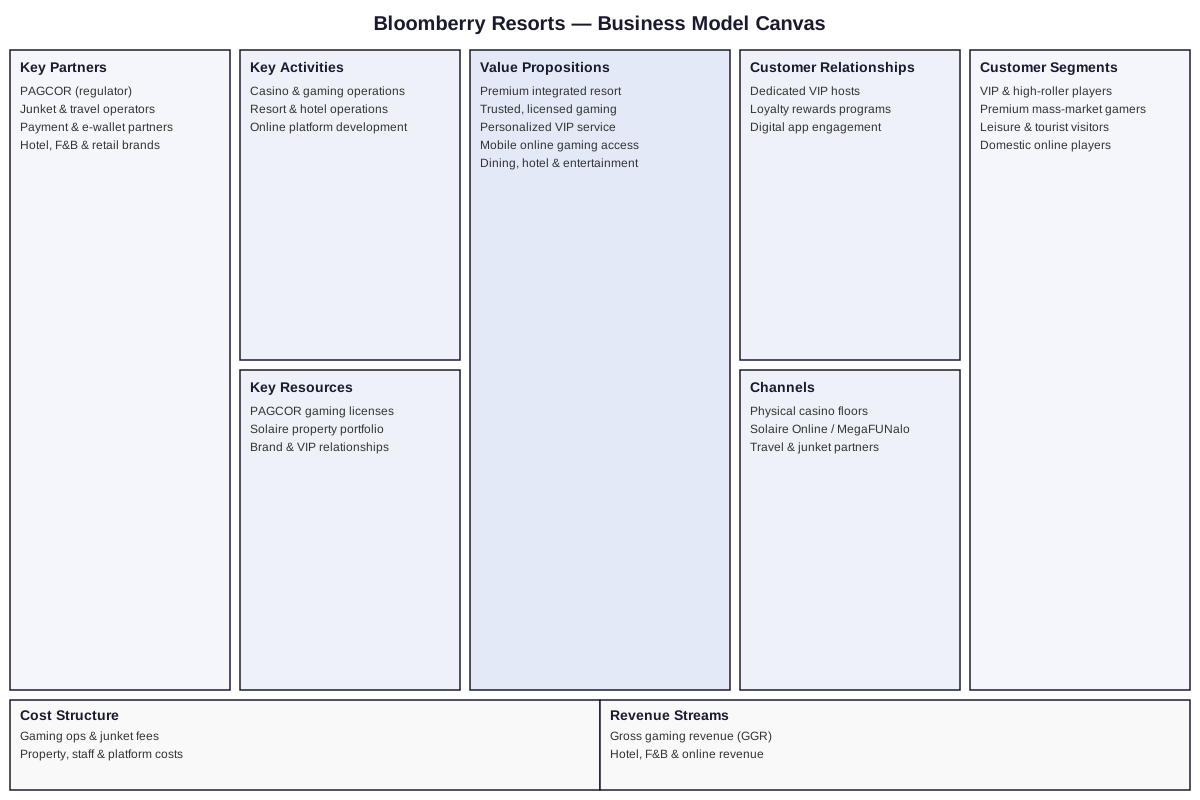
The nine sections below break down how Bloomberry and Solaire structure that model across the building blocks of the business model canvas.
Key Partners
Bloomberry relies on the Philippine Amusement and Gaming Corporation [PAGCOR] as its regulator and license issuer, a relationship that shapes every product decision. Junket and travel operators bring high-value players to the VIP floor, while payment processors and e-wallet providers keep transactions fast and compliant on-property and online. Retail, dining and entertainment brands operating inside Solaire round out a network that keeps guests on-site longer.
Key Activities
Running Solaire means operating table games, electronic gaming machines and a full resort simultaneously, from casino floor management to hotel and event operations. Bloomberry also builds and maintains its own online gaming platforms rather than outsourcing that work entirely, following its stated push toward proprietary technology. Compliance monitoring, player verification and responsible gambling checks run continuously across both physical and digital channels.
Key Resources
Solaire's value starts with its PAGCOR gaming licenses, which few competitors can easily replicate given how tightly the regulator controls new licensing. The physical property portfolio, including two large integrated resorts in Metro Manila, represents years of capital investment that a new entrant could not quickly match. Equally important are the brand and the VIP relationships built over more than a decade of operation.
Value Propositions
Solaire offers a premium, fully integrated resort experience that pairs licensed, trustworthy gaming with hotel, dining and entertainment under one roof. VIP players get a personalized, host-driven experience built around trust and discretion, while mass-market visitors get a broader mix of games and amenities. The addition of a licensed mobile platform extends that same value proposition to players who want to wager without visiting the property.
Customer Relationships
Bloomberry maintains close, host-driven relationships with its VIP segment, built on personal attention, credit arrangements and tailored perks. Mass-market and leisure guests interact more through loyalty and rewards programs that reward repeat visits and spending. Its newer online platforms add a digital layer of engagement, using apps and account-based tools to keep players connected between property visits.
Channels
The primary channel remains the physical casino floor and resort itself, where most gaming revenue is still generated. Licensed online platforms extend that reach to players who wager from home or on mobile devices. Travel agencies and junket partners also function as a channel, funneling VIP players from the region directly into Solaire's premium gaming areas.
Customer Segments
Solaire's business spans several distinct groups: VIP and high-roller players who generate outsized gaming revenue, premium mass-market gamers who represent steadier volume and leisure or tourist visitors drawn by the resort experience. A newer segment, domestic online players, has emerged as Bloomberry extends its licensed gaming brand onto mobile and web platforms.
Cost Structure
Gaming operations carry significant costs, including junket commissions and the expenses of running VIP programs during periods of soft demand. Property costs, staffing across two large resorts and technology spending on its online platforms add further fixed and variable expense. Rising online platform costs were a specific driver of Bloomberry's profitability decline in 2025.
Revenue Streams
Gross gaming revenue [GGR] from VIP and mass-market tables and electronic gaming machines remains Bloomberry's largest revenue source. Non-gaming revenue from hotels, restaurants, retail and entertainment has grown as a share of the total, cushioning swings in gaming demand. Its licensed online platform adds a newer, smaller revenue stream that management expects to scale as regulatory clarity improves.
Philippine casino technology keeps evolving because its underlying business models reward flexibility. Platform licensing lowers the cost of entry, affiliate networks convert traffic into revenue and cloud systems let operators absorb demand spikes without overbuilding capacity. Bloomberry's experience at Solaire Resort shows both the opportunity and the strain: online expansion adds cost before it adds durable profit and regulatory tightening can erase gains as quickly as it creates them. Companies that treat technology as a compliance requirement rather than a growth lever risk falling behind operators that invest in proprietary platforms, localized payments and player analytics. The next phase of growth depends on how well operators balance premium, on-property experiences with scalable digital products, under a regulator that is still redefining its own role in the market.
Citation
Cite this article
Sridharan, M. A. (2020, November 15). Philippine Casino Tech Business Models. Think Insights. https://thinkinsights.net/strategy/philippine-casino-tech-business-models (Accessed [[ACCESS_DATE]])
Sridharan, Mithun A. "Philippine Casino Tech Business Models." Think Insights, 15 Nov. 2020, https://thinkinsights.net/strategy/philippine-casino-tech-business-models. Accessed [[ACCESS_DATE]].
Mithun A. Sridharan, "Philippine Casino Tech Business Models," Think Insights, November 15, 2020, https://thinkinsights.net/strategy/philippine-casino-tech-business-models. Accessed [[ACCESS_DATE]].
Sridharan, M.A. (2020) 'Philippine Casino Tech Business Models', Think Insights. Available at: https://thinkinsights.net/strategy/philippine-casino-tech-business-models (Accessed: [[ACCESS_DATE]]).
M. A. Sridharan, "Philippine Casino Tech Business Models," Think Insights, 2020. [Online]. Available: https://thinkinsights.net/strategy/philippine-casino-tech-business-models. [Accessed: [[ACCESS_DATE]]].
Sridharan MA. Philippine Casino Tech Business Models. Think Insights. Published November 15, 2020. Accessed [[ACCESS_DATE]]. https://thinkinsights.net/strategy/philippine-casino-tech-business-models
Test Your Knowledge
Philippine Casino Tech Business Models
Challenge yourself on the concepts from this article and see how well you understood them.
Subscribers get weekly quizzes and insights — subscribe free
Sponsor this article
Partner with Think Insights
Reach 50,000+ business leaders, consultants, and strategists. Feature your brand alongside expert articles on strategy, leadership, and digital transformation.
Become a Sponsor