The MoviePass Pricing Collapse


MoviePass promised unlimited movie theater visits for a flat monthly fee and for a few months in 2017 it looked like a genuine disruptor of movie ticketing. Founded by Stacy Spikes in 2011, the subscription card spent its first years fighting theater chains that refused to honor it. New owner Helios & Matheson then cut the price to $9.95 a month, chasing subscriber growth and data value instead of profit. Membership passed three million, losses mounted into the hundreds of millions and the company throttled heavy users, delayed cards and pivoted toward film financing before collapsing into Chapter 7 bankruptcy in January 2020. Spikes bought the brand back in 2021 and relaunched it in 2022 with usage caps and city-based pricing built to avoid the earlier mistakes. This case shows what happens when a subscription business chases volume over unit economics.
Why did MoviePass fail
MoviePass failed because its pricing did not cover its costs. At $9.95 a month, the company paid theaters close to full ticket price for every visit while collecting a fraction of that from subscribers and no secondary revenue stream, whether data sales or film financing, closed the gap fast enough.
Who owns MoviePass now
Stacy Spikes, MoviePass's original founder, owns the company today. He bought the brand and customer records out of the 2020 bankruptcy in 2021 and has run the relaunched version since 2022, this time with credit-based pricing instead of unlimited access.
Is MoviePass still available in 2026
Yes, MoviePass operates as a private company offering tiered monthly movie credits alongside Mogul, a prediction-market game tied to box office and awards outcomes. It has reported profitable results since 2023, a contrast with the unprofitable growth phase that ended in its 2020 bankruptcy.
Founding a Flat-Fee Cinema Pass
Stacy Spikes founded MoviePass in 2011 with a simple pitch: pay one monthly fee and watch as many movies as you want in a theater. The beta launched in San Francisco that July, charging members between $29 and $34 a month, depending on their city, for one ticket a day. Each subscriber received a Mastercard-branded debit card linked to the app, so a purchase at the box office drew from the subscription balance rather than a personal bank account. Spikes pitched the idea as a way to modernize an industry that had barely touched its pricing model since the multiplex era began.
Winning Over a Reluctant Industry
Nearly 20,000 people signed up on the first day of the pilot, but MoviePass had not secured cooperation from theater chains before launch and many simply refused the card at the register. A second version in 2012 fared no better against the largest networks, which viewed subscription pricing as a threat to full-price ticket sales. Attendance kept declining industry-wide and by December 2014 AMC relented and agreed to a limited partnership after years of resistance. That truce gave MoviePass its first real foothold in major theaters, three years after it opened for business.1
The $9.95 Gamble
In August 2017, new owner Helios & Matheson cut the price to a single $9.95 monthly plan, betting that volume and data would matter more than what each subscriber paid. The response was immediate: 150,000 people signed up within two days and the subscriber base passed a million within four months. AMC broke ties again, calling the price unsustainable and warning that MoviePass would lose money on any member who saw more than two movies a month. That warning proved accurate, since the company paid theaters close to full ticket price while collecting less than $10 from each member.2
Data as the Real Product
Helios & Matheson's strategy depended on subscriber data, covering location, viewing frequency and preferences, becoming valuable enough to offset the losses from ticket subsidies. To manage cash burn without admitting the price was wrong, the company changed usage rules constantly, at times allowing a movie a day and at other times capping access at three a month. Regulators later found that MoviePass had gone further, using so-called trip wires to invalidate the passwords of subscribers who watched too many movies, blocking as many as 75,000 people from a service they had already paid for. That practice, along with storing personal data in plain text, became the basis of a Federal Trade Commission (FTC) complaint years after the company collapsed.3
The Collapse
Subscribers were leaving faster than new ones joined by 2018 and Helios & Matheson posted losses in the hundreds of millions of dollars. MoviePass tried to pivot into film financing and production, taking equity stakes in movies it hoped would benefit from its subscriber base, but that effort never generated meaningful revenue. Theater chains that had once resisted the concept now offered their own versions, AMC Stubs A-List and Regal Unlimited among them, competing directly for the same customers. Active membership fell from roughly three million at its peak to about 225,000 by July 2019, when the company suspended service and by January 2020 Helios & Matheson had filed for Chapter 7 bankruptcy.4
A Cautious Second Act
Spikes, who had been pushed out of the company in 2018, bought the MoviePass brand and customer list out of bankruptcy in 2021 for roughly $140,000. He relaunched the service in 2022 with tiered monthly credits priced by city instead of a single unlimited plan, a structural fix aimed directly at the cash-burn problem that sank the original version. Members now choose a credit allowance sized to what the company can afford to reimburse theaters, rather than paying a flat fee for unlimited visits. The FTC settlement tied to the earlier company also left the new venture under pressure to handle subscriber data more carefully than its predecessor did.5
Where MoviePass Stands Today
The relaunched company reported its first profitable year in 2023 and stayed profitable in 2024, a result Spikes attributes to pricing credits closer to what theaters actually charge rather than chasing subscriber volume. MoviePass added Mogul by 2026, a prediction-market game built around box office results and awards outcomes, as a second product alongside the core subscription. The two businesses together generate roughly $14 million in annual recurring revenue, a fraction of the scale the original company reached but built on a model designed to sustain itself. Whether Mogul becomes a meaningful revenue stream or stays a marketing hook, the underlying subscription business now reflects the unit economics the 2017 version ignored.6
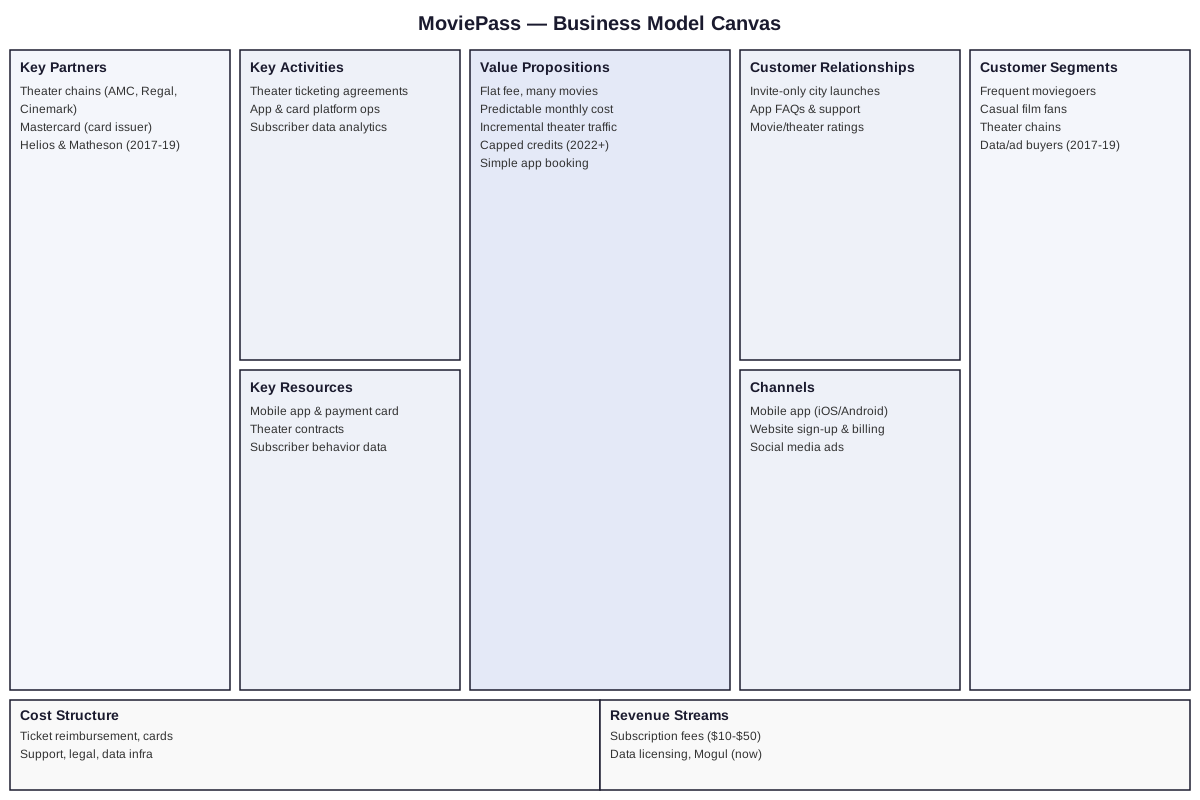
Key Partners
MoviePass depended on movie theater chains such as AMC, Regal and Cinemark to accept its card at the box office, a relationship it had to rebuild after early rejections. Mastercard issued and processed payments on the linked debit card that powered every ticket purchase. Parent company Helios & Matheson supplied capital and set pricing strategy during the 2017-2019 growth phase. After the 2022 relaunch, the company works with independent theater partners and outside financiers backing the Mogul platform.
Key Activities
Running MoviePass meant negotiating box-office agreements theater by theater, since no national ticketing standard covered subscription resale. The company operated a mobile app and card network that verified location, released tickets and processed payments in real time. Customer support handled a high volume of billing disputes as pricing and usage rules changed repeatedly. Collecting and analyzing subscriber viewing data became a core activity once Helios & Matheson took control.
Key Resources
The mobile app and payment card formed the operational backbone, letting subscribers convert a flat fee into a ticket at any participating theater. Contracts with theater chains determined which screens honored the card and at what markup. Subscriber behavior data, covering viewing frequency, location and film preference, became the resource investors valued most after 2017. Brand recognition built during the service's cult following later helped Spikes relaunch the company out of bankruptcy.
Value Propositions
For subscribers, MoviePass offered a flat monthly fee for unlimited or near-unlimited theater visits, replacing per-ticket pricing with one predictable charge. That shifted ticket-price risk onto the company itself, which paid theaters full price while collecting a fraction of that amount from members. For theaters, MoviePass promised incremental foot traffic and concession sales from moviegoers who might otherwise stay home. The 2022 relaunch narrowed this proposition to a sustainable credit allowance instead of unlimited access.
Customer Relationships
Early access ran through invite-only city launches that built anticipation ahead of national rollout. Ongoing relationships depended on a mobile app, FAQs and customer support fielding constant questions as plans changed. A rating system let members review theaters and films, encouraging engagement beyond ticket purchases. Those relationships frayed as pricing and usage rules shifted with little warning during the service's final years.
Channels
The primary channel was the MoviePass mobile app, available through Apple's App Store and Google Play, paired with a physical debit card for in-theater use. The company's website handled sign-ups, billing and plan changes. Social media and paid advertising drove subscriber acquisition during the 2017 growth push. Word of mouth around the near-implausible price point became its own unpaid channel for a period.
Customer Segments
The core segment was frequent moviegoers who watched enough films monthly to make a flat fee worthwhile. Film enthusiasts and casual viewers drawn in by the low headline price broadened that base quickly after 2017. Movie theaters and distributors counted as a secondary segment, benefiting from incremental attendance and, eventually, licensing of subscriber data. That data itself effectively became a product for advertisers and analytics buyers once Helios & Matheson prioritized it.
Cost Structure
The dominant cost was reimbursing theaters at or near full ticket price for every visit a subscriber made, regardless of the discounted subscription fee collected. Card issuance and transaction fees, customer service staffing and app development added ongoing overhead. Legal and administrative costs grew as pricing disputes, lawsuits and eventually the FTC investigation accumulated. Data infrastructure to collect, store and analyze subscriber activity became a meaningful expense once that data became the company's stated strategic asset.
Revenue Streams
Subscription fees, ranging from about $10 to $50 a month depending on the era and city, were the primary revenue source. Sale and licensing of subscriber viewing and location data became a second stream once Helios & Matheson took control in 2017. The company also explored revenue from co-financing films and from advertising placed inside the app. Under the 2022 relaunch, revenue comes from tiered monthly credits sized to match what the company can profitably reimburse theaters.
- 1AMC agreed to a MoviePass partnership in December 2014
- 2MoviePass added 150,000 subscribers within two days of its price cut
- 3The FTC alleged MoviePass blocked heavy users from the service
- 4MoviePass parent Helios & Matheson filed for Chapter 7 bankruptcy
- 5Stacy Spikes bought MoviePass out of bankruptcy and relaunched it in 2022
- 6MoviePass reported profitable results in 2023 and 2024 after its relaunch
MoviePass remains one of the clearest lessons in subscription economics available to strategists. The original team proved that consumers wanted flexible access to theaters, but pricing below marginal cost only works with a credible plan to monetize volume elsewhere and MoviePass never built one. Helios & Matheson chased subscriber counts and data revenue while ticket subsidies drained cash faster than any funding round could replace it. The Federal Trade Commission's later findings, that the company blocked heavy users instead of fixing its unit economics, confirmed the model was untenable well before bankruptcy. Stacy Spikes' 2022 relaunch, with capped monthly credits and city-tiered pricing, has stayed closer to what the service can actually afford to deliver. The lesson for any subscription business: growth without a path to profitability is borrowed time, not strategy.
Citation
Cite this article
Sridharan, M. A. (2024, July 19). The MoviePass Pricing Collapse. Think Insights. https://thinkinsights.net/strategy/moviepass-pricing-collapse (Accessed [[ACCESS_DATE]])
Sridharan, Mithun A. "The MoviePass Pricing Collapse." Think Insights, 19 July 2024, https://thinkinsights.net/strategy/moviepass-pricing-collapse. Accessed [[ACCESS_DATE]].
Mithun A. Sridharan, "The MoviePass Pricing Collapse," Think Insights, July 19, 2024, https://thinkinsights.net/strategy/moviepass-pricing-collapse. Accessed [[ACCESS_DATE]].
Sridharan, M.A. (2024) 'The MoviePass Pricing Collapse', Think Insights. Available at: https://thinkinsights.net/strategy/moviepass-pricing-collapse (Accessed: [[ACCESS_DATE]]).
M. A. Sridharan, "The MoviePass Pricing Collapse," Think Insights, 2024. [Online]. Available: https://thinkinsights.net/strategy/moviepass-pricing-collapse. [Accessed: [[ACCESS_DATE]]].
Sridharan MA. The MoviePass Pricing Collapse. Think Insights. Published July 19, 2024. Accessed [[ACCESS_DATE]]. https://thinkinsights.net/strategy/moviepass-pricing-collapse
Test Your Knowledge
The MoviePass Pricing Collapse
Challenge yourself on the concepts from this article and see how well you understood them.
Subscribers get weekly quizzes and insights — subscribe free
Sponsor this article
Partner with Think Insights
Reach 50,000+ business leaders, consultants, and strategists. Feature your brand alongside expert articles on strategy, leadership, and digital transformation.
Become a Sponsor