Industry Analysis: Automotive


Automakers that keep chasing volume without repricing their electric line-ups will keep bleeding margin, while those that treat software, batteries and regional manufacturing footprint as the real profit levers will pull ahead. The industry designs, builds and sells passenger and commercial vehicles at a scale exceeding two trillion dollars a year, yet its return on invested capital lags most other industrial sectors because overcapacity, political tariffs and a costly parallel transition to electric drivetrains squeeze every producer at once. Suppliers holding scarce battery chemistry, semiconductor and software intellectual property increasingly capture more margin than the brands whose names sit on the hood. Executives evaluating this sector should treat manufacturing scale as necessary but no longer sufficient and instead prioritize control over software platforms, battery supply and regional assembly footprint as the decisive sources of durable advantage.
Is the automotive manufacturing industry attractive for new entrants?
It is attractive selectively rather than broadly. Capital requirements for a competitive assembly plant run into billions of dollars and incumbent scale in purchasing and distribution is hard to replicate. Entrants that succeed, such as electric vehicle specialists building in low-cost regions, tend to pick a narrow segment, control battery costs tightly and avoid the fixed cost of maintaining a combustion engine business alongside an electric one.
Which parts of the automotive value chain are most profitable?
Software licensing, financing and battery cell supply currently generate the strongest margins, well ahead of final vehicle assembly. Premium branding still commands pricing power at the top of the market, but the assembly step itself has become a low single-digit margin activity for most volume manufacturers because of overcapacity and price competition.
How is technology changing vehicle manufacturing?
Vehicles are shifting from mechanically defined products to software-defined ones, where a centralized computing architecture governs functions once controlled by dozens of separate electronic modules. This shift moves profit toward companies that own the operating system, sensors and over-the-air update infrastructure and it compresses the advantage that used to come purely from mechanical engineering skill.
What capabilities are table stakes versus differentiators in this industry?
Reliable manufacturing quality, safety compliance and a functioning dealer or delivery network are table stakes that every serious competitor must have. Differentiation now comes from battery chemistry cost control, software update cadence, brand equity that supports pricing above cost and the ability to localize production quickly enough to avoid tariff exposure.
How should investors and consultants evaluate automotive opportunities?
Evaluate exposure to underlying commodity and currency risk, the credibility of a company's electric vehicle cost trajectory toward parity with combustion vehicles and whether its manufacturing footprint is diversified enough to withstand a sudden tariff shift. Balance sheet strength matters more than usual in this sector because the industry is capital-intensive and cyclical and a downturn can strand years of tooling investment.
Why do legacy automakers earn lower margins than newer electric vehicle entrants in some markets?
Legacy automakers fund two parallel product lines, combustion and electric, which duplicates engineering, tooling and dealer training costs. Newer entrants that build electric-only platforms from a blank sheet avoid this duplication and can design a lower-cost architecture, though they pay a different price in the form of unproven brand trust and thinner service networks.
What role do dealerships and distribution networks play in profitability?
Dealerships absorb inventory risk and provide financing and after-sales service, both of which generate steady margin independent of new vehicle sales. Direct-to-consumer models cut out this layer and can improve pricing transparency, but they shift inventory financing and local service burden back onto the manufacturer, which raises working capital needs.
How exposed is the industry to geopolitical and tariff risk?
Highly exposed. Tariff regimes in the United States and European Union targeting Chinese-made vehicles, along with reciprocal duties on parts and steel, can alter a manufacturer's cost base within a single policy cycle. Companies are responding by building regional assembly plants inside their largest markets to convert tariff exposure into a fixed, more predictable cost.
What is the biggest structural risk facing the industry over the next decade?
Structural overcapacity paired with uneven electric vehicle demand is the biggest risk. Manufacturers built plants assuming faster adoption curves than have materialized in several major markets, leaving idle capacity that erodes fixed cost absorption and forces further price cuts that damage the whole industry's profitability.
Which regions are best positioned to lead the next phase of the industry?
China currently leads on electric vehicle cost curves, battery supply chain integration and export volume growth. North America and Europe retain strength in premium branding, engineering depth and regulatory influence, but both face the challenge of reshoring battery and semiconductor supply chains while managing labor cost structures that are higher than competing regions.
The automotive industry sits at the center of global industrial output, converting raw materials, semiconductors and increasingly complex software into machines that move people and goods. Few sectors touch as many adjacent industries at once, from steel and aluminum smelting to lithium mining, insurance underwriting and highway construction and few sectors are undergoing as sharp a strategic reset. The shift toward electric drivetrains, the rise of vehicle software as a profit center and a wave of new competitors out of China have together rewritten the rules that governed vehicle manufacturing for most of the twentieth century. This article examines how the industry is structured, where its profit actually concentrates and what levers matter most for anyone evaluating a position in it.
Industry at a glance
Vehicle manufacturing covers the design, engineering, assembly and sale of passenger cars, light trucks and commercial vehicles by original equipment manufacturers (OEMs) and their tier-one and tier-two suppliers. It excludes the separate aftermarket business of repair, maintenance and parts replacement, which operates on distinct economics and is treated elsewhere. The industry generates roughly 2.6 trillion dollars in annual global revenue from automobile and light-duty vehicle manufacturing alone, with global light vehicle volumes approaching 90 million units a year1.
Customers span three distinct categories that behave differently. Retail consumers, a business-to-consumer (B2C) segment, buy on brand, monthly payment and perceived reliability. Corporate and rental fleets, a business-to-business (B2B) segment, buy on total cost of ownership and residual value. Government and municipal buyers, a business-to-government (B2G) segment, purchase for public transit, defense and municipal services under procurement rules that reward durability and lifecycle cost over styling. The industry depends heavily on adjacent sectors:
steel and aluminum producers, semiconductor foundries, battery cell manufacturers and financial services firms that underwrite the loans and leases through which most vehicles are actually purchased
Capital intensity is extreme. A single assembly plant typically requires more than a billion dollars in tooling and equipment before it produces its first vehicle and a new vehicle platform can cost several billion dollars to develop and certify. Labor intensity remains meaningful despite decades of automation, particularly in final assembly and in the broader supplier base, where millions of workers globally are employed in stamping, welding and electronics integration. Regulatory intensity is among the highest of any manufacturing sector, spanning emissions standards, crash safety requirements, fuel economy mandates and, increasingly, rules governing vehicle software and data privacy. Revenue models remain dominated by one-time unit sales financed through loans or leases, though software subscriptions, connected-car services and usage-based insurance partnerships are growing as supplementary streams.
Industry segmentation
The industry divides into several segments defined primarily by vehicle type, customer channel and powertrain technology, each carrying distinct capital requirements and margin profiles.
Mass-market passenger vehicles form the largest segment by unit volume, sold through franchised dealer networks or direct online channels and competing primarily on price, reliability and financing terms. Premium and luxury vehicles carry materially higher margins, sustained by brand equity, styling and performance rather than raw manufacturing cost advantage and this segment has historically funded much of an OEM's research spending. Commercial and light-duty trucks serve fleet operators and small businesses, where purchase decisions hinge on payload capacity, fuel efficiency and total lifecycle cost rather than brand appeal. Electric vehicles now constitute a technology-defined segment cutting across the first three, distinguished by battery cost structure, charging infrastructure dependence and a different supplier base centered on cell chemistry rather than internal combustion components. Commercial fleet and mobility services, including ride-hailing and corporate leasing, represent a growing B2B channel where manufacturers increasingly sell directly to large buyers rather than through traditional retail. Finally, autonomous and software-defined vehicle platforms are emerging as a distinct segment where the primary source of differentiation is computing architecture and sensor suite rather than mechanical engineering.
Market structure
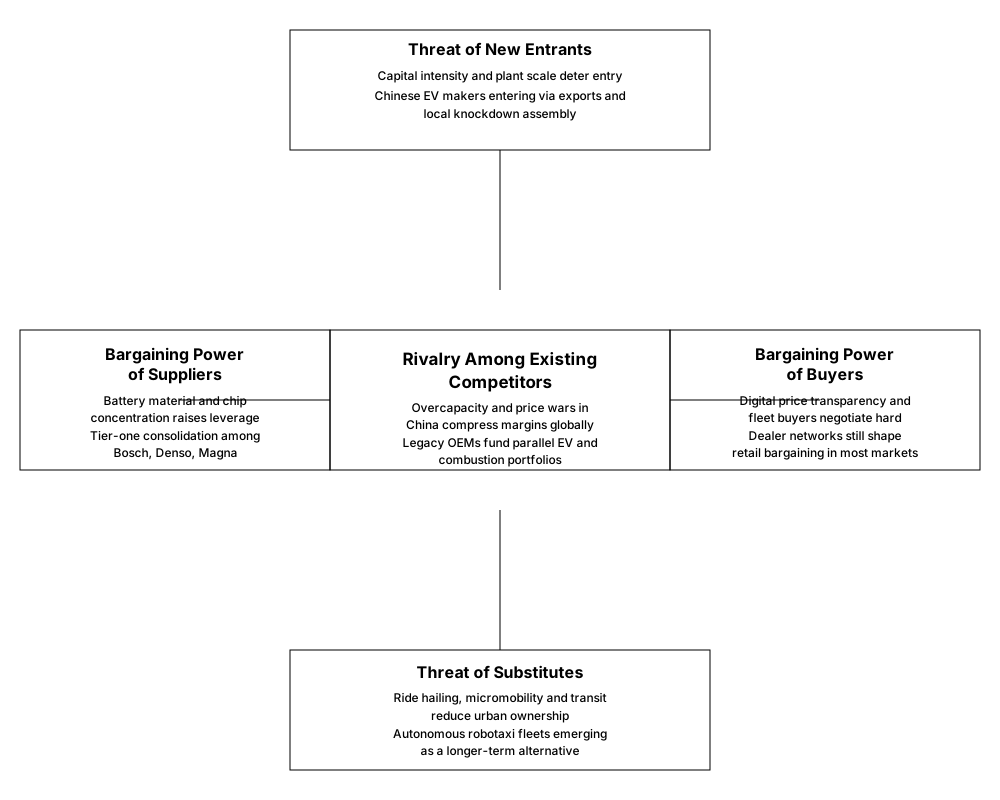
Industry structure today reflects a collision between mature, capital-heavy incumbents and a new wave of electric-first entrants, most notably from China, that have compressed pricing across nearly every segment. Buyers hold more information and switching power than at any point in the industry's history, suppliers of scarce battery materials and semiconductors have gained leverage and rivalry has intensified into open price competition in the world's largest market. New entry remains difficult in absolute terms but has become materially easier for well-capitalized electric specialists, while substitutes in the form of ride-hailing and public transit continue to erode urban ownership at the margin.
Bargaining power of buyers
Buyer power has risen steadily as digital tools stripped away the information asymmetry that once favored dealers and manufacturers. Retail buyers now compare prices, financing terms and reviews across multiple online sources before ever visiting a showroom and this transparency has compressed dealer markups in most mature markets. Fleet and rental buyers, who purchase in volumes large enough to negotiate directly with manufacturers, exercise even stronger leverage, often securing pricing tied closely to production cost plus a modest margin. Corporate fleet contracts can represent a meaningful share of an OEM's regional volume, giving a small number of buyers outsized influence over pricing and product specification.
At the same time, buyer power is not uniform across segments. Premium and luxury buyers remain comparatively price-insensitive, willing to pay for badge prestige, performance and perceived exclusivity, which preserves pricing power for manufacturers who have built genuine brand equity over decades. Switching costs for the buyer are generally low in the sense that no contractual lock-in exists, but psychological and practical switching costs, including familiarity with a brand's service network and resale value expectations, still create some stickiness. The shift toward electric vehicles has, if anything, increased buyer power further because it reset brand loyalty:
many EV buyers are purchasing outside their previous brand for the first time, forcing manufacturers to compete harder on price and features to win first-time and switching customers
| Buyer segment | Primary leverage | Effect on pricing |
|---|---|---|
| Retail consumers | Price comparison tools, online reviews | Downward pressure on markup |
| Corporate and rental fleets | Volume purchasing, direct negotiation | Near cost-plus pricing |
| Government and municipal buyers | Procurement rules, multi-year contracts | Lifecycle cost focus over price |
| Premium and luxury buyers | Low price sensitivity | Preserves margin |
| First-time EV switchers | Weak prior brand loyalty | Increases price competition |
Bargaining power of suppliers
Supplier power has shifted markedly with electrification. In the combustion engine era, OEMs held strong leverage over a fragmented base of mechanical parts suppliers, many of whom competed on price for standardized components. Electrification concentrates critical inputs, lithium, nickel, cobalt, graphite and rare earth materials, in a much smaller number of hands and battery cell manufacturing itself is dominated by a handful of large players who now negotiate from a position of strength. Global automotive supplier profit margins recently averaged around 6.9 percent, outperforming OEM margins for six consecutive quarters, a reversal from the historical pattern in which manufacturers extracted concessions from suppliers rather than the other way around2.
Semiconductor suppliers gained similar leverage during the shortage years earlier this decade, when a handful of foundries controlled the chips needed for everything from infotainment to engine control units and manufacturers were forced to idle plants for want of components worth only a few dollars each. Software and technology suppliers, including firms providing operating systems, sensors and mapping data for advanced driver assistance, are gaining structural power as vehicles become more software-defined, since switching an entire electrical architecture to a new supplier mid-program is prohibitively expensive. Tier-one suppliers with scale, such as major bosch, denso and magna-style global players, retain negotiating strength because OEMs depend on their engineering capacity as much as their parts.
| Supplier category | Source of leverage | Trend |
|---|---|---|
| Battery cell and material producers | Concentrated global supply | Rising |
| Semiconductor foundries | Limited fabrication capacity | Rising, still volatile |
| Software and sensor platform providers | High switching costs once integrated | Rising |
| Large tier-one component suppliers | Engineering scale and specialization | Stable to rising |
| Commodity mechanical parts suppliers | Fragmented, price-competitive base | Declining |
Rivalry among existing competitors
Rivalry has intensified sharply, driven by a combination of overcapacity, an unfinished technology transition and an aggressive new competitor set. OEM margins fell to roughly 2.7 percent for the full year and quarterly margins that include electric vehicle write-offs and canceled program costs turned negative in some periods, a level of pressure not seen broadly across the industry in over a decade3. Much of this pressure originates in China, where domestic brands now account for roughly two-thirds of passenger car sales and are exporting aggressively, pushing prices down in every market they enter.
Legacy manufacturers face a specific structural disadvantage: they are funding two parallel product lines, combustion and electric, which duplicates tooling, dealer training and engineering spend at a time when neither line is generating strong returns. Newer entrants building electric-only platforms avoid this duplication but face their own cost pressures around scaling production and building brand trust. Price wars in China have already forced several smaller domestic brands out of business and are now spilling into Southeast Asia, Latin America and parts of Europe as exporters seek volume outside a saturated home market. Rivalry is compounded by the capital-intensive nature of the business:
once a plant is built, the marginal cost of running it below capacity is far higher than the marginal cost of running it at capacity, which pushes every competitor toward volume-chasing behavior even when it damages industry-wide profitability
| Competitive dimension | Current dynamic |
|---|---|
| Chinese domestic price competition | Intense, driving margin compression industry-wide |
| Legacy dual-portfolio cost burden | High, weighs on combustion-plus-EV manufacturers |
| Export-driven volume expansion | Rising, especially into Southeast Asia and Latin America |
| Premium segment differentiation | Comparatively stable, brand-protected |
| Plant utilization pressure | High, incentivizing further price cuts |
Threat of new entrants
Entry barriers remain formidable in absolute dollar terms but have fallen in relative terms for well-capitalized specialists who skip the combustion engine legacy entirely. A competitive assembly plant still requires well over a billion dollars in upfront capital and building a global dealer, service and charging-adjacent support network takes years even with strong financial backing. Chinese manufacturers have nonetheless entered dozens of new markets over a short period, first through direct exports and increasingly through local knockdown assembly in Brazil, Southeast Asia and other regions specifically designed to sidestep import tariffs4.
Regulatory approval processes for safety and emissions certification act as a genuine barrier, particularly in the United States and European Union, where compliance testing can take years and requires deep local regulatory expertise. Brand trust is arguably the hardest barrier to overcome, since vehicle purchases are high-value, infrequent decisions where buyers weight reputation heavily and new entrants without a service history must often underprice established brands substantially to win first-time buyers. Technology-first entrants building software-defined vehicles from a blank sheet face a different, more favorable calculus, since they can design a leaner electrical architecture without the burden of legacy platforms, though they must still clear the same capital and regulatory hurdles as any other manufacturer.
| Entry pathway | Typical barrier | Recent example pattern |
|---|---|---|
| Greenfield assembly plant | Multi-billion dollar capital requirement | Selective, mostly by well-funded specialists |
| Direct vehicle export | Tariff and trade policy exposure | Increasingly restricted by import duties |
| Local knockdown assembly | Requires regional partnership and logistics | Growing rapidly among Chinese exporters |
| Regulatory and safety certification | Multi-year compliance process | Consistent barrier across all entrants |
| Brand and service trust building | Requires sustained investment over years | Hardest barrier for new entrants to overcome |
Threat of substitutes
Substitution pressure operates mostly at the margin of vehicle ownership rather than threatening the core product outright, since most regions still lack transportation infrastructure dense enough to replace private vehicles entirely. Ride-hailing services reduce the need for a second household vehicle in dense urban areas and public transit investment in several major cities has measurably slowed growth in per-capita vehicle ownership. Micromobility options, including e-bikes and scooters, capture a meaningful share of short urban trips that would once have used a car, particularly among younger buyers who are delaying vehicle purchases relative to prior generations.
Autonomous robotaxi fleets represent a longer-horizon substitute with potentially larger structural implications, since a shift toward shared autonomous mobility could reduce total vehicle ownership even as total miles traveled rises, compressing the addressable market for personally owned vehicles while creating a new commercial vehicle segment built for fleet operation rather than individual ownership. This substitution risk cuts both ways for manufacturers:
those that build for fleet-optimized durability and integrate well with autonomous software platforms could capture new commercial demand even as retail unit sales soften
| Substitute category | Primary impact | Segment most exposed |
|---|---|---|
| Ride-hailing services | Reduces second-vehicle ownership need | Urban retail buyers |
| Public transit expansion | Slows per-capita ownership growth | Dense metropolitan markets |
| Micromobility, e-bikes and scooters | Captures short urban trips | Younger, urban first-time buyers |
| Autonomous robotaxi fleets | Long-term ownership model shift | Personal vehicle segment broadly |
| Delayed purchase behavior | Extends vehicle replacement cycles | Price-sensitive retail buyers |
Value chain and profit pools
The automotive value chain runs from raw material extraction through to end-of-life recycling, but six stages capture most of the strategic and economic weight. Upstream inputs begin with mining and refining of steel, aluminum and battery-grade minerals such as lithium and nickel, an increasingly geopolitically sensitive stage given how concentrated global mineral processing capacity has become. Component and battery manufacturing follows, where semiconductors, battery cells and mechanical parts are produced by a mix of large tier-one suppliers and specialized technology firms, several of whom now hold more negotiating leverage than the OEMs they supply.
Vehicle assembly is the traditionally central stage, where components are integrated on a production line into a finished vehicle, but it has become the lowest-margin activity in the chain as competition and overcapacity compress assembly economics toward the cost of capital. Distribution and logistics move finished vehicles from plants to regional markets and dealer lots, a capital-intensive stage involving specialized transport and, increasingly, direct-to-consumer delivery models that bypass traditional distribution. The customer interface stage, encompassing dealership networks, direct online sales channels and financing arms, is where much of the durable profitability actually resides, since financing spreads, service contracts and trade-in arbitrage generate steady margin independent of vehicle production cost. Finally, enabling infrastructure, including charging networks, software platforms and connected-car services, has emerged as a genuinely new value chain stage over the past decade, one that barely existed when the combustion engine dominated.
Profit pool
Profit has migrated decisively away from the physical act of assembling a vehicle and toward financing, software and premium branding. A generation ago, manufacturing scale itself was the primary source of advantage and the largest assemblers earned the strongest returns simply by spreading fixed costs over more units. That logic has weakened considerably as overcapacity turned assembly into a commodity activity for all but the most efficient or most premium producers.
Financing arms, which most large OEMs operate as captive finance companies, now generate profit margins well above those of the manufacturing business itself, since they earn a spread on loans and leases with comparatively low incremental cost once the lending infrastructure exists. Software and connected services represent the newest and fastest-growing profit pool, as the market for vehicle electronics and software is expanding far faster than the overall vehicle market, creating new value pools for whoever owns the underlying platform, whether that is the OEM, a technology supplier, or increasingly a semiconductor company that has moved up the stack5. Battery cell suppliers, particularly those with proprietary chemistry advantages, capture disproportionate margin because they hold genuine technical differentiation in a stage of the chain where most other suppliers compete on price alone.
The relevance of software for core technology trends is increasing rapidly and value pools are shifting toward companies that can build scalable, flexible and robust electronics platforms
Premium branding remains the one traditional profit pool that has held up well, since badge equity is difficult to replicate regardless of how commoditized the underlying manufacturing process becomes. The clearest strategic implication is that companies competing purely on assembly scale, without a credible position in financing, software or premium branding, are increasingly exposed to margin compression they cannot escape through volume alone.
Industry economics and business models
Three business model patterns dominate the industry today. The traditional asset-heavy manufacturing and dealer-network model remains the backbone for most volume producers, built around owning or closely controlling assembly plants and distributing through franchised dealers who absorb inventory risk in exchange for service and financing margin. This model rewards scale, tight supply chain coordination and disciplined capital expenditure timing, but it carries significant fixed cost exposure during demand downturns.
A direct-to-consumer model, pioneered by electric vehicle specialists and increasingly adopted by legacy manufacturers for their EV lines, removes the dealer layer and sells directly online or through company-owned showrooms. This model improves pricing transparency and captures retail margin that would otherwise go to independent dealers, but it shifts inventory financing and local service delivery burden back onto the manufacturer, raising working capital intensity. A hybrid model blends the two, using franchised dealers for service and delivery logistics while centralizing pricing and online ordering at the manufacturer level, an approach gaining traction as legacy OEMs try to capture more of the customer interface margin without fully dismantling their dealer networks.
Layered on top of all three is a growing subscription and services revenue stream, where manufacturers charge recurring fees for connected features, advanced driver assistance upgrades or battery range extensions delivered through software rather than hardware changes. This usage-based layer behaves more like a technology business than a traditional manufacturing one, carrying near-zero marginal cost once the underlying hardware exists and it represents the clearest structural shift in how the industry generates recurring, higher-margin revenue beyond the initial vehicle sale.
Cost drivers and scalability
Vehicle manufacturing carries an unusually high fixed cost base relative to most consumer-facing industries. Plant construction, tooling, platform engineering and regulatory certification are sunk costs that must be recovered across hundreds of thousands of units before a program becomes profitable, which is why manufacturers guard production volume so fiercely even at the cost of price discipline. Variable costs, dominated by raw materials, purchased components and direct labor, fluctuate with commodity prices and currency movements and battery materials have become the single most consequential variable cost input for any electric vehicle program.
Economies of scale remain central to profitability, since spreading platform development and tooling costs across a larger production run lowers per-unit cost meaningfully, which is why shared vehicle platforms across multiple models and even multiple brands have become standard practice. Economies of scope also matter: manufacturers that can share battery packs, electrical architecture and software across an entire vehicle lineup reduce engineering duplication substantially compared with those still designing each model in relative isolation. Plant utilization functions as the industry's core unit economic lever, roughly analogous to load factor in the airline business, since a plant running below roughly 80 percent of capacity typically struggles to earn an adequate return on its fixed investment, while a plant running near full capacity can generate strong incremental margin on every additional unit.
Battery cost curves add a newer dimension to scalability. As cell prices have fallen with expanded global production capacity, the cost gap between electric and combustion vehicles has narrowed, though it has not fully closed in most segments and the pace of that closure remains the single most important variable determining how quickly electric vehicle programs can reach the volume needed to justify their upfront tooling investment.
Moats, advantages and strategic levers
Durable advantage in this industry now rests on a different foundation than it did a generation ago. Cost advantage still matters, particularly for manufacturers with vertically integrated battery supply or regional manufacturing footprints that minimize tariff exposure and logistics cost, but pure manufacturing cost leadership is no longer sufficient on its own given how thin assembly margins have become across the board. Differentiation through brand equity remains one of the strongest and most durable moats in the industry, since premium and luxury buyers demonstrate genuine willingness to pay well above production cost for perceived quality, heritage and status, a dynamic that has persisted for decades and shows little sign of eroding.
Switching costs have shifted meaningfully with software-defined vehicles, since a manufacturer that builds a loyal base of over-the-air software subscribers creates a form of retention that a purely mechanical product never offered. Data and learning advantages are emerging as a genuine moat for manufacturers with large connected vehicle fleets, since the driving data collected across millions of vehicles can improve advanced driver assistance systems, predictive maintenance algorithms and eventually autonomous driving performance in ways that smaller competitors cannot easily replicate without comparable fleet scale. Regulatory moats exist in a narrower sense, primarily around safety and emissions certification, which favor manufacturers with deep compliance expertise and established relationships with regulators across multiple jurisdictions, though this advantage rarely blocks entry outright, it mainly slows it.
Network effects play a smaller but growing role, particularly around charging infrastructure and software ecosystems, where a manufacturer's proprietary charging network or app ecosystem can lock in customers who value convenience and integration over marginal price differences.
Strategic levers
Executives operating in or evaluating this industry have several concrete levers available and the right combination depends heavily on starting position. Customer segment focus is the most immediate lever:
a manufacturer or entrant can choose to compete broadly across mass-market, premium and commercial segments, or concentrate resources on a single segment where it can build genuine differentiation, an approach that has worked well for premium electric specialists who avoided diluting their brand across a wide price range
Vertical integration versus partnering represents a second major decision point, particularly around battery cells and software. Manufacturers integrating backward into battery cell production gain cost control and supply security but take on significant capital risk and technology obsolescence exposure, while those partnering with specialized battery and software suppliers preserve capital flexibility at the cost of some margin and strategic control. Geographic expansion, particularly building regional assembly footprint inside major markets, has become a near-mandatory lever given the current tariff environment, converting what would otherwise be variable trade policy risk into a fixed, more predictable local manufacturing cost.
Ecosystem orchestration is a subtler but increasingly important lever, where a manufacturer positions itself as the integrator of a broader mobility ecosystem, spanning charging, financing, insurance and software subscriptions, rather than treating vehicle sale as the endpoint of the customer relationship. Finally, capital discipline around the pace of the electric transition itself functions as a strategic lever in its own right:
manufacturers that calibrate their electric vehicle investment to actual demand signals rather than aspirational targets have generally protected their margins better than those who over-invested ahead of the curve
Structural risks, regulation and trends
The industry faces several structural risks that compound one another. Regulatory risk is significant and shifting quickly, as emissions targets, safety mandates and tariff policy can each change the economics of an entire product line within a single legislative cycle. Technology disruption risk centers on the pace and direction of the electric and autonomous vehicle transition, where manufacturers that bet too aggressively or too conservatively on the timing of adoption both face real financial exposure. Commodity and price risk remains elevated given how much of vehicle cost now depends on volatile battery material and semiconductor prices and geopolitical risk has intensified as trade tensions between major economies increasingly target the automotive sector specifically, given its symbolic and economic importance to domestic manufacturing employment.
Several macro and secular trends will shape the next decade. Demand growth is increasingly concentrated in emerging markets, even as unit volumes in mature markets plateau or decline slightly. Battery cost curves continue to fall, though the pace has slowed from the sharp declines of the early 2020s and further cost reduction will likely depend on new chemistry breakthroughs rather than simple manufacturing scale. Supply chains are regionalizing, with manufacturers building parallel production capacity across multiple continents specifically to hedge against tariff and geopolitical disruption, even though this duplication raises short-term cost. Software-defined vehicle architecture is becoming the industry standard rather than a differentiator, meaning manufacturers that fail to modernize their electrical architecture risk falling structurally behind on cost and feature velocity.
A useful strategic playbook divides cleanly between entrants and incumbents. Entrants generally succeed by choosing a narrow segment rather than competing broadly, building or acquiring battery and software capability rather than assuming it can be bought cheaply later and treating regulatory strategy as a first-order concern rather than an afterthought, given how much emissions and safety policy can determine which markets are even accessible. Incumbents face a different set of choices, generally needing to defend their premium and fleet segments where brand and relationship advantages remain strong, expand deliberately into adjacent profit pools such as financing and software rather than treating them as side businesses and deepen their moats by accelerating the transition away from maintaining two full parallel product lines, since that duplication is the single largest avoidable cost burden most legacy manufacturers carry today.
Caselet: Toyota Motor Corporation
Toyota Motor Corporation offers a useful lens into how disciplined capital allocation and a deliberately hedged technology strategy can preserve profitability even during an industry-wide margin squeeze. Founded in 1937 as a spinoff of a Japanese textile machinery manufacturer, Toyota built its early reputation on manufacturing discipline rather than product novelty, developing what became known globally as lean production, a system built around eliminating waste, empowering line workers to halt production when defects appeared and holding minimal inventory buffers. That manufacturing philosophy, refined over decades, remains a genuine and difficult-to-replicate operational advantage, allowing Toyota plants to run at higher utilization and lower defect rates than many competitors even as the company has scaled to become the world's largest automaker by volume.
Strategic positioning on electrification
Where Toyota has diverged most notably from many Western and Chinese competitors is in its measured approach to full battery electrification. Rather than committing its entire lineup to battery electric vehicles on an aggressive timeline, the company has maintained a broader portfolio strategy spanning hybrid, plug-in hybrid, battery electric and hydrogen fuel cell technology, betting that different markets and customer segments will adopt electrification at different speeds depending on charging infrastructure, electricity cost and driving patterns. This hedged strategy drew criticism from analysts who viewed it as slow-footed during the peak of electric vehicle enthusiasm earlier in the decade, but it has proven financially resilient as demand growth for fully electric vehicles moderated in several major markets and as competitors who committed heavily to battery-only strategies absorbed significant write-offs on canceled or delayed programs.
Manufacturing footprint and supply chain resilience
Toyota's global manufacturing footprint, built over decades across North America, Europe, Southeast Asia and its home market, has positioned the company relatively well against the current wave of tariff-driven regionalization, since much of its production for major markets already occurs inside those markets rather than depending heavily on cross-border exports. The company has also maintained tighter, longer-term supplier relationships than many competitors, a legacy of its keiretsu-influenced supply chain model, which gave it somewhat better resilience during the semiconductor shortage that disrupted the wider industry earlier in the decade, though it was not immune to those disruptions entirely.
Profitability and capital discipline
Toyota has consistently posted operating margins above many global peers, a function both of its hybrid technology, which carries lower incremental cost than full battery electric vehicles while still meeting many emissions targets and of its disciplined approach to capital expenditure, avoiding the kind of aggressive plant overbuild that left several competitors with excess electric vehicle manufacturing capacity relative to actual demand. The company's continued investment in hydrogen fuel cell technology, an area where near-term commercial returns remain uncertain, illustrates a willingness to fund long-horizon technology bets from a position of financial strength rather than desperation, a posture few competitors currently facing negative or near-zero margins can afford to match. Toyota's experience over the past several years suggests that in an industry undergoing simultaneous technological and geopolitical disruption, operational discipline and portfolio flexibility can matter as much as being first to any single new technology.
Vehicle manufacturing remains one of the economy's largest industrial systems, converting steel, semiconductors and battery chemistry into mobility for billions of people while employing millions across assembly, engineering and distribution. Its economics have inverted: hardware assembly, once the primary profit center, now yields thin single-digit margins, while software licensing, battery integration and financing capture a growing share of value. The decisive strategic levers are no longer plant count or badge prestige but control of electrical architecture, battery cost curves, regional manufacturing footprint that dodges tariffs and disciplined capital allocation between combustion and electric portfolios. Incumbents that keep running both drivetrains without a clear sunset plan will keep funding their own disruption, while entrants with software-first architectures and lower-cost regional assembly are positioned to compound advantage over the next decade.
Citation
Cite this article
Sridharan, M. A. (2023, August 19). Industry Analysis: Automotive. Think Insights. https://thinkinsights.net/strategy/industry-analysis-automotive (Accessed [[ACCESS_DATE]])
Sridharan, Mithun A. "Industry Analysis: Automotive." Think Insights, 19 Aug. 2023, https://thinkinsights.net/strategy/industry-analysis-automotive. Accessed [[ACCESS_DATE]].
Mithun A. Sridharan, "Industry Analysis: Automotive," Think Insights, August 19, 2023, https://thinkinsights.net/strategy/industry-analysis-automotive. Accessed [[ACCESS_DATE]].
Sridharan, M.A. (2023) 'Industry Analysis: Automotive', Think Insights. Available at: https://thinkinsights.net/strategy/industry-analysis-automotive (Accessed: [[ACCESS_DATE]]).
M. A. Sridharan, "Industry Analysis: Automotive," Think Insights, 2023. [Online]. Available: https://thinkinsights.net/strategy/industry-analysis-automotive. [Accessed: [[ACCESS_DATE]]].
Sridharan MA. Industry Analysis: Automotive. Think Insights. Published August 19, 2023. Accessed [[ACCESS_DATE]]. https://thinkinsights.net/strategy/industry-analysis-automotive
Test Your Knowledge
Industry Analysis: Automotive
Challenge yourself on the concepts from this article and see how well you understood them.
Subscribers get weekly quizzes and insights — subscribe free
Sponsor this article
Partner with Think Insights
Reach 50,000+ business leaders, consultants, and strategists. Feature your brand alongside expert articles on strategy, leadership, and digital transformation.
Become a Sponsor