Industry Analysis: Apparel Manufacturing


Apparel manufacturing converts fiber and fabric into finished garments through cut-make-trim operations concentrated in Asia and, increasingly, the Western Hemisphere. The industry moves well over a trillion dollars of product annually, yet factories keep single-digit margins while the brands that design and distribute the goods capture the bulk of the value. Sourcing power has begun shifting away from pure low-cost labor toward speed, compliance credibility and proximity to end markets, a change accelerated by tariff volatility and buyer demand for shorter lead times. Executives evaluating this sector should treat labor compliance and supply chain diversification as core strategy, not a cost center and should prioritize factories and regions that combine automation readiness with trade-agreement access. The decision facing incumbents and investors is direct: consolidate scale and vertical capability now, or remain exposed to the next tariff shock and buyer defection.
Is apparel manufacturing attractive for new entrants?
It depends on where in the value chain an entrant plays. Basic cut-make-trim sewing has low capital barriers but wafer-thin margins and intense price competition, which makes it unattractive without a differentiated angle such as automation, speed or a captive buyer relationship. Specialty manufacturing in technical fabrics, performance wear or compliance-certified niches offers a more defensible entry point because buyers pay a premium for reliability and certification rather than shopping purely on price.
Which parts of the value chain are most profitable?
Fiber and fabric production, particularly synthetic and technical textiles protected by patents or proprietary finishing processes, tends to carry higher margins than garment assembly. On the finished-goods side, brand design, marketing and retail distribution capture the largest share of consumer spending, while the cut-make-trim factories that physically assemble garments typically retain single-digit net margins.
How is technology changing this industry?
Automation is moving from cutting and pattern-making, where it has been established for years, into sewing itself through semi-automated sewbots and robotic material handling for standardized items like T-shirts and basic knitwear. Digital product creation, three-dimensional sampling and radio-frequency identification tracking are compressing sampling cycles and giving brands real-time visibility into factory output, reducing the information advantage that manufacturers once held over buyers.
What capabilities are table stakes versus differentiators?
Compliance certification, on-time delivery and basic quality control are table stakes that every credible factory must demonstrate to stay in a buyer's approved vendor list. Differentiators include speed-to-market for small-batch or reactive replenishment orders, technical capability for complex or performance fabrics and vertical integration that lets a manufacturer offer fabric sourcing, dyeing and finishing under one roof.
How should investors or consultants evaluate opportunities here?
Evaluate exposure to a single sourcing country or trade regime, since tariff and labor-cost shocks can move margins by several percentage points overnight. Assess whether a manufacturer's customer base is diversified across brands and categories and whether the factory has invested in automation and compliance infrastructure that raises switching costs for buyers rather than competing purely on unit price.
What role do trade agreements and tariffs play in sourcing decisions?
Tariff regimes and preferential trade agreements directly determine landed cost and can reroute billions of dollars of orders within a single sourcing cycle, as seen when duty changes shifted volumes between Bangladesh, Vietnam and Western Hemisphere suppliers. Manufacturers and brands increasingly build sourcing models that diversify across multiple trade zones specifically to hedge against this kind of policy risk.
Why does labor compliance matter so much to profitability?
Non-compliant factories face buyer delisting, reputational damage for the brands they supply and, increasingly, regulatory bans tied to forced-labor enforcement in major import markets. Certification and audit readiness have become a prerequisite for winning and keeping large orders, effectively converting compliance from a cost of doing business into a competitive differentiator.
Is nearshoring a durable trend or a temporary reaction to tariffs?
Nearshoring reflects a structural rebalancing toward shorter lead times and lower freight and inventory risk, not just a reaction to any single tariff announcement, though tariff volatility has accelerated the shift. Automation investment in Mexico, Central America and parts of Eastern Europe is making proximity sourcing more cost-competitive against traditional low-wage hubs, which suggests the trend will persist even if trade policy stabilizes.
How concentrated is buyer power in this industry?
Buyer power is high because a relatively small number of global apparel brands and retailers place the bulk of large-volume orders and most can multi-source across dozens of qualified factories in different countries. This concentration lets buyers dictate price, payment terms and compliance requirements, which is the single biggest structural reason factory margins stay compressed.
What is the biggest structural risk facing apparel manufacturers over the next five years?
Trade policy volatility, particularly tariff and forced-labor enforcement actions in the United States and Europe, represents the most immediate risk because it can reprice entire sourcing corridors within months. Over a longer horizon, automation-driven reshoring and on-demand production models threaten the labor-cost advantage that has anchored offshore manufacturing hubs for four decades.
Apparel manufacturing sits at the physical center of one of the largest consumer categories in the global economy, converting fiber, yarn and fabric into the garments that clothe billions of people every day. It is an industry built on scale and repetition, yet it remains stubbornly dependent on human hands at the sewing machine, a combination that has shaped its geography, its economics and its politics for more than half a century. Understanding how value is created and captured inside this industry requires separating the visible glamour of fashion brands from the far less visible, far more labor-intensive work of cutting, sewing and finishing that happens in factories most consumers never think about.
Industry at a glance
Apparel manufacturing refers specifically to the production side of the clothing business: spinning and weaving or knitting fabric, cutting patterns, sewing garments and finishing them for shipment, activities commonly grouped under the term cut-make-trim (CMT). It excludes brand design, marketing, retail merchandising and e-commerce, which belong to the apparel and fashion industry proper, though the two are deeply intertwined because manufacturers exist almost entirely to serve brand and retail customers. The global apparel market, spanning production through retail, is valued in the range of 1.4 trillion to nearly 1.9 trillion dollars depending on scope, with manufacturing representing the upstream production layer of that broader figure.1
The industry's customer base is almost entirely business-to-business, since factories sell finished garments or contract sewing services to apparel brands, private-label retailers and, in smaller volume, government and institutional uniform buyers rather than directly to consumers. This B2B structure means demand is derived rather than primary, dependent on how well brands forecast and sell downstream, which makes manufacturing revenue inherently more volatile than retail revenue because factories absorb the whiplash of brand order cancellations and reforecasts. Capital intensity varies sharply by segment: basic sewing operations require modest investment in machinery and floor space, while fabric mills, dyeing and finishing plants and increasingly automated cutting and sewing lines demand substantial fixed investment. Labor intensity remains the industry's defining characteristic, with garment assembly still employing tens of millions of workers worldwide, concentrated overwhelmingly in Asia and regulation touches nearly every stage through labor law, environmental permitting for wet processing and trade compliance tied to rules of origin and preferential tariff programs.
Industry segmentation
The industry organizes naturally around position in the production process and around the type of product being made and six segments capture most of its structure. Fiber and yarn production covers the growing or synthesizing of raw material, from cotton farming through petrochemical-based polyester and nylon manufacturing and sits closest to commodity economics. Textile and fabric manufacturing takes yarn and produces woven or knitted fabric, often including dyeing, printing and finishing and is where much of the industry's technical differentiation and intellectual property resides. Cut-make-trim assembly is the labor-intensive core of garment production, where fabric is cut into pattern pieces and sewn into finished apparel, typically performed by contract factories rather than the brands themselves.
Full-package or original design manufacturing extends beyond CMT to include sourcing of fabric and trims, sometimes design input and full production management, letting brands outsource nearly the entire physical supply chain to a single vendor. Private-label and white-label manufacturing serves retailers that want store-brand product without operating factories of their own, a segment that has grown as mass retailers push margin improvement through vertical control of sourcing. Specialty and technical apparel manufacturing, covering performance sportswear, protective and military clothing and medical or industrial garments, commands premium pricing because it demands certified materials, precise tolerances and often domestic production for regulatory or security reasons. These segments are not mutually exclusive; the largest manufacturing groups often operate across several simultaneously, using scale in basic CMT to subsidize investment in higher-margin technical capability.
Market structure
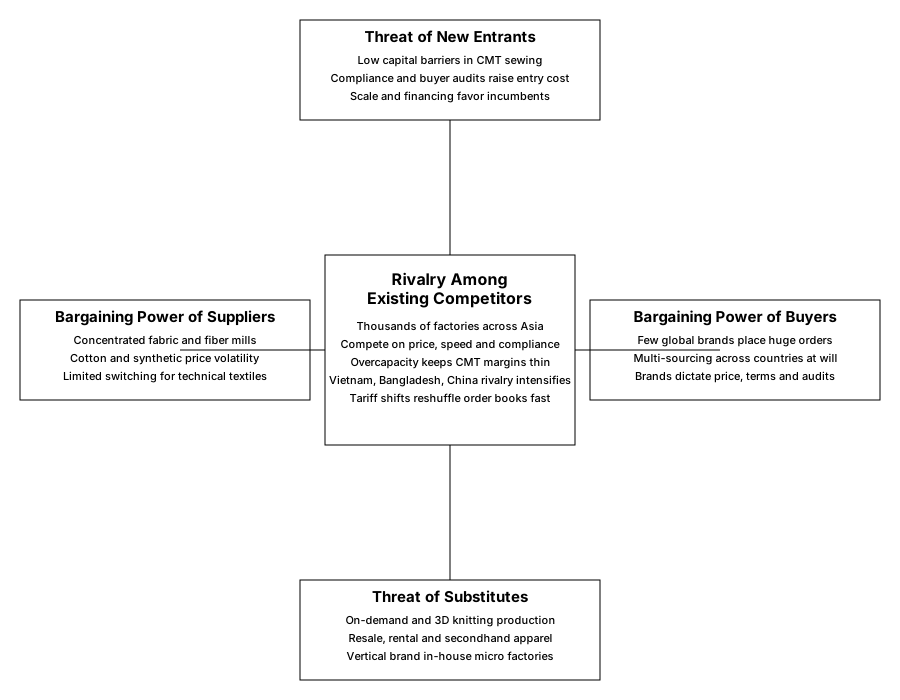
Porter's Five Forces framework clarifies why apparel manufacturing has historically been a difficult industry in which to build durable profitability. Buyer concentration among global brands, low switching costs for buyers moving orders between countries and persistent overcapacity among factories combine to keep pricing power firmly on the buyer's side. Supplier power varies by segment, rising sharply for specialty and technical textiles and staying comparatively low for commodity fabric. New entrants face a paradox: basic sewing operations are easy to start but hard to sustain profitably, while credible participation in premium segments requires capital, certification and buyer trust built over years. Rivalry is intense and geographically dispersed and substitutes are emerging from automation-enabled on-demand production and the resale economy rather than from an entirely different product category.
Bargaining power of buyers
Buyer power is the single most important force shaping profitability in apparel manufacturing and it is structurally high. A relatively small number of global apparel brands, mass retailers and private-label programs place the overwhelming majority of large-volume orders, giving each buyer significant leverage over any individual factory that depends on its business. Because garment assembly capacity exists in dozens of countries and thousands of qualified factories, buyers can and routinely do multi-source the same product across several countries simultaneously, playing factories against each other on price, lead time and payment terms. Order volumes are large enough that losing a single major customer can threaten a factory's survival, while a buyer losing a single factory barely registers against its total sourcing base, an asymmetry that defines the relationship.
Buyers have also extended their leverage into compliance and sustainability requirements, mandating audits, certifications and traceability data as a condition of doing business, which raises factory costs without necessarily raising the price paid for goods. This trend has intensified as Western regulators tighten forced-labor and environmental-disclosure rules, effectively deputizing brands to police their supply chains and brands, in turn, deputizing factories to prove compliance. The one countervailing force is that buyers increasingly value speed and reliability over marginal cost savings, particularly for replenishment and fast-fashion categories, which gives factories with strong on-time performance and shorter lead times somewhat more negotiating room than pure price competition would suggest.
| Buyer segment | Typical order scale | Primary leverage point |
|---|---|---|
| Global fast-fashion brands | Very high volume, frequent reorders | Multi-country sourcing and rapid reorder cancellation |
| Mass-market retailers and private label | High volume, seasonal | Price benchmarking across competing factories |
| Premium and performance brands | Moderate volume, higher margin | Compliance and technical certification demands |
| Government and institutional buyers | Fixed contract volume | Domestic-sourcing and security requirements |
Bargaining power of suppliers
Supplier power in apparel manufacturing depends heavily on which input is under discussion and the picture is more mixed than the buyer side. Commodity fiber inputs such as raw cotton trade on global exchanges with many producing countries, which limits any single supplier's pricing power even though weather and geopolitical events can cause sharp price swings that ripple through the entire chain. Synthetic fiber production, dominated by a smaller number of large petrochemical-linked producers concentrated in China and a handful of other countries, carries more concentrated supplier power because switching between polyester suppliers involves qualification time and consistency risk. Specialty and technical fabrics, including moisture-wicking, flame-resistant or patented performance materials, exhibit the highest supplier power in the chain because they are often protected by intellectual property and produced by a limited set of qualified mills.
Trim and accessory suppliers, covering zippers, buttons, labels and other components, are typically fragmented and low-power individually, though a handful of global players hold meaningful share in hardware categories like zippers. Machinery suppliers for sewing and cutting equipment hold moderate power, particularly as automated sewing systems concentrate around a small number of specialized manufacturers whose equipment locks factories into specific maintenance and parts relationships. Labor itself functions as a supply input with rising bargaining power in some hubs, as Vietnam's stronger labor-law enforcement and wage growth in China have pushed manufacturers toward newer, lower-cost labor markets in South Asia and Africa.
| Supplier category | Concentration | Switching difficulty |
|---|---|---|
| Raw cotton and natural fiber | Low, globally dispersed | Low |
| Synthetic fiber and petrochemical feedstock | Moderate to high | Moderate |
| Technical and performance fabric mills | High | High |
| Trim, hardware and accessory suppliers | Low to moderate | Low |
| Sewing and cutting machinery vendors | Moderate | Moderate to high |
Rivalry among existing competitors
Competitive rivalry in apparel manufacturing is fierce and structurally persistent because global sewing capacity has consistently outpaced demand growth for most of the last two decades, keeping downward pressure on CMT pricing. Factories compete simultaneously on unit price, lead time, minimum order quantity, quality consistency and compliance credentials, a multidimensional competition that makes it difficult for any single manufacturer to build lasting differentiation on cost alone. Country-level rivalry compounds factory-level rivalry, as Bangladesh, Vietnam, China, India, Cambodia and a growing set of African and Central American hubs actively compete for the same brand sourcing budgets, with governments offering tax incentives and trade-zone benefits to win investment. Recent tariff volatility in major import markets has sharpened this rivalry further, since a tariff change on one country's exports can instantly redirect billions of dollars of order volume toward competitors, as seen when United States apparel imports from India and Bangladesh fell sharply year over year while Vietnam's rose.2
Scale leaders such as large Asian manufacturing groups that operate hundreds of thousands of sewing machines across multiple countries have built some insulation from single-country risk by diversifying production footprints, a strategy smaller independent factories cannot easily replicate. Rivalry also plays out over speed, with fast-fashion supply chains rewarding factories that can turn around small-batch or reactive replenishment orders in weeks rather than months, pushing investment toward flexible production lines rather than pure volume capacity. The net effect of this multidimensional, geographically dispersed rivalry is chronic margin compression at the CMT layer, forcing manufacturers to seek differentiation through vertical integration, automation or specialization rather than pure price competition.
| Competitive dimension | Where advantage is built | Typical outcome |
|---|---|---|
| Unit cost per garment | Labor cost, plant utilization | Persistent price pressure |
| Lead time and flexibility | Automation, proximity to market | Premium for fast-fashion replenishment |
| Compliance and certification | Audit investment, governance | Access to premium buyer programs |
| Country and trade-zone positioning | Tariff exposure, diversification | Order volume volatility |
Threat of new entrants
Entry barriers in apparel manufacturing vary dramatically depending on which segment a new participant targets, which is why the industry simultaneously looks easy and hard to enter. Basic cut-make-trim sewing operations require comparatively modest capital, since sewing machines are inexpensive relative to industrial equipment in most other manufacturing sectors and labor rather than machinery dominates the cost structure, which explains why new small factories continue to open across South and Southeast Asia and parts of Africa. That low capital barrier, however, does not translate into an attractive business, because new entrants immediately face the same buyer power and price competition that squeeze incumbents, often without the accumulated compliance credentials, buyer relationships or working-capital access that established factories carry.
Entering premium or technical segments is considerably harder, requiring investment in specialized equipment, certified quality systems and, frequently, years of audit history before major brands will place meaningful orders. Compliance infrastructure itself has become an entry barrier, since certifications from bodies such as the Worldwide Responsible Accredited Production (WRAP) program or the Fair Labor Association require sustained investment in facilities, training and documentation before a new factory can qualify for large brand programs.3 Trade policy adds another layer of entry difficulty, since access to preferential tariff treatment under agreements tied to specific countries can make or break a new factory's cost competitiveness regardless of its operational quality, meaning geography and trade-agreement access function as much as an entry barrier as capital or skill.
| Entry pathway | Capital requirement | Realistic barrier |
|---|---|---|
| Basic CMT sewing operation | Low | Price competition, no differentiation |
| Full-package or vertically integrated factory | High | Working capital, sourcing relationships |
| Technical and compliance-certified niche | Moderate to high | Certification time, buyer trust |
| Automated or near-market production line | High | Technology investment, skilled operators |
Threat of substitutes
Substitution threats in apparel manufacturing are less about consumers choosing a different product category and more about alternative production models displacing the traditional offshore CMT factory. On-demand and small-batch production, enabled by digital printing, automated cutting and increasingly capable robotic sewing, allows garments to be made close to the point of sale in quantities that were previously uneconomical, reducing reliance on large offshore production runs for certain categories. Three-dimensional knitting technology, which produces a finished garment in a single machine pass without traditional cut-and-sew assembly, substitutes directly for CMT labor in categories like sweaters, socks and some athletic wear, though it remains limited to specific product types rather than apparel broadly.
The resale, rental and secondhand apparel markets represent a demand-side substitute that reduces the total volume of new garments manufactured, as consumers increasingly satisfy some wardrobe needs through circular channels rather than new production, a trend reinforced by sustainability-conscious younger consumers. Brand-owned micro-factories and vertically integrated in-house production, adopted by a small but growing number of direct-to-consumer apparel companies, substitute for third-party contract manufacturing by bringing production in-house, though this remains a minority strategy given the capital and expertise required. None of these substitutes threatens to eliminate apparel manufacturing as a category, but each one erodes the addressable volume available to traditional offshore CMT factories at the margin, adding pressure to an already thin-margin business.
| Substitute model | Category affected | Maturity |
|---|---|---|
| On-demand digital and small-batch production | Fast fashion, personalized apparel | Emerging, growing |
| Three-dimensional knitting | Knitwear, socks, select athletic wear | Established in niches |
| Resale, rental and secondhand channels | General apparel demand | Mature and expanding |
| Brand-owned micro-factories | Direct-to-consumer premium apparel | Early, limited scale |
Value chain and profit pools
The apparel manufacturing value chain runs through six stages, beginning with upstream fiber and raw material production, where cotton growers, synthetic fiber producers and recycled-material processors supply the industry's basic inputs. Textile production follows, spinning fiber into yarn and then weaving or knitting it into fabric, often combined with dyeing, printing and chemical finishing that adds functional properties such as water resistance or stretch. Garment assembly, the cut-make-trim stage, transforms flat fabric into finished apparel through pattern cutting, sewing and quality inspection and remains the most labor-intensive and geographically mobile stage in the entire chain.
Finishing and packaging follows assembly, covering pressing, labeling, tagging and preparation for shipment, frequently performed at the same facility as sewing but sometimes outsourced to specialized finishing houses for embellishment or technical treatments. Logistics and distribution move finished goods from factory to brand distribution centers and eventually retail or direct-to-consumer channels, a stage that has grown in strategic importance as lead-time compression becomes a competitive weapon. Brand and customer interface, encompassing design, merchandising, marketing and retail or e-commerce sale, sits outside manufacturing proper but captures the largest share of the consumer dollar and effectively commissions everything upstream. Enabling infrastructure threads through every stage, including trade compliance and customs brokerage, quality assurance and testing labs, financing and trade credit and increasingly digital supply chain platforms that give brands visibility into factory-level production status.
Profit pool
Profit concentrates disproportionately at the two ends of this chain rather than in the middle where physical production happens. Brand design, marketing and retail distribution typically capture the largest share of the final consumer price, reflecting the premium consumers pay for intellectual property, marketing investment and retail convenience rather than for the physical act of assembly. Specialty textile and technical fabric production captures the next largest share, protected by patents, proprietary finishing processes and the switching costs buyers face when qualifying a new technical material supplier.
Cut-make-trim assembly, despite being the stage most people associate with apparel manufacturing, is structurally the thinnest margin link in the chain, with factories commonly targeting high single-digit to low double-digit net margins even in well-run, compliant operations and considerably thinner margins in commodity basics where price competition is most acute.4 Raw material costs alone, spanning fabric and trims, typically account for roughly half to two-thirds of a garment's total factory-gate cost, meaning even efficient CMT operations are managing margin on a relatively small base once materials and overhead are stripped out.5 This distribution has shifted over the past decade as buyers pushed compliance and sustainability costs onto factories without proportionally raising prices, while simultaneously rewarding a smaller set of scaled, vertically capable manufacturers with larger order books, meaning profit pools within the CMT layer itself have become more concentrated even as the layer's overall share of value stays thin.
Industry economics and business models
Three business models dominate apparel manufacturing, distinguished primarily by how much of the value chain a manufacturer controls and how risk is allocated between factory and buyer. The pure cut-make-trim model is asset-light relative to full-package manufacturing, since the factory sews garments from fabric and trims the buyer supplies or specifies, collects a labor fee and carries comparatively little inventory or design risk, but also captures the least value and remains most exposed to buyer price pressure. The full-package or original design manufacturing model shifts more risk and more reward onto the manufacturer, which sources fabric and trims, sometimes contributes design input, manages the full production process and often extends trade credit to the buyer, allowing it to command higher margins in exchange for absorbing raw material price risk and working-capital exposure.
The vertically integrated model, practiced by the largest manufacturing groups, controls multiple stages from fiber or fabric production through finished garment assembly, sometimes spanning several countries to manage tariff exposure and labor cost simultaneously. This model requires substantial capital investment but insulates the manufacturer from single-stage margin compression by capturing profit across more of the chain and it has become increasingly attractive as trade policy volatility makes single-country, single-stage operations riskier. A smaller but growing fourth pattern, automation-enabled near-market production, trades lower labor-cost advantage for shorter lead times and lower freight and inventory-carrying costs, a model gaining traction in Mexico, Central America and parts of Eastern Europe as automation reduces the labor-cost gap with traditional Asian hubs.6
Cost drivers and scalability
Labor cost dominates the CMT stage of the cost structure, typically representing the largest controllable expense after raw materials, which is precisely why manufacturing has migrated repeatedly over decades toward whichever region offers the best combination of low wages and adequate skill and infrastructure. Fixed costs, including factory rent or ownership, machinery depreciation and compliance overhead such as audit fees and certification maintenance, are relatively modest compared to capital-intensive manufacturing sectors, which is part of why entry barriers at the basic CMT level remain low despite the difficulty of sustaining profitability. Variable costs dominate the structure overall, led by fabric and trim purchases that typically represent the largest single cost category, followed by direct labor tied to piece rates or line efficiency and utilities and consumables that scale with production volume.
Economies of scale matter primarily through purchasing power on raw materials and through the ability to spread compliance and overhead costs across larger production volumes, which is why the largest manufacturing groups can sustain slightly better margins than small independent factories even while competing in the same commodity segments. Plant utilization functions as the key unit-economic lever in this industry, similar to load factor in other operationally intensive sectors, since sewing lines represent a largely fixed capacity that must run near full utilization to absorb overhead, making order-book stability as important to profitability as unit pricing itself. Automation changes this calculus meaningfully for standardized products, since robotic or semi-automated sewing systems convert a portion of variable labor cost into fixed capital cost, improving marginal economics at high volume while raising the capital bar for entry, a trade-off that favors scaled incumbents over new entrants in categories where automation is mature enough to deploy.
Moats, advantages and strategic levers
Durable advantage in apparel manufacturing is harder to build than in most industries because the core physical process, cutting and sewing fabric, has changed comparatively little over decades and remains widely replicable. Where moats do exist, they cluster around four sources. Compliance and audit history function as a genuine switching-cost moat, because buyers face real cost and risk in qualifying a new factory and an established track record of clean audits across WRAP, the Fair Labor Association or similar programs meaningfully reduces a buyer's due-diligence burden compared with an unproven alternative.
Scale and geographic diversification constitute a second advantage, letting large manufacturing groups absorb a single-country tariff shock or labor-cost spike by shifting volume across their own multi-country footprint rather than losing the order to a competitor entirely. Technical and specialty capability, particularly in performance fabrics, precision tolerances for categories like outerwear and activewear, or certified production for regulated categories such as medical or military apparel, creates a differentiation-based moat that insulates a manufacturer from pure price competition. Vertical integration into fabric production or finishing provides a cost and coordination advantage, letting an integrated manufacturer offer shorter lead times and tighter quality control than a pure CMT competitor dependent on externally sourced fabric.
Every factory says it is different until a buyer asks for its third-party audit history and then the differences become very real very quickly
Strategic levers
Manufacturers and investors have several concrete levers available to improve position within this structurally challenging industry. Geographic diversification across multiple sourcing countries and trade regimes reduces exposure to any single tariff or labor-cost shock, a lever that has moved from optional to essential given the volatility of trade policy over the past several years. Vertical integration into fabric sourcing, dyeing or finishing captures a larger share of the value chain and improves lead-time control, though it requires meaningful capital investment and a willingness to carry more inventory risk than a pure CMT model.
Specialization into technical or compliance-intensive niches, rather than competing broadly across commodity basics, allows a manufacturer to escape the most brutal price competition by offering capabilities that fewer competitors can replicate. Automation investment targeted at standardized, high-volume product categories converts variable labor cost into fixed capital cost, improving margin at scale while also supporting the shift toward near-market production that shorter fashion cycles increasingly demand. Finally, deepening buyer relationships through dedicated capacity, joint planning and shared compliance infrastructure builds switching costs that shift the balance of power incrementally away from the buyer, even in an industry where multi-sourcing remains the norm.
Structural risks, regulation and trends
Trade policy volatility stands as the most immediate structural risk facing apparel manufacturing, since tariff changes and forced-labor enforcement actions in major import markets can redirect billions of dollars of sourcing volume within a single business cycle, as recently demonstrated by sharp swings in United States import volumes from India, Bangladesh and Vietnam tied to tariff and compliance investigations. A parallel regulatory risk involves environmental and labor disclosure requirements tightening across the European Union and United States, which raise compliance costs for manufacturers and, by extension, for the brands that source from them, particularly affecting factories in countries where enforcement infrastructure remains uneven. Commodity price volatility in cotton and petrochemical-based synthetic fibers introduces a further layer of risk, since sharp input-price swings compress margins for manufacturers who have fixed pricing with buyers before raw material costs are locked in.
Automation-driven reshoring represents a longer-horizon but structurally significant risk to the offshore manufacturing model that has anchored the industry since the 1970s, since it threatens to erode the labor-cost advantage that justified moving production overseas in the first place, particularly for standardized product categories where robotic sewing is most mature. Secular demand trends remain broadly supportive, with global apparel consumption continuing to grow alongside rising incomes in developing markets, even as growth in mature Western markets slows and shifts toward value-conscious and sustainability-conscious purchasing patterns. Supply-side trends favor diversification and proximity, with nearshoring investment accelerating in Mexico, Central America and parts of Eastern Europe as automation narrows the cost gap with traditional low-wage hubs and as brands prioritize shorter lead times over marginal unit-cost savings.7
For entrants evaluating this industry, the playbook depends heavily on ambition and capital available. A niche entry strategy, targeting a specific technical category or a specific buyer relationship, offers a more realistic path to sustainable margin than attempting to compete broadly in commodity CMT, where incumbent scale and price competition make profitable entry extremely difficult. Partnering with an established manufacturer or acquiring a compliance-certified factory rather than building greenfield capacity shortens the time to credible buyer relationships, since audit history and track record matter more to large brands than raw production capacity. Regulatory strategy should treat compliance investment as a market-access requirement rather than a discretionary cost, building audit and certification readiness before pursuing large buyer relationships rather than after losing a deal to a better-certified competitor.
Incumbent manufacturers face a different set of choices. Defending existing position requires continuous investment in compliance credibility and operational reliability, since buyer switching costs, while real, are not infinite and a compliance failure or consistent delivery problem can erase years of accumulated trust quickly. Expanding requires deliberate geographic and customer diversification rather than concentration in a single country or a small number of buyers, given how exposed single-country operations have proven to tariff and trade-policy shifts in recent cycles. Deepening moats means investing selectively in automation for standardized product lines while building genuine technical differentiation in at least one specialty category, a combination that allows an incumbent to defend margin on commodity volume while capturing premium pricing where its capability genuinely exceeds what competitors can offer.
Caselet: Hansae and the multi-country manufacturing model
Hansae, a South Korean-founded apparel manufacturer, illustrates how a large contract manufacturer builds resilience in an industry defined by thin margins and geographic risk. Founded in the 1970s as Korea's own low-wage manufacturing advantage began eroding, the company built its early growth on shifting production to lower-cost countries as wages rose at home, a pattern that has effectively repeated itself every decade since as each new low-cost hub matures and prices itself out of the most price-sensitive segments. Today Hansae operates production facilities across Vietnam, Nicaragua, Myanmar, Guatemala, Indonesia and several other countries, supplying major global apparel brands with everything from basic knitwear to more technical woven categories and this multi-country footprint sits at the center of its competitive strategy rather than being incidental to it.
Hansae's operating model centers on the full-package manufacturing approach described earlier in the value chain discussion, sourcing fabric, managing production and offering buyers a single point of accountability rather than pure labor-only CMT service, which allows the company to capture a larger share of the value chain than a basic sewing contractor could. The company has continued to invest in expanding capacity in Central America specifically, announcing a planned expansion of sewing lines at its Nicaragua facility, a decision that reflects the broader nearshoring trend discussed earlier and the strategic logic of proximity to the large United States apparel market.8 This expansion did not happen in isolation; it followed a period of tariff-driven volatility that made single-country concentration in traditional Asian hubs look considerably riskier to large buyers than it had a decade earlier.
The company's geographic spread also demonstrates the industry-wide lesson about diversification as a genuine strategic lever rather than a defensive afterthought. When tariff policy or labor-cost dynamics shift unfavorably in one country, a manufacturer with production capacity spread across multiple continents and trade regimes can reallocate orders internally, preserving the buyer relationship and the order book even as the specific country of origin changes. A single-facility factory dependent on one country's trade status has no equivalent flexibility and is fully exposed to whatever policy or cost shock hits that specific market.
Hansae's scale, reportedly encompassing well over one hundred thousand employees across its global operations, also illustrates how consolidation reshapes bargaining dynamics within the CMT segment specifically. A manufacturer of this size can negotiate raw material purchasing terms, invest in compliance infrastructure across all its facilities simultaneously and absorb the fixed cost of maintaining certifications like WRAP or facility-level sustainability audits far more efficiently than a small independent factory operating a single plant. This scale advantage does not eliminate the structural thinness of CMT margins described throughout this analysis, but it does allow a company like Hansae to compete for larger, more stable order books from major global brands that increasingly prefer working with fewer, larger, more diversified manufacturing partners rather than managing a fragmented base of small single-country suppliers.
The broader lesson for the industry is that scale and geographic diversification, rather than any single country's labor-cost advantage, have become the more durable source of manufacturing competitiveness. Hansae's continual relocation and expansion across successive low-cost hubs over five decades is less a story about any one country's wage advantage and more a story about a company that treated manufacturing location as a strategic variable to actively manage rather than a fixed cost to simply accept.
- 1Apparel market size estimates
- 2US apparel import shifts by country
- 3Third-party audit adoption in Vietnam apparel factories
- 4Net margin benchmarks for export garment manufacturers
- 5Raw material share of garment FOB cost
- 6Nearshoring momentum in apparel sourcing
- 7Automation supporting nearshoring competitiveness
- 8Hansae Nicaragua expansion announcement
Apparel manufacturing remains the physical backbone of a consumer category that never stops reinventing itself at the surface while staying stubbornly labor-intensive underneath. Its economics reward factories that convert compliance and speed into pricing power rather than those chasing the next lowest wage. Margins concentrate upstream in specialty textiles and downstream in brand and retail, leaving cut-make-trim as the structurally thinnest link even as it remains indispensable. The strategic levers that matter now are geographic diversification away from single-country exposure, investment in automation for repeatable operations and vertical integration into fabric or finishing to capture a larger share of the value chain. Executives who treat manufacturing capability as a strategic asset, rather than a fungible cost line, will be better positioned as trade rules and consumer expectations keep shifting under the industry's feet.
Citation
Cite this article
Sridharan, M. A. (2023, October 19). Industry Analysis: Apparel Manufacturing. Think Insights. https://thinkinsights.net/strategy/industry-analysis-apparel-manufacturing (Accessed [[ACCESS_DATE]])
Sridharan, Mithun A. "Industry Analysis: Apparel Manufacturing." Think Insights, 19 Oct. 2023, https://thinkinsights.net/strategy/industry-analysis-apparel-manufacturing. Accessed [[ACCESS_DATE]].
Mithun A. Sridharan, "Industry Analysis: Apparel Manufacturing," Think Insights, October 19, 2023, https://thinkinsights.net/strategy/industry-analysis-apparel-manufacturing. Accessed [[ACCESS_DATE]].
Sridharan, M.A. (2023) 'Industry Analysis: Apparel Manufacturing', Think Insights. Available at: https://thinkinsights.net/strategy/industry-analysis-apparel-manufacturing (Accessed: [[ACCESS_DATE]]).
M. A. Sridharan, "Industry Analysis: Apparel Manufacturing," Think Insights, 2023. [Online]. Available: https://thinkinsights.net/strategy/industry-analysis-apparel-manufacturing. [Accessed: [[ACCESS_DATE]]].
Sridharan MA. Industry Analysis: Apparel Manufacturing. Think Insights. Published October 19, 2023. Accessed [[ACCESS_DATE]]. https://thinkinsights.net/strategy/industry-analysis-apparel-manufacturing
Test Your Knowledge
Industry Analysis: Apparel Manufacturing
Challenge yourself on the concepts from this article and see how well you understood them.
Subscribers get weekly quizzes and insights — subscribe free
Sponsor this article
Partner with Think Insights
Reach 50,000+ business leaders, consultants, and strategists. Feature your brand alongside expert articles on strategy, leadership, and digital transformation.
Become a Sponsor