IFE Analysis


The IFE Matrix helps strategists assess a firm's internal environment by rating and weighting key strengths and weaknesses. It provides a quantitative basis for comparing internal capabilities and supports further strategic planning tools.
What is an IFE Matrix?
The Internal Factor Evaluation (IFE) Matrix is a strategic tool that summarizes and evaluates a firm's key internal strengths and weaknesses using weighted scores.
How are weights assigned in an IFE Matrix?
Each factor receives a weight from 0.0 to 1.0 based on its importance to industry success. All weights must sum to 1.0, and no single factor should typically exceed 0.30.
What do the ratings in an IFE Matrix represent?
Ratings range from 1 to 4: a score of 4 indicates a major strength, 3 a minor strength, 2 a minor weakness, and 1 a major weakness.
What does a total weighted score of 2.5 mean?
A total score of 2.5 is considered average. Scores below 2.5 suggest the firm has notable internal weaknesses relative to competitors.
How is the IFE Matrix used alongside other tools?
IFE results are most useful when combined with EFE analysis, supporting tools such as the IE Matrix and advanced SWOT matrix for strategy formulation.
Internal Factor Evaluation (IFE) Matrix is a strategy tool used to evaluate firm's internal environment and to reveal its strengths as well as weaknesses. The internal and external factor evaluation matrices have been introduced by Fred R. David in his book Strategic Management1. Both tools are used to summarize the information gained from company's external and internal environment analyses.
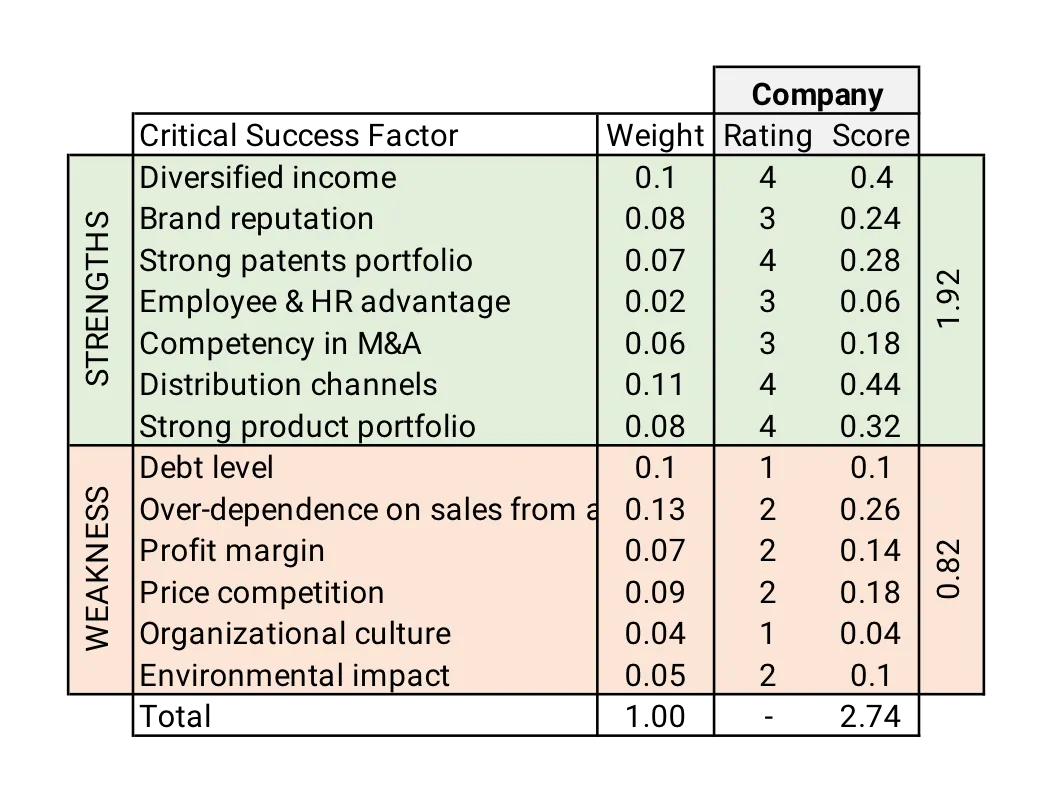
Strengths and weaknesses are used as the key internal factors in the evaluation. When looking for the strengths, ask what do you do better or have more valuable than your competitors have? In case of the weaknesses, ask which areas of your company you could improve and at least catch up with your competitors? The general rule is to identify as many key internal factors as possible.
Weights
Each key factor should be assigned a weight ranging from 0.0 (low importance) to 1.0 (high importance). The number indicates how important the factor is if a company wants to succeed in an industry. If there were no weights assigned, all the factors would be equally important, which is an impossible scenario in the real world. The sum of all the weights must equal 1.0. Separate factors should not be given too much emphasis (assigning a weight of 0.30 or more) because the success in an industry is rarely determined by one or few factors.
Ratings
The ratings in internal matrix refer to how strong or weak each factor is in a firm. The numbers range from 4 to 1, where 4 means a major strength, 3 – minor strength, 2 – minor weakness and 1 – major weakness. Strengths can only receive ratings 3 & 4, weaknesses – 2 and 1. The process of assigning ratings in IFE matrix can be done easier using benchmarking tool.
Score
The score is the result of weight multiplied by rating. Each key factor must receive a score. Total weighted score is simply the sum of all individual weighted scores. The firm can receive the same total score from 1 to 4 in both matrices. The total score of 2.5 is an average score. In internal evaluation a low score indicates that the company is weak against its competitors. IFE and EFE analyses have little value on their own. You should do both analyses and combine their results to discuss new strategies or for further analysis. They are especially useful when building advanced SWOT analysis, SWOT matrix for strategies or IE matrix.
Use IFE results alongside EFE analysis for a complete strategic picture. The combined scores feed into tools like the IE Matrix and SWOT-based strategy development, making isolated IFE scores more meaningful in context.
- 1David, F.R. (2009). Strategic Management: Concepts and Cases. 12th ed. FT Prentice Hall
Citation
Cite this article
Sridharan, M. A. (2018, July 26). IFE Analysis. Think Insights. https://thinkinsights.net/strategy/ife-analysis (Accessed [[ACCESS_DATE]])
Sridharan, Mithun A. "IFE Analysis." Think Insights, 26 July 2018, https://thinkinsights.net/strategy/ife-analysis. Accessed [[ACCESS_DATE]].
Mithun A. Sridharan, "IFE Analysis," Think Insights, July 26, 2018, https://thinkinsights.net/strategy/ife-analysis. Accessed [[ACCESS_DATE]].
Sridharan, M.A. (2018) 'IFE Analysis', Think Insights. Available at: https://thinkinsights.net/strategy/ife-analysis (Accessed: [[ACCESS_DATE]]).
M. A. Sridharan, "IFE Analysis," Think Insights, 2018. [Online]. Available: https://thinkinsights.net/strategy/ife-analysis. [Accessed: [[ACCESS_DATE]]].
Sridharan MA. IFE Analysis. Think Insights. Published July 26, 2018. Accessed [[ACCESS_DATE]]. https://thinkinsights.net/strategy/ife-analysis
Test Your Knowledge
IFE Analysis
Challenge yourself on the concepts from this article and see how well you understood them.
Subscribers get weekly quizzes and insights — subscribe free
Sponsor this article
Partner with Think Insights
Reach 50,000+ business leaders, consultants, and strategists. Feature your brand alongside expert articles on strategy, leadership, and digital transformation.
Become a Sponsor